

Plot Summary
The Bridge Without Appointments
From the Pont des Arts, Argentine expatriate Horacio Oliveira1 scans the riverbank for La Maga,2 the Uruguayan woman2 he once expected to meet by chance. He knows the streets where they used to wander, but neither looks for the other at home.
Their first meeting began in a café, where her uneven account of herself challenged his habit of turning life into an argument. Their later encounters made Paris feel like a city of clues: cats, scraps of red cloth, shop windows, and improbable coincidences.
Now the bridge offers no answer. Oliveira1 remembers their discarded umbrella and their walks among the river barges, but memory cannot tell him where La Maga2 has gone. His search begins as a private mystery, and exposes how little he understands the person he misses.2
The bridge is both a meeting place and a limit. Oliveira treats coincidence as evidence that the world might disclose a hidden order, yet the missing woman makes that habit look less like insight than a way of postponing direct contact. His memories are precise about objects and evasive about La Maga's independent life. The opening therefore establishes the novel's central tension in action: he wants a route to meaning, but repeatedly substitutes interpretation for participation. His search begins not because he knows where La Maga is, but because her absence has made his methods of knowing fail.
A Child in the Room
La Maga2 has come to Paris from Montevideo with little money, hopes of studying singing, and a small son5 she calls Rocamadour.5 She leaves him with a country nurse while she joins Oliveira1 and his circle of expatriate friends, the Serpent Club.
The group debates painting, literature, jazz, and metaphysics; La Maga2 often misses their references but notices details they overlook. Oliveira1 admires her instinctive way of seeing, then resents the ease with which she lives without his explanations.
Their love is vivid but unsettled, made of hotel rooms, walks, arguments, and sudden tenderness. When La Maga2 brings Rocamadour5 into their cramped shared room, her responsibilities become impossible to ignore. Oliveira's1 abstract life now includes a sick child5 whose crying cannot be argued away.
Rocamadour turns an intellectual and erotic arrangement into a material one. A room that the Club can treat as bohemian disorder must also hold a cot, medicine, laundry, and the demands of a vulnerable child. La Maga's attentiveness works through touch and immediate response, while Oliveira values distance as a form of freedom. Neither mode is sufficient on its own, but he is especially threatened by needs that cannot be converted into ideas. The child makes that conflict concrete: Oliveira can admire La Maga's unmediated life until it asks something of him.
The Past Enters the Club
Ossip Gregorovius,6 a fellow Club member who is attracted to La Maga,2 presses her to explain her childhood in Uruguay. She describes an unstable home, a father who drank and beat her, and a neighbor who raped her when she was thirteen.
The Club's response shifts uneasily between sympathy, embarrassment, and intellectual analysis. Oliveira,1 who has listened to her life in fragments, treats the account with a cruelty that makes their distance unmistakable. Gregorovius6 offers attention, but he too frames her history as something to interpret.
La Maga's2 willingness to tell it is not a bid for a theory; she is trying to put experience into words. The story leaves the room quieter, while the people listening remain unsure how to meet her without turning pain into material.
La Maga's account tests the Club's claim to openness. Its members welcome unconventional art and argument, but her experience resists their preferred distance between concept and feeling. Gregorovius's questions carry both care and desire, while Oliveira responds by intellectualizing and belittling what he cannot absorb. The scene does not make La Maga's pain a lesson that the men successfully learn. Instead, it reveals the cost of treating testimony as an object for discussion. Her disclosure is an attempt at connection; the listeners' difficulty is that connection requires more than understanding the facts.
Pola's Green Effigy
While still involved with La Maga,2 Oliveira1 begins seeing Pola,13 a Parisian woman whose cultivated beauty and attentiveness offer him another kind of intimacy. La Maga2 senses Pola's13 presence in Oliveira's1 clothes and manner, although she has never met her.
She makes a small green wax figure and pricks it with pins, imagining that Pola13 has entered her home and taken possession of what is hers. Oliveira1 discovers the doll, rejects its power, and crushes it underfoot. La Maga2 interprets his response as making the danger worse, not ending it.
Pola,13 meanwhile, is seriously ill, a fact Oliveira1 knows but does not tell La Maga.2 The affair gives him novelty without resolving his dissatisfaction, while the doll reveals how painfully La Maga2 experiences what he dismisses as an idea.
The doll is an attempt to give jealousy a body that can be handled. La Maga cannot enter Pola's apartment or control Oliveira's desire, so she makes an object through which fear can be expressed. Oliveira's destruction of it asserts rational authority without repairing the relationship that produced it. His silence about Pola's illness deepens the asymmetry: he decides which facts matter, while La Maga is left to read signs. The episode complicates any simple opposition between her intuition and his skepticism. Her belief may be magical, but his confidence that only the visible counts is also a defense against responsibility.
A Pianist in the Rain
After another quarrel with La Maga,2 Oliveira1 leaves their room and wanders Paris. At a poorly attended recital, he listens as the aging pianist Berthe Trépat14 performs to a thinning audience. He stays after the concert and offers to accompany her home, moved by the humiliation of seeing her work dismissed. On the wet walk, Trépat14 speaks of her ambitions and grievances, then suspects Oliveira1 of trying to seduce her.
She slaps and scratches him in the entrance to her building, loudly recasting his offer as an insult. He leaves alone in the rain, ashamed of his wish to help and furious that kindness has made him vulnerable. When he finally returns to La Maga's2 flat, he is still carrying the day's failed attempt at connection.
Oliveira's encounter with Trépat is a small but consequential test of his capacity for care. He responds to her public failure with genuine attention, yet cannot sustain that response when she distrusts him and turns it against him. The injury matters less than the speed with which he retreats into self-reproach and irony. His compassion is real, but it remains entangled with a desire to be recognized as compassionate. The episode prepares the reader for the more devastating failure at home: when care becomes demanding rather than voluntary, Oliveira's instinct is again to protect himself from the other person's need.
The Spoon Falls
Back in the flat, Oliveira1 finds La Maga2 caring for Rocamadour,5 whose fever has worsened. The Club gathers around the child,5 drinking coffee and talking while the night stretches on. When La Maga2 finally carries medicine to the bed, she spills it and sees that Rocamadour5 is dead.
She collapses beside him, unable at first to separate grief from shock. Her friends move the child5 and try to steady her, but Oliveira1 withdraws rather than comfort her, telling himself that consolation would serve his own needs.
He leaves with Etienne8 as the others arrange to notify the authorities. The death ends the couple's already unstable domestic life, but it does not produce a clean parting: La Maga2 remains in the room, and Oliveira1 carries away the knowledge of what he failed to do.
The tragedy arrives through an ordinary caregiving task, not through a grand revelation. A spoon, a dose of medicine, and the fragile hope that the fever will break become the last actions around Rocamadour. The Club's presence cannot convert grief into fellowship; its members are witnesses, not rescuers. Oliveira's withdrawal is psychologically consistent with his fear of acting for another person and discovering that his motives are mixed. Yet the distinction he draws between helping her and helping himself becomes morally sterile at the precise moment when action matters. His self-awareness registers the failure without undoing it.
Morelli's Unfinished Pages
The Club's favorite absent authority, the writer Morelli,7 is struck by a car in Paris and taken to hospital. Oliveira1 and Etienne8 visit him, and Morelli7 welcomes them as readers rather than admirers seeking an autograph.
He asks them to collect and arrange the notebooks scattered through his apartment, then entrusts Oliveira1 with the key. The papers contain fragments, arguments, and unfinished experiments that challenge the orderly novel the Club expects to read. Oliveira1 is moved by the trust, but his attention remains divided by La Maga's2 disappearance and his own guilt.
Morelli's7 request gives him a practical task, yet no simple explanation for how the fragments should fit together. The Club later gathers in the apartment to examine the work, turning a private readership into a collective encounter with an unfinished book.
Morelli's notebooks make form part of the story's action. The characters are not merely discussing whether a different kind of novel is possible; they are asked to handle its fragments and decide how, or whether, to arrange them. Oliveira receives responsibility without receiving a key to meaning. This parallels his emotional life, where he can identify patterns but cannot make them resolve into a stable whole. Morelli's intervention also exposes the Club's limits: its members can debate radical form, yet they still seek a coherent order that will reassure them about what they have read and what they have done.
The Club Loses Its Center
In the days after Rocamadour's5 death, La Maga2 packs her belongings and leaves the flat. She believes Oliveira1 has chosen Pola13 and does not know whether he will return. At a Club gathering, Babs10 condemns Oliveira's1 coldness and strikes him; he responds by cutting himself off from the group. Gregorovius6 takes over the room, but cannot tell Oliveira1 where La Maga2 has gone.
Oliveira1 searches for her in Paris and, during a stop in Montevideo, asks after her near the neighborhood of her childhood. He finds no reliable trace. On the ship to Argentina, he thinks he sees her among the passengers, but the figure disappears before he can follow. His European life ends not with a farewell, but with an absence he cannot verify.
The separation has no agreed account. La Maga leaves because she reads Oliveira's conduct as rejection, while Oliveira's search begins only after he has lost the chance to answer her directly. Babs's slap turns private guilt into public judgment, prompting him to reject the Club rather than remain among people who can name his behavior. His failed search in Montevideo repeats the structure of the opening: he looks for La Maga through places and signs, not through communication. The possible sighting aboard ship keeps grief unsettled, neither confirmed as supernatural nor reduced to a mistaken glance.
The Return to Buenos Aires
Oliveira1 arrives in Buenos Aires and is met at the docks by Manuel Traveler,3 his old friend, and Traveler's wife,4 Talita,4 a pharmacist. He barely acknowledges Talita4 before asking about the circus cat they have brought along, and she returns to work offended by his manners.
Traveler3 and Oliveira1 reconnect over food, but Oliveira1 offers scattered details about Paris rather than a full account of what happened there. He resumes a relationship with Gekrepten,12 an old companion who gives him a place to stay, and tries selling cloth door to door.
Traveler3 eventually secures him a job with the circus. Oliveira's1 return does not restore his old life: he is still searching for a different way to live, while his friends' marriage and everyday routines become the new setting for that search.
Homecoming reverses geography without producing belonging. Oliveira returns to the city he once left, but the familiar routines feel as foreign to him as Paris did. Traveler offers practical loyalty, while Talita's first response correctly registers Oliveira's disregard. Gekrepten's care provides shelter, though it does not resolve his restlessness. The circus job places him inside a community again, but it also brings his habits of observation into close contact with Traveler and Talita's shared life. His return therefore introduces a new relational problem: whether he can be present among people whose ordinary commitments he both needs and distrusts.
A Bridge of Planks
From his small rented room, Oliveira1 whistles to Traveler3 across the street, asking for mate and nails. Instead of taking the stairs, the men build a precarious bridge from planks balanced between their windows.
Talita4 climbs onto it with the package, while her husband3 and Oliveira1 argue over whether she should cross or simply toss it. She feels caught between the two men and recognizes that their contest is using her as its measure. Under the heat and their competing instructions, she throws the package through Oliveira's1 window and then retreats to Traveler.3
The boards never become a safe passage; their purpose was less practical than emotional, a way for the two men to stage their rivalry without naming it. The stunt leaves Talita4 shaken and makes the strain between the friends visible.
The bridge materializes a relationship that neither man can discuss plainly. Traveler and Oliveira create the danger together, then debate who should ask Talita to bear it. Their apparent joke therefore has a real cost: she becomes the body placed between their competing claims. Her decision to throw the package and return refuses the role of mediator, even as the men continue to interpret her actions. The scene's comedy depends on its precariousness, but the physical risk prevents it from being mere play. In this novel, a symbolic structure becomes consequential as soon as someone has to stand on it.
Hopscotch in the Courtyard
The circus is sold, and Traveler,3 Talita,4 and Oliveira1 begin work at a mental clinic. Its patients, staff, and routines soon become part of the friends' daily life. One night, an elderly patient in pink pajamas wanders through the building, gently carrying a pigeon.
Oliveira1 and Talita4 follow him to the basement, where a freezer stands open. The encounter unsettles Oliveira,1 who begins speaking to Talita4 as though she were La Maga,2 the lost woman he has searched for2 since Paris.
Talita4 resists being treated as a substitute, but Oliveira1 kisses her in a moment he experiences as a meeting with someone beyond the present room. She returns to Traveler3 and tells him what happened. The act unsettles the marriage without resolving whether Oliveira1 has mistaken Talita4 for La Maga2 or glimpsed something he cannot explain.
The clinic gathers the novel's recurring uncertainties into one place: identities shift, the dead occupy the same working environment as the living, and patients are classified by people no less fallible than themselves. The hopscotch and the patient's wandering do not prove that Oliveira's perceptions are supernatural. They show how intensely his grief organizes what he sees. Talita's resemblance to La Maga is not merely visual; she also offers the attentive response Oliveira longs for. Yet Talita remains a person with her own marriage and judgment, and her protest against substitution is a crucial limit on his metaphysical interpretation.
The Last Square
After Talita4 tells Traveler3 about the kiss, Oliveira1 barricades his clinic room with strings, basins, and slippery rollers, convinced that Traveler3 will come to attack him. When Traveler3 arrives, he triggers the traps but refuses to force a fight.
The two men speak across the wreckage, recognizing their bond even as Oliveira1 insists that they are divided by different realities. Traveler3 eventually leaves the room and protects Oliveira1 from the attendants, asking them to give his friend time. At the window, Oliveira1 watches Talita4 and Traveler3 near the courtyard hopscotch.
He feels an instant of reconciliation, but the final image leaves him balanced at the edge, with no clear account of whether he will climb down or jump. Fragments placed later in the book show him being tended, but they do not turn the ending into a settled victory.
The confrontation brings Oliveira's private theories into physical form. His defenses are elaborate, but Traveler does not answer them with violence; his refusal to force an outcome is the clearest act of loyalty between them. The moment of understanding does not cure Oliveira or reunite him with La Maga. It briefly lets him experience belonging without mastering it. The unresolved window preserves the difference between insight and change: recognizing a bond is not the same as knowing how to live within one. The later glimpses of care soften the danger without supplying the certainty Oliveira has spent the novel demanding.
Analysis
Hopscotch makes Oliveira's1 search for a way beyond ordinary consciousness inseparable from the people his search unsettles. La Maga's2 immediate attention, Traveler's3 practical loyalty, and Talita's4 mixture of care and refusal all offer forms of contact that Oliveira1 can recognize but rarely sustain. His difficulty is not simply that he thinks too much. He treats understanding as a condition that must precede participation, then finds that the demand for certainty has become a means of avoiding the risk of acting without guarantees.
The book's fragmented reading order gives that problem a formal counterpart. The reader must make connections across chapters, but cannot assume that arrangement will erase contradiction. This is especially important because the novel's philosophical language often competes with its concrete events: a child5 needs medicine, a friend is grieving, a woman4 is placed on a dangerous plank, a man1 may be standing at an open window. Abstract thought does not cancel those consequences. It can reveal them, or serve as a detour around them.
Morelli's7 experiments raise the possibility that fiction might interrupt habitual perception rather than merely represent it. Yet the novel is suspicious of any promised escape that becomes a system, whether intellectual, spiritual, or political. Oliveira's1 final moment with Traveler3 is meaningful precisely because it does not deliver a solved life. Traveler's3 restraint and their shared recognition create a brief experience of connection, not a doctrine. The ending leaves the central question open: can a person enter the world without turning other people into symbols of a passage out of it?
Review Summary
Hopscotch is a polarizing novel that challenges traditional narrative structures. Many readers praise its innovative format, philosophical depth, and poetic language, while others find it frustratingly complex and self-indulgent. The book's experimental structure, allowing multiple reading orders, is both admired and criticized. Cortázar's exploration of existential themes, love, and the nature of reality resonates strongly with some readers, particularly young adults. However, the novel's dense prose and meandering plot can be off-putting to others, leading to mixed reactions overall.
People Also Read





Characters
Horacio Oliveira
The restless observerAn Argentine intellectual living first in Paris and later back in Buenos Aires, Oliveira distrusts conventional explanations and searches for a more immediate way to experience reality. He is alert to small accidents, contradictions, and patterns, yet this sharpness often becomes a shield against emotional responsibility. His relationships with La Maga2, Traveler3, and Talita4 expose the cost of remaining a spectator to the lives he claims to value. He wants freedom from inherited assumptions, but his fear of choosing makes him dependent on the very people whose ordinary attachments he critiques. His wit and self-awareness are genuine, though neither reliably turns into action.
La Maga
The instinctive wandererA Uruguayan woman who comes to Paris with ambitions of studying singing and a young son, La Maga moves through life by attention, impulse, and physical curiosity. Her lack of formal learning makes the Club's intellectual codes difficult to follow, but she often notices human and sensory truths that the others reason past. She loves Oliveira1 while resisting his attempts to define her, and her history gives her a complicated mixture of vulnerability, humor, and stubborn independence. Her relation to her child5, her friends, and her own past is never tidy. La Maga's presence unsettles Oliveira1 because she can inhabit experience without first converting it into an argument.
Manuel Traveler
The loyal realistOliveira's1 old Buenos Aires friend, Traveler works around a traveling circus and jokes about the life he never managed to lead elsewhere. He is practical, inventive, and more emotionally perceptive than his teasing manner suggests. His marriage to Talita4 is built from shared routines, humor, and a durable tenderness, though Oliveira's1 return unsettles him. Traveler is a man of action in modest forms: he finds Oliveira1 work, negotiates difficult situations, and tries to protect the people around him. His loyalty does not make him a simple foil to Oliveira1. He also fears being trapped by ordinary life, but he continues to inhabit it rather than theorize his way out.
Talita
The balancing presenceA pharmacist and Traveler's wife3, Talita is intelligent, curious, and grounded in daily work, though she shares the couple's taste for word games and odd enthusiasms. She reads encyclopedias, handles practical responsibilities, and can move between domestic life and the strange schemes Oliveira1 brings into the household. His attention makes her feel caught in a role she did not choose, especially when he treats her as a possible reflection of someone else2. Talita is neither a passive emblem nor a simple voice of common sense. Her warmth and independence let her care for others while naming the limits of what she will accept.
Rocamadour
La Maga's young sonLa Maga's2 small son, born Carlos Francisco and given the name Rocamadour, is often cared for at a country nurse's home while his mother tries to establish herself in Paris. He is too young to participate in the adults' arguments, but his health and needs shape the space La Maga2 and Oliveira1 share. His presence brings feeding, medicine, and care into a world otherwise given over to ideas, music, and wandering.
Ossip Gregorovius
The rival confidantA stateless, bookish member of the Serpent Club, Gregorovius is drawn to La Maga2 and curious about her past. He presents himself through shifting stories about his origins and family, making uncertainty part of his identity. His attention can be tender, but it is also investigative: he wants to understand people by assembling their histories. His rivalry with Oliveira1 is rarely direct, yet their mutual suspicion gives the Club's gatherings an undercurrent of competition.
Morelli
The experimental novelistAn older writer admired by Oliveira1 and the Serpent Club, Morelli thinks of fiction as a form that should unsettle its readers rather than comfort them with orderly explanations. His scattered notes challenge the usual boundaries between plot, essay, and fragment. He is not simply a teacher with a finished doctrine; his manuscripts reveal a writer still testing the limits of what language and narrative can do.
Etienne
The skeptical painterA French painter in the Club, Etienne values direct visual experience and resists turning every work of art into a philosophical puzzle. He is quick to criticize La Maga's2 lack of formal knowledge and Oliveira's1 abstractions, but he can also recognize their force. His friendship with Oliveira1 is argumentative and durable, grounded in shared nights of art, drink, and debate.
Ronald
The jazz-loving musicianA red-haired musician, Ronald hosts many of the Club's gatherings with his partner, Babs10. Jazz is not just taste for him but a social language that makes people feel briefly connected. He challenges Oliveira's1 passivity and defends music's ability to carry emotion without reducing it to theory. His warmth and impatience coexist, especially when he believes a friend is using ideas to avoid action.
Babs
The volatile hostA ceramic artist and Ronald's partner9, Babs helps anchor the Club's evenings with food, music, drink, and an unguarded emotional presence. She is generous but can become sharply confrontational when she believes someone has behaved cruelly. Her reactions expose the gap between the Club's talk of human connection and its actual treatment of people.
Wong
The enigmatic archivistA quiet, scholarly member of the Club, Wong carries books and images that complicate the group's casual talk about art and violence. He listens closely, contributes strange objects and theories, and often acts as a steady presence amid the others' arguments. His interest in cultural difference broadens the Club's discussions without making him a simple source of answers.
Gekrepten
The patient caretakerAn old companion of Oliveira's1 in Buenos Aires, Gekrepten offers him a room, food, and practical tenderness when he returns from Europe. She works in a shop and does not share his appetite for metaphysical speculation. Her domestic steadiness reveals a kind of care he accepts more readily than he knows how to reciprocate.
Pola
Oliveira's Parisian loverA cultivated Parisian woman with an independent home and social world, Pola becomes involved with Oliveira1 while he is still connected to La Maga2. Their relationship offers him a different rhythm of intimacy, one that is both real and entangled with his appetite for novelty. Through Pola, the novel examines the way Oliveira1 carries one relationship into another rather than fully inhabiting either.
Berthe Trépat
The disregarded pianistAn aging composer and pianist whose poorly attended recital becomes one of Oliveira's1 brief encounters with another person's vulnerability. Proud of her work and wounded by public indifference, she is both difficult company and an object of his unexpected sympathy.
Emmanuèle
The riverbank outcastA homeless woman living near the Seine, Emmanuèle is known to La Maga2, who recognizes her attachment to another drifter. Her precarious life brings Oliveira1 into contact with people outside the social world he usually observes from cafés and bridges.
Guy Monod
The troubled Club friendA friend who drifts through the Club's Paris gatherings, Guy is part of the group's loose network of artists and expatriates. His personal crises remind the others that their late-night talk unfolds alongside real emotional danger.
Ferraguto
The circus proprietorThe manager who owns the circus and later acquires the clinic, Ferraguto brings the group's bohemian life into contact with employment and institutional responsibility. His business decisions create the setting for Oliveira1, Traveler3, and Talita's4 next shared chapter.
Cuca Ferraguto
The anxious administratorFerraguto's wife17, Cuca is invested in making the clinic respectable and orderly. She regards the new staff with a mixture of suspicion and fascination, and her efforts to impose conventional standards provide a comic counterweight to the clinic's unruly reality.
Plot Devices
The reading map
Reorders the storyThe book announces that it can be read as a conventional sequence ending at Chapter 56 or through an alternate route beginning at Chapter 73 and jumping among numbered sections. This structure makes the reader perform an act of searching like Oliveira's1, while the fragments about Morelli7 give that search a thematic purpose. Some episodes deepen the central story, others interrupt it with quotations, essays, and experiments in language. The result is not a hidden puzzle with one solution. It asks whether reading can create connections without pretending that every gap has been repaired.
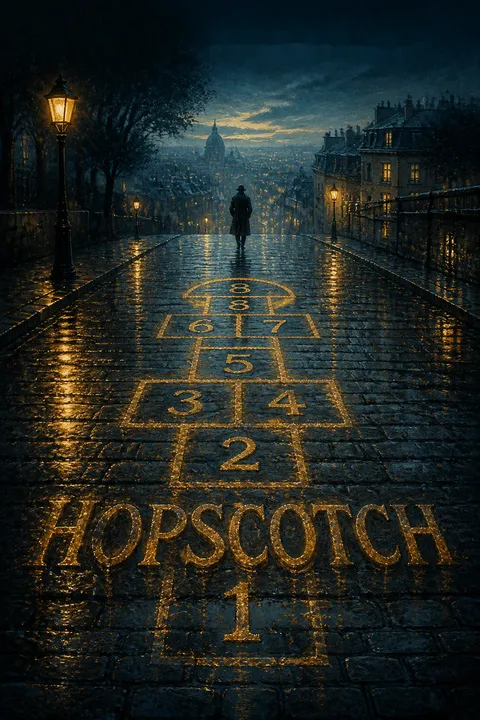
Hopscotch
Maps a hoped-for passageThe children's game of moving a pebble from earth toward heaven recurs as an image and a literal activity. Oliveira1 and La Maga2 encounter hopscotch in Paris, and later patients play it in the clinic courtyard. Its simple rules promise a route to a final square, but a missed stone or a broken sequence interrupts the climb. The game gives physical shape to Oliveira's1 desire for another way of living, while its childishness resists his tendency to make that desire into a grand system. Its final appearance leaves him near a threshold rather than safely beyond it.
Bridges and windows
Make distance physicalThe Pont des Arts, the Seine's many crossings, and the plank bridge between Oliveira1 and the Travelers' windows3 turn separation into a visible problem. In Paris, Oliveira1 and La Maga2 meet on bridges, but he often observes her from a position of safety rather than crossing into her experience. In Buenos Aires, the improvised plank bridge forces Talita4 to bear the risk created by the two men's rivalry. These structures do not guarantee connection. They show how badly Oliveira1 wants a passage and how easily that wish becomes a demand placed on someone else.
Morelli's notebooks
Turn form into plotMorelli's7 manuscripts appear as fragments, reflections, and proposed narrative experiments rather than as a finished, orderly novel. His request that Oliveira1 and Etienne8 handle the papers makes the problem of arrangement concrete: they must decide how to approach a work that distrusts conventional sequence. The notebooks echo Oliveira's1 habit of collecting signs without knowing how to make them cohere. They also invite the reader to become an active participant, joining scattered episodes while recognizing that any complete pattern may be provisional.
Language games
Disrupt habitual meaningsOliveira1, La Maga2, Traveler3, and Talita4 play with dictionaries, invented words, translations, and misheard expressions. These games provide genuine pleasure and briefly loosen the authority of familiar labels. They also expose a limit: Oliveira1 can criticize language for shaping reality, yet he still relies on words to explain why words fail. The games connect the Club's intellectual experiments to ordinary life, from the argument over mate to the jokes traded across windows. Language becomes a tool for intimacy and evasion at once.
FAQ
Synopsis & Basic Details
What is Hopscotch about?
- A Labyrinthine Quest: Hopscotch follows Horacio Oliveira, an Argentine intellectual in Paris, as he navigates a bohemian existence, a passionate but volatile relationship with La Maga, and profound existential questions. The narrative is a non-linear exploration of his search for meaning, authenticity, and a "center" in a world he perceives as fragmented and absurd.
- Two Paths, One Journey: The novel offers two reading orders: a conventional path ending at Chapter 56, and a "hopscotch" path that jumps between chapters, including "expendable" ones. This structural choice mirrors Oliveira's own meandering quest and the novel's central theme of multiple realities and interpretive freedom.
- Exile, Art, and Love: At its core, the story delves into the lives of expatriates in Paris, their intellectual debates in the "Serpent Club," and the complexities of human connection. It explores how love, art, and philosophy serve as both escapes from and confrontations with the inherent chaos and loneliness of existence.
Why should I read Hopscotch?
- Unparalleled Reader Engagement: Hopscotch challenges traditional reading by offering a nonlinear structure, inviting you to become an active participant in constructing the narrative. This unique approach makes the reading experience deeply personal and intellectually stimulating, unlike any other novel.
- Profound Philosophical Inquiry: Beyond its plot, the novel is a rich tapestry of philosophical debates on reality, language, identity, and the search for meaning. It delves into existentialism, metaphysics, and the nature of consciousness, offering insights that resonate long after the final page.
- A Masterpiece of Modernism: Julio Cortázar's Hopscotch is a landmark work of Latin American literature, celebrated for its innovative style, poetic language, and psychological depth. It's a must-read for anyone interested in experimental fiction, literary modernism, or a truly transformative literary journey.
What is the background of Hopscotch?
- Cortázar's Expatriate Experience: The novel is deeply rooted in Julio Cortázar's own life as an Argentine expatriate in Paris, reflecting the intellectual ferment and bohemian lifestyle of the Latin Quarter in the 1950s. This personal context imbues the narrative with an authentic sense of alienation and cultural displacement, central to the characters' quests for identity.
- Influence of Jazz and Surrealism: Cortázar, an amateur jazz musician, infuses the novel with the improvisational spirit of jazz, mirroring its non-linear structure and thematic fluidity. Surrealism also plays a significant role, influencing the dreamlike sequences, the exploration of the subconscious, and the rejection of conventional logic.
- Critique of Western Rationalism: Hopscotch engages with a broader intellectual current of its time, questioning the limitations of Western rational thought and traditional narrative forms. Through characters like Morelli and the debates of the Serpent Club, Cortázar explores alternative ways of perceiving reality, drawing on Eastern philosophies and challenging established societal norms.
What are the most memorable quotes in Hopscotch?
- "I touch your mouth, I touch the edge of your mouth with my finger..." (Chapter 7): This iconic passage, a tender and sensual exploration of intimacy, transcends physical description to become a poetic act of creation and re-creation, symbolizing the constant reinvention of love and connection. It highlights the novel's deep dive into the subjective experience of desire.
- "We are not in the world." (Chapter 31, Morelli's philosophy): This phrase encapsulates a core philosophical theme in Hopscotch analysis, suggesting a fundamental detachment from conventional reality and a yearning for an "other side" of existence. It drives Oliveira's relentless search for a deeper truth beyond superficial appearances.
- "Hopscotch is played with a pebble that you move with the tip of your toe. The things you need: a sidewalk, a pebble, a toe, and a pretty chalk drawing, preferably in colors. On top is Heaven, on the bottom is Earth..." (Chapter 36): This quote directly explains the central Hopscotch symbolism, illustrating the game as a metaphor for life's journey, the pursuit of transcendence, and the inherent difficulty of reaching one's "Heaven" while grounded in earthly realities.
What writing style, narrative choices, and literary techniques does Julio Cortázar use?
- Stream-of-Consciousness & Interior Monologue: Cortázar extensively employs stream-of-consciousness, particularly for Horacio Oliveira, allowing readers direct access to his unfiltered thoughts, philosophical digressions, and emotional turmoil. This technique blurs the line between narration and internal experience, immersing the reader in Oliveira's complex psyche.
- Intertextuality and Metafiction: The novel is rich with allusions to literature, philosophy, art, and music, often through the character of Morelli, whose "expendable chapters" and notes comment on the very act of writing and reading. This metafictional approach questions the nature of fiction and the relationship between author, text, and reader, making the novel a commentary on itself.
- Linguistic Playfulness and Fragmentation: Cortázar experiments with language, introducing "Gliglish" (Chapter 20) as a private language between lovers, and using fragmented dialogue and non-standard grammar to reflect the characters' search for new modes of expression. This linguistic innovation underscores the themes in Hopscotch of communication breakdown and the inadequacy of conventional language to capture profound experience.
Hidden Details & Subtle Connections
What are some minor details that add significant meaning?
- Oliveira's "Red Rag" Superstition: In Chapter 1, Oliveira describes his childhood compulsion to pick up anything he drops, especially a "red rag," to prevent disaster for a loved one whose name starts with the same letter. This seemingly trivial quirk reveals his deep-seated anxieties, his sense of responsibility for others, and a hidden, almost magical, belief system that contrasts with his intellectual skepticism.
- The Recurring Motif of Cats: Cats appear frequently throughout the novel, from La Maga's affinity for them (Chapter 4) to the "counting cat" in the circus (Chapter 37). They symbolize intuition, independence, and a connection to a more primal, non-rational existence, often serving as silent witnesses or reflections of the characters' inner states, particularly La Maga's.
- The "Wh" Prefix in Oliveira's Thoughts: In Chapter 90, Oliveira's internal monologues sometimes feature words prefixed with "wh" (e.g., "whaffair," "whunity"). This subtle linguistic tic highlights his intellectual detachment and his attempt to distance himself from concepts, to "disinfect" language and thought, even as he grapples with profound personal and philosophical issues.
What are some subtle foreshadowing and callbacks?
- La Maga's Premonition of Rocamadour's Illness: Early in Chapter 2, La Maga's thoughts about Rocamadour are often linked to his sickness, and she mentions sending him "to the country to be brought up en nourrice." This subtly foreshadows his eventual illness and death, hinting at a vulnerability that will later shatter the group's fragile reality.
- The "Killing the Dog" Metaphor: The phrase "killing the dog" (Chapter 51, 56) is introduced as a patient's demand in the clinic, but it becomes a recurring metaphor for radical change, the destruction of old habits, or a necessary sacrifice to achieve a new state of being. Its repeated appearance foreshadows the climactic confrontation and the characters' desperate attempts to break free from their established patterns.
- The "Kibbutz of Desire" and Hopscotch "Heaven": Oliveira's longing for a "kibbutz of desire" (Chapter 36) as a place of authentic connection and belonging is a direct callback to the "Heaven" square in the hopscotch game. This parallel suggests that his ultimate quest is for a spiritual or emotional home, a transcendent state that is both elusive and deeply yearned for, linking his philosophical journey to a childhood game.
What are some unexpected character connections?
- Talita as La Maga's Unconscious Double: Beyond the explicit comparisons, Talita's actions and even her physical appearance (especially in Oliveira's perception, Chapter 54) often mirror La Maga's. This creates an unsettling sense of doubling and substitution, suggesting that Oliveira is projecting his unresolved feelings for La Maga onto Talita, making their connection less about genuine interaction and more about a psychological echo.
- Oliveira and Berthe Trépat's Shared Vulnerability: Oliveira's unexpected empathy for the aging, delusional pianist Berthe Trépat (Chapter 23) reveals a shared vulnerability beneath his cynical exterior. His decision to accompany her home, despite her absurdities, connects them in a moment of raw, un-intellectualized human connection, highlighting his capacity for compassion that he often denies.
- Morelli and the "Old Man in the Accident": The unnamed "old man" hit by a car (Chapter 22) and Morelli, the author-within-the-novel (Chapter 154), are subtly linked as figures of misunderstood genius and societal indifference. Both are artists whose profound insights are dismissed or ignored by a conventional world, underscoring the novel's critique of superficiality and the struggle for authentic expression.
Who are the most significant supporting characters?
- Morelli: The Author's Alter Ego and Philosophical Guide: Morelli, the enigmatic writer whose fragmented notes and theories populate the "expendable chapters," is arguably the most significant supporting character. He serves as Cortázar's metafictional mouthpiece, articulating the novel's experimental intentions, its critique of conventional literature, and its deep philosophical inquiries into reality, language, and the "other side" of existence. His ideas are central to understanding the Hopscotch analysis.
- Gekrepten: The Unseen Anchor of Domesticity: Oliveira's long-suffering, practical, and often overlooked partner in Buenos Aires, Gekrepten, represents the mundane, grounding aspects of life that Oliveira simultaneously despises and relies upon. Her quiet devotion and domesticity (Chapter 40, 58) highlight Oliveira's inability to fully embrace conventional happiness, making her a poignant symbol of the life he rejects.
- The Old Man Upstairs (in Paris and Buenos Aires): The Voice of Conventionality and Judgment: This recurring figure, whether the pounding neighbor in Paris (Chapter 28) or the complaining resident in Buenos Aires (Chapter 56), embodies societal norms, judgment, and the resistance to chaos. He serves as a constant reminder of the "normal" world that the bohemian characters are trying to escape or subvert, highlighting the tension between individual freedom and social expectation.
Psychological, Emotional, & Relational Analysis
What are some unspoken motivations of the characters?
- Oliveira's Fear of Commitment and Authenticity: Horacio Oliveira's intellectual detachment and constant search for a "center" are often unspoken defenses against genuine emotional commitment. He fears that any fixed relationship or belief system will trap him in a "false order" (Chapter 21), leading him to sabotage connections like his love for La Maga, driven by a subconscious terror of losing his perceived freedom, even if that freedom is a form of paralysis.
- La Maga's Desire for Intellectual Validation: Beneath La Maga's intuitive and spontaneous nature lies an unspoken longing for intellectual acceptance from Oliveira and the Club. Her attempts to understand complex ideas (Chapter 4) and her sadness when dismissed as "silly" (Chapter 142) reveal a deep-seated insecurity, a desire to bridge the gap between her emotional world and their intellectual one, even if it means conforming to their expectations.
- Traveler's Unfulfilled Wanderlust: Despite his grounded, pragmatic exterior, Traveler harbors an unspoken yearning for the adventures and experiences he has missed by staying in Argentina. His fascination with Oliveira's European travels (Chapter 37) and his occasional outbursts about being "stuck" reveal a suppressed desire for a different life, making him a Traveler motivation driven by a quiet, internal restlessness.
What psychological complexities do the characters exhibit?
- Oliveira's "World-Ache" and Existential Nausea: Oliveira experiences a profound "world-ache" (Chapter 17), a pathological sensitivity to the pressure of his surroundings and the absurdity of existence. This manifests as a constant intellectualizing of emotions and a pervasive sense of nausea (Chapter 83) when confronted with the mundane or the conventional, reflecting a deep-seated existential angst that drives his search for transcendence.
- La Maga's Intuitive "Blindness" and Direct Perception: La Maga's psychological complexity lies in her "blindness" to conventional intellectual frameworks, which paradoxically allows her a more direct and unmediated perception of reality. As Oliveira observes, "She closes her eyes and hits the bull's-eye... But she hits the bull's-eye because she doesn't know that it is the method" (Chapter 4). This intuitive grasp of truth, unburdened by logic, is both her strength and her vulnerability.
- Traveler's "Double" Identity and Internal Conflict: Traveler embodies a psychological doubling, acting as Oliveira's pragmatic counterpart while secretly sharing many of his friend's anxieties and unfulfilled desires. His internal conflict between his grounded reality and his suppressed longing for the "other side" (Chapter 44) makes him a complex figure, constantly negotiating between societal expectations and personal yearning, often expressed through his dreams and subtle behaviors.
What are the major emotional turning points?
- Rocamadour's Death as a Catalyst for Disintegration: The death of La Maga's son, Rocamadour (Chapter 5, 24, 30), is a pivotal emotional turning point. It shatters the fragile illusion of bohemian freedom and forces the characters to confront raw grief and the limits of their intellectual detachment. For La Maga, it leads to her disappearance, while for Oliveira, it intensifies his existential crisis and prompts his return to Buenos Aires, marking the end of an era.
- Oliveira's Unexpected "Joy" with Berthe Trépat: In Chapter 23, Oliveira experiences a moment of "inconceivable happiness" while helping the delusional pianist Berthe Trépat. This unbidden, non-intellectualized joy, arising from an act of pure, unselfish compassion, is a significant emotional shift. It challenges his cynical detachment and hints at a different path to meaning, one found in simple human connection rather than abstract thought.
- Talita's "Zombie" Realization and Embrace of Pity: Talita's growing awareness of being a "zombie" or a "mirror" for Oliveira's projections (Chapter 55) marks a crucial emotional turning point for her. Her subsequent embrace of "pity" and her decision to actively support Traveler, even in his own anxieties, signifies her move towards a more authentic and empathetic engagement with her own life and relationships, rather than merely reflecting others' desires.
How do relationship dynamics evolve?
- From Fated Serendipity to Exhausted Codependency: The relationship between Horacio and La Maga evolves from an initial state of "casual meetings are apt to be just the opposite" (Chapter 1) and passionate, almost fated encounters, into a strained, codependent dynamic. Oliveira's intellectual demands and La Maga's emotional needs create a "dialectic of magnet and iron filings" (Chapter 2) that ultimately exhausts them, leading to La Maga's disappearance and Oliveira's profound sense of loss.
- The Buenos Aires Trio: A Mirror of Parisian Dynamics: In Buenos Aires, the relationship between Oliveira, Traveler, and Talita mirrors the earlier Parisian dynamics, but with a new layer of complexity. Talita becomes a "bridge" (Chapter 43) and a surrogate for La Maga, while Traveler acts as Oliveira's "Doppelgänger" (Chapter 56). This trio constantly shifts between affection, rivalry, and projection, reflecting Oliveira's ongoing struggle to reconcile his past loves and his search for an authentic connection.
- The Serpent Club's Intellectual Camaraderie to Fractured Isolation: The Serpent Club initially functions as a vibrant hub of intellectual debate and shared bohemian life. However, as the novel progresses, the members' individual neuroses and philosophical differences lead to increasing friction and eventual disintegration. The shared "jazz and improvisation" (Chapter 10) that once bound them gives way to "monstrous rows" (Chapter 74) and a recognition of their fundamental isolation, highlighting the fragility of intellectual bonds without deeper emotional grounding.
Interpretation & Debate
Which parts of the story remain ambiguous or open-ended?
- La Maga's Ultimate Fate: One of the most enduring ambiguities in Hopscotch explained is La Maga's ultimate fate. Did she drown in the Seine, as Oliveira sometimes fears (Chapter 20), or did she simply leave Paris for Montevideo or Lucca (Chapter 29)? Cortázar deliberately leaves this unresolved, emphasizing her elusive nature and the subjective reality of memory and loss, allowing readers to interpret her disappearance as either literal death or a symbolic vanishing from Oliveira's life.
- The Nature of Oliveira's "Jump" in the Ending: The novel's climax, particularly in the "hopscotch" reading path (Chapter 135), leaves Oliveira teetering on a window ledge, contemplating a "jump." Whether this is a literal suicide, a metaphorical leap of faith, or a surrender to madness remains open to interpretation. This ambiguity underscores the novel's central themes in Hopscotch of choice, freedom, and the elusive nature of transcendence, inviting the reader to decide his destiny.
- The "Kibbutz of Desire" and the "Center": Oliveira's lifelong quest for a "kibbutz of desire" or a "center" (Chapter 36, 56) is never explicitly defined or achieved. This concept remains abstract and open-ended, representing a yearning for authenticity, unity, or a transcendent state that is always just beyond reach. The novel suggests that the search itself, rather than the destination, is the true meaning, leaving the reader to ponder their own "kibbutz."
What are some debatable, controversial
Download PDF
Download EPUB
.epub digital book format is ideal for reading ebooks on phones, tablets, and e-readers.








