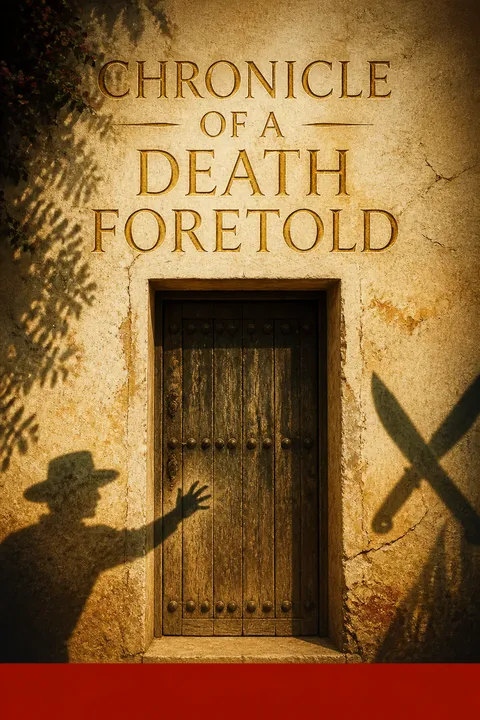


Plot Summary
The Morning No One Stops
Twenty-seven years later, the narrator returns to gather testimony about the Monday Santiago Nasar was killed. At twenty-one, Santiago wakes after a night of wedding revels with a headache and a dream of trees, then dresses in white to greet the bishop. His mother, Plácida Linero, hears the dream but misses its danger.
In the kitchen, Victoria Guzmán knows the Vicario twins are waiting to kill him, yet her anger at Santiago’s harassment of her daughter Divina keeps her silent; Divina is too frightened to speak. A precise warning note lies unseen beneath the front door. Santiago takes the formal exit, though he usually uses the back. The bishop’s boat passes without landing, leaving the crowd distracted and Santiago unprotected.
The opening makes knowledge abundant but action scarce. A note, a kitchen warning, and a mother’s dream all offer possible routes away from danger, yet each fails for a different reason: neglect, resentment, fear, or misinterpretation. Santiago’s formal clothing sends him through the door that exposes him, while the bishop’s passing absorbs the town’s attention. The narrator’s return adds another layer: the event is already fixed, but its causes remain under examination. By beginning with the outcome already announced, the story shifts suspense away from whether violence will happen and toward how ordinary decisions can make a known danger feel strangely unreal.
A House Bought for Love
Six months before the killing, Bayardo San Román arrives in town with polished manners, conspicuous money, and a story that he is looking for a wife. He notices Angela Vicario at a fair and wins a music box for her by buying every raffle ticket.
Angela dislikes his arrogance, but her family welcomes the match as a rare chance to improve their prospects. Her mother, Pura, treats Angela’s objections as an inconvenience and insists that affection can follow marriage.
Bayardo then buys the hilltop home Angela admires from its grieving owner, the widower Xius, despite his reluctance to part with it. Each gesture makes refusal harder: Bayardo can obtain objects and arrangements with ease, while Angela has little authority over the future being prepared for her.
Bayardo’s courtship operates less like a mutual discovery than a demonstration of purchasing power. The music box and the widower’s house are not merely lavish gifts; they show how easily Bayardo can turn desire into acquisition. Angela’s family interprets his money as security, while Angela experiences his confidence as pressure. Pura’s insistence that love can be learned converts a private hesitation into a problem to be managed by the family. The contrast exposes the narrow choices available to Angela: everyone around her treats marriage as a practical solution, but no one asks whether she wants the life being bought on her behalf.
The Bride Sent Home
After four months of preparation, Bayardo and Angela marry amid a celebration so extravagant that the whole town shares in it. Angela enters the marriage under pressure from her family; although confidantes have taught her ways to conceal her lack of virginity, she cannot bring herself to use them.
Before dawn, Bayardo returns her to her parents’ house. Pura beats Angela in secret, and the twins, Pedro and Pablo Vicario, come home to find their sister bruised and silent. They demand the name of the man they believe has dishonored her.
Angela gives them Santiago Nasar’s name. The accusation becomes the brothers’ warrant for violence, although the story offers no proof that Santiago was responsible and later testimony cannot establish how or when Angela was harmed.
The wedding turns a private mismatch into a public crisis because the community has made a woman’s sexual history the measure of her family’s standing. Angela’s decision not to fake virginity is an act of honesty, but it leaves her exposed to the punishment built into that code. Bayardo’s return of the bride is swift and decisive; the family’s response is to make Angela’s body answer for the humiliation. Her naming of Santiago sets the plot in motion, yet the absence of corroboration prevents the accusation from becoming settled fact. The gap between certainty and evidence is central: the brothers act as if honor requires no further inquiry.
Knives Announced in Public
Before dawn, the twins take slaughtering knives from their family’s pigsty and sharpen them at the meat market. They tell butchers and customers that they intend to kill Santiago, but most listeners assume the brothers are drunk or bluffing.
Clotilde Armenta, who runs the milk shop where they wait, recognizes their uncertainty and tries to make someone intervene. Colonel Aponte, the mayor, hears the warning and confiscates their first knives, then sends them away instead of detaining them or making sure Santiago is safe.
The twins return with replacements. Pedro falters as pain and exhaustion overtake him, but Pablo presses him to continue. Their repeated announcements give the town chances to interrupt the plan, while each casual response leaves the brothers closer to carrying it out.
The twins’ threats are both sincere and strangely public. Their announcements can be read as a demand for recognition, but also as an appeal for someone to assume responsibility and stop them. Clotilde understands their hesitation more clearly than the officials do, yet her insight has no institutional force. Aponte treats the knives as the whole problem: once confiscated, the danger seems resolved. The brothers’ return with new blades shows how shallow that intervention was. Their divided resolve complicates the image of men obeying an unquestioned code; they are also exhausted people being carried forward by the expectation that no one else will interrupt them.
Every Warning Arrives Late
After the bishop’s boat passes, Margot learns that Bayardo has returned Angela to her family and that the twins are waiting for Santiago. She sends her mother to warn Plácida, but Santiago is already moving through the town with his friend Cristo Bedoya. Cristo hears the danger from Yamil Shaium and searches Santiago’s house, only to be misled by the servants and Plácida’s mistaken belief that her son is upstairs.
Santiago has gone instead to Flora Miguel, his fiancée, who receives him in anger and gives back his letters. Flora’s father, Nahir, tells Santiago that he can hide in the house or take a rifle. Santiago is too bewildered to choose shelter. Outside, people shout conflicting directions as he turns toward home.
The town’s warning system works only in fragments. Margot acts as soon as she learns the truth; Cristo searches for his friend; Yamil tries to pass on what he knows; Nahir offers practical protection. Yet information keeps arriving after the person who needs it has moved on. Santiago’s visit to Flora adds a personal shock at the precise moment he needs clear judgment. Her anger makes him confront the accusation through the collapse of their engagement, while Nahir’s offer cannot overcome his confusion. The sequence makes the failure more than a lack of warning: people do try to help, but their efforts are uncoordinated, and no one takes command of the danger.
The Door That Would Not Open
Plácida sees the twins running toward the house and believes Santiago has already gone upstairs, because Divina has told her he entered. She shuts and bars the front door just as Santiago reaches it. He pounds on the wood, then turns to face Pedro and Pablo with no weapon. The brothers stab him repeatedly against the entrance, striking his hands and body as neighbors watch and shout.
When they have finished, Santiago remains upright long enough to circle the house. Holding his wounded body together, he passes through a neighboring home and returns by the back entrance he usually used. He reaches the kitchen and collapses. His mother’s attempt to keep the killers outside has, without her knowing it, shut her son out as well.
The door gives the book’s chain of mistakes a physical form. Plácida acts on false information and sees only the threat at the entrance, not Santiago approaching from another direction. Her decision is understandable within the moment, yet its consequence is irreversible. The twins’ attack turns the public square into a scene witnessed by many people who have already heard what will happen. Santiago’s long route through the neighborhood reverses his ordinary passage through the house: he comes home by the service entrance, but too late to be saved. The scene makes fate feel real without making it supernatural; the decisive force is a series of human misreadings.
A Body Given Back
The twins surrender their knives to the priest and insist that they acted in defense of family honor. While Santiago’s body lies in the crowded house, heat and decay make it impossible to wait for the absent doctor. Father Amador performs the autopsy with inadequate tools, damaging the body further before it is sewn up and buried at dawn.
The twins spend the day in jail, unable to sleep and unable to wash away the smell they associate with the killing. A few days later, Bayardo is found unconscious in the house he had bought for Angela and is taken away by his family. The town begins to remember him as another casualty of the wedding, even as the physical costs of Santiago’s death remain in view.
The aftermath refuses the comfort of a clean ending. The autopsy is meant to serve practical and legal needs, but its crude execution repeats the bodily violation rather than clarifying it. The twins’ insistence that they are innocent sits beside their insomnia and sensory distress, suggesting that public justification does not erase private consequence. Bayardo’s collapse widens the circle of damage beyond the person killed and the people who wielded the knives. Yet the town’s pity for him risks shifting attention away from Santiago and Angela, the people whose lives were shaped most directly by the honor code. Grief is real, but its distribution is unequal.
The Case Cannot Close
Twelve days after the killing, an investigating magistrate arrives to find a town eager to explain its part in the tragedy. He gathers testimony but finds no evidence that Santiago harmed Angela, and he cannot determine what happened to her or why she named him.
At trial, the twins’ lawyer presents the killing as legitimate defense of honor, and the court accepts that argument. The brothers maintain that they would act the same way again.
Years later, the narrator recovers only fragments of the magistrate’s report, while residents continue to revisit the morning and their missed chances to intervene. The twins are absolved: Pablo marries Prudencia Cotes and becomes a goldsmith, while Pedro returns to military service and disappears on patrol.
The investigation promises a stable account, but its documents preserve uncertainty rather than resolve it. The magistrate can collect statements and test claims, yet no testimony establishes that Santiago was Angela’s attacker. The court’s acceptance of the honor defense supplies legal closure without factual certainty. That distinction matters: the judgment explains how the brothers escaped punishment, not whether their premise was true. The narrator’s fragmentary archive mirrors the town’s memory, which is crowded with recollections but unable to produce a shared understanding. By presenting guilt as both unresolved and socially distributed, the book asks readers to consider not only who struck Santiago, but who made the violence possible.
Letters Across Decades
Sent away with her mother, Angela settles in a distant village and returns to embroidery. The rejection that first shamed her gradually becomes the center of a feeling she had not expected: she falls in love with Bayardo.
She begins writing to him, first cautiously and then every week, sending letter after letter without receiving a reply. Over the years, the writing becomes a practice she controls, unlike the marriage arranged for her.
More than two decades after the wedding, Bayardo appears at her home carrying luggage and bundles of her unopened letters, nearly two thousand in all. His return does not explain the old accusation or undo what happened in the town. It does, however, bring the long silence between them into the room at last.
Angela’s letters transform a history imposed on her into a story she authors herself. At first, she had been passed from family decision to husband’s judgment; now she chooses the rhythm, content, and persistence of her own communication. Bayardo’s unopened bundles make the relationship’s imbalance tangible: he has possessed her words without receiving them, while she has lived through the act of sending. His return creates a new possibility, not a neat repair. The novel ends this strand with presence rather than explanation. The letters answer neither the town’s mystery nor the violence, but they reveal Angela as more than the passive figure others once defined.
Analysis
The novel turns a murder into a problem of collective knowledge. Santiago’s death is announced in advance, so suspense comes not from concealment but from watching information circulate without producing effective action. Each person sees only a piece: a threat mistaken for drunkenness, a warning delayed by politeness, a door closed on false assumptions. The structure makes individual responsibility difficult to isolate, but it does not dissolve responsibility into fate. The town repeatedly has opportunities to interrupt the violence, and its failures acquire force through accumulation.
The honor code gives that failure a social logic. Angela’s sexual history becomes a public measure of family worth, while the twins’ violence is treated as a duty that the court can recognize. This arrangement turns gendered control into communal procedure. Angela is punished for a condition the narrative never explains, and Santiago is assigned guilt without evidence sufficient to establish it. The uncertainty is not a puzzle with a hidden answer waiting to be found; it exposes how a community can act decisively on a claim while remaining unable, or unwilling, to verify it.
The narrator’s investigation offers no final correction. Memory is vivid but inconsistent, and the surviving legal record is incomplete. That form matters because it prevents the reader from escaping into a tidy verdict about who alone caused the tragedy. At the same time, Angela’s long correspondence supplies a counterpoint to the town’s gossip and official documents. She begins as someone whose choices are made by others, then claims a private language and sustains it for years. The book’s sharpest insight is therefore double: public stories can trap people, but acts of attention and authorship can still recover a life from the roles imposed on it.
Review Summary
Chronicle of a Death Foretold is praised for its masterful storytelling and unique narrative structure. Many reviewers appreciate Márquez's ability to create tension and intrigue despite revealing the outcome early on. The novella's exploration of fate, honor, and collective responsibility resonates with readers. Some find the writing style captivating, while others struggle with it. The vivid descriptions and complex characters are frequently mentioned as strengths. Overall, the book is widely regarded as a compelling and thought-provoking work, though opinions on its place among Márquez's oeuvre vary.
People Also Read


Characters
Santiago Nasar
The town’s Arab heirSantiago is a twenty-one-year-old landowner who takes over his family ranch after his father’s death. Sociable, confident, and fond of horses and falconry, he is accustomed to moving easily through the town’s social world. His charm coexists with entitlement, especially in his treatment of young women in his household. He values display and celebration, yet also shows tenderness and a capacity for distress that those around him do not always recognize. His position as an Arab descendant sets him apart in a community where people know his family well but still describe him through inherited ethnic assumptions.
Angela Vicario
The daughter under scrutinyAngela is the youngest daughter in a poor, tightly controlled family, raised to marry and preserve its reputation. Her outward passivity conceals a sharper mind and a capacity to endure pressures that others mistake for weakness. She resists the marriage arranged for her but has little power to refuse it. The expectations placed on her body and behavior expose the difference between how the town defines a woman’s honor and how she understands her own choices. As the story’s central uncertainty, she remains difficult for others to interpret, including the narrator.
Bayardo San Román
The wealthy outsider groomBayardo arrives with money, polished manners, practical skills, and a confidence that makes him seem capable of arranging any outcome. His charm wins over Angela’s family before he has built a meaningful bond with Angela herself. He tends to express desire through grand gestures and material acquisitions, as though comfort and wealth might secure affection. Beneath his public ease, the narrator senses sadness and tension. Bayardo is both an outsider whose origins invite rumor and a man whose private feelings remain difficult for the town to read.
Pedro Vicario
The commanding twinPedro is one of Angela’s twin brothers and a trained slaughterer. Military service has made him more forceful and accustomed to taking charge, especially in the presence of his brother. He treats the defense of family honor as a duty laid upon him, but his physical pain and exhaustion reveal strain beneath the public performance of certainty. Pedro’s character shows how an inherited code can be enforced by someone who may feel trapped by it, even as he continues to act in its name.
Pablo Vicario
The resolute twinPablo is Pedro’s twin and Angela’s brother. Before Pedro’s return from military service, Pablo was the more decisive of the two; later, he becomes the one who pushes their shared obligation forward when his brother falters. His relationship with Pedro is intimate but hierarchical, shaped by years of shared work and shifting authority. Pablo’s conduct reflects the pressure to prove manhood in a community that treats violence as a legitimate response to an insult.
The narrator
Returning village chroniclerA childhood friend of Santiago, the unnamed narrator returns to the town years later to reconstruct what happened. He interviews relatives, witnesses, and officials, then pieces their accounts together with fragments of the legal record. His closeness to the people involved gives him intimate knowledge, but not certainty: his memories are partial, and the witnesses contradict one another. The narrator’s effort to explain the tragedy is also personal, since the event belongs to the history of his own family and community.
Plácida Linero
Santiago’s dream-reading motherPlácida is Santiago’s widowed mother, known for interpreting other people’s dreams with confidence. She is observant and steady, but the dreams that might have warned her about her son do not strike her as ominous. Her bond with Santiago is deep, and her later memories preserve small details of his habits and appearance. She represents the painful gap between knowing someone intimately and being able to understand what is about to happen.
Clotilde Armenta
The shopkeeper who seesClotilde runs the milk shop where Pedro and Pablo wait. She recognizes their uncertainty and understands that they may want someone to stop them, so she repeatedly seeks help. Her practical judgment contrasts with the officials’ casual responses. The limits of her authority frustrate her, but she remains one of the few adults who grasps the seriousness of the threat before it is too late.
Cristo Bedoya
Santiago’s searching friendCristo is Santiago’s close friend and a medical student. He is loyal and quick to act once he understands the danger, searching Santiago’s home and trying to locate him. His efforts are hampered by incomplete information, misleading assumptions, and the speed with which Santiago moves through town. Cristo later becomes a doctor, but his training cannot spare him the helplessness of being a friend who arrives too late.
Victoria Guzmán
The guarded housekeeperVictoria is the cook in Santiago’s household and the mother of Divina Flor. She once had a secret relationship with Santiago’s father, Ibrahim, and resents the way Santiago repeats his father’s sexual entitlement. Her anger gives her a reason to resist helping Santiago, while her protective instinct makes her wary of his attention to Divina. Victoria’s divided loyalties reveal how old injuries can shape a decision made in a single morning.
Divina Flor
The frightened young servantDivina is Victoria’s daughter, young and vulnerable in the household where Santiago holds power over her. She anticipates his unwanted advances and is frightened when he touches her. Her silence is not indifference but the response of someone who has little authority and little confidence that speaking will protect her. Through Divina, the household’s hierarchy becomes personal rather than abstract.
Flora Miguel
Santiago’s arranged fiancéeFlora is engaged to Santiago through an agreement between their families. Their relationship is orderly and conventional rather than passionate, and she has kept the letters he sent while away at school. Her sense of security depends on the expected marriage, leaving her vulnerable when she hears the town’s rumor and interprets it through her own fear and anger.
Nahir Miguel
Flora’s protective fatherNahir is Flora’s father and a respected elder in the Arab community. He speaks with authority and offers Santiago a practical choice when he realizes the danger. His calm presence contrasts with the confusion outside his home. Nahir’s attempt to help shows how personal trust can briefly cut through the paralysis of the larger community.
Pura Vicario
The family’s iron matriarchPura is Angela’s mother, a former schoolteacher who has built her identity around sacrifice and family discipline. She considers marriage the proper future for her daughters and regards reputation as a household responsibility. Her strictness is rooted in a social order she believes she must uphold, but that order leaves little space for Angela’s wishes or vulnerability.
Colonel Lázaro Aponte
The complacent mayorA retired military officer serving as mayor, Aponte relies on personal confidence and informal authority. He removes the twins’ first knives and believes that this has settled the danger. His failure is less a lack of access to information than a habit of treating a serious threat as a minor disturbance. He embodies the difference between holding office and accepting responsibility.
Father Carmen Amador
The distracted priestFather Amador is the town priest, occupied on the morning of the danger by preparations for the bishop’s visit. He receives warnings but does not act decisively, later admitting that the arrival diverted his attention. When the doctor is unavailable, he is ordered to perform Santiago’s autopsy. His role joins religious ceremony to civic failure without suggesting that good intentions alone can repair either.
María Alejandrina Cervantes
The beloved party hostMaría Alejandrina runs a lively house where Santiago and his friends gather. She has a close history with Santiago and retains affection for him, even while setting boundaries around her own life and household. Her home offers the young men pleasure and refuge, but its festivities also contribute to the exhaustion and confusion surrounding the morning’s events.
Margot
The narrator’s concerned sisterMargot is the narrator’s sister and one of Santiago’s friends. She invites him to breakfast after the bishop’s boat passes and only later learns that the twins are waiting for him. Her immediate desire to protect him contrasts with the delay built into the town’s many attempts to warn him.
Yamil Shaium
The family’s trusted elderYamil is an older Arab friend of Santiago’s family and a longtime adviser to the household. He takes the threat seriously and tries to pass the warning to Cristo Bedoya, hoping to avoid frightening Santiago if the rumor proves false. His caution is understandable, but it becomes another delay in a morning already crowded with them.
Widower Xius
The grieving homeownerXius is an older widower whose hilltop house is the home Angela admires. The property holds memories of his marriage, making its sale more than a financial transaction. His resistance reveals what Bayardo’s wealth cannot easily replace: a person’s attachment to a life already lived.
Prudencia Cotes
Pablo’s steadfast fiancéePrudencia is Pablo’s fiancée. She accepts the town’s code of masculine honor and regards his willingness to defend his family as part of the man she expects to marry. Her response demonstrates how the honor system is sustained not only by men who act, but by the people who reward those actions.
Dr. Dionisio Iguarán
The absent town doctorDr. Iguarán is the town physician and a friend of the narrator’s family. His absence forces Father Amador to conduct the autopsy. Later, the doctor disputes the priest’s medical conclusions, bringing professional skepticism to a record shaped by haste and limited expertise.
Plot Devices
The retrospective inquiry
Memory as courtroom evidenceThe narrator reconstructs the killing years later through interviews, personal recollections, and fragments of the magistrate’s report. This structure lets the story move between the morning itself and the later lives of witnesses without offering a single all-knowing account. Conflicting memories become evidence of how a community processes a shared event: people remember where they stood, what they heard, and why they did not act, but those details do not add up to certainty. The inquiry gives the reader a chain of causes while preserving the central gap in the record.
Honor’s public script
A code that licenses violenceThe town treats female virginity as family property and masculine retaliation as a duty. Once Angela’s marriage collapses, the Vicario brothers invoke this code to explain their plan, while neighbors and officials repeatedly mistake the threat for bluster or assume someone else will intervene. The code is powerful because it is not enforced by the brothers alone; families, witnesses, and the court all help make it legible as respectable conduct. Its use in the story exposes how a social rule can disguise personal violence as an obligation.
Doors and missed messages
Warnings blocked by thresholdsThe warning note under Santiago’s door, the division between his front and back entrances, and the door his mother bars at the final moment form a repeated chain of failed passage. Information exists, but it does not reach the right person at the right time. The doors are ordinary features of the house, yet their use determines who can enter, who can be seen, and who is shut out. The device links the town’s larger failure to small physical decisions, making the final mistake feel both accidental and painfully concrete.
Dreams and disputed omens
Foreknowledge without understandingSantiago dreams of trees before the killing, and Plácida, who is known for interpreting dreams, reads no danger in them. Other recollections disagree about the weather, the light, and what people noticed that morning. These signs do not operate as a reliable supernatural map; instead, they show how easily people turn ordinary images into omens after an event has fixed their meaning. The dreams heighten the sense of forewarning while underlining that foreknowledge is useless when no one can translate it into action.
Letters that outlast silence
A private voice kept aliveAngela’s letters to Bayardo change from cautious messages into an enduring record of feeling and self-expression. Their importance lies not only in what she writes, but in the years she chooses to keep writing without a reply. When the unopened pages return with Bayardo, they make the distance between speaking and being heard visible. The letters do not solve the town’s central uncertainty or erase the marriage’s harm; they give Angela a sustained voice beyond the role her family and neighbors assigned her.
FAQ
Synopsis & Basic Details
What is Chronicle of a Death Foretold about?
- Inevitable murder foretold: The novella centers on the foretold murder of Santiago Nasar, a young man in a small Colombian town, exploring the events leading up to his death and the community's complicity.
- Honor culture explored: The story examines the rigid social codes of honor and revenge that dictate the actions of the Vicario brothers, who openly declare their intention to kill Santiago Nasar to avenge their sister's dishonor.
- Narrative reconstruction unfolds: The narrator, a friend of Santiago Nasar, returns to the town years later to piece together the fragmented memories and testimonies of the townspeople, attempting to understand the circumstances surrounding the tragedy.
Why should I read Chronicle of a Death Foretold?
- Masterful storytelling captivates: Gabriel García Márquez's unique blend of journalistic precision and magical realism creates a compelling and suspenseful narrative that keeps readers engaged from beginning to end.
- Exploration of complex themes resonates: The novella delves into universal themes of fate, free will, honor, guilt, and collective responsibility, prompting readers to reflect on the complexities of human nature and societal norms.
- Cultural insights enlighten: The story offers a glimpse into the cultural values and traditions of a small Latin American community, providing insights into the dynamics of honor, gender roles, and social expectations.
What is the background of Chronicle of a Death Foretold?
- Based on real events: The novella is inspired by a real-life murder that occurred in Colombia in 1951, lending a sense of authenticity and urgency to the narrative.
- Colombian societal norms: The story is set against the backdrop of a traditional Colombian society where honor and reputation are highly valued, and where violence is sometimes seen as a legitimate means of restoring social order.
- Post-colonial influences evident: The novella reflects the lingering effects of colonialism on Latin American culture, including the persistence of patriarchal values and the complex relationship between tradition and modernity.
What are the most memorable quotes in Chronicle of a Death Foretold?
- "On the day they were going to kill him, Santiago Nasar got up at five-thirty in the morning...": This opening line immediately establishes the inevitability of Santiago Nasar's death, creating a sense of suspense and foreboding that permeates the entire novella. It highlights the theme of fate and the predetermined nature of the tragedy.
- "There had never been a death more foretold.": This quote encapsulates the central irony of the story, emphasizing the community's awareness of the impending murder and their failure to prevent it. It underscores the theme of collective responsibility and the town's complicity in Santiago Nasar's death.
- "Love can be learned too.": This chilling statement by Pura Vicario reflects the societal pressure on women to conform to traditional gender roles and the devaluation of individual agency in matters of love and marriage. It highlights the theme of societal expectations and the constraints placed on women in a patriarchal society.
What writing style, narrative choices, and literary techniques does Gabriel García Márquez use?
- Journalistic precision blends: Márquez employs a journalistic style, presenting the story as a factual account based on interviews and investigations, creating a sense of realism and immediacy. This is juxtaposed with elements of magical realism.
- Fragmented narrative builds suspense: The non-linear narrative structure, with its shifting perspectives and fragmented memories, creates a sense of mystery and suspense, gradually revealing the events leading up to Santiago Nasar's death.
- Symbolism enriches meaning: The novella is rich in symbolism, with recurring motifs such as dreams, weather, and colors adding layers of meaning and foreshadowing to the narrative. The use of white linen as Santiago's attire symbolizes innocence and vulnerability.
Hidden Details & Subtle Connections
What are some minor details that add significant meaning?
- Starch in white linen: Santiago's mother notes that his skin is too delicate for starched linen, yet he wears it anyway. This detail subtly foreshadows his vulnerability and the violence his body will endure, as the unyielding fabric contrasts with his defenselessness.
- Victoria Guzman's rabbit guts: Victoria Guzman's deliberate act of feeding rabbit guts to the dogs to upset Santiago Nasar reveals her deep-seated resentment towards him and his father. This seemingly minor act foreshadows the brutal violence that Santiago Nasar will soon face, connecting animalistic cruelty to human violence.
- Widower Xius's tears: The widower Xius's tears "bubbling inside his heart" when forced to sell his house highlight the profound emotional cost of material transactions and foreshadow the emotional devastation that will engulf the town after Santiago Nasar's death. This connects to the theme of loss and the disruption of personal history.
What are some subtle foreshadowing and callbacks?
- Dreams of trees and birds: Santiago Nasar's dreams of trees and birds are initially dismissed as harmless, but later serve as a haunting reminder of his impending doom. The recurring motif of dreams underscores the theme of fate and the inability to escape one's destiny.
- The accidental gunshot: The story of the servant girl accidentally firing a gun in Santiago Nasar's childhood home foreshadows the accidental nature of his death, highlighting the role of chance and unintended consequences in the tragedy. This also connects to the theme of violence and its unpredictable nature.
- "He was just like his father": Victoria Guzman's statement that Santiago Nasar was "just like his father" after he grabs Divina Flor by the wrist foreshadows his eventual fate, suggesting that he is destined to repeat his father's mistakes and suffer a similar end. This reinforces the theme of inherited traits and the cyclical nature of violence.
What are some unexpected character connections?
- Narrator's family ties: The narrator's familial connections to both the Nasar and Vicario families create a sense of personal involvement and complicate his role as an objective investigator. This highlights the theme of collective guilt and the difficulty of separating oneself from the tragedy.
- Maria Alejandrina Cervantes and Santiago Nasar: The past relationship between Maria Alejandrina Cervantes and Santiago Nasar, though no longer romantic, reveals a deeper connection between them and adds another layer of complexity to his character. This also highlights the theme of lost love and the enduring impact of past relationships.
- Colonel Lázaro Aponte and spiritualism: Colonel Lázaro Aponte's interest in spiritualism, revealed later in the story, contrasts with his initial dismissive attitude towards the Vicario brothers' threats. This highlights the theme of human fallibility and the limitations of reason in the face of irrationality.
Who are the most significant supporting characters?
- Clotilde Armenta: The reluctant prophet: Clotilde Armenta's attempts to warn Santiago Nasar and her recognition of the twins' ambivalence make her a crucial figure. She embodies the theme of individual responsibility and the struggle to act against societal norms, even when facing overwhelming odds.
- Cristo Bedoya: The loyal friend: Cristo Bedoya's desperate attempts to warn Santiago Nasar and his subsequent guilt highlight the theme of friendship and the limitations of human intervention in the face of fate. His medical knowledge and social standing further emphasize his potential to have altered the course of events.
- Divina Flor: The unwilling participant: Divina Flor's fear of Santiago Nasar and her inability to warn him, despite knowing of the impending danger, underscore the theme of power dynamics and the vulnerability of young women in a patriarchal society. Her role highlights the complexities of complicity and the difficulty of acting against one's own self-preservation.
Psychological, Emotional, & Relational Analysis
What are some unspoken motivations of the characters?
- Vicario brothers' desire to be stopped: The Vicario brothers' open declaration of their intent to kill Santiago Nasar suggests an unspoken desire to be stopped, revealing their internal conflict between societal expectations and their own conscience. This highlights the theme of honor as a burden.
- Plácida Linero's guilt and denial: Plácida Linero's locking of the door and her subsequent denial of any ominous signs in Santiago Nasar's dreams suggest an unspoken guilt and a desire to protect herself from the truth. This underscores the theme of maternal love and the lengths to which a mother will go to protect her child, even in death.
- Angela Vicario's hidden love for Bayardo: Angela Vicario's initial rejection of Bayardo San Roman and her subsequent accusation against Santiago Nasar may mask an unspoken attraction to Bayardo, revealing the complexities of love and desire in a society where marriage is often based on social and economic considerations. This connects to the theme of societal expectations and the constraints placed on women.
What psychological complexities do the characters exhibit?
- Vicario twins' fractured masculinity: The Vicario twins' alternating displays of resolve and vulnerability reveal a complex understanding of masculinity, highlighting the psychological toll of adhering to rigid gender roles and the internal conflict between societal expectations and personal feelings.
- Plácida Linero's denial and superstition: Plácida Linero's reliance on dream interpretation and her subsequent guilt over misinterpreting Santiago Nasar's dreams reveal a complex psychological state marked by denial, superstition, and a desperate attempt to make sense of the tragedy.
- Bayardo San Roman's wounded pride: Bayardo San Roman's initial arrogance and his subsequent descent into alcoholism reveal a complex psychological state marked by wounded pride, a sense of entitlement, and an inability to cope with the loss of control.
What are the major emotional turning points?
- Angela's accusation: Angela Vicario's naming of Santiago Nasar as her "perpetrator" is a major emotional turning point, setting in motion the chain of events that will lead to his death and transforming her from a passive victim into an active agent in the tragedy.
- Plácida Linero locking the door: Plácida Linero's decision to lock the door, believing Santiago Nasar is safe inside, is a major emotional turning point, sealing his fate and condemning her to a lifetime of guilt and regret.
- Bayardo's return with the letters: Bayardo San Roman's return with the unopened letters is a major emotional turning point, offering a glimmer of hope and redemption after years of suffering and highlighting the enduring power of love and forgiveness.
How do relationship dynamics evolve?
- Angela and Bayardo's reconciliation: The relationship between Angela Vicario and Bayardo San Roman evolves from one of forced marriage and rejection to one of enduring love and reconciliation, highlighting the transformative power of time, distance, and self-discovery.
- Vicario brothers' shifting power dynamic: The relationship between the Vicario brothers shifts from one of fraternal loyalty to one of shifting power dynamics, as Pedro's initial resolve gives way to Pablo's determination, revealing the complexities of sibling relationships and the burden of shared responsibility.
- Santiago and his mother's strained bond: The relationship between Santiago Nasar and his mother, Plácida Linero, is marked by a subtle distance and a lack of communication, highlighting the theme of miscommunication and the tragic consequences of unspoken emotions.
Interpretation & Debate
Which parts of the story remain ambiguous or open-ended?
- Santiago Nasar's guilt or innocence: The central question of whether Santiago Nasar was actually guilty of dishonoring Angela Vicario remains unanswered, leaving the reader to grapple with the ambiguity of truth and the unreliability of memory. This ambiguity underscores the theme of collective guilt and the difficulty of assigning blame.
- Angela Vicario's true motivations: Angela Vicario's reasons for naming Santiago Nasar as her "perpetrator" are never fully explained, leaving room for speculation about her true motivations and the extent to which she was influenced by societal pressure or personal desires.
- The role of fate versus free will: The extent to which Santiago Nasar's death was predetermined by fate or the result of individual choices remains open to interpretation, prompting readers to consider the interplay between destiny and human agency.
What are some debatable, controversial scenes or moments in Chronicle of a Death Foretold?
- The community's inaction: The townspeople's failure to prevent Santiago Nasar's murder is a controversial aspect of the story, raising questions about moral responsibility, collective guilt, and the power of social pressure to override individual conscience.
- Angela Vicario's accusation: Angela Vicario's naming of Santiago Nasar as her "perpetrator" is a controversial moment, prompting debate about the validity of her claim and the extent to which she was justified in seeking revenge.
- The graphic violence: The novella's graphic depiction of Santiago Nasar's murder is a controversial element, raising questions about the author's intent and the ethical implications of portraying violence in such a visceral manner.
Chronicle of a Death Foretold Ending Explained: How It Ends & What It Means
- Santiago's brutal demise: The story culminates in the graphic and brutal murder of Santiago Nasar, who is repeatedly stabbed by the Vicario brothers in front of his own home. This ending underscores the destructive power of honor culture and the senselessness of violence.
- Community's enduring guilt: The novella concludes with the narrator reflecting on the enduring guilt and remorse of the community, highlighting the long-lasting consequences of their inaction and the impossibility of escaping the shadow of the tragedy.
- Ambiguous resolution lingers: Despite Angela and Bayardo's eventual reconciliation, the ending remains ambiguous, leaving the reader to grapple with the unresolved questions surrounding Santiago Nasar's guilt or innocence and the true meaning of honor and redemption. The "Chronicle of a Death Foretold ending explained" reveals a cyclical nature of violence and the lasting impact of societal pressures.
About the Author
Other books by Gabriel García Márquez



Download PDF
Download EPUB
.epub digital book format is ideal for reading ebooks on phones, tablets, and e-readers.








