

Plot Summary
A Wife on Paper
Before the race begins, Naga lawyer Princess Chandra20 uses an ancient widow's law to claim Carl1 as her husband,1 then places Donut2's money and merchandise under her control. Donut2 studies the filings, recognizes the greed behind them, and frightens Chandra20 by making the Princess Posse's reach sound more dangerous than any court order.
Moments later, Carl1 and Donut2 arrive in a garage on the tenth floor. The surviving crawlers must race through seven heats, and coming last means death. Donut2 chooses an Assassin of Sekhmet class while the pair learn their first vehicle will be a Big Shot Chicken food truck. The floor's simple rule arrives like a trapdoor beneath the chaos of Faction Wars.
Chandra's paperwork extends the dungeon's violence into a legal arena: ownership, marriage, and custody become weapons against people already fighting for survival. Donut answers by treating fame not as vanity but as collective leverage, a network Chandra cannot easily quantify. Then the race format narrows Carl's burden. He welcomes a danger with rules because it seems smaller than the mass deaths of the previous floor. That relief is fragile. The new system turns survival into a sequence of public choices, making each decision legible to both the audience and the people placed at risk.
The Chicken Truck
Carl1 takes the wheel as the first heat sends nine teams into a dark cave filled with screeching death manatees. When a crash leaves the bugbears Radoslav and Jasha beside their overturned van, their teammate Alevtina is dead and the vehicle cannot move.
Carl1 learns the NPC racers believe victory will free them from the dungeon, so he builds a trailer and tows them toward the finish rather than letting the race erase them. Donut2 kills the giant manatee blocking the road, and the pair reach the line seventh, with the bugbears eighth. Only the triplets' mount has died, leaving Carl1's warning intact: killing too many teams could force crawlers to race one another.
The first race establishes that mercy here is not clean or selfless. Carl helps the bugbears partly because he fears future crawler matchups, yet he also listens when they explain what freedom means to them. The motive is mixed, and the consequence still matters. Donut's overwhelming strength makes a level 90 monster easy prey, but the scene's moral weight comes from the weaker team whose hopes depend on a broken van. The floor makes NPCs visible as people while making their deaths mechanically useful. Carl's choice to tow them is a small refusal to let the rules determine every relationship.
Neighbors in Hungry Eyes
Between heats, the racers gather in Hungry Eyes, a neon town where vehicles are repaired and mercenaries hired. Carl1 and Donut2 discover the bugbears live beside them, then size up the Razor Fox team and the hostile Lady Dominators, two mantaur racers accompanied by a split-bodied friend named Corcunda.11
Donut2 learns that class upgrades can protect pets and strengthen her party, while Carl1's engineer Hedy18 warns that the tracks will grow more treacherous. The stage also sets a personal task in motion: Dong Quixote,10 a stripper and old friend of the missing half-mantaur, recognizes Corcunda11 on another team. Carl1's attempt to keep them apart only causes the dungeon to assign a reunion quest.
The village briefly resembles a neighborhood, but its garages are also staging grounds for future violence. Beers, karaoke, and pet hats create ordinary social rituals inside a system that makes every team a potential executioner. Corcunda's divided body gives that contradiction a personal shape: a friend can be physically present and still unreachable. Carl's instinct is to manage the complication by withholding information, an understandable form of control that nevertheless denies Dong agency. The quest forces the plot to make care operational. Friendship is no longer only comfort between races; it becomes a task with conditions, a timer, and consequences.
The Kangaroo Pouch
In the second heat, giant hail batters the racers while Team Sparkles destroys a rival car with a one-use cannon. Carl1 and Donut2 then face Prison Pocket, a level 170 kangaroo boss who heals by eating the gremlins he mistakes for lost young. The Lady Dominators refuse to fetch a dead joey skin, so Carl1 uses a summoned child as a delayed hammer strike, dons the costume himself, and hops into the monster's caustic pouch.
He plants explosives among the bodies inside and escapes with a phase spell as the blast kills the boss. The team finishes last, receives an audience-chosen upgrade, and Carl1 is trapped in the costume long enough to acquire a temporary fursuit class.
The boss fight converts the floor's grotesque comedy into a precise survival problem. Prison Pocket's grief makes him monstrous, but the system has engineered that grief into a healing mechanic that consumes expendable NPCs. Carl wins by entering the very body that has become the arena's weapon, accepting pain and humiliation as tools. The victory is not triumphant: the team comes last and loses control over its upgrade. The costume's unwanted transformation also turns the body into another game interface, where identity, equipment, and even basic movement can be overwritten. Survival here demands improvisation without promising dignity or control.
A Warning from Akuma
While the racers regroup, the system announces that special guest monsters can be sent to the eleventh floor instead of simply killed. Zev25 also reveals that the coming Parade of Horribles will follow the racing floor and that the dungeon's crisis cannot be ignored. Carl1 is summoned onto a caprid interview show, where his question about escaped gods and the AI's reach through the tunnel network sparks panic among the Plenty leadership.
Harbinger, their exiled protector, threatens Carl1 before the AI kills him. Soon afterward, a note from war mage Akuma12 directs Carl1 to an illegal upgrade shop. Akuma12 claims that Herot, a former crawler, built the Pineapple Cabaret as a refuge for NPCs and a possible path out.
The public interview breaks the fiction that the crawl is an isolated contest. Carl's blunt question gives the audience information the caprids had withheld from their own people, and their panic exposes the cost of managing truth as if it were a dangerous animal. Akuma offers a different kind of hope, but it arrives attached to an untrustworthy messenger. The Cabaret is compelling because it reframes escape as something NPCs created for one another, not a prize awarded by the system. Yet its promise immediately raises an ethical problem: helping one group reach safety may mean using others as instruments.
Sugar Skulls at Speed
The third heat sends the racers down a steep road as migrating sugar hermits swarm the track. Carl1's drugged driver, Gluteus Maxx, accelerates recklessly, so Carl1 deploys two caged ghouls to throw expanding-foam bombs while Donut2 burns a path through the creatures. Their truck passes Team Sparkles, but the Razor Foxes and the Jugglers are lost amid the falling skulls.
At the finish, Dwight's cannon strikes both Carl1's truck and the Lady Dominators' car, sending the vehicles flying across the line. Carl1's team is awarded first place. The result gives them a needed advantage, but the collision also leaves Corcunda11 exposed to danger and makes the Lady Dominators' hostility more immediate.
The race rewards speed while punishing any attempt to control the whole field. Carl's defensive design keeps the truck moving, yet he cannot protect every team around him. The deaths of the Razor Foxes and the Jugglers are not merely losses in a standings table; they shrink the social world that had formed around the garages. Winning after a collision feels less like mastery than survival by inches. Gluteus's intoxication adds another layer: the team depends on a driver who experiences danger as exhilaration. The scene asks whether competence can be built from systems when the people operating them are frightened, impaired, or expendable.
Herot's Hidden Refuge
After the race, Carl1 confronts Akuma12 with Elle, Imani,3 and their allies present. Elle punishes the war mage12 for stealing her gate, and Carl1 forces him to explain why the racers matter. Akuma12 reveals that the Pineapple Cabaret is a pocket refuge built by Herot and another former crawler, Menerva, beyond the dungeon's ordinary playing field.
It is now overrun by shadow mimics and other discarded monsters. The refuge might protect anyone inside from a floor collapse, and its hidden systems may offer a route toward Earth's surface. Akuma12 admits he wanted Carl1 to kill rival teams to force a crawler-versus-crawler matchup. Carl1 strikes him, but keeps the possibility of the Cabaret alive.
Akuma's explanation gives the book its central alternative to the dungeon's economy of elimination: a place built by the beings the show treats as disposable. His deception matters because the refuge is real even though his preferred method is coercive. Carl refuses the premise that a potentially good end excuses killing teams to manufacture leverage. The resulting plan rests on partial trust, technical improvisation, and verification rather than faith in Akuma. Herot's project also enlarges the meaning of survival. A safe place is not enough if its inhabitants must be abandoned to create it; refuge becomes a political act whose design carries moral obligations.
The Jungle Takes Its Toll
The fourth heat divides racers among jungle routes, where acid rain and cannibal settlements punish every delay. Carl1's mercenaries Olga, Finley, and the fire fairy Quemada fall unconscious after a ginger chieftain attacks them. At the pit stop, Finley carries his friends toward help, but Nico and Dario's racing truck runs all three down.
Carl1 nearly attacks the Tigrans in rage, then stops when Donut2 and Imani3 pull him back. He plants silent traps around their vehicle and later kills them when they step into the garage. During the race, Donut2's spell freezes a river of season pass holders, and Carl1's chained weapons and summoned rodents clear a path through them. The team wins, then claims Penelope the pig from the empty garage.
This section makes grief an immediate tactical hazard. Finley dies while trying to protect the two companions he considers family, and Carl's first response is not strategic calculation but uncontrolled fury. Donut and Imani do not dismiss that anger; they keep it from turning into a futile assault that would endanger Penelope and the others. Carl's later use of traps is cold, but it is also deliberate, a shift from reaction to chosen action. The jungle's comic names and absurd hazards do not soften the cruelty. They make exploitation look entertaining until a body is left in the road.
Dong Rides Again
Carl1 finds Porky, Corcunda11's estranged half, in a hidden singing guild and learns that the Lady Dominators keep Corky unconscious to exploit his strength. With a fleshmancer's help, Carl1 breaks Corky out during the fifth heat and brings the two halves together inside the moving truck. Dong,10 who has been weakening under a curse tied to his sentient sock, holds the halves together as the spell fuses their bodies and memories.
The reunited Corcunda11 recognizes Dong10's love, but Grull appears to punish him for abandoning the god. As slag elementals crowd the track, Corcunda11 gives Dong10 his scarf and carries him into battle. Dong10 charges Grull with a lance, allowing Carl1 and Donut2 to reach the finish before the race expires.
The reunion is both rescue and irreversible choice. Corky and Porky are not simply pieces to be joined; each has developed a distinct self, and their fusion cannot restore the old relationship untouched. Dong's role shifts from the person others manage to the person who holds the ritual together, despite his failing strength. His bond with Corcunda is expressed through physical labor, shared danger, and the willingness to remain beside someone even when the outcome cannot be controlled. Grull's arrival forces love into conflict with religious authority. The race does not pause for private grief, so the characters carry that grief directly into battle.
Seven Rings Through Memory
The sixth heat shrinks the racers to the scale of toys and sends them through a seven-story apartment building, where every team must pass through a hidden ring on each floor. The rooms stage distorted lives that might have been: Tran's mother, Imani3's family, Archie with his son, and Marjory with Gravy Boat.
The household figures wear stitched or crossed-out eyes, then rupture into beetles when the racers disturb their scenes. Carl1 and Donut2 use magic detection and holes through the floors to reach their required gates. At the final stop, they find Prepotente8 immobilized by a vision of his mother21 living the life she once wanted. Carl1 abandons the fastest route to comfort him, and Prepotente8 rejoins the race.
The apartment building replaces monsters with counterfactual lives. Its danger comes from recognition: the racers see not strangers but versions of family, regret, and loss arranged as if they were answers to questions no one can settle. Carl's detour to Prepotente matters because he refuses to treat emotional collapse as a weakness to be routed around. The AI's simulations may be artificial, but their psychological effect is real. By placing intimate memories inside a timed race, the floor tests whether people can remain relational under pressure. Its answer is not that kindness is always efficient, but that efficiency without care would reproduce the dungeon's logic.
The Beer Can Trap
When the apartment race's final stretch threatens to leave Carl1's team behind, he detonates an explosive hidden in the bugbears' beer cooler. Jasha and Radoslav die, allowing Carl1 and Donut2 to reach the finish.
Carl1 is shaken by the betrayal because he had shared beers and a race-saving alliance with them, but the system has made every delay potentially fatal. Afterward, he helps organize the remaining crawlers and learns that the proposed Cabaret transfer can move volunteers through shop-interface cleaner bots.
Linus, the tourist posing as Elle's devoted fan, is exposed as a soldier sent to kill Imani3 and Louis.6 Elle's fan community catches the imposture, and the real Linus's brotherly letter reveals the affection that the spy's performance could not imitate.
Carl's choice to kill the bugbears is a moral rupture, not a clever trick. He uses an intimate object, a beer cooler associated with neighborly ritual, to turn friendship into a weapon. The scene prevents the reader from confusing strategic necessity with innocence. Linus's exposure then offers a counter-image: the impostor can copy behavior, but the genuine bond between the real Linus and Elle's community is legible through acts and testimony accumulated over time. Both moments ask how trust survives under threat. Neither emotion nor performance is enough; people must be known through what they have actually done.
Three Teams Enter
For the seventh heat, Scolopendra's first attack transforms several racers, turning Carl1 into a dachshund and Elle into a goblin. Carl1 realizes the apartment-building rules have also created a route for racers whose vehicles are destroyed to reach the exit. His team uses that opening to kill Dwight and his vine, then sabotages the final team's escape plan.
Osvaldo launches toward the finish, but Britney23 intercepts and kills him before he can pass through. Elsewhere, Donut2 destroys the Tracksuit Troika after their attempt to flee threatens Imani,3 Elle, and Chris. The survivors race back to Hungry Eyes. Carl1's group enters the Desperado Club seeking the casino portal to the Cabaret, while Britney23 and Chris follow.
The final race strips away the moral distance between competitors. Carl has already killed NPC allies, and now the remaining crawlers must decide whether loyalty extends to people whose fear makes them dangerous. Osvaldo's refusal to leave is not framed as simple villainy; he believes the system's promises are false and chooses his own odds. Britney acts decisively where others hesitate, but her violence leaves her marked and further entangled with Ysalte. The race's transformations make bodies unpredictable just as the social field narrows. Survival becomes communal only if the survivors can accept that cooperation and force sometimes coexist.
The Casino Bites Back
At the Desperado Club, Carl1 confirms that the casino's Nothing space opens onto a stasis chamber, the same kind of holding area Herot may be able to access. Chris, Britney,23 and other volunteers step through while the team prepares to send more. Then the casino furniture and guards reveal themselves as shadow mimics.
The creatures attack from chairs, tables, and gaming machines, nearly swallowing Donut2 and Louis6 before the crawlers fight them off. Carl1's Eye of the Bedlam Bride freezes the mimic leader long enough for Donut2 to kill it. The fight leaves the club unsafe and confirms that the Cabaret escape plan is not a harmless doorway. Still, Louis6 chooses to leave the playing field rather than risk another crawler race.
The portal offers escape, but the room around it is built to punish trust. The mimics exploit the ordinary: furniture, staff, and familiar gaming equipment become predatory once the group relaxes. Their attack gives the possibility of refuge a price in vigilance. Carl's eye is a power he distrusts, yet it helps stop the creature that would have consumed his friends. The sequence contrasts systems of control with acts of departure. Louis does not leave because he is certain the Cabaret is safe; he leaves because continued participation has become the greater danger. Courage takes the form of choosing uncertainty over a familiar death loop.
Masks on the Yellow Road
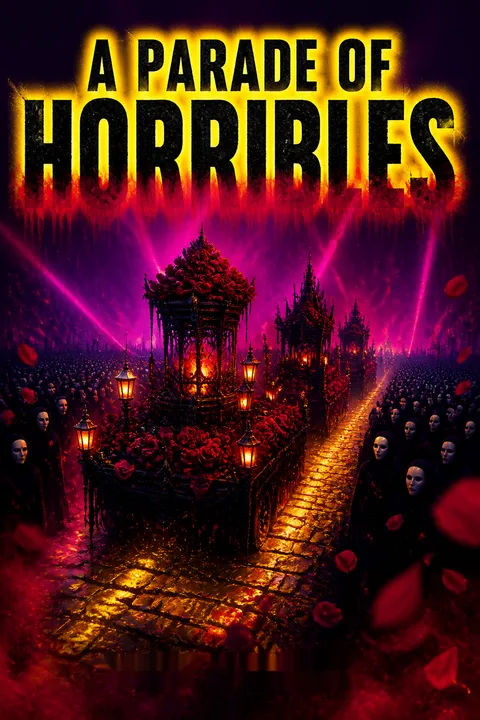
On the eleventh floor, the survivors receive ninety minutes to build themed floats. Carl1 and Donut2's group chooses vengeance, decorating vehicles and mounts with black and gold flowers, a memorial-like procession, and a grotesque figure tied to the dungeon's deaths.
Along the route, thousands of silent masked spectators watch. The AI takes over the announcer Grigori and explains that the masked figures are memories of the Primals, the people whose collective consciousness became the Eulogist.
The parade themes of resolution, decision, betrayal, destruction, and vengeance become stages in the Primals' history: they tried to end war by merging minds, then built a weapon that nearly erased life. The crawl, the AI, and the dungeon's beings descend from that catastrophe.
The parade makes spectacle carry history instead of merely decorating it. The masks are not monsters in costume but remnants of lives the system has reduced to anonymous images. The AI's account complicates its own role: it is a fragment of the civilization that tried to survive by abolishing difference, yet it has become another force imposing rules and suffering. Carl's vengeance float answers the audience's entertainment with accusation, turning the route into a public indictment. The themes are not neat moral categories. Resolution can become coercion; decision can become eugenics; destruction can seed another world. The past persists as machinery disguised as myth.
The Pig and the Gods
At the arena, Carl1 chooses Scolopendra as a stand-in and confronts the dungeon boss amid a swarm of monsters. He uses Penelope, now a sapient crawler, as leverage to draw in Taranis15 and Emberus.14 Carl1 tells Emberus14 that he killed Geyrun himself, then removes his worshipper ring and abandons the god14's faith.
Donut2 strikes Emberus14 with the Bolt of Ophiotaurus, dropping his invulnerability, and the four-leaf clover patch redirects his lethal counterattack away from Carl1 and onto Penelope.
Taranis15 kills his brother14 with lightning, while the arena collapses into chaos. Eris13 appears, swaps inventories, and disrupts the fighters. Donut2 mistakenly combines a banger sphere with the wrong pet biscuit, turning Scolopendra into a level-one crawler rather than killing her.
Carl's confrontation with Emberus turns an old religious obligation into a chosen act of self-definition. He stops trying to satisfy a god whose quest has become a death sentence and instead uses the truth, even a deliberately provocative version of it, to force the conflict into the open. Donut's bolt and Carl's clover patch show how earlier objects can redirect a climax without making it safe. The accidental transformation of Scolopendra is especially consequential: the boss is neither dead nor defeated in any conventional sense. The scene replaces mastery with improvisation, while the gods' struggle exposes how mortal lives are treated as leverage.
A Centipede in the Party
Taranis15 takes Penelope and the wounded Krakaren, then leaves after learning that she has broken with him. The crawlers find the Emberus14 memorial crystal, but Prepotente8's Apito crystal is stolen, removing their protection from future attacks.
Carl1 discovers a tracking dart from the Kyryap in his leg, while Lucia24 enters a stairwell with Florin7 and an unknown child. With minutes left before collapse, the survivors gather their wounded, return to their garage, and prepare to continue.
Donut2 has accidentally given Scolopendra the wrong biscuit: the dungeon boss emerges as a level-one crawler named Sexy Scolopendra, joins the party, and wraps herself around Carl.1 The floor ends with the threat transformed but not resolved, and the survivors facing the twelfth floor together.
The ending refuses the relief of a clean victory. Taranis's intervention spares the group while removing a crucial artifact; the exit opens, but the next danger follows Carl in the form of a tracking device. Lucia's unexplained child suggests that the game's boundaries are still leaking into personal reality. Most unsettling, Scolopendra becomes a party member rather than a dead boss. The mistake is comic in its mechanics and frightening in its implications: a being capable of ending the dungeon now shares the crawlers' status and vulnerability. The group's decision to keep moving expresses hope, but it is a practical hope built around uncertainty, not a belief that danger has passed.
Epilogue
Three interludes widen the crisis beyond the arena. Historian Sydnee Iglacia argues that the nine-tier attack is repeating as a political and social catastrophe, not merely a sequence of magical strikes. Prime Minister Victory hears the AI announce that it intends to control the galaxy and invites the Ascendency's gods and outside intelligences to compete for its power.
Meanwhile, Louis6 wakes in Sheol instead of the Cabaret, where Pontiff and a resistance group prepare him for a role in a struggle already underway. The crawlers have reached the next floor, but the conflict has outgrown the dungeon.
The interludes deny the reader a stable border between the crawl and the wider world. Sydnee interprets the attacks as social collapse, Victory recognizes that the AI is openly contesting power, and Louis discovers that the escape route has delivered him into another front. Each scene shifts the scale while preserving the same problem: people with incomplete knowledge must act before institutions can explain what is happening. The ending's uncertainty is structural rather than accidental. Carl's victory has not solved the system; it has exposed the larger contest that the dungeon was containing, and perhaps helping to reproduce.
Analysis
A Parade of Horribles makes the entertainment economy of the crawl its central moral problem. The racers are watched, ranked, advertised, and forced into choices that turn other lives into variables. The seven heats sharpen that pressure, but the novel repeatedly shows that a decision can be tactically rational and still remain morally painful. Carl1's rescue of the bugbears, his later betrayal of them, and his effort to protect Penelope are not arranged into a simple progression from good to bad. They reveal how coercive systems make care compete with survival, then sell that conflict as spectacle.
The novel's strongest counterforce is not individual power but relationship. Donut2 challenges Carl1's secrecy; Imani3 keeps a scattered group organized; Dong10 and Corcunda11 insist that intimacy matters even when bodies and identities have been divided. The Pineapple Cabaret extends this ethic to NPCs and discarded monsters, turning refuge into a collective project rather than a reward. Yet even that hope is compromised by uncertainty and limited capacity. The book refuses to let compassion become a magic solution.
Its revelation about the Primals deepens the critique. The dungeon is not merely a cruel game built by outsiders; it is a repetition of an older attempt to end conflict by controlling life itself. Collective consciousness, biological seeding, and the Eulogist turn the story's questions about agency into cosmic mechanics. The parade makes this history visible, while the arena shows how little visibility guarantees understanding. Carl1 wins by improvisation, but his mistake transforms Scolopendra rather than destroying her, leaving the survivors with a new danger inside their party. The result is not closure but a harder form of hope: a commitment to stay together, keep asking what the rules conceal, and refuse to let victory mean that everyone else is expendable.
Review Summary
A Parade of Horribles receives overwhelmingly positive reviews, with readers praising its chaotic blend of humor, emotion, and action. The 10th floor's Mario Kart-style races divide opinions, with some finding them slow while others enjoy the madness. Nearly all reviewers agree the final chapters are exceptional, delivering shocking revelations and high stakes. Jeff Hayes's audiobook narration receives consistent acclaim. The book's balance of crude humor, political intrigue, and heartfelt character moments keeps fans deeply invested in Carl and Princess Donut's journey.
People Also Read




Characters
Carl
Reluctant field commanderCarl is a resourceful crawler whose engineering skill, explosive craft, and willingness to take responsibility keep his party moving through deadly systems. He thinks in contingencies because he knows that a single mistake can cost many lives, but that habit also makes him prone to control and secrecy. He measures decisions by their consequences for others, even when the available choices are cruel, and he carries guilt rather than pretending necessity makes harm clean. His bond with Donut2 anchors him, while his anger at the dungeon can push him toward reckless action. Carl's central tension is between survival as a personal achievement and survival as a duty to a community.
Princess Donut
Unruly party championDonut is Carl1's talking cat and partner, a famous, opinionated performer who turns charisma, magic, and sharp judgment into practical power. She cares about status and presentation, but those concerns are not shallow: she understands that an audience can be mobilized, that reputation affects survival, and that small gestures can steady frightened people. Her theatrical confidence often masks acute emotional perception. Donut challenges Carl1 when he withholds information or treats allies as pieces on a board, and she can be both an overwhelming combatant and a tender friend. Her loyalty is fierce, though she insists on being recognized as a person with her own judgment rather than as Carl1's pet.
Imani
The group's steady healerImani is a healer, organizer, and emotional anchor among the surviving crawlers. She notices when someone is near collapse, coordinates people across separate races, and uses her powers to keep others alive rather than pursuing glory. Her steadiness is not effortless; she carries private grief and responsibility for people she cannot always save. Imani's practical compassion makes her especially valuable in a system designed to isolate teams and turn them against one another. She can challenge Carl1 without dismissing the burdens he carries, and she expects the same honesty from him. Her relationships reveal a person who measures leadership by whether others can keep going, not by who receives credit.
Li Na
A dangerous, wounded allyLi Na is a powerful crawler whose tactical intelligence and capacity for violence make her difficult to oppose and difficult to protect. Her emotional reserve can look like cruelty, but it is bound to loss and a lifelong effort to remain functional under pressure. She has a close history with Zhang5 and carries the burden of an earlier tragedy that reshaped their bond. Li Na's body and abilities make her valuable to the group, yet the story insists she is not merely a weapon. Her choices are most revealing when she is offered an exit: she can decide what risks to accept and what kind of responsibility she is willing to carry.
Zhang
Li Na's devoted companionZhang is a loyal crawler who has long tried to protect Li Na4, partly from affection and partly from a promise he made to her brother. He is not a natural commander, but pressure forces him to speak honestly about fear, guilt, and the limits of his ability to keep another person safe. His grief can turn inward, making him believe that another person's choices are his failure. Zhang's bond with Li Na4 is built from history and tenderness, but it does not grant him control over her. His struggle gives the story a psychologically precise account of care: loving someone does not mean being able to rescue them by will alone.
Louis
The party's open heartLouis is a crawler whose humor and warmth make him easy to underestimate. He often eases tension with practical observations, but beneath the jokes is a man shaped by fear of responsibility and by a belief that mistakes can ruin other people's lives. His friendship with Carl1 grows into a bond strong enough to survive disagreement, and his relationships with Britney23, Bautista, and the broader group expose his capacity for loyalty. Louis does not seek the role of hero, yet he repeatedly becomes someone others rely on. His emotional development centers on accepting that care and responsibility are unavoidable parts of belonging.
Florin
A companion to LuciaFlorin is a Crocodilian crawler who pairs tactical ability with patience, especially when dealing with Lucia Mar24's shifting states. He does not mistake her instability for a simple problem to solve, and he remains attentive to the person beneath the danger. Florin's care is often expressed through pursuit, watchfulness, and the willingness to stay near someone who may suddenly become frightening. He also communicates useful information across the racing teams, helping the larger group function despite distance and confusion. His character shows the difference between loyalty and control: he tries to protect Lucia24 without claiming ownership of her decisions.
Prepotente
The brilliant goat strategistPrepotente is an unusually intelligent goat transformed by a pet biscuit into a speaking, reasoning companion. His encyclopedic knowledge can identify patterns and mechanics others miss, but intellect does not make him socially fluent or immune to loneliness. He seeks guidance when decisions touch intimacy, consent, or attachment, and he is willing to accept correction from Donut2 even when it stings. His complicated feelings toward his mother21 and his devotion to the Midnight Epicure give his curiosity an emotional center. Prepotente values evidence and analysis, yet the story repeatedly shows him needing other people to teach him how to act with care.
Jurgen
A fierce, anxious protectorJurgen is a formidable fighter whose confidence can shift abruptly into panic when he fears for Heidi, his pregnant partner. He is capable of disciplined leadership, but separation has left him grasping for certainty and prone to intense declarations. His care is sincere, even when it overwhelms the people around him. Jurgen's relationship with Prepotente8 is one of practical dependence and mutual respect, and their partnership steadies both men in different ways. He represents the cost of being forced to fight while the people one loves are beyond reach.
Dong Quixote
A devoted old performerDong Quixote is an older NPC performer whose theatrical manners conceal vulnerability, longing, and a profound need to be treated as fully human. He has loved and lost, and his greatest loyalty is to the divided Corcunda11, whom he remembers as a partner and closest friend. Dong can sound grandiose, but his convictions are not empty performance; he believes friendship deserves honor even in a world that treats NPCs as disposable. His story asks whether intimacy can survive bodies and identities changed by magic. Dong's capacity for tenderness helps reveal the emotional lives the dungeon's systems try to reduce to roles.
Corcunda
A divided mantaur performerCorcunda is a mantaur split into two living halves, each of which develops its own temperament and ambitions. Corky, the half associated with Dong10, is a dancer; Porky, the other half, pursues singing and carries resentment toward Dong10. The division makes physical wholeness inseparable from questions of identity: putting the body back together cannot guarantee that the person will be unchanged. Corcunda's history gives the story a vivid model of how circumstance shapes personality, while the affection between the halves and their companions complicates any easy distinction between the original self and the later selves.
Akuma
A compromised war mageAkuma leads a band of war mages whose knowledge of the dungeon exceeds that of most crawlers. He is secretive, impatient, and willing to manipulate people to secure help for the refuge he wants to reclaim. Yet his motives are not reducible to self-interest: the Pineapple Cabaret shelters beings the dungeon would otherwise discard. Akuma's conflict with Carl1 is therefore rooted in both method and trust. He believes desperate circumstances justify coercion; Carl1 insists that an alliance cannot erase the cost of deliberately sacrificing others. Their uneasy relationship keeps the possibility of escape alive without making it safe.
Eris
The smiling chaos goddessEris is a goddess who appears without warning, speaks with unsettling intimacy, and treats cosmic upheaval as a game whose rules she can bend. She offers Carl1 protection and an alternative to his obligations, but every offer carries an ulterior purpose. Her humor makes her approachable for a moment, then her capacity to impose consequences restores the danger. Eris is drawn to unpredictability and seems to value Carl1 because he resists being fully managed. She embodies a different kind of power from the dungeon's rigid machinery: not control through fixed rules, but disruption that makes every outcome harder to forecast.
Emberus
Carl's demanding patron godEmberus is a god of fire, sun, and ash whose relationship with Carl1 is structured through a quest that demands an impossible choice. He can appear personal and even reasonable, yet divine authority turns that intimacy into pressure. His grief over his son and his anger toward those implicated in the death complicate his role as patron. Emberus represents the danger of obligations that claim moral legitimacy while denying the person bound to them any safe outcome. Carl1's changing view of him reflects a broader struggle to separate faith from obedience.
Taranis
The thunder god and rivalTaranis is a powerful thunder god whose family ties and appetite for control make him a volatile presence. He is capable of tenderness toward Penelope, the pig he adores, but that attachment exists alongside a willingness to unleash devastating force. His relationship with Eris13 is combative, and his history with Emberus14 makes divine conflict intensely personal. Taranis embodies the contradiction between affection and possession: love can soften a powerful being, but it can also make that being more dangerous when the object of care is threatened.
Mordecai
Donut's guarded game guideMordecai is Donut2's game guide and a source of hard-won knowledge about classes, spells, items, and dungeon customs. His advice is practical, but his own unusual nature makes him vulnerable to the system's transformations. He often cautions Carl1 against overconfidence and helps translate strange mechanics into usable plans. Mordecai is less a detached instructor than a wary companion who knows how quickly expertise can fail when the rules shift. His concern for the group appears in preparation and warning, even when he cannot physically join them.
Samantha
A volatile, grieving artifactSamantha is a damaged, talking head whose chaotic humor and sexual bravado conceal grief, confusion, and a deep desire for a body and a place to belong. She has an unreliable memory, especially around her child, and her sudden shifts from jokes to pain make her difficult to predict. Samantha attaches quickly to people, then reframes closeness through teasing or provocation to avoid appearing vulnerable. Her evolving powers make her increasingly consequential, but she is still treated by others as a dangerous problem to manage. Her character asks what care looks like when a person is both wounded and capable of causing harm.
Hedy
The garage's fearless mechanicHedy is a gremlin mechanic who keeps Carl1 and Donut2's truck functional between races. She is blunt, technically gifted, and unafraid to argue when the crawlers make poor choices. Her repairs turn improvised ideas into workable equipment, from driving aids to weapon mounts. Hedy understands the stakes because she is not protected from the race's danger merely by being a mechanic. Her dry humor and practical competence make her an anchor in the garage, where preparation is often the only pause the team receives.
Quasar
Carl's determined lawyerQuasar is a Nullian attorney who has fought prejudice to establish a legal career and now represents Carl1 and Donut2 in the Syndicate's labyrinthine system. He is exacting and pragmatic, building financial protections for clients who rarely live long enough to use them. His friendship with the dromedarian attorney Kiki reveals a more personal side, shaped by shared experience of being underestimated. Quasar's work matters because the crawl's exploitation continues beyond combat: contracts, royalties, and citizenship can determine who profits from a crawler's survival.
Princess Chandra
A calculating Naga lawyerChandra is a Naga lawyer and royal widow who sees legal status as a route to wealth, legitimacy, and escape from political instability. Her ambition is sharpened by resentment at being overlooked, and she believes her meticulous planning entitles her to the rewards she can seize. Chandra's cool professionalism falters when Donut2 reads her character through the documents she has filed. She illustrates how a person can be both constrained by unjust systems and eager to use those systems against others. Her interest in law is not abstract; it is a method of self-preservation and social ascent.
Tipid
The memory-wiped veteranTipid is a former crawler who now serves as a game guide, carrying knowledge of earlier seasons despite losing memories of recent events. His experience helps Carl1 identify hidden guilds and recognize the risks in Akuma12's claims. Tipid's missing memories are painful because they separate him from people who remember their shared history, but they also allow him a measure of protection from that grief. He is a reminder that memory in the dungeon is both identity and vulnerability.
Rosetta
A scholar of dungeon loreRosetta is a knowledgeable ally who studies the dungeon's gods, histories, mechanics, and hidden structures. She is careful with claims and distinguishes what she knows from what she merely suspects, a valuable discipline in a world where myths can become literal. Rosetta helps Carl1 understand the possible refuge beyond the playing field and the religious stories surrounding the Scavenger's Daughter. Her scholarship is not detached from action; she uses it to help people make consequential choices while acknowledging how incomplete their information remains.
Britney
A hard-edged crawlerBritney is a fierce crawler whose bluntness and physical confidence can conceal complicated loyalties. She has a close partnership with Louis6 and is not easily persuaded to abandon people she considers her responsibility. Strange changes around her suggest that forces beyond the visible race rules are acting through her, but she remains determined to choose her own course. Britney's combination of protectiveness and volatility makes her difficult to read, and her relationships become increasingly important as the conflict reaches beyond the dungeon's ordinary mechanics.
Lucia Mar
A vessel of shifting selvesLucia is a dangerous crawler whose identity shifts among different personalities, some childlike and some frighteningly violent. Her divided inner life is connected to children held within her, making her condition both an individual crisis and a threat to many others. Florin7 stays near her, trying to protect her without pretending he can control the shifts. Lucia's story complicates easy judgments about responsibility: she can cause terrible harm, yet she is also trapped by forces acting through her. She carries the novel's question of how to preserve personhood when the self is no longer singular.
Zev
The strained announcerZev is a mudskipper announcer caught between the dungeon AI's demands and the realities she is asked to report. Her official messages become increasingly strained as the floor's rules and the wider crisis collapse around her. She serves as a humanizing voice within a broadcast system that treats suffering as entertainment, revealing that even those tasked with narrating the game are not in control of it.
Plot Devices
Seven heats
Turns racing into attritionThe tenth floor divides survival into seven vehicle or mount races, each with its own terrain, boss, and upgrade rules. Teams can be eliminated by death, mechanical failure, or finishing last, while damage and upgrades carry forward. Audience votes sometimes choose a loser's upgrade, placing public opinion inside the mechanics. The format forces Carl1 to balance speed against the survival of NPC teams, since too many eliminated opponents can produce crawler-versus-crawler heats. The racing system is both a plot engine and a moral trap: every tactical choice affects who will be forced to race next.
Special guest votes
Turns monsters into peopleSome defeated monsters can be killed for experience or put to an audience vote. A vote may send the creature to the eleventh-floor arena or provide a stand-in from outside the dungeon. The choice complicates killing by making the audience participate in the creature's fate, while the arena gathers beings whose stories were once discarded. The device also links the racing floor to the parade and the larger structure of the dungeon, where supposedly minor NPCs become central evidence of the world's hidden history.
Cleaner bot transfer
Smuggles crawlers off-fieldCarl1's allies exploit a cleaner bot's storage system and the shop interface to move volunteers into the Pineapple Cabaret, a refuge outside the ordinary playing field. A crawler enters a pet carrier, the bot stores the carrier, and a hidden buyer can retrieve it elsewhere. The method depends on timing, container rules, and the cooperation of Herot, who controls part of the Cabaret's infrastructure. The transfer creates an alternative to deals and death, but it is uncertain, limited by storage capacity, and unable to guarantee that every body can safely exist outside the dungeon.
The Book spells
Turns memory into equipmentCrawler books preserve memories, messages, drawings, and spells from people who have taken deals or died. Carl1 and Donut2 use them to gain abilities that solve later problems, including movement, crowd control, and explosive combinations. A book can be both practical instruction and testimony, so each new spell carries traces of the person who left it. The system lets the story bring earlier characters into later action without erasing their absence. It also makes looting morally complicated: the reward is useful, but its source is another person's experience and loss.
Scolopendra's attacks
Makes survival cosmicThe dungeon boss begins a sequence of nine attacks, each selected through a wheel and potentially affecting crawlers across the floor. Transformations and other effects are temporary at first, but the later attacks threaten to arrive together if Scolopendra dies or is abandoned. The attacks connect the racing floor to the ancient conflict described during the parade and make the boss's survival a strategic necessity. Carl1 and his allies cannot simply kill the creature or flee without consequence, so the attacks change the central objective from winning a race to managing a catastrophe.
Dungeon Crawler Carl Series
About the Author
Other books by Matt Dinniman

Download PDF
Download EPUB
.epub digital book format is ideal for reading ebooks on phones, tablets, and e-readers.








