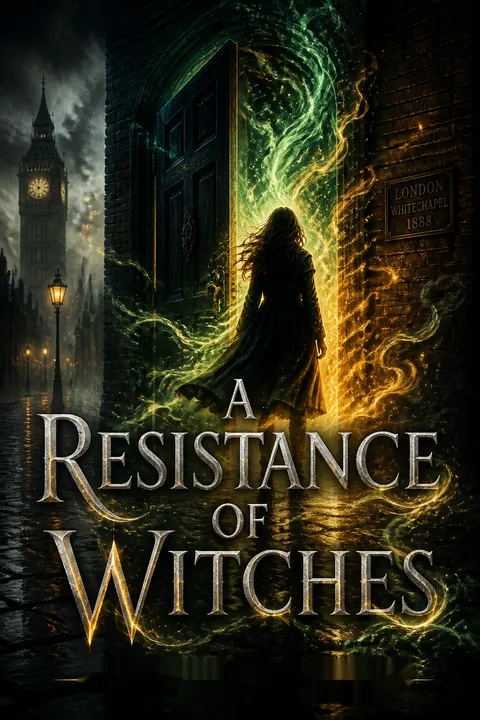


Plot Summary
A Door at Number Ten
In Blitz-scarred London, sixteen-year-old Lydia Polk1 accompanies her new mentor, Isadora Goode,5 to Downing Street. While the two meet Winston Churchill,10 Lydia1 secretly projects herself beyond her body and overhears Isadora5 offer the academy’s witches to Britain’s war effort. Their visions warn that the Nazis will overrun Europe unless the witches intervene.
Isadora5 has made the choice without the high council’s approval, risking the academy’s centuries-long secrecy. On the ride back, she explains that Lydia1 was chosen not for diplomacy but for her stubborn honesty and refusal to abandon a conviction. Lydia1 agrees that the witches should help, though she does not yet know what the decision will demand of her.
The threshold of Number Ten is both political and personal: Isadora crosses from secrecy into public action, while Lydia crosses from student observation into historical responsibility. The wartime decision is framed not as a simple alliance but as a wager made without institutional consent. Isadora’s choice exposes a conflict between protecting a vulnerable community and refusing to let its safety depend on everyone else’s defeat. Lydia’s defining quality is already visible in her answer. She is not persuaded by prestige or command; she judges the decision by the lives at risk beyond the academy’s walls.
The Book of War
By October 1943, Lydia1 is a graduate, Isadora’s5 right hand, and a teacher of projection. On a strained visit to her mother, Evelyn,4 she conceals the academy’s operation, Project Diana, which tracks occult objects coveted by the Nazis. Isadora5 reveals the new target: the Grimorium Bellum, a grimoire rumored to wield destructive magic.
Its last known French hiding place was Château de Laurier, but a recent retrieval attempt failed. The witch who reached the book escaped with only a fragment of a page. Isadora5 believes the Nazis are recruiting magical young women and may try to use the grimoire at the winter solstice. She assigns Lydia1 to locate it first, before a full coven can weaponize it.
The grimoire turns the war’s ordinary race for territory into a struggle over who gets to define the use of power. Its reputation is uncertain, but the consequences of losing it are not. Lydia’s secrecy toward Evelyn also makes the mission intimate: protecting her mother means withholding the very danger that might soon reach her. Project Diana gives Lydia a practical role, yet Isadora’s warning that the council resists the war effort foreshadows a second conflict inside the academy. The clock to the solstice forces Lydia to act before either knowledge or trust is complete.
A Knife in the Circle
At the full-moon ceremony, Lydia1 reaches through Kitty Fraser,8 her best friend and a skilled Glamourer who had secretly tried to retrieve the grimoire in France. Instead of Kitty’s8 memories, Lydia1 senses hunger, terror, and drowning. The woman beside her drops Kitty’s8 appearance, draws a bone-handled dagger, and cuts Isadora’s5 throat.
Lydia1 drives her projection into the attacker, but the witch9 silences the council with a spell and escapes with the page fragment. Lydia1 cannot save Isadora,5 and then finds Kitty8 dead in their suite. As the council discusses funeral arrangements and a successor, Lydia1 demands they pursue the book. When they dismiss the threat, she condemns their cowardice and walks out alone.
The attack destroys more than two lives. It exposes the academy’s belief that instruction and tradition can substitute for experience under fire. Lydia’s projection gives her one decisive move, but it cannot reverse the violence or make the senior witches capable of responding. Her grief becomes anger because the council immediately treats institutional continuity as more urgent than the danger Isadora died confronting. The false Kitty is especially cruel: the familiar face becomes a weapon, and Lydia’s trust is turned against her before she can recognize the change.
The Breach in the Wards
Sybil Winter,6 Lydia’s1 former projection teacher, supports her nomination to replace Isadora5 and urges her to rest. Vivian Osborne,11 the council’s senior Seer, instead offers Lydia1 the position only if she ends Project Diana and withdraws the academy from the war. Lydia1 refuses.
Before the Samhain selection ceremony, she uses a warding manual to inspect the academy’s protective magic and finds a doorway cut through its layers, marked with the same Othala rune as the assassin’s dagger. The breach means someone inside helped the enemy9 enter. Sybil6 tells her the council has already limited the grand mistress’s wartime authority. Facing a hollow title and an unanswered conspiracy, Lydia1 abandons the ceremony and leaves for France.
The damaged warding changes the mystery from an external invasion into an institutional betrayal. Its centuries of interwoven magic represent collective protection, so the deliberate cut is also an attack on shared memory and labor. Vivian’s offer makes leadership conditional on retreat, while the council’s vote strips the title of practical power. Lydia’s departure is not simply impatience: she recognizes that procedure cannot protect anyone if the institution has already been penetrated. By going alone, however, she exchanges political helplessness for physical danger.
The Resistance Driver
On the French coast, Resistance fighter Rebecca Gagne2 is ordered by SOE agent David Harlowe19 to drive a mysterious Englishwoman inland. Lydia’s1 cover story cannot disguise her boarding-school French, so Rebecca2 hides her in the car’s luggage compartment when they reach a militia checkpoint.
After the men inspect the vehicle and let them pass, Rebecca2 assumes Lydia1 is an informant and threatens her with a pistol. Lydia1 vanishes from sight, then freezes Rebecca2 with a spell long enough to take the weapon.
She explains that she is a witch searching for the grimoire, and Rebecca2 agrees to continue to Château de Laurier. There they meet Henry Boudreaux,3 an American art curator who has hidden the Louvre’s evacuated treasures and sent the dangerous book elsewhere.
Rebecca’s habits of suspicion are not a flaw to be corrected but a survival system built under occupation. Lydia’s magic saves them at the checkpoint, yet her use of it against Rebecca repeats the coercive pattern that later becomes central to their conflict. Trust begins here as a practical bargain, not affection: Rebecca believes the mission matters because Hitler’s forces must be resisted, while Lydia has to prove that her strange powers do not make her another threat. Henry’s work protecting art widens the story’s idea of resistance beyond combat.
The Cave of Beasts
At the château, Lydia1 discovers that Henry3 cleansed the room where the grimoire was kept, weakening the magical trail she hoped to follow. He says the book seemed to urge him to read it, then admits he does not know where his mentor René12 took it.
Lydia1 offers to search for René,12 and Henry3 reluctantly lets her use the mark the book left on him. They travel to an ancient cave painted with herds of animals, where its wild magic can amplify her projection. Lydia1 reaches an abandoned farmhouse but cannot establish its location.
The German witch who killed Isadora9 appears through a rival spell, confirms that her coven is real, and claims the Nazis have found the book. Lydia1 returns with clues, including a mezuzah and a child’s drawing signed Jean-Luc.
The cave’s prehistoric paintings place magic outside the academy’s orderly system. Lydia must depend on a landscape and a partner rather than the council’s ritual machinery, and the attempt reveals the cost of treating Henry as a means to an end. The farmhouse clues acquire moral weight through their domestic details: a meal left behind, a child’s drawing, a Jewish marker on a doorway. The enemy’s boast that she has found the book may be a lie, but it weaponizes Lydia’s limited knowledge. The danger now comes from uncertainty as much as from hostile magic.
A Body Beneath the Oak
While Lydia1 returns to her body, Rebecca2 is captured by a German witch9 and a Gestapo officer. Lydia1 projects into Rebecca’s2 cell, recognizes the Othala-marked knife, and guides her to draw a hex-breaking sigil that lets Rebecca2 kill the witch.9
Rebecca2 escapes by disguising herself in the dead woman’s clothes and returns to the château. Henry3 recognizes the farmhouse details from Lydia’s1 projection and leads them north. They find the grimoire hidden beneath the floorboards, then discover René’s12 body by an oak tree.
René12 had hidden the book after its voices began driving him toward harm; his family had already been deported. Rebecca2 recites a Jewish mourning prayer over his grave, and the three leave with the book as its influence presses closer.
The rescue turns Lydia’s projection into a form of solidarity, but Rebecca’s escape depends on her own judgment and willingness to act under coercion. The farmhouse reveals what the grimoire’s abstract danger means in human terms: René tried to resist its influence while the Nazi deportation machinery had already taken his family. Rebecca’s prayer gives the burial a communal dignity René would otherwise have been denied. The book’s power is no longer hypothetical. It has entered a household, distorted a person’s will, and left the survivors carrying both the weapon and its consequences.
Fire Cannot Hold It
At the château, Rebecca2 throws the grimoire into the hearth, but the book forces her body to retrieve it. Lydia1 and Henry3 drag her away as she struggles for breath. Soon Gestapo vehicles surround the building. Lydia1 uses a spell from the grimoire to kill three attackers, but the magic nearly kills her in return.
An academy Traveler, Fiona McGann,7 arrives and takes Lydia1 back to London, leaving Rebecca2 to hold off the remaining soldiers. Rebecca2 burns a valuable art book to distract them, shoots her way out, and drives away wounded. Henry3 has escaped earlier with the grimoire. At a Resistance safe house, Rebecca2 is treated, but her unexplained escape and unmarked body make Claire, her former lover,13 suspect she has collaborated.
The failed attempt to burn the grimoire establishes that the book can defend itself by commandeering a human body, while Lydia’s spell shows that wielding its power exacts an immediate physical price. Rebecca’s stand protects Henry’s escape, but the Resistance’s suspicion makes survival look like guilt. The burned art volume is a costly improvisation, not the grimoire itself; the distinction matters because Henry remains its bearer. Claire’s doubt also turns Rebecca’s old home into another unsafe place, where loyalty must be proven under rules shaped by occupation and betrayal.
The Dead Give Directions
Carrying the grimoire, Henry3 returns to the château and encounters René’s spirit, who directs him toward a farm with a blue door and broken gate. Along the route, the book’s presence draws other dead figures into view, and Henry3 realizes his childhood ability to perceive spirits is returning. At Claire’s13 safe house, Rebecca2 is held under suspicion.
Henry3 arrives with the book, but Claire’s13 men soon imprison both companions. Henry’s mother, Miriam,18 appears as a spirit and steals a key from a guard, opening their way out. In the forest, a dead woman named Hannah possesses the Resistance leader Pierre20 long enough to stop him from killing them. Henry3 promises to check on Hannah’s son, and he and Rebecca2 escape with the grimoire.
Henry’s gift changes from a burden he has spent years suppressing into a means of obligation. The dead do not offer abstract wisdom; René and Miriam provide concrete directions and a key, while Hannah asks him to care for her child. That exchange makes spiritual power relational rather than simply supernatural. Rebecca, meanwhile, experiences another community turning its suspicion into a threat. Their escape succeeds because Henry accepts help from the dead and Rebecca stays beside him, not because either can make the living world trustworthy.
The Mother’s Hidden Power
In London, Lydia1 wakes from weeks of illness unable to use her magic. Evelyn4 reads the cards and recognizes that Lydia’s1 power has been bound. She gives Lydia1 her grandmother’s shield stone, which blocks other projectionists from spying on her. When a young German witch, Gerda Horn,14 watches the flat, Evelyn4 forces her inside and uses a truth powder to learn that the Nazi coven has eleven members.
Gerda14 names the assassin as Ursula Wolfe,9 then reveals that Sybil6 is the coven’s grand mistress and ordered Lydia1 kept alive. Evelyn4 sends Gerda14 to the SOE with a warning and gives Lydia1 a potion to clear Sybil’s6 poison. Lydia,1 devastated by the betrayal, confides the full danger of the grimoire and forms a plan to return to France.
Evelyn’s abilities overturn Lydia’s assumption that academy magic is the only serious kind. Her force and herbal knowledge operate through restraint, observation, and domestic practice, methods Lydia had once dismissed as lesser. The shield stone is protection against surveillance, but it also makes a wider family history available to Lydia. Gerda’s compelled confession exposes the cost of trusting charisma without evidence. Sybil’s betrayal is especially destabilizing because she has occupied both a political and maternal role in Lydia’s life.
A Family Called Together
Knowing the academy may be compromised, Lydia1 asks Fiona7 to take her to France without telling Sybil.6 Fiona7 agrees after revealing that Sybil6 concealed the grimoire’s importance from her during the first extraction attempt.
Evelyn4 prepares healing and protective charms, then helps Lydia1 locate Henry3 by projection. Fiona7 travels with Lydia1 to the Boucher farm, where Henry3 and Rebecca2 have been hiding with the book. Lydia1 reunites with them and begins binding the grimoire to herself, a way to prevent other witches from using it.
Ursula9 tracks Lydia’s1 projection to the farm and arrives with six witches. Fiona7 attacks the intruders, but the German coven overwhelms the group. Lydia’s1 binding shields the book from Ursula,9 who instead captures Lydia,1 Henry,3 and Rebecca2 and takes them to Bavaria.
The title of this section rests on Lydia’s decision to treat family as a source of power rather than a private weakness. Evelyn’s help, Fiona’s choice to distrust authority, and Henry and Rebecca’s presence form a fragile alliance outside the academy’s chain of command. Binding the book is a protective act that also makes Lydia vulnerable: she ties her own life to the object she intends to destroy. The raid demonstrates that secrecy alone cannot keep this improvised family safe, but cooperation gives them a chance to resist.
Sybil’s Golden Age
In a Bavarian castle, Sybil6 keeps Lydia1 inside a room whose carved wards suppress magic. She admits that she helped Ursula9 enter the academy and arranged Isadora5 and Kitty’s8 murders, then explains why: she believes alliance with Hitler will restore witches to public power. Sybil6 sees the Nazi leader as a tool, not a master, and expects Lydia1 to become grand mistress of the British academy while she builds the German coven.
Evelyn4 is also imprisoned, and Sybil6 tries to persuade Lydia1 that the two of them can create a world where witches no longer hide. Lydia1 recognizes that Sybil6 means to control her, not liberate her. Meanwhile, Henry3 and Rebecca2 escape their underground cell with help from Miriam’s spirit.
Sybil’s argument is coherent enough to be dangerous: she identifies real histories of persecution, then uses those wounds to justify a future built on racial hierarchy and mass violence. Her betrayal does not arise from ignorance of Hitler’s brutality; she treats it as an acceptable instrument. Lydia’s refusal therefore requires more than choosing Britain over Germany. She must reject the premise that safety for one group can be purchased by abandoning everyone outside it. Miriam’s help gives the captives a route out, but not yet a way to reach Lydia.
The Oath and the Chase
Lydia1 pretends to accept Sybil’s6 offer, then takes the oath joining the German coven, concealing her plan to destroy the grimoire. At the castle’s solstice gathering, Sybil6 prepares her for the Unmaking spell. Henry3 and Rebecca,2 meanwhile, escape into the Bavarian woods as Ursula9 hunts them. Henry’s3 returning spirit-sight lets him recognize Miriam,18 Rebecca’s mother,18 among the dead.
Miriam18 enters Henry’s3 body and shields Rebecca2 from Ursula’s9 spells. Because the dead are beyond the reach of magic aimed at the living, Miriam18 strikes Ursula9 with a rock and throws her over the falls. The pair return toward the castle. Their escape buys Lydia1 a chance to act, but Ursula’s9 fate is uncertain and the solstice ritual is already beginning.
Lydia’s oath is a performance under coercion, yet it matters because the ritual treats vows as binding acts. She has to inhabit the language of allegiance without surrendering her judgment. Henry’s possession by Miriam similarly depends on consent; unlike the Nazi witches’ control spells, he chooses to share his body. That contrast gives the supernatural plot an ethical distinction between collaboration and domination. The escape does not erase the danger. It only changes who has agency for a few crucial moments.
The Unmaking Turns Back
At the solstice, Lydia1 leads the Witches of the Third Reich into the Unmaking spell and names their coven as its target. The grimoire consumes the witches one by one, leaving Sybil6 alive to face the consequences. Ursula9 returns from the falls and attacks Lydia1 before Evelyn’s4 protective potion can stop her. Lydia1 kills Ursula,9 but Sybil6 breaks free and stabs Evelyn4 in the back.
As Evelyn4 dies in Lydia’s1 arms, the grimoire offers Lydia1 enough power to save her if she will surrender to it. Lydia1 refuses. The book takes hold of her instead, turning its shadow toward the blood on the floor. When Henry3 and Rebecca2 enter the chamber, they find Lydia1 standing over ash and bodies, speaking with the book’s hunger in her voice.
The Unmaking defeats the Nazi coven through the very instrument it meant to wield, but victory does not produce moral cleanliness. Lydia has chosen a devastating spell, and the book immediately treats that violence as permission to demand more. Evelyn’s death tests whether grief will become another justification for absolute power. Lydia refuses the bargain that might save her mother, preserving her ethical boundary at the most intimate possible cost. The scene then makes possession visible: the political weapon is no longer merely in the room; it is speaking through its wielder.
Ash at Last
Rebecca2 distracts the grimoire-controlled Lydia1 while Henry3 restrains her, then tears the book away and forces it into the fire. The effort nearly kills Rebecca,2 but the book’s grip on Lydia1 loosens. Lydia1 resumes the Unmaking spell, this time without the German coven.
Henry3 opens the doors of his mind to the spirits of Lydia’s family and friends, including Evelyn,4 Isadora,5 and Kitty,8 whose joined voices help carry the spell. Lydia1 names the Grimorium Bellum itself as the target, and the book crumbles into ash. Sybil6 survives, bound for trial before the high council. Lydia1 says goodbye to her mother’s spirit and chooses to return Sybil6 to the academy to answer for her crimes.
The final destruction is possible only because each character contributes a different form of resistance. Rebecca acts through physical courage, Henry through a spiritual openness he once feared, and Lydia through the magic she has learned to direct without surrendering to the book. The ancestral chorus reframes family as a continuing relation across death, not a supernatural shortcut around grief. Lydia does not recover what the war has taken; she gains the ability to stop the weapon from taking more. Keeping Sybil alive preserves accountability where revenge would end the inquiry.
Epilogue
On Victory in Europe Day, Lydia1 returns to Downing Street as grand mistress1 and walks through a city celebrating the end of the war. She and Fiona7 discuss new missions, including the search for missing German officers, while Lydia1 plans a journey to New Orleans.
Rebecca2 is alive and working elsewhere, still pursuing the fight on her own terms. The women move through the celebrating crowd together, letting grief and relief coexist. Then they vanish from a little girl’s sight, leaving behind only the impression of rain beneath a clear sky.
The return to Number Ten closes the book’s political circle without pretending that victory repairs every loss. Lydia now stands inside the public world Isadora once entered, but her work continues beyond the formal end of the war. Fiona’s future missions and Rebecca’s continued resistance suggest that justice will require more than a celebration or a surrender. The little girl’s glimpse of the women preserves magic as something that can pass through ordinary life without being recognized. Lydia’s authority is therefore not an escape from secrecy, but a chance to decide when secrecy protects and when it abandons others.
Analysis
The novel sets two forms of resistance against one another. Isadora5 and Lydia1 act to prevent a fascist victory, while Sybil6 argues that witches can escape persecution by aligning themselves with a power strong enough to remake society. Sybil’s6 history contains genuine injuries, but her response converts those injuries into permission to sacrifice people outside her chosen group. The book’s central political question is therefore not whether witches deserve safety, but whether safety purchased through domination can be called liberation.
Magic gives that question bodily consequences. Projection crosses into other minds; glamour turns identity into both disguise and vulnerability; the grimoire can override the will of those who touch it. The book is not only dangerous because of its spells. It offers the emotionally persuasive fantasy that sufficient force can make loss stop. Lydia1 comes closest to accepting that offer after Evelyn’s4 death, when the desire to end all suffering begins to resemble the book’s hunger. Her refusal depends on the people around her, not on purity of will alone.
The relationships are also competing models of power. Rebecca2 distrusts authority because institutions and collaborators have repeatedly failed her. Henry3 tries to close the doors through which the dead enter, until he learns that boundaries can be chosen rather than imposed. Evelyn’s4 hedge magic and the family spirits challenge the academy’s hierarchy of valuable knowledge. Together, the characters create a form of collective action that differs from both Sybil’s6 authoritarian coven and the council’s defensive isolation.
The ending refuses to equate victory with restoration. Lydia1 destroys the weapon, but loses her mother;4 the dead help her act, then depart. She becomes a leader capable of continuing the work, while grief remains present in the celebrations of 1945. The novel’s answer is not that power can prevent every loss. It is that power becomes defensible when it remains answerable to other people, limits its own reach, and refuses to turn pain into a warrant for unlimited violence.
Review Summary
A Resistance of Witches is a highly praised debut novel blending historical fiction and fantasy. Set during WWII, it follows Lydia, a young witch battling Nazi forces to find a powerful grimoire. Readers commend the well-developed characters, intricate magic system, and seamless integration of historical elements. The book is praised for its fast-paced action, emotional depth, and exploration of themes like grief and family relationships. While some found certain plot elements predictable, most reviewers were captivated by the unique premise and strong writing, eagerly anticipating future works from the author.
People Also Read









Characters
Lydia Polk
The stubborn projectionistLydia is a young witch trained at the Royal Academy, gifted at projection and unsparing in her judgments. She is exacting about appearances, often maintaining a glamour that makes her look more conventionally pretty, and equally exacting about right and wrong. Her bluntness can alienate people, but it also makes her difficult to manipulate once she recognizes a moral line. She loves her friends and mentor deeply, though secrecy strains her bond with her mother4. Lydia’s central struggle is not whether she can wield power, but whether she can act decisively without allowing grief or urgency to make cruelty seem necessary.
Rebecca Gagne
The relentless Resistance fighterRebecca is a French Resistance fighter who survives through discipline, suspicion, and a willingness to make hard choices quickly. She is skilled behind the wheel and with a gun, but her toughness covers grief she rarely allows herself to share. Occupation has made her wary of strangers and uncompromising toward anyone she believes has betrayed the cause. She is Jewish, a fact she keeps private in a world where disclosure can be dangerous. Rebecca’s instinct is to keep moving, yet her loyalty to people in danger repeatedly draws her into risks she cannot dismiss as someone else’s problem.
Henry Boudreaux
The curator who hears the deadHenry is an American curator protecting art evacuated from the Louvre. Thoughtful and observant, he values preservation because he has seen how power claims the right to decide what deserves to exist. As a Black man in occupied France, he navigates danger shaped by both Nazi rule and racism. He has long tried to close himself off from the spirits he perceives, fearing their demands and the loss of control they bring. His quiet steadiness makes him a careful ally, although his reluctance to expose his own gifts leaves him isolated until the people he cares about need him.
Evelyn Polk
Lydia’s formidable motherEvelyn is an herbalist and fortune-teller whose cluttered Hackney home stands in contrast to the academy’s polished grandeur. She loves Lydia1 fiercely but has struggled to understand why her daughter1 chose institutional magic over the family’s older practices. Her humor, practical intelligence, and willingness to speak plainly make her more formidable than Lydia1 initially realizes. Evelyn respects privacy as well as intimacy, and she understands that care does not mean controlling another person. Her knowledge joins domestic experience with powerful magic, challenging Lydia’s1 assumption that the academy holds the only legitimate form of witchcraft.
Isadora Goode
The daring grand mistressIsadora leads the Royal Academy of Witches with political skill, personal style, and a willingness to challenge traditions that have outlived their purpose. She understands influence and uses it to build alliances, but she does not confuse charm with moral courage. As Lydia’s1 mentor, she recognizes that her apprentice’s stubbornness can serve a larger purpose, even when it makes Lydia1 difficult to guide. Isadora is protective of the academy yet unwilling to treat isolation as safety. Her choices force those around her to confront what responsibility means when a hidden community is threatened by a wider catastrophe.
Sybil Winter
The beloved projection teacherSybil is a warm, encouraging teacher who gives Lydia1 confidence in projection and offers the motherly attention Lydia1 often lacks at the academy. She has known Isadora5 since girlhood and moves comfortably within the institution’s politics. Sybil’s gentleness makes her easy to trust, while her experience gives her an apparent authority that younger witches rely on. She is also shaped by a family history of migration and persecution, which informs her strong beliefs about the dangers witches face. Her calm manner can soothe a crisis, though it can also make her difficult to read.
Fiona McGann
The precise academy TravelerFiona is an accomplished Traveler and Glamourer, admired for her competence and immaculate composure. She and Kitty8 have long disliked one another, leaving Lydia1 caught between a close friend and a capable colleague. Fiona prefers evidence to sentiment and keeps most people at a careful distance. That reserve can look like vanity, but it also reflects her fear of making consequential mistakes. When she questions the academy’s leadership, she risks the standing she has spent years earning.
Kitty Fraser
Lydia’s dazzling best friendKitty is a Scottish witch with a gift for Glamour, a quick wit, and a talent for turning danger into an audacious performance. She is Lydia’s1 closest friend and often softens Lydia’s1 seriousness with teasing and affection. Kitty is bold in the field but uncomfortable with formal ceremony, where rules and scrutiny leave her restless. Her ease with disguises is both a professional strength and a reminder that people often see what they expect to see. She values friendship enough to take risks without demanding recognition for them.
Ursula Wolfe
The German witch hunterUrsula is a powerful German witch who combines Glamour, projection, and travel, making her unusually difficult to predict or contain. She is fiercely loyal to her coven and especially protective of the young witch Margot15. Her hostility toward Lydia1 is shaped by both political allegiance and personal grievance. Ursula has endured a childhood marked by fear and violence, but her suffering has not made her merciful. She uses magic as an instrument of control and sees hesitation as weakness.
Winston Churchill
Britain’s wartime prime ministerChurchill receives Isadora5 at Downing Street when Britain’s war effort is under severe pressure. He is wary of the witches’ offer, aware that their community has kept its existence from him, but he listens to Isadora’s5 warning about the scale of the Nazi threat. His role connects the academy’s hidden world to the government’s public war, without granting witches automatic trust or recognition.
Vivian Osborne
The academy’s senior SeerVivian is an elderly member of the high council whose authority comes from long service and a reputation for foresight. She is guarded, skeptical of Isadora’s5 intervention in the war, and deeply protective of the academy’s traditions. Vivian believes witches have ample reason to distrust the country that has historically persecuted them. Her severity can sound cruel, especially to Lydia1, but it grows from a political logic centered on institutional survival.
René Dreyfus
Henry’s mentor and curatorRené is an experienced Louvre curator who becomes a mentor and chosen family to Henry3. He helps preserve art threatened by Nazi seizure and destruction, taking responsibility for objects that cannot defend themselves. His affection for Henry3 is expressed through practical care, opportunities, and trust. René is also connected to a French Jewish family caught in the machinery of deportation, grounding the story’s magical conflict in the occupation’s human losses.
Claire
Rebecca’s former partnerClaire leads a Resistance group with discipline and little patience for uncertainty. She and Rebecca2 share a history of love, conflict, and political work, but their closeness has been damaged by grief and anger. Claire’s rules about captured fighters come from the real danger of informants and torture, yet those rules leave little room for trust. Her authority is tested when Rebecca2 returns with a story that sounds impossible.
Gerda Horn
The young German TravelerGerda is a teenage witch serving the German coven as a Traveler. She is proud, combative, and determined to protect her companions from interrogation. Her childhood was marked by abandonment and violence, leaving her vulnerable to anyone who offers structure and belonging. She reflects the danger of recruiting young people whose magical abilities have never been safely understood or taught.
Margot
Ursula’s fanatical coven sisterMargot is a young German witch whose exceptional power emerged before her family knew how to help her. Sybil6 took her in and trained her, giving her a place in the German coven. Margot’s intensity and cruelty are presented alongside a childhood shaped by fear, a history that explains her vulnerability without excusing the harm she inflicts.
Ingrid
A senior German witchIngrid is a member of Sybil’s6 coven, known for a harsh temperament and a history of religious abuse. She uses her magic to inflict pain and serves as one of the coven’s enforcers. Her damaged eye bears physical evidence of a childhood in which her own abilities were punished rather than taught.
Fabienne Boudreaux
Henry’s Vodou-practicing motherFabienne raised Henry3 in New Orleans within a lively spiritual community, teaching him that he could set boundaries with the spirits he encountered. She treats the unseen as part of ordinary life rather than a source of shame. Her practical guidance gives Henry3 a way to understand his gift, even after he leaves home and tries to shut it away.
Miriam Gaiser
Rebecca’s missing motherMiriam is Rebecca’s mother2, remembered as protective, affectionate, and attentive to the small rituals that comfort a frightened child. Her presence remains important to Rebecca2 even after the family is torn apart by Nazi persecution. Through Henry’s3 spiritual gift, she becomes more than a memory, carrying a maternal bond that reaches beyond Rebecca’s2 knowledge.
David Harlowe
The SOE field officerDavid is an English SOE officer who arranges covert routes and supplies for Resistance operations in France. He brings Rebecca2 into Lydia’s1 mission without explaining everything he knows, reflecting the secrecy and compartmentalization of wartime intelligence.
Pierre
Claire’s imposing Resistance allyPierre is a large, controlled member of Claire’s13 Resistance network. He prefers calm authority to shouting and believes harsh decisions may be necessary to protect the group. His confidence in the network’s rules makes him a danger to Rebecca2 and Henry3 when their explanation sounds implausible.
André
The compromised Resistance contactAndré is a Resistance contact whose carelessness and weak commitment make him a risk to others. His connection to Roger22 gives Rebecca’s2 return to Claire’s13 group an immediate political cost, since the two men remember him very differently.
Roger
The suspicious young maquisardRoger is a member of Claire’s13 group and André’s cousin21. He takes Rebecca’s2 survival as evidence against her and turns grief for his cousin21 into hostility. His distrust escalates quickly into personal menace, complicating the group’s claim to be a refuge.
Plot Devices
Grimorium Bellum
The living weaponThe Book of War is an ancient grimoire whose spells include famine, plague, despair, and a force that can consume named targets. It leaves a magical mark on anyone who touches it, allowing Lydia1 to track it, and it can resist attempts to destroy it by seizing control of nearby bodies. Its attraction is not limited to witches: Henry3 senses its demands, and René12 is eventually driven to harm himself. The book makes the desire to end a war inseparable from the risk of becoming an agent of indiscriminate destruction.
Projection and tracking
Finding what is hiddenA Projectionist can leave her body and search through magical traces, memories, and places linked to an object or person. Lydia1 uses fragments of the grimoire’s influence on Kitty8, Henry3, and the page scrap to locate it, and later projects into Rebecca’s2 prison cell to help her escape. The ability is powerful but limited by fatigue, distance, and the strength of the connection. It can also expose private memories, turning tracking into an intimate act that requires trust as well as skill.
The shield stone
A guard against spyingMade by Lydia’s1 grandmother, the shield stone blocks other projectionists from following her movements. Evelyn4 gives it to Lydia1 after recognizing that someone has bound her magic and may be watching her. The protection also imposes a cost: Lydia1 cannot project freely while wearing it. The stone turns privacy into a tactical resource, allowing Lydia1 to hide her return to France while reminding her that surveillance in this world can cross the boundary between bodies and minds.
The family dead
Guidance across the veilHenry’s3 ability to perceive and eventually invite spirits into his awareness links the living characters to people lost in war and occupation. René12 guides Henry3 toward a hiding place, Miriam18 helps prisoners escape, and Hannah asks Henry3 to protect her child. The spirits cannot simply solve every problem; their help depends on recognition, consent, and a living person willing to accept responsibility. Their presence makes grief active rather than decorative, since the dead remain connected to unfinished obligations among the living.
The Unmaking
Naming a target for destructionThe grimoire’s most dangerous spell allows its caster to name a target and unleash a force that consumes it. Lydia1 first uses the spell against the German coven, then recognizes that the same magic can be turned against the book itself. The casting requires tremendous power and risks consuming its user. Its structure makes language an instrument of judgment: whoever names the target decides who or what the violence will reach, and the spell offers no easy way to separate justice from annihilation.
Download PDF
Download EPUB
.epub digital book format is ideal for reading ebooks on phones, tablets, and e-readers.








