

Key Takeaways
Build a whole mind: pair analytical precision with human interpretation
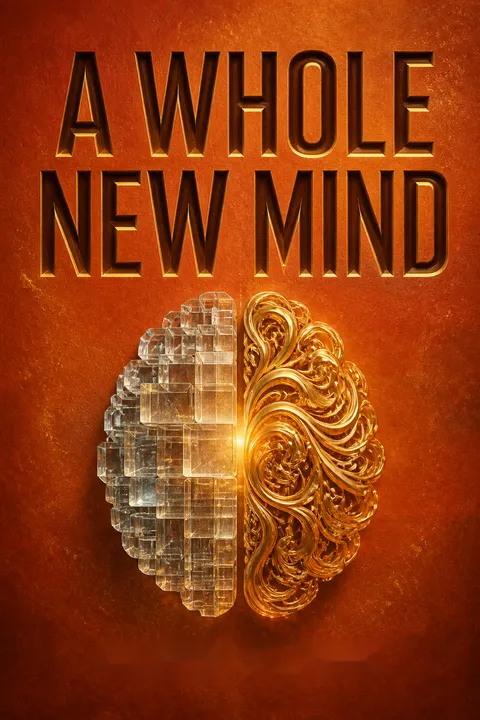
Two modes, one mind. Pink contrasts L-Directed Thinking, which handles sequence, language, and analysis, with R-Directed Thinking, which is stronger at context, emotion, and synthesis. His brain-scan account illustrates the contrast: interpreting facial expressions leaned more on right-hemisphere processes, while understanding threatening scenes called on more left-hemisphere analysis. The point is not that one side should take over. Both contribute to ordinary thought.
A cultural correction. Pink argues that schools and organizations have rewarded measurable, analytical skills while treating artistic judgment and emotional understanding as secondary. Those skills still matter, but they are incomplete on their own. The book uses the hemispheres as a metaphor for balancing capabilities, not as a claim that people are simply left-brained or right-brained.
The useful move is away from a false choice between rigor and imagination. Analysis can test whether an idea works; context and empathy can reveal whether it addresses the right problem. The brain metaphor makes that complementarity memorable, but it can also tempt readers into treating complex abilities as separate brain departments. The strongest practical reading is therefore behavioral: cultivate both close inspection and whole-situation judgment, rather than trying to identify a personal hemisphere type.
Ask whether your work is cheaper overseas, faster by software, or still distinctive
Three pressures reshape work. Pink names them Abundance, Asia, and Automation. Abundance gives consumers many affordable choices, so basic function is less likely to distinguish a product. Globalization lets companies move routine knowledge work to skilled workers in lower-cost regions. Automation lets software handle repeatable tasks once performed by professionals. Together, these forces weaken the value of work that is standardized, rule-based, and easy to compare.
Use a task-level test. Pink proposes asking whether someone elsewhere can do the work for less, whether a computer can do it faster, and whether customers still want it amid abundant alternatives. In the book's 2004 context, he cites a projection that 3.3 million U.S. service jobs and $136 billion in wages could move offshore by 2015. His answer is to strengthen capabilities that are harder to routinize: solving novel problems, building relationships, and seeing the larger picture.
This framework is strongest as a diagnostic for tasks, not a prediction that whole professions vanish. A lawyer or physician may do routine work that software can standardize while also handling ambiguous human situations that resist a checklist. That distinction points toward redesigning jobs, not merely retraining individuals. The framework also has a limit: workers cannot personally solve every disruption caused by trade or technology. Institutions and employers shape whether displaced expertise is supported or simply discarded.
Treat design as utility made meaningful, not decoration added afterward
Function needs feeling. Pink defines design as more than making an object attractive. Good design joins usefulness with significance: a product should work, but it can also communicate identity, pleasure, or care. In a crowded market, affordability and reliability may be only the entry ticket. A distinctive form or experience can help a product stand out and make ordinary surroundings more rewarding.
Bad design has consequences. At Philadelphia's Charter High School for Architecture and Design, students used design projects to connect art with subjects such as history and mathematics. Pink also points to the confusing butterfly-shaped ballot used in Palm Beach County during the 2000 U.S. presidential election. Its layout was associated with many mistaken or invalid votes. These examples show that design affects learning and public decisions, not just shopping preferences.
Design becomes most consequential when it is treated as a way of structuring choices. A ballot, a classroom, or a medical form directs attention before anyone reads the fine print. That gives designers real responsibility: elegance is not enough if a system confuses or excludes its users. The butterfly ballot makes the stakes vivid, although attributing a national election result to one design is more definitive than the evidence can comfortably support. The broader lesson is sound: usability is a civic value.
Turn abundant facts into stories people can understand and remember
Narrative supplies context. Pink argues that information is increasingly easy to retrieve, while the ability to make it meaningful is harder to automate. A fact can establish what happened; a story connects events, motives, and consequences. The contrast appears in his midbook quiz: readers are more likely to remember the story of chess champion Garry Kasparov facing a computer than an isolated statistic about jobs moving overseas.
Stories can improve practice. Physician Rita Charon developed narrative medicine, which asks doctors to attend to a patient's account of illness and life, not only a list of symptoms. Her students kept both a conventional medical chart and a parallel narrative record. The aim was not to replace diagnosis with anecdote, but to understand clinical information in the context of a person's experience. Businesses, too, can use employee stories to communicate knowledge that formal reports may miss.
Narrative is a powerful compression tool: it helps an audience see why a detail matters and how one event leads to another. In medicine, that can make the patient's priorities visible; in organizations, it can preserve practical knowledge that never enters a manual. Yet stories also persuade by selecting and arranging facts. A compelling account can conceal missing evidence or imply a causal link that has not been shown. Narrative works best alongside verification, not as a substitute for it.
Practice synthesis: connect fields, patterns, and overlooked relationships
See relationships, not just parts. Pink calls the ability to connect ideas across domains Symphony. It includes recognizing patterns, combining unlike elements, and understanding how components work together. In a drawing class based on Betty Edwards's method, Pink learned to see proportions, shadows, and the empty space around a face rather than rely on familiar symbols for eyes or lips. The exercise made observation a practice in relationships.
Crossing boundaries creates options. Pink describes boundary crossers who draw on expertise from more than one field, inventors who recombine existing ideas, and metaphor makers who explain one subject through another. A skier named John Fabel, for example, adapted the structure of a suspension bridge to improve a backpack. The larger skill is not knowing every detail. It is noticing a useful connection that specialists working within one narrow frame might miss.
Synthesis is not a rejection of expertise. Strong combinations usually depend on knowing enough about each component to recognize what can be joined and what cannot. The practical advantage of a broad perspective is that it expands the set of possible solutions before a team settles on the familiar one. But breadth can become shallow novelty if it is not paired with testing. An inspired analogy is a beginning, not proof that the borrowed solution will work in its new setting.
Listen for the person behind the data, especially when rules seem sufficient
Empathy means feeling with. Pink distinguishes empathy from sympathy: sympathy is concern for another person, while empathy involves imagining that person's perspective and responding to it. He emphasizes that emotion is often conveyed through facial expression, tone, and other nonverbal signals, not just words. The book discusses Paul Ekman's research on facial expressions and the difficulty people can have detecting concealed feelings.
Listening can change a decision. Pink recounts two postal workers who sought care during an anthrax scare. One doctor followed standard guidance and sent a patient home; another listened when a worker described the exposure, ordered further action, and kept him at the hospital. The patient had anthrax. The example shows how attention to a person's account can prompt a clinician to reconsider a routine response. Empathy complements technical skill; it does not replace it.
Empathy is especially valuable when a person's stated concern carries information that a standard form does not capture. It can improve service by prompting better questions and more responsive decisions. But reading a face is not the same as knowing what someone feels. Nonverbal cues can be ambiguous, and confident interpretation can become projection. The most reliable empathic habit is therefore not to guess silently, but to notice, check, and invite correction. Attunement works best when paired with humility.
Use play to rehearse complexity, loosen thinking, and strengthen collaboration
Play has serious uses. Pink describes the U.S. Army's video game America’s Army, designed to give prospective recruits a virtual experience of missions and teamwork. He also cites studies associating video-game play with improved visual attention and fewer errors in laparoscopic surgery among doctors who played regularly. Games can require players to notice patterns, manage multiple signals, and adapt as situations change.
Humor and joy matter, too. In Mumbai, physician Madan Kataria organized laughter clubs where people practiced laughing together without relying on jokes. Pink presents laughter as a social activity that can encourage connection and reduce stress. He also argues that humor can help managers communicate and reveal tensions inside an organization. Play is not a cure-all: jokes can exclude, games can consume time, and forced fun can backfire. Its value depends on purpose and setting.
Play creates a low-stakes space for experimenting with choices and seeing consequences, which can make learning more active than passive instruction. Shared humor can also soften status differences and help a group speak honestly. But play cannot be prescribed as a universal productivity hack. A game imposed on employees may feel like another demand, and humor aimed downward can reinforce hierarchy. The important distinction is between play that grants people room to explore and entertainment used to disguise a lack of autonomy.
Measure prosperity by purpose and attention, not accumulation alone
Comfort does not settle the question. Pink argues that material abundance can free people from some daily struggles without answering what makes life worthwhile. He draws on psychiatrist Viktor Frankl, who developed logotherapy, an approach centered on the human search for meaning. Frankl's experience in Nazi concentration camps informed his claim that people can seek purpose even under extreme suffering, although suffering is not required for a meaningful life.
Put values into practice. Psychologist Martin Seligman's framework distinguishes a Pleasant Life, rich in positive feelings; a Good Life, using personal strengths in absorbing work; and a Meaningful Life, putting those strengths in service of something larger. Pink's labyrinth example offers a counterimage to frantic problem-solving: a winding path walked slowly for reflection. A practical test is to compare stated priorities with how time is actually spent.
Meaning is not a luxury item to purchase after success; it is a way of organizing choices around what deserves commitment. That makes the time-audit especially concrete: values become visible in calendars, not merely in declarations. Still, the language of purpose can be misused if it implies that material hardship is simply a failure of perspective. Meaning can help people interpret difficulty, but it does not remove the need for security, fair treatment, or practical support.
Analysis
Pink's central argument is best understood as a shift in the composition of valuable work, not the arrival of a world without analysis. He gives readers a memorable explanation for why rote information processing loses advantage when software and global labor markets can reproduce it cheaply. The alternative is not vague creativity, but a cluster of capacities: noticing context, making useful connections, communicating through narrative, and responding to other people as people. The book's six senses turn that claim into a practical vocabulary that spans business, education, medicine, and private life.
Its strongest method is storytelling. The brain-scan opening gives a physical image to the book's contrast, while the cases of the classroom design program, the physician who listens, and Frankl's search for meaning translate abstraction into human consequence. Those stories make the framework easy to carry into new situations. They illustrate possibilities, however, rather than proving that a single economic transformation explains every example.
The framework also needs careful handling. Pink explicitly treats hemispheric difference as metaphor, yet the left-brain and right-brain labels can still suggest a sharper biological division than the argument requires. His offshoring estimates are projections from the book's 2004 setting, not timeless measurements. More broadly, creative work is not automatically secure, and caring work is not automatically rewarded. The value society assigns to a skill and the pay it gives for that skill are separate questions.
The most durable application is to inspect tasks rather than label people or occupations. Identify which parts of a job are routine, which require judgment in a novel situation, and which depend on trust, interpretation, or taste. Then develop the human capacities that complement technical competence. Pink's case is persuasive when it argues for integration: analysis without context is brittle, while imagination without evidence is unreliable. A whole mind needs both.
Review Summary
A Whole New Mind argues that right-brain skills like creativity and empathy will be crucial in the future economy. Many readers found the book insightful and inspiring, praising Pink's accessible writing style and practical suggestions. However, some critics felt the arguments were simplistic or lacked substantial evidence. The book's emphasis on right-brain thinking resonated with creative professionals, while others found it overly focused on a Western perspective. Overall, reactions were mixed, with some viewing it as a thought-provoking guide and others dismissing it as pop psychology.
People Also Read







Glossary
L-Directed Thinking
Sequential analytical thinkingPink's term for a thinking style associated metaphorically with the left hemisphere. It emphasizes sequence, literal language, functional reasoning, and analysis of details. In the book, it describes the dominant approach of the Information Age, especially work that applies learned knowledge to defined problems. Pink argues that it remains necessary but is no longer sufficient by itself.
R-Directed Thinking
Contextual synthetic thinkingPink's term for a thinking style associated metaphorically with the right hemisphere. It emphasizes context, simultaneous perception, emotional understanding, aesthetic judgment, and synthesis. The book presents it as increasingly valuable when routine analysis can be automated or outsourced. It is meant to complement, not replace, L-Directed Thinking.
Conceptual Age
An era valuing human interpretationPink's name for an emerging economic and social period in which creators, empathizers, pattern recognizers, and meaning makers gain importance. He argues that abundance, globalization, and automation reduce the advantage of routine analytical work while increasing demand for design, narrative, synthesis, empathy, play, and purpose.
High concept and high touch
Inventive and empathic capacitiesPink's paired description of abilities he sees as central to the Conceptual Age. High concept includes recognizing patterns, creating beauty, shaping narratives, and combining ideas. High touch includes empathy, understanding human interaction, fostering joy, and seeking purpose. Together they describe the creative and relational capacities that complement technical and analytical skill.
The Six Senses
Six capacities for modern lifePink's framework for developing abilities he believes are valuable in work and life: Design, Story, Symphony, Empathy, Play, and Meaning. Each sense addresses a limitation of relying only on function, argument, specialization, logic, seriousness, or material accumulation. The framework is presented as a set of learnable human aptitudes rather than a fixed personality type.
Symphony
Connecting ideas into wholesPink's term for the ability to synthesize rather than merely analyze. It involves recognizing patterns, relating apparently separate fields, combining existing ideas in new ways, and seeing how parts fit into a larger system. He illustrates it through boundary crossing, invention, metaphor, and the capacity to grasp the big picture.
narrative competence
Understanding and responding to storiesA term used in the book's discussion of narrative medicine, associated with physician Rita Charon. It means the capacity to absorb, interpret, and respond to stories. For doctors, this includes hearing a patient's account, understanding its significance, and considering medical facts within the context of that person's life.
logotherapy
Therapy centered on meaningViktor Frankl's approach to psychotherapy, named from the Greek word logos, meaning meaning. It treats the search for meaning as a fundamental human motivation. Frankl developed the approach before his imprisonment and drew on his experience in concentration camps to describe how people may find purpose even amid severe suffering.
FAQ
What's "A Whole New Mind" about?
- Conceptual Age Shift: "A Whole New Mind" by Daniel H. Pink explores the transition from the Information Age to the Conceptual Age, where right-brain qualities like creativity and empathy become crucial.
- Right-Brain Dominance: The book argues that the future belongs to those who can harness right-brain skills such as design, storytelling, and symphony.
- Economic and Personal Impact: Pink discusses how these changes will affect both the economy and personal fulfillment, emphasizing the need for a whole new mind to thrive.
Why should I read "A Whole New Mind"?
- Future Preparation: The book prepares readers for the evolving job market where right-brain skills are increasingly valued.
- Holistic Development: It offers insights into developing a balanced mind that combines analytical and creative thinking.
- Practical Guidance: Pink provides practical advice and exercises to cultivate the six essential senses needed in the Conceptual Age.
What are the key takeaways of "A Whole New Mind"?
- Six Essential Senses: The book identifies six key aptitudes—Design, Story, Symphony, Empathy, Play, and Meaning—that are crucial for success.
- Shift in Skills Demand: There is a growing demand for skills that computers and low-cost overseas workers cannot replicate.
- Integration of Thinking Styles: Success requires integrating left-brain analytical skills with right-brain creative abilities.
What are the six senses discussed in "A Whole New Mind"?
- Design: Beyond function, design emphasizes beauty and emotional engagement.
- Story: The ability to craft compelling narratives is essential for persuasion and understanding.
- Symphony: This involves synthesizing information and seeing the big picture.
- Empathy: Understanding and sharing the feelings of others is crucial in personal and professional settings.
- Play: Incorporating humor and joyfulness can enhance creativity and productivity.
- Meaning: Pursuing purpose and spiritual fulfillment is vital in an age of abundance.
How does Daniel H. Pink define "Design" in "A Whole New Mind"?
- Utility and Significance: Design is about creating solutions that are both functional and meaningful.
- Democratization of Design: Good design is now accessible to more people, influencing everyday life and business.
- Business Differentiation: In a crowded market, design is a key differentiator for products and services.
What role does "Story" play according to "A Whole New Mind"?
- Memory and Understanding: Stories are easier to remember and help us understand complex information.
- Business Application: Storytelling is a powerful tool for persuasion and differentiating products in the market.
- Personal Fulfillment: Crafting and understanding stories can lead to a deeper sense of meaning and connection.
What is "Symphony" in the context of "A Whole New Mind"?
- Synthesis Over Analysis: Symphony involves seeing relationships and integrating diverse elements into a cohesive whole.
- Boundary Crossing: It requires the ability to operate across different disciplines and perspectives.
- Big Picture Thinking: Recognizing patterns and understanding the broader context are key components.
How does "Empathy" contribute to success in "A Whole New Mind"?
- Emotional Intelligence: Empathy involves understanding others' emotions, which is crucial for effective communication and leadership.
- Nonverbal Cues: Reading facial expressions and body language is a significant aspect of empathy.
- Professional Relevance: Empathy is increasingly important in fields like medicine and law, where understanding clients and patients is essential.
What is the significance of "Play" in "A Whole New Mind"?
- Joy and Creativity: Play encourages creativity and innovation, making work more enjoyable and productive.
- Humor in Leadership: Humor is linked to emotional intelligence and effective management.
- Games as Learning Tools: Video games can enhance problem-solving skills and teach complex systems thinking.
How does "Meaning" fit into the framework of "A Whole New Mind"?
- Pursuit of Purpose: Meaning involves seeking purpose and fulfillment beyond material success.
- Spiritual and Emotional Health: Engaging with spirituality and gratitude can improve well-being and life satisfaction.
- Cultural Shift: There is a growing societal focus on meaning and self-expression in the Conceptual Age.
What are the best quotes from "A Whole New Mind" and what do they mean?
- "The future belongs to a very different kind of person with a very different kind of mind." This quote emphasizes the shift towards valuing right-brain skills.
- "Design is a classic whole-minded aptitude." It highlights the importance of integrating function with beauty and significance.
- "Empathy is the ultimate virtual reality." This underscores the power of empathy to connect us deeply with others' experiences.
How can I apply the concepts from "A Whole New Mind" in my life?
- Develop the Six Senses: Engage in activities and exercises that enhance design, storytelling, symphony, empathy, play, and meaning.
- Balance Thinking Styles: Cultivate both analytical and creative skills to adapt to changing demands.
- Seek Purpose and Joy: Focus on finding meaning and joy in both personal and professional life to achieve fulfillment.
About the Author


Download PDF
Download EPUB
.epub digital book format is ideal for reading ebooks on phones, tablets, and e-readers.








