

Plot Summary
I-90's Hidden Grave
Kane Hargrave, a forty-year-old independent trucker, selects a woman at a roadside stop, kills her in his sleeper cab, and buries her in the woods. His truck is both home and hiding place, and the interstate lets him move between victims and graves without drawing notice.
Elsewhere at the same stop, twenty-four-year-old Aurora Rivelle is traveling east toward her parents in New York. She left college in California after a traumatic assault, has lost touch with her family, and survives by exchanging sex with truckers for rides and food.
A shower and a cheap meal briefly restore her sense of herself, but she still has no secure destination or dependable money. Their paths are about to cross because both are searching for something the road can provide.
The opening places two forms of dispossession beside each other. Kane converts mobility into concealment, treating the road as territory where he can act without being known. Aurora relies on the same mobility because poverty and shame have left her without a stable home. Their shared setting does not make their positions equivalent: he chooses violence, while she navigates danger to survive. The truck is introduced as an intimate space with a double function, refuge for its driver and a trap for women he selects. Aurora's hoped-for return home also gives the journey an emotional direction before she knows how badly that hope will be tested.
Dinner Becomes a Ride
At the diner, Aurora sees a trucker spill coffee and offers him napkins. The man, Jax, responds by paying for her steak, then leaves before she can understand his interest. Back in his cab, Kane watches her leave and offers her a ride east. He keeps the exchange deceptively ordinary, lets her pet Pup, his three-legged dog, and learns that Aurora is heading toward New York and sells sexual services for cash.
His real plan is not to take her home. He owes money to a trafficking operation called the Nameless, who helped him buy his prized truck, and he weighs whether Aurora is valuable enough to sell. When the cab turns onto the interstate, Aurora has accepted a ride from a man whose danger she cannot yet measure.
The meal creates a debt that Aurora did not ask for, then makes Kane's offer look like a continuation of ordinary truck-stop exchange. Her survival skills are practical rather than naïve: she prices services, watches the driver, and stays alert. Yet the apparent transaction conceals a radically different intention on his side. Jax's generosity complicates the first impression of the shared body, while Pup offers a small, disarming sign of care that Aurora cannot interpret. The dramatic irony rests on unequal knowledge: Kane understands the ride as the opening move in a sale, while Aurora believes its destination may still be negotiable.
Three Men, One Cab
On the road, Aurora notices Kane's face and manner change, but he dismisses her questions and warns her not to pry into his criminal past. At a rest stop, another personality takes control. Tobin demands the full price Aurora charges, threatens her family after finding their address on her identification, and forces a sexual encounter without paying her.
He later leaves a note identifying himself, while Jax returns to the cab, apologizes, and admits that he and Tobin are distinct people sharing Kane's body. Aurora tries to leave, but Kane takes control again and restrains her. She manages to flee during a bathroom stop, only for Tobin to chase her through the woods, catch her at a fence, and bring her back to the truck.
The reveal changes the central danger from a single unpredictable captor into a conflict among distinct selves who share consequences but not motives. The notes function as evidence because Aurora has no reason to trust a spoken explanation from people who have already manipulated her. Tobin's sexual aggression, Jax's remorse, and Kane's possessiveness cannot be collapsed into one moral temperament, though Aurora remains physically captive to all three. Her escape attempt is a decisive act of agency, even though it fails. The sequence also establishes the system's internal dilemma: Jax's protective instincts do not automatically overcome Kane's control or Tobin's appetite.
The Cab's Shifting Captor
After Tobin's assault, Jax cleans Aurora's cuts and explains that each personality has different impulses, but he still refuses to let her go. She tries to exploit his gentleness, and he briefly allows intimacy before offering her a chance to escape.
Kane immediately takes over, catches her, and secures her to the bed. He then uses a choke chain to force her to crawl through a filthy restroom and humiliates her with commands designed to make her feel powerless.
Later, Tobin turns a shock collar into part of a sexual game, mixing pleasure with punishment while Aurora adapts to survive. The shifting treatment gives her no reliable rule for safety. She begins distinguishing the men by how they handle control, not simply by what they call themselves.
The cab's changing emotional climate becomes a mechanism of captivity. Jax can offer genuine care, but his tenderness does not equal freedom, and Kane's force makes that distinction painfully concrete. Aurora's compliance is not evidence that the power imbalance has disappeared; it is a strategy shaped by the immediate threat. Tobin's mixture of pain and pleasure further unsettles any simple boundary between resistance, arousal, and survival. The sequence asks the reader to track separate intentions without treating shared embodiment as shared consent. Aurora's growing ability to identify who is present is a form of knowledge, but knowledge alone cannot unlock the door.
The Inspection Station
A transport inspection gives Aurora a rare chance to expose the kidnapping. Jax takes control because Kane cannot manage the officers, and he asks her to stay quiet, explaining that prison was especially difficult for him.
The inspector checks the truck and notices Aurora, while Pup shifts the blanket enough to reveal the handcuff on her wrist. Aurora deliberately covers it and tells the officer she is merely tired from the trip. Once the truck is cleared, she asks Jax why he protects Kane.
He explains that he was formed to absorb and manage trauma Kane could not bear, and that his role is to protect the whole system. Aurora recognizes the explanation through her own history of surviving trauma, though she remains unsure whether silence will keep her safe.
The inspection turns a procedural stop into a moral decision. Aurora could seek immediate outside help, but she weighs that possibility against the visible vulnerability of Jax and the uncertainty of what would happen next. Her choice is neither uncomplicated loyalty nor proof that she has accepted captivity. It is a calculation made under coercion, with limited information and a strong emotional response to Jax's distress. His account also gives her a framework for understanding why the men do not behave as a unified character. The scene shifts her from merely observing the system to considering its internal bonds, a change that will make later decisions more painful.
A Body in the Freezer
At a Texas-bound stop, Kane takes Aurora to a diner and pretends she is his daughter when a waitress asks about her. His discomfort around her is still sharp, but Tobin later seeks her out and becomes sexually intimate with her. A message from the Nameless confirms that they have found a buyer, making the planned sale harder to reverse.
The next morning, Kane reacts with panic when he notices an erection and blames Aurora for provoking a response he cannot control. He locks her inside the refrigerated trailer attached to his truck. There, Aurora finds the body of an earlier victim beneath a blanket, realizes Kane has used the trailer to conceal a corpse, and fears the same cold will kill her before anyone returns.
The trailer makes Kane's hidden violence material: Aurora is trapped not only with a threat but beside the evidence of what he has already done. His reaction to his own body is more revealing than the erection itself. Desire appears to him as danger and loss of control, so he converts panic into punishment. The planned sale gains urgency through the buyer's confirmation, even as Tobin's intimacy pulls the system toward attachment. These competing movements make the truck feel less like a stable home than a structure whose occupants are at war over what Aurora means. Her discovery removes any remaining possibility of mistaking Kane's danger for performance.
Jax Finds Her Alive
Jax finds a note from Kane stating where Aurora has been put and searches the trailer. He discovers her alive but dangerously cold, wrapped in a blanket beside the dead woman. He carries Aurora into the cab, warms her with blankets and his own body, and stays with her until the shaking subsides.
Aurora then tells him that a group of college men assaulted her after she returned drunk to her dorm, and that shame kept her from reporting them or returning home. Jax tells her the assault was not her fault and listens without demanding details. His care gives Aurora her first chance to speak about the event without being blamed. Their closeness deepens, even though she still knows Kane may take control again.
The rescue does not erase the danger that put Aurora in the trailer; it gives her a brief interval in which care is not conditional on sexual access or obedience. Her disclosure links her past and present without equating them: earlier assault shaped her flight from college, while her current captivity repeatedly narrows her choices. Jax's response matters because he does not convert her story into a lesson about her behavior or press her for proof. At the same time, his ability to comfort her is constrained by the system he protects. The scene makes intimacy ethically complicated: genuine tenderness exists, but it cannot by itself make the circumstances safe.
Pup Runs Into Rain
Kane takes Aurora into the woods to bury the refrigerated trailer's dead victim, making her dig the grave while he watches. A storm breaks, and thunder sends Pup bolting into the trees. Kane leaves Aurora with the unfinished grave and searches for the dog, unable to abandon the animal he once rescued from a roadside accident.
When he returns, Aurora and Pup are both gone, and Kane is forced to admit how much their absence unsettles him. He begins heading back to the truck, expecting to lose them, but Aurora emerges from the woods carrying Pup. She had an opportunity to flee and chose to return with the dog. Her choice makes Kane confront an attachment he had tried to dismiss as another inconvenience.
Pup exposes a vulnerability Kane cannot disguise as strategy. He once chose to save her when his habits pointed toward destruction, and now the possibility of losing her produces a panic that resembles attachment. Aurora's return is equally consequential: she chooses the dog, but that choice also brings her back to Kane's orbit. The grave makes the scene's moral imbalance explicit, since she is made to help erase the evidence of his violence. Yet her actions are not reducible to submission. She can care about Pup and still judge Kane. The storm externalizes the instability of the moment, while the rescue forces Kane to register that his captive has acted from compassion.
The Nameless Take Her
At a truck stop, Kane gives Aurora money for a shower, but men working for the Nameless intercept her outside and bind her in their car. They tell her that Kane sold her to settle part of his debt and that a buyer is already arranged. Taken to a house in his former neighborhood, Aurora is inspected and locked in a basement holding room.
Meanwhile, Kane realizes the men have tracked his truck and understands that Aurora is no longer simply a promised delivery. He drives to the house where the Nameless are keeping her, carrying weapons and risking retaliation from men who once helped finance his truck. The sale he initiated has become a threat he chooses to confront, although Aurora has no reason yet to trust him.
The abduction converts Kane's private bargain into an external crisis, and Aurora's disbelief at the sale is emotionally earned: the tenderness she experienced from Jax and Tobin had not prepared her for the possibility that all three might be complicit. The Nameless regard her as inventory, making the transaction's logic brutally visible. Kane's decision to return is not yet proof of moral transformation; it grows from attachment, guilt, possessiveness, and the danger of losing something the system has come to value. The distinction matters. The rescue can be an act of care and still emerge from a man whose earlier choices helped place Aurora in the basement.
Blood at the Old House
Kane enters the house, kills Sacha in the kitchen, then finds Aurora in the basement with Ivan and Victor. He forces Victor to submit while Aurora restrains him, and kills both men before leading her out. Aurora is furious that Kane sold her, and she refuses to leave with him until he explains.
He admits the deal was real but says he tried to cancel it after deciding he could not hand her over. He also confirms that Jax and Tobin knew of the arrangement but could not stop him without risking the system. The violence frees Aurora from the Nameless, but it does not restore her trust. Kane has saved her from the consequences of a danger he helped create.
The rescue is deliberately morally compromised. Kane uses lethal force against the men holding Aurora, but his intervention cannot retroactively make the sale harmless or erase the fact that he initiated it. Aurora's anger protects her from being swept into gratitude before she has a truthful account. Kane, meanwhile, has to face a contradiction between his claim to control the situation and his decision to risk himself for her. The scene places possession and protection close together without making them synonymous. His actions save Aurora's life, but her refusal to follow him immediately insists that survival is not the same as reconciliation.
The Locked Memories Open
Back in the truck, Aurora listens as Kane struggles to explain why he came for her, then holds him when he begins to unravel. Her touch triggers memories that Jax and Tobin had kept outside his awareness: his stepmother and her sister sexually abused him when he was a child. Kane releases Aurora and collapses under the recollection, while she stays with him until he can breathe steadily again.
He responds to her comfort by kissing and having sex with her, an experience he had believed his body could not tolerate. Afterward, he agrees to take her to New York. The connection is real, but so is the danger; Kane knows that keeping Aurora beside him may expose her to the violence he cannot reliably control.
The revelation reframes Kane's misogyny and sexual incapacity as expressions of buried trauma, but it does not excuse his murders or his treatment of Aurora. The distinction between explanation and absolution is essential: understanding the origin of harm cannot undo harm already inflicted. Aurora's touch becomes a form of present-tense evidence, demonstrating that contact need not reproduce the past, though one compassionate encounter cannot cure decades of fear. Kane's decision to take her home is therefore both an act of care and an acknowledgment of limitation. His first sexual intimacy with her represents a shift in what his body can experience, not a guarantee that his danger has vanished.
Home Is Not Safe
Jax drives Aurora to her parents' home, where she admits she dropped out of college. Her father reacts with anger, and her mother focuses on the lost degree rather than asking what happened to her. Jax leaves Aurora with a letter from Kane, who reveals that he is the I-90 Killer and explains that he is letting her go because he cannot promise her safety.
He tells her that she changed him, but does not ask her to stay. At home, Aurora's father gets drunk, calls her a disappointment, and hits her. Her mother avoids confronting the abuse. The return Kane intended as protection instead shows Aurora that her childhood home offers neither acceptance nor safety.
The homecoming tests the story's original promise of return. Aurora's parents do not meet her vulnerability with curiosity; her father's violence and her mother's avoidance repeat the conditions that made home feel unavailable. Kane's letter gives Aurora the truth about his identity, but also turns release into a painful form of care. He refuses to frame possession as love, even while admitting that Aurora matters to him. The emotional force comes from the failure of both conventional destinations: the truck is dangerous, yet her family home is not a refuge. Aurora must decide where belonging can exist without pretending that danger has disappeared.
The Radio Calls Them Home
Unable to endure her father's abuse and her mother's silence, Aurora uses the CB radio her father once taught her to operate. She calls the truck's radio handle repeatedly until Kane answers. He initially challenges her decision, but her account of home makes clear that she wants him, not merely rescue.
He asks her to plead over the radio, and she plays along, turning their private dynamic into a deliberate invitation. Kane returns to the house and finds a bruise on her face. Aurora makes him promise not to hurt her father; he leaves the man alive, then drives her away. Pup welcomes her back, and Aurora chooses life on the road with Kane, Jax, and Tobin, despite its danger and complexity.
Aurora's return is an active choice, not a rescue imposed upon her. The radio gives her a channel of communication and a way to set the terms of her request, even as Kane's demand for a performance preserves their charged power dynamic. Her insistence that he spare her father shows that returning to the men does not erase her moral agency. Kane's restraint is narrow but meaningful: he obeys a boundary that conflicts with his impulses. The ending rejects the idea that safety can be located simply by going home. Instead, Aurora chooses an imperfect bond with clear risks, while the story leaves the tension between love, violence, and autonomy unresolved.
Epilogue
Aurora's life in the truck is complicated by the fact that she never knows which of the three men will be present when she wakes. Jax offers tenderness and laughter, Tobin entwines pain with pleasure, and Kane remains difficult, angry, and capable of danger, yet lets her comfort him.
Pup travels with them, a small, stubborn companion linking the four of them. Aurora no longer treats home as a fixed address or her body as the only means of survival. The road remains uncertain, but she has chosen the people and the imperfect shelter she wants.
The epilogue defines belonging as a repeated practice rather than a stable location. Aurora's home is not made safe by the truck itself; it becomes meaningful through the distinct forms of care and conflict she shares with its occupants. The narrative does not pretend that love resolves Kane's violence or the system's internal instability. Instead, it shows Aurora learning to live with difference while retaining a sense of choice. Pup's presence grounds the arrangement in ordinary acts of care, such as feeding and sheltering an animal. The ending's satisfaction is therefore deliberately uneasy: intimacy provides belonging, but it does not remove the risks that accompany it.
Analysis
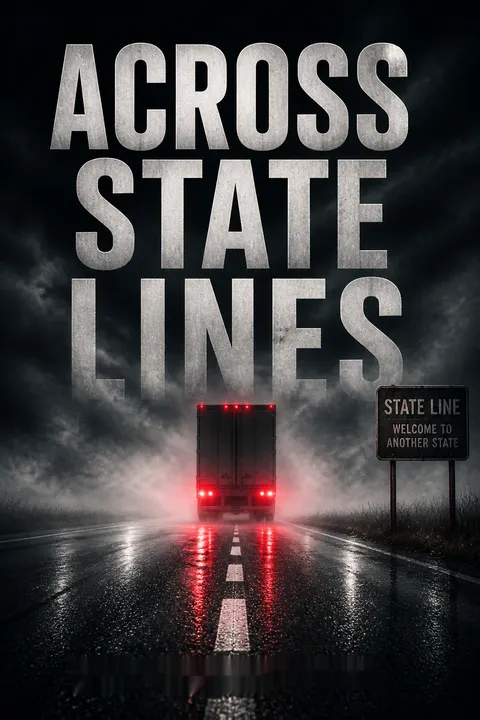
Across State Lines makes mobility its central paradox. The interstate gives Kane concealment and gives Aurora a possible route home, yet neither traveler is free simply because the wheels keep moving. The truck becomes a compressed social world: it contains a captive, a killer, two protective or desiring personalities, a dog, and evidence of prior violence. Its apparent comforts make the danger more intimate, not less.
Aurora's survival depends on reading behavior and adapting, but the novel refuses to equate adaptation with consent. She can seek pleasure, negotiate a price, or protect Jax while still being held against her will. That tension is especially important in a romance organized around coercion. Desire complicates the characters' bonds, but it does not retroactively erase the force and threats that shape their choices. Aurora's resistance remains legible even when she makes compromises to survive.
Kane's buried childhood abuse explains the fracture between his violence, Jax's care, and Tobin's sexual appetite. Explanation is not exoneration: his victims remain victims, and his attachment to Aurora does not undo his decision to sell her. The story's emotional turning point occurs when trauma becomes consciously visible and Kane accepts comfort without immediately turning it into violence. That moment opens a possibility, not a cure.
The ending rejects a simple return to normal life. Aurora's parents cannot provide the safety she hoped to find, and the truck remains a dangerous home. Her final choice is meaningful because she knows the risks and asks to return. The novel locates belonging not in conventional respectability but in negotiated intimacy, while leaving the ethical and physical costs of that intimacy in view.
Review Summary
Across State Lines receives high praise for its dark romance and complex characters. Readers appreciate the accurate portrayal of Dissociative Identity Disorder and the intense, twisted relationship between the protagonists. The book is described as depraved, filthy, and extraordinary, with many considering it Lauren Biel's best work yet. Reviewers warn about numerous triggers and graphic content but commend the author's ability to create morally gray characters and push boundaries. The audiobook narration by Teddy Hamilton and Michelle Sparks is highly praised for bringing the multiple personalities to life.
People Also Read










Characters
Aurora Rivelle
Road-worn survivorAurora is a twenty-four-year-old former college student traveling from California toward her parents in New York. She survives by arranging paid encounters with truckers, a practical response to having little money and nowhere secure to stay. Her bluntness and humor help her resist shame, but they also conceal how deeply an earlier assault has redirected her life. Aurora is alert to danger, yet she sometimes accepts risks because immediate needs leave few good choices. She is neither simply fearless nor passive: she calculates, adapts, tests other people's motives, and continues to make decisions under pressure. Her desire for belonging is real, but so is her capacity to question whether the people offering it can be trusted.
Kane Hargrave
The guarded killerKane is a forty-year-old long-haul trucker who has built his life around his customized rig, his dog, and the freedom of the interstate. He is a serial killer whose violence offers him an intense, temporary sense of control. His hostility toward women and inability to tolerate sexual touch are tied to childhood trauma that he cannot consciously access. Kane treats vulnerability as a threat and often answers fear with aggression, yet his care for Pup reveals an attachment he struggles to admit. He is the primary personality in a system shared with Jax and Tobin, and his need to remain in control repeatedly conflicts with their different needs. Understanding his trauma explains part of his behavior without excusing the harm he causes.
Jax
The protective caretakerJax is a distinct personality sharing Kane's body, formed to contain and manage pain that Kane could not bear. He is empathetic, socially capable, and especially attentive to other people's distress. He recognizes Aurora's vulnerability early and tries to protect her, but his loyalty to the whole system limits how far he can oppose Kane. Jax's gentleness is genuine, not a disguise, yet it cannot guarantee Aurora's freedom or safety. He is also vulnerable to guilt, particularly when his protective instincts fail. Through him, the story shows how care can exist inside a coercive arrangement without making that arrangement ethical.
Tobin
The sexual provocateurTobin is another personality sharing Kane's body, shaped by memories of sexual abuse that he carries for the system. He is sexually confident, provocative, and drawn to pain, power, and transgression. Unlike Kane, Tobin can experience sexual pleasure; unlike Jax, he does not approach intimacy through tenderness first. His behavior toward Aurora is often coercive and dangerous, even as their encounters develop into a complicated attachment. Tobin's desire to protect her eventually collides with the bargain Kane made. He is not a simple symbol of liberated sexuality: his appetite is bound to trauma, and his affection does not automatically make his actions safe.
Pup
The three-legged companionPup is Kane's small, three-legged dog, rescued after being struck by a car. She travels in the cab and is initially suspicious of nearly everyone, though Aurora wins her trust. Kane's attachment to Pup is one of the clearest signs that he can protect a vulnerable creature rather than destroy it. Pup also becomes a source of comfort and a shared point of connection among the characters. Her practical needs and stubborn presence interrupt the violence around her with ordinary acts of care.
Aurora's father
The volatile parentAurora's father is a former trucker who left long-haul work to be closer to his family. His drinking and temper make the homecoming Aurora hopes for far less safe than she imagined. He treats her decision to leave college as a personal affront and responds with verbal and physical aggression. His character complicates the idea that returning to one's family automatically means returning to protection.
Aurora's mother
The avoidant parentAurora's mother wants the appearance of a settled family life and expected her daughter to finish college. When Aurora returns, she struggles to meet her daughter's needs or challenge her husband's anger. Her avoidance deepens Aurora's sense that home is not a place where she can safely tell the truth.
Sacha
Nameless brotherSacha is one of the brothers behind the trafficking operation that financed Kane's truck. He helps manage the group's dealings and treats Aurora as a commodity in their business.
Ivan
Nameless brotherIvan is one of the brothers who operates with the Nameless. He helps hold Aurora in the basement and assumes the power of the group will keep her under their control.
Victor
Nameless brotherVictor is one of the brothers involved in the trafficking arrangement. He treats Aurora as merchandise and underestimates the personal history Kane has with the family.
The first truck-stop victim
Kane's first victim shownAn unnamed woman seeking work at a truck stop becomes the first victim readers see Kane choose and kill. Her brief appearance establishes the danger hidden behind his life on the road.
Plot Devices
The Purple Wet Dream
A home and a trapKane's customized purple truck is both his home and the mobile setting for much of the story. Its comfortable sleeper cab initially persuades Aurora that the ride may be safer than the other trucks she has known. The same enclosed space makes escape difficult and allows Kane to conceal his crimes. Its refrigerated trailer later holds a victim's body and nearly becomes Aurora's grave. As a recurring setting, the truck gathers the story's contradictions: comfort beside captivity, routine beside murder, and a possible home whose safety depends on which personality is in control.
Notes Between Alters
Proof of divided selvesKane, Jax, and Tobin sometimes leave written notes for one another when one personality has taken control. Aurora first encounters a note from Tobin after an encounter, and the message makes the changing behavior harder to dismiss as deception or a mood shift. Notes also let the personalities communicate plans and feelings they cannot easily share directly. This device gives Aurora concrete evidence of their internal divisions, while also showing that their cooperation is partial and conflict-ridden. It helps the reader follow shifts in control without treating the three personalities as interchangeable.
The Interstate
Mobility without escapeThe road gives Kane the distance and anonymity he uses to travel between killings, while Aurora depends on trucks for food, transportation, and a possible route home. State lines make the characters physically mobile without guaranteeing freedom: Aurora moves constantly yet remains captive, and Kane's criminal reach follows him across the map. The repeated stops, inspection point, roadside diners, and wooded pull-offs make the journey feel both ordinary and perilous. The interstate also makes home an unresolved question, first imagined as Aurora's parents' house and later chosen as the truck and the people inside it.
The Nameless Debt
A sale set in motionKane owes money to the Nameless, the trafficking operation that helped him obtain his truck. He reduces the debt by delivering women, which turns Aurora's capture into a business decision before it becomes an emotional crisis. The buyer's confirmation raises the cost of backing out, while the group's tracking of Kane's rig ensures that he cannot quietly abandon the deal. This device links the novel's two forms of violence, Kane's serial killing and the organized exploitation of women, without making them identical. It also forces Kane to choose whether his attachment to Aurora outweighs his debt and the danger of defying his former associates.
Pup
A test of tendernessPup, Kane's injured three-legged dog, provides a recurring measure of the characters' capacity to care. Kane once chose to rescue her rather than leave her to die, a decision that complicates the image he has of himself. Aurora's bond with Pup becomes a reason to act compassionately even when escape is possible, and the dog's disappearance in the storm forces Kane to confront his attachment. Pup does not redeem Kane or make the truck safe. Instead, she gives the story a vulnerable living presence whose needs expose tenderness the human characters struggle to express.
About the Author
Other books by Lauren Biel






Download PDF
Download EPUB
.epub digital book format is ideal for reading ebooks on phones, tablets, and e-readers.








