Key Takeaways
1. A Childhood Interrupted: The Rise of Nazism
My child’s eyes took the city’s majestic size and sophistication for granted; it was home, and I was a true Wiener.
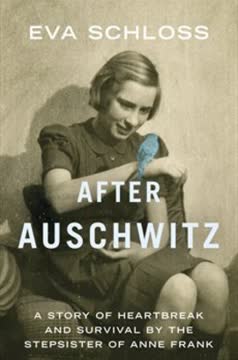
Idyllic beginnings. Eva Schloss's early life in Vienna was one of comfort and close family bonds, a typical middle-class Jewish upbringing in a vibrant cultural hub. Her father, Erich Geiringer, a successful shoe factory owner, and her mother, Fritzi, provided a loving home for Eva and her older brother, Heinz. Despite their secular lifestyle, Jewish traditions like Sabbath dinners were cherished, fostering a strong sense of identity.
Whispers of change. The economic turmoil of the 1930s and the rise of anti-Semitism in Vienna gradually encroached upon their sheltered world. Eva's first direct encounter with prejudice came when a friend's mother slammed the door in her face, declaring, "We don't have to bother with your kind any more." The 1938 Anschluss, when Germany annexed Austria, brought Nazi rule and its brutal realities directly to their doorstep.
Forced exodus. With the Nazis in power, Jewish families faced escalating persecution, including job bans, property confiscation, and public humiliation. Eva's father, foreseeing the danger, had already invested in a Dutch shoe factory, providing a precarious escape route. The family was forced to sell their cherished possessions, and Eva, Heinz, and Fritzi fled to Brussels, leaving Erich to secure their future in Holland, a temporary separation that foreshadowed greater losses.
2. The Perilous Journey to Hiding
We were truly ‘stateless’ people, and not welcome anywhere.
Refugee life. After fleeing Vienna, Eva, her mother, and Heinz endured a traumatic period as refugees in Brussels, where they faced unwelcoming attitudes and the constant threat of discovery. Eva struggled with a new language and the loss of her former life, while Heinz developed a stutter from the trauma. This period was marked by a deeply disturbing incident of sexual abuse by a fellow boarder, Mr. Dubois, which left Eva withdrawn and ashamed, highlighting her parents' inability to protect her from the world's evils.
Amsterdam's brief reprieve. In February 1940, the family finally reunited in Amsterdam, finding a temporary sense of normalcy and happiness. Eva thrived, making new friends like Anne Frank, and rediscovering her outgoing nature through games and cycling. Heinz pursued his artistic talents, and the family found solace in music and bridge games, creating a close-knit unit.
The net closes. This fragile peace was shattered on May 10, 1940, when Germany invaded the Netherlands. Despite initial Dutch denial, the country quickly fell under Nazi occupation, bringing with it a cascade of restrictive anti-Jewish laws. The family was forced to wear the Star of David, and rumors of "work camps" in the East grew increasingly ominous. When Heinz received a deportation order in July 1942, Eva's father declared, "I think it's time for us to disappear."
3. Betrayal and the Gates of Auschwitz
I was captured by the Nazis on my fifteenth birthday.
Life in hiding. Eva and her mother, disguised with false identities, entered a life of constant fear and boredom, moving between various safe houses provided by courageous Dutch resistors. Their days were a monotonous cycle of silence and anxiety, punctuated by the terrifying possibility of Gestapo raids. The only respite came from clandestine visits with Eva's father and Heinz, who were hiding separately, and from listening to BBC broadcasts that brought news of the war and chilling whispers of a death camp called Auschwitz.
The ultimate betrayal. On Eva's fifteenth birthday, May 11, 1944, their hiding place was raided. They were betrayed by a network of informants, including Miep Braams and Branca Simons, who lured Jewish families into false safe houses for financial gain. Eva's father and Heinz had also been captured through a similar deception, a devastating revelation that intensified Eva's terror during her brutal interrogation by the Gestapo.
Westerbork and the journey to hell. After imprisonment, the family was sent to Westerbork, a Dutch transit camp. Though conditions were initially less severe, it was a temporary stop before the dreaded transports to the East. Just two days after their arrival, Eva, her mother, father, and Heinz were put on a cattle train bound for Auschwitz-Birkenau. The three-day journey was a horrific ordeal of darkness, thirst, and despair, culminating in their arrival at the infamous death camp.
4. Survival in the Hell of Birkenau
When I was marched away from Auschwitz railway station, I left the girlish Eva Geiringer and her dreams, behind.
The selection. Upon arrival at Auschwitz-Birkenau, Eva and her family faced immediate selection by Josef Mengele. Her mother's quick thinking, dressing Eva in a coat and hat to make her appear older, saved her life; children under fifteen were sent directly to the gas chambers. Eva was one of only seven children from her transport to survive this initial selection. She was separated from her father and brother, a parting that would prove permanent.
Stripped of humanity. Eva became prisoner A/5272, enduring the systematic dehumanization of the camp. She was forced to strip naked, had her head and body hair shaved, and was tattooed with her number. The camp was a world of filth, starvation, and depravity, where survival depended on adapting to unimaginable conditions and fighting for every scrap of food. Eva learned to barter and scavenge, clinging to small acts of defiance and solidarity.
An angel in hell. A crucial turning point came when Eva developed typhus. Her mother's desperate pleas led to a miraculous intervention from her cousin, Minni, a nurse in the camp hospital. Minni, whose husband was a doctor treating Nazis, used her privileged position to secure medication for Eva, saving her life. Minni would continue to be their "angel," providing small comforts and, later, saving Eva's mother from the gas chambers.
5. The Unbearable Weight of Loss
I felt his arms stiffen and he stepped back, looking at me with such horror and pain.
Canada's grim bounty. Eva and her mother were assigned to "Canada," the work unit responsible for sorting the vast piles of possessions taken from arriving prisoners. This "land of plenty" was a stark contrast to the rest of the camp, but it was also a gruesome graveyard of stolen lives. Eva's work involved sifting through personal items, often finding carefully folded family photos, a poignant reminder of the millions murdered.
A father's hope, a daughter's despair. During her time in Canada, Eva reconnected with her father through the electrified fence. He was working in the lumber office and managed to visit her, bringing a fleeting sense of hope. However, his visits abruptly ceased, leaving Eva to fear the worst. Later, her mother was "selected" for the gas chambers, and Eva, believing her dead, spiraled into a deep depression, losing the will to live.
The final goodbyes. In a moment of profound anguish, Eva was reunited with her father, who had managed to secure extra food for her. Overwhelmed, she blurted out her belief that her mother had been gassed. His face, etched with horror, was the last image she would have of him. Eva's father and brother, Heinz, perished during the forced death march from Auschwitz to Mauthausen, their exact fates remaining a painful mystery.
6. Liberation and the Long Road Home
I was truly liberated, and terrified.
The end of Auschwitz. By late 1944, the war turned against Germany, and Himmler ordered the destruction of the gas chambers to hide the evidence. As Soviet forces advanced, the SS began evacuating prisoners on forced "death marches." Eva and her mother, too weak to join the march, were among the few left behind when the Germans abandoned the camp on January 19, 1945.
A fragile freedom. The days immediately following the German departure were a mix of relief and continued peril. Eva and her mother, along with other survivors, organized themselves, scavenging for food and warm clothes. They faced the grim task of carrying out the bodies of those who died from the cold or from eating too much too soon. On January 27, 1945, Soviet soldiers arrived, bringing liberation and a new, albeit uncertain, future.
The journey back. Eva and her mother embarked on a slow, arduous journey across war-torn Poland and Ukraine, eventually reaching the Black Sea port of Odessa. Along the way, Eva briefly reunited with Otto Frank, who was also searching for his daughters. A harrowing separation from her mother in Lemberg tested Eva's resilience, but they eventually found each other again in Czernowitz. The war ended while they were in Odessa, and they finally secured passage on a troop ship to Marseille, then a train to Amsterdam, a city scarred by the "Hunger Winter" and often indifferent to returning Jewish refugees.
7. Rebuilding Life Amidst Lingering Shadows
The rest of my life starts now, but I have no idea what to do with it.
A hollow homecoming. Returning to Amsterdam, Eva and her mother found their apartment at Merwedeplein intact, a strange time capsule of their pre-war life. However, the city itself felt drab and unwelcoming, and the Dutch population, having endured their own hardships, showed little interest in the plight of returning Jewish refugees. Eva struggled with a profound sense of displacement and the overwhelming grief of losing her father and brother.
The Red Cross letter. The devastating news of Erich and Heinz's deaths arrived via a cold, official Red Cross letter on August 8, 1945. This confirmation plunged Eva into a deep depression, marked by self-blame and a lingering disbelief that her strong father and talented brother could have perished while she survived. The conflicting information and lack of clear answers from the Red Cross only intensified their anguish.
Finding Heinz's legacy. Despite her despair, Eva clung to a memory of Heinz hiding his paintings. She persuaded her mother to visit their former hiding place, where they discovered twenty of Heinz's and ten of her father's artworks, miraculously preserved. This discovery was a poignant connection to their lost loved ones, a tangible reminder of Heinz's talent and a source of comfort amidst their profound grief.
8. A New Family and the Legacy of Anne Frank
We both have suffered so much, and we understand each other perfectly.
Otto Frank's solace. Otto Frank, devastated by the loss of Anne and Margot, became a frequent visitor to Eva and her mother, Fritzi, seeking mutual support. It was during this time that Otto shared Anne's diary, a raw and intimate account that revealed a daughter he hadn't fully known. This shared grief and understanding laid the foundation for a deep connection between Otto and Fritzi.
A new chapter. Eva's mother and Otto Frank eventually fell in love and married in 1953, a quiet ceremony that Eva's mother initially kept secret due to its proximity to Eva's father's birthday. This union, born of shared trauma and a profound understanding, provided Fritzi with a new life and a partner who valued her as an equal. For Eva, it meant a new stepfather and the freedom to pursue her own life.
Anne's enduring presence. Otto dedicated his life to preserving Anne's legacy, ensuring her diary was published and translated worldwide. He and Fritzi tirelessly managed the Anne Frank House and Foundation, answering countless letters and defending the diary's authenticity against deniers. While Otto was a loving stepfather and grandfather, Anne's memory often overshadowed their new family, with Otto sometimes using Anne as an example for Eva's children, a practice that occasionally made them feel they lived in her shadow.
9. Finding a Voice: From Silence to Advocacy
I was terrified when they asked me to talk, I don’t even know where the words came from.
A life of quiet struggle. For decades after the war, Eva remained a "cowed shell" of her former self, crippled by shyness and the unspoken trauma of Auschwitz. Despite building a successful life in London with her husband Zvi, raising three daughters, and running an antique shop, she carried a deep internal struggle. The question of her "normality" after such experiences haunted her, and she felt a part of herself was missing.
The turning point. In 1986, Eva was invited to speak at the opening of the Anne Frank Travelling Exhibition in London. This unexpected request, initially met with terror, became a pivotal moment. As she spoke, the dam of suppressed memories broke, and her story tumbled out. This experience, though draining, ignited a new purpose within her, prompting her to confront her past and share her testimony.
From personal to public. With Zvi's support, Eva began to craft her story, moving from factual accounts to deeply emotional narratives. She realized the power of her personal experience to connect with others and spread a message of tolerance. This led to her first book, "Eva's Story," a raw account of her time in Auschwitz, and later, a play, "And Then They Came For Me," which brought her story to audiences across the globe.
10. Confronting the Past: Education and Empathy
I was touched that they responded with such genuine feeling to my experiences.
The power of testimony. Eva's journey as a Holocaust educator began with speaking at the Anne Frank Exhibition, evolving into a mission to share her story with diverse audiences. She found that direct, heartfelt communication, rather than scripted speeches, resonated most deeply. Her experiences taught her the importance of empathy and understanding, especially when confronting difficult historical truths.
Reaching diverse communities. Eva's work extended to schools and prisons, where she engaged with young people and incarcerated individuals. She found common ground with those who felt different, bullied, or hopeless, emphasizing that "there is always hope." Her story, delivered with raw honesty, helped prisoners reflect on their own lives and the dangers of prejudice, fostering a sense of responsibility and empathy.
A global message. The play "And Then They Came For Me" became a powerful vehicle for her message, staged in various countries and contexts. From the US State Senate to rural schools, and even in Latvia to bridge ethnic divides, Eva witnessed the transformative impact of her story. She saw how it resonated with those affected by war, discrimination, or personal trauma, proving that the lessons of the Holocaust are universally relevant.
11. The Enduring Power of Hope
I want them to know what I have learned: that however deep your despair, there is always hope. Life is very precious and beautiful – and no one should waste it.
A legacy of resilience. Eva's life is a testament to human resilience, demonstrating that even after unimaginable suffering, it is possible to rebuild, find purpose, and live a full life. Her journey from a traumatized survivor to a passionate advocate for tolerance embodies the strength of the human spirit. She found joy in her family, her work, and her mission to educate.
The unbroken chain. Despite the profound loss of her father and brother, Eva found solace in the continuation of her family line. Her three daughters and five grandchildren became the "unbroken chain" her father had once spoken of, fulfilling his prophecy. This new generation, growing up in a world free from the immediate threat of the Holocaust, represented hope for the future.
Remembering and moving forward. Eva's work is not about dwelling on the past but about learning from it to build a better future. Her return to Auschwitz, though devoid of "closure," reinforced her belief in the importance of remembrance and education. She continues to share her story, urging people to confront prejudice, embrace empathy, and cherish the preciousness of life, ensuring that the voices of those lost are never truly silenced.
Last updated:
Review Summary
After Auschwitz receives overwhelmingly positive reviews (4.32/5), with readers praising Eva Schloss's powerful Holocaust testimony. Reviewers appreciate her account of survival at Auschwitz at age fifteen and particularly value the book's coverage of post-war life and recovery. Many highlight the importance of her message about hope, humanity, and preventing future atrocities. Some critics note the second half focusing on domestic life feels disconnected from the camp narrative. Readers emphasize this memoir stands independently from Anne Frank's story, celebrating Eva's unique voice and resilience.