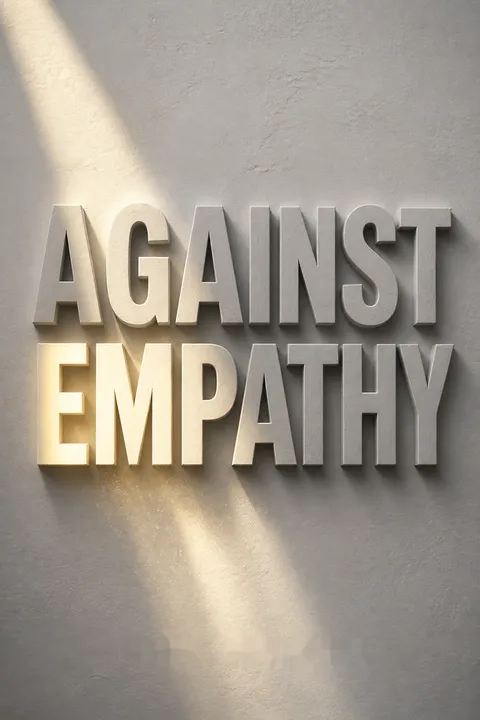


Key Takeaways
Choose compassion and reasoning over emotional mirroring when deciding what is right.
Separate feeling from goodness. Bloom uses empathy to mean emotionally sharing what someone else seems to feel. If a child is frightened, for instance, empathy means feeling some of that fear. Understanding that the child is afraid, without feeling afraid too, is a different capacity. Kindness, compassion, and moral concern are different again. The argument is not that people should care less, but that emotional mirroring is an unreliable way to decide what care requires.
A moving beginning. Bloom opens with the public grief after the Sandy Hook killings. The response was humane, but its force also illustrates how vividly particular suffering can command attention. Feeling another person’s pain may motivate help; it does not establish whether that help is fair, effective, or proportionate. His case is that deliberate reasoning should guide moral judgment, while compassion can keep human welfare among its goals.
The key move is conceptual hygiene. When empathy is used to mean kindness, understanding, emotional contagion, and morality all at once, criticizing it sounds like a plea for coldness. Separating those capacities makes the argument testable: emotional sharing can be assessed for what it does, rather than being protected by the positive associations of the word. The distinction also cautions against treating visible emotion as proof of moral seriousness. A quiet, composed person may care deeply, while an emotionally moved person may still choose badly.
Let vivid victims move you, but use numbers to decide where help goes.
Attention is selective. Bloom describes empathy as an attention beam: it makes one person’s suffering vivid while leaving countless others indistinct. In an experiment, people told to imagine the distress of a terminally ill child were much more likely to move her ahead of other children on a treatment waiting list. The decision favored the visible child over fairness to patients with greater priority.
Specificity distorts scale. Experiments on the identifiable victim effect find that people give more when a recipient has a name or a face. Bloom also contrasts the national response to Sandy Hook with the far less noticed deaths of children in Chicago. This uneven attention is not a measure of who suffers more. Emotion registers a particular life powerfully, but it does not reliably compare needs across people or populations.
The point is not that personal stories are useless. They can reveal suffering that abstraction hides and can prompt action that otherwise never begins. The danger comes when vividness is mistaken for importance. A sound decision process can let a story identify a problem, then ask how many people are affected, what help changes, and who bears the costs. That sequence preserves the human signal without letting one emotionally compelling case quietly stand in for everyone else.
Give where evidence says help works, not where emotion feels strongest.
Measure the result. Effective Altruism, the movement Bloom discusses, combines motivation to help with an effort to determine which interventions produce the most benefit. Peter Singer compares a costly Make-A-Wish event for one child with donations that could provide malaria bed nets and save several lives. The comparison asks donors to count outcomes, not just the warm feeling produced by a memorable story.
Good intentions need scrutiny. Bloom describes how aid can have unintended effects: food shipments can undermine local farmers, and donations to orphanages or child beggars can feed exploitative systems. These examples do not prove that aid is generally harmful. They show why giving should follow evidence about consequences, including consequences that arrive later or fall on people outside the immediate scene.
This is an important shift from moral display to practical responsibility. The donor’s emotional satisfaction is real, but it is only one consequence among many, and often not the one that matters most to those in need. At the same time, measurement should not be mistaken for certainty. Outcomes can be hard to predict, especially when institutions and incentives are involved. The strongest version of evidence-based giving is therefore not blind faith in a ranking, but a willingness to test claims, notice harms, and revise choices.
Understand another person's mind without absorbing their pain.
Feeling and understanding differ. Bloom distinguishes emotional empathy, sharing another’s feeling, from cognitive empathy, inferring what another person thinks or feels. Neuroscience finds some overlap between the brain activity associated with experiencing pain and witnessing someone else’s pain, but the experiences are not identical. Research also suggests that the systems for sharing feelings and for reasoning about other minds can operate separately.
Understanding is morally neutral. It helps a doctor explain a diagnosis sensitively or a judge assess how a search affected a teenager. Yet the same insight can help a manipulator exploit someone. In Orwell’s 1984, O’Brien accurately anticipates Winston’s fears and uses that knowledge to torture him. Bloom also cautions against treating mirror neurons as a complete explanation for empathy. Reading another person is useful, but it does not by itself make anyone benevolent.
This distinction prevents a common false choice: either feel exactly what another person feels or remain indifferent. Understanding can support respectful action without requiring emotional absorption. It also explains why social skill cannot be treated as a moral credential. The same ability to anticipate another’s reactions can support care, persuasion, or coercion; ethical direction depends on the goals and constraints governing its use. The practical question is not only whether someone can read others, but what they do with that knowledge.
Stay warm and steady; another person's distress need not become yours.
Care can outlast distress. Bloom distinguishes compassion, a warm concern and motivation to improve someone’s welfare, from sharing that person’s suffering. In research discussed with neuroscientist Tania Singer, compassion meditation produced a positive, prosocial state, while deliberately empathizing with suffering left Matthieu Ricard feeling drained. The book connects this difference to unmitigated communion, an excessive preoccupation with others that can crowd out one’s own needs.
Steadiness can help. A surgeon or therapist may need to understand a patient’s fear while remaining composed enough to act. Bloom recounts a physician who found intense emotional resonance overwhelming during disaster relief. Patients may value a professional who listens and cares but does not echo their panic. Emotional closeness can matter in personal relationships, yet constant mirroring is not the only way to show love or attention.
The distinction matters most in roles where suffering is frequent and action must remain possible. If every encounter becomes an emotional emergency for the helper, care can become unsustainable. Composure, however, should not become an excuse for detachment or dismissiveness. The useful standard is attentive steadiness: listen carefully, take the person seriously, and stay regulated enough to respond. This preserves the informational and relational value of connection without treating another’s distress as something the helper must reproduce.
Before punishing, ask whose suffering your empathy has made visible.
Concern can escalate conflict. Empathy for an injured person can spark anger at the person blamed for the injury. At Dachau after liberation, American soldiers tortured and killed captured German guards, driven in part by what they had just witnessed in the camp. Bloom argues that this pattern also appears in political conflict: stories of harm to one’s own group can make retaliation feel like moral duty, while the likely suffering of opponents remains abstract.
The frame chooses a side. In an experiment, people who heard that a financially worried student was distressed gave her competitor more hot sauce, despite the competitor’s innocence. Bloom also notes that empathy appears across political camps: people focus on different victims, such as refugees, police officers, gun owners, or people threatened by violence. Compassion for one group does not settle what action is justified.
Empathy can make injury morally legible, but it can also turn concern into permission to retaliate. The important check is to distinguish responding to harm from satisfying the injured party’s anger. That distinction is difficult in real conflicts, where refusing retaliation can look like indifference and where some force may be necessary. Still, decision-makers need to examine likely consequences for all affected groups, including people who are absent from the story that first stirred outrage.
Do not mistake an empathy deficit for a complete theory of cruelty.
Cruelty has many sources. A meta-analysis discussed by Bloom found that lack of empathy accounted for about 1 percent of the variation in aggression. Psychopathy measures include emotional shallowness and low empathy, but also impulsivity, irresponsible behavior, and criminal history. Those other traits may better explain harmful conduct. Some people who commit atrocities can understand others well, or show concern in selected relationships.
Moral motives can harm. People may inflict suffering because they believe they are defending honor, enforcing justice, or protecting a community. Bloom gives the example of a father who prevented lifeguards from rescuing his drowning daughter because he believed a strange man should not touch her. The act was horrifying, but it arose from a moral commitment, not simple indifference. Perpetrators also tend to minimize their own harms while experiencing others’ actions as deliberate and severe.
A one-cause account of cruelty is comforting because it allows decent people to locate evil somewhere outside ordinary moral life. The evidence described here makes that comfort unsafe: harmful acts can arise from distorted principles, poor restraint, self-interest, or selective concern. This does not erase differences between perpetrators or make explanation equivalent to excuse. It instead directs attention toward the mechanisms that can be changed, including how strongly people regulate impulses and how they test moral convictions against the interests of those they might harm.
Build moral rules with evidence and self-control, not momentary emotional intensity.
Reason can correct instinct. Bloom does not claim people reason perfectly. He describes predictable errors, such as misunderstanding a positive medical test when the disease is rare, and the A&W Third Pounder, whose name confused customers who mistook one-third for less than one-quarter. Yet recognizing such errors is itself evidence that people can reflect and correct an initial judgment.
Judgment needs discipline. Intelligence helps people anticipate consequences; self-control helps them resist immediate impulses. Bloom points to the effective altruists who use numbers to decide how to give, and to the historical expansion of rights as a change in moral principle rather than a sudden universal surge of empathy. Reason is not a replacement for caring. It helps determine whether an action actually serves the human welfare that compassion values.
The strongest argument for reason is not that people are unbiased, but that bias can be identified, challenged, and corrected through shared procedures. A person acting alone may rationalize a preferred answer; a community that asks for evidence, exposes assumptions, and permits criticism can do better. This is why impartial rules and careful comparison matter. They are not guarantees of justice, and numerical analysis can encode bad values, but they make hidden preferences more visible and open to dispute.
Don't assume children's kindness begins with feeling another person's pain.
Helping appears early. Toddlers have been observed assisting adults who struggle to reach an object or open a door, sometimes leaving an appealing toy to help. Bloom describes a 15-month-old who tried to cheer his crying brother by performing a familiar game, without showing distress himself. Such behavior suggests that children can care about another person without sharing that person’s feelings.
The evidence remains open. Babies may become upset when they hear other babies cry, and toddlers sometimes show distress at another’s pain. But distress alone does not prove that a child understands whose feeling it is or that empathy causes the helping. Chimpanzees also console distressed companions with apparent concern. Bloom’s cautious conclusion is that early kindness is visible, while empathy’s necessity as its foundation remains unproven.
The developmental question matters because claims about empathy’s moral necessity often rest on an origin story: caring begins as shared feeling and grows into principle. The observations here permit another account, in which concern and emotional resonance develop alongside one another but are not identical. Early behavior is difficult to interpret, especially when infants cannot explain their motives. The useful conclusion is modest: visible care should not be dismissed simply because the caregiver does not display the recipient’s distress.
Analysis
Bloom’s most useful contribution is not simply the claim that empathy can mislead. It is the separation of capacities that everyday language bundles together: emotional sharing, understanding another mind, compassion, and moral judgment. Once disentangled, empathy becomes a psychological process with particular strengths and failure modes, not a synonym for virtue. Its capacity to make an individual’s pain vivid can motivate help, but vividness is a poor instrument for comparing needs, anticipating consequences, or distributing public resources.
The book’s central image of selective attention also connects individual psychology to institutional design. A waiting list, blind audition, or charity assessment can use procedures to counteract the unequal force of faces and stories. Such procedures do not remove human concern; they reduce the chance that concern will be allocated according to familiarity, attractiveness, or narrative drama. This is a strong practical implication: moral reliability may depend less on cultivating perfectly impartial feelings than on building decision processes that do not require them.
The case for reason is persuasive when treated as a corrective practice, not a superior inner faculty untouched by bias. People can use analysis to challenge gut responses, but they can also use intelligence to defend self-interest or harmful commitments. Bloom recognizes this danger, yet his emphasis on consequences raises a real philosophical tension. Cost-benefit calculation needs judgments about which outcomes count, whose interests receive weight, and which rights should not be traded away. Numbers cannot settle those questions by themselves.
The most balanced reading is therefore neither to obey empathy nor to eradicate it. Emotional resonance can reveal what abstract descriptions conceal, especially in close relationships, art, and encounters that would otherwise be ignored. It should serve as a source of attention and motivation, while fairness, evidence, and public reasoning test what action follows. That division of labor preserves empathy’s human value without mistaking its intensity for moral accuracy.
Review Summary
Against Empathy challenges the notion that empathy is universally beneficial, arguing it can lead to biased and irrational decision-making. Bloom distinguishes between emotional empathy and rational compassion, advocating for the latter in moral reasoning. While some readers found the book thought-provoking and well-argued, others felt it was repetitive or misrepresented opposing views. Critics praised Bloom's clear writing and use of scientific evidence, but some found the title misleading or the arguments lacking impact. Overall, the book sparked discussion about the role of empathy in morality and decision-making.
People Also Read








Glossary
Emotional empathy
Sharing another's feelingsThe experience of feeling, to some degree, what another person is believed to feel. In Bloom’s argument, this differs from recognizing that someone is distressed, caring about their welfare, or deciding to help. Emotional empathy can make a particular person’s suffering vivid, but its selectivity and intensity can distort moral judgment.
Cognitive empathy
Inferring another's mental stateThe ability to infer what another person thinks, wants, or feels without necessarily experiencing that person’s emotions. It supports social understanding and can help someone respond sensitively. Bloom treats it as a morally neutral capacity: the same ability may support caregiving, negotiation, manipulation, or cruelty, depending on the user’s aims.
Identifiable victim effect
A named victim draws more aidThe tendency for people to respond more generously to a specific, recognizable person than to an unnamed or statistical group in comparable need. A name, photograph, or personal story can make suffering emotionally vivid. Bloom uses this effect to show how intuitive concern can favor one individual over a larger number of people who need help.
Effective Altruism
Evidence-guided efforts to helpA movement and approach to charitable action that combines a desire to improve lives with investigation into which interventions do the most good. Rather than letting emotional appeal alone determine where resources go, it compares likely outcomes. Bloom presents it as a practical alternative to giving primarily for the immediate emotional reward of helping a vivid individual.
Unmitigated communion
Excessive focus on othersA pattern of placing other people’s needs ahead of one’s own to an excessive degree. The concept is associated with intrusive helping, difficulty refusing requests, and continued distress about others’ problems. Bloom connects it to empathic distress, emphasizing that caring for others can become harmful when emotional involvement overwhelms self-care and effective action.
Empathy-altruism hypothesis
Empathy motivates altruistic helpC. Daniel Batson’s hypothesis that feeling empathy for a person in need can produce a genuine motivation to improve that person’s welfare, even when helping is costly and escape is possible. Bloom accepts that empathy can motivate assistance, while stressing that this motivation is not automatically moral: it may favor the person who is emotionally salient over others with equal or greater claims.
Moralization gap
People excuse their own harmsThe tendency for people to see their own harmful actions as less serious and more justified than similar actions committed against them. This asymmetry can fuel retaliation: one side regards its response as measured, while the other experiences it as a fresh injustice. Bloom uses the concept to explain how conflict can escalate without either party seeing itself as the aggressor.
Mirror neurons
Neurons responding to observed actionsNeurons first identified in monkeys that responded both when an animal performed an action and when it watched someone else perform a similar action. Some researchers proposed that this shared response helps explain understanding and empathy. Bloom notes that claims about mirror neurons have been widely extended beyond the evidence; they may contribute to social processes but do not by themselves explain complex moral capacities.
FAQ
What's Against Empathy: The Case for Rational Compassion about?
- Central Argument: Paul Bloom argues that empathy, often seen as a moral compass, can lead to biased and irrational decisions. He suggests that empathy can distort moral judgments and result in negative outcomes.
- Empathy vs. Compassion: Bloom distinguishes between empathy (feeling others' emotions) and compassion (caring for others without emotional entanglement). He advocates for compassion as a more reliable moral guide.
- Rational Decision-Making: The book promotes using rational, deliberative reasoning in moral decision-making, which Bloom believes leads to better societal outcomes.
Why should I read Against Empathy?
- Challenge to Conventional Wisdom: The book challenges the belief that empathy is inherently good and necessary for moral behavior, encouraging readers to rethink their assumptions.
- Insightful Analysis: Bloom provides a thorough analysis of the psychology and neuroscience behind empathy, supported by research and real-world examples.
- Practical Implications: It offers practical advice on approaching moral decisions more effectively, emphasizing rational compassion over empathy.
What are the key takeaways of Against Empathy?
- Empathy Can Mislead: Empathy often leads to biased and shortsighted decisions, focusing on immediate emotional responses rather than long-term consequences.
- Compassion is Superior: Compassion, which involves caring for others without feeling their pain, is a more effective moral guide.
- Rationality Matters: Using reason and deliberation in moral judgments can lead to better outcomes for individuals and society.
What are the best quotes from Against Empathy and what do they mean?
- “Empathy is always perched precariously between gift and invasion.”: This highlights empathy's dual nature, fostering connection but also intruding on personal boundaries.
- “On balance, empathy is a negative in human affairs.”: Bloom asserts that empathy often leads to poor moral decisions and actions that can harm rather than help.
- “We are better off without empathy.”: This encapsulates Bloom's main argument, advocating for rational compassion as a more effective means of promoting kindness and moral behavior.
How does Paul Bloom define empathy in Against Empathy?
- Feeling Others' Feelings: Empathy is defined as feeling what you believe others feel, experiencing their emotions as if they were your own.
- Cognitive vs. Emotional Empathy: Bloom distinguishes between cognitive empathy (understanding others' thoughts) and emotional empathy (feeling others' emotions), focusing on the latter.
- Empathy's Limitations: Emotional empathy is often biased and shortsighted, leading to decisions that prioritize immediate emotional responses over rational considerations.
What are the negative effects of empathy according to Against Empathy?
- Bias and Parochialism: Empathy often leads to biased judgments, favoring those similar or close to us while neglecting broader societal issues.
- Shortsightedness: It can cause individuals to focus on immediate emotional responses, ignoring long-term consequences.
- Emotional Exhaustion: High levels of empathic distress can negatively impact mental health and well-being, particularly in helping professions.
How does Against Empathy relate to moral decision-making?
- Rational Compassion: Bloom advocates for rational compassion as a more effective moral guide than empathy, using reason and deliberation for better moral outcomes.
- Empathy's Role in Morality: Empathy can lead to poor moral judgments, and moral decisions should be based on rational considerations rather than emotional responses.
- Long-Term Consequences: A rational approach allows individuals to weigh broader implications, leading to more ethical outcomes.
What is the difference between empathy and compassion in Against Empathy?
- Empathy Defined: Empathy is the capacity to feel what others feel, leading to biased and shortsighted decisions.
- Compassion Defined: Compassion involves feelings of warmth and concern for others without sharing their emotional experiences.
- Practical Implications: Cultivating compassion can lead to more effective and rational actions that benefit others.
How does Bloom support his arguments in Against Empathy?
- Psychological Research: Bloom references studies showing how empathy can lead to biased and irrational decisions.
- Neuroscience Findings: Insights from neuroscience highlight different brain areas activated during empathic versus compassionate responses.
- Real-World Examples: Case studies illustrate empathy's negative effects in contexts like charity, parenting, and politics.
What alternatives to empathy does Bloom propose in Against Empathy?
- Rational Decision-Making: Emphasizes using reason and deliberation for better outcomes.
- Compassionate Action: Encourages cultivating compassion, caring for others without feeling their pain.
- Effective Altruism: Discusses using evidence and reason to determine the most effective ways to help others.
How does Against Empathy address the role of empathy in personal relationships?
- Empathy in Relationships: Empathy can complicate relationships by leading to emotional overload and biased support.
- Importance of Emotional Distance: Maintaining emotional distance can enhance relationship quality, allowing support without being overwhelmed.
- Rational Understanding: Understanding and caring for loved ones without empathic mirroring can lead to healthier relationships.
What are the implications of Against Empathy for public policy?
- Empathy in Policy Decisions: Empathy can lead to biased decisions favoring certain groups, resulting in ineffective policies.
- Rational Policy-Making: Advocates for using data and reasoned analysis rather than emotional appeals in policy-making.
- Effective Altruism: Emphasizes objective assessments of need for more equitable and effective outcomes.
About the Author





Download PDF
Download EPUB
.epub digital book format is ideal for reading ebooks on phones, tablets, and e-readers.








