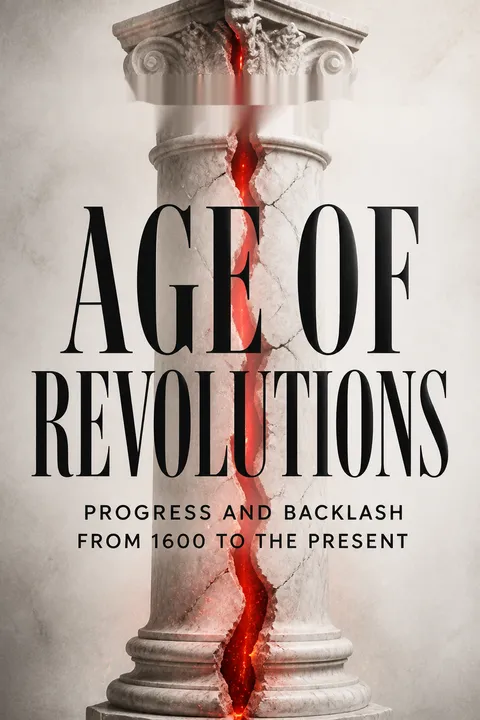


Key Takeaways
Read revolutions as cycles: disruption advances society, then summons a backlash.
Change has two directions. A revolution can mean a sudden break with the past, but it also carries an older sense of returning or turning back. Zakaria uses that tension to explain a recurring pattern: technological and economic shifts unsettle how people live; new opportunities and losses reshape identity; politics then reorganizes around the disruption, often producing both reform and backlash.
The Dutch revolt, British industrialization, and today’s digital and geopolitical upheavals differ in their details, but each shows how change in one sphere spreads into others. When people feel that familiar ways of life are dissolving, political movements can promise either adaptation or restoration. The cycle is not automatic, and its outcome depends on how societies respond to those left behind.
What's useful about this model is that it discourages treating political upheaval as a bolt from the blue. It directs attention to the economic and social pressures accumulating beneath public arguments. The sequence is best used as a diagnostic lens, not a law of history: technological change does not always produce the same political response, and identity can shape economic policy as much as follow it. The book's strongest insight is the feedback loop itself. Politics is not merely reacting to disruption; it also decides who bears its costs and what forms of change remain possible.
Open societies thrive by adapting faster than empires can command.
The Dutch advantage was cooperation. The Netherlands had little fertile land and no powerful central monarch. Managing floods and reclaiming territory required towns and residents to coordinate, share costs, and build local institutions. This decentralized system suited a commercial society: merchants, artisans, and immigrants could contribute without waiting for a royal court to approve every move. By the seventeenth century, Amsterdam's income per person was about four times Paris's.
The contrast with Venice shows how success can curdle. Venice's ruling merchants shut newcomers out, extracted wealth from distant subjects, and tried to preserve industrial secrets by restricting skilled glassmakers. The Dutch, too, eventually turned protectionist as their advantage faded. Openness was not a permanent national trait; it was a source of strength that could be abandoned when incumbents felt threatened.
The comparison makes institutions feel less like constitutional diagrams and more like habits of solving shared problems. Dutch water management required trust, revenue, and negotiation, capacities that also supported trade and political participation. That connection is persuasive, though it should not turn the republic into a simple model of virtue. Its commercial empire used enslaved labor and coercion abroad. A society may be open to talent and argument at home while closed to the people whose labor sustains its prosperity. Openness, then, is not a single national score. It has boundaries, and those boundaries reveal who is allowed to benefit.
Build political compromise on social changes already underway.
England adjusted; France tried to leap. The Glorious Revolution of 1688 limited royal power and strengthened Parliament after generations of political conflict. The settlement did not create full democracy, but it gave competing groups a durable way to bargain. Tories and Whigs could disagree while accepting Parliament's role in public finance and a degree of religious toleration.
France began with similar hopes for constitutional rule, but its revolutionaries faced a largely rural, hierarchical society and tried to remake it at speed. Foreign invasion and internal fear intensified the radical turn. During the Terror, roughly 17,000 people were officially executed, many of them ordinary workers and peasants. The book's contrast is not between change and no change, but between reforms built on social foundations and plans imposed before those foundations existed.
The comparison gives reform a practical test: does a proposed political settlement have social groups and institutions capable of sustaining it? The English case suggests that compromise can preserve change by giving opponents a stake in the new order. The French case also warns that abstract ideals can become coercive when leaders treat disagreement as disloyalty. Still, the contrast is not a controlled experiment. France's fiscal crisis and foreign invasion mattered, and its revolutionary era produced legal reforms that endured. The lesson is not that gradual change is always peaceful, but that political design cannot simply legislate away a society's existing structure.
Industrial growth reshapes politics, but reform decides who shares its gains.
Machines changed daily life and political coalitions. Britain's industrial transformation brought steam power, railways, and mass production into ordinary experience. Between 1770 and 1870, real wages rose by more than 50 percent, although the gains were uneven and early factory work could be brutal. Industrialization also drew women into paid textile work, helping create new routes toward education, organization, and political participation.
The disruption rearranged the political map. In Britain, parties that once divided over land and commerce changed sides as industry created new classes and interests. In the United States, the Civil War and industrial boom helped shift the parties toward the familiar contest over business, regulation, and the role of government. Independence mattered, but the book argues that industrialization remade American society more deeply than the Revolution of 1776.
This history separates invention from distribution. A new machine can enlarge total output while weakening a craft, a town, or a worker's bargaining position. The resulting political conflict is not an irrational refusal of progress; it is a dispute over who controls the transition and receives its rewards. The comparison across Britain and the United States also shows why political labels are unstable: coalitions follow interests and identities, not timeless definitions of left and right. Material gains matter, but they do not settle questions of dignity, security, or influence.
Globalization raises living standards, but concentrated losses invite revolt.
Connection spreads gains and shocks. In the nineteenth century, steamships, railways, refrigeration, and telegraphs made distant markets part of everyday life. The Dunedin, a ship carrying frozen meat from New Zealand to London, completed a journey of nearly one hundred days with only one spoiled carcass. Cheaper transport broadened trade, but it also exposed local producers to competition they could not withstand. The Long Depression that began in 1873 helped fuel tariffs, nationalism, and imperial rivalry.
After World War II, trade expanded alongside welfare programs, labor protections, and international rules. The 1990s brought a new surge of integration, but many communities experienced factory closures, financial instability, or stagnant status. Zakaria calls attention to relative deprivation: people judge their prospects against those of others, not only against their own past. Economic improvement in aggregate does not erase the experience of being left behind.
The central tension is not simply whether trade is good or bad. It is whether institutions can help people absorb its shocks without asking them to surrender security, status, and community in exchange for cheaper goods. The postwar combination of open markets and domestic protections offers an important counterexample to the idea that globalization requires a weak state. At the same time, protection can become a costly defense of incumbents rather than a bridge to new work. A serious response should distinguish support for people from a promise to restore every vanished industry.
Digital abundance expands choice while thinning the ties that anchor people.
Information became nearly effortless. The internet puts encyclopedias, entertainment, shopping, and communication within reach of billions. Wikipedia offers far more material than the printed encyclopedia once did, at no cost to users. Yet convenience can displace shared places and routines. Robert Putnam's study Bowling Alone described the weakening of American civic associations, while Zakaria points to shrinking friendship circles and rising loneliness alongside online connection.
The same technology changes work and authority. Software can augment workers, but artificial intelligence may unsettle jobs and challenge the assumption that human reasoning is the final source of expertise. Biotechnology adds the power to alter living systems, including human genes. These tools offer real gains, but their effects depend on choices about access, oversight, and how communities share the benefits and risks.
Digital connection and social isolation can coexist because contact is not identical to belonging. Online networks can offer vital support to people excluded from local communities, while recommendation systems can also reward outrage and keep users inside narrow circles. The relevant question is not whether technology is inherently liberating or corrosive, but what kinds of relationships and institutions it makes easier to sustain. The book is right to resist technological fatalism. Yet optimism about innovation should be matched by concrete attention to who owns the systems, who can contest their decisions, and who is exposed to their mistakes.
When survival eases, dignity and identity become political battlegrounds.
Security changes what people demand. The idea of postmaterialism, associated here with political scientist Ronald Inglehart, describes a shift from prioritizing basic needs such as food and safety toward values like self-expression, participation, and personal freedom. The postwar boom helped make the 1960s a turning point: students and activists challenged authority, while civil rights, feminist, and gay rights movements pressed for recognition and equal standing.
These advances also provoked backlash. In the United States, struggles over race, religion, gender, and immigration increasingly shaped party loyalties. Politics became more tightly bound to group identity, making a vote feel like an act of tribal belonging. This helps explain why economic statistics alone cannot account for populist anger: people may be materially better off yet feel that their status, traditions, or place in the country are diminishing.
The postmaterialist lens explains why prosperity does not end political conflict; it can move conflict toward questions of recognition and cultural authority. It also helps clarify why the same social change can feel liberating to one group and threatening to another. But material security and identity are not cleanly separated. A lost job can also mean lost standing, and a cultural dispute can carry economic consequences. Treating identity politics as mere distraction would miss how people experience power. The analytical challenge is to recognize genuine claims for dignity without allowing group identity to erase individual rights or justify exclusion.
Manage rising powers without abandoning the rules that restrain them.
Power shifts create danger, not destiny. After the Cold War, the United States enjoyed an unusually dominant position, while trade and democratic institutions spread. That period helped generate new competitors. China grew into a major economic and military power; Russia sought to restore influence through coercion, most starkly in its invasion of Ukraine. Zakaria describes a dual revolution: the return of great-power rivalry alongside a liberal international order built around rules and cooperation.
Interdependence can restrain conflict, but it can also become a weapon, as financial sanctions against Russia illustrate. The Thucydides Trap is the risk that fear between a rising power and an established one can lead to war. The book treats that risk seriously without calling war inevitable. Diplomacy, alliances, and practical cooperation still shape what rivals choose to do.
The dual lens avoids two convenient errors: assuming trade automatically prevents war, and assuming power rivalry makes war unavoidable. Economic ties create costs and channels for negotiation, but they can also become leverage. The quality of institutions and leaders matters because interdependence is not self-enforcing. The Thucydides Trap is useful as a warning about fear and miscalculation, not as a forecast with a fixed ending. Its historical examples cannot establish that every rising power follows the same path. Policy should prepare for competition while preserving areas where cooperation serves shared interests.
Defend freedom by making change gradual, fair, and socially rooted.
Freedom needs more than rules. Liberal institutions protect rights and let people choose their own version of a good life, but they do not automatically provide community or purpose. As old sources of belonging weaken, political movements can offer a simpler refuge in nation, religion, or tradition, sometimes at the expense of minorities and independent institutions.
Zakaria's response is reform rather than retreat: support families and local infrastructure, make immigration rules credible, strengthen civic participation, and keep space for free speech and compromise. He also proposes national service as one way people from different backgrounds could work together. The aim is not to freeze society in an imagined golden age. It is to ensure that change does not leave whole communities feeling powerless or disposable.
The strongest closing insight is that liberalism must be experienced as a shared civic project, not only defended as a set of procedures. Communities need places to meet, work, and argue across difference; policy can support those conditions without dictating a common private belief. Yet no program can manufacture belonging by decree. National service, for instance, could build solidarity only if participation is fair and its work is valued. The book's case for gradual reform is persuasive when gradual means responsive and inclusive, not a polite excuse for delay. Preserving freedom requires changing institutions before exclusion becomes the easier answer.
Analysis
Zakaria's book is a wide historical argument organized around a compact sequence: structural change unsettles livelihoods, identity reorganizes around the disruption, and politics catches up through reform, backlash, or both. Its comparative strength comes from placing the Dutch Republic, England, France, industrial Britain, and the United States beside present-day globalization, technology, identity conflict, and geopolitics. This makes familiar events legible as parts of a recurring problem: societies must absorb change without either freezing it or forcing it by decree.
The narrative is also openly normative. It favors classical liberalism, markets, technological innovation, and political pluralism, while acknowledging that their benefits are uneven and that liberal systems can leave people lonely, insecure, or voiceless. Its most useful distinction is not simply progress versus reaction, but change that develops through institutions capable of bargaining and change imposed on societies that lack the capacity to sustain it. The Dutch and English cases illustrate adaptation; the French case supplies a warning about coercive acceleration.
That architecture has limits. The book concentrates on a Western historical line and explicitly treats it as a shadow-casting model, but this selection can make different societies appear to be following a single sequence. Its accounts of Dutch tolerance and British modernization also need to be read beside slavery, empire, and exclusions that complicate any clean story of liberal progress. Further, the sequence from economic disruption to identity backlash is illuminating but not a universal causal law. Political leaders, institutions, and cultural histories can redirect the same material pressures in sharply different ways.
The book's lasting contribution is therefore less a prediction than a political test. When a society changes, do its institutions distribute gains, give people a voice, and preserve room for disagreement? If not, the appeal of restoration becomes understandable, even when its promised past is fictional. Liberalism's challenge is to make freedom socially inhabitable: to protect individual choice while sustaining the relationships and shared institutions that prevent autonomy from becoming isolation.
Review Summary
Age of Revolutions explores historical revolutions and their impact on modern society, drawing parallels to current global challenges. Zakaria's analysis of liberalism, technological progress, and geopolitical shifts resonates with readers, though some find it oversimplified. The book's balanced perspective on political extremes and its insights into the roots of populism are praised. While some critics desire more detailed solutions, most appreciate Zakaria's cogent explanation of how past revolutions shape our present and future, offering a thoughtful examination of liberalism's strengths and weaknesses.
People Also Read







Glossary
Revolution
Rupture and returnZakaria uses revolution in two connected senses: a radical break that carries society away from its previous order, and a turning or rolling back toward an earlier state. The tension matters because rapid change often produces a counter-movement that promises restoration, so revolutionary politics can advance or reverse social change.
classical liberalism
Rights and limited authorityIn this book, classical liberalism means a political tradition centered on individual rights and liberties, religious freedom, markets and open trade, and cooperation under rules. It is not synonymous with the contemporary American use of liberal to mean left-wing. Zakaria treats liberalism as a framework of protections and procedures, not a prescribed set of political outcomes.
open versus closed
Openness or restrictionA political divide between people who favor markets, trade, immigration, diversity, and rapidly developing technology, and those who want to restrict or slow these forces. The divide cuts across the older left-right spectrum: supporters of more state intervention and supporters of markets can each favor either openness or closure.
Little Divergence
Early North Sea growthThe Little Divergence describes the economic rise of the Netherlands and Britain in the seventeenth century, as these North Sea economies pulled ahead of much of Europe. Their commercial institutions, urban economies, and growing productivity preceded the much wider nineteenth-century economic gap known as the Great Divergence.
Engels' pause
Early wage stagnationA term for the period during the early British Industrial Revolution when technology and production advanced while workers' wages and living conditions remained stubbornly stagnant. The pause complicates simple claims that productivity gains immediately benefit workers. As industrial systems matured and labor competition shifted, wages and living conditions improved.
postmaterialism
Values beyond survivalA shift in social priorities from material security, such as food, housing, and order, toward values such as self-expression, political participation, and personal freedom. Zakaria uses the concept to explain why economic growth can coincide with demands for cultural and political change, and why identity issues become more prominent as basic needs are met.
Thucydides Trap
Rising-power war riskThe danger that fear between a rising power and an established power can intensify into conflict. The term draws on Thucydides' account of Athens's rise and Sparta's anxiety. In Zakaria's discussion, it frames the risk of conflict between China and the United States, while serving as a warning rather than a claim that war is inevitable.
illiberal democracy
Elections without liberal safeguardsA political system in which leaders gain power through elections but weaken the protections that make democracy liberal, including individual rights, independent institutions, and constraints on executive power. Such governments may preserve voting while undermining the rules and freedoms that allow citizens to oppose the government safely and fairly.
Somewheres and Anywheres
Place-rooted and mobile identitiesA distinction between people who ground their identity in a particular place and community, called Somewheres, and people who define themselves more through education, profession, or portable interests, called Anywheres. The terms help explain why economic mobility can feel liberating to some and like the erosion of home and local identity to others.
FAQ
What's Age of Revolutions: Progress and Backlash from 1600 to the Present about?
- Historical Overview: The book by Fareed Zakaria explores significant political, economic, and social revolutions from 1600 to the present, focusing on their impact on modern society.
- Key Themes: It discusses the rise of liberal democracy, the impact of globalization, and the resurgence of authoritarianism, highlighting how these forces have shaped international relations.
- Modern Context: Zakaria connects historical revolutions to current global trends, emphasizing the ongoing struggle between liberalism and illiberalism in today’s political landscape.
Why should I read Age of Revolutions?
- Insightful Analysis: The book provides a comprehensive analysis of how revolutions have transformed societies, making it essential for understanding modern political dynamics.
- Relevance to Current Events: Zakaria draws parallels between historical events and contemporary issues, helping readers grasp the roots of current political tensions and identity crises.
- Engaging Narrative: With a blend of historical detail and contemporary relevance, the book is both informative and engaging, appealing to history enthusiasts and general readers alike.
What are the key takeaways of Age of Revolutions?
- Revolutionary Patterns: The book identifies patterns in revolutions, such as the interplay between economic change, identity shifts, and political upheaval.
- Backlash Against Change: Zakaria emphasizes that revolutions often provoke backlash, as seen in the rise of populism and nationalism in response to rapid societal changes.
- Evolving Political Landscape: The author discusses the transformation of the political spectrum, moving from traditional left-right divisions to a new open-closed divide.
What are the best quotes from Age of Revolutions and what do they mean?
- "All that is solid melts into air": This quote from Marx and Engels highlights the transient nature of societal structures during revolutionary times.
- "The old order changeth, yielding place to new": This phrase encapsulates the essence of revolutions, indicating that societal upheaval is a natural process.
- "Do we embrace the challenge of more open societies or build defenses against it?": Zakaria poses this question to provoke thought about the future of global politics.
How does Fareed Zakaria connect historical revolutions to modern politics in Age of Revolutions?
- Historical Parallels: Zakaria draws parallels between past revolutions and contemporary political movements, illustrating ongoing struggles for identity and power.
- Populism and Nationalism: He discusses how modern populist movements echo sentiments of past revolutions, reacting against globalization and liberalism.
- Evolving Ideologies: The book highlights the shift from traditional left-right politics to a new ideological divide, emphasizing modern governance complexities.
What role does identity play in revolutions according to Age of Revolutions?
- Identity Shifts: Zakaria argues that revolutions often lead to significant changes in how individuals and groups define their identities.
- Backlash and Resurgence: Rapid changes can provoke backlash, as people cling to traditional identities in response to perceived threats from modernization.
- Cultural Dynamics: Identity politics are increasingly central to contemporary political discourse, shaping movements and ideologies globally.
How does Fareed Zakaria address the concept of backlash in Age of Revolutions?
- Backlash Defined: Zakaria defines backlash as the reaction against rapid societal changes, often manifesting in populism and nationalism.
- Historical Examples: The book provides historical examples of backlash following revolutions, illustrating societal struggles to adapt to new realities.
- Contemporary Relevance: Zakaria connects historical backlash to current events, emphasizing its importance in navigating today’s political landscape.
What is the liberal international order discussed in Age of Revolutions?
- Definition: Zakaria defines it as a system promoting democracy, free trade, and international cooperation, established post-World War II.
- Historical Context: Emerged from war devastation, with the U.S. playing a pivotal role, contributing to global prosperity and peace.
- Current Challenges: Faces challenges from rising nationalism and authoritarianism, with its future uncertain as countries balance global interdependence and sovereignty.
How does Fareed Zakaria describe the rise of nationalism in Age of Revolutions?
- Nationalism's Resurgence: Described as a reaction to globalization and perceived loss of national identity, leading to populist movements.
- Impact on Global Politics: Complicates international relations as countries prioritize national interests over global cooperation.
- Examples: Provides examples of nationalist movements challenging established political norms, emphasizing the need to understand these movements.
What role does globalization play in Age of Revolutions?
- Globalization Defined: Increasing interconnectedness of economies, cultures, and political systems, transforming international relations.
- Benefits: Economic growth, technological advancement, and cultural exchange, contributing to improved living standards.
- Challenges: Economic inequality and cultural displacement, fueling nationalist sentiments and undermining the liberal international order.
How does Age of Revolutions address the concept of illiberal democracy?
- Definition: Elected leaders undermine democratic institutions and civil liberties, posing a threat to liberal democracy principles.
- Historical Context: Roots traced to backlash against globalization and political system failures, a global issue.
- Consequences: Can destabilize international relations and hinder cooperation, calling for renewed commitment to democratic values.
What does Fareed Zakaria suggest about the future of global governance in Age of Revolutions?
- Complex Future: Marked by complexity and uncertainty, shaped by globalization and nationalism interplay.
- Need for Leadership: Strong leadership is crucial for navigating challenges and creating a cooperative future.
- Potential Outcomes: Scenarios include a return to nationalism or strengthened interdependence, depending on nations' responses to geopolitical challenges.
About the Author



Download PDF
Download EPUB
.epub digital book format is ideal for reading ebooks on phones, tablets, and e-readers.








