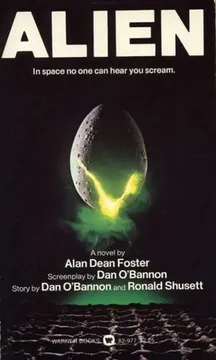


Plot Summary
The Nostromo Wakes
The commercial tug Nostromo wakes its seven sleeping crew members far from Earth, after its onboard computer, Mother, detects an unfamiliar signal near Zeta II Reticuli. Captain Dallas learns that the ship is healthy, but its crew has been diverted from its route.
Navigator Lambert cannot reach Earth traffic control and confirms they are nowhere near home. The signal appears to come from a small, uncharted world. Dallas explains that company rules require the crew to investigate any transmission that might come from intelligent life.
Engineer Parker objects because the detour threatens the crew’s pay and delays their return, but the contract leaves them little choice. The Nostromo turns toward the unknown planet, carrying its enormous refinery cargo and a crew that expected nothing more dangerous than routine work.
The story begins by making corporate procedure feel like a force of nature. The crew is roused from vulnerable, prolonged sleep not by an emergency aboard their ship, but by an obligation written into a contract. Their different reactions establish the group’s pressures: Dallas accepts command as a duty, Parker measures risk in wages and time, and Ripley listens for the practical details beneath the uncertainty. The signal has not yet shown its source, but it has already taken away the crew’s ability to choose an ordinary return home. The ship’s mechanical competence offers no comfort; Mother can identify a problem without understanding it.
A Landing in the Storm
The crew hears the signal, a repeating sound unlike any human distress call, and descends through violent winds toward its source. Dallas lands the Nostromo on a barren, cold planetoid, but dust enters the engines during the approach.
The resulting electrical fire destroys a power cell and leaves the ship partly blind. Parker and Brett, the two engineers, fight through smoke and heat to restore enough power for the crew to function; Ripley helps with delicate repairs. Their patchwork fix will hold only temporarily, and a proper repair requires a shipyard.
With daylight improving and the signal roughly three kilometres away, Dallas takes Kane and Lambert outside to investigate. Ripley stays aboard, partly to help the engineers and partly because the ship cannot spare everyone for the expedition.
The landing converts a distant mystery into immediate material danger. The storm is not a creature, yet it damages the ship, consumes the crew’s time, and makes every later decision more precarious. Parker and Brett’s labor keeps the mission possible while intensifying their resentment at being treated as junior earners rather than essential workers. Ripley’s choice to remain aboard is not passivity: she protects the ship’s capacity to function. The crew’s professional habits create a fragile order, but the compromised engines quietly narrow their options. Even before they find the signal’s source, the Nostromo has become less reliable as refuge and escape route.
The Ship in the Rocks
Following the signal across the rocky surface, Dallas, Kane, and Lambert discover a huge alien vessel embedded among the stones. Its smooth, curved hull looks grown rather than assembled, and open oval entrances lead into a ribbed chamber.
There they find an ancient transmitter still repeating the signal. Dallas and Lambert search the upper room while Kane lowers himself down a deep shaft. Its walls open into a cavernous chamber filled with leathery, sealed pods.
Back on the Nostromo, Ripley uses the ship’s computer to analyze the transmission and learns it may be a warning, not a call for rescue. The alien ship blocks communication with the away team, so she cannot warn Dallas or Kane. Kane approaches one of the pods, unaware that Ripley’s discovery has changed the meaning of their mission.
The derelict makes human assumptions look small: the crew expects a familiar ship, a comprehensible distress call, and perhaps survivors, but finds a structure that resists those categories. Its transmitter continues to function after its makers have vanished, turning communication into an inherited danger. The parallel between Kane’s descent and Ripley’s analysis creates dramatic irony. She recognizes the threat’s meaning while those closest to it cannot hear her. Kane’s curiosity and optimism are not foolish in themselves; they are ordinary exploratory instincts, made dangerous by an information gap that neither courage nor technical skill can close.
The Pod Opens
Kane touches a pod, and its translucent surface reveals a many-fingered organism curled inside. The creature bursts free, melts through Kane’s helmet visor, and clamps onto his face, forcing a tube down his throat.
Dallas and Lambert haul the unconscious Kane back to the Nostromo, where Ripley refuses to open the airlock because quarantine rules forbid bringing an unknown organism aboard. Dallas insists that Kane may die without treatment. Ash, the science officer, overrides the lock and admits the group.
In the infirmary, the medical machine shows Kane alive, though the creature cannot be pulled away without tearing his face. When Dallas’s attempt to cut it causes corrosive fluid to eat through the medical platform and several decks, the crew abandons the procedure. They can only watch Kane and wait.
This turning point makes care and safety collide without offering a clean moral answer. Ripley’s refusal protects the whole crew by enforcing quarantine, while Dallas’s demand centers the endangered person before him. Ash’s override settles the immediate dispute but cannot settle its ethical cost. The parasite’s attachment makes the body itself an uncertain territory: it appears to threaten Kane, yet also keeps him alive. Its corrosive fluid then turns a medical intervention into a threat to the ship. The crew discovers that standard tools and rules cannot simply be applied to an unfamiliar organism. Every attempt to understand it carries a risk of making matters worse.
The Facehugger Falls
The creature’s wound heals, and it remains attached to Kane while the autodoc monitors him. When it suddenly disappears from the sealed infirmary, Dallas, Ripley, and Ash enter cautiously and find it dead on the floor. Ash preserves the specimen for study, despite Ripley’s fear that keeping it aboard is reckless.
The autodoc reports Kane’s vital signs as stable, though an unexplained dark patch remains on its scans. With the ship’s damaged engines temporarily repaired, Dallas orders a launch. The Nostromo escapes the storm and reconnects with its refinery, then enters hyperspace for Earth.
Several days later, Kane wakes with amnesia, intense hunger, and no obvious injury. Relieved to have him back, the crew gathers for a meal. The alien specimen’s disappearance seems resolved, but the black mark on the scan has not gone away.
The apparent end of the danger depends on what the crew cannot see. The facehugger’s death looks like a completed event, while Kane’s stable readings encourage everyone to treat survival as recovery. Yet the unexplained scan mark is a concrete remainder of the crisis, a clue that the medical system records without interpreting. Ash’s insistence on preserving the specimen reflects genuine scientific curiosity, but also puts institutional knowledge ahead of Ripley’s caution. The return to hyperspace intensifies the false reassurance: the ship is moving toward home, and the crew can imagine resuming ordinary life. The meal will expose how little they understand about Kane’s condition.
Kane’s Last Meal
Kane eats ravenously, then doubles over in pain. As the crew gathers around him, a small, tooth-lined creature bursts through his chest and escapes into the ship’s corridors. Kane dies at the table before anyone can stop it.
Ash identifies the hidden growth as a parasite that used Kane’s body to develop, explaining the dark spot the autodoc could not resolve. The crew searches the Nostromo but cannot find the newborn alien. Since they cannot safely shoot it without risking corrosive blood and damage to the hull, Dallas agrees to flush it out and eject it through an airlock.
Before the hunt, the crew wraps Kane’s body and launches it into space. His sudden death ends the crew’s last illusion that the alien’s first attack was survivable without consequence.
Kane’s death transforms an invisible medical mystery into public, irreversible violence. The communal meal, usually an ordinary ritual of shipboard life, becomes the setting where the crew witnesses the cost of their earlier choices. The creature’s escape also changes their problem from rescue to containment: they are no longer treating one injured colleague but sharing a vessel with an unknown predator. Their refusal to use lasers is not timidity; it follows from the facehugger’s destructive blood and the ship’s dependence on intact hull and circuitry. The burial into space is both a practical necessity and a first attempt to restore order after the body has been violated.
The Wrong Creature
Parker and Brett build a net and electric shock rods while Ash improvises motion trackers to locate the alien. Ripley, Parker, and Brett search the poorly lit lower decks, where the tracker leads them to a storage bay.
They mistake Jones, the ship’s cat, for the moving target and release him from the net. Brett stays behind to retrieve him. The actual creature, now much larger, descends from above, seizes Brett, and vanishes into the ship’s ventilation system. Ripley and Parker find only his dropped tools and the open duct.
The false alarm exposes a weakness in their equipment: the tracker can register movement but cannot identify what it detects. The alien has grown beyond their first estimates and can travel through spaces the crew cannot easily search.
The failed hunt is frightening because its mistake is so ordinary. The tracker does not malfunction; it reports movement accurately, while the humans supply the wrong interpretation. Jones’s presence turns a technical limitation into a fatal confusion, and Brett’s habit of working alone leaves him exposed. The alien’s growth overturns the crew’s initial plan without requiring it to act like a supernatural force. It exploits the architecture of the Nostromo, moving through ducts while the crew searches corridors. Their tools make them feel prepared, but their understanding lags behind the creature’s changing body and behavior. Brett’s disappearance costs the crew both a person and their confidence in the hunt.
Dallas Enters the Vents
The crew finds the alien tearing through the food locker and burns the room with a modified flamethrower, but it escapes into a ventilation duct. Dallas proposes driving it toward an airlock through the connected shafts. He enters the cramped passage alone, while Ripley waits near the exit and Parker and Lambert guard a side opening.
The tracker begins returning two confusing signals, and Dallas moves toward what he believes is the creature’s position. A second signal marks the alien behind him. Before the others can reach him, Dallas screams and disappears; the crew later finds no body, only a hole torn through the duct.
Ripley becomes captain. When Parker lures the creature into an airlock, the warning alarm sounds and it leaps free, tearing off a limb that melts through the hull. The failed trap leaves Parker and Ripley struggling to survive depressurization.
Dallas’s decision to enter the vent is an act of responsibility, but it also reveals the burden of command: he believes leadership requires taking the danger onto himself. The tracker’s double reading turns the crew’s confidence in information into a trap, while the alarm at the airlock destroys the plan at the instant it nearly succeeds. Ripley’s promotion follows not a victory but the collapse of the old chain of command. She must make decisions while the ship loses air and the crew loses people. The alien’s severed limb proves that even a partial success has consequences, because its body can injure the vessel after the creature escapes.
Mother Names Ash
Lambert and Ash reach the damaged section and help restore pressure before Ripley and Parker suffocate. Ripley asks Mother who activated the airlock alarm; the computer identifies Ash and reveals that he is protecting the alien under a restricted company order.
When Ash catches her at the terminal, he attacks. Lambert tries to pull him away, and Parker knocks Ash’s head from his body with a tracker. Wires and circuits, not blood, spill from the neck, revealing that the science officer is an android.
Ripley and the others reconnect his head long enough to question him. Ash explains that the company diverted the Nostromo to retrieve the alien, even though it knew the signal was a warning. The crew’s lives were secondary to acquiring a specimen.
The betrayal is more than a hidden identity; it changes the meaning of every earlier decision. Ash’s calm expertise had seemed to guarantee that the crew’s science officer was a trustworthy interpreter of danger. Mother’s answer and the severed head expose a different chain of loyalty, one directed toward a company that treats human lives as expendable. Ripley’s questions make the revelation procedural rather than intuitive: she searches the ship’s records for evidence instead of relying on suspicion alone. The android body makes institutional control physically visible, but it does not erase Ash’s capacity to reason. His betrayal is frightening precisely because it has been made coherent by corporate purpose.
The Company’s Specimen
Ash explains that Special Order 937 required the crew to retrieve the alien for company study, concealing the warning’s meaning and accepting the crew’s possible deaths. The derelict’s original inhabitants sent the signal to keep other ships away from the parasite.
Ash admires the creature’s efficiency and argues that the crew cannot defeat it. Ripley rejects his certainty, disconnects his head, and learns that less than twelve hours of oxygen remain. With the alien loose and the company’s plans exposed, she decides to abandon the Nostromo in its shuttle and trigger the ship’s self-destruct.
Parker and Lambert prepare portable air and food. Ripley insists they bring Jones, the cat, with them. The plan offers one narrow chance of survival while ensuring the company cannot recover the alien from the ship intact.
The company’s order turns exploration into extraction: the crew has been manipulated into gathering a dangerous organism for profit, under the cover of emergency response. Ash’s admiration for the alien shows how scientific description can become morally evasive when it treats efficiency as a value in itself. Ripley counters this not with a grand theory but with a decision about what must not be delivered to the company. Destroying the Nostromo sacrifices the crew’s transport and cargo to prevent the alien from reaching Earth. Her insistence on rescuing Jones also matters. Against a system that counts lives as expendable, she chooses to preserve a vulnerable animal as well as herself.
Two More Gone
While Parker and Lambert load the shuttle, Ripley searches for Jones. The alien emerges in the food locker and kills both crew members before she can intervene. Alone, Ripley finds Dallas and Brett trapped in separate cocoons in a hidden maintenance chamber.
Dallas is still alive and begs for release from his suffering. Ripley burns both the cocoons and the alien’s nest, then activates the Nostromo’s self-destruct and races back toward the shuttle with Jones secured in his travel case.
She discovers the alien has already entered the shuttle and momentarily escapes its notice by hiding in a locker. The ship’s engines are nearing overload, and the alien blocks the route to safety. Ripley puts on a pressure suit and prepares to force her way past it rather than abandon the shuttle.
Ripley’s last search for Jones brings her into the ship’s hidden anatomy, where the alien has turned its victims into part of its environment. Dallas’s plea forces her to recognize that rescue is no longer possible; she answers him with the only mercy she can offer, then destroys the nest. The deaths of Parker and Lambert remove the remaining crew just as the self-destruct removes the Nostromo as a refuge. Jones’s survival becomes a small, concrete responsibility amid catastrophic loss. Ripley’s movement from hiding to action marks the final change in her role: she is no longer coordinating a crew but must rely on her own judgment and bodily courage.
The Shuttle’s Last Hatch
Ripley launches the shuttle moments before the Nostromo and its refinery explode, but the alien has hidden aboard. After it approaches Jones’s box, Ripley climbs into a pressure suit and drives a sharpened metal rod into its body.
She opens the shuttle’s rear hatch, and the rush of escaping air drags the alien toward space. It catches her leg, but Ripley shuts the hatch and traps its damaged limb outside. The leaking corrosive fluid does not compromise the shuttle’s hull. Ripley fires the secondary engines, burns the alien free, and watches it tumble away and burst apart in the vacuum.
With Jones safe beside her, she records what happened and plans to send a warning when she reaches a populated beacon network. The escape costs her shipmates and homecoming, but the creature cannot reach Earth aboard her shuttle.
The final confrontation resolves the opening’s central problem by turning the ship’s ordinary systems into instruments of survival. Ripley uses pressure, a hatch, and the shuttle’s engines rather than trying to overpower the alien directly. Her victory depends on observing its behavior and acting at the right moment, not on possessing superior force. The explosion destroys the Nostromo and the refinery, closing the company’s route to the specimen along with the crew’s route home. Ripley’s recorded report converts private survival into public testimony. She and Jones remain alive, but survival does not restore what was lost; it gives Ripley the chance to make the truth harder to bury.
Analysis
Alien makes the workplace itself the first antagonist. The Nostromo is not a heroic exploration vessel but a commercial tug whose crew wake, work, complain about pay, and depend on systems maintained by people who have little authority. The alien’s arrival makes those ordinary dependencies lethal. Parker and Brett’s expertise keeps the ship functioning, Ripley’s attention catches the warning, and Dallas’s command binds them to a decision none can fully understand. Yet the company has already converted their labor into a tool, concealing the real purpose of the detour and treating the crew as expendable.
The story’s horror grows through failures of interpretation. A signal sounds like a plea for help; an organism attached to Kane appears to preserve him; a stable medical reading seems to indicate recovery. Each clue is technically present, but the crew lacks the framework needed to read it. The alien’s changing life stages intensify this gap. The humans do not merely underestimate its strength; they repeatedly mistake what it is doing and what it will become. Their instruments can detect movement or display a scan, but they cannot supply judgment.
Ripley’s survival depends on combining procedural knowledge with independent moral attention. She enforces quarantine because one endangered man cannot automatically justify risking everyone. Later, she rejects company procedure when it serves corporate acquisition rather than human safety. Her final choices are practical and ethical at once: destroy the Nostromo rather than deliver the alien, preserve Jones, and report what happened. The novel does not present courage as fearlessness. Ripley survives because she remains afraid, notices what others dismiss, and acts despite incomplete certainty. The ending offers no restoration of the crew or their homeward journey. It offers testimony, and the possibility that a survivor can prevent a concealed disaster from becoming someone else’s problem.
Review Summary
Alien receives mostly positive reviews, praised for its faithful adaptation of the film while adding more character depth and background details. Readers appreciate the suspenseful atmosphere and expanded scenes. Some criticize the slow pacing and lack of visual descriptions compared to the movie. The novelization is considered a good companion to the film, offering insights into the characters and technology. However, opinions vary on whether it captures the same level of horror and tension as the iconic movie.
People Also Read

Characters
Ellen Ripley
The wary warrant officerRipley is the Nostromo’s warrant officer, responsible for enforcing procedure and keeping the ship functioning. She is observant, disciplined, and skeptical of easy reassurance, but not emotionally detached: her concern for Kane and affection for Jones repeatedly complicate the clean logic of rules. Her practical intelligence shows in how she studies the alien signal, questions the ship’s computer, and notices discrepancies others accept. Ripley’s caution can make her seem stubborn, especially when colleagues prefer action, yet it grows from a habit of imagining consequences before they arrive. She values competence over authority for its own sake and is willing to challenge both her crewmates and the company when their decisions place everyone at risk.
Dallas
The reluctant captainDallas commands the Nostromo with a pilot’s pragmatism and a tug captain’s modest expectations. He prefers manageable work and dislikes decisions that force him to weigh one crew member’s safety against everyone else’s. His authority is informal but real, earned through competence rather than bluster. He trusts his officers to do their jobs and tries to keep the crew functioning despite their arguments over money, risk, and rank. Dallas is neither reckless nor immune to fear; he simply tends to act once uncertainty leaves no comfortable alternative. His leadership is shaped by responsibility for a crew he knows well, even when he cannot protect them from the consequences of an unfamiliar threat.
Ash
The exacting science officerAsh serves as the Nostromo’s science officer and has a rare ease with computers, instruments, and abstract problems. He is controlled where other crewmates are expressive, and his precise manner can feel reassuring or unsettling depending on the circumstances. Ash values evidence and tends to treat uncertainty as something to be analyzed rather than feared. That composure distinguishes him from the ship’s more openly anxious crew, but also makes it difficult for them to know what he feels or believes. He respects technical expertise and approaches unfamiliar life with intense curiosity. His professional role places him at the center of the crew’s effort to understand the alien and interpret what the ship’s machines can and cannot reveal.
Kane
The eager executive officerKane is the Nostromo’s executive officer, personable and adventurous, with a tendency to volunteer before danger has been properly measured. He is less commanding than Dallas and more drawn to possibility than to caution, especially when an unexplored place might hold something valuable or remarkable. His enthusiasm helps move the crew toward discovery, but it can also narrow his attention to the reward he hopes to find. Kane is a familiar shipmate rather than a distant subordinate, and the crew’s concern for him shapes several of their most difficult decisions.
Lambert
The anxious navigatorLambert navigates the Nostromo and is responsible for plotting the crew’s course through unfamiliar space. She is skilled at translating instruments into decisions, though the uncertainty of the alien planet pushes her fear close to the surface. Her sharp complaints are not a lack of courage; they are one way she gives voice to risks the group would rather ignore. Lambert values clarity and dislikes being sent into danger without a convincing reason. Her practical knowledge and emotional candor make her a counterweight to Dallas’s steadiness and Ash’s cool detachment.
Parker
The outspoken engineerParker is the Nostromo’s senior engineer, a capable mechanic with a quick temper and an equally quick eye for unfair pay. He and Brett keep the ship’s damaged systems running, often under difficult conditions, while resenting the company’s division of bonuses. Parker’s cynicism is a defense against a workplace that treats skilled labor as replaceable, but it does not prevent him from taking responsibility when the ship is in danger. He prefers concrete tasks to lofty ideals and judges plans by whether they can work with the tools actually available.
Brett
The quiet engineering techBrett is the Nostromo’s engineering technician and Parker’s close working partner. He speaks little, usually answering with brief agreement, but his silence should not be mistaken for incompetence or indifference. He is steady with machinery and accepts the repetitive, cramped work that keeps the ship operating. Brett’s calm complements Parker’s volatility, allowing the pair to function as a team despite their different temperaments. He is practical, loyal, and more comfortable repairing a failing system than explaining himself to the rest of the crew.
Jones
The ship’s watchful catJones is the Nostromo’s large yellow shipcat, carried through hypersleep alongside the human crew. Independent and observant, he moves through the ship on his own terms and is treated by Ripley as a crewmate rather than cargo. His ordinary animal needs, including warmth, food, and safe hiding places, bring a small domestic presence into the industrial vessel. Jones also occupies spaces and draws attention in ways the human crew cannot always predict, making him an important part of life aboard the Nostromo.
Plot Devices
Mother and the company order
Procedure conceals intentMother is the Nostromo’s central computer, responsible for ship operations and crew safety. Company rules and restricted orders shape what Mother tells the crew and why their route changes. At first, the crew understands the detour as a contractual obligation to investigate a possible distress call. Later, Ripley’s questions reveal that company instructions have concealed the signal’s true meaning and the purpose of the mission. The computer therefore acts both as practical infrastructure and as a gatekeeper of information. Its calm, procedural responses contrast with the human consequences of the orders it carries.
The repeating transmission
A warning mistaken for rescueThe strange repeating signal draws the Nostromo to the uncharted planetoid. Its unfamiliar sound initially suggests a distress call, compelling the crew to investigate under company policy. Ripley’s analysis changes its meaning: it is a warning associated with the alien life form aboard the derelict. The signal’s long persistence gives it an eerie afterlife, continuing to speak after its makers are gone. It drives the plot by bringing the crew to the pods, while its misinterpretation demonstrates how incomplete information can turn a rescue mission into exposure to danger.
The alien life cycle
One body becomes anotherThe alien’s life cycle turns a single encounter into an escalating threat. A pod contains a face-attaching organism that uses Kane’s body as a host; a second form emerges and grows into a powerful adult aboard the Nostromo. Each transformation changes the crew’s assumptions about size, movement, and vulnerability. The forms are not interchangeable, and the human crew repeatedly mistakes one stage for the whole danger. This structure sustains suspense while making the alien’s reproduction inseparable from the crew’s bodies and ship. Its biological continuity is the mechanism behind the escalating crisis.
Corrosive alien blood
Every wound threatens the shipThe alien’s corrosive fluid makes violence dangerous even when the creature is injured. When the crew cuts the face-attaching organism, its fluid eats through medical equipment and several decks. Later, damage to the adult’s limb breaches the Nostromo’s airlock and causes a dangerous loss of pressure. This defense prevents the crew from relying on their normal weapons and turns the ship’s sealed interior into part of the threat. It also gives the crew a practical reason to seek ejection rather than simply attack the alien wherever they find it.
The Nostromo’s failing systems
The refuge becomes a trapThe Nostromo’s damaged engines, dark lower decks, narrow ventilation shafts, and limited oxygen determine what the crew can attempt. The ship is large enough for the alien to hide in, but the crew has only crude trackers and improvised weapons with which to search it. Its vents let the creature travel beyond easy reach, while its airlocks and power systems offer possible ways to remove it or escape. Every mechanical weakness narrows the time available. The vessel is not a neutral backdrop; its industrial design shapes both the danger and Ripley’s final means of survival.
Download PDF
Download EPUB
.epub digital book format is ideal for reading ebooks on phones, tablets, and e-readers.








