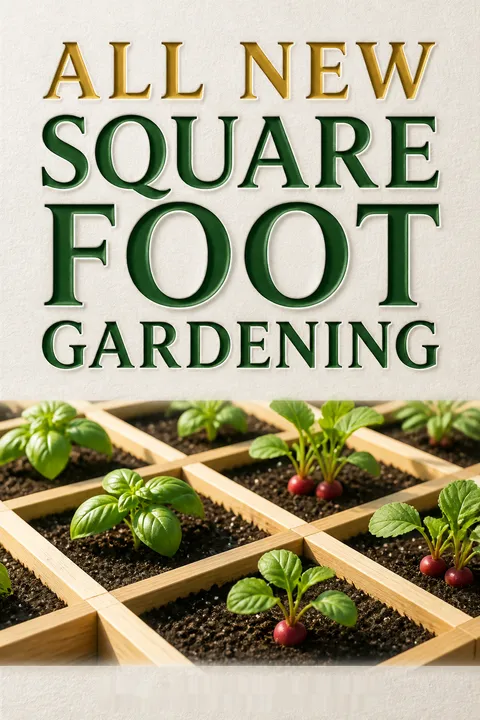


Key Takeaways
Trade sprawling rows for a compact garden planned around actual meals
Start with a better question. After retiring from engineering, Mel Bartholomew helped organize a community garden. By midsummer, weeds had taken over and many enthusiastic gardeners had stopped showing up. He began questioning familiar practices: Why leave broad aisles between rows, sow far more seeds than needed, and grow more food than a household can use? The method he developed treats those habits as design problems, not unavoidable parts of gardening.
Make space earn its keep. A standard Square Foot Garden is a 4-by-4-foot raised box divided into 16 planting spaces. The book compares it with a surveyed average row garden of 700 square feet and estimates that a Square Foot Garden can grow comparable amounts in about one-fifth the area. Actual yields vary by crop, climate, and care, but the principle is clear: plan for food you will use, not acreage you can barely maintain.
The book’s strongest move is to make gardening an exercise in redesign rather than endurance. Its origin story turns an abandoned, weedy community plot into evidence that the old layout may be the problem, not the gardener’s character. This is a useful lesson in any practical system: if people routinely abandon a task, reduce the task’s friction before blaming their motivation. The yield comparison is an estimate, not a universal guarantee. Still, a smaller bed near the house can make tending and harvesting easier, which is often more valuable than theoretical maximum output.
Build the garden around Mel's Mix, not whatever soil you have
Use a prepared growing medium. Mel’s Mix is a blend measured by volume: one-third blended compost, one-third peat moss, and one-third coarse vermiculite. Bartholomew chose these materials to create a light, crumbly medium that holds moisture while draining excess water. The compost supplies nutrients, so a standard box only needs about 6 inches of growing medium for most crops. The method avoids digging and improving the existing ground soil, and can even be used on a patio if the box has a suitable bottom and drainage.
Replenish what plants consume. The mix settles and loses compost as plants grow. Add a trowelful of fresh compost to a square after harvest, then top up the whole box before a new season. The book reports that well-maintained Mel’s Mix can last 7 to 10 years. Peat moss alternatives such as coconut coir are discussed, but the book regards the original ingredients as the most dependable formula.
Mel’s Mix makes the method unusually coherent: the shallow bed, dense planting, and simple watering all depend on a growing medium designed to support them. In systems terms, it replaces repeated repair of variable ground with a more controlled starting condition. That can make gardening easier for beginners, renters, and people with poor native soil. The tradeoff is that the recipe depends on sourced materials, and compost quality matters. Treat the formula as a strong design standard, while checking ingredient availability, local growing conditions, and the environmental cost of materials such as peat.
Use the grid to plan harvests before buying seeds or building boxes
Count plants, not rows. The one-foot grid makes a garden plan visible before anything is planted. As a rule of thumb, a square can hold one extra-large plant, four large plants, nine medium plants, or 16 small plants. The seed packet’s spacing instructions help refine those numbers. For instance, a 4-by-4 box contains 16 squares, but a cabbage may use one whole square while radishes can be planted 16 to a square.
Match the garden to appetite. The book suggests that one 4-by-4 box can provide an adult with daily salad greens during the growing season; a second can add supper vegetables, and a third can supply extra produce. Those are planning guides, not promises. Draw the grid, assign crops, and estimate how often each square can be replanted. Starting with one box lets a gardener learn real household demand before expanding.
The grid is more than a spacing aid. It is a planning interface that turns an abstract garden into a set of manageable decisions: how many plants, what will ripen, and what should follow. That resembles portion planning in food service or capacity planning in operations. The book’s adult and child estimates make a useful starting point, but appetite, climate, and crop preferences differ widely. A written map helps close that gap: it converts a generic yield claim into a plan the household can revise after one season.
Train vines upward before they steal space from neighboring crops
Use the vertical plane. Beans, peas, cucumbers, melons, squash, pumpkins, and tomatoes can be supported on trellises rather than allowed to sprawl. A trellis frees ground space and lifts leaves and fruit away from soil contact, while improving exposure to air and sunlight. The classic design uses metal electrical conduit for the frame and nylon netting for climbing plants. The book recommends placing the trellis on the north side of the garden in most climates so it is less likely to shade shorter crops.
Support the weight. Heavy crops need a stronger frame than light peas or beans. The book describes using steel fence posts instead of rebar for extra support and tying large fruits in slings. In a demonstration garden, pumpkins weighing 35 pounds were grown several feet above the ground. Vertical growing is not just a space-saving trick; it requires a frame built for the crop it will carry.
Vertical gardening shows how a small footprint can be expanded without making the bed harder to reach. It also changes the garden’s visual character, turning a box into a leafy screen or an archway. The structural advice matters: a trellis is a load-bearing garden component, not decoration, especially when fruit becomes heavy or wind catches a mature vine. Vertical growth will not suit every plant or every site. The useful principle is to choose supports according to crop weight, sunlight direction, and access for harvesting.
Put beds where sunlight, access, and daily attention converge
Choose the site before the shape. Most vegetables need 6 to 8 hours of sunlight a day. A spot with only 4 to 6 hours may still support leafy crops and some root vegetables, but fruiting crops generally need more. Avoid low areas where water pools and places close to trees or shrubs, whose shade and roots can interfere. Because the garden uses its own growing medium, poor native soil is not a reason to abandon the idea.
Make reaching easy. Position boxes near the house or a well-used path, where watering and harvesting will not require a special expedition. A 4-by-4 box is accessible from all sides; narrower boxes work better when access is limited to one side. The method adapts to decks, patios, sloped yards, and elevated beds for gardeners who cannot comfortably bend. The grid squares, not the bed’s overall outline, define the planting system.
This is a practical insight about attention as much as horticulture. A garden placed where it is seen during ordinary routines is easier to inspect, and small problems are easier to notice before they spread. The design also challenges the assumption that gardening requires a conventional backyard. Raised and tabletop beds can support access for people with mobility limitations, though height, weight, drainage, and stability still need careful planning. Sunlight is less negotiable than soil quality, so observing a site through the day is a better first step than buying lumber.
Plant each square precisely, then replant it as soon as harvest ends
Waste fewer seeds. Instead of scattering a packet and thinning most seedlings later, place seeds at their intended final spacing. Bartholomew recalled counting more than 1,000 seeds in a lettuce packet, illustrating how a small amount can last across multiple seasons. Store unused seeds cool, dark, and dry; the book recommends sealed jars in the refrigerator. Follow each packet’s planting depth and temperature guidance, and keep the surface moist while seeds sprout.
Keep squares in production. When a crop is finished, remove its remains, mix a trowelful of compost into the square, and plant again. A short-season crop may be followed by a warm-season crop, then by a cool-season one. The book also recommends selective separation: grow repeated instances of the same crop in different boxes where possible, rather than clustering them, to reduce the chance that a crop-specific problem spreads easily.
Precise sowing and rapid replanting turn a garden into a sequence of small, legible cycles. This is a form of resource efficiency: seeds, space, and nutrients are assigned to a crop rather than spent on plants that will be discarded. The grid makes succession planning unusually concrete. Yet crop timing is local, and a square cannot be replanted just because the calendar says so; soil temperature, frost dates, and the crop’s maturity period matter. The book’s emphasis on keeping notes is therefore valuable, because each season can improve the next plan.
Water at the roots when plants ask, not on a fixed schedule
Keep maintenance targeted. Mel’s Mix is designed to retain moisture, so a Square Foot Garden generally needs less watering than a broad row garden. Bartholomew’s preferred approach is to watch the plants and pour water directly at the base when they show signs of needing it, using a cup of water warmed in a nearby bucket. Drip irrigation or a homemade watering grid can make the job easier, especially across several boxes.
Skip routine inputs. Fresh Mel’s Mix begins without weed seeds, and a layer of landscape fabric beneath the box blocks many weeds from below. Windblown weeds can still appear, but the loose medium makes them easy to pull. The compost normally supplies nutrients, so routine fertilizer is unnecessary; a small amount of ground limestone may help selected crops that prefer less acidic conditions. The book favors physical pest barriers and hand removal over synthetic pesticides.
The method’s low-maintenance promise comes from putting effort where it has leverage: at the root zone, in the growing medium, and around the bed’s perimeter. It replaces broad, repetitive inputs with observation and small corrections. That is an appealing model for resource-conscious gardening, but it should not be mistaken for zero care. Water needs vary with weather, crop size, and container exposure; a box in hot, windy conditions can dry faster than one in a sheltered yard. The gardener still needs to inspect the bed, just not spend the season fighting its layout.
Use covers and cool-season crops to stretch harvest beyond summer
Treat the season as extendable. A Square Foot Garden’s small size makes it easier to cover against cold, wind, insects, or intense sun. Clear plastic can warm the growing medium for early planting; a dome or covered frame can protect seedlings, while shade cloth can shelter cool-season greens from summer heat. As one crop finishes, a square can be replanted with a crop suited to the next part of the season. Fall crops such as lettuce, spinach, and radishes can keep a bed productive after summer vegetables decline.
Harvest for use, not display. Pick leafy crops a few outer leaves at a time, and harvest fruit before it becomes overripe. Store vegetables according to their needs: some, such as onions and winter squash, prefer cool, dry conditions; many root crops need colder, more humid storage. Freezing, drying, and canning can preserve surplus, but careful handling and timely harvest reduce waste in the first place.
Season extension is a reminder that gardening is partly the management of local microclimates. A cover, a sunny wall, or a sheltered corner can change what a small bed can produce, while a crop calendar helps the gardener use those advantages deliberately. The book offers a range of techniques, but winter production is not equally realistic in every climate, and covers require ventilation when sunlight raises temperatures. The broader lesson is to treat harvest timing as a design choice, then use storage and preservation methods suited to the actual crop.
Turn a small bed into a shared classroom, pantry, and neighborhood project
Scale the method socially. The compact boxes and simple routines make Square Foot Gardening adaptable to schools, community sites, care homes, and urban spaces. A school garden can teach planting, arithmetic, and plant growth through hands-on work. Elevated beds can improve access for older gardeners and wheelchair users. The book also encourages community organizers to set clear rules, allow adequate paths, and plan for maintenance, liability, and shared resources.
Build partnerships around food. One example joins St. John Baptist Church in Columbia, South Carolina, Columbia College, and the Square Foot Gardening Foundation. They replaced a neglected row garden with 10 Square Foot Garden boxes as part of a broader health-awareness effort that included gardening, cooking, and walking. The project shows how a garden can connect organizations and produce food in a modest space. It illustrates a possible contribution to food access, not proof that one gardening method can solve hunger by itself.
The community case extends the book’s central design logic: a method is valuable when people can learn it, maintain it, and share its output. A garden can function simultaneously as food production, informal education, and a place where neighbors cooperate. Those benefits depend on governance as much as horticulture. Clear responsibilities, accessible paths, and reliable watering often matter more than an attractive launch day. The book’s ambition to address hunger is compelling, while the garden itself remains one part of a larger response involving food distribution, land access, and sustained community support.
Analysis
Square Foot Gardening is best understood as a deliberately integrated system, not simply a raised bed with a decorative grid. Its parts reinforce one another: the small box limits the area that needs attention, the grid turns planting into repeatable units, Mel’s Mix replaces variable ground soil, vertical supports add growing surface, and succession planting keeps each unit productive. The system’s memorable achievement is behavioral as much as botanical. A garden close to the home, sized to a household, and organized into small tasks is easier to keep tending than a distant plot with long rows and recurring weeds.
The method also makes gardening knowledge more accessible. Instead of asking beginners to master soil testing, tilling, fertilizer schedules, and broad pest control before producing food, it provides a narrow set of decisions they can practice immediately. This can reduce intimidation and give children or mobility-limited gardeners a clearer entry point. The grid is especially effective as a teaching tool because it makes spacing, counting, and crop planning visible.
The book’s most sweeping claims deserve context. Yield per square foot depends on crop choice, climate, skill, and the value assigned to a harvest; a compact bed does not make every crop equally productive. The recommendation to use peat moss also raises an environmental tradeoff because it is not a rapidly renewable material. Compost quality and access to coarse vermiculite can limit the method’s convenience or affordability. Dense planting is not a substitute for observation, and diverse crops can reduce some shared risks without eliminating pests or disease.
These qualifications do not weaken the method’s core insight. They clarify where its value lies: organize the garden so that space, attention, water, and seeds are used intentionally. The recipe may need adaptation, but the engineering instinct behind it remains broadly useful. Make the productive unit small enough to manage, put it where people will notice it, and give every square a next purpose.
People Also Read


Glossary
Square Foot Gardening
Grid-based intensive gardeningA vegetable-growing method that organizes a raised bed into one-foot planting squares. Each square is planted according to the crop’s size, and finished squares can be replanted. The method emphasizes a prepared growing medium, dense planting, vertical supports for suitable crops, and a compact layout intended to reduce wasted space and routine maintenance.
Mel’s Mix
Prepared garden growing mediumThe growing medium recommended for Square Foot Gardening, measured by volume as equal parts blended compost, peat moss, and coarse vermiculite. The compost supplies nutrients, while peat moss and vermiculite help create a light medium that retains water and drains excess. Gardeners replenish the compost as crops use it and the mix settles.
Selective separation
Separate repeated crop plantingsA planting practice recommended in the book: when growing several squares of the same crop, place them in different boxes where possible rather than clustering them together. The purpose is to make it less likely that a crop-specific pest or disease affecting one planting will easily spread to all the others.
Download PDF
Download EPUB
.epub digital book format is ideal for reading ebooks on phones, tablets, and e-readers.








