

Key Takeaways
Treat racism as America's founding sin, not a string of isolated incidents
Trace the inheritance. Wallis calls racism America’s original sin because conquest of Indigenous peoples and the enslavement of Africans were not side notes to nation-building. They shaped its laws, economy, and ideas about who counted as fully human. Slavery lasted 246 years; its end did not dismantle white supremacy, which continued through segregation and exclusion.
Measure the present. Wallis connects that history to unequal conditions in his own era. In 2013, he reports, median white household wealth was about $142,000, compared with $11,000 for Black households. Native Americans and Asian Americans also face distinct legacies of dispossession, exclusion, and stereotyping. The point is not that every racial history is identical, but that old arrangements leave durable effects.
The phrase original sin shifts attention from isolated prejudice to inherited institutions and habits. That is analytically useful: a society can outlaw explicit discrimination while preserving unequal outcomes through housing, education, employment, or criminal law. The theological frame also insists that history is morally consequential, not merely something to regret. Its risk is that a religious vocabulary may not persuade readers outside the faith tradition, or may sound like inherited personal guilt. The strongest reading separates guilt for ancestors’ acts from responsibility for present arrangements: people need not have created an unjust system to have a role in changing it.
Believe the pattern even when one incident's facts are complicated
Separate the questions. Ferguson became a national flashpoint after police officer Darren Wilson killed Michael Brown. A Justice Department investigation of the shooting did not substantiate the early claim that Brown was killed with his hands raised, and found insufficient evidence for federal charges. A separate investigation examined the city’s police department and courts, finding a pattern of discriminatory enforcement and revenue collection.
Read beyond the headline. Black residents were 67 percent of Ferguson’s population, yet accounted for 85 percent of vehicle stops, 90 percent of citations, and 93 percent of arrests. Wallis argues that uncertainty about one confrontation does not erase documented institutional abuse. The two reports show why trustworthy debate requires both factual care about individual cases and attention to the broader system around them.
This is a valuable model of disciplined moral reasoning. People often treat a disputed detail in a highly publicized case as a verdict on whether systemic injustice exists at all. The reverse mistake is also possible: an urgent cause can become attached to a claim that later evidence complicates. Wallis’s account makes room for correction without abandoning the underlying concern. That distinction strengthens public argument because it replaces tribal loyalty with a shared obligation to follow evidence. Still, statistics describe disparities, not by themselves every cause behind them. Good analysis needs both careful data and the testimony of people who experience the system.
Make repentance visible in changed rules, institutions, and daily choices
Turn around, concretely. Wallis uses the biblical idea of repentance, including the Greek term metanoia, to mean a change of mind and direction that shows up in conduct. Regret or apology alone cannot repair a wrong that has been embedded in laws and institutions. If racism is named as sin, repentance must include changing the practices that perpetuate it.
Repair what can be repaired. Wallis points to South Africa’s Truth and Reconciliation Commission as an imperfect but influential effort to bring victims and perpetrators together around truth, acknowledgment, and accountability. In the United States, he argues, repentance should mean confronting unequal policing, restoring voting rights, and addressing disparities in schools and economic opportunity. The goal is neither inherited personal blame nor quick absolution. It is a sustained turn toward justice.
This account makes moral language operational. It asks whether an apology changes who holds authority, how institutions behave, or who receives repair. That prevents reconciliation from becoming a performance in which the injured are asked to forgive while the underlying arrangement remains untouched. At the same time, repentance should not collapse into a demand for symbolic self-punishment. A useful standard is whether actions reduce harm and restore agency, especially for those most affected. The South African example also points to a hard design problem: truth-telling and forgiveness can open a path forward, but they do not automatically settle questions of material repair or legal accountability.
Notice inherited advantage, then use it to dismantle unequal systems
Look past intentions. Wallis describes whiteness as a social identity formed in America that helped distinguish Europeans from people of color and justify unequal treatment. White privilege, in his account, means benefits attached to that history, even when an individual opposes racism. Implicit bias adds another layer: learned associations can influence judgments without conscious intent.
Follow the benefits. Wallis recalls that his family used the postwar GI Bill for education and home ownership, while Black veterans were often blocked from comparable benefits by local discrimination. He also discusses white fragility, a term for defensive reactions when racial assumptions are challenged. His practical ask is not for white readers to prove they are good people, but to listen, examine their advantages, and act against systems that preserve them.
This distinction between intent and effect is essential: a person can reject bigotry and still benefit from arrangements shaped by it. The GI Bill example gives that claim a concrete mechanism rather than leaving privilege as an abstraction. The frame is most productive when it leads to inquiry about rules, resources, and decision-making, not a fixed moral label attached to individuals. Wallis’s account of defensiveness also identifies a barrier to learning: discomfort can be mistaken for harm. Yet listening cannot mean that people of color must continually educate white audiences. Responsibility includes preparation, sustained attention, and willingness to change practice.
Build multiracial churches that share power, not just worship space
Make diversity intentional. Wallis contrasts the church’s biblical vision of a community across racial and social divisions with the persistence of segregated congregations. In surveys cited in the book, multiracial congregations rose from 7.4 percent in 1998 to 13.7 percent in 2010. That growth remained limited, and a congregation can appear diverse while leaving people of color with little influence.
Share the work. Wallis draws on research by sociologist Michael Emerson: meaningful participation requires more than token presence. Congregations need leaders from different backgrounds with real authority, practices that welcome different traditions, and a shared purpose larger than demographic variety. The example of Rural Hill Church of Christ shows members teaching one another languages and building a leadership team across racial lines. Friendship matters, but justice and decision-making matter too.
The church serves here as more than a religious venue. It is a small institution in which communities can practice shared authority before attempting it at larger scale. That makes representation a question of governance, not decoration: whose theology shapes worship, whose needs shape budgets, and who can disagree without being dismissed? The emphasis on intentionality is persuasive because diversity does not automatically produce trust. A caution follows, however: a congregation should not treat people of color as instruments for improving a white institution. Shared life requires mutual influence, attention to unequal histories, and the freedom for each community to retain its own traditions.
Train police to protect communities, not occupy them
Change the role. Wallis contrasts a warrior model of policing, oriented toward conquering threats, with a guardian model, oriented toward protecting people from within the community. The distinction changes what success looks like: not simply fewer reported crimes, but safety, dignity, and public trust. Officers still face dangerous work, and Wallis argues that their well-being matters to the public as well as to them.
Build trust in ordinary moments. The book draws on the President’s Task Force on 21st Century Policing, which recommends fair, transparent encounters and relationships beyond emergencies. Consistent neighborhood assignments, community participation, better training, recorded interactions, and independent review of lethal-force cases can make accountability more credible. Wallis’s central point is that police cannot build trust only when a crisis erupts; they must have a real relationship with the people they serve before one does.
The guardian model reframes policing from control toward public service without pretending that safety concerns are imaginary. Its strength is that it links legitimacy to everyday conduct: respect, explanation, and a chance for people to be heard can matter as much as equipment or enforcement volume. The approach also treats officers as members of a system whose incentives and internal culture shape behavior. Community presence alone is not a cure, though. Without accountability, transparent data, and consequences for misconduct, familiarity can become cosmetic. Trust is earned through consistent, fair treatment, not simply through officers appearing in neighborhood life.
Replace punishment that cages people with justice that repairs harm
See the scale. Wallis cites a striking comparison: the United States held about 5 percent of the world’s population but nearly 25 percent of its prisoners. He describes mass incarceration as a modern system of exclusion, especially for Black and Latino communities. People convicted of felonies can lose voting rights and face barriers to jobs, housing, education, and public assistance long after release.
Repair, not just punish. Restorative justice is an approach that treats crime as harm to people and relationships, then involves victims, offenders, and communities in deciding how to address that harm. It does not mean ignoring wrongdoing. It centers victim needs and offender responsibility for repair, rather than making punishment the sole measure of justice. Wallis argues for this shift alongside changes to drug sentencing, school discipline, and the legal disabilities imposed after incarceration.
The restorative approach asks a more useful question than how much pain the state should inflict: what has been damaged, and what would repair require? That perspective can make victims active participants rather than witnesses in a process controlled by prosecutors. It also challenges the assumption that harshness reliably produces safety. But restorative processes need safeguards, especially when power is unequal or victims do not want direct contact with offenders. Repair cannot be compelled as a performance, and it should not displace due process. The strongest model combines accountability with reintegration, rather than treating either as the enemy of the other.
Welcome immigrants as neighbors, and turn faith into public pressure
Put faces on policy. Wallis describes an immigration system that left about 11 million undocumented people living with insecurity, family separation, and vulnerability to exploitation. He recounts a pastor’s story of Jose, a church member deported despite years of lawful conduct; afterward, Jose’s son Joaquin joined a gang. The story made an abstract enforcement debate immediate for the people who knew the family.
Organize beyond the pulpit. The Evangelical Immigration Table brought together churches across racial and political lines around principles including human dignity, family unity, lawful process, and a path to legal status for eligible residents. Wallis also describes Fast for Families, a public act of fasting and prayer intended to keep pressure on Congress. For him, welcoming the stranger is both a religious obligation and a civic question about what kind of system protects families and communities.
The Jose story shows how policy consequences travel through families rather than stopping at the person formally deported. Personal testimony can make those consequences legible to people insulated from them, and cross-partisan coalitions can widen the political audience for reform. Yet a moving story cannot settle every question of border policy, enforcement capacity, or eligibility. Moral urgency and workable administration have to be considered together. The book’s most durable insight is not that compassion replaces law, but that a law is judged partly by the human conditions it creates and by whether its burdens fall fairly.
Cross racial distance through sustained relationships, not occasional sympathy
Begin by listening. As a teenager in Detroit, Wallis befriended Butch, a Black coworker. At Butch’s home, he heard the stark difference between his own mother’s advice to seek help from police and Butch’s mother’s warning to avoid them. Wallis came to understand that the same city could contain profoundly different lived realities.
Create repeated contact. The book urges parents, congregations, schools, sports teams, and neighbors to make room for honest conversations across racial lines. Wallis describes discussions among college students and long-term work in Washington neighborhoods as experiences that changed his assumptions through shared life, not abstract study alone. He also warns white readers to educate themselves rather than making friends of color responsible for their entire learning. Stories open a door, but listening must continue beyond a single emotional encounter.
Proximity can unsettle stereotypes because it replaces an imagined group with people whose lives are particular and difficult to reduce. Wallis’s Detroit story makes that transformation vivid: police are not an abstract institution when one family sees them as protectors and another as danger. Contact is most valuable when it is sustained and reciprocal, rather than a brief visit that leaves existing power relations untouched. Relationships can change perception, but they cannot substitute for policy reform. Listening matters most when it affects what people are willing to challenge, resource, and change together.
Prepare for a majority-minority America by sharing power before fear hardens
Treat change as a choice. Wallis cites the Census Bureau’s projection that by 2045, no single racial group would form a majority of the United States population. He warns that demographic change does not automatically redistribute wealth, influence, or political authority. It can become a source of conflict if people interpret greater diversity as loss rather than as a shared civic future.
Build the bridge through action. Wallis links the next chapter of the national story to practical commitments: fair policing, restored voting rights, better schools and jobs, and humane immigration policy. He connects this work to Selma, where activists risked their lives to expand the franchise, and asks the next generation to carry that unfinished work forward. The goal is not to erase racial differences, but to build institutions in which people with different histories can exercise equal citizenship.
The demographic forecast is a prompt, not a guarantee. A change in population shares does not by itself change who owns assets, sets rules, or occupies leadership roles. Wallis is strongest when he treats the coming transition as a test of civic imagination and institutional design, rather than as a countdown to inevitable harmony. Shared power has to be built deliberately, through participation and fair rules, or demographic change can intensify defensive politics. The bridge metaphor captures a useful distinction: a new society is not reached merely by arriving at a future date. People cross it through choices made in the present.
Analysis
America’s Original Sin is a hybrid of memoir, history, theological argument, and civic action guide. Its structure moves from personal encounters with racial difference to historical diagnosis, then to institutional remedies and a vision of the country’s demographic future. That arc matters: the book argues that racial inequality is not understood through statistics alone, but neither can moving stories substitute for structural analysis. Its central chain is narrative, recognition, responsibility, and reform.
The book’s strongest move is to connect individual experience with institutional pattern without treating them as competing explanations. Ferguson illustrates this discipline particularly well: disputed facts about one police shooting can coexist with documented discriminatory practices in the city’s police and courts. Wallis also makes responsibility concrete by moving beyond guilt toward changed rules, shared authority, and repair. His account of multiracial churches adds an institutional laboratory to a discussion otherwise centered on government.
The theological language gives the argument moral depth. Calling racism sin insists that the issue concerns character, collective practice, and obligations to the harmed. The language can also create a translation challenge for secular readers, and at moments the book’s broad moral claims move faster than its policy detail. Its 2016 statistics and political context should be read as the evidence available in that period, not as current measurements. The argument’s enduring value lies less in any single figure than in its method: pair historical memory with contemporary evidence, listen across unequal experience, and demand that moral conversion show up in public life. Its hope is serious rather than sentimental because it makes a multiracial future contingent on choices, relationships, and institutional change.
Review Summary
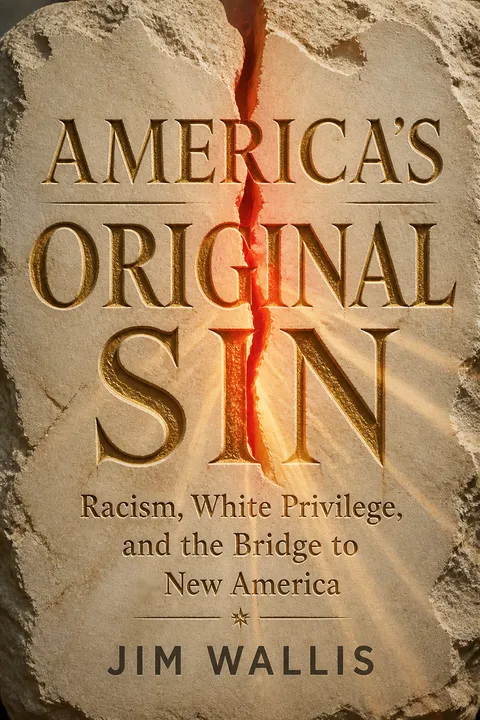
America's Original Sin explores racism as the foundational sin of the United States, challenging white Christians to confront their privilege and work towards racial reconciliation. Wallis argues that the church must play a central role in addressing systemic racism and building a more just society. While some readers found the book repetitive or basic, many praised its thoughtful examination of racial issues through a Christian lens. The book offers practical steps for individuals and churches to combat racism and create a more inclusive America.
People Also Read







Glossary
America’s Original Sin
Foundational racial injusticeWallis’s theological description of the racial oppression embedded in the country’s founding and carried forward through later institutions. It refers especially to the dispossession of Indigenous peoples and the enslavement of Africans, while emphasizing that these histories continue to shape present inequalities. The term frames racism as a collective moral problem requiring truth-telling and repair.
White privilege
Advantages attached to whitenessBenefits that accrue to people identified as white within a society shaped by white supremacy. In Wallis’s account, those benefits do not depend on an individual’s racist intent or family history of slaveholding. The term directs attention to unequal access, institutional practices, and inherited advantages, and to the responsibility of beneficiaries to help change unjust systems.
Implicit bias
Unconscious learned associationsAttitudes or stereotypes that can shape judgment and behavior without conscious awareness or deliberate intent. Wallis describes these associations as learned through family, community, media, and other social experiences. They may conflict with a person’s stated beliefs, yet still influence decisions, including high-stakes judgments by police officers and other professionals.
Metanoia
Transformative change of directionA Greek New Testament term Wallis uses to explain repentance as more than sorrow or an apology. It describes a change in mind and orientation that leads to transformed behavior. Applied to racism, metanoia means turning away from unjust practices and toward concrete actions that support justice and repair.
Beloved community
Inclusive community grounded in justiceA vision associated in the book with Martin Luther King Jr. for a society in which people across racial, social, and cultural divisions live together in justice and fellowship. Wallis presents the church as a place that should embody this vision, not merely preach it, by sharing leadership and confronting exclusion.
Guardian model
Policing centered on protectionA model of law enforcement that understands officers as protectors serving from within a community, rather than as soldiers sent to conquer or control it. Wallis uses the distinction to argue for relationships, fair treatment, transparency, and community trust as central measures of effective policing.
The New Jim Crow
Racial exclusion through incarcerationA term associated with Michelle Alexander’s argument, discussed by Wallis, that mass incarceration can reproduce forms of racial segregation and civic exclusion after formal Jim Crow laws ended. Felony convictions may bring lasting barriers to voting, employment, housing, education, and public benefits, disproportionately affecting Black and Latino communities.
Restorative justice
Repairing harm through accountabilityAn approach to justice that treats crime as harm to people and relationships, not only as a violation of state law. It brings victims, offenders, and affected communities into processes aimed at addressing needs, taking responsibility, and repairing damage. It differs from a system focused primarily on assigning guilt and imposing punishment.
White fragility
Defensive response to racial challengeA term Wallis draws from Robin DiAngelo to describe defensive reactions that can arise when white people experience racial discussion as threatening or intolerable. Responses may include anger, guilt, argument, silence, or withdrawal. The concept helps explain how discomfort can interrupt listening and protect unexamined assumptions from challenge.
The talk
Safety guidance for police encountersA conversation many Black parents have with their children about how to behave during encounters with police in order to reduce danger. Wallis uses the contrast between this guidance and the advice commonly given to white children to show how racial inequality is experienced inside family life, not only through public statistics.
FAQ
What's America's Original Sin about?
- Focus on Racism: The book delves into the historical and systemic nature of racism in America, labeling it as "America’s original sin." It examines how racism has influenced American society and its ongoing impact.
- Call for Repentance: Jim Wallis urges a collective acknowledgment of this sin, advocating for repentance and action to address racial injustices. He stresses the importance of confronting personal biases and privileges.
- Spiritual and Social Justice: The book combines theological insights with social justice, arguing that racism is a sin requiring a moral and spiritual response from individuals and communities.
Why should I read America's Original Sin?
- Timely Relevance: The book is crucial in the context of ongoing discussions about race in America, providing a critical examination of racism's roots and consequences.
- Personal Reflection: Wallis encourages readers to reflect on their own experiences and biases, making it both a personal journey and a societal critique.
- Practical Solutions: It offers practical advice for individuals and churches to engage in racial reconciliation and justice work, providing a roadmap for progress in a multiracial society.
What are the key takeaways of America's Original Sin?
- Racism as a Sin: Wallis frames racism as a fundamental sin that requires acknowledgment and repentance for true healing to occur.
- Community Importance: The book stresses the need for multiracial communities and churches to work together towards justice, modeling the beloved community envisioned in the Gospel.
- Action Required: Understanding racism is not enough; Wallis emphasizes the need for action to dismantle systemic injustices and support marginalized communities.
What are the best quotes from America's Original Sin and what do they mean?
- "Racism is a sickness...": This quote underscores the deep-rooted nature of racism in American history, highlighting it as an enduring issue.
- "Repentance means more...": Wallis stresses that true repentance involves a radical change in behavior and mindset, not just verbal acknowledgment.
- "If white Christians acted...": This statement calls for prioritizing faith over racial identity, advocating for a more just and equitable society.
How does Jim Wallis define repentance in America's Original Sin?
- Radical Change: Repentance is defined as a complete turnaround in behavior and mindset, moving towards justice and righteousness.
- Biblical Foundation: Wallis uses biblical teachings to illustrate that repentance involves both personal and communal responsibility.
- Practical Application: It must lead to concrete actions promoting racial justice and healing within communities, transforming both individual hearts and societal structures.
What role does white privilege play in America's Original Sin?
- Systemic Advantage: White privilege is described as a product of systemic racism, providing unearned advantages to white individuals.
- Call for Awareness: Wallis urges white Americans to recognize their privilege and its impact on interactions with people of color.
- Responsibility to Act: With privilege comes responsibility; white individuals must work to dismantle systems perpetuating racial inequality.
How does America's Original Sin address the church's role in racial justice?
- Prophetic Voice: Wallis calls on the church to be a prophetic voice against racism, challenging congregations to confront systemic injustices.
- Multiracial Community: The book emphasizes creating multiracial congregations that reflect the diversity of the body of Christ.
- Spiritual Responsibility: Addressing racism is a spiritual imperative for the church, requiring faith leaders to engage in conversations about race.
How does America's Original Sin propose to achieve racial reconciliation?
- Repentance and Acknowledgment: Wallis emphasizes the need for acknowledging and repenting for roles in perpetuating racism.
- Building Relationships: Intentional efforts to build relationships across racial lines are advocated to foster understanding and empathy.
- Community Engagement: Active participation in community organizing and social justice movements is encouraged to promote racial equity.
How does America's Original Sin connect the issues of immigration and race?
- Intersection of Issues: Wallis discusses how immigration policies disproportionately affect people of color, reflecting broader racial injustices.
- Personal Stories: The book includes narratives of immigrants facing discrimination, illustrating the human impact of immigration policies.
- Call for Compassion: Wallis advocates for treating immigrants with dignity, aligning with the biblical mandate to welcome the stranger.
What is the significance of the "guardian" model in policing as discussed in America's Original Sin?
- Shift in Policing: Wallis highlights the need to transform policing from a warrior mentality to a guardian approach, emphasizing protection and community engagement.
- Community Policing: The book advocates for strategies that foster trust and collaboration between law enforcement and communities.
- Reducing Racial Bias: Adopting the guardian model can help reduce racial bias and improve interactions with communities of color.
What examples of systemic racism does America's Original Sin provide?
- Criminal Justice System: Wallis highlights disparities in treatment of people of color, including higher incarceration rates and police violence.
- Economic Inequality: The book discusses economic disparities affecting communities of color, linking them to the legacy of racism.
- Education Disparities: Ongoing inequalities in education are pointed out, with schools in predominantly black neighborhoods often receiving less funding.
How can individuals and churches take action after reading America's Original Sin?
- Engage in Conversations: Wallis encourages open and honest discussions about race within communities and churches.
- Support Racial Justice Initiatives: Individuals and churches are urged to support organizations promoting racial justice and equity.
- Commit to Personal Change: Personal reflection and commitment to change are emphasized, with a focus on dismantling systemic racism.
About the Author

Download PDF
Download EPUB
.epub digital book format is ideal for reading ebooks on phones, tablets, and e-readers.








