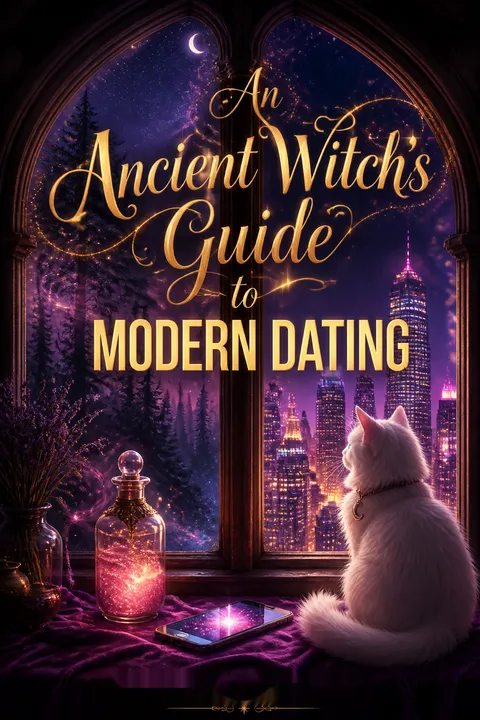


Plot Summary
The Blacksmith's Borrowed Heart
In 1690, Thorn Scarhart is thirty-nine, unmarried, and newly desperate after a seamstress calls her a spinster. Matchmaker Madam Maude finds her a courtship with a widowed blacksmith, and Thorn secretly gives him a True Love potion that keeps his affection alive only as long as she doses him.
Their first meeting seems promising: he makes her a copper kettle and gazes at her as if she were the only woman in town. But Thorn mistakes his romantic compliments for an invitation to discuss stolen hearts, and her blunt response breaks the spell. The blacksmith sees her age, apologizes, and leaves. Thorn is left with the kettle, a poison-ivy rash, and ninety days before her fortieth birthday.
Thorn's failure is not simply that she uses magic, but that the spell supplies an emotion without giving her the social fluency to inhabit it. She wants to be chosen while remaining armored by sarcasm and secrecy; when the blacksmith offers the familiar language of romance, she answers from her own practical, solitary world. His affection vanishes, exposing the gap between being desired under enchantment and being known. The deadline sharpens a belief inherited from Thorn's mother: that a woman's unmarried life is a failure. Her urgency is therefore both personal longing and an old family script she has never examined.
Feather at the Grave
Flying home through a storm, Thorn remembers her mother's lifelong work on a potion meant to secure permanent love, and the years she spent alone after her lover Thomas left. She decides to improve her own recipe, replacing its raven feather with one from the vampire parrots that attacked her sister Rose thirty years earlier.
At Rose's riverside cairn, Thorn lures a flock with her blood; her familiar, Bandit, interrupts their hunt and leaves her with enough feathers for a new batch. Back at the cottage, a customer breaks Thorn's concentration, and Thorn accidentally drinks the potion she has brewed. The cottage changes around her. Furniture appears, daylight replaces night, and strangers begin touring her home as a historical museum.
The cairn and the feather make Thorn's experiments inseparable from her grief. She thinks of the past as a settled loss, yet she mines its most frightening remains to improve a spell that promises a different future. The accident turns that contradiction literal: her attempt to engineer love dislodges her from the century in which her family history makes sense. Bandit's interruption is comic, but it also marks how little control Thorn truly has over the forces she treats as recipes. Her skill is real; certainty about what magic will do is not.
Covenstead's Living Exhibit
The visitors tell Thorn that the cottage is a preserved heritage site called Covenstead, and the year is somewhere in the twenty-first century. Her broom will not fly, her potions have curdled, and the forest outside has become a city park. When a veterinary worker frees Bandit from a cat trap, Thorn mistakes him for a scientist experimenting on animals.
The man, Wallace Mileston, whom everyone calls Walls, calmly explains that he is rescuing strays. Later, museum treasurer Meg catches Thorn breaking into the locked cottage and watches security footage of her appearing from nowhere. Rather than expose her, Meg bargains with the Historical Society: Thorn can stay if she becomes the museum's resident witch and helps attract visitors.
Covenstead turns Thorn's private refuge into a public object, forcing her to confront what happens when her home is interpreted by people who do not share her assumptions. The tourists treat her as an entertaining performance; Meg is the first to take the evidence seriously without immediately claiming to understand it. Walls, meanwhile, responds to Thorn's accusation with patience rather than ridicule. These encounters establish different kinds of modern attention: consumption, stewardship, and practical care. Thorn's agreement to perform buys her shelter, but it also makes her visible in a way her solitary life has always helped her avoid.
The Vet Across Traffic
Thorn decides that modern dating may offer a better chance at marriage than Madam Maude's book of local prospects. While crossing a busy road to gather ingredients, she watches a bicycle hit Bandit and finds him bleeding in a bush. She calls Meg by mistake, but Walls arrives and treats the cat's injured paw with veterinary supplies, earning Thorn's trust one careful bandage at a time.
He later guides her across the road and helps her identify potion ingredients in modern shops. Thorn brews a Youth potion, which makes her look ten years younger, then downloads a dating app. Its easy matches thrill her, though the flood of apparent interest soon proves less meaningful than she hoped.
Walls's importance begins in an emergency, not a romantic gesture. He earns Thorn's confidence by making Bandit safer while respecting the cat's resistance, then helps her negotiate a world whose traffic and shops are bewildering. His care gives Thorn a lived alternative to the potion logic she trusts: another person can help without first being manipulated into affection. Yet she initially translates this kindness into evidence that she might finally secure a husband. The Youth potion and dating app promise control over how she is seen, revealing how readily Thorn treats her own body as another problem to solve.
A Date Turns Giant
Thorn's first modern dates expose rules she cannot read. Jason stops responding, and Brad abandons her at a restaurant with an enormous bill. After Thorn takes the Youth potion's antidote to escape unnoticed, she develops a Shape-Shifting potion to resemble a popular actress.
Its effect brings a flood of matches, but it also imports the actress's reflexes and habits. At a date with Noah, Thorn discovers he wants casual sex despite his profile promising commitment; the borrowed body punches him, then grows so large she has to squeeze back into Covenstead.
Walls prepares an antidote and helps her out of the bathroom where she becomes trapped. Thorn is relieved to return to herself, but she has learned that a convincing image cannot make a dishonest match safe.
These comic disasters turn online dating's ambiguity into physical consequences. Thorn reads profile language literally, while other daters treat it as disposable self-advertising; her magic magnifies that mismatch instead of fixing it. The celebrity potion is especially revealing because it imports not only appearance but practiced bodily behavior. Thorn can borrow another woman's face, yet cannot control what that face has learned to do. Walls's help during the giant episode again arrives without judgment, giving Thorn a glimpse of intimacy built from attention rather than performance.
Speed Dating and Sick Cats
After pushing herself to brew and date until she collapses, Thorn accepts Meg's health check and makeover, then attends speed dating. Three men mark her as a possible match, a small victory that brightens her hopes.
Soon afterward, Walls asks her to help with cats at his clinic: several are physically healthy but terrified, and each has only one life left. Thorn can speak with them, yet cannot explain their fear. During a later visit to Walls and his niece Charlie, she finds a laminated vampire-parrot feather that once belonged to his childhood cat, Pirate.
Its existence suggests Thorn's missing familiar, Turnip, may have reached the future. Stray cats Pepper and Pumpkin confirm that cats can travel through time, but the cost is paid in extra lives.
Thorn's collapse echoes the family pattern she has long tried to outrun: under pressure to achieve love, she neglects food, rest, and her own body. Meg's makeover and the speed-dating event offer genuine social participation, but the frightened cats redirect Thorn from finding a man to caring for vulnerable creatures. The feather and the cats' account also unsettle her assumptions about loss. What she understood as a final disappearance may have another explanation, though the possibility is costly. The novel makes its fantasy mechanics emotionally legible: each life spent crossing time is a measure of attachment and risk.
The Dagger Takes Lives
Walls traces the frightened cats to a pattern involving women from dating-app encounters, while Bandit follows a raven that has been watching Covenstead. Thorn discovers her inherited Dire Dagger is missing. She identifies Lily, a tourist who had helped her with dating, as the witch behind the attacks.
Lily has used the dagger to steal cats' extra lives and store them in enchanted matches for a Never Love Again potion. When Lily threatens Bandit, Thorn uses the dagger and ordinary matches to return his stolen lives, then restores lives to the other affected cats with Walls's help. The attack leaves Thorn certain that her cottage, its magic, and the people around her are no longer safe from the past.
The dagger transforms a familiar tool of Thorn's craft into a moral test. She has treated soul-taking as routine because she believes the harm is limited and the purpose justified; Lily extends that logic to cats, exposing how easily a private standard of acceptable damage can become predatory. Thorn's response does not depend on a stronger spell. She repurposes the same mechanism to give lives back, an act of repair that links her knowledge to responsibility. Walls's veterinary care and Thorn's magic work together, making their partnership practical before either can name it as intimate.
A Sister in the Mirror
At the river, Thorn questions her memory of Rose's death and learns that the supposed grave contained no remains. She brews an antidote to the Liar Liar potion she once took, then asks Meg about a strange girl seen near the river decades earlier. Meg remembers brown hair and green eyes; Thorn's scrying confirms that Rose is alive in the future.
Before she can face her sister, Thorn meets Andy, a kind man interested in her without a spell. She turns him down when she realizes she loves Walls. Walls asks her on a date, and Thorn secretly assumes he must be under the influence of the True Love potion she had prepared for Andy. She accepts, already uneasy about the deception.
The empty grave shifts Thorn's grief from a fixed story into an unresolved question. She has used the Liar Liar potion to survive what she could not bear, but now the protection itself obstructs knowledge. Rose's presence in the future offers hope and danger at once. Meanwhile, Andy's straightforward interest clarifies that Thorn's desire is no longer simply to be selected by a suitable man. She wants a particular person. Her assumption that Walls is enchanted lets her accept his attention while avoiding the vulnerability of believing it might be freely given.
The Memory Under Love
Walls takes Thorn to the zoo because she once delighted in hearing about its animals, then brings her to shop for dinner. She enjoys being considered, but when a near-kiss stirs the memories hidden by the Liar Liar potion, she sees what happened thirty years earlier. Rose tried to sacrifice Thorn to complete their mother's Forever True Love potion; their familiar Turnip attacked Rose, and both vanished into the future.
Thorn had returned home alone and accepted her mother's blame. The following morning, Thorn gives Walls an antidote, believing his affection was caused by her potion, then leaves him a note and returns to 1690. She cannot bear to face the possibility that she has exploited the first person who made her feel safe.
The recovered memory replaces a childhood account of random predation with a family betrayal shaped by desperation. Rose's attempt to save their mother does not excuse her choice, but it reveals how the mother's obsession turned love into a sacrificial economy. Thorn's departure repeats her oldest coping strategy: when affection becomes morally complicated, she withdraws before someone can reject or condemn her. She believes she is protecting Walls, yet she makes the decision for him, just as others once decided what she could bear to know. The zoo date briefly offers mutual attention before fear sends Thorn back into isolation.
Back Before the Breakthrough
Madam Maude explains that she gave Thorn the Liar Liar potion after finding her beside her dead mother, hoping to spare her unbearable memories. Back in 1690, Thorn and Maude organize a speed-dating evening for witches and warlocks.
Thorn refuses to dose anyone, but Penny, the seamstress she once turned into a frog, secretly pours Thorn's old True Love potion into the lemonade. The couples fall under its spell, and Thorn stops her new date Alder from declaring love by kicking him off her broom.
She and Maude break the enchantment and discover Penny's role. Thorn recognizes that the potion cannot manufacture the kind of love she wants. A coven gathers to find a way to send her back to the future, where Rose may be preparing something dangerous.
This return to the past brings the book's competing beliefs about love into the same room. Penny repeats Thorn's earlier mistake for reasons that are compassionate but misguided, while Thorn now understands the difference between creating an attachment and choosing a relationship. Her rescue of Alder is slapstick, but it marks a serious change: she will not accept affection simply because it arrives on schedule. Maude's account also reframes her earlier intervention as care rather than control. Thorn's new challenge is not finding love by any means available, but acting without reproducing the coercions that shaped her childhood.
A Mirror Through Time
The witches pool their magic through Penny's enchanted mirror and see the future cottage. A witch wearing Thorn's appearance is brewing beside a pentagram; Thorn recognizes her sister Rose, disguised as Lily. She understands that Rose is pursuing the same Forever True Love potion their mother once sought, and fears she will use Walls as its human sacrifice.
The coven cannot open the mirror far enough to intervene, so Thorn prepares the potion that first brought her to the future. This time she uses it deliberately, with Bandit beside her. The journey deposits them on a Halloween street outside Walls's home, where Thorn sees him with Charlie and learns Rose has already taken over her job at Covenstead.
The mirror makes historical repetition visible before Thorn can stop it. Rose is not merely an echo of their mother; she is a sister attempting to solve fear with the same coercive formula. Thorn's decision to travel is the inverse of her earlier flight. She accepts uncertainty because another person may be harmed, rather than retreating to escape her own pain. The potion remains unpredictable, but her motive has changed: magic is now a means of reaching someone, not a substitute for consent. Bandit's willingness to accompany her underscores that loyalty is expressed through risk, not possession.
The Pentagram's False Thorn
At Covenstead, Rose impersonates Thorn and draws Walls into a pentagram, hoping to take his soul for the Forever True Love potion. The real Thorn calls him and warns him, but the chalk circle begins pulling him back as Rose chants. Walls reaches a vial Thorn left behind and drinks it. The potion carries him across time to Thorn's location on Halloween night.
He arrives angry that she disappeared, but relieved to see her; Thorn apologizes for leaving and admits she mistook his feelings for enchantment. Their reunion establishes what her potions could never guarantee: Walls chose to care for her without being compelled. Together, with Bandit and the other cats, they return to the cottage to face Rose.
The pentagram reverses Thorn's earlier willingness to take a piece of a person's soul: this time Walls enters the circle voluntarily, but he misunderstands the danger and offers himself anyway. Rose's imitation of Thorn weaponizes intimacy, while the real Thorn's phone call cuts through the disguise because it carries fear for Walls rather than a demand for his sacrifice. His choice to drink the potion is an act of trust under pressure. Their reunion does not erase Thorn's wrongdoing or restore time lost; it creates a chance for honesty, which is a more durable basis for love than the spell she once prepared.
Two Sisters, One Future
Rose tries to persuade Thorn to drink the Never Love Again potion, believing it will spare her sister heartbreak. Thorn refuses and tells Rose that she is not their mother; love has hurt them, but it has also made kindness possible. Rose admits she fears loving anyone because of what she did, then leaves without taking the potion, promising to return.
Thorn grieves the sister she lost and the one she has only just found, while Walls stays beside her. A year later, Thorn is back in the future, working at Covenstead and selling potions at a market. She has pursued therapy and let Walls set the pace. On her forty-first birthday, they share their first real kiss, without a love potion between them.
The resolution refuses an easy cure. Rose does not instantly become trustworthy, and Thorn does not pretend their shared history can be repaired in one conversation. Letting Rose leave preserves her agency while ending the cycle of force that began with their mother's potion. Thorn's relationship with Walls likewise becomes meaningful because it is not settled by a declaration extracted under enchantment. Therapy, work, friendship, and time remain part of her life alongside romance. The final kiss answers the opening's desire for love, but changes its terms: Thorn can receive affection without turning it into proof that she is finally complete.
Analysis
The novel makes romance less a destination than a test of how Thorn understands agency. She begins with a social premise inherited from her mother: a woman's completeness depends on being loved by a man. Because Thorn accepts that premise, she treats courtship as a technical problem. She adjusts recipes, appearance, and behavior, hoping to secure a result before rejection can reach her. The comedy comes from the mismatch between her literal-minded craft and modern dating customs, but the deeper pattern is serious: she tries to control the conditions of intimacy because she has learned to expect abandonment.
Magic gives this fear a visible form. A potion can produce attention, youth, or a new face, yet none can make a relationship reciprocal. Thorn's spells repeatedly work in narrow, literal ways while failing at the human task she assigns them. Her arrival in the future expands the experiment. Online dating offers more possible partners but also more ambiguity; a historical museum makes her public identity into a performance. Walls's care matters because it is neither spectacle nor bargain. He helps with Bandit, crosses streets with Thorn, and makes room for her confusion without asking her to become easier to manage.
The buried family history deepens the critique. Thorn and Rose inherit their mother's effort to make love permanent, but Rose's attempt to save their mother shows how that ideal can turn affection into a justification for coercion. Thorn's own use of a love potion is not morally identical to Rose's violence, but it belongs to the same desire to bypass another person's freedom. Returning the cats' lives and later refusing to exploit Walls mark a change in conduct, not merely a new belief.
The ending does not claim that love heals trauma by itself. Thorn pursues therapy, keeps working, and gives Rose room to choose what comes next. Her eventual kiss with Walls matters because it is freely offered and accepted. The story's answer to inherited loneliness is not guaranteed romance, but a wider capacity for care: friendship, family, work, and love can coexist without any one of them serving as proof that a person is complete.
Review Summary
An Ancient Witch's Guide to Modern Dating receives mostly positive reviews, praised for its cozy, humorous, and heartwarming story. Readers enjoy the time-travel element, witchy themes, and relatable dating struggles. The protagonist, Thorn, and her cat familiar, Bandit, are particularly well-liked. Some criticize the repetitive mentions of age and simplistic writing, but most find it a delightful, low-stakes romance with magical elements. The book is often recommended for fans of witchy romcoms and cozy fantasy, with many highlighting its perfect timing for autumn reading.
People Also Read



Characters
Thorn Scarhart
Time-lost potion makerA sharp-tongued witch raised to believe marriage is the measure of a woman's worth, Thorn has spent decades relying on recipes, routines, and self-sufficiency. Her curiosity makes her inventive, but her fear of rejection leads her to treat appearance and affection as problems magic can solve. She is deeply attached to her family and familiars, though grief has taught her to hide that attachment behind bluntness. In a future she never expected to see, Thorn must learn new technologies, new dating customs, and a less transactional understanding of care. Her humor is both genuine delight and a shield she has used to avoid asking others for help.
Wallace Mileston, called Walls
Patient animal healerWalls is Meg's younger brother and a veterinarian whose calm manner is grounded in professional competence rather than detachment. He treats animals gently, listens before deciding what a problem means, and offers Thorn help without demanding that she perform gratitude or charm. His work gives him a practical understanding of vulnerability, including the limits of what even modern medicine can fix. Though long single after a past relationship, he is not cynical about love. His affection grows through repeated acts of care, shared curiosity, and respect for Thorn's independence, making him a strong contrast to the romance she tries to manufacture with potions.
Rose Scarhart
Thorn's elder sisterRose is Thorn's older sister, beloved in childhood and bound to the same isolated household and family beliefs. The sisters shared work, stories, and the wish for a safer, happier home. Rose's closeness to Thorn is central to how Thorn understands love, loyalty, and loss, even when memories of their childhood are incomplete. She is associated with the rose Thorn's name evokes, a bond Thorn carries into adulthood. Rose's own relationship to love is shaped by watching their mother pursue a potion that promised certainty, giving the sisters a shared inheritance of longing and fear.
Madam Maude
Matchmaker and witchMadam Maude is Thorn's mother's old friend, a witch who prefers matchmaking and conversation to the lonely labor of potion-making. She knows Thorn well enough to challenge her assumptions, although her faith in conventional courtship can make her underestimate the younger woman's fear. Maude offers practical help, shelter, and hard truths, and her affection for Thorn is more familial than formal. Her matchmaking world reflects the social rules Thorn is trying to navigate, while her own choices show that people can care deeply even when they do not always know how to intervene.
Meg Mileston
Museum's practical stewardMeg is Walls's older sister, a Historical Society treasurer and tour guide who takes responsibility seriously without losing her humor. She is organized, financially practical, and willing to revise her understanding when evidence challenges it. Meg becomes Thorn's guide to phones, dating apps, modern safety, and health care, while also protecting the museum and its staff. Her marriage to Greg provides Thorn with a visible example of everyday partnership, built from shared domestic care rather than magical guarantees. Meg is generous, but she also sets boundaries when Thorn's impulsiveness threatens her or the Society.
Bandit
White familiar with opinionsBandit is Thorn's white cat familiar, a shameless opportunist who measures most people by the treats they carry. He is sarcastic, territorial, and apparently indifferent to Thorn's romantic hopes, yet he repeatedly stays close when she is frightened or unwell. His ability to speak with Thorn and other cats makes him a bridge between her magical world and the modern veterinary clinic. Bandit resists being handled, dressed, or treated like a pet, but his loyalty is unmistakable in the moments when Thorn most needs a companion.
Thorn's mother
Devoted potion makerThorn's mother raised Thorn and Rose in the woods and taught them the practical craft of witchery. She devoted much of her life to perfecting a potion that she believed would secure lasting romantic love. Her lessons helped make Thorn skilled and self-reliant, but her teachings also passed down a narrow idea of what makes a woman complete. She is remembered through recipes, household habits, and the emotional rules her daughters learned around love, work, and blame.
Lily
Modern dating adviserLily is a young visitor to Covenstead who befriends Thorn and offers candid advice about dating apps, fashion, and modern courtship. Her directness contrasts with Thorn's literal interpretations of contemporary behavior, and she treats Thorn's awkwardness with more patience than the average tourist. Lily also has her own guarded views about romance, shaped by painful experience. She provides Thorn with a glimpse of modern independence, even as her certainty about love's dangers differs sharply from Thorn's growing willingness to risk it.
Penny
Seamstress turned frogPenny is a young seamstress whose thrift and sharp tongue helped provoke Thorn's renewed search for a husband. After seeking a love potion, she becomes caught up in Thorn's magic and the leap into the future. Penny is practical, eager for romance, and more vulnerable than her insults suggest. Her experience places her beside Thorn as another woman trying to find love in a world that gives them very different choices.
Charlie
Walls's observant nieceCharlie is Meg and Greg's seven-year-old daughter and Walls's niece. She is imaginative, frank, and eager to participate in the witchy world around her, especially when costumes and cats are involved. Her unfiltered observations often expose what adults are trying not to say. Charlie enjoys her uncle's company and becomes part of Thorn's growing modern circle, offering a warm, everyday connection that has nothing to do with courtship.
Greg
Meg's dependable husbandGreg is Meg's husband and Walls's brother-in-law. He is steady and attentive, particularly when Meg is hurt or overwhelmed. His practical kindness gives Thorn another example of partnership expressed through ordinary actions. Greg is also willing to respect Thorn's judgment when she needs to confront family matters herself.
Andy
Kind dog-loving suitorAndy is a prospective date Thorn meets through the Covenstead community. He is considerate, comfortable with silence, and devoted to his pug, Nugget. His good nature makes him a plausible partner rather than a comic villain, which forces Thorn to recognize that kindness alone cannot substitute for her own feelings. Andy handles disappointment with maturity and leaves Thorn room to reconsider without pressure.
Brad
Unreliable app matchBrad is a forty-five-year-old marketing manager and cat owner whom Thorn meets through a dating app. He presents himself as looking for a settled relationship, but his first date with Thorn ends in confusion and an unpaid restaurant bill. His later reappearance complicates Thorn's attempt to distinguish sincere interest from outside influence.
Noah
Casual daterNoah is a dating-app match whose profile suggests he wants commitment, though he is actually seeking casual sex. Thorn's earnestness and his dishonesty collide during their first meeting. His date becomes a turning point in Thorn's experiment with a borrowed appearance.
Thomas
Thorn's first heartbreakThomas was Thorn's first lover, a young woodcutter she met when she began venturing into town. Their relationship lasted fourteen months before he ended it. Though he is absent from the present action, the memory of the breakup helps explain why Thorn withdrew from romance for so many years.
Turnip
Thorn's earlier familiarTurnip was one of Thorn's first familiars, a kitten she found among freshly gathered turnips. He was part of the sisters' childhood world and became a source of comfort and companionship. Thorn remembers his distinctive appearance and the affection they shared, even when she cannot fully account for his disappearance.
Pumpkin and Pepper
Park cats with secretsPumpkin and Pepper are two cats who live in the modern park near Covenstead. Pumpkin is sociable and food-motivated; Pepper is more cautious and often hides behind his friend. They speak with Thorn and Bandit, bringing feline knowledge and perspective into the mystery around the park's cats.
Janet
Blunt speed-dating guideJanet is a Historical Society member who guides tours and later gives Thorn advice about online dating. She is forthright about modern social norms, sometimes to the point of exasperation. Her practical warnings help Thorn understand that a swipe or a profile does not guarantee genuine interest.
Payton Jules
Demanding tour guidePayton is the Historical Society's secretary and one of Covenstead's tour guides. He worries about visitor feedback and expects Thorn to provide a lively performance. His pressure highlights the difference between the witch Thorn is and the attraction the museum wants her to be.
Noodle
Walls's watchful catNoodle is one of Walls's cats, gentle in her manner but fiercely protective of her person. She watches Thorn with a judgmental intelligence that echoes Bandit's, and her presence reveals how much the animals in Walls's life matter to him.
Plot Devices
Love and transformation potions
Magic with a priceThorn's potions promise to alter affection, age, or appearance, but their effects are unstable and often expose problems they cannot solve. Her True Love recipes create temporary devotion, her Youth potion changes how others see her, and her Shape-Shifting potion imports habits along with a new face. Antidotes and unintended side effects keep these remedies from functioning as simple solutions. Across the story, the potions externalize Thorn's wish to control rejection and romance, while their failures force her to confront the difference between changing a person's feelings and building mutual trust.
The Dire Dagger
A blade that stores livesThis inherited amethyst dagger can remove a portion of a person's soul, which can be stored in an enchanted object. Thorn regards the practice as manageable, but the dagger's power becomes more dangerous when another witch uses it to take cats' extra lives. The same mechanism can also return what has been stolen, allowing Thorn to use her knowledge for restoration. The dagger ties together the family's history, the cats' illness, and Thorn's developing understanding that good intentions do not by themselves make the taking of life harmless.
The cat distribution system
Cats travel through timeCats can move across time when summoned by a need for companionship, though unscheduled travel costs them several extra lives. The idea first appears as a modern joke about cats appearing in people's homes, then becomes a real explanation for how familiars can vanish from one century and reappear in another. Its cost makes time travel a physical sacrifice rather than an effortless escape. The system links Thorn's lost familiar to Walls's childhood and gives the cats a role in the human plot without making them mere magical equipment.
Covenstead and its mirror
A home that holds magicThorn's cottage is a powerful magical nexus, though she has lived there so long that its effects feel ordinary. In the future, the Historical Society preserves it as a museum, unaware that its location strengthens spells. An enchanted mirror becomes a way for witches in the past to glimpse the cottage centuries later. The house therefore acts as shelter, historical exhibit, and magical instrument. Its fixed place in both eras lets the novel connect domestic memory to larger questions of what survives time and who gets to interpret the past.
Covenstead tours and dating apps
Two kinds of public performanceThe museum tours turn Thorn into a staged version of herself, while dating apps ask her to package her appearance and intentions for strangers. Both systems bring her into contact with people, but neither guarantees that she will be understood. The tourists enjoy her witch act even when they mistake truth for performance; app matches often swipe without serious intent. Together, the devices dramatize Thorn's struggle to move from being looked at to being known. The tours also give her a job, income, and a community in the future.
Download PDF
Download EPUB
.epub digital book format is ideal for reading ebooks on phones, tablets, and e-readers.








