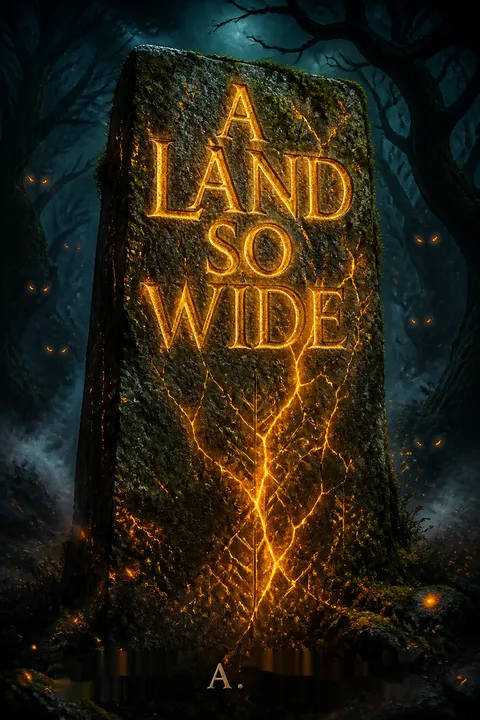


Plot Summary
Prologue
Resolution Beaufort hears that a northern forest holds trees strong enough to build an empire, then buys the explorer’s silence and leads families across the sea to claim them. A storm drives his ship into a narrow cove, where it breaks apart and scatters the settlers.
The survivors find Resolution impaled beneath one of the trees he coveted. His death leaves the settlers stranded among strange stones and a wilderness they cannot understand, while the coveted forest begins a chain of choices that will shape Mistaken for generations.
The opening makes greed the first force to enter the wilderness, but it refuses the comforting idea that the settlers simply conquer what they find. Resolution’s ambition brings families into danger, and his death leaves them dependent on the very land he meant to exploit. The strange timber is both commodity and warning: its value draws people into a place whose rules they do not know. By grounding the community’s history in a shipwreck and a failed act of possession, the prologue prepares the novel’s central question: whether safety built on taking from others can ever remain stable.
Tracks Beyond the Flags
Greer Mackenzie, a gifted mapmaker in the isolated town of Mistaken, hunts rabbits with her closest friend, Louise Beaufort. Their argument over leaving the animals’ organs as offerings exposes their unequal lives: Greer trusts the unseen guardians, while Louise worries that her struggling family cannot spare food.
After Louise storms away, Greer crosses the warning flags to leave the offerings herself. She finds enormous footprints with only two toes, then hears a strange voice behind her. The offerings vanish while she is turned away. Greer returns home unsettled, carrying evidence that the monsters she has been taught to fear may be real, and a fresh wound in her friendship with Louise.
The first rupture is both supernatural and social. Greer reads the forest through inherited reverence, while Louise reads it through scarcity, and their conflict makes belief inseparable from class and family responsibility. Greer’s mapmaking suggests that the unknown can be made safer by careful attention; the two-toed tracks defeat that confidence without yet explaining themselves. The vanished offering is particularly destabilizing because it seems to confirm Greer’s faith while withholding any reliable witness. Her certainty is not simple credulity. It is a way of organizing fear, one that the story will test against evidence and inherited authority.
A Bride by Design
Back in Mistaken, Greer reunites with Ellis Beaufort, the baker she loves, and learns that the Stewards have ordered Louise to join the coming Hunt despite her need to care for her widowed mother and younger siblings. The Hunt sends eligible women into hiding so men can claim brides, a custom Greer expects will finally unite her with Ellis.
Her father, Hessel Mackenzie, instead promotes Lachlan Davis, a prosperous hunter suited to his plans for the family mill. Greer resists him, and Hessel nearly strikes her. A memory from 1740 reveals how Hessel himself found Ailie, Greer’s mother, during a Hunt: Ailie had hidden under a false promise meant for another girl.
The Hunt turns courtship into a civic mechanism, making marriage less a private choice than a resource allocated by a community worried about its survival. Hessel’s pressure on Greer carries the same logic as the town’s rules: individual desire is tolerable only when it serves an inherited order. The account of his own marriage complicates his authority. He, too, entered adulthood through chance and deception, yet treats his daughter’s future as something he can manage. Greer’s refusal is therefore not merely romantic stubbornness. It is an early rejection of the town’s claim to define what a woman owes.
The Stones Turn
At a barn gathering, Greer and Ellis hear cries for help and join a search party headed for the Calloway farm. The rescuers find shepherd Tàmhas Baird alive beside the mutilated body of Fiona Calloway, with the family and their sheep scattered across the field.
Greer realizes no predator could have caused the devastation: the Warding Stones have shifted from their old positions and swept everything in their path aside. Her maps become essential, so she agrees to survey the altered boundary at dawn. The town’s protection, once treated as immovable fact, has become a force capable of killing its own residents without warning.
The massacre overturns Mistaken’s most basic moral geography. The Stones are not simply a wall between safety and danger; their movement makes protection itself an agent of violence. Greer’s ability to map the new border offers practical value, but it also exposes the gap between what the town believes and what it can verify. The dead Calloways turn that gap into a public crisis. The scene’s horror comes not just from bodily destruction, but from the collapse of a reassuring distinction: inside the boundary no longer means safe, and obedience to the boundary can no longer guarantee survival.
The Pact’s First Lie
As Greer and Ellis measure the newly shifted Stones, the story reaches back to Mistaken’s founding. In 1669, survivors bury Resolution Beaufort’s body after a mysterious wind kills the men assigned to the task. One survivor returns describing hostile beings beyond the Stones. Tormond Mackenzie then claims to have met benevolent wardens who will protect the settlement in exchange for gratitude.
When a dissenting settler tries to seek freedom, Tormond forces him through the boundary, where the creatures kill him. The account reveals that the town’s founding bargain began as fear, coercion, and a story designed to quiet resistance, though its full truth remains hidden from Greer.
This history shows how a frightened community can turn a desperate explanation into an institution. Tormond’s invented guardians offer hope, but the story also grants leaders a language for policing dissent and demanding compliance. The sacrificed settler is not an accidental cost of protection; he is made into one by people who want the settlement to remain governable. That origin casts a long shadow over the present crisis. When authority later insists that sacrifice is necessary, readers can recognize the pattern before Greer understands it: a public myth can make coercion feel like communal duty.
Reaping Turns to Slaughter
With the Stones still threatening the town, the Stewards move Reaping forward and demand an overnight harvest, followed by the Hunt. Greer and the residents pile food, livestock, and personal treasures at the Gratitude Tree, hoping the ritual will restore the boundary. At the ceremony, Greer hears the uncanny voice again but cannot identify its speaker.
The Stones remain still through sunset, and the town celebrates. Then a mass of giant moths sweeps from the forest, followed by bats that attack the moths and one another. The panicked crowd scatters in darkness. Greer reaches home injured and temporarily unable to hear normally, while a knife-pinned message waits on her door.
Reaping’s frantic abundance answers fear with more of the town’s established ritual, as if a larger offering could repair a system no one understands. That response is psychologically credible and politically useful: the Stewards can direct labor and preserve familiar customs even when their explanations fail. The swarm then turns the ritual’s momentary reassurance into bodily chaos. Because Greer’s hearing is damaged, the attack also strips her of the sense she relies on to orient herself and protect others. The note on the door extends the violence into the domestic sphere, signaling that the crisis has been deliberately arranged.
Ellis Crosses Alone
Despite the previous night’s attack, the Stewards proceed with the Hunt. Greer hides in a hollow tree, expecting Ellis to find her, but he passes her and crosses the town’s boundary after sunset. A huge winged creature follows him into the forest. Lachlan finds Greer instead and claims her, while Hessel and the town accept his version of events.
Greer insists Ellis is alive, but her father locks her in his study and prepares for her marriage to Lachlan. Searching for a way out, she discovers a hidden box of glowing beads and a ledger listing missing girls, including Ellis. She realizes the beads may let someone pass the Stones.
Greer’s failed hiding place makes the Hunt’s central promise collapse in one image: the person she expects to choose her walks past, while a man she rejects claims her instead. The town accepts the convenient version because it preserves the ceremony and avoids confronting an impossible breach in its rules. Hessel’s confinement of Greer turns paternal control into literal imprisonment. Yet her discovery of the beads and ledger shifts her from abandoned bride to investigator. The private archive contradicts the public story, showing that the town’s rituals have concealed a recurring disappearance rather than resolved it.
Greer Breaks the Boundary
Hessel reveals that the missing girls are sacrifices demanded to maintain Mistaken’s safety, and that Ellis knowingly took the same role to protect Greer and the town. He expects her to marry Lachlan rather than pursue him. Louise and her younger sister Norah help Greer escape the Joining Ceremony by staging a public disturbance, then leave a packed bag near the Hunting Grounds.
Lachlan catches Greer outside the boundary and tries to drag her home. When he strikes and restrains her, Greer releases a scream powerful enough to hurl him back across the border. She steps beyond the Stones carrying a map, supplies, and a necklace of enchanted beads, then follows Ellis’s tracks.
This escape joins two kinds of agency. Louise and Norah use performance to create a gap in the ceremony’s surveillance, while Greer’s uncontrolled voice turns the body that the Hunt meant to deliver into a force no one can contain. The shift is not a tidy empowerment fantasy: Greer leaves after possibly killing Lachlan and cannot yet control her power. Still, her choice is unmistakable. She refuses both the marriage and the town’s definition of safety, accepting exposure to the wilderness rather than a life chosen for her.
The Forest Keeps Its Dead
Greer follows Ellis through a landscape far larger and harsher than the territory she has mapped around Mistaken. At his first campsite, she finds a note written on the northern map he once gave her. Ellis explains that he has gone willingly to fulfill the town’s bargain and begs her to return. Instead, Greer continues, discovering an old skeleton marked by deep cuts.
She recognizes it as one of the women who fled the Hunt and realizes those runaways did not simply disappear. Her pursuit leads her toward a river and a ruined settlement, while enormous two-toed tracks reveal that something silent has been following her. The map remains both a practical guide and a promise of a wider world.
The wilderness converts Greer’s cartographic confidence into a more difficult discipline: she must admit how little she knows and keep moving anyway. Ellis’s letter offers an emotionally persuasive reason to stop, since his sacrifice is an act of care, not betrayal. But the old skeleton exposes the brutal cost hidden beneath that care. Greer cannot accept a social bargain simply because someone she loves has chosen to pay it. The map’s dual role is crucial. It records distance, but it also keeps their shared desire for elsewhere alive, even when the journey itself becomes frightening and materially dangerous.
Finn’s Blood Reveals Kinship
At a rocky overlook, Greer falls while trying to follow a flock of starlings and wakes beside a stranger who calls himself Noah Finn. He shelters her, then vanishes overnight, leaving her to believe a predator took him. Later, while crossing a river, Greer nearly drowns and is carried to safety by a winged creature.
She wakes beside Finn again and sees him change into the two-toed monster that has tracked her. Finn explains that Greer’s mother, Ailie, belonged to his kind and that Greer has inherited unusual senses and power. His blood helps heal her injuries, but it also sharpens her sight and awakens a hunger she does not trust.
Finn’s reveal collapses the categories Greer has relied upon: monster, rescuer, stranger, and kin are no longer separate. His blood saves her life while altering her body and complicating her ability to consent to what follows. The rescue is therefore neither simple benevolence nor simple predation. Greer’s sharpened senses make the world more legible, but they also intensify appetite and danger. The revelation about Ailie reframes Greer’s lifelong difference as inheritance rather than defect, though knowing its source does not immediately make it feel like a gift.
A Queen’s Heir
Finn tells Greer that Ailie was once sovereign among the Bright-Eyeds and intended Greer to inherit her place. The current sovereign, Elowen, has taken Ellis and means to draw Greer into a confrontation. Greer and Finn pass through Laird, a settlement destroyed by Bright-Eyeds, where a hunter and his granddaughter warn that the creatures have devastated the surrounding land.
The granddaughter gives Greer an iron knife that Ellis traded for food and protection. Greer also recognizes her mother’s old ribbon on Finn’s wrist, learning he comforted her after Ailie died. When Elowen calls from the mountains, Greer continues toward the abandoned Sandry mine.
The inheritance Finn describes offers Greer power, but not a clean identity. The ruined settlement makes the costs of Bright-Eyed hunger visible in a way no inherited legend could, and the iron knife gives Ellis a means to resist even while Greer remains uncertain what she will become. Finn’s preserved ribbon complicates his role: his long attention to Greer is not merely surveillance but grief and loyalty, though that intimacy does not erase the imbalance between them. Her movement toward Sandry is a choice made with partial knowledge, not a sudden acceptance of a crown.
The Wrong Ellis Falls
Greer reaches Ellis on the mountain road during a snowstorm and helps him into Finn’s coat. His body is cold, his side is wounded, and when he attacks her with sharpened teeth, she screams and hurls him onto discarded mining machinery. Believing she has killed the man she crossed the wilderness to save, Greer collapses in grief.
When the storm covers the body, she later discovers the dead figure was a Bright-Eyed impersonator, not Ellis. Finn returns and confirms the creature was one of Elowen’s guards. Hessel arrives bound in ropes, having followed Greer into the wild. The false reunion leaves Greer shaken but alive, and her father brings knowledge of Ailie’s hidden history.
The impersonation weaponizes Greer’s strongest attachment, turning recognition into a trap. Her scream saves her, but the immediate cost is the apparent murder of Ellis, a consequence that makes power feel morally dangerous rather than triumphant. The body’s transformation after death corrects her mistaken reading, yet relief cannot erase the trauma of having acted against the person she loves. Hessel’s arrival introduces a different kind of threat and knowledge: the past is no longer an abstract history in a ledger but a living conflict among people who have all concealed something.
Mistaken’s Founding Unravels
Hessel reveals that the Benevolence never existed. The first Stewards invented the protective pact, while Resolution Beaufort had enchanted the Stones to keep Ailie’s kind inside Mistaken. Ailie had arrived on Resolution’s second voyage after he captured her, and Hessel later killed her when she tried to leave.
He says her magical cloak, hidden somewhere in Mistaken, holds her power. Before he can bargain for Greer’s return, Elowen attacks, kills Hessel, and carries him away. Greer finds the cloak in his abandoned pack. Reeling from grief, she nearly yields to Finn’s blood and desire, but stops herself and chooses to continue after Ellis rather than surrender her identity.
The revelation dismantles the town’s moral foundation: its safety was not granted by generous guardians but engineered through deception, confinement, and a carefully managed origin story. Hessel’s confession confirms that love and protection can coexist with violence, without excusing either. His death removes the possibility of repairing their relationship through explanation or apology. Greer’s near surrender to Finn’s blood marks an intimate version of the same struggle: she must distinguish what she wants from what has been induced in her. Choosing Ellis is not a rejection of her inheritance so much as a refusal to let inheritance decide for her.
The Mantle Takes Hold
Greer and Finn reach the abandoned Sandry mine, where Elowen waits with Ellis and her court. Ellis has traded an iron knife for protection, and when he sees Greer, he throws it into Elowen’s throat. The attack gives Greer a chance to help Ellis escape, while Finn fights the guards. Greer draws the pursuit away by carrying Ailie’s cloak into the woods.
She retrieves the knife and kills a pursuing Bright-Eyed, then enters the mine. When wolves corner her in the tunnels, she puts on the mantle. Its power enters her body, heightening her senses and making the mine’s iron painful to the Bright-Eyeds. Greer realizes Elowen has gone deeper underground and follows her scent.
Greer’s entrance into Sandry is a convergence of preparation and improvisation. Ellis’s iron knife, the cloak’s hidden power, and the mine’s iron deposits each become useful because someone has paid attention to material details rather than trusting inherited stories. Putting on the mantle is not a neutral upgrade; Greer feels its magic remake her and begins to understand that she may not be able to return to her former life. The scene therefore makes power both tactical resource and irreversible intimacy with the past.
The Mountain’s Last Scream
In the mine, Elowen’s court attacks Greer, and she discovers the tunnels hold far more Bright-Eyeds than Finn expected. They maul her and begin draining the mantle’s power. Finn reaches her, but Elowen captures him and feeds on him above a chasm. With his final movement, he urges Greer onward.
Greer uses her strength to escape, but Finn falls to his death. Grief and rage fuel a scream that tears through the mine, bringing down its roof and burying Elowen and the court beneath iron-rich rock. The blast throws Greer clear of the collapse. She survives, clutching Finn’s ribbon, while the mine seals the creatures inside.
The climax refuses a victory untouched by loss. Greer’s power is finally large enough to end the court’s threat, but its force cannot save Finn, whose loyalty has helped bring her to this moment. The scream that once emerged in panic now becomes a deliberate act of protection, though it is driven by grief rather than calm mastery. Iron, previously a painful barrier, becomes the instrument that seals the mine. Greer’s survival leaves her with a responsibility rather than uncomplicated triumph: she carries the last of the power she has just used to destroy its source.
A World Without Stones
After sunrise, Greer hears Ellis searching the forest and reunites with him outside the collapsed mine. He has survived Elowen’s deception and followed Finn’s route back to her. The lovers mourn Finn together, and Greer tells Ellis what happened to Ailie, Hessel, and the Bright-Eyed court. Ellis accepts her without asking her to become the woman she was before.
In the years that follow, Greer’s power destroys the Warding Stones, freeing Mistaken from the boundary that had confined it for generations. The townspeople sail toward the old world. Greer and Ellis stand together aboard ship, facing the open sea, while Greer takes to the sky as a Bright-Eyed.
The ending resolves the opening’s image of a world narrowed by a boundary, but it does not restore Greer to her former self. Her future with Ellis depends on recognition that can accommodate change, not on pretending the transformation never happened. The town’s voyage reverses Resolution’s original expedition: this time, people leave without claiming the land or mistaking confinement for security. Greer’s final flight preserves a tension the ending could have erased. She is neither simply human nor simply monstrous, and freedom means learning to move between identities rather than being forced into one.
Epilogue
Years later, Mistaken’s people cross the former boundary without being pulled back. They reach the coast and board a ship bound for the old world, watching the Redcap forests diminish behind them as the open sea replaces the cove’s familiar limits.
Greer and Ellis stand together at the bow, still joined by love but no longer held in place by the town’s rules. Above them, Greer shifts into her Bright-Eyed form and rides the wind toward the approaching night. The voyage that began with Resolution’s ambition ends with a community choosing the unknown for itself.
The epilogue converts the prologue’s voyage into a deliberate counter-image. Resolution carried settlers west to possess a resource; Greer and the townspeople sail away from a system built on possession, secrecy, and coerced sacrifice. The open sea does not promise safety, only movement and the possibility of choosing what comes next. Greer’s flight above the ship makes that freedom personal as well as communal. She does not escape her inheritance by denying it. Instead, she uses its most frightening capacity on her own terms, turning a legacy of predation into a chosen direction.
Analysis
A Land So Wide builds its horror from the institutions people create to survive uncertainty. Mistaken’s Warding Stones appear to offer a clean bargain: safety inside, danger outside. Yet the town’s leaders cannot explain the Stones honestly, so they fill the gaps with ritual, fabricated history, and controlled sacrifice. The central revelation is not simply that a supernatural guardian does not exist. It is that the community’s most cherished account of its origins has been useful to those with power, and costly to those with the least choice.
Greer’s maps provide a counter-method. She studies rather than commands, recording boundaries and routes without pretending that knowledge makes her master of the land. Her gift becomes politically meaningful because she can test what the Stewards present as unquestionable fact. But the novel complicates any easy celebration of reason: maps cannot protect her from grief, inherited power, or the limits of her own understanding. Her heightened senses make the world more vivid while making appetite and danger harder to ignore.
The relationships deepen this conflict. Ellis’s sacrifice is an act of love, but it repeats the town’s assumption that one person should be offered up for many. Greer’s refusal does not diminish his care; it challenges the social logic that turns care into compulsory self-erasure. Finn, meanwhile, embodies a different possibility: a dangerous being capable of loyalty and tenderness, though neither quality cancels the harm associated with his kind. Greer must judge actions without relying on comforting categories.
The ending refuses a return to innocence. Greer survives, but she cannot simply resume the human life she imagined, and Mistaken’s release from the Stones does not erase the history that shaped it. Freedom comes as a difficult capacity to choose, travel, and live with consequences. The novel’s final movement from a voyage of conquest to a voyage of departure suggests that the unknown is not automatically merciful. It is simply a world in which the people on the ship may decide for themselves what to do next.
Review Summary
A Land So Wide receives mostly positive reviews for its atmospheric, gothic fantasy setting and compelling storytelling. Readers praise Craig's vivid descriptions and ability to create a creepy, folklore-inspired world. Many found the first half of the book stronger than the second, with some feeling the ending was rushed or predictable. Critics note that despite being marketed as adult fiction, the protagonist reads more like a young adult character. Overall, fans of Craig's previous works and those who enjoy dark fairy tales will likely appreciate this novel.
People Also Read


Characters
Greer Mackenzie
The boundary-breaking mapmakerGreer is a twenty-seven-year-old mapmaker whose exceptional hearing makes Mistaken’s noise both useful information and a source of exhaustion. She studies the wilderness because naming its features gives shape to her fear, yet her maps also express a hunger to travel beyond the town’s borders. Her love for Ellis is deep, but she is not willing to let romance or family custom decide her future. Greer is thoughtful, anxious, observant, and capable of stubborn courage when another person’s safety is at stake. Her central tension is between the comfort of familiar identity and the pull of an inheritance she does not yet understand.
Ellis Beaufort
Greer’s steadfast belovedEllis is a baker and the eldest son in the Beaufort family. Warm, patient, and quietly practical, he offers Greer a place where her unusual hearing and restless curiosity are accepted rather than treated as defects. His loyalty extends beyond their romance to his mother and younger siblings, whose needs shape many of his decisions. Ellis prefers a life built from familiar work and close relationships, while Greer looks toward the distant world; he respects that difference instead of trying to cure it. His gentleness should not be mistaken for passivity. When someone he loves is threatened, he is willing to act at considerable personal cost.
Noah Finn
The watchful northern hunterFinn appears as a solitary hunter encountered far from any known settlement. He is guarded, dryly humorous, and difficult to read, with a practical instinct for survival and an unexpectedly attentive manner toward Greer. His past is bound to the mountains and to the people who once lived there, though he rarely volunteers what he remembers. Finn carries grief quietly and expresses care through action more readily than explanation. His proximity unsettles Greer because it combines danger, familiarity, and a level of attention she cannot easily interpret. He embodies the possibility that loyalty can persist even when the world that created it has changed.
Hessel Mackenzie
The controlling town stewardHessel is Greer’s father, a powerful Steward and owner of Mistaken’s valuable lumber mill. He prizes order, reputation, and the town’s continued prosperity, and he often treats uncertainty as a problem to be managed rather than explored. His affection for Greer is real but constrained by his belief that he knows what future is best for her. Hessel is practiced at keeping private fears away from public view, and his authority makes that habit consequential for everyone around him. He is neither a simple tyrant nor a reliable protector: his choices grow from a mixture of paternal concern, ambition, and fear of losing control.
Louise Beaufort
Greer’s skeptical closest friendLouise is Ellis’s younger sister and Greer’s childhood friend. Since her father’s death, she has managed much of the Beaufort household, caring for her mother and younger siblings while trying to keep food and supplies in reach. Her skepticism toward Mistaken’s rituals comes from material experience, not mere contrariness: offerings that seem harmless to Greer can mean less food for Louise’s family. She is sharp-tongued, resourceful, and resistant to rules that preserve other people’s comfort. Her friendship with Greer is tested by their differing beliefs and circumstances, but Louise’s loyalty is expressed through practical courage.
Ailie Mackenzie
Greer’s enigmatic motherAilie was Greer’s mother, a gifted seamstress whose stories, songs, and love of the outdoors shaped Greer’s imagination. She taught her daughter to pause, observe, and treat the natural world with wonder. Ailie was more restless and inwardly complex than the orderly life of Mistaken could comfortably contain, and her moods left Hessel unsure how to understand her. Greer remembers her through fragments: laughter, listening pauses, star-patterned handiwork, and encouragement to explore. Ailie’s influence gives Greer both a language for reverence and a hunger for experiences beyond the town she was raised to call home.
Elowen
The mountain court’s sovereignElowen rules the strange court beyond Mistaken and regards Greer as a threat to her authority. She is volatile, ambitious, and skilled at exploiting other people’s attachments, especially when those attachments can draw an opponent into danger. Elowen’s ability to change form makes her difficult to assess and nearly impossible to confront on ordinary terms. She presents herself as certain of her right to rule, but her need to defend that claim reveals how much she fears a rival. Her presence forces Greer to confront the difference between possessing power and having the judgment to use it responsibly.
Martha Kingston
The household’s wary anchorMartha lives with the Mackenzies and helps care for Greer. A survivor of a settlement destroyed by creatures from the wilderness, she regards the forest with hard-earned caution. Her practical skills and blunt humor keep daily life moving, while her memories make her more aware than most of what Mistaken’s safety may cost. Martha respects Ailie’s influence on Greer even when she worries about the dangers of wandering. She offers care without romanticizing hardship and often serves as the person willing to say what others would rather leave unspoken.
Lachlan Davis
The favored Hunt suitorLachlan is a skilled hunter and one of Mistaken’s most desirable prospective husbands. He is confident, competitive, and accustomed to having others treat his ambition as proof of worth. His interest in Greer is entangled with her family’s wealth and influence, even when he presents it as courtship. He reads the Hunt as a contest he expects to win, revealing how easily the town’s customs reward entitlement. Lachlan is physically capable and socially favored, but his confidence leaves little room for another person’s refusal.
Norah Beaufort
The youngest Beaufort siblingNorah is the youngest Beaufort child, affectionate toward her older siblings and closely guided by Louise. She is emotionally open and still young enough to turn an idea into an enthusiastic performance. Her family’s hardship has made her attentive to the people who show them kindness. Norah’s presence also reminds the adults that the Hunt and the town’s decisions shape children’s lives long before they understand the rules.
Mary Beaufort
The grieving Beaufort motherMary is the widowed mother of Ellis, Louise, and their younger siblings. Grief has left her vulnerable to confusion and periods of emotional distress, making it difficult for her to manage the household alone. Her condition forces Louise to take on adult responsibilities early and shapes Ellis’s strong sense of obligation to his family. Mary’s struggles are not treated as a moral failing; they are part of the family’s daily reality and a reason its children must depend on one another.
Rhys and Riley Beaufort
The growing Beaufort twinsRhys and Riley are Ellis and Louise’s twelve-year-old twin brothers. Their growing appetites and awkward adolescent energy add pressure to a household already stretched by grief and limited resources. They depend on their older siblings and are still learning how much responsibility Louise and Ellis carry.
Tormond Mackenzie
The first StewardTormond is Hessel’s ancestor and one of the leaders among Mistaken’s first settlers. He favors a disciplined community built around the valuable trees and the certainty of collective rules. When fear threatens to fracture the settlement, he uses a powerful story to restore cohesion. Tormond’s choices establish the mixture of leadership, coercion, and secrecy that later generations inherit.
Resolution Beaufort
The empire-minded founderResolution is the Beaufort patriarch whose pursuit of unusual timber brings the settlers across the sea. Clever, ambitious, and consumed by the prospect of wealth, he sees the wilderness chiefly through what it can provide. His expedition creates the circumstances in which Mistaken is founded, while his obsession leaves the survivors with a dangerous legacy. The Beaufort name remains burdened by the choices he made.
John Beaufort
Ellis’s late fatherJohn Beaufort was Ellis and Louise’s father. His death leaves Mary grieving and places the practical work of caring for the family on Ellis and Louise. The Beauforts’ social standing is already strained, so his absence deepens both their emotional and economic vulnerability.
Albert Crowley
The ambitious explorerAlbert Crowley is the explorer whose account of the unusual trees reaches Resolution Beaufort. His knowledge and reports help set the founding voyage in motion. Crowley’s role demonstrates how a single discovery can become entangled with competition, profit, and the desire to control information.
Laird’s hunter
A cautious wilderness guideThe older hunter Greer meets among the ruins of Laird travels with his granddaughter and distrusts the creatures known to Greer as Bright-Eyeds. He is cautious about strangers and unwilling to mistake a warning for a promise of safety. His knowledge reflects a community that survives through movement, observation, and distance from the mountains.
Laird’s granddaughter
The iron-knife giverThe hunter’s granddaughter is alert, compassionate, and more willing than her grandfather to help Greer. She has learned to treat the Bright-Eyed threat as a practical danger rather than a distant legend. Her decision to share a protective iron knife shows a capacity for kindness that survives amid distrust and displacement.
Plot Devices
The Warding Stones
Protection with a priceThe basalt stones mark Mistaken’s boundary and prevent residents from leaving after sunset, while also discouraging the creatures beyond it. The townspeople treat them as a fixed guarantee of safety, though their power comes from a spell tied to the settlement’s founding. When the stones shift, their movement kills people and exposes the limits of the town’s understanding. They function both as a physical barrier and as an image of safety that has become indistinguishable from confinement. Their eventual destruction allows Mistaken’s people to choose movement for themselves.
The Hunt and Reaping
Custom disguises coercionReaping is the yearly ritual in which Mistaken offers food and cherished belongings to its supposed guardians. The seven-year Hunt pairs eligible women with men who find them in designated grounds, after which the community celebrates their marriages. The ceremonies give the town a shared structure, but they also make private choice subordinate to collective survival. Their importance changes when Greer learns that women who flee the Hunt are part of a hidden sacrifice system. The rituals therefore connect romance, reproduction, public order, and the violence leaders conceal to preserve the community.
Greer’s Maps
The unknown made legibleGreer’s maps begin as careful records of the woods around Mistaken, helping her mark Redcap groves, warning flags, and the town’s borders. They offer her a method for managing fear: observation turns unfamiliar terrain into something she can navigate. The northern map Ellis gives her expands that impulse beyond the cove and becomes a tangible reminder of their shared longing for a larger world. During her search, maps help Greer find rivers, trails, and the mine, while also making clear that recording a place is not the same as controlling it.
The Beaded Charms
A loophole in the boundaryHessel hides luminous beaded jewelry alongside a ledger of people who vanished during past Hunts. The charms are connected to the magic of the Warding Stones and allow their wearer to cross the boundary without being pulled back. Ellis uses one to leave Mistaken after sunset, and Greer steals another to pursue him. The beads offer a concrete way out of the town’s most absolute rule, but their existence also reveals that the Stewards knew more about disappearances than they admitted. Their protection proves limited once Greer takes on a power opposed by the Stones.
Ailie’s Mantle
Inheritance made weaponAilie’s velvet cloak, embroidered with stars, conceals the power she left behind when she entered Mistaken. Hessel hides it, and Greer finds it in his pack during the pursuit of Elowen. When Greer puts it on, the mantle’s magic enters her body, changing her senses and physical capabilities while also making her vulnerable to the iron deposits in Sandry mine. It gives Greer a way to confront a court she could not otherwise challenge, but it also makes her future incompatible with the old boundaries of Mistaken. The cloak turns inheritance into an embodied, irreversible choice.
About the Author
Other books by Erin A. Craig
Download PDF
Download EPUB
.epub digital book format is ideal for reading ebooks on phones, tablets, and e-readers.








