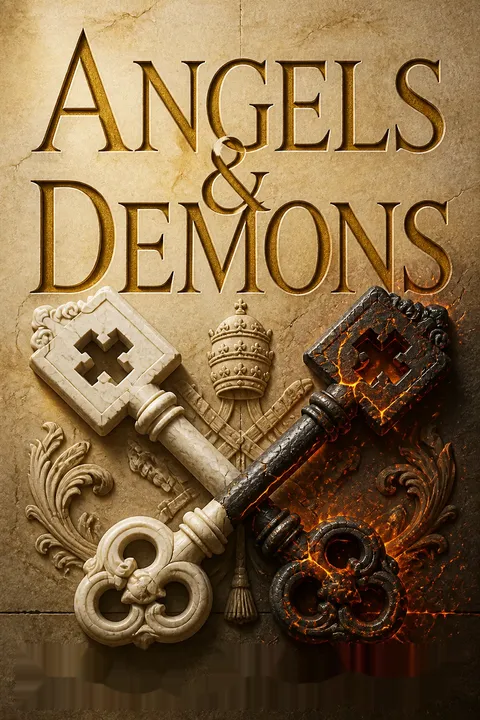


Plot Summary
Prologue
At CERN, physicist Leonardo Vetra is tortured by a masked intruder demanding a password. Vetra cannot provide one, and the attacker brands his chest with a symbol before turning a blade toward his face.
The scene establishes the story’s central collision: scientific secrets are already being pursued through religious imagery and deliberate cruelty. Vetra’s murder will draw a scholar of symbols into a crisis that threatens both the Vatican and the people gathered around it.
The opening makes knowledge feel bodily vulnerable. Vetra’s scientific authority cannot protect him from an attacker who treats information as something to be extracted by force, while the brand turns his body into a message for an audience not yet identified. The scene’s religious imagery is therefore not simply decoration: it is part of the crime’s machinery. By beginning with violence before explaining the science or the history, the novel makes interpretation itself urgent. Readers, like the investigators who follow, must decide whether the symbol reveals the truth or has been planted to manipulate belief.
The Illuminati Brand
At 5:18 in the morning, Robert Langdon, a Harvard professor of religious symbology, wakes to a call from CERN director Maximilian Kohler. A fax of Vetra’s branded body convinces Langdon to board an experimental aircraft to Switzerland, despite his unease about its sealed cabin. At CERN, Kohler leads him to the frozen murder scene.
Langdon recognizes the word on Vetra’s chest as an ambigram, readable both upright and inverted, associated with the long-supposedly vanished Illuminati. He traces the brotherhood’s origins to scientists persecuted by the Church, but warns that a surviving symbol alone cannot prove its makers are alive. Kohler rejects caution: Vetra’s body makes the old history a present danger.
Langdon’s expertise begins as a discipline of doubt. He can identify the emblem and reconstruct its history, yet he refuses to treat a sign as proof of the group behind it. Kohler, by contrast, wants a culprit quickly because the murdered scientist was both colleague and friend. Their disagreement establishes two competing habits of mind: interpret evidence cautiously, or act on the threat it appears to announce. The frozen room sharpens that conflict. Vetra’s body has been preserved as evidence, but also staged as an argument, forcing Langdon to examine not only what the brand means but who benefits from his interpretation.
The Daughter's Key
Leonardo Vetra’s adopted daughter, Vittoria, returns from marine fieldwork to find CERN hiding the circumstances of her father’s death. Her childhood explains their closeness: Vetra, a priest and physicist, adopted the curious orphan and taught her to see nature through both science and faith.
When she scans her eye to enter their private laboratory, Langdon realizes why Vetra’s eye was removed. Inside, Vittoria reveals their experiment: recreating a miniature Big Bang has produced antimatter, matter’s unstable counterpart.
She and her father designed magnetic traps to suspend tiny samples in a vacuum, and a demonstration annihilates one in a blinding burst of energy. Then they discover a far larger quarter-gram sample is missing from a deeper vault.
Vittoria inherits her father’s two-sided way of seeing, but she brings a different emphasis. Vetra sought a scientific account of creation that might support faith; Vittoria sees antimatter as a possible clean energy source whose value depends on responsible use. Their shared discovery is therefore both intellectual achievement and family legacy. Her childhood memory matters because it explains why she experiences science as a relationship rather than a contest with religion. The missing sample turns that inheritance into guilt: she had urged her cautious father to create a larger specimen. Her grief now carries a practical burden, since the technology she helped make possible can be used to kill.
Rome Becomes Ground Zero
Vittoria explains that each portable trap runs on a backup battery for only twenty-four hours, giving the stolen antimatter a fixed deadline. Kohler resists calling authorities, fearing damage to CERN, but the crisis reaches Rome when the Swiss Guard reports a suspicious camera feed from inside Vatican City. Langdon and Vittoria fly there as the Church prepares to elect a new Pope.
In the Pope’s office, an anonymous caller claims the Illuminati have kidnapped four favored cardinals and will kill them one by one in churches, each marked with an element. The caller also promises the antimatter will destroy the Vatican at midnight. The cardinals are trapped behind conclave protocol while the clock keeps running.
The danger changes scale: a private laboratory crime becomes a public siege, and the conclave makes the Vatican unusually vulnerable by concentrating its leadership in one sealed space. The caller’s schedule turns violence into performance. Each threatened murder is meant to be witnessed, interpreted, and circulated, so media attention becomes part of the weapon. The antimatter adds a different kind of clock, indifferent to ritual or negotiation. Langdon’s historical knowledge is suddenly operational, while Vittoria’s technical knowledge gives the threat physical dimensions. Neither can solve the crisis alone, and the two kinds of expertise must now work inside institutions more concerned with procedure than speed.
The Path of Illumination
Vittoria and Langdon first encounter Commander Olivetti, who doubts their account and refuses to disrupt the conclave. The late Pope’s chamberlain, Carlo Ventresca, takes the threat seriously and orders a search, though Olivetti remains responsible for security. Langdon connects the threatened elemental brands to an old Illuminati recruitment route through Rome, marked by religious-looking artworks that secretly represent Earth, Air, Fire, and Water.
He persuades Ventresca to grant him access to the Vatican’s restricted archives, where he hopes to find Galileo’s lost booklet, Diagramma della Verità. The plan depends on an unverified clue and leaves Vittoria, Langdon, and the Guard racing against the first scheduled killing.
Ventresca’s decision places moral responsibility ahead of institutional comfort, while Olivetti embodies the opposite pressure: security depends on controlled information and established authority. Neither position is wholly foolish. Secrecy may protect the Church, but it also prevents a rapid response to danger. Langdon’s proposed route is an attempt to convert historical knowledge into a map, yet it rests on fragile assumptions. The episode also establishes that art in this novel can work as camouflage: a sculpture may look devotional while carrying a second meaning. Reading correctly may save lives, but reading incorrectly can send armed people to the wrong place.
Raphael's Wrong Tomb
In the archives, Langdon and Vittoria find Galileo’s fragile Diagramma and uncover a concealed English poem referring to a path of light and a sacred test. Its first clue appears to point to Raphael Santi’s tomb and a roof opening, so they hurry to the Pantheon. Vittoria notices the dates do not fit: Raphael’s remains were moved there more than a century after the poem was written.
A guide’s explanation of an old term for a burial pit redirects them to Raphael’s Chigi Chapel at Santa Maria del Popolo. There, the first cardinal has already been killed. He is buried in an underground crypt with earth forced into his mouth and the word Earth burned into his chest.
The first clue demonstrates that intelligence does not eliminate error; it only gives error a more persuasive vocabulary. Langdon’s confidence in a familiar tomb nearly costs him the chance to follow the real trail. Vittoria’s attention to chronology corrects him, showing how their different disciplines complement one another: his symbolic pattern recognition needs her empirical skepticism. The cardinal’s death makes the poem’s intellectual puzzle brutally concrete. Earth is not merely a sign on a map but an element used in the victim’s execution. The investigation’s central danger is now visible: every symbolic solution arrives attached to a human body.
The Wind at Saint Peter's
Inside the Chigi Chapel, Langdon recognizes Bernini’s sculpture of Habakkuk and an angel as the first marker. The angel’s gesture points toward the next altar, which Langdon identifies as the West Ponente, a relief of wind in St. Peter’s Square. At nine, Cardinal Lamassé is found there among tourists, disguised as a homeless man.
The killer has punctured his lungs and branded him Air. Vittoria tries to save him, but the wounds make resuscitation impossible. A BBC camera operator records the body before the guards can stop her. Langdon and Vittoria have found the second marker, but the killer escapes again, and the footage soon carries the murder beyond the Vatican walls.
The second killing reveals the pathway’s double function. Bernini’s works guide the investigators, but the public locations also let the killer turn sacred landmarks into stages. The contrast between the delicate wind relief and Lamassé’s ruined lungs makes Air a grotesquely literal emblem. Vittoria’s attempt at resuscitation exposes the limit of technical competence: knowledge can diagnose the damage without undoing it. The BBC footage changes the crisis again. What the Vatican tries to contain becomes a spectacle watched by millions, fulfilling the killer’s publicity strategy even when security recovers the body. The media is not a neutral observer here; its camera alters the political consequences of every failure.
The Poisoned Pope
News broadcasts show the killings and report the Illuminati’s claim that the late Pope was poisoned with Heparin, a drug he used for a medical condition. Vittoria explains that an overdose could resemble a stroke. Ventresca and the guards open the Pope’s tomb and find his tongue blackened, a sign consistent with internal bleeding.
The chamberlain then addresses the world, admitting the danger and arguing that faith must retain a moral voice as science advances. While Ventresca manages the public crisis, Langdon returns to the archives to locate the Fire altar. A security power failure traps him in a sealed vault, where he escapes by toppling a chain of heavy shelves into the glass wall.
The Pope’s body turns an unverified accusation into evidence that cannot be dismissed, although it does not yet establish who is responsible. Ventresca’s public address rejects the Vatican’s reflex toward silence, but it also risks giving the attacker the audience he wants. Langdon’s escape from the archive is a physical counterpart to that institutional problem: preservation systems designed to protect knowledge can become prisons when their operators lose control. His survival depends on rearranging the very stacks meant to keep the past safe. The scene questions whether stewardship means guarding information unchanged or accepting damage to preserve the lives and truths that matter more.
Fire in the Chapel
Langdon identifies Bernini’s Ecstasy of Saint Teresa as the Fire marker and reaches Santa Maria della Vittoria with Vittoria and Olivetti. Inside, Cardinal Guidera hangs above a burning pyre, branded Fire. Langdon cannot reach the cables before the flames kill him. The Hassassin attacks, shoots at Langdon, and leaves Vittoria unconscious; Olivetti is found dead nearby, his head twisted backward.
When Langdon wakes after the fire is extinguished, the cardinal and commander are dead, and Vittoria has vanished. The attacker’s earlier threats now feel personal as well as strategic. Langdon stops trying to manage the larger crisis and commits himself to finding Vittoria before the killer can harm her.
Fire marks the moment the investigation loses its remaining illusion of control. Langdon has identified the correct place, yet correct interpretation cannot overcome the physical limits of time, distance, and violence. His failure to save Guidera leaves him carrying a different kind of responsibility from the one he began with: he is not only an academic helping authorities but a witness whose choices have consequences for people he knows. Vittoria’s abduction concentrates his attention, while Olivetti’s death removes the security structure that has alternately obstructed and protected them. The crisis narrows from a public emergency to an intimate rescue without making the public threat any less real.
The Cross Beneath Rome
Using the first three locations, Langdon plots the altars across Rome and sees them form a cross. The fourth point falls at Piazza Navona, where Bernini’s Fountain of the Four Rivers represents Water. There, the Hassassin has chained Cardinal Baggia and branded him Water. Langdon confronts the killer in the fountain, but the Hassassin knocks him under and leaves him for dead.
Langdon survives by breathing through a fountain aerator, then pulls Baggia from the water and attempts CPR. The cardinal dies. As Langdon searches the fountain for the final direction, he recognizes a bronze dove atop its obelisk as the hidden marker. It points toward Castel Sant’Angelo, the presumed Church of Illumination.
The cross turns the killer’s sequence into a structure that is at once scientific and religious. Langdon’s insight depends on seeing the four places not as isolated clues but as a geometry across the city. Yet the pattern offers no power to reverse its human cost: Baggia dies despite Langdon’s rescue attempt. Langdon’s survival comes through a practical detail learned earlier at CERN, not through mastery of symbols alone. The aerator becomes a narrow channel of life in a scene dominated by water as execution. The dove then sends him toward the final confrontation, while the story’s religious imagery remains deliberately unstable, capable of guiding, concealing, or deceiving.
The Castle of Angels
Langdon follows the dove’s direction to Castel Sant’Angelo, where Bernini’s Bridge of Angels leads toward the fortress. The Hassassin has taken Vittoria there and is preparing to assault her. Langdon enters through concealed passages and reaches the meeting chamber just as the killer threatens her.
Vittoria has worked herself free of her restraints; together she and Langdon turn on the Hassassin, using a torch and the iron bar to drive him over the castle’s high balcony. Before he dies, the killer reveals that his master, Janus, intends to brand Ventresca and will arrive in Vatican City under the guise of a helpful visitor. Langdon and Vittoria take the Passetto back toward the Vatican to stop him.
The rescue gives Vittoria agency at the point where the killer had treated her as property. Her escape from the bindings is not a sudden gift from Langdon but the result of discipline and physical knowledge she has developed over a lifetime. Their victory is collaborative: Langdon’s persistence brings him to the chamber, but neither could safely overcome the Hassassin alone. The assassin’s final information shifts the meaning of the night from pursuit to interception. The threat now comes from someone expected to be welcomed inside the Vatican, turning hospitality and trust into vulnerabilities. The secret passage becomes both a route of escape and a test of whom the institution allows through its walls.
The Brand in the Pope's Office
Langdon and Vittoria cross the Passetto with rookie guard Chartrand’s help and reach the Pope’s office too late to prevent a confrontation. Kohler is there with a gun; Ventresca lies injured, his chest burned by the square brand later called the Illuminati Diamond. The guards shoot Kohler, then Chartrand kills Captain Rocher when Ventresca identifies him as a traitor.
Before dying, Kohler passes Langdon a tiny camcorder and asks him to give it to the media. The chamberlain orders the cardinals evacuated and heads into the basilica. Langdon and Vittoria still do not know whether Kohler was the promised Janus, why the attack occurred, or where the antimatter is hidden.
The office scene deliberately gives appearances the force of verdict. Kohler holds a gun, Ventresca bears the brand, and Rocher is exposed as compromised; the guards act within seconds, before anyone can reconstruct the full chain of events. Chartrand’s intervention saves the possibility of an account beyond the immediate violence, while Kohler’s camcorder preserves evidence that might otherwise die with him. The square brand remains unreadable to Langdon because he sees the tool rather than its reversed impression. That failure foreshadows a broader problem: in a crisis saturated with symbols, even a trained interpreter can mistake the sign for the truth it is meant to convey.
The Tomb of Peter
Ventresca claims to have received a revelation and leads the guards, Langdon, Vittoria, and the BBC crew down into the Necropolis. He identifies the hidden canister beside the tomb of Saint Peter, the literal rock on which the Church was built. With only minutes remaining, he carries it up through the basilica and takes off in the Vatican helicopter.
Langdon realizes Ventresca means to explode it far above the city, but the chamberlain locks the sample in a cargo box and jumps with a parachute. Langdon escapes the rising helicopter with a windshield tarp and falls into the Tiber. Rescuers pull him from the water alive, while the antimatter detonates high above Rome.
The chamberlain’s discovery resolves the spatial puzzle through literal reading: the Church’s symbolic foundation is also its physical foundation. Yet the rescue becomes an act of sacrifice whose meaning is initially impossible to judge. Ventresca chooses altitude over a safer, uncertain destination, and Langdon survives through a crude substitute for a parachute, a detail seeded by the wind tunnel at CERN. The explosion saves the city but produces an image that can be interpreted as miracle, spectacle, or weapon. The public sees a radiant sphere above Rome; Langdon experiences falling, terror, and physical survival. The gap between those viewpoints prepares the story’s final argument about who controls meaning.
Janus Behind the Brand
After recovering in a hospital, Langdon returns to the Vatican with Kohler’s camcorder. Its recording shows that Ventresca had Vetra murdered after learning of the antimatter, and that he poisoned the Pope. The supposed Illuminati resurgence was a plan Ventresca manufactured, using the Hassassin, the stolen brands, and the captured cardinals to frighten the world back toward faith.
He had also branded himself, provoking the guards to shoot Kohler and making himself appear a victim. In the chapel, Mortati reveals the Pope had fathered Ventresca through artificial insemination with a nun, so he had kept his celibacy vow. Ventresca had misunderstood the truth. After the cardinals learn his guilt, he leaves and sets himself on fire.
The revelation dismantles the story’s apparent opposition between science and religion by exposing a religious leader who weaponizes both. Ventresca does not merely invent a false enemy; he arranges real deaths to make that enemy persuasive. His actions are driven by grief, fear of scientific power, and a damaged understanding of the family truth that shaped his faith. The Pope’s secret is not the sexual scandal Ventresca imagined, but a chaste use of science to become a parent. This reverses the accusation at the story’s center: the crime is not that science has impersonated God, but that a human being has claimed divine authority to justify murder.
A Pope Chosen Twice
With Ventresca dead and the conspirators exposed, Cardinal Mortati resists the cardinals’ impulse to treat the chamberlain’s brief public acclaim as a legitimate election. He insists that law and reason still matter after a night of apparent miracles. In the morning, the cardinals elect Mortati Pope by unanimous vote.
Langdon and Vittoria choose not to publish every detail of the conspiracy, aware that the public’s belief has been shaped by an event it witnessed but cannot fully explain. Mortati sends them a note declining to demand silence, and he loans Langdon the Illuminati Diamond from the papal vault. The new Pope’s choice leaves the truth available without turning it into another weapon.
Mortati’s restraint offers a counterweight to Ventresca’s absolutism. He does not dismiss the crowd’s experience, but he refuses to let collective emotion replace the procedures meant to govern the Church. His election is therefore less a triumph than an attempt to rebuild legitimacy through deliberation. Langdon and Vittoria face a related ethical choice: disclosure may correct the record, but it may also deepen public cynicism and compound the harm. Their decision does not erase the truth; Mortati’s note explicitly leaves the choice with them. The diamond, transferred from secret vault to scholar, changes from an instrument of deception into an artifact whose meaning remains open to scrutiny.
The Last Night in Rome
After the crisis, Langdon and Vittoria spend the night at the Hotel Bernini, where their closeness finally softens the formality between them. Earlier, a scholar explains on television that the cardinals’ spontaneous acclaim may have elected Ventresca Pope for a brief interval, though the Church offers no official confirmation.
The possibility leaves Rome with another unresolved religious question rather than a neat public account. Langdon receives the Illuminati Diamond and Mortati’s letter, but he and Vittoria agree not to puncture the world’s sense of wonder with every private fact. Their ending is intimate rather than triumphant: they share food, teasing, and a tentative attraction while the meaning of the night remains unsettled.
The closing movement trades the thriller’s public scale for a private, human one. Langdon and Vittoria cannot repair the dead or produce certainty about the night’s supernatural appearance, but they can choose how to live beside uncertainty. Their humor matters because it restores ordinary time after a day governed by countdowns, symbols, and violence. The possible second papacy extends the novel’s central ambiguity: law, belief, and witnessed experience do not always align. Rather than resolving that tension, the ending lets intimacy coexist with unanswered questions. The result is not that truth becomes irrelevant, but that people must decide how to carry it without pretending they possess the whole of it.
Analysis
Angels & Demons builds its thriller around a conflict that is repeatedly misread as a simple war between science and religion. Antimatter appears to make the opposition literal: a scientific discovery with creation-like implications becomes a weapon aimed at the Vatican. Yet the final revelation complicates that frame. The danger does not come from science acting autonomously, nor from an ancient brotherhood returning. It comes from a religious authority who turns a scientific device, historical symbols, and public fear into instruments of control. Ventresca’s violence is motivated by a desire to restore faith, but his methods reproduce the coercion he claims to oppose.
The novel also treats interpretation as a form of power. Langdon can read ambigrams and artworks, but accurate recognition does not guarantee accurate judgment. The Illuminati signs are real artifacts, yet they are arranged to implicate the wrong people. The false confidence produced by a coherent pattern is one of the story’s most effective dangers: once the evidence appears to fit, investigators and audiences become less likely to ask who constructed the fit. Kohler’s recording eventually matters because it supplements interpretation with testimony, though even that testimony requires the listeners to reconsider their assumptions.
Vittoria and Langdon represent complementary ways of knowing. She tests claims against physical processes and consequences; he reads the cultural layers that give objects meaning. Neither method is sufficient alone. Their collaboration succeeds when curiosity remains open to correction, as when Vittoria’s attention to Raphael’s burial date overturns Langdon’s initial conclusion. The book’s deeper lesson is not that reason should defeat faith, or faith should limit science. It is that power without accountability becomes dangerous, whether it speaks in the language of technical progress or divine command. The final questions remain unresolved because the characters cannot control how the public will interpret the miracle it believes it witnessed. They can only choose whether uncertainty becomes an excuse for manipulation or an invitation to think more carefully.
Review Summary
Angels & Demons receives mixed reviews, with many praising its fast-paced, thrilling plot and exploration of science vs. religion themes. Readers appreciate Brown's ability to create page-turning suspense and weave historical and scientific details into the story. However, some criticize the writing style, character development, and factual inaccuracies. Despite these criticisms, many find it an entertaining read, with some preferring it to The Da Vinci Code. The book's impact on readers' perspectives on religion and science is frequently mentioned.
People Also Read




Characters
Robert Langdon
Reluctant symbol readerA Harvard professor of religious symbology, Langdon is trained to read images, rituals, and historical traces without confusing interpretation with proof. His academic caution can make him slow to accept danger, but his curiosity repeatedly draws him beyond the safety of the lecture hall. He carries a childhood trauma involving a fall into a well, which has left him claustrophobic and makes enclosed spaces physically difficult. Swimming has given him confidence in water and unusual bodily discipline, skills that matter alongside his scholarship. Langdon is courteous, self-effacing, and more emotionally responsive than his detached manner suggests. His growing partnership with Vittoria forces his intellectual gifts into immediate service, where a mistaken reading has consequences no book can contain.
Vittoria Vetra
Scientist shaped by wonderA CERN physicist and marine researcher, Vittoria studies how living systems connect. She is the adopted daughter of Leonardo Vetra, who raised her from childhood and encouraged her questions about both nature and faith. Her scientific work is practical as well as ambitious: she cares about clean energy, ecological consequences, and safeguards against misuse. Yoga and disciplined breathing help her regulate fear, though they do not make her immune to grief or anger. Vittoria’s independence can appear severe, especially when others question her judgment or appearance instead of her expertise. She is capable of tenderness, but she does not accept comfort in place of action. Her partnership with Langdon brings together physical courage and symbolic reasoning while allowing her to remain fully her own agent.
Carlo Ventresca
The Pope's chamberlainThe young priest serving as chamberlain to the late Pope, Ventresca is responsible for guiding the Church through the vulnerable interval before a new pontiff is chosen. His composure and directness give him an authority that exceeds his formal rank. He is devoted to the Church and shaped by a childhood marked by religious practice, personal loss, and an extraordinary survival. His faith is not merely a set of doctrines; it is the framework through which he interprets duty, pain, and moral choice. Ventresca speaks to people outside the clergy in a modern, accessible way, while remaining deeply attached to tradition. His presence unsettles assumptions about who can lead and what religious conviction demands.
Maximilian Kohler
CERN's guarded directorThe wheelchair-using director of CERN, Kohler is a brilliant physicist whose manner is clipped, controlled, and difficult to read. His disability and serious health problems have shaped how he moves through the world, but he refuses to invite pity and often meets it with anger. He trusts scientific method and has little patience for religious explanations that claim authority without evidence. His respect for Leonardo Vetra complicates his usual emotional distance, while his position forces him to weigh scientific discovery against the institution’s safety and reputation. Kohler’s certainty can look like courage or rigidity, depending on who is asking him to reconsider. He treats knowledge as a responsibility, even when his own motives remain opaque to those around him.
Leonardo Vetra
Priest and physicistVetra is a CERN physicist, Catholic priest, and adoptive father to Vittoria. He believes that the laws of nature can illuminate rather than diminish spiritual questions. Warm and patient, he gives Vittoria the freedom to challenge explanations and helps make inquiry part of their family bond. His research joins particle physics to questions about creation, a combination that draws admiration as well as suspicion. Vetra’s concern for the implications of his work leads him to seek guidance beyond the laboratory, while his daughter presses toward practical applications. He represents a rare attempt to hold scientific rigor and religious devotion together without treating either as a substitute for the other.
The Hassassin
Hired instrument of terrorA highly skilled assassin employed for a campaign of murder and spectacle, the Hassassin combines patience, physical strength, and an appetite for domination. He frames violence as service to a cause, but his treatment of others reveals how much personal cruelty accompanies that self-image. His belief in the authority of his employer makes him willing to undertake tasks he considers nearly impossible. He is alert to fear and uses it as deliberately as any weapon, while his confidence can become a weakness when he assumes an opponent has no means of resistance. His role is both practical and theatrical: he kills, but also leaves branded bodies designed to make the world interpret the killings in a particular way.
Commander Olivetti
Vatican security chiefOlivetti commands the Swiss Guard’s security operation and measures every emergency against protocol, manpower, and the protection of Vatican City. He is disciplined, proud, and initially dismissive of claims that do not fit his understanding of explosives or Church security. His bluntness makes him difficult to work with, but his caution is rooted in years of responsibility rather than simple indifference. He is willing to revise his plans when evidence becomes compelling, though his instinct is to preserve order and control. Olivetti’s relationship with the chamberlain is tense because each man understands duty differently: one through security procedure, the other through moral authority.
Cardinal Mortati
Conclave's senior electorAt seventy-nine, Mortati is the senior cardinal overseeing the papal election. He is thoughtful, broad-minded, and more attentive to conscience than political ambition. His role demands that he preserve the rules of conclave even when an emergency tempts the cardinals to abandon them. Mortati understands that institutions need ritual and procedure, but he is not blind to their capacity for secrecy or self-protection. He listens before acting and bears the emotional weight of decisions that others want made quickly. His quiet authority comes from years of observing the Church’s internal workings and from a willingness to admit uncertainty when certainty would be more comforting.
Captain Elias Rocher
Second-in-commandRocher is the Swiss Guard’s second-in-command, a physically imposing officer trusted to coordinate personnel and crisis response. His men see him as formidable but more visible and approachable than Olivetti. He is accustomed to translating command decisions into action, particularly when the Guard must operate under pressure and limited information. Rocher’s professional confidence can make him appear reliable even when the larger situation remains unclear. His position places him between the rigid security hierarchy and the chamberlain’s authority, a dangerous place in a crisis where the chain of command itself becomes uncertain.
Lieutenant Chartrand
Young guard with initiativeA twenty-year-old Swiss Guard and recent recruit, Chartrand is earnest, disciplined, and still forming his judgment about the institution he serves. His training has prepared him to obey orders, but not to accept them without thought when someone may be in danger. He admires the chamberlain’s conviction and is troubled when security decisions appear to conflict with the protection of human life. Chartrand’s youth gives him less authority than the senior officers, yet it also leaves him open to acting on immediate evidence rather than defending past choices. His role shows how responsibility can fall to someone who has not yet learned to mistake rank for moral certainty.
Gunther Glick
Ambitious BBC reporterGlick is a young BBC journalist eager to escape low-profile assignments and prove he can break an important story. His earlier tabloid work has made him comfortable with sensational framing, and he is quick to see opportunity in the crisis. He can be funny and resourceful, but ambition sometimes outruns judgment, especially when he speculates beyond the evidence. His reporting helps bring the Vatican’s secrecy into public view, while also feeding the spectacle the attacker wants. Glick’s work exposes the moral ambiguity of journalism during catastrophe: a camera can preserve evidence and alert the world, yet the demand for a compelling story can distort what that evidence means.
Chinita Macri
BBC camera operatorMacri is Glick’s experienced BBC camera operator, sharp-eyed, technically skilled, and far more skeptical than her reporter. She understands how framing changes a story and keeps her attention on what the lens can actually establish. Her skepticism protects her from easy conspiracy claims, but she does not ignore evidence when it appears before her. She risks losing recorded footage when the Swiss Guard confiscates her camera, then helps ensure the evidence survives. Macri’s professional competence provides a grounded counterweight to Glick’s appetite for dramatic conclusions. She is not simply behind the story; her choices determine what the public gets to see.
The late Pope
A reform-minded pontiffThe recently deceased Pope had served for twelve years and was widely admired. He showed greater openness to science than many Church leaders, supporting selective research and hoping to bring religious faith into conversation with modern discoveries. His private life reflects a deep personal attachment and a belief that scientific medicine could make possible a family without violating a vow. He also chose Ventresca as his chamberlain and mentor, entrusting him with the Church’s transition. The Pope’s interest in reform makes him a point of tension between tradition and adaptation, while his influence continues to shape the choices of those who survive him.
Cardinal Baggia
The favored candidateAn Italian cardinal widely regarded as the leading candidate for the papacy, Baggia is respected for his service, language skills, and ability to communicate spiritual ideas. His absence from conclave unsettles the election and gives the crisis a personal face within the Church’s political structure. He represents the possibility of a more open, modern leadership, though his role in the events is constrained by forces beyond his control.
Plot Devices
Antimatter trap
A ticking scientific threatVittoria’s magnetic trap keeps antimatter suspended in a vacuum so that it cannot touch ordinary matter. A battery powers the fields and provides only a twenty-four-hour window once the capsule is removed from its recharging stand. The quarter-gram sample is powerful enough to devastate a large area if it annihilates. Its countdown gives the plot a measurable deadline, while the canister’s compact, nonmetallic construction lets it evade ordinary security screening. The trap is both a scientific breakthrough and a portable weapon, making the same invention appear as promise, liability, and instrument of terror.
Illuminati ambigrams
Symbols that reverse meaningThe Illuminati brand can be read upright or inverted, making it a visual signature that seems to authenticate the brotherhood’s return. Similar reversible brands appear on the cardinals, while Bernini’s public artworks conceal markers for the four classical elements. These symbols guide Langdon through Rome, but they also invite him and the public to believe the killer’s account of who is responsible. The square brand used on Ventresca is especially deceptive because the iron tool is the reverse of its imprint. The plot uses ambigrams to show how a sign can be technically accurate and still encourage a false conclusion.
Path of Illumination
A city-wide coded routeA concealed route attributed to the Illuminati links four Roman sites through artworks associated with Earth, Air, Fire, and Water. Galileo’s Diagramma contains a poem that points toward the first marker, while Bernini’s sculptures and reliefs direct the search onward. The route functions as both an initiation trail from the brotherhood’s history and the killer’s schedule for the cardinals. Langdon must combine art history, chronology, architectural orientation, and close observation to follow it. The route is not a simple treasure map: its clues can be misread, and each delay has a human cost.
The conclave
A locked political arenaThe papal election gathers the cardinals inside the Sistine Chapel and seals them off from outside contact. This ancient procedure is intended to protect the election from interference, but it also concentrates the Church’s leadership inside a threatened city. The rules create friction between Mortati’s duty to conduct the vote, Olivetti’s security concerns, and Ventresca’s authority as chamberlain. News coverage and the public crowd outside further undermine the intended isolation. Conclave becomes both a setting and a pressure system: tradition can preserve legitimacy, but rigid procedure can also delay a response to danger.
Kohler's camcorder
A hidden record of guiltKohler secretly records his meeting with Ventresca using a tiny camcorder concealed beneath his wheelchair. After the confrontation, he gives the device to Langdon, who initially does not understand its importance. The recording preserves Ventresca’s admission and explains why the apparent conflict between Kohler and the chamberlain was not what it seemed. It gives Langdon evidence that can be shown to the cardinals rather than another interpretation of a symbol. The camcorder turns the novel’s concern with images toward a more dependable form of witness: a recorded voice can still be disputed, but it makes denial much harder.
FAQ
Synopsis & Basic Details
What is Angels & Demons about?
- Ancient feud reignites: A secret society, the Illuminati, resurfaces after centuries, seeking revenge on the Catholic Church.
- Race against time: Harvard symbologist Robert Langdon and scientist Vittoria Vetra must decipher clues and stop a stolen antimatter device from destroying Vatican City.
- Clash of ideologies: The story explores the conflict between science and religion, as well as the power of faith and the dangers of extremism.
Why should I read Angels & Demons?
- Intriguing mystery: The novel is a fast-paced thriller with a complex plot, filled with twists, turns, and hidden codes.
- Exploration of themes: It delves into the historical conflict between science and religion, raising questions about faith, power, and the pursuit of knowledge.
- Rich symbolism: The story is packed with symbolism, art, and historical references, offering a deeper reading experience.
What is the background of Angels & Demons?
- Historical context: The novel draws on the real history of the Illuminati, a secret society that existed in the 16th and 17th centuries, and their conflict with the Catholic Church.
- Scientific elements: The story incorporates real scientific concepts, such as antimatter, and the research being conducted at CERN.
- Religious symbolism: The novel is set in Vatican City and explores the rich symbolism and traditions of the Catholic Church.
What are the most memorable quotes in Angels & Demons?
- "Science and religion are not at odds. Science is simply too young to understand.": This quote encapsulates the central theme of the novel, highlighting the potential for harmony between science and religion.
- "Sometimes to find truth, one must move mountains.": This quote emphasizes the lengths to which the characters are willing to go in their pursuit of knowledge and justice.
- "The most dangerous enemy is that which no one fears.": This quote foreshadows the Illuminati's resurgence and their ability to operate in secret.
What writing style, narrative choices, and literary techniques does Dan Brown use?
- Fast-paced narrative: Brown employs short chapters, cliffhangers, and frequent plot twists to maintain a high level of suspense and keep the reader engaged.
- Detailed descriptions: The author provides vivid descriptions of the settings, art, and historical locations, immersing the reader in the story's world.
- Symbolism and codes: Brown uses symbolism, codes, and puzzles to add layers of complexity to the plot, challenging the reader to decipher the hidden meanings.
Hidden Details & Subtle Connections
What are some minor details that add significant meaning?
- The Free Fall Tube: The description of the free fall tube at CERN, initially presented as a stress reliever, foreshadows the later use of friction to slow a falling body, saving Langdon's life.
- The Ionic Column: The joke about the Ionic column at CERN, which is actually Doric, foreshadows the later misinterpretations of symbols and the importance of understanding their true meaning.
- The Sticky Note: The sticky note on the column, "THIS COLUMN IS IONIC," is a subtle hint at the presence of ions, which are electrically charged particles, and the importance of physics in the story.
What are some subtle foreshadowing and callbacks?
- Langdon's claustrophobia: Langdon's mild claustrophobia, mentioned early in the book, foreshadows his discomfort in the confined spaces of the Vatican and the Necropolis.
- The Hassassin's name: The Hassassin's name, derived from "hashish," foreshadows his drug-induced stupors and his violent nature.
- The Z-particle: Vittoria's description of the Z-particle as pure energy with no mass foreshadows the nature of antimatter and its potential for both creation and destruction.
What are some unexpected character connections?
- Galileo and the Illuminati: The revelation that Galileo was a member of the Illuminati connects the historical conflict between science and religion to the present-day events.
- Leonardo Vetra and the Church: The fact that Leonardo Vetra was both a Catholic priest and a physicist highlights the novel's theme of the potential for harmony between science and religion.
- The camerlegno and the Pope: The camerlegno's personal connection to the Pope, as his son, adds a layer of complexity to his motivations and actions.
Who are the most significant supporting characters?
- Cardinal Mortati: As the Great Elector, he is a voice of reason and tradition, and his eventual election as Pope represents a return to stability.
- Captain Rocher: The head of the Swiss Guard, his initial skepticism and later betrayal highlight the theme of trust and deception.
- Sylvie Baudeloque: Kohler's secretary, she is a minor character, but her actions reveal the extent of Kohler's influence and the reach of the conspiracy.
Psychological, Emotional, & Relational Analysis
What are some unspoken motivations of the characters?
- Kohler's revenge: Kohler's actions are driven by a deep-seated resentment towards the church for his physical condition and the persecution of science.
- Vittoria's grief: Vittoria's determination to find her father's killer is fueled by her grief and a desire for justice.
- The camerlegno's faith: The camerlegno's actions are driven by a fervent belief in God and a desire to protect the church, even if it means sacrificing himself.
What psychological complexities do the characters exhibit?
- Langdon's fears: Langdon's claustrophobia and his fear of enclosed spaces reveal a vulnerability beneath his intellectual exterior.
- Kohler's bitterness: Kohler's bitterness and cynicism stem from his physical disability and his belief that the church has always persecuted science.
- The camerlegno's fanaticism: The camerlegno's unwavering faith and his willingness to sacrifice himself for the church reveal a complex and potentially dangerous level of devotion.
What are the major emotional turning points?
- Langdon's acceptance: Langdon's initial skepticism about the Illuminati is replaced by a sense of urgency and responsibility as he witnesses the evidence of their resurgence.
- Vittoria's transformation: Vittoria's grief and anger are transformed into a fierce determination to stop the killer and protect the world from the antimatter.
- The camerlegno's revelation: The camerlegno's discovery of the Pope's secret and his own identity as the Pope's son leads to a profound shift in his motivations and actions.
How do relationship dynamics evolve?
- Langdon and Vittoria: Their initial professional relationship evolves into a deep bond of trust and mutual respect as they face danger together.
- Kohler and Langdon: Their relationship shifts from one of suspicion to a reluctant partnership as they work together to solve the mystery.
- The camerlegno and the church: The camerlegno's relationship with the church evolves from one of devotion to one of betrayal and sacrifice.
Interpretation & Debate
Which parts of the story remain ambiguous or open-ended?
- The Illuminati's true nature: The novel leaves open the question of whether the Illuminati are a truly evil force or simply a group of scientists seeking to challenge the church's authority.
- The camerlegno's motivations: The camerlegno's actions are open to interpretation, leaving the reader to decide whether he is a hero or a villain.
- The future of science and religion: The novel does not offer a definitive answer to the conflict between science and religion, leaving the reader to ponder the potential for harmony or continued conflict.
What are some debatable, controversial scenes or moments in Angels & Demons?
- The camerlegno's actions: The camerlegno's decision to sacrifice himself and the cardinals is a controversial act that raises questions about the nature of faith and the limits of religious extremism.
- The portrayal of the church: The novel's depiction of the Catholic Church as a secretive and power-hungry institution has been criticized by some readers.
- The use of violence: The novel's graphic descriptions of violence and torture have been criticized by some readers as gratuitous and unnecessary.
Angels & Demons Ending Explained: How It Ends & What It Means
- The antimatter's fate: The antimatter is destroyed in a high-altitude explosion, preventing its use as a weapon of mass destruction.
- The camerlegno's sacrifice: The camerlegno's self-immolation is a complex act that can be interpreted as both a heroic sacrifice and a tragic act of religious extremism.
- The new Pope: Cardinal Mortati's election as Pope represents a return to reason and compassion, offering hope for a more balanced future for the church.
Robert Langdon Series


About the Author
Other books by Dan Brown


Download PDF
Download EPUB
.epub digital book format is ideal for reading ebooks on phones, tablets, and e-readers.








