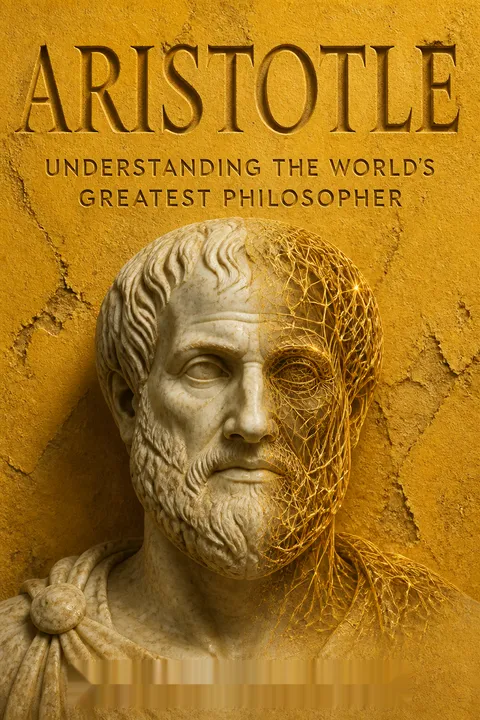


Key Takeaways
Treat curiosity as a human capacity to exercise, not a hobby to justify
Curiosity needs direction. The book opens at the excavated site of Aristotle’s Lyceum in Athens. Work on a modern museum uncovered the remains of the school where Aristotle and his companions pursued questions ranging from animals and logic to politics and drama. The discovery gives a physical setting to the book’s central claim: inquiry is not a luxury reserved for specialists. Aristotle believed people naturally want to know, but collecting facts is only a beginning. Understanding how those facts fit together is the deeper aim.
Thinking is part of living. Aristotle treated reflection on the world and human life as an expression of our nature, not merely a tool for earning money or solving immediate problems. His ideal was demanding, but he thought ordinary people could share in it by pausing to ask serious questions and attend to the world around them.
What's striking is the distinction between information and understanding. A person can accumulate facts about a subject without asking what those facts reveal about causes, purposes, or relationships. Aristotle’s account makes curiosity less like browsing and more like sustained attention. That is an inviting view of intellectual life, though it risks making reflective inquiry sound equally available to everyone. Time, education, and security are unevenly distributed. The Lyceum itself depended on people with leisure. The principle remains useful, but the social conditions that make inquiry possible deserve attention too.
Explain change without forcing the world into a choice between flux and permanence
Being has several senses. Aristotle developed his metaphysics amid a conflict between thinkers who treated reality as unchanging and those who saw everything as perpetually shifting. Plato’s ideal forms offered stable objects of knowledge, but Aristotle questioned whether such separate forms could explain particular things. He argued instead that actual individuals, such as this horse or this person, are primary, while qualities such as color depend on them.
Possibility is real too. An acorn is actually an acorn and potentially an oak. Potentiality, in Aristotle’s technical sense, is not any imaginable future; it is a capacity connected to what a thing is. Actuality is the exercise or realization of a capacity. This gives him a way to discuss change without saying that a thing must be either entirely what it is now or nothing at all.
Aristotle’s account is powerful because it treats identity as compatible with development. A growing organism can change profoundly while remaining the kind of organism it is. That perspective helps avoid two familiar mistakes: assuming that stable categories rule out change, or that change makes meaningful description impossible. The acorn example also reveals a limit. Not every apparent potential is guaranteed to unfold, and conditions can prevent a capacity from being realized. Potentiality is best understood as a structured possibility, not a promise about the future.
Study living things by asking what their parts enable the whole to do
Observation starts the explanation. On the island of Lesbos, Aristotle examined and dissected marine animals, describing their structures and comparing species. He also acknowledged when evidence was incomplete. In considering how bees reproduce, he mapped plausible explanations but said that direct observation should outweigh a theory if future evidence became available. His confidence in inquiry did not require pretending to know what he did not.
Four questions clarify a thing. Aristotle’s four causes are kinds of explanation: what something is made from, how it is organized, what brings it about, and what it is for. A wall, for instance, involves bricks, their arrangement, a builder, and the goal of making a wall. For living things, function matters: dissecting an animal reveals its parts, but not by itself what makes those parts work together as a living whole.
This approach anticipates a useful habit in systems thinking: a component is easier to understand when its relation to the whole is visible. Describing an organ only by its material composition misses what it contributes to an organism. The framework also resists explanations that stop at a chain of physical events. Its purpose-focused dimension, however, needs care. In biology, a function can describe what a structure does without implying that nature consciously designed it. Aristotle’s explanatory questions remain fertile even when his account of nature’s purposes is not accepted literally.
Separate an argument’s logical shape from the truth of its premises
Logic checks the inference. Aristotle treated logic as a tool for inquiry, not as a source of facts about the world. In a syllogism, two premises support a conclusion through a defined structure. The argument that all humans are animals, all animals are mortal, and therefore all humans are mortal has a valid form. Replacing the second premise with the false claim that all animals can fly leaves the structure valid but makes the conclusion unsound.
Different questions need different reasoning. Aristotle also studied disputed opinions through dialectical reasoning, testing a view by drawing out what follows from it. Ethical and political questions rarely permit the same precision as mathematics, he warned. His discussion of whether a sea battle will occur tomorrow shows the tension between statements being true or false and the future remaining open to human action.
The distinction between validity and truth remains a powerful defense against confident nonsense. A polished argument can preserve its structure while resting on a false premise, so checking its form is not enough. Aristotle’s broader point is equally important: method should fit the subject. A moral judgment is not a geometry theorem, but that does not make it immune to criticism. Dialectical testing offers a way to examine contested beliefs without pretending that every disagreement can be settled by a formula.
Build communities where people can participate, not merely survive
The city makes a fuller life possible. Aristotle pictured human communities growing from households to villages and then to city-states. A community, in his view, should provide more than food and protection. Its scale should make possible shared culture, education, public decision-making, and the leisure needed for a richer life. People are social animals, not self-sufficient individuals who first exist alone and later make a bargain to cooperate.
Inequality threatens cooperation. Aristotle favored a mixed political order rather than rule by one person, a wealthy elite, or the poor majority alone. He saw a substantial middle class as a stabilizing force because sharp divisions can turn citizens into hostile groups. Yet his own political world accepted slavery and subordinated women. His observations about community coexist with assumptions that exclude many people from equal participation.
Aristotle’s account connects political legitimacy to lived participation. People are more likely to regard a community as their own when they can contribute to decisions that shape it. That idea resonates beyond ancient city-states, including in workplaces and local institutions. But the model’s limits are not incidental: the same thinker who stresses shared civic life leaves many people outside its political agency. The enduring lesson is not to copy his social hierarchy, but to ask who counts as a participant and who bears the costs of a supposedly common good.
Use stories to rehearse choices and emotions before life makes them urgent
Plot matters more than spectacle. In the Poetics, Aristotle studies how drama is made and how it affects an audience. He argues that a strong plot presents a complete action, with events that contribute to a unified story. A reversal or recognition can surprise an audience while still making sense in retrospect. Characters and staging matter, but elaborate production cannot rescue a story whose events do not hold together.
Fiction reveals recurring patterns. Tragedy lets audiences encounter fear, pity, loss, and the consequences of poor decisions in a shared, bounded setting. Aristotle calls the emotional process catharsis, a purification or release associated with experiencing these feelings through drama. He also considers poetry more philosophically revealing than a record of particular events: invented stories can show patterns of human action that apply beyond one historical case.
Aristotle’s account treats art as a way of learning about people, not simply as decoration or escape. A well-shaped story lets an audience consider motives and consequences without having to undergo the exact crisis themselves. That resembles a form of emotional rehearsal, though the book presents this as an interpretation rather than a proven therapeutic effect. The focus on plot also offers a practical test for any narrative: does each event deepen the central action, or is it present only because the creator liked it?
Measure happiness by a flourishing life, not by a passing feeling
Well-being is activity over time. Aristotle’s eudaimonia means flourishing or living well, not simply feeling cheerful. He asks what humans do distinctively and answers that a good human life involves activity guided by reason. Virtue, or excellence, is the development of traits that help people act well as rational and social beings. Generosity and courage, for example, are not labels to possess but patterns of good action.
Good judgment avoids extremes. Many moral virtues lie between two failures: courage between cowardice and recklessness, for instance. This middle is not a fixed numerical midpoint. Finding it depends on the person, circumstances, timing, and reasons for acting. Aristotle rejects lives devoted only to money or pleasure, since these are not sufficient as final aims. A flourishing life includes worthy activity, relationships, and the conditions that allow people to act well.
The account shifts the question from how happy someone feels today to what their life is enabling them to do. That makes room for difficult but worthwhile actions that bring little immediate pleasure. The virtue of a mean also avoids simplistic rules: generosity is not always giving more, and courage is not always taking greater risks. Still, judging a life by a single ideal of rational activity can understate emotion, disability, or different forms of human flourishing. The framework works best as a guide to reflection, not a universal scorecard.
Protect leisure for reflection, because unused capacities cannot make a life flourish
A capacity must be exercised. Aristotle distinguishes having the ability to think from actually thinking. Human beings are rational animals, but merely possessing reason does not fulfill that capacity. The contemplative life devotes itself to understanding the world and is, for Aristotle, the highest form of human activity. He also recognizes that people are embodied and social, so a life entirely removed from practical needs and other people may be too high an ideal for most.
Leisure is not mere idleness. Aristotle’s idea of leisure is free time for worthwhile activity, especially reflection, not simply passive amusement after work. He considered an engaged political life, oriented toward civic contribution and honor, a serious alternative to contemplation. Both express human capacities, though he ultimately gives intellectual inquiry the highest place. His model asks readers to make room for thought without confusing a good life with endless abstraction.
This distinction exposes a modern paradox: leisure is often treated as recovery time whose value comes from making a person more productive. Aristotle gives it a purpose of its own, the exercise of attention and judgment. Yet access to leisure is shaped by work, care, health, and wealth, not merely by personal discipline. The ideal therefore has both an individual and a political dimension. A society that values reflection must make time for it materially possible, rather than praising contemplation while denying people the conditions to practice it.
Follow evidence far enough to disagree with the authority who taught you
Aristotle’s legacy is not a frozen doctrine. His surviving works are often lecture materials, collected and arranged after his death, and they can be tentative or appear inconsistent. His ideas later shaped scholarship across Greek, Arabic, Hebrew, and Latin traditions. At different moments, he was treated as dangerous, authoritative, or an obstacle to new science. The book argues that this reputation often says as much about his followers as about Aristotle himself.
Inquiry outranks allegiance. Aristotle criticized earlier thinkers, including Plato, and remained open to revising claims when observation or argument demanded it. Renaissance scholars and Galileo could depart from Aristotle’s conclusions while claiming fidelity to his method of investigation. The useful sense of being Aristotelian, then, is not accepting everything Aristotle wrote. It is joining the unfinished effort to understand the world, with claims answerable to reasons and evidence.
The history of Aristotle’s reception illustrates how a thinker can become a symbol of the opposite of his own method. Once a body of writing is treated as final authority, interpretation can crowd out investigation. The same danger applies to contemporary experts and intellectual movements. Still, openness to revision does not mean all views deserve equal weight. Inquiry requires standards for evidence and argument, not merely a willingness to change one’s mind. Aristotle’s example is most valuable when intellectual independence remains disciplined.
Analysis
Sellars presents Aristotle less as the builder of a sealed philosophical system than as a restless investigator whose questions connect fields now divided into separate disciplines. Biology informs his account of form and function; logic supplies tools for evaluating claims; politics asks what kind of community makes human development possible; and drama becomes a way to examine action and emotion. The unifying thread is not one doctrine but a method: identify what is being studied, distinguish the senses in which claims are made, gather evidence, and ask what would count as an adequate explanation.
That method makes Aristotle approachable without pretending that his conclusions remain reliable. His rejection of evolutionary explanations, his account of celestial permanence, and his assumptions about women and slavery belong to the historical limits of his thinking. The book’s strongest interpretive move is to distinguish those conclusions from the habits of inquiry that produced them. A theory can be wrong while its questions remain useful. The distinction is especially important because Aristotle’s later authority sometimes encouraged readers to treat his texts as answers rather than invitations to examine evidence.
There is also a productive tension in the ideal of contemplation. Aristotle describes intellectual activity as the highest human fulfillment, yet his own political account recognizes that leisure depends on social arrangements and material support. This makes contemplative life more than a private aspiration. It raises a question about who has time to think, whose labor secures that time, and whether a society can claim to value reason while reserving its fullest exercise for a privileged few.
The result is a portrait of philosophy as both a practice and a political achievement. Curiosity begins in an individual, but careful inquiry benefits from shared institutions, evidence, conversation, and criticism. Aristotle’s lasting importance lies not in being right about everything, but in showing how widely the demand to understand can reach, from the structure of an argument to the shape of a good life.
Review Summary
The reviews for Aristotle are generally positive, with readers praising its accessibility and comprehensive overview of Aristotle's life and work. Many appreciate the book's concise nature and clear explanations of complex philosophical concepts. Some reviewers found it an excellent introduction to Greek philosophy, while others noted its simplicity and brevity as both strengths and limitations. A few criticized the lack of deeper analysis or connections to modern thought, but overall, most readers found it a valuable primer on Aristotle's contributions to various fields of study.
People Also Read








Glossary
eudaimonia
human flourishingAristotle’s term for living well over the course of a life. It is often translated as happiness, but it means more than a passing pleasant feeling. Eudaimonia describes flourishing through worthwhile activity, especially activity guided by reason and virtue, within the conditions of a human life.
hylomorphism
matter organized by formAristotle’s account of physical things as matter organized into a particular form. Form is not a separate object added to matter. It is the structure and, especially in living things, the capacities and functions that make the material thing the kind of thing it is.
four causes
four kinds of explanationAristotle’s four explanatory questions ask what something is made from, how it is organized, what brings it about, and what goal or function it serves. These are traditionally called the material, formal, efficient, and final causes. Together they aim to explain a thing more fully than a description of its physical ingredients alone.
logos
reasoned speech and accountA Greek term with several related meanings, including word, speech, reason, and explanation. In Aristotle’s account of human beings, logos names the capacity to think and communicate through meaningful language, including the ability to give reasons and explain how things are.
actuality
realized capacityThe state of a capacity being exercised or realized. Aristotle contrasts actuality with potentiality: a person can possess the capacity to speak while silent, and that same capacity becomes active when the person speaks. The distinction helps explain change without treating possibility and present reality as identical.
potentiality
capacity for a defined changeA real capacity for becoming or doing something, grounded in what a thing is. An acorn is potentially an oak because its development is tied to its nature, not because every imaginable future is equally possible. Potentiality may refer to a future development or to an ability that can be exercised.
dialectical reasoning
testing views through argumentA method of examining a question by starting from accepted or proposed opinions and exploring what follows from them. Aristotle presents it as useful for testing claims, exposing contradictions, and considering opposing positions, especially where ethical or political questions do not permit mathematical certainty.
catharsis
emotional release through dramaAristotle’s term for a purification or release associated with the emotions aroused by tragedy. Audiences experience feelings such as pity and fear through a staged story. The term is debated, but in Sellars’s account it describes how drama can provide an emotionally powerful, bounded experience.
golden mean
virtue between extremesA common name for Aristotle’s view that many moral virtues lie between excessive and deficient responses. Courage, for example, avoids both reckless risk-taking and cowardice. The mean is not a simple midpoint or rule; it depends on the person, circumstances, timing, and reasons for acting.
About the Author
Other books by John Sellars
Download PDF
Download EPUB
.epub digital book format is ideal for reading ebooks on phones, tablets, and e-readers.








