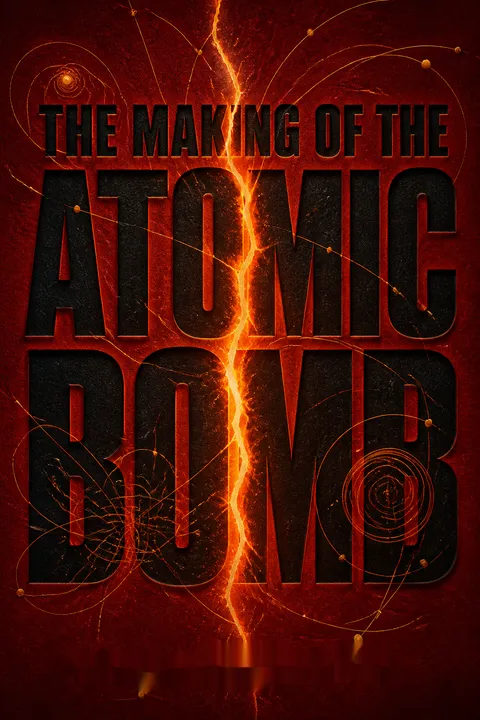


Key Takeaways
Treat scientific discovery as inevitable, but its use as a choice.
A London insight. In 1933, Leo Szilard read that Ernest Rutherford had dismissed large-scale atomic energy as fanciful. Crossing Southampton Row, Szilard imagined a nuclear chain reaction: neutrons entering a suitable material could trigger a reaction that released more neutrons, sustaining itself in a large enough mass. He did not yet know which element could do it, but saw that such a process might produce power or an explosive.
Knowledge has consequences. Rhodes argues that fission was not a secret waiting to be buried. Physicists around the world were already probing uranium with neutrons, and the experimental path made discovery likely wherever the next result appeared. Suppressing physics would have been required to suppress fission. That does not make the bomb inevitable: governments and scientists still made choices about secrecy, research, construction, and use.
What's striking is the separation between discovering a fact and authorizing its application. Science can show what nature permits, but it cannot decide which risks a society should accept. This distinction resembles the modern idea of dual-use research, where knowledge can support medicine or weapons. The book's claim that discovery was effectively inevitable is persuasive for fission's identification, but it should not be mistaken for technological or political inevitability. Building a bomb required extraordinary organization, money, and choices that discovery alone did not dictate.
Make scientific dissent testable within a community of peers.
An anomaly earns attention. Rutherford did not set out to overturn the accepted model of the atom. He asked Ernest Marsden to test whether alpha particles might bounce directly off a metal surface. Most passed through thin gold foil, but a few scattered backward. Rutherford compared the result to a heavy shell rebounding from tissue paper, then spent more than a year working out what it meant. The finding supported a small, dense nucleus, not Thomson's diffuse positive charge.
Science works collectively. Chemist Michael Polanyi called science a republic of science: independent researchers monitor one another through publications, overlapping specialties, and shared standards of plausibility, value, and originality. This network can catch errors, but its consensus can also resist ideas that are too new to seem plausible. Rutherford's experiment shows why evidence must be strong enough to challenge theory, and visible enough for others to test.
The episode anticipates distributed cognition: a scientific community can notice and verify more than any one researcher, because expertise overlaps across neighboring specialties. Yet a network is not automatically wise. The same standards that screen out error can delay recognition of a genuine anomaly, especially when a finding conflicts with a successful model. The safeguard is not blind deference to consensus, but a process in which dissent produces experiments that others can inspect and repeat.
See fission as a cross-border chain of insight, not a national trophy.
Chemistry found the clue. In late 1938, Otto Hahn and Fritz Strassmann bombarded uranium with neutrons and chemically identified barium among the products. Barium was far lighter than uranium, an outcome that seemed impossible under existing nuclear theory. Lise Meitner, forced to flee Nazi Germany, worked through the puzzle with her nephew Otto Frisch in Sweden. Using Niels Bohr's liquid-drop model and Einstein's mass-energy relation, they concluded that a uranium nucleus could split into two fragments and release enormous energy. Frisch then confirmed the energetic fragments experimentally and named the process nuclear fission.
Credit crossed borders. Hahn and Strassmann supplied the crucial chemical evidence; Meitner and Frisch explained its meaning; Bohr's model helped make the explanation imaginable. The discovery emerged from a scientific community already linked by papers, conferences, and personal ties, even as persecution scattered its members.
This sequence makes scientific credit look less like a medal ceremony and more like an account of intellectual dependencies. The chemical identification, theoretical interpretation, and confirming measurement were distinct contributions, each necessary to establish the result. That view also highlights the costs of persecution: forced migration separated collaborators from laboratories and colleagues. A caution remains: retrospective narratives can make a discovery appear cleaner and more inevitable than it felt to the people making it. The letters and doubts preserve that uncertainty.
Protect scientific talent before persecution turns laboratories into exile networks.
A purge emptied universities. After Hitler took power, a 1933 law removed Jewish scholars and other targeted academics from German universities. Physicist Leo Szilard had already left, then helped organize the Academic Assistance Council with economist William Beveridge and Ernest Rutherford. Its purpose was practical: find posts and support for scholars driven from their work. Einstein, Max Born, Edward Teller, Otto Frisch, and Hans Bethe were among the scientists whose careers were reshaped by persecution and migration.
Exile became a scientific force. The book estimates that about one hundred refugee physicists emigrated to the United States between 1933 and 1941. Their knowledge and international connections strengthened laboratories in Britain and America. But the rescue effort was uneven, and the people who fled carried the cost of family separation, lost positions, and danger. The same governments that sheltered them would soon organize their expertise for war.
The story links refugee policy to research capacity in a way that modern debates about migration often miss: talent is not merely a stock of individual skills, but a network of collaborators, mentors, and shared methods. Removing people from a university can weaken one country and strengthen another, while inflicting enormous human costs. The adaptation also complicates any easy celebration of this transfer. The rescued scientists gained safety and a place to work, but their new institutions directed their knowledge toward a weapon.
Track the isotope and neutron, not just the element.
The neutron changed the target. James Chadwick identified the neutron in 1932. Because it has no electrical charge, it can enter a nucleus without being repelled by the nucleus's positive charge. Enrico Fermi then found that slowing neutrons with paraffin or water could make some nuclear reactions more likely. A cross section is a measure of the probability that a particular nuclear interaction will occur. Fermi's work showed that neutron speed and the surrounding material mattered as much as the target element.
Uranium was not one substance. Natural uranium is about 99.3 percent uranium-238 and 0.7 percent uranium-235. Niels Bohr reasoned that the rarer U235 isotope could fission under slow-neutron bombardment, while U238 behaved differently. A critical mass is the quantity and arrangement of material needed to sustain a chain reaction despite neutron losses. Graphite could slow neutrons without absorbing too many, making a reactor using natural uranium seem possible.
This is a useful scientific habit beyond nuclear physics: do not let a familiar label hide variation within a sample. Isotopes share chemical identity but differ in nuclear behavior, just as biological strains can behave differently despite sharing a species name. The important question is not simply whether a reaction occurs, but under what conditions and with what probability. Fermi's graphite work also illustrates a broader engineering lesson: a material's usefulness depends on both its desired function and the side effects it introduces.
Keep scientific openness alive, but make secrecy answerable to politics.
Two duties collided. Szilard urged scientists to restrict publication once fission suggested a bomb, fearing Germany might get there first. Niels Bohr resisted secrecy because open communication was essential to the scientific community's ability to correct errors and build reliable knowledge. His principle of complementarity holds that apparently incompatible descriptions can both be valid within different limits; he also used the idea to argue that understanding complex human societies requires more than one viewpoint. The scientists never settled the conflict simply by appealing to professional virtue.
Government took the decision. Roosevelt's advisers moved nuclear work into a secret wartime structure, and policy authority increasingly rested with the President, military leaders, and administrators. Scientists could contribute, or decline, but had little say over the weapon's political use. Secrecy may have reduced the chance of aiding Germany, yet it also narrowed debate about what the project was for.
The conflict resembles a problem in institutional design: security can protect a project from an adversary while also blocking the criticism needed to detect errors and challenge assumptions. Bohr's defense of openness is not a claim that every technical detail should be public during war. It points instead toward accountable limits: who imposes secrecy, what risks justify it, and who reviews the decision. The book shows how quickly emergency authority can become the only authority scientists are allowed to encounter.
Treat the bomb as an industrial system, not a laboratory object.
Three sites, many disciplines. The Manhattan Project was far larger than Los Alamos. Oak Ridge housed uranium-enrichment plants, Hanford built production reactors and plutonium-separation facilities, and Los Alamos designed and assembled the weapons. Each depended on a chain of materials, construction, chemistry, engineering, logistics, and secrecy. At Hanford, for example, a reactor required thousands of channels for uranium slugs, a vast supply of graphite, and enormous volumes of cooling water. Los Alamos could not build a bomb from theory alone.
Scale changed the science. A reactor, called a pile by its builders, used uranium and graphite to sustain neutron multiplication and produce plutonium. The project employed hundreds of thousands of workers across a secret network of factories and sites. Its technical success depended on solving manufacturing problems, coordinating contractors, and correcting designs as evidence arrived. The celebrated scientists were crucial, but so were laborers, machinists, operators, and administrators.
The project resembles a modern megaproject more than a solitary act of invention. Its success depended on interfaces between organizations, not just excellence within them. That is a central lesson of systems engineering: a component that works in a laboratory may fail when scaled, supplied, staffed, and maintained. The book also makes clear that efficiency was not neutral. Secrecy and military command accelerated some decisions, while suppressing others; the same system that delivered the bomb narrowed participation in choices about its use.
Deterrence rests on a threat too catastrophic to control.
Restraint has a terrible foundation. The book's foreword describes nuclear weapons as containers of potential death that made the costs of total war impossible to ignore. No nuclear weapon has been used in anger since Nagasaki, a record often read as evidence of deterrence. But the threat is not reliably contained by intention. A modeled regional exchange involving 100 Hiroshima-scale weapons, with a combined yield of 1.5 megatons, could produce firestorms, 20 million immediate deaths, and a billion more from agricultural collapse.
The scale crosses borders. Nuclear danger does not stop at the national boundary of the countries that possess the weapons. The same firestorms that destroy cities can affect climate and food supplies far away. The book's argument is not that deterrence has no effect, but that its apparent restraint depends on avoiding accident, miscalculation, and escalation every time a crisis occurs.
Deterrence is a strategic bargain in which each side's safety depends on the other's belief that retaliation is possible. That can restrain attack, but it creates a security dilemma: measures taken to feel safer can appear threatening and prompt an opponent to build more weapons. The regional-war scenario is especially important because it treats nuclear conflict as a systems risk, with food and climate as downstream effects. A record of non-use is reassuring, but it cannot by itself prove that the underlying arrangement is safe.
End nuclear double standards before proliferation makes privilege universal.
Possession invites imitation. The Canberra Commission's axiom of proliferation states that as long as any state has nuclear weapons, other states will seek them. Richard Rhodes adds a fairness problem: nuclear-armed states claim the weapons are essential for their own security while denying the same logic to others. That double standard undermines trust and can make nonproliferation appear less like shared safety than preserved privilege. Nuclear weapons also function as visible markers of national status, not just military tools.
Disarmament is not utopia. Removing the bombs would not remove political insecurity. The book instead imagines a world where dismantled warheads and nuclear materials are managed so that rearmament takes months or years, creating more time to resolve disputes. If negotiations fail, the world might return to the present dangerous condition, but not instantly. The practical goal is to replace immediate nuclear threat with a longer interval for judgment and diplomacy.
The fairness argument connects to a basic problem in international cooperation: rules are difficult to sustain when powerful states claim exceptions for themselves. Arms-control agreements need verification and credible reciprocal limits, not moral appeals alone. The book's proposed longer rearmament timelines are a useful design principle because they create decision time without pretending that rivalry disappears. Its more difficult question is whether states would accept reduced sovereignty when possession itself signals status. That tension cannot be solved by technical safeguards alone.
Analysis
The book's narrative moves from a thought on a London pavement to an industrial and political system capable of destroying cities. Its strongest structural choice is to make the physics legible through experiments and people: Rutherford's unexpected scattering result, Chadwick's neutron, Hahn and Strassmann's chemical evidence, and Meitner and Frisch's interpretation. The bomb does not appear as a single flash of genius. It emerges from accumulated measurements, international exchange, exile, engineering, and state power.
That history also exposes a tension between scientific culture and wartime organization. Open publication and criticism help science correct itself, while secrecy and centralized authority can accelerate construction under threat. Yet speed does not settle the moral question. The decision to use the bomb on cities followed from a war in which civilian destruction had already become normalized, but the atomic weapon made the consequences both more concentrated and more visible. The book's account resists a simple story of either heroic science or uniquely evil technology.
The most ambitious claim is that nuclear weapons helped suppress major war by making total war irrational. The post-1945 decline in large-scale interstate conflict is consistent with that argument, but it cannot establish that deterrence caused the decline. Other political and economic changes also matter, and deterrence itself carries risks of accident, escalation, and misperception. Rhodes is most persuasive when he treats the bomb as a shared danger that changes every state's choices, not as a guarantee of peace. His closing political insight follows: a world without nuclear weapons would still have rivalries, but longer rearmament timelines could create space for negotiation. That is not a promise of harmony. It is a proposal to make time, transparency, and reciprocal restraint part of security.
Review Summary
The Making of the Atomic Bomb is praised as a comprehensive, detailed account of the development of nuclear physics and the Manhattan Project. Readers commend Rhodes' ability to blend scientific explanations with compelling historical narratives and character studies. The book is lauded for its thorough research, engaging writing style, and exploration of ethical dilemmas surrounding the bomb's creation and use. While some find the level of detail overwhelming, most reviewers consider it a masterpiece of science history, offering profound insights into the intersection of science, politics, and warfare.
People Also Read




Glossary
nuclear chain reaction
self-sustaining neutron multiplicationA process in which a nuclear reaction releases neutrons that trigger further reactions. If each generation produces enough neutrons to cause more reactions than are lost through absorption or escape, the process sustains itself. Szilard recognized the possibility in 1933; a working uranium-graphite pile demonstrated a controlled chain reaction in 1942.
nuclear fission
splitting a heavy nucleusThe division of a heavy atomic nucleus into two lighter nuclei, usually after neutron absorption. Fission releases energy because the fragments together have slightly less mass than the original nucleus, and it can also release additional neutrons. Hahn and Strassmann identified barium among uranium's reaction products; Meitner and Frisch explained the result.
republic of science
self-correcting research communityMichael Polanyi's account of science as a decentralized community of researchers who choose problems, share results, and judge one another's work through overlapping areas of expertise. No single authority determines scientific truth. The system supports cumulative discovery, though its standards of plausibility can sometimes make it slow to accept findings that challenge established models.
cross section
probability of nuclear interactionA measure of how likely a particular nuclear event is, such as a nucleus capturing a neutron or splitting after one strikes it. Cross sections vary with the energy of the incoming particle and the isotope involved. They are essential for predicting whether neutrons in a pile will trigger fission, be absorbed, or escape.
critical mass
minimum self-sustaining quantityThe amount and arrangement of fissile material needed for a chain reaction to sustain itself. Neutrons are continually lost through absorption or escape; a sufficiently large or well-arranged assembly allows enough to cause further fissions. The required mass depends on the material, its purity, its shape, and surroundings that may reflect neutrons back into it.
complementarity
paired, limited descriptionsNiels Bohr's principle that two descriptions of a system can be individually valid yet mutually limiting, because an experiment that reveals one aspect may prevent precise measurement of another. Particle and wave descriptions of light are a central example. Bohr extended the principle to human understanding, arguing that different perspectives may be needed to grasp a complex reality.
calutron
electromagnetic isotope separatorA large electromagnetic device developed at Berkeley to separate uranium isotopes. It ionized uranium vapor and bent the ions through a magnetic field; the lighter U235 and heavier U238 followed slightly different paths and could be collected separately. The process worked, but required vast equipment, skilled operators, substantial electricity, and repeated handling of material.
pile
graphite-moderated reactor assemblyThe name Enrico Fermi used for a structure of graphite and uranium arranged to slow neutrons and sustain a controlled chain reaction. The first successful pile, CP-1, was built under the stands at the University of Chicago in 1942. Later, larger piles at Hanford produced plutonium for the bomb program.
uranium-235
rare fissile uranium isotopeAn isotope of uranium present at about 0.7 percent in natural uranium. Unlike the much more abundant uranium-238, U235 can fission readily when it absorbs slow neutrons. Its rarity made isotope separation a central challenge in bomb development. The contrast between U235 and U238 also shaped reactor design and the search for plutonium.
FAQ
What is The Making of the Atomic Bomb by Richard Rhodes about?
- Comprehensive historical narrative: The book provides a detailed account of the scientific, political, and military developments that led to the creation and use of the atomic bomb during World War II.
- Focus on key figures: It weaves together the personal stories and contributions of scientists, military leaders, and political figures, such as Niels Bohr, Enrico Fermi, Leo Szilard, and J. Robert Oppenheimer.
- Scientific breakthroughs and consequences: The narrative covers the discovery of nuclear fission, the Manhattan Project, and the bombings of Hiroshima and Nagasaki, exploring both the technical achievements and the profound human and ethical consequences.
- Context of global conflict: Rhodes situates the atomic bomb’s development within the broader context of World War II, including the race against Nazi Germany and the impact on international relations.
Why should I read The Making of the Atomic Bomb by Richard Rhodes?
- Meticulously researched history: The book is widely regarded as the definitive account of the atomic bomb’s development, praised for its depth, accuracy, and narrative power.
- Humanizes scientific achievement: Rhodes brings to life the personalities, motivations, and moral struggles of the scientists and leaders involved, making complex history accessible and compelling.
- Explains science and ethics: The book breaks down complicated nuclear physics concepts and delves into the ethical dilemmas and political decisions surrounding nuclear weapons.
- Relevance to modern issues: Understanding the origins and consequences of the atomic bomb provides essential context for ongoing debates about nuclear proliferation, arms control, and global security.
What are the key takeaways from The Making of the Atomic Bomb by Richard Rhodes?
- Science and society intertwined: The book demonstrates how scientific discovery, political urgency, and human ambition combined to create a weapon of unprecedented power.
- Moral and ethical complexity: Rhodes highlights the profound ethical dilemmas faced by scientists and policymakers, emphasizing the lasting impact of their decisions.
- Permanent change in world affairs: The development of nuclear weapons fundamentally altered international relations, introducing the possibility of human self-annihilation.
- Legacy of caution: The narrative serves as a cautionary tale about the dangers of unchecked technological advancement and the need for international cooperation and control.
Who were the key scientists and leaders featured in The Making of the Atomic Bomb by Richard Rhodes, and what were their contributions?
- Niels Bohr: Developed the quantum model of the atom and contributed to the understanding of nuclear fission; advocated for international control of atomic energy.
- Enrico Fermi: Led critical experiments on nuclear chain reactions and pile construction, playing a central role in the Manhattan Project’s scientific leadership.
- Leo Szilard: Conceived the idea of a nuclear chain reaction and was instrumental in initiating the U.S. atomic bomb program; advocated for ethical considerations and control.
- J. Robert Oppenheimer: Directed the Los Alamos Laboratory, coordinating the bomb’s development and balancing scientific innovation with moral reflection.
- General Leslie Groves: Oversaw the Manhattan Project’s military and logistical operations, ensuring the project’s success under immense pressure.
What are the main scientific concepts explained in The Making of the Atomic Bomb by Richard Rhodes?
- Nuclear fission and chain reactions: The book details how splitting uranium atoms with neutrons releases vast energy, enabling self-sustaining chain reactions—the principle behind atomic bombs.
- Isotope separation methods: Rhodes explains the technical challenges of isolating uranium-235 from uranium-238, covering electromagnetic separation (calutrons), gaseous diffusion, and thermal diffusion.
- Implosion vs. gun-type bomb design: The narrative contrasts the simpler uranium gun-type bomb (“Little Boy”) with the complex plutonium implosion bomb (“Fat Man”), highlighting the engineering breakthroughs required.
- Radiation and biological effects: The book discusses the types of radiation emitted by nuclear explosions and their devastating impact on human health and the environment.
How did the political and military context influence the development of the atomic bomb in The Making of the Atomic Bomb by Richard Rhodes?
- Fear of Nazi Germany: The possibility that Germany might develop a bomb first drove urgent research and government investment in the U.S. and Britain.
- Government committees and secrecy: The project was managed by a series of committees and agencies, with strict secrecy and compartmentalization to prevent espionage and leaks.
- International collaboration and competition: Allied cooperation, especially between the U.S. and Britain, was crucial, while parallel efforts in Germany, Japan, and the USSR shaped the global race.
- Postwar arms race: The bomb’s creation triggered a nuclear arms race, fundamentally altering global politics and leading to the Cold War.
What were the major technical and engineering challenges in building the atomic bomb, according to The Making of the Atomic Bomb by Richard Rhodes?
- Isotope separation scale: Separating uranium-235 from uranium-238 required massive, unprecedented industrial plants and innovative engineering solutions.
- Plutonium production and purity: Producing and purifying plutonium in nuclear reactors posed significant chemical and safety challenges, with impurities threatening bomb design.
- Implosion mechanism complexity: The implosion design for the plutonium bomb demanded precise shaping of explosive lenses and advanced diagnostics to ensure symmetrical compression.
- Safety and assembly: Handling radioactive materials and assembling the bombs under tight security and time constraints required meticulous planning and execution.
How does The Making of the Atomic Bomb by Richard Rhodes portray the human and ethical dimensions of nuclear weapons development?
- Scientists’ moral struggles: The book reveals the internal conflicts of scientists like Szilard and Oppenheimer, who grappled with the destructive potential of their discoveries.
- Political and military pressures: Scientists were caught between their pursuit of knowledge and the demands of wartime governments, often facing surveillance and suspicion.
- Legacy of caution and fear: Rhodes reflects on the paradox that nuclear weapons have prevented large-scale war but pose an ongoing existential threat.
- Hope for disarmament: The author envisions a future where nuclear weapons are dismantled and replaced by peaceful dispute resolution mechanisms.
How does The Making of the Atomic Bomb by Richard Rhodes describe the bombings of Hiroshima and Nagasaki and their aftermath?
- Graphic survivor accounts: The book includes vivid descriptions from survivors, detailing the immediate devastation, injuries, and psychological trauma.
- Massive casualties and destruction: Rhodes reports that 70,000 died in Nagasaki and 140,000 in Hiroshima by the end of 1945, with long-term suffering from radiation sickness.
- Societal and cultural impact: The bombings shattered social structures, families, and cultural heritage, leaving survivors to cope with loss and the challenge of rebuilding.
- Moral and symbolic reflections: The narrative uses powerful imagery and survivor testimony to convey the bomb’s profound psychological and ethical impact.
What were the political and military decisions surrounding the use of the atomic bomb, as described in The Making of the Atomic Bomb by Richard Rhodes?
- Target selection and mission planning: The book details the careful selection of targets and the logistical challenges faced by bomber crews during the missions.
- Debates over surrender terms: Rhodes covers the Japanese government’s surrender negotiations and the U.S. insistence on unconditional surrender, as well as internal debates among American officials.
- Committee deliberations: The Interim and Target Committees played key roles in advising on bomb use, timing, and targeting, influenced by political and military considerations.
- Aftermath and surrender: The narrative recounts the final days leading to Japan’s surrender, including the Emperor’s broadcast and the cessation of bombing missions.
What are some of the best quotes from The Making of the Atomic Bomb by Richard Rhodes and what do they mean?
- On scientific discovery: Oppenheimer said, “It is a profound and necessary truth that the deep things in science are not found because they are useful; they are found because it was possible to find them,” highlighting the role of curiosity in scientific progress.
- On nuclear weapons’ threat: Niels Bohr noted that nuclear weapons “are a common danger to all, like an epidemic disease,” emphasizing their universal threat.
- On knowledge and civilization: Bohr’s statement, “Knowledge is itself the basis for civilization,” underscores the double-edged nature of scientific advancement.
- On proliferation: The Canberra Commission’s axiom, “As long as any state has nuclear weapons, others will seek to acquire them,” explains the persistent challenge of nuclear disarmament.
How does The Making of the Atomic Bomb by Richard Rhodes explain the legacy and ongoing relevance of nuclear weapons?
- Permanent change in warfare: The atomic bomb introduced a new era where humanity possesses the means for self-destruction, fundamentally altering the nature of war and peace.
- Ongoing ethical debates: The book’s exploration of the bomb’s origins and consequences remains relevant to current discussions about nuclear proliferation and arms control.
- Call for vigilance and diplomacy: Rhodes advocates for continued vigilance, international cooperation, and the pursuit of disarmament to prevent future catastrophe.
- Cautionary tale for the future: The narrative serves as a warning about the dangers of unchecked technological power and the importance of learning from history.
About the Author
Other books by Richard Rhodes

Download PDF
Download EPUB
.epub digital book format is ideal for reading ebooks on phones, tablets, and e-readers.








