

Key Takeaways
Turn ideals into durable power before political resistance buries them
The first lesson came at Yale. Robert Moses was an earnest idealist who wanted public service to help ordinary people. But when he proposed misleading a swimming-team donor about where his money would go, his captain rejected the plan. Moses threatened to quit, and did. His imagination and will were already formidable; so was his belief that his judgment should prevail.
Reason alone failed. In New York, Moses designed a sweeping merit-based civil service system, then watched Tammany Hall dismantle it. He concluded that sound ideas did not implement themselves: they needed executive backing and power. That discovery changed his career. He kept the ambition to build, but increasingly treated power as the necessary instrument, then as something worth acquiring in its own right.
What's striking is that Moses does not begin as a simple cynic. His early idealism is real, and so is his frustration when patronage defeats reform. The danger appears when he draws an expansive lesson from a genuine failure: because democratic institutions can block useful work, the builder should be allowed to bypass them. That inference turns competence into a claim of entitlement. The story invites a harder question than whether good intentions survive power: who gets to decide when an elected process is merely obstructive, and who can challenge that judgment?
Learn political compromise without mistaking access for public virtue
Al Smith and Belle Moskowitz taught Moses how government moved. As head of Smith's Reconstruction Commission, Moses wanted sweeping administrative reform. Moskowitz showed him that eliminating patronage posts could alienate legislators whose votes were needed. Smith, a Tammany politician with genuine reform ambitions, supplied the executive support that Moses had lacked under Mayor Mitchel.
The results were substantial. The commission proposed consolidating 187 state agencies into a smaller set of departments, creating an executive budget, and making the Governor accountable for administration. Much of that blueprint later became law. Moses learned how to draft bills, assemble support, and trade concessions for progress. He also learned to shape facts and tactics for political advantage, even when accuracy or transparency suffered.
The Smith-Moskowitz partnership shows that compromise can be a technology of implementation, not simply a retreat from principle. Smith understood constituencies and timing; Moses brought technical command and relentless follow-through. Together they achieved reforms that abstractly correct proposals had not. Yet the same skill has a double edge: once political access is treated as proof of virtue, a workable coalition can shield practices that deserve scrutiny. The useful distinction is between compromise that makes a public goal possible and accommodation that quietly transfers public decision-making to insiders.
A public authority can turn tolls into an empire beyond elections
Moses found power in a legal form. A public authority is a government-created corporation able to build and operate projects, finance them with revenue bonds, and keep many records outside ordinary public scrutiny. Moses used this structure to assemble what he called Triborough: bridge and tunnel authorities, park agencies, and departments coordinated under his control.
The empire generated both land and money. By 1960, the territory under direct control of its components totaled 103,071 acres, and their combined annual income reached as much as $213 million. Moses described his personally conceived and completed public works as worth $27 billion in 1968 dollars. Authorities did not literally cost taxpayers nothing: public land, state support, toll roads, and lost tax revenue all carried costs. But secrecy made those costs hard to see.
The public authority is not merely a financing device here. It changes who can see decisions, who can challenge them, and how long a leader can remain powerful. Revenue bonds can make construction possible when ordinary budgets cannot, but opaque records and control of toll income weaken democratic oversight. The central institutional question is therefore not whether authorities are efficient or inefficient in the abstract. It is whether their independence is balanced by disclosure, review, and a clear path for elected officials and residents to correct mistakes.
Open parks by joining land to access, not merely drawing boundaries
Moses saw a public resource where others saw closed land. Long Island's beaches and woods were blocked by private estates, local rules, narrow roads, and hostile landowners. He discovered about 3,500 acres of unused New York City watershed property, then planned parks and parkways that could connect those tracts to New York. Jones Beach, once a remote sandbar, became the centerpiece of a system built for swimming, sports, picnics, and family outings.
The scale was remarkable. By 1928, Long Island had fourteen state parks totaling about 9,700 acres; attendance at its parks exceeded half a million that summer. Moses joined conservation with recreation and made the countryside reachable. But the access system depended mainly on automobiles, excluding families without cars and helping make the suburbs more car-dependent.
This is Moses at his most persuasive: he treats access as part of the public good, not an afterthought. Land that is legally public but practically unreachable is only public in theory. His parkways helped open beaches that wealth and local exclusion had kept private. Yet the chosen means shaped who benefited. A park connected mainly by car favors households able to own and operate one. The section therefore holds two truths together: Moses democratized access to prized landscapes, while designing that access around a technology that left many urban poor behind.
Treat eminent domain as a moral power, not a drafting trick
Moses changed what a word could do. He wrote a Long Island park law that invoked an old conservation statute allowing the state to enter and take land before full compensation was settled. The technical term, entry and appropriation, had rarely been used outside remote forests. Moses applied it to farms and estates, sometimes before the commission had money available to pay.
The Taylor Estate fight exposed the stakes. Courts found the initial seizure illegal, and a jury assessed damages against Moses and his fellow commissioners. Yet Moses developed the property while appeals and delays continued. Once the public was using the park, reversing the project became harder. The park survived, but the episode showed how legal ingenuity and delay could blunt remedies for people whose land was taken.
The episode is not simply a clash between public benefit and private property. The state may need to acquire land for roads or parks, but the method determines whether affected people have meaningful protection. A technical authorization to take first and settle compensation later can turn due process into a contest of endurance, where the public agency has more lawyers and more time than an individual owner. The standard should be more demanding than eventual legality: necessity, fair compensation, transparent procedure, and real consideration of less harmful alternatives.
Follow the money when a public builder claims to stand above politics
Moses denied making political deals. He said his projects were chosen for public welfare, not patronage, and that authority bonds meant taxpayers paid nothing. But Triborough's wealth gave him a political machine aimed not at voters but at influential actors: contractors, banks, lawyers, insurers, retailers, unions, and party leaders.
The benefits were legal, but politically potent. Triborough spent about $1 million a year on public relations retainers, legal fees, and insurance commissions. Moses distributed this work according to the recipient's place in the political order. The recipients then had a direct stake in keeping his authority intact and backing his projects. He could be personally honest with money while still becoming the center of a system that bent public decisions toward organized economic interests.
The important distinction is between personal bribery and structural corruption. A leader need not pocket cash to make corruption central to a system; allocating public contracts and fees can create a coalition whose members profit from the leader's continued power. This is why formal legality is not enough. The relevant questions are who receives recurring benefits, who can inspect the records, and whether decisions remain contestable by people who do not belong to the benefiting network.
Count displaced neighbors as part of every project's true cost
The city paid for Moses' public works in homes as well as dollars. He estimated that highways alone displaced 250,000 people. One detailed study found that 320,000 were displaced between 1946 and 1956 across his projects; the total for his career was probably close to half a million. Those forced out were disproportionately poor, Black, and Puerto Rican.
East Tremont shows what the totals conceal. The Cross-Bronx Expressway displaced 1,530 families in one section, despite an alternate route that would have harmed far fewer homes. Relocation help was inadequate, and families often ended up in overcrowded slums. Urban renewal could clear one slum while making another. A project's accounting that records land, concrete, and labor but not uprooted households is incomplete.
Displacement is not a side effect to be appended after the engineering is finished. It is part of the design decision itself, because route, scale, and timing determine who loses a home and who receives the benefit. The pattern described here anticipates what is now called environmental justice: burdens fall unevenly, and those with the least political influence often bear the most concentrated costs. Public improvements may require land acquisition, but legitimacy depends on credible relocation, resident participation, and honest comparison of less damaging routes.
More roads can generate the traffic they promise to relieve
Moses built for the automobile as its use exploded. New York had 125,101 motor vehicles when Mayor Hylan took office in 1918 and 790,173 when Mayor Walker left in 1932. Yet the city built no usable mile of arterial highway during those fifteen years. Moses filled that gap with parkways, bridges, and expressways, while mass transit and commuter rail received less attention.
The system helped create the problem it was meant to solve. Roads made distant suburbs easier to reach, encouraging low-density growth that relied on cars. Each new bridge and parkway attracted more driving, and traffic quickly overwhelmed the capacity Moses had added. The Cross-Bronx, Triborough, and Long Island routes became crowded despite their scale. Moses himself never drove a car, an irony that underscores how much his transportation vision centered on traffic as an engineering problem rather than a daily human experience.
The book's strongest transportation insight is a feedback loop: roads make car-dependent development easier, that development creates more car trips, and congestion then justifies more roads. The resulting infrastructure is path-dependent; once homes, jobs, and shops spread around highway access, alternatives become more expensive to build. This does not mean highways have no value. It means their benefits cannot be assessed in isolation from land use and transit. A transportation plan should ask what travel patterns it will produce, not only how many vehicles it can move today.
A city that cannot build invites power that cannot be checked
New York's failure was real. Under Tammany, corruption and patronage consumed resources, while parks, housing, roads, and schools fell behind need. From 1918 to 1932, the city population grew by 15 percent as its budget rose 250 percent and debt reached nearly $1.9 billion. Yet it built no usable mile of arterial highway, and its parks deteriorated.
Moses solved a capacity problem by creating an accountability problem. He could deliver work at a speed and scale elected institutions had not managed. But his authority over priorities and design escaped ordinary public checks. Caro's argument is deliberately uncomfortable: democratic processes had failed to build what the city needed, but an unaccountable builder could also impose choices the public had never made.
The book resists an easy moral. Tammany's corruption and administrative weakness were not imaginary, and leaving New York to them would not have solved its housing, recreation, or transportation crises. Yet competence does not itself confer a right to rule. The deeper challenge is institutional design: government needs durable technical capacity to build at scale, alongside transparent budgets, independent review, and resident voice. Without capacity, democracy disappoints; without accountability, capacity can become personal sovereignty.
Treat public acclaim as a reason for scrutiny, not proof of consent
Moses' popularity rose with visible results. After the city parks were rebuilt and playgrounds multiplied, newspapers praised him as a heroic public servant. That acclaim helped protect him even when courts found his seizure of the Taylor Estate illegal; the public saw the park and largely overlooked the means. His 1934 campaign for Governor showed the other side: he attacked Lehman so personally that he lost by more than 800,000 votes, damaging his own standing.
The Central Park Casino fight exposed the cost of the myth. In 1936, Moses demolished a beloved restaurant despite protests and a judge's warning that his powers should not be treated as limitless. The courts ultimately let him proceed under a law he had helped shape. The public's affection for parks had made criticism seem unimportant — until the fight made the methods visible.
Popularity can be evidence that a public work meets a genuine need, but it is not evidence that the process was fair or that benefits and burdens were shared well. Moses understood how strongly parks resonated with voters, and that affection became political protection. The same mechanism appears in many celebrated projects: visible outputs create a moral halo around the decision-maker. A healthier test separates outcome from process: Does the project work, who benefits, who pays, and could the people affected meaningfully object?
Analysis
The book's central achievement is to make infrastructure legible as politics. Robert Moses does not merely build roads and parks; he reorganizes who can decide what a city becomes. His arc begins with idealistic faith in merit and public service, then turns through repeated defeat into an insistence that executive power is the missing ingredient. Al Smith supplies that power, and Moses proves what it can accomplish: a state park system, major bridges, beaches, and a new scale of public construction. The same capacity then becomes self-protecting. Public authorities, toll revenues, legal drafting, press relationships, and patronage align around one builder, while the ordinary points of democratic review lose force.
The narrative's tension is not simply Moses versus the people. New York's elected institutions had repeatedly failed: Tammany diverted resources, reform administrations could not build at needed scale, and the Depression exposed a city unable to meet basic needs. Moses' record therefore contains real public value, not just monuments to ego. Yet the means matter because infrastructure distributes opportunity and harm for generations. A bridge or expressway changes land values, commuting patterns, neighborhood cohesion, and access to parks. Once built, it also makes alternative futures more expensive.
The book is strongest when it follows mechanisms rather than motives: who controls plans, money, land, contracts, and information. Its account of Moses' personality explains the force of his methods, but the institutional machinery explains their durability. One caution is that the narrative's focus on a dominant individual can make structural failures look like the product of one man's will. The deeper lesson is that charismatic competence should not be allowed to substitute for public capacity and public consent. A city needs people able to build, but it also needs procedures capable of asking whether the proposed thing should be built, where, for whom, and at whose cost.
Review Summary
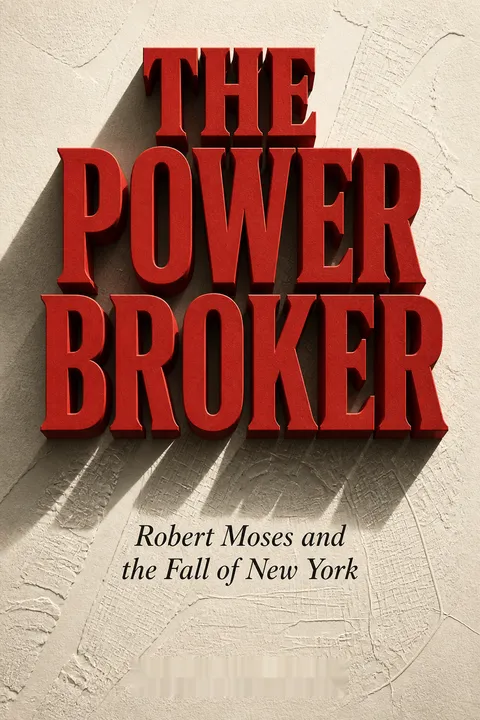
The Power Broker is widely praised as a monumental biography of Robert Moses, detailing his rise to power and influence over New York City's infrastructure. Readers appreciate Caro's meticulous research, engaging writing, and ability to weave complex political machinations into a compelling narrative. The book is seen as a study of power itself, revealing how Moses shaped the city through parks, highways, and bridges, often at the expense of communities and public transit. While some find its length daunting, most consider it an essential read for understanding urban planning and political power.
People Also Read




Glossary
public authority
Independent public corporationA government-created corporation that can build and operate public facilities, issue revenue bonds, collect tolls, and often keep its records outside ordinary public inspection. Moses used authorities to finance projects and to gain flexibility unavailable to conventional departments. Their independence could enable construction, but also weakened direct oversight by elected officials and the public.
Triborough
Moses' public-works empireA name used by politicians and officials for the network Moses controlled: the Triborough Bridge Authority, other public authorities, the New York City Park Department, and the Long Island State Park Commission. Though formally separate bodies, they were administered as a unified system under Moses, with substantial land, revenue, staff, and construction power.
entry and appropriation
Take land, compensate laterA procedure Moses used under an old New York conservation statute. It allowed a public agency to enter and take possession of land before compensation had been settled, leaving owners to seek payment afterward. Moses applied the procedure to developed property on Long Island, although it had been created for remote forest land and its constitutionality was doubtful.
Title I
Federal urban renewal programA federal program established in 1949 that enabled cities to acquire and clear property, then transfer it to private developers for redevelopment. In New York, Moses directed the program and produced large physical projects. The book emphasizes that clearance displaced many poor and nonwhite residents, while replacement housing often served people with higher incomes.
Moses Men
Moses' loyal administrative cadreThe engineers, architects, lawyers, and administrators who rose through Moses' organizations and carried out his policies. They were selected for ability and intense work habits, but also for loyalty and subservience to his decisions. The group could execute projects rapidly and consistently, while restricting internal dissent and keeping information from outsiders.
executive budget
Governor-proposed state budgetA budgeting system in which the Governor submits a unified spending and revenue plan to the Legislature, which can review and reduce it. Moses helped design this reform as part of a broader reorganization of New York State government. It made responsibility easier to identify and strengthened executive coordination, while preserving legislative review.
FAQ
What is The Power Broker: Robert Moses and the Fall of New York by Robert A. Caro about?
- Comprehensive biography and urban history: The book is a detailed biography of Robert Moses, chronicling his rise to power and his profound impact on New York City’s infrastructure, politics, and society.
- Focus on power and urban development: It explores how Moses used public authorities to build parks, highways, bridges, and housing, transforming the city and its suburbs over four decades.
- Political and social analysis: Caro examines the interplay between Moses’ personal ambitions, political maneuvering, and the consequences of his projects, especially for marginalized communities.
- Historical context: The narrative situates Moses’ career within the broader history of New York, including the roles of key political figures and major events like the Great Depression and postwar era.
Why should I read The Power Broker by Robert A. Caro?
- Insight into power dynamics: The book offers a profound understanding of how power operates in government, urban planning, and public works, revealing the mechanisms behind Moses’ dominance.
- Urban planning lessons: It provides a critical look at the social and ethical implications of large-scale infrastructure projects, especially their impact on poor and minority communities.
- Masterful storytelling and research: Caro’s exhaustive research and compelling narrative make complex political and technical subjects accessible and engaging.
- Historical and contemporary relevance: The book is essential for anyone interested in history, politics, urban studies, or the consequences of unchecked authority.
What are the key takeaways from The Power Broker by Robert A. Caro?
- Power can corrupt and isolate: Moses’ story illustrates how immense, unchecked power can lead to arrogance, isolation, and disregard for public welfare.
- Urban development has social costs: Large-scale projects can displace communities and exacerbate social inequalities, as seen in Moses’ expressways and housing policies.
- Political skill and manipulation: Moses’ mastery of political maneuvering, patronage, and media control was central to his success and longevity.
- Institutional innovation and danger: The creation of quasi-sovereign public authorities allowed Moses to bypass democratic checks, serving as both a tool for progress and a cautionary tale.
Who was Robert Moses and what was his role in New York City’s development according to The Power Broker?
- Master builder and planner: Robert Moses was the most influential urban planner in New York during the 20th century, responsible for major highways, bridges, parks, and housing projects.
- Powerful public official: He held multiple key positions simultaneously, giving him unprecedented control over public works and urban development.
- Controversial legacy: Moses’ projects modernized the city but often displaced hundreds of thousands, especially poor and minority residents, and reinforced segregation.
- Political boss and empire builder: He used patronage, intimidation, and alliances to maintain his power, creating an empire centered on public authorities like the Triborough Bridge and Tunnel Authority.
How did Robert Moses acquire and maintain power according to The Power Broker?
- Use of public authorities: Moses exploited the legal and financial structure of public authorities, which operated independently and with little transparency, to secure financial and political autonomy.
- Political alliances and patronage: He distributed contracts and favors to politicians, contractors, and unions, building a network of loyalty and support.
- Manipulation of democratic processes: Moses concentrated decision-making in his hands, bypassed traditional oversight, and kept records closed to public scrutiny.
- Control over city and state projects: He held veto power over major contracts and shaped priorities to enhance his influence, making himself indispensable to government operations.
What were the social and urban consequences of Robert Moses’ projects as described in The Power Broker?
- Mass displacement: Moses’ highways and urban renewal projects displaced nearly half a million people, often targeting poor and minority neighborhoods.
- Promotion of automobile culture: His focus on highways encouraged car use and suburban sprawl, while neglecting public transit and worsening congestion.
- Segregation and ghettoization: Public housing and recreational facilities were often designed to reinforce racial and economic segregation, with limited amenities for the poor.
- Destruction of urban fabric: Historic neighborhoods and cultural sites were destroyed, fragmenting the city and delaying rational urban planning.
How did Robert Moses use public authorities to gain and wield power, according to The Power Broker?
- Creation of powerful authorities: Moses drafted legislation to create entities like the Triborough Bridge Authority, granting them broad, indefinite powers and financial independence.
- Financial autonomy and secrecy: These authorities collected tolls and issued bonds, operating with private records and minimal public oversight.
- Legal entrenchment: Moses embedded his powers in bond contracts, making them nearly impossible to revoke without bondholder consent, effectively creating a “fourth branch” of government.
- Institutional innovation: This structure allowed Moses to bypass elected officials and maintain control for decades.
What was the significance of the Cross-Bronx Expressway and other highway projects in The Power Broker?
- Engineering challenges: Projects like the Cross-Bronx Expressway required complex construction through dense urban areas, involving tunnels, viaducts, and massive interchanges.
- Human cost: Thousands of families were displaced with minimal compensation, and entire neighborhoods like East Tremont were destroyed.
- Political maneuvering: Moses bypassed democratic processes, using intimidation and bureaucratic pressure to push projects through despite public opposition.
- Long-term impact: These highways accelerated urban decay, increased congestion, and shaped the city’s development around automobiles.
How did Robert Moses’ approach to urban planning and democracy conflict, according to The Power Broker?
- Autocratic philosophy: Moses believed large-scale public works required autocratic power, often dismissing public input and democratic procedures.
- Disdain for opposition: He openly mocked protests and enjoyed imposing his will, prioritizing projects over people.
- Bypassing elected officials: Moses used his control over public authorities to circumvent mayors, city councils, and community groups.
- Consequences for democracy: His methods undermined democratic governance and set a precedent for unchecked bureaucratic power.
What role did political alliances, banks, unions, and contractors play in Robert Moses’ power as described in The Power Broker?
- Alliance with economic forces: Moses provided lucrative contracts and jobs to banks, unions, and contractors, ensuring their support for his projects.
- Political patronage: He distributed favors, campaign contributions, and patronage jobs to politicians and party bosses, creating a network of loyalty.
- Manipulation of bond sales: Banks profited from purchasing bonds issued by Moses’ authorities, reinforcing their political backing.
- Symbiotic relationships: These alliances created a powerful coalition that protected Moses from political challenges and enabled his dominance.
What controversies and criticisms of Robert Moses are highlighted in The Power Broker?
- Displacement and social injustice: Moses’ projects led to the eviction of thousands, especially in poor and minority communities, often with inadequate relocation assistance.
- Corruption and patronage: His use of political machines, contractors, and unions involved graft, favoritism, and manipulation of public funds.
- Authoritarian style: Moses was known for bullying, secrecy, and intolerance of dissent, alienating allies and opponents alike.
- Neglect of community needs: He prioritized grand projects over neighborhood preservation, often ignoring the voices and welfare of affected residents.
What are the best quotes from The Power Broker by Robert A. Caro and what do they mean?
- “The important thing is to get things done.” Reflects Moses’ pragmatic, results-oriented approach, often prioritizing achievement over legality or ethics.
- “You can’t make an omelet without breaking eggs.” Justifies the collateral damage and displacement caused by his projects, emphasizing sacrifice for the greater good.
- “An institution is the lengthened shadow of one man.” Highlights how Moses shaped public authorities to reflect his personality and ambitions, for better or worse.
- “The ancient truth is that power corrupts.” Underscores the book’s central theme about the dangers of unchecked authority and its impact on character and governance.
About the Author
Other books by Robert A. Caro
Download PDF
Download EPUB
.epub digital book format is ideal for reading ebooks on phones, tablets, and e-readers.








