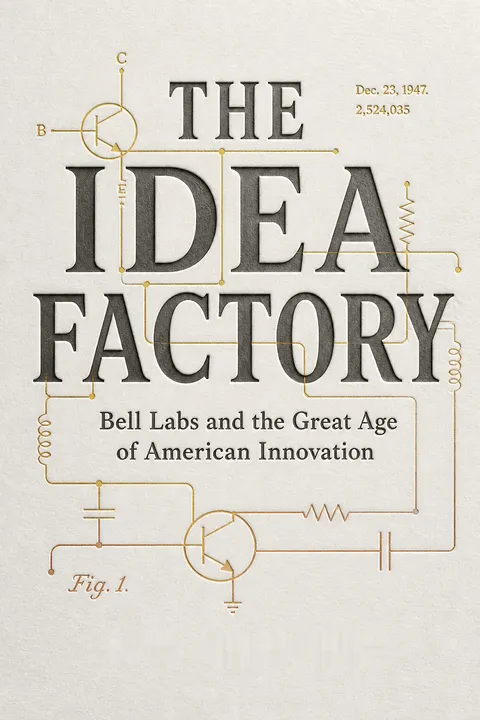


Key Takeaways
Build an idea factory around a mission too large for one genius
A system-sized ambition. Bell Labs grew from AT&T's effort to connect people across the country and, eventually, the world. That goal required more than inventing a better telephone. It meant solving problems in cables, switches, materials, power, and reliability, then making solutions work together. The organization became a vast industrial research center, employing about 15,000 people at its late-1960s peak, including roughly 1,200 PhDs.
From oil drops to phone calls. Its future leader, Mervin Kelly, began as a young physicist helping measure charged oil droplets in Robert Millikan's experiment on the electron. He carried that respect for fundamental investigation into a company built around practical service. Bell Labs' story is therefore not simply a parade of gifted inventors. It is a case study in building an institution whose scale and mission made discoveries useful.
What's striking is how the mission makes freedom productive without making it aimless. Researchers could explore questions whose commercial value was not immediately clear because the larger communications system supplied a continuing purpose and a source of real problems. This resembles public infrastructure research, where benefits spread beyond the lab that produces them. But the arrangement had a political price: AT&T's monopoly helped fund the work while limiting competitors. The institution's scientific achievement and the fairness of its business model are separate questions. Keeping them separate makes the example more useful than either simple nostalgia or simple condemnation.
Let stubborn system problems, not fashionable ideas, set the research agenda
Problems kept multiplying. A telephone call depended on thousands of components, and each one could fail, wear out, or distort a signal. The system needed better cable insulation, durable switches, reliable measurement tools, and ways to route and bill millions of calls. Engineers even tested how often a receiver could be dropped and studied whether animals chewed through buried cables.
Small fixes mattered. Bell Labs' mathematician Walter Shewhart developed statistical quality control to make factory output more consistent. In another case, researchers designed an oil can for a telegraph machine that dispensed a controlled number of drops. A new solution often created another task: more calls on a network demanded better equipment, and better equipment demanded new standards for testing it. The lab did not lack ideas. It had more worthwhile work than people or budgets could handle.
This is systems thinking in a practical form: improve the whole chain, not just the component with the most glamorous name. Modern reliability engineering uses a similar logic, tracing failures across interdependent parts rather than blaming a single weak link. The approach also widens the meaning of invention. A test rig, a production standard, or a cable treatment can matter as much as a headline-grabbing device. The caution is that an endless backlog can become its own justification. A healthy research organization still needs a way to choose which problems deserve scarce time and money.
Give fundamental research room, then connect it to builders
Research needs breathing room. Bell Labs distinguished basic research, which sought fundamental knowledge without an immediate product target, from applied research and development, which moved that knowledge toward usable equipment. Clinton Davisson could pursue questions about electrons even when their practical value was unclear. His work later helped shape the scientific culture Kelly built.
The handoffs mattered. After World War II, Kelly reorganized researchers from physics, chemistry, metallurgy, and engineering into groups working across specialties. The Murray Hill laboratory supported this mix physically: offices and labs were close together, with long corridors and shared spaces that encouraged encounters. Wartime projects had also taught the organization how urgency, government funding, and large teams could accelerate development. The goal was not to replace free inquiry with a schedule. It was to connect open-ended discovery to people capable of testing, refining, and building.
The strongest version of this model is not a rigid pipeline from scientist to engineer. It is a porous boundary: discoveries travel toward applications, while practical failures send new questions back to researchers. This is close to the idea of distributed cognition, where problem-solving emerges across people, tools, and shared routines rather than inside one mind. Physical proximity can help, but architecture is not magic. Without trust, common purpose, and permission to ask for help, a hallway is only a hallway. Bell Labs made encounters useful by combining space with an institutional norm of collaboration.
Treat materials science as invention, not merely support work
The transistor depended on matter. After earlier attempts to make a solid-state amplifier failed, Bell Labs researchers investigated silicon and germanium, materials whose electrical behavior could be altered by tiny amounts of other elements. A semiconductor conducts less readily than copper but more readily than glass, and carefully chosen impurities can change how its charge moves.
Different talents converged. John Bardeen developed an explanation for surface states, where electrons trapped at a semiconductor's surface blocked the desired electrical effect. Walter Brattain tested possible solutions, and their point-contact device produced substantial amplification in December 1947. The discovery rested on theory, experiment, chemistry, and exceptionally controlled materials. William Shockley's later junction transistor drew on the same research community, though disputes over credit and control strained the group. Shockley's later fixation on racial hierarchy further showed that scientific brilliance does not guarantee sound judgment beyond one's field.
The story corrects a familiar bias: observers often celebrate the visible device and overlook the materials, technicians, and preparation that make it work. In contemporary technologies, the same pattern appears in batteries, medical implants, and advanced manufacturing. Performance is often a property of a carefully engineered material system, not an isolated idea. The credit disputes also matter. Collaboration can generate breakthroughs while leaving status and authorship unresolved. Institutions need norms that recognize contributions across theory, hands-on experimentation, and materials work, especially when a famous scientist's reputation might otherwise dominate the record.
A breakthrough is only a prototype until factories and users can rely on it
Invention is not yet innovation. The book uses innovation for the full conversion of new knowledge into a practical product or process used at scale. The first point-contact transistor proved that amplification was possible, but humidity or vibration could disrupt it. A useful device had to be reliable, reproducible, manufacturable, and worth buying.
Development completed the leap. Jack Morton led the work to improve production, while metallurgist Gordon Teal found a way to grow large, high-quality germanium crystals. Bell Labs eventually licensed transistor technology to other companies and trained engineers to work with it. Sharing helped expand the industry and created more chances to improve the device. The same lesson appeared in the transatlantic cable: it became a genuine achievement only when its many parts worked together reliably and economically over years of service.
This distinction resembles the difference between a scientific proof and a functioning technology. A proof establishes that something can work under defined conditions; a product must survive variation, cost constraints, maintenance, and human use. Innovation research often calls the surrounding capabilities complementary assets: manufacturing, distribution, standards, and customer access. The transistor's history makes those assets visible. Still, scale is not the only measure of value. Fundamental discoveries can transform later work without becoming products themselves. The point is not that every insight must sell, but that claims of practical innovation require evidence beyond a successful demonstration.
Measure messages in bits, then engineer against noise
Information became measurable. Claude Shannon's information theory treated communication as the transmission of messages through a channel that can distort them. Instead of defining information by meaning, the theory measured how much uncertainty a message resolves. A bit is the information gained by choosing between two equally likely possibilities, such as heads or tails.
Capacity sets the limit. A channel can carry only so much information at a given rate. Shannon showed how engineers could compare message demand with channel capacity, then design more efficient codes. Redundancy can be reduced to compress messages, or deliberately added so a receiver can detect and correct errors. His work grew from Bell Labs' practical communications problems, but its mathematical framework applied to many kinds of messages and media. It gave engineers a common way to reason about telephones, radio, and digital systems.
Shannon's great move is to separate the engineering question from the question of what a message means. That abstraction makes it possible to compare a phone call, a file, or a radio signal using the same mathematics. It also clarifies why redundancy is not simply waste: repeated or structured information can make a message more resilient when a channel is unreliable. The boundary matters, however. Measuring information does not explain whether a message is true, wise, or meaningful. A precise transmission system can faithfully deliver nonsense, which is a reminder that communication quality has technical and human dimensions.
A future arrives when mature components meet a newly solvable problem
Ideas need the right moment. John Pierce's work on communications satellites drew on technologies developed for other purposes, including transistors, solar cells, horn antennas, and amplifiers. Bell Labs' Echo project used a large reflective balloon to test whether signals could be relayed through orbit. Its success helped turn satellite communication from an intriguing proposal into a workable engineering direction; Telstar then combined many inventions developed over decades.
Cellular service took its own convergence. A 1947 Bell Labs memo described a honeycomb of small radio coverage areas that reused frequencies. The idea waited for practical advances in switching and computing before engineers could manage a moving call from cell to cell. Cellular service was not just a radio invention. It required a system that could locate phones, allocate channels, and hand calls between antennas without interrupting them.
The pattern resembles platform innovation: a new capability appears when previously separate technologies become compatible enough to solve a larger problem. That makes timing partly technical and partly institutional. A satellite needs launch capacity, ground stations, and reliable electronics; a cellular network needs software, spectrum, antennas, and switching. The concept of convergence helps explain why an idea can be imaginable long before it is practical. It also warns against treating success as inevitable. A promising combination can still fail if one essential component, permission, or market is missing.
Test demand honestly: brilliant engineering can still meet indifference
The Picturephone looked inevitable inside Bell Labs. The device combined video and telephone service, and visitors to the 1964 World's Fair showed curiosity. Yet early market research asked whether people valued seeing the person they called, not whether they wanted to be seen themselves. The distinction mattered. After a costly rollout, Pittsburgh had only eight paying customers after a year and a half, while Chicago had 46 customers despite lower prices and a vigorous sales effort.
A network needs users. Picturephone service cost far more than ordinary calls and required substantial bandwidth. With few customers, the service offered little reason for others to join. Bell Labs also backed waveguide pipes for future high-capacity communication, but advances in clear glass fiber provided a better path. Technical capability, internal enthusiasm, and a hopeful survey could not substitute for evidence that a solution fit people's actual needs.
The Picturephone illustrates the gap between stated preference and revealed preference. People may sincerely praise a prototype in a special setting, yet decline to pay for it, change habits, or accept the social friction it introduces. Network effects intensify that problem because a communication product is useful only when enough relevant people adopt it. The episode is not proof that video calls lack value; it shows that product-market fit depends on price, context, and user norms as well as engineering. Market research is most informative when it tests behavior, not just polite enthusiasm.
Bell Labs' inventions helped make its telephone monopoly obsolete
Success changed the rules. AT&T's integrated system once made sense because fragile analog calls required coordinated equipment and maintenance. Bell Labs helped create transistors, digital transmission, electronic switching, and other technologies that made communications more flexible and easier for competitors to reproduce. AT&T also licensed patents, first to satisfy political demands and then to spread the technology.
The institution lost its old foundation. As rivals such as MCI challenged the phone monopoly, regulators and courts pushed AT&T toward divestiture. The 1984 breakup separated local phone companies from AT&T, while Bell Labs continued within the changing corporate structure. Some important research survived, but its scale and mission narrowed. The history does not prove that monopoly is the ideal home for research. It shows that a lab's funding, purpose, and relationships must evolve when the system that sustains it changes.
Bell Labs presents a productive paradox: its research strengthened AT&T, but also helped make the surrounding technology less dependent on one company. That is creative destruction at the institutional level. The monopoly supplied patient funding and a large deployment environment, while also restricting entry and provoking regulation. A modern lesson is not to recreate AT&T's market power, but to preserve long-horizon research through arrangements that can outlast a single product cycle, such as public funding and durable research partnerships. Competition can improve services, yet it does not automatically finance work whose benefits are broad and distant.
Analysis
The book's central subject is not a collection of inventions but an organizational achievement: Bell Labs linked fundamental inquiry, practical engineering, manufacturing, and a vast communications system. Its most persuasive insight is that these functions reinforce one another. The network supplied concrete problems, stable funding, and a route to deployment. Researchers supplied new knowledge. Development teams exposed weaknesses hidden by laboratory demonstrations. Manufacturers and operators turned devices into dependable infrastructure.
The transistor story makes this structure legible. A theorist's proposal did not produce the device by itself. Experimental work, understanding of semiconductor surfaces, control of impurities, crystal growth, production engineering, and licensing all mattered. Shannon's information theory shows a different route from the same environment: a difficult industrial question became the occasion for a general mathematical framework whose value extended far beyond telephone service. Bell Labs could accommodate both paths because it had a mission broad enough to orient inquiry but a technical system specific enough to generate useful questions.
The historical conditions are not easily copied. AT&T's monopoly offered a protected revenue stream and a captive deployment system, but it also concentrated power and limited competition. Patents and technologies spread outward, while the organization itself depended on the monopoly's revenues and purpose. Once digital systems made communications more modular and competitive, the institution's original justification weakened. This is not evidence that competition is bad or that corporate research cannot succeed. It is evidence that research institutions depend on political and economic structures that may change as a result of their own work.
The book's most useful contemporary implication is therefore institutional, not nostalgic. Long-term innovation needs patient funding, technically competent leadership, interdisciplinary exchange, and a serious path from experiment to deployment. It also needs permission to stop failed projects without treating failure as personal disgrace. Those conditions can be assembled across universities, firms, and governments, even if a single Bell Labs cannot be recreated. The unresolved test is whether society can sustain that combination when commercial returns arrive slowly and knowledge benefits many parties at once.
Review Summary
The Idea Factory is a fascinating account of Bell Labs' history and innovations. Readers praise Gertner's thorough research and engaging storytelling, highlighting the lab's revolutionary inventions like the transistor and information theory. The book explores the unique environment that fostered innovation and the brilliant minds behind it, such as Claude Shannon and William Shockley. While some found it dense or lacking in certain areas, most reviewers appreciated the insights into Bell Labs' impact on modern technology and its eventual decline.
People Also Read








Glossary
innovation
Knowledge put to useIn this book, innovation means the integrated process of turning knowledge or an invention into something used in practice. It includes development, manufacturing, and a market or operational use, not just the original scientific result. A working laboratory transistor was an invention; reliable production and widespread application made it an innovation.
information theory
Mathematics of communicationClaude Shannon's mathematical framework for analyzing how messages move through communication channels. It measures information in terms of uncertainty, compares the information in a message with a channel's capacity, and studies how noise affects transmission. The framework treats the engineering structure of communication separately from the meaning of the message.
bit
Binary information unitA unit of information associated with a choice between two equally likely possibilities. For example, learning whether a fair coin landed heads or tails supplies one bit. Shannon used the concept to measure information and to analyze how much a communication channel can carry.
surface states
Trapped surface electronsConditions at a semiconductor's surface that can trap electrons and prevent an applied electrical charge from influencing the material's interior. John Bardeen used this idea to explain why the solid-state team's early field-effect experiments failed. Understanding the surface barrier helped redirect the search for a working semiconductor amplifier.
functional impurity
Purposeful trace elementA very small, controlled amount of another element added to a semiconductor to change how it conducts electricity. In silicon, different impurities can create regions with different electrical properties. The material must be extremely pure overall, yet contain the right trace elements in the right places.
systems engineering
Integrating technology into systemsAt Bell Labs, systems engineering connected new knowledge with the requirements of the existing telephone network. Systems engineers assessed whether an application was technically possible, useful, economical, and compatible with the larger system. They helped determine how research and development could become an integrated service rather than a collection of isolated devices.
tyranny of numbers
Too many circuit connectionsJack Morton's name for the growing difficulty of connecting ever larger numbers of components in electronic circuits. As circuits gained transistors, resistors, and capacitors, they also required vast numbers of tiny connections, each adding manufacturing complexity and potential failure. The integrated circuit addressed this problem by placing components together on one semiconductor chip.
pulse code modulation (PCM)
Digital sampling of signalsA method for representing an analog signal, such as speech, as a sequence of samples encoded into pulses. A receiver uses the coded samples to reconstruct the original signal. Bell Labs helped develop and apply PCM, which made it possible to transmit digital information and regenerate signals without the cumulative degradation associated with analog transmission.
oil-drop experiment
Measurement of electron chargeRobert Millikan's experiment used tiny charged oil droplets suspended or moved between electrically charged plates to estimate the electron's charge. Replacing water droplets with oil made longer observations possible because oil evaporated less quickly. The painstaking work gave Mervin Kelly an early encounter with fundamental experimental research.
FAQ
What's The Idea Factory: Bell Labs and the Great Age of American Innovation about?
- Focus on Bell Labs: The book chronicles the history and innovations of Bell Labs, a pivotal research and development organization in American technology.
- Key Figures and Innovations: It highlights contributions from figures like Claude Shannon and William Shockley, and innovations such as the transistor and laser.
- Impact on Society: The narrative explores how Bell Labs' work shaped telecommunications and information technology, influencing modern society and the economy.
Why should I read The Idea Factory by Jon Gertner?
- Rich Historical Context: The book offers a detailed account of a significant period in American industrial history, valuable for those interested in technology and innovation.
- Inspiring Stories: It presents stories of scientists overcoming challenges to achieve breakthroughs, adding depth to the narrative.
- Lessons on Innovation: Readers can learn about fostering innovation and collaboration, applicable in various fields today.
What are the key takeaways of The Idea Factory?
- Collaboration is Crucial: Significant innovations often arise from collaborative efforts rather than individual genius, as seen at Bell Labs.
- Long-term Vision: A commitment to basic research allowed Bell Labs to develop technologies that transformed industries.
- Adaptation to Change: Organizations must adapt to changing market conditions and technological landscapes, as illustrated by Bell Labs' history.
Who were the key figures in The Idea Factory?
- Claude Shannon: Known as the "father of information theory," his work laid the foundation for digital communication.
- William Shockley: Co-inventor of the transistor, his contributions were pivotal in modern electronics, despite later controversies.
- Mervin Kelly: A leader at Bell Labs, he championed basic research and interdisciplinary collaboration, shaping the lab's culture.
What innovations originated from Bell Labs as described in The Idea Factory?
- Transistor: Invented in 1947, it enabled the miniaturization of circuits and the development of modern computing.
- Laser Technology: Bell Labs' work on masers laid the groundwork for laser technology, impacting telecommunications and medicine.
- Fiber Optics: The development of fiber optic technology revolutionized telecommunications with high-speed data transmission.
How did Bell Labs contribute to wartime efforts during World War II?
- Redirection of Research: Bell Labs focused on military applications, developing technologies like radar and communications systems.
- Collaboration with Government: Worked closely with military officials to create effective solutions for wartime challenges.
- Technological Advancements: Innovations such as the cavity magnetron for radar had lasting impacts on military and civilian technologies.
What challenges did Bell Labs face in the post-war period?
- Transition to Peacetime Research: The lab had to pivot from military projects to civilian applications, rethinking research priorities.
- Market Competition: New competitors in the electronics industry posed challenges, necessitating innovation to maintain leadership.
- Need for New Technologies: Faced pressure to develop new technologies, like the transistor, to meet growing market demands.
How did the breakup of AT&T affect Bell Labs as described in The Idea Factory?
- Loss of Funding: The breakup reduced financial resources, forcing the lab to adapt to a competitive environment.
- Shift in Focus: Bell Labs had to focus on more immediate, market-driven projects, impacting innovation types.
- Cultural Changes: The collaborative culture altered as Bell Labs became part of a larger, fragmented corporate structure.
What is information theory, and why is it important according to The Idea Factory?
- Definition of Information Theory: Developed by Claude Shannon, it quantifies information and addresses efficient transmission over communication channels.
- Applications in Technology: Foundational for modern telecommunications, data compression, and error correction in digital communications.
- Broader Implications: Influences fields beyond engineering, including computer science and cognitive psychology.
How did Bell Labs contribute to the development of fiber optics?
- Research and Innovation: Engineers worked on creating high-quality glass fibers for long-distance light signal transmission.
- Collaboration with Corning: Partnered to share patents and advancements, leading to breakthroughs in clarity and efficiency.
- Future of Telecommunications: Enabled higher capacity and faster data transmission, foundational to the modern internet.
What role did government and military funding play in Bell Labs according to The Idea Factory?
- Support for Research: Provided essential funding for projects, especially during World War II, allowing advanced research.
- Influence on Innovation: Military needs shaped research direction, leading to innovations in radar and communications.
- Post-War Transition: Navigated the shift from military contracts to commercial projects, impacting long-term strategy.
What are the best quotes from The Idea Factory and what do they mean?
- “The impossible is not impossible”: Reflects the mindset of pushing boundaries and the importance of ambition in scientific inquiry.
- “Innovation is not just about technology”: Emphasizes aligning technology with market needs and societal impacts for true transformation.
- “We build for the day and not for the ages”: Highlights the transient nature of technological advancements within a historical context.
About the Author
Other books by Jon Gertner

Download PDF
Download EPUB
.epub digital book format is ideal for reading ebooks on phones, tablets, and e-readers.








