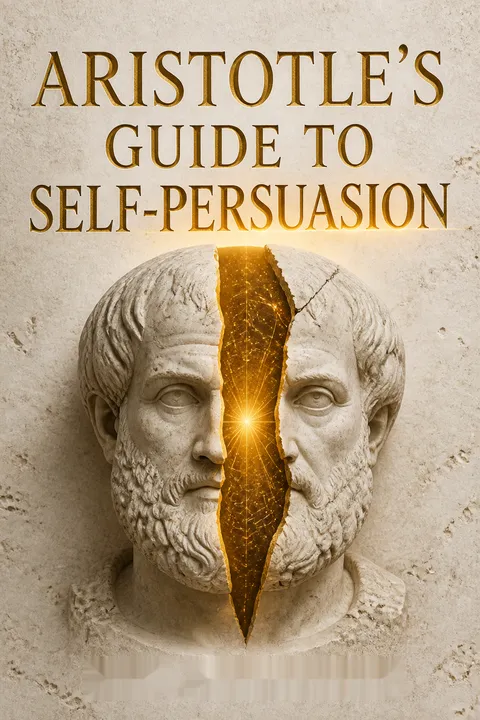


Key Takeaways
Persuade the deeper self you want to serve, not merely the appetite you feel.
Find the real audience. Heinrichs adapts Aristotle’s idea of the soul: not a ghost, but the person’s deepest character and needs. In self-persuasion, this better self becomes the audience the everyday self must win over. To find it, recall moments of generosity, courage, shame, and endurance. Those actions reveal more than familiar slogans about personal values, which may mostly express group identity. Then separate immediate wants from deeper needs. A person may want comfort tonight but need a life with more movement, learning, or connection.
The book’s personal story begins with the author stuck in midlife, in pain, drinking too much, and nostalgic for an earlier outdoor life. His wife suggests using rhetoric on himself. That experiment begins by treating his discouraged self as changeable, not as the final definition of who he is.
What's powerful here is the shift from asking whether a person feels motivated to asking which version of the self deserves a hearing. That resembles identity-based approaches to behavior: actions are easier to sustain when they express a valued role, rather than satisfy a distant metric. But an ideal self can become a harsh internal supervisor. Shame may reveal a value, yet it can also become chronic self-attack. The soul works best as a compass, not a prosecutor. Its needs should be tested against lived experience and care for the body, rather than treated as infallible commands.
Treat upheaval as a decision window, not only as damage to endure.
Look for the opening. Kairos is the chance created by a moment of change, when familiar rules loosen and a choice can redirect events. A tale about three banished princes illustrates the idea: accused of stealing a camel, they used small clues in the landscape to infer what had happened. Their close observation impressed a ruler, and their banishment became a route to fortune. The lesson is not that hardship is secretly good. It is that an unexpected situation still contains choices.
Heinrichs broke his leg on New Year’s Eve, derailing his resolutions. The crisis also brought his family and old friends close, changing his view of relationships. To act in a chaotic moment, define the specific need, then focus on decisions about the future rather than blame or panic. The book calls that precise need an exigence.
This account makes a useful distinction between control over events and agency within them. Stress research often finds that appraisal matters: a situation interpreted as a challenge can invite problem-solving, while one seen only as threat can narrow attention. The princes’ careful observation is a model of curiosity under pressure. Still, an opportunity frame should not turn suffering into a moral test people must pass. Poverty, illness, and loss can close options as well as open them. Recognizing a possible next move is empowering; insisting that every crisis contains a hidden gift is not.
Make inspiration by combining, revising, and reexamining what already exists.
Build from available pieces. The book treats invention as discovery: a new idea often comes from combining familiar elements or applying an old solution in a new setting. The iPhone, for example, joined existing technologies rather than appearing from nowhere. A more personal prompt is to define a real problem precisely, then look for useful connections. A trainer seeking a fresh home workout might observe children alternating vigorous play with squatting and bending, then adapt that pattern for adults.
Failure can supply material, too. A chef responding to a complaint about thick fries sliced potatoes thinly, creating a crisp new dish. A weak adhesive that failed its original purpose became useful for removable notes. These stories suggest a practical cycle: identify a need, notice overlooked material, combine or revise, and remain open to results that differ from the original plan.
The combinatorial view aligns with how innovation often works: creativity can depend less on producing ideas from nothing than on crossing boundaries between fields, materials, or problems. Defining the need also directs attention, making relevant details easier to notice. Yet invention stories are vulnerable to hindsight bias. Once a product succeeds, its path can look cleaner and more inevitable than it was. An unusual combination is only a candidate idea, not proof of usefulness. The strongest version of this method pairs imaginative recombination with testing, so novelty earns its place by solving a real problem.
Choose a daunting goal that makes ordinary practice feel worth repeating.
Aim past the comfortable. Heinrichs gives the Greek term hyperbole a practical twist: imagine a goal just beyond what seems possible, so the attempt itself pulls effort toward a larger horizon. The author’s challenge was to run up New Hampshire’s Mount Moosilauke in fewer minutes than his age. At fifty-eight, after years of hip trouble, he reached the summit in 54:53. Training also helped him lose weight, rebuild strength, and recover a sense of possibility.
A useful ambitious goal carries some risk, feels fresh, and can make the person better off even if the finish line is missed. The point is not to worship an arbitrary record. The grand aim should make the necessary practice compelling, while the skills and health gained along the way remain valuable outcomes in their own right.
A vivid stretch goal can organize attention and make repetitive work feel connected to a meaningful challenge. Goal-setting research generally supports difficult, specific aims when people have commitment, feedback, and adequate resources. The qualification matters: a target that is truly unattainable can sap confidence, and physical challenges require medical judgment, not optimism alone. Heinrichs’s example works because the mountain goal sits alongside gradual training and substantial preparation. The transferable principle is to enlarge the horizon without confusing ambition with recklessness, or a dramatic finish with the only measure of success.
Earn your own trust by acting like an ally, not a judge.
Build a credible character. Aristotle’s ethos is the impression of character that makes an audience trust a speaker. Applied inward, the everyday self must seem caring, capable, and committed to the deeper self’s values. Heinrichs calls one part decorum: behave in ways that fit the person you are trying to become. He began walking with the posture of an athlete, which made his daily behavior feel less distant from that identity and helped him begin painful exercises.
Trust also depends on loyalty and forgiveness. Benjamin Franklin tracked thirteen virtues while trying to improve himself, but never reached the perfection he wanted. The experiment still mattered because it expressed his scientific curiosity. When a habit slips, distinguish a temporary lapse from a settled identity. Acknowledging regret can show that the value still matters, then the next choice can return to it.
The advice combines behavioral rehearsal with self-compassion. Acting in line with a valued identity can make that identity feel more plausible, while forgiving a lapse can interrupt the all-or-nothing thinking that derails change. Franklin’s self-tracking is useful precisely because it treats character as something to study, not merely announce. But self-persuasion can slide into self-excuse: a reassuring story is not evidence that harmful behavior is harmless. Allyship means supporting long-term welfare, which sometimes requires honest feedback, outside accountability, or professional help rather than a clever reinterpretation.
Check the evidence, then choose a belief that helps you take the next step.
Give reason two jobs. Aristotle’s induction gathers evidence before reaching a conclusion. Heinrichs summarizes its questions as: What is this? What caused it? Why is it happening? Is it a pattern? Applied to distressing news, these questions can separate a verified event from a rumor, identify its source, and prevent one frightening case from masquerading as a trend.
Deduction in rhetoric works differently. An enthymeme begins with a belief and draws a practical conclusion from it. Someone who sees herself as persistent might conclude that she can try a difficult course. Taking that step can reinforce the belief. But the same loop can trap a person in a limiting premise, such as deciding that one past failure proves permanent inability. Framing adds another lever: broaden or redefine a problem so its meaning supports a useful choice without losing sight of reality.
This is a bridge between critical thinking and behavior change. The inductive questions resemble basic media literacy: check whether a claim is real, trace its source, and distinguish an anecdote from a trend. The enthymeme captures how beliefs can guide action and how action can, in turn, strengthen beliefs. That loop resembles cognitive behavioral work, where interpretations are examined alongside behavior. The risk is motivated reasoning: people can select evidence to protect a preferred identity. A constructive frame should make action possible while remaining open to correction by facts and consequences.
Give effort a new name, then repeat the words that make it feel doable.
Use language as leverage. Heinrichs calls repeated, rhythmically shaped phrases paeans, drawing on ancient chants used to steady and encourage people. In his own training, brief self-directed phrases helped him rise early, hold yoga positions, and move over rocky trails. Their first value was not that they proved a claim true. Repetition made the words familiar, memorable, and easier to use at the moment of effort.
Tropes can change how an activity feels by recasting it. A metaphor can make a jog seem like an escape; a synecdoche can let one small action stand for the whole task. The important move is to find language that invites the first step, then use it consistently. These devices can soften resistance, but they do not replace training, accurate information, or treatment for medical problems.
Self-talk can shape attention and perceived effort, while a short verbal cue is easy to retrieve when concentration is strained. The book’s examples also show how humor and metaphor can lower the embarrassment of trying something new. That is a modest, plausible use of language, not evidence that slogans can directly control outcomes. Claims about repetition changing brain structure should be treated carefully: learning does involve changes in neural connections, but a catchy phrase alone does not guarantee a specific result. The useful test is behavioral: does this wording help someone begin, persist, or recover after a setback?
Shrink the ramp until repetition, not heroic willpower, carries the habit.
Make action less steep. The Lure & Ramp method pairs an appealing destination with steps that seem manageable. Heinrichs’s Tortoise Method applies that principle gradually: secure a small routine, let it become ordinary, then add another step. He wanted time for exercise and writing, so he used the clock change in autumn to wake an hour earlier. At first he only occupied the new time. Reading and easy workouts came later, followed by more demanding training.
The larger lesson is to reduce the number of difficult decisions required each day. A person learning piano need not leap straight to a polished performance. A modest, repeatable practice can make the instrument part of ordinary life. Habits can free attention for other things, although the same automaticity can also preserve an unhelpful routine.
The gradual approach fits evidence that repeated behavior in stable contexts can become more automatic, reducing the effort of deciding each time. It also treats time and friction as design problems rather than moral defects. The author’s early-morning schedule is a personal solution, not a universal prescription; sleep needs, caregiving, work shifts, and chronotype differ. A routine that borrows time from sleep may undermine health. The deeper lesson is to protect a realistic opening in the day and make the desired behavior easy to repeat within the life a person actually has.
Write your future as a chain of problems that reveals who you are.
Give change a plot. Aristotle’s account of story depends on connected events: one problem leads to a choice, and that choice creates the next situation. A list of accomplishments may report what happened, but a sequence of obstacles and responses reveals character. Heinrichs illustrates this with his own childhood writing: a plain account of starting a journal becomes more compelling when each difficulty, from having nothing to say to noticing a classmate’s mishap, leads to a discovery about what to write.
The same method can imagine a future. A story-shaped goal includes a catalyst, a commitment to change, setbacks, and a response that shows what the protagonist values. A setback becomes part of the plot rather than automatic proof that the effort is over. The imagined story is a rehearsal, not a prediction, and its usefulness depends on what the person does next.
Narrative identity research explores how people organize experience into stories that give continuity to a changing self. A future-oriented story can make an abstract goal emotionally concrete and prepare someone to interpret obstacles without abandoning the larger aim. The emphasis on responses is especially useful: character is shown through choices under constraint. Yet stories can also distort. A tidy heroic arc may erase luck, social support, or structural barriers, and a setback does not always lead to triumph. A good personal narrative leaves room for revision and treats asking for help as part of competent action.
Measure happiness by soulful action and interpretation, not applause alone.
Align life with need. Heinrichs presents Aristotle’s happiness, eudaimonia, as a combination of favorable circumstances, good functioning, and the interpretation of experience. Luck matters, but so do habits and choices that fit a person’s deepest needs. This differs from defining a good life only by status, wealth, or entertainment. Epicurus offers a related tool, the tetrapharmakos, a four-part remedy for fears about divine punishment, death, pain, and possessions. Its practical thread is to question which desires are necessary and which mainly generate anxiety.
The book ends with the author recalling a breakfast with the Dalai Lama, whose laughter stayed with him. He reads that laughter as a sign of a person who can meet hardship without letting it define the whole of life. Wonder, gratitude, and disciplined action can coexist with difficult circumstances.
This account resists the idea that well-being is simply pleasure or achievement. It connects flourishing to conduct, material conditions, and interpretation, a more complete view than mindset alone. The distinction between needs and status-driven wants can clarify spending and ambition, but modest desire is not a universal cure for insecurity. Poverty, illness, and injustice constrain happiness in ways reframing cannot remove. The closing image of laughter is evocative because it represents emotional freedom, not denial. A humane reading keeps both truths in view: agency matters, and circumstance matters too.
Analysis
The book’s central move is to treat rhetoric as an instrument for governing the self. Instead of addressing motivation as a scarce inner fuel, Heinrichs imagines a relationship between an ordinary self and a more deeply valued self. Classical rhetoric supplies the techniques for making that audience receptive: interpret the moment, establish trust, manage emotion, construct plausible reasoning, reshape language, and make action habitual. The author’s climb up Mount Moosilauke gives the ideas a concrete narrative arc. A man who once limped and felt detached from his former identity sets an improbable target, trains through incremental routines, and finishes in 54:53 at age fifty-eight. The result is not only a record-like achievement, but a changed account of who he can be.
The adaptation’s greatest strength is its insistence that words are practical, not decorative. A new description can lower the emotional cost of effort; a future story can make a goal vivid; a repeated phrase can serve as a cue at the moment action is difficult. The book also treats failure and crisis as occasions for interpretation and choice, without requiring every objective to be achieved exactly as imagined.
Its most important tension is ethical and psychological. The same persuasive tools can support growth or rationalize self-deception. A belief can motivate a useful experiment, but it can also shield a person from evidence. Heinrichs recognizes this tension through his interest in facts, causes, and the risks of faulty reasoning, yet some claims about neural effects and rhetorical influence are presented more confidently than the described examples can establish. The techniques are best used as prompts for behavior, not as proof that a goal is wise or safe.
The book is consequently less a universal method than a creative vocabulary for self-direction. It is especially useful when a person’s problem is not ignorance of what to do, but difficulty seeing a meaningful reason to begin. Its Aristotelian soul need not be understood metaphysically. It can function as a disciplined question: what action would make the daily self more consistent with the person’s considered values?
Review Summary
Aristotle's Guide to Self-Persuasion receives positive reviews, with readers praising its unique approach to self-improvement using ancient philosophy and rhetoric. The book explores Aristotle's concept of the "soul" as a tool for ethical self-persuasion, drawing parallels to modern psychology. While some find it challenging to follow at times, readers appreciate the author's wit, personal anecdotes, and relevant examples. The book is described as thought-provoking and inspiring, offering practical tools for aligning actions with one's higher identity.
People Also Read









Glossary
Soul
deeper self and needsIn Heinrichs’s Aristotelian usage, the soul is not necessarily an immortal spirit. It is a person’s deepest character, identity, and ultimate needs. Treating it as an audience makes self-persuasion possible: the everyday self can try to bring behavior into closer alignment with this more considered self.
Kairos
timely opening for actionKairos is the ability to recognize and act within a temporary opening created by change. It is not simply good luck. A chaotic transition becomes an opportunity only when someone identifies what needs solving and chooses a course of action suited to the moment.
Exigence
the specific need to solveExigence is the precise problem or need that calls for a response. Defining it helps distinguish the real task from the surrounding confusion. In a crisis, the exigence might be restoring peace, securing income, or finding a new direction, rather than assigning blame for how events began.
Hyperbole
ambition beyond the ordinaryHeinrichs uses Hyperbole for an unusually ambitious goal that appears to stretch beyond ordinary expectations. It should feel novel and involve some risk, while making the work toward it worthwhile even if the exact target is missed. The goal motivates practice and can strengthen the person through the attempt.
Enthymeme
belief linked to a choiceAn enthymeme is a compact rhetorical argument that starts with a belief or likely premise and moves to a practical conclusion. Its self-persuasive effect is recursive: the belief supports an action, and taking the action can make the belief feel more credible. A limiting premise can create the same loop in reverse.
Lure & Ramp
appealing goal, manageable stepsLure & Ramp is Heinrichs’s method for making action attractive and accessible. First, focus on an appealing outcome, the lure. Then make the route toward it seem less daunting by breaking it into manageable steps, the ramp. The method applies rhetorical persuasion to personal goals and routines.
Tortoise Method
gradual habit buildingThe Tortoise Method builds a routine slowly, beginning with actions that are easy to sustain and adding difficulty only after they become familiar. It applies the Lure & Ramp idea to habits. Its point is to rely less on bursts of discipline and more on a gradual sequence of repeated choices.
Paean
rhythmic motivational phraseA paean is a rhythmic chant or phrase used to encourage action and steady attention. Heinrichs adapts the ancient rhetorical form for private self-talk. A short repeated phrase can serve as a cue during a difficult task, helping effort feel more familiar or manageable without guaranteeing success.
Eudaimonia
flourishing through a good lifeEudaimonia is the Greek concept of happiness or flourishing associated with Aristotle. In this book, it involves more than pleasant feelings: favorable circumstances matter, but so do virtuous action, sound habits, and the way experience is interpreted. A life aligned with a person’s deeper needs is part of the good.
Tetrapharmakos
four-part cure for fearThe tetrapharmakos is an Epicurean four-part remedy for distress associated with divine punishment, death, pain, and anxiety about material goods. Heinrichs presents it as a way to question fears and unnecessary desires. It is a philosophical tool for changing perspective, not a medical treatment.
Thaumaston
sublime wonderThaumaston refers to a state of amazement or wonder in response to something experienced as sublime. Heinrichs connects it with moments such as encountering a striking natural scene. It represents an openness to intense appreciation, which the book associates with a life more fully engaged with experience.
FAQ
1. What is Aristotle's Guide to Self-Persuasion by Jay Heinrichs about?
- Ancient Rhetoric for Change: The book explores how Aristotle’s ancient rhetorical techniques can be used for self-persuasion, not just to influence others but to motivate and transform oneself.
- Soul as Audience: Heinrichs introduces the idea of persuading your own “soul”—your truest, noblest self—to align daily actions with higher values and ambitions.
- Modern and Practical: The book blends classical philosophy with modern examples, including Taylor Swift, to provide actionable tools for personal growth and habit change.
2. Why should I read Aristotle's Guide to Self-Persuasion by Jay Heinrichs?
- Unique Philosophical Approach: Unlike typical self-help books, it grounds personal change in the classical art of rhetoric, offering a fresh, time-tested framework for self-improvement.
- Comprehensive, Actionable Tools: Heinrichs provides a wide range of rhetorical techniques—ethos, pathos, logos, framing, and more—that can be immediately applied to reshape mindset and behavior.
- Empowerment and Agency: The book promises to help readers gain agency over their lives by teaching them to “bend their souls,” turning internal conflict into motivation and resilience.
3. What are the key takeaways from Aristotle's Guide to Self-Persuasion by Jay Heinrichs?
- Self-Persuasion as Core Skill: Rhetoric is not just for others; it’s a powerful tool for persuading yourself to adopt better habits and pursue ambitious goals.
- Soul Alignment: True happiness and change come from aligning your daily self with your noble soul through habits, narrative, and reframing.
- Practical Rhetorical Methods: Techniques like Lure & Ramp, the Tortoise Method, and crafting personal paeans (charms) are central to building courage, forming habits, and motivating action.
- Framing and Hyperbole: Reframing challenges and setting “Hyperbolic” goals are essential for overcoming low aspiration and injecting excitement into personal growth.
4. What is the concept of the “soul” in Aristotle's Guide to Self-Persuasion by Jay Heinrichs?
- Aristotelian Soul Defined: The soul is your highest, most rational and virtuous self—not a religious spirit, but your deepest identity and truest character.
- Audience for Self-Persuasion: Your soul acts as the internal audience you must persuade, helping you align daily actions with your noblest motives.
- Virtues and Traits: Heinrichs describes the soul as just, courageous, wise, and magnanimous, and the gap between your soul and daily self is the source of unhappiness and the target for change.
5. How does Jay Heinrichs explain the role of habits in self-persuasion and happiness in Aristotle's Guide to Self-Persuasion?
- Habits as Choicelessness: Habits reduce the mental burden of constant decision-making, putting beneficial behaviors on autopilot and aligning actions with the soul’s desires.
- Gradual Habit Building: The Tortoise Method advocates starting with small, easy steps and building up over time, making change sustainable and less daunting.
- Virtues Through Habits: Courage (embracing discomfort) and temperance (avoiding temptation) are supported by steady habits, leading to lasting happiness.
6. What are the key rhetorical tools and methods taught in Aristotle's Guide to Self-Persuasion by Jay Heinrichs?
- Lure & Ramp Technique: Make a goal highly desirable (the lure) and break it into small, manageable steps (the ramp) to reduce resistance and ease the path to change.
- Tortoise Method: Emphasizes slow, steady progress by starting with the easiest steps and gradually increasing effort, inspired by Aesop’s fable and Aristotle’s ideas.
- Figures and Tropes: Use rhythmic language (figures like paeans) and analogical thinking (tropes such as metaphor and metonymy) as “charms” to reframe reality and embed new beliefs.
7. How does Aristotle's Guide to Self-Persuasion by Jay Heinrichs use storytelling and narrative for self-change?
- Narrative Shapes Identity: Crafting a compelling personal story with connected events reveals and shapes your soul, making your self-image more believable and motivating.
- Tying and Untying Knots: The book teaches how to structure stories with problems and solutions, reflecting personal growth and heroic character development.
- Hero’s Journey Framework: Using storytelling beats like the hero’s journey, readers can frame their goals as epic quests, increasing motivation and cognitive ease.
8. What is the significance of “charms” and “paeans” in Aristotle's Guide to Self-Persuasion by Jay Heinrichs?
- Charms as Mental Spells: Charms are rhythmic or patterned phrases repeated often enough to become ingrained beliefs, motivating and reinforcing habits.
- Paeans as War Cries: Short, catchy slogans (e.g., “Just Do It”) can be personalized to boost courage and focus, inspired by ancient Greek chants.
- Neuroscience Backing: Repetition of these phrases strengthens neural connections, embedding new realities into the brain and effectively “bending the soul.”
9. How does Aristotle's Guide to Self-Persuasion by Jay Heinrichs explain the concepts of ethos, pathos, and logos for self-persuasion?
- Ethos (Character Projection): Projecting caring, craft, and cause to your own soul builds trust and credibility, helping close the gap between your daily self and your noble self.
- Pathos (Emotion Management): Managing emotions and moods creates a receptive state for self-persuasion, with positive moods increasing cognitive ease and motivation.
- Logos (Reasoning and Belief): Using induction, deduction, and the enthymeme (belief-based syllogism) helps reinforce positive self-beliefs and rational decision-making.
10. What is “framing” in Aristotle's Guide to Self-Persuasion by Jay Heinrichs, and how can it redefine your life?
- Definition and Power: Framing is the act of defining or redefining an issue to change its meaning and influence perception, giving you control over how you see your life and challenges.
- Examples and Fallacies: The book uses real-world examples and logical fallacies as tools to reframe reality in beneficial ways.
- Reframing Suffering: Pain and obstacles can be reframed as skills or debts owed, reducing self-pity and increasing resilience.
11. What is the “Hyperbole” method in Aristotle's Guide to Self-Persuasion by Jay Heinrichs, and how does it motivate change?
- Definition and Etymology: Hyperbole means “to throw beyond” and involves setting goals that seem just beyond the possible, inspiring grand ambition and motivation.
- Elements of Hyperbolic Goals: These goals are risky, novel, and culminate in a dramatic moment, pushing you to extraordinary effort and growth.
- Psychological Effect: Hyperbolic goals inject moral energy and excitement, making the pursuit itself motivating even if the goal seems impossible.
12. How does Aristotle's Guide to Self-Persuasion by Jay Heinrichs connect rhetoric, reality, and happiness?
- Rhetoric Shapes Perception: The book discusses how rhetoric creates shared impressions of reality, making belief malleable even if truth is fixed.
- Soul Alignment for Happiness: True happiness (eudaimonia) comes from aligning daily actions with the soul’s virtues—justice, courage, wisdom—through habits and reframing.
- Purpose of Self-Persuasion: The ultimate goal is self-mastery, using language and rhetoric to connect with your noble soul and live a life of virtue and purpose, fulfilling Aristotle’s vision of the good life.
About the Author


Download PDF
Download EPUB
.epub digital book format is ideal for reading ebooks on phones, tablets, and e-readers.








