

Key Takeaways
Treat aspects as the chart's plot, not isolated planetary labels
Relationships create the drama. An aspect is an angular relationship between two planets or chart points, measured around the zodiac. Tompkins treats these relationships as the horoscope's active ingredients: they show how different drives reinforce, interrupt, or complicate one another. A planet alone suggests a theme; its aspects suggest how that theme meets the rest of the personality.
Read combinations in context. A chart is not a list of separate traits. A Mercury-Saturn link, for instance, brings thinking and communication into contact with caution, authority, or fear. That combination might describe careful speech, anxious learning, or disciplined study, depending on the rest of the chart. The point is not to attach one fixed label, but to interpret an interaction within a whole life-pattern.
What's useful here is the shift from trait labels to relationships. Personality psychology also treats people as systems of competing motives, not tidy collections of adjectives. A person can crave closeness and independence at once; the tension between them often explains more than either desire alone. Astrology offers a compact symbolic vocabulary for exploring those tensions. Its interpretive usefulness, however, should not be mistaken for evidence that planetary positions cause personality. The strongest use is as a prompt for careful reflection, not as a verdict about someone.
Read aspect geometry as a style of interaction, never a moral score
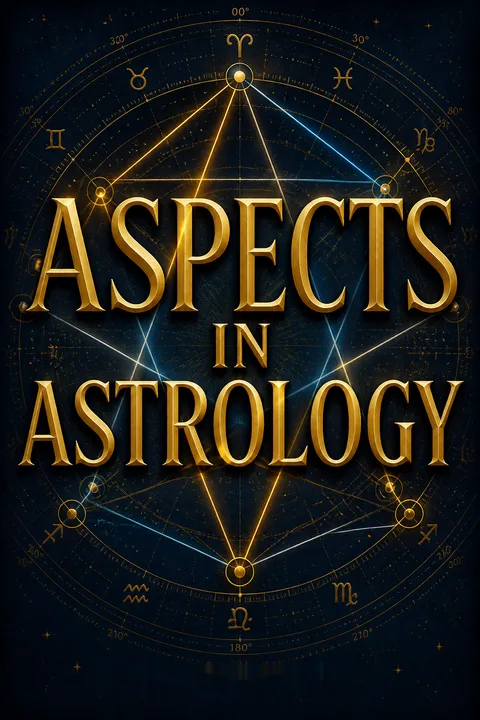
The angles suggest a dynamic. The circle is divided into familiar relationships: a conjunction places planets together, an opposition faces them across the chart, a square sets them at a right angle, and a trine links planets 120 degrees apart. Tompkins calls squares and oppositions challenging, and trines and sextiles easier, but rejects the old idea that one group is simply bad and the other good. Tension can mobilize; ease can preserve a pattern.
Allow for imprecision. An orb is the distance permitted on either side of an exact angle for an aspect to count. The book presents different working limits, including an example of eight degrees for major aspects and smaller allowances for minor ones. Signs, elements, and modes add nuance, and an aspect spanning unexpected signs may require a more delicate reading.
This geometric approach is memorable because it separates the kind of pressure from its eventual outcome. In engineering, tension can stabilize a structure or break it, depending on design and load. Likewise, ease can support recovery or leave a dysfunctional arrangement undisturbed. The caution against moral labels is especially valuable: it prevents a reader from treating a square as a sentence or a trine as a prize. The limitation is that angle categories remain part of an interpretive tradition, not independently verified psychological mechanisms.
Conjunctions fuse motives; oppositions make the other side impossible to ignore
Togetherness can obscure difference. In a conjunction, two planetary energies are blended so closely that a person may experience them as one. Tompkins compares this to the Sun and Moon at the New Moon, when the Moon is not visible. A Sun-Mercury conjunction, for example, can make opinions feel inseparable from identity: disagreement with an idea may feel like rejection of the person.
Distance can reveal a split. An opposition sets two principles across from each other. The person may recognize one side and encounter the other through partners, rivals, or circumstances. Tompkins calls this projection: disowned qualities are experienced as belonging to someone else. The task is not to choose one pole forever, but to notice both and find ways to use them in turn or in combination.
The contrast between fusion and opposition resembles a basic problem in self-awareness. People often struggle to see assumptions they have never had to question, while disagreement can make those assumptions visible. Relationship can function as a mirror, but the mirror is not neutral: the other person has motives and history of their own. The idea of projection can help generate questions, such as whether a recurring conflict echoes a disowned trait. It becomes less helpful when used to dismiss another person's real behavior as merely one's own projection.
Use tension to develop capacity, but question what effortless trines normalize
Friction can force engagement. Squares link principles that seem to work at cross-purposes, creating pressure to act or find a workable compromise. Tompkins sees this strain as potentially productive: obstacles can strengthen skill and determination, while avoidance can leave the conflict stuck. Oppositions also create tension, but often through the challenge of balancing two related needs.
Ease can hide its price. Trines describe energies that flow readily together, which can indicate talents and sources of restoration. Yet they can also make a habit feel natural simply because it is familiar. Tompkins describes a woman with a Venus-Saturn-Pluto water grand trine who maintained a long marriage while justifying harsh control of her family as loving protection. The ease of the pattern, in her reading, helped keep it unquestioned.
The most sophisticated point is that comfort and difficulty are not reliable measures of health. Behavioral science distinguishes useful challenge from overwhelming stress, and the same pressure can either promote learning or impair it depending on support and context. Similarly, a practiced response can feel effortless while still causing harm. The example of the family makes the interpretive warning vivid, though the chart cannot establish why the woman behaved as she did. Concrete evidence about choices and their effects should outrank a symbolic explanation.
Interpret the planet pair before deciding whether the aspect feels easy
Start with the ingredients. Tompkins gives each planet a broad psychological territory: the Sun relates to identity and purpose, the Moon to feeling and habitual response, Mercury to thought and communication, Venus to value and relating, and Mars to assertion and action. Jupiter enlarges and seeks meaning; Saturn constrains and tests; Uranus seeks freedom and disruption; Neptune idealizes or blurs; Pluto intensifies and exposes buried material.
Then combine, not merely add. A Mercury-Mars contact might bring quick thought and forceful speech together. Sun-Saturn can make recognition and authority important while also making self-expression feel risky. The exact outcome depends on sign, house, aspect type, and other chart factors. Tompkins therefore treats cookbook descriptions as starting points, not full readings.
This method resembles compositional reasoning: a complex meaning emerges from how parts interact, rather than from adding fixed definitions mechanically. It is a useful discipline in any symbolic system because it slows premature labeling. The planetary keywords also form a compact set of questions about identity, care, thought, desire, action, belief, limits, freedom, ideals, and power. A reader should still resist treating those categories as universal psychological facts. The same behavior can arise from many histories, and an interpretive vocabulary is most responsible when it remains open to correction.
Let outer planets name the pressure, then locate its human outlet
Personal and collective themes overlap. Tompkins treats Uranus, Neptune, and Pluto as symbols with both individual and generational reach. Uranus is associated with rebellion and changing ideas, Neptune with ideals, longing, and blurred boundaries, and Pluto with hidden power, crisis, and transformation. Because these planets move slowly, many people born around the same time share their relationships with one another.
Look for a personal connection. A slow-moving pattern becomes more central to an individual reading when it closely contacts a personal planet or an angle. Tompkins discusses Mikhail Gorbachev's Saturn-Uranus-Pluto configuration in connection with reform and resistance to established systems. In this approach, the outer-planet pattern supplies a broad historical atmosphere; the more personal contacts suggest where a particular person might embody or confront it.
The distinction between shared historical atmosphere and individual biography is analytically useful. It resembles the sociological idea that people act within institutions and periods they did not choose, while still making distinctive choices inside them. A generational symbol can encourage questions about the political and cultural setting of a life. It cannot, by itself, explain an individual's actions or prove that a planetary cycle shaped a historical event. The more specific the claim, the more important it is to compare the interpretation with documented history and the person's actual decisions.
Read angles as the interface between private roots and public identity
The angles make a chart personal. The Ascendant-Descendant axis concerns how a person meets the world and encounters others; the Midheaven-Imum Coeli axis concerns public direction and private roots. Tompkins insists these points work as complexes, shaped by their signs, nearby planets, aspects, and ruling planets, rather than as isolated meanings. The Ascendant can suggest a first approach; the Descendant shows qualities that become salient through relationship.
Small timing differences matter. The book compares charts for June and Jennifer Gibbons, twins born ten minutes apart. Their Ascendants differ, Taurus for June and Gemini for Jennifer, illustrating how a small birth-time difference can alter the angle-based reading. The example also underscores a practical issue: uncertain birth times weaken claims that depend on exact angles.
The image of an interface captures an important psychological fact: people present themselves differently across settings, and public roles do not exhaust private identity. Family systems theory likewise studies how a person's role in a household can shape later relationships and ambitions. The twins' charts make a compelling illustration of why birth time matters within astrology, but illustration is not a test of accuracy. Their life histories are also too complex to reduce to a rising sign. The model is most useful when it opens inquiry into context rather than substitutes for it.
Rank close, angular, and repeated patterns before trusting cookbook readings
Give the loudest factors priority. Tompkins weighs an aspect by its closeness, whether it involves the Sun, Moon, Ascendant, or Ascendant ruler, and whether a planet is prominent by sign, house, or position near an angle. A tight angular conjunction usually matters more in her method than a wide, isolated contact. She also warns that a chart's overall pattern changes the meaning of any one detail.
Notice repetition. Stephen Arroyo's phrase "double whammy" refers to a theme reinforced several times within a configuration. Tompkins uses Princess Margaret's Mercury-Mars square as an example: Mars is in Mercury-ruled Gemini and the third house, while Mercury is in Virgo and the sixth house, both associated with Mercury. Applying aspects are moving toward exactness; separating aspects have already passed it. The author treats applying contacts as often stronger, but not as an absolute rule.
This is the book's strongest safeguard against simplistic readings: interpretation is weighted, not conducted as a keyword lottery. In statistics, repeated measurements can increase confidence only when they are genuinely independent. Astrological repetitions are not independent evidence, since several may stem from the same chart structure. Still, looking for convergence can help an interpreter avoid making a major claim from one weak indicator. Exactness and prominence are useful internal rules for consistency, not proof that the selected theme is objectively true.
Use symbolism to recover choice, not to outsource your future
Build an interpretation step by step. Tompkins recommends combining planetary keywords, aspect dynamics, signs, houses, and chart rulerships. If interpretation stalls, her keyword method pairs words from each planet to generate possibilities. Saturn and Uranus, for instance, might suggest cautious reform or fear of change. Mythology can add associations, while discussion of a person's actual history helps test what fits.
Treat the chart as a question. The author argues that recurring responses may have roots in early experience, but does not frame childhood as a simple cause. The practical aim is to make habitual patterns more conscious, then consider how they might be expressed differently. A cookbook entry can suggest questions about a relationship or a fear; it cannot establish a diagnosis, predict an inevitable event, or replace the person's own account.
This approach has a clear affinity with narrative therapy, where people examine the stories organizing their lives and look for interpretations that allow more agency. A symbolic image can make a tangled experience discussable, especially when direct language is difficult. But an evocative explanation can also become self-sealing: every outcome may be taken as confirmation. The best safeguard is collaborative testing. Ask what fits, what does not, and what evidence would change the interpretation. Symbolism should widen a person's options, never authorize fatalism or excuse harm.
Analysis
Aspects in Astrology is best understood as an interpretive manual organized around relationships. Its central move is to turn astrology from a catalogue of planetary meanings into a grammar of interaction: a symbol gains significance from what it touches, how closely it touches it, and where that relationship sits in the chart. This structure gives the book unusual coherence despite its cookbook format. The examples range from Jane Austen's quintiles to the Gibbons twins' angles, allowing abstract rules to meet biographies and events.
The book's most valuable intellectual contribution is its refusal to equate ease with virtue or difficulty with misfortune. A trine may sustain a talent, but it may also sustain an unquestioned habit. A square may frustrate, but it can demand the effort that builds competence. This is a more psychologically nuanced model than simple benefic and malefic labels. Its emphasis on context, repetition, and chart weighting also recognizes that interpretation is a problem of synthesis, not keyword lookup.
The method has a clear boundary. The book's case histories are illustrative anecdotes, not controlled evidence that planetary configurations reliably describe personality or events. Many interpretations are flexible enough to fit multiple outcomes, and readers may select confirming details after learning a person's story. This creates risks familiar from cognitive psychology, including confirmation bias and the tendency to recognize broad descriptions as uniquely personal. Accordingly, the text is strongest as a symbolic language for reflection and weakest when its claims are treated as causal explanations or forecasts.
A responsible reader can preserve the book's practical value without adopting its strongest metaphysical assumptions. Planetary combinations can be used as prompts to examine tensions, inherited roles, and preferred defenses. The individual's experience, cultural setting, and observable behavior must remain the deciding evidence. The chart may offer a story to test, but it should not overrule the person living it.
Review Summary
Aspects in Astrology receives mostly positive reviews, with readers praising its comprehensive coverage of astrological aspects. Many find it informative, well-written, and accessible for both beginners and advanced students. Reviewers appreciate the author's insights, practical examples, and psychological approach. Some criticize the occasional guesswork and spelling errors. The book is considered a valuable resource for understanding planetary relationships and self-discovery. Several readers describe it as a must-have for astrology enthusiasts, while a few find it too dense or lacking in certain areas.
People Also Read

Glossary
Aspect
planetary angular relationshipAn aspect is the angular distance between two planets or chart points, measured along the zodiac. In Tompkins's interpretive method, the relationship describes how the corresponding symbolic principles interact. Its meaning depends on the angle, the planets involved, and other chart factors, rather than on either planet being read alone.
Orb
allowed angular distanceAn orb is the number of degrees an aspect may differ from its exact angle while still being considered active. Astrologers disagree about appropriate orb sizes. Tompkins offers working guidelines and argues that closer aspects generally deserve more interpretive weight, while also considering the number of other aspects in a chart.
Disassociate aspects
aspects across sign expectationsDisassociate aspects are angular relationships between planets in signs that would not normally be expected to form that aspect by element or mode. They can occur when one planet is near the end of a sign and the other near the beginning of another. Tompkins advises interpreting them with added care.
Stellium
cluster of close planetsA stellium is a close grouping of three or more planets, usually within about eight degrees. It concentrates attention and symbolic emphasis in a chart area, but can be difficult to interpret because the planets act together. Tompkins suggests identifying a particularly prominent planet as one possible way into the cluster.
Quintile series
five-based aspect familyThe quintile series consists of aspects derived by dividing the 360-degree circle by five or its multiples. The quintile is 72 degrees and the bi-quintile is 144 degrees. Tompkins associates this family with style, creative form, and the shaping of ideas, while cautioning that its meanings are unusually specific.
Applying and separating aspects
approaching or past exactnessAn applying aspect is moving toward its exact angular relationship at the birth moment; a separating aspect has already passed exactness. The faster-moving planet determines the movement. Tompkins considers applying aspects potentially more active, but notes that their effects may depend on the planets involved.
Double Whammies
repeated chart emphasisA double whammy is a theme reinforced more than once within a chart configuration. Tompkins uses the term for overlapping indicators that strengthen an interpretation, such as a planet placed in a sign and house associated with the other planet in an aspect. Repetition raises emphasis within the reading, not independent proof of a claim.
FAQ
What's Aspects in Astrology about?
- Understanding Planetary Relationships: The book delves into the angular relationships between planets in a horoscope and their influence on personality and life experiences.
- Two-Part Structure: It is divided into two parts, with the first focusing on aspect interpretation principles and the second serving as a "planetary cookbook" for specific aspects.
- Practical Application: Aimed at both beginners and experienced astrologers, it provides insights into synthesizing astrological symbols to understand a chart comprehensively.
Why should I read Aspects in Astrology by Sue Tompkins?
- Comprehensive Guide: Authored by seasoned astrologer Sue Tompkins, it offers a thorough exploration of aspects, crucial for interpreting horoscopes.
- Empirical Research: The material is grounded in the author's empirical research and teaching experience, making it informative and practical.
- Enhances Astrological Skills: Reading this book can improve your ability to interpret charts and understand planetary dynamics, essential for aspiring astrologers.
What are the key takeaways of Aspects in Astrology?
- Importance of Aspects: Aspects are vital for understanding the energy and dynamics within a horoscope, transforming it into a living narrative.
- Complexity of Interpretation: Interpreting aspects requires synthesizing various symbols, including planets, signs, and houses, to grasp their full meaning.
- Unique Perspective: Tompkins offers a unique view on how aspects describe psychological complexes and influence an individual's fate.
What are the main types of aspects discussed in Aspects in Astrology?
- Hard Aspects: Conjunctions, oppositions, and squares are characterized by tension and challenges, indicating areas of conflict or struggle.
- Soft Aspects: Trines and sextiles represent ease and harmony, suggesting areas of support and natural talent.
- Other Aspects: Less common aspects like quincunxes and semi-sextiles indicate subtle tensions or adjustments needed in life.
How does Sue Tompkins define aspects in astrology?
- Angular Relationships: Aspects are defined as angular relationships between planets, measured in degrees of longitude along the ecliptic.
- Influence on Interpretation: They are crucial for interpreting energy and relationships within a chart, describing planetary interactions.
- Complexity of Relationships: Understanding aspects requires a nuanced approach, as they manifest differently depending on involved planets, signs, and houses.
What is the significance of the Sun in astrology according to Aspects in Astrology?
- Core Identity: The Sun represents an individual's core identity, will, and purpose, driving ambitions and self-expression.
- Influence of Aspects: Aspects to the Sun affect self-perception and goals, such as challenges with authority in a Sun square Saturn.
- Integration of Self: The Sun acts as a unifying force, integrating various aspects of the self, including conscious and unconscious elements.
How does the Moon influence emotional responses in astrology?
- Emotional Foundation: The Moon signifies feelings, instincts, and nurturing, representing where one seeks comfort and security.
- Impact of Aspects: Aspects to the Moon reveal emotional expression, such as quick reactions with Moon–Mars or controlled responses with Moon–Saturn.
- Mother Figure: Often associated with the mother or primary caregiver, influencing nurturing and emotional support relationships.
What does Aspects in Astrology say about the role of Mercury?
- Communication and Thought: Mercury governs thought processes, communication styles, and the rational mind, affecting idea expression and connections.
- Influence of Aspects: Aspects to Mercury indicate communication and learning styles, such as challenges in expression with Mercury–Saturn.
- Connection to Siblings: Mercury signifies relationships with siblings and peers, shaping communication styles and learning experiences.
How does Tompkins describe the relationship between Venus and personal values?
- Cooperation and Harmony: Venus symbolizes the desire for cooperation, beauty, and love, reflecting harmony in relationships and surroundings.
- Influence of Aspects: Aspects to Venus reveal self and others' valuation, such as independence needs in a Venus–Uranus aspect.
- Artistic Appreciation: Associated with artistic expression and aesthetic appreciation, influencing engagement with beauty and creativity.
What are the challenges associated with Saturn in astrology as per Aspects in Astrology?
- Fear and Control: Saturn is linked to fear, control, and lessons through hardship, representing life's limitations and responsibilities.
- Influence of Aspects: Aspects to Saturn indicate dealing with authority and discipline, such as freedom versus structure in Saturn–Uranus.
- Growth Through Challenges: While imposing restrictions, Saturn offers growth and maturity opportunities through challenges and overcoming fears.
What is the significance of Moon-Saturn aspects in astrology?
- Emotional Development: Moon-Saturn aspects indicate a need for emotional security, reflecting childhood experiences shaping nurturing abilities.
- Parental Influence: Often linked to strict or emotionally distant parents, leading to challenges in expressing vulnerability and seeking support.
- Healing Opportunities: Understanding these dynamics offers healing and growth opportunities through conscious parenting or nurturing relationships.
How do Moon-Uranus aspects affect emotional independence?
- Need for Freedom: Moon-Uranus individuals require emotional space, resisting routine and seeking excitement and change.
- Childhood Trauma: These aspects may stem from early emotional shock or abandonment, leading to a quest for autonomy.
- Intuitive Sensitivity: Highly intuitive, their sensitivity can cause relationship misunderstandings, necessitating clear communication of needs.
Download PDF
Download EPUB
.epub digital book format is ideal for reading ebooks on phones, tablets, and e-readers.








