

Key Takeaways
Judge inventions by the risks they create, not only the problems they solve.
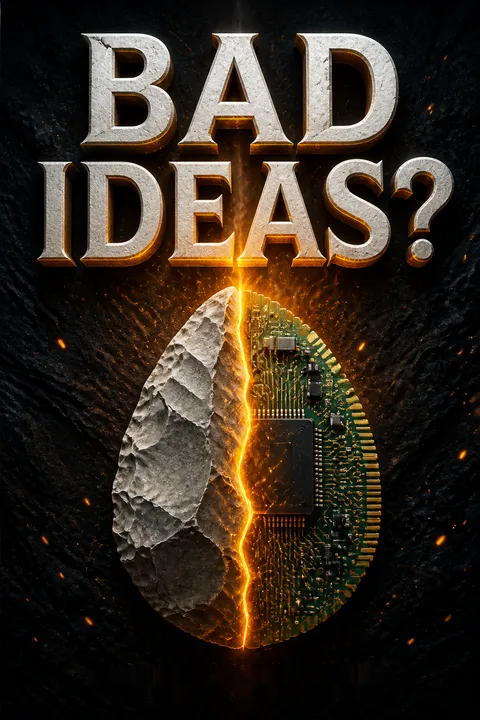
Power has two edges. The book follows human ingenuity from sharpened stone to genetic engineering, arguing that a tool rarely changes only the task it was made for. A stone hand-axe helped early humans process food, but could also become a weapon. The atlatl, a lever-like spear launcher, made hunting safer and more effective while increasing the reach of violence. Technology also produces benefits its makers never intended, as when stone tools later served crafts beyond survival.
Progress is not a straight line. The same capacity to alter the environment that supports human life can damage ecosystems, concentrate power, or create new dangers. Winston’s history therefore treats inventions as bargains: they expand what people can do, while shifting risks onto others, other species, or the future.
What's valuable here is the shift from asking whether an invention is good or bad to asking who gains power, who absorbs the costs, and what new behavior becomes possible. That is close to systems thinking, where a local improvement can create distant side effects through feedback and scale. The caution needs one qualification: harms are not automatic properties of tools. Institutions, incentives, and access shape outcomes. A weapon, a medical device, and a communication network can all be redirected by the systems surrounding them.
Do not mistake higher food output for healthier lives.
Farming had costs. Early agriculture supported settled communities and larger populations, but archaeological evidence in the book suggests that some first farmers were shorter and less healthy than hunter-gatherers. Skeletons from early farming sites show severe strain from grinding grain, while teeth reveal damage from grit in ground flour. In some agricultural populations, diets based heavily on a single crop coincided with more cavities, anaemia, disease, and early deaths.
The trade-off was not obvious. Research on the !Kung people of the Kalahari found that men spent about six hours a week hunting, while nutritious mongongo nuts supplied much of the community’s calories. This example challenges the simple story that farming replaced a miserable existence with progress. Farming could yield more calories from a given area, but its value depended on local conditions, labor, diet, and health.
The distinction between calories produced and well-being achieved is useful far beyond ancient history. Modern systems often reward measurable output, while nutrition, resilience, and labor conditions are harder to count. The comparison with hunter-gatherers also helps disrupt assumptions that settled life is inherently superior. Yet the evidence is not a universal verdict against farming: ancient communities differed, and present-day hunter-gatherer groups cannot stand in perfectly for all prehistoric populations. The stronger lesson is to judge food systems by multiple outcomes, not yield alone.
Demand traceability when food production becomes industrial and anonymous.
Distance weakens accountability. Friedrich Accum’s 1820 investigation exposed food adulteration in Britain, including alum added to bread and copper used to color pickles. As production moved from local makers into large, separated supply chains, consumers had fewer ways to see how food was made or challenge unsafe practices. Later examples in the book include pesticide residues, intensive animal farming, and cattle feed made with animal remains, a practice linked to the BSE crisis.
Efficiency can export costs. Antibiotics used to speed animal growth or control disease may encourage resistant bacteria; crowded livestock facilities can also create conditions in which infections spread. These risks are not proof that every industrial food practice is harmful. They show why inspection, honest labeling, and public oversight matter when producers and consumers are far apart.
This argument anticipates a familiar problem in complex supply chains: the farther a decision travels from its consequences, the easier it is for responsibility to disappear. Traceability is therefore not merely a consumer convenience. It is a way to connect incentives to outcomes and make correction possible. The book sometimes draws strong causal lines from food production to health harms that require careful evidence in each case. That caution strengthens, rather than weakens, the case for transparent data and independent monitoring.
Protect evidence from political loyalty and scientific ambition.
Vavilov put science to work. Nikolai Vavilov collected seeds from across the world, hoping genetic research could help improve crops and relieve hunger. His rival Trofim Lysenko gained political favor by promoting claims that plants could inherit changes acquired from their environment. When experiments failed to support those claims, the Soviet state increasingly treated disagreement as disloyalty. Vavilov was arrested, tortured, and died of starvation in prison.
Power can punish correction. Lysenko’s story shows how political ideology and a scientist’s ambition can reinforce each other, turning weak evidence into state policy. The book notes that epigenetics has since shown that some experiences can affect gene activity and, in limited cases, descendants. That does not vindicate Lysenko’s unsupported claims. It illustrates why scientific conclusions need to remain open to new evidence, while public decisions require protection from political coercion.
The episode is a sharp lesson in institutional failure: science needs more than accurate methods; it needs conditions in which criticism can be voiced without punishment. Modern research institutions can also reward confident claims, prestige, and rapid results, so political pressure is not the only threat to correction. At the same time, opposition to an expert consensus is not automatically courageous or insightful. The essential safeguard is a process that tests claims against evidence and permits revision without making truth depend on rank or ideology.
Treat communication systems as infrastructure for power, not neutral pipes.
Writing began as administration. The book traces early writing to clay counters used to track goods, harvests, and taxes. Centuries later, printing made texts cheaper and more widely available, helping readers encounter religious and political arguments beyond the control of a single authority. But mass communication also enabled censorship, propaganda, sensational journalism, and the spread of false claims. The medium expands both access to information and the ability to steer attention.
Speed changes the stakes. The telegraph helped police catch murderer John Tawell, while modern texts and online networks can coordinate crowds, spread harassment, or expose personal information. The internet also makes it easy to encounter persuasive misinformation without knowing who created it or how it reached the screen. A communication tool is not neutral in practice: its design, ownership, and rules shape who can speak and who is believed.
Communication technology changes more than the speed of a message. It alters the size of audiences, the persistence of claims, and the ease with which a private exchange becomes public. That makes media literacy partly a form of civic literacy: readers need to assess source, motive, and evidence, not just content. The book is right to resist both utopian and apocalyptic accounts of new media. Literacy and access can broaden participation, but neither guarantees good judgment or equal influence.
Build energy plans around dependence, not promises of endless supply.
Fire made industry scalable. Control of fire enabled cooking, metalworking, and eventually the steam engines that powered factories and railways. Coal freed industry from the location and variability of water power, but it brought dangerous mines, polluted cities, and harsh working conditions. Oil then became embedded in transport, manufacturing, food production, and suburban life. The book argues that this dependence makes supply disruptions economically and politically consequential.
Count the energy cost. ERoEI means energy returned over energy invested: a fuel source is useful only if obtaining it yields enough energy to justify the effort. A proposed alternative may sound promising but still depend on oil-intensive materials, transport, or construction. This does not mean renewable power or nuclear energy is useless. It means energy transitions require infrastructure, time, and realistic accounting, rather than confidence that a substitute will appear on demand.
The emphasis on dependence is stronger than a simple forecast about when a resource might run short. Systems built around cheap energy create habits, infrastructure, and political interests that make change difficult even when alternatives exist. ERoEI usefully directs attention to the whole production chain, not just the final fuel. Still, energy choices involve more than energy return: reliability, safety, land use, emissions, and distribution also matter. No single metric can settle a decision, but ignoring the energy invested can make a plan look easier than it is.
Let medical technology serve the patient, not its own momentum.
Medical progress was uneven. For much of history, doctors had limited ability to cure disease, despite elaborate theories and treatments. Major modern therapies sometimes emerged through serendipity: Fleming noticed that a mould inhibited bacteria, and researchers later developed penicillin into a treatment. Other advances, including better hygiene, insulin, and surgery, have saved lives. But technology can also encourage doctors to pursue tests or procedures when listening, restraint, or honest uncertainty would better serve a patient.
Capability is not a mandate. Winston describes unnecessary tonsillectomies, risky experimental treatments, and fertility clinics that may offer IVF without adequately investigating why conception is difficult. These examples raise a practical question: does an intervention improve the patient’s likely outcome, or mainly satisfy a system’s expectation that something must be done? The book’s answer is not to reject medicine, but to balance technical skill with care, consent, and humility.
The distinction between treating a disease and attending to a person is a powerful corrective to technology-centered care. Clinical tools can reduce uncertainty, but they can also narrow attention to what is measurable and billable. The strongest version of the argument is not that intervention is suspect; it is that intervention should be proportionate to evidence, patient priorities, and likely benefit. Some of the book’s criticisms rely on individual cases or broad judgments, so they should prompt scrutiny rather than be treated as proof that modern medicine generally over-treats.
Separate treating inherited disease from engineering preferred human traits.
Genetic knowledge has real promise. Mendel’s pea experiments revealed predictable patterns of inheritance, and later work identified DNA as the material carrying genetic information. Gene therapy has offered hope for severe conditions, while genetic screening can help families understand the risk of certain inherited diseases. Yet many common illnesses involve numerous genes and environmental influences, so a DNA result does not simply predict a person’s future health.
History warns against ranking people. Francis Galton’s eugenics movement treated socially valued traits as if they could be cleanly measured and bred. Governments used such ideas to justify forced sterilization and discrimination. Modern genetics is not the same as eugenics, but the book argues that the ability to alter genes raises questions about consent, inequality, and who defines desirable traits. Treatment aimed at preventing severe disease is ethically distinct from efforts to design people to match a social ideal.
The ethical boundary is not always simple: preventing a devastating inherited illness can overlap technically with enhancement, and the distinction may depend on context and consent. The book’s historical account of eugenics shows how claims about biological improvement can disguise class, racial, and political preferences. Genetic information also carries a risk of false certainty, especially when probabilities are mistaken for destiny. Good governance must therefore address both physical safety and the social power to classify people by their inherited traits.
Give citizens a real voice in science whose risks they inherit.
Engagement must go both ways. Winston argues that science is funded substantially by society and that its consequences are not borne by scientists alone. Public participation should therefore mean more than explaining technical facts after decisions are made. Scientists need to communicate clearly, disclose uncertainty and conflicts of interest, listen to public concerns, and consider how research may be used. Citizens, in turn, need enough scientific understanding to judge claims and participate in democratic choices.
Build safeguards into the culture. The book’s proposed principles include fair peer review, attention to ethics, caution about predictions, independence from political and commercial pressure, and stronger science education. This approach is neither rule by scientists nor rejection of expertise. It treats scientific knowledge as a public responsibility: specialists contribute knowledge, while affected communities help decide which risks and benefits are acceptable.
The most important distinction is between public understanding and public influence. Clear explanations matter, but they cannot substitute for a role in setting priorities or deciding acceptable risk. This is especially relevant when effects are uncertain, long-lasting, or unevenly distributed. Public involvement is not automatically wise, just as expert judgment is not automatically neutral. Structured dialogue can make both more accountable by exposing assumptions, identifying overlooked harms, and clarifying who has authority to make the final decision.
Analysis
The book’s central achievement is its refusal to tell a simple story in which invention steadily improves human life. Its historical range makes the argument tangible: a stone tool enlarges human agency, farming increases food supplies while changing health and social life, writing preserves knowledge while enabling administration and propaganda, and medical or genetic technologies can relieve suffering while inviting overconfidence or abuse. These episodes make technological change feel less like a sequence of isolated breakthroughs and more like a chain of choices with consequences that travel beyond their makers.
The book is also strongest when it connects technical systems to institutions. Vavilov’s fate makes clear that scientific truth does not protect itself from political power. The histories of industrial food, oil, and medicine likewise show how incentives, ownership, and public oversight determine what a technology becomes. This is a valuable corrective to accounts that assign responsibility solely to individual inventors.
The same breadth creates a challenge. A long catalogue of harms can make technology appear intrinsically dangerous, even though the effects of a tool depend heavily on its use and governance. Some of the book’s claims are more persuasive as warnings than as settled historical or scientific conclusions, and its treatment of climate and energy reflects the period in which it was written. Readers should distinguish the durable framework from each specific forecast: examine evidence, uncertainty, and counterfactuals separately.
The most useful practical principle is to match oversight to a technology’s scale, reversibility, and distribution of risk. A small, reversible experiment does not require the same governance as an intervention that could alter ecosystems or inherited traits. Public engagement is essential, but so are independent evidence, transparent uncertainty, and the ability to correct mistakes. The book’s enduring point is not that invention should stop. It is that societies must become as inventive about responsibility as they are about tools.
Review Summary
Bad Ideas? receives mixed reviews, with an average rating of 3.57/5. Many readers find it engaging and informative, praising its balanced approach to scientific advancements and their consequences. Some appreciate Winston's insights into various fields, particularly medicine and agriculture. Critics argue the book lacks coherence and depth, with some finding it overly negative or basic. Several reviewers commend the author's writing style and research, while others feel it rambles or oversimplifies complex topics. Overall, readers appreciate the thought-provoking nature of the book, even if they don't agree with all of Winston's conclusions.
People Also Read




Glossary
atlatl
spear-launching leverA hand-held throwing device, usually a notched stick or piece of bone, that supports and launches a dart or spear. Swinging the atlatl adds momentum to the projectile, allowing it to travel farther and strike with greater force than a person could achieve by throwing it unaided.
ERoEI
energy return on investmentThe amount of energy obtained from a fuel or energy source compared with the energy required to extract, process, and deliver it. The concept helps distinguish a resource that is physically present from one that is practically useful. If obtaining the energy consumes too much energy, the resource may not support a viable system.
mirror neurons
action-observation brain networksBrain networks described in the book as becoming active when a person watches another person perform certain goal-directed actions. They are presented as one possible aid to learning by observation, including learning how to use tools. The book also notes that similar neurons occur in monkeys, so their presence alone does not explain human inventiveness.
Koch's Postulates
tests linking microbes to diseaseA set of criteria used to test whether a particular microorganism causes a particular disease. In the account given, the organism should be found in cases of the disease, grown in culture, shown to produce the disease when introduced into an animal, and recovered again from that animal. The method helped organize the developing science of bacteriology.
epigenetics
gene activity shaped by experienceThe study of changes in how genes function without changes to the underlying DNA sequence. The book describes research suggesting that nutrition, stress, or maternal care may affect gene activity and, in some cases, influence descendants. Such findings concern regulation of genes, not the inheritance of acquired traits in the broad manner claimed by Lysenko.
synthetic biology
designing biological systemsA field that applies engineering approaches to biological material, including assembling or modifying genetic sequences to make organisms perform useful tasks. Examples in the book include engineered microbes intended to produce biofuels or medicines. The field may bring benefits, but its use raises concerns about accidental release, ecological effects, and deliberate creation of harmful organisms.
recursion
ideas nested within ideasA language feature in which one idea or phrase can be embedded inside another, allowing a limited set of sounds and rules to express many complex meanings. The book discusses the claim that recursion distinguishes human language from simpler animal communication, while noting disagreement about whether the Pirahã language provides an exception.
Download PDF
Download EPUB
.epub digital book format is ideal for reading ebooks on phones, tablets, and e-readers.








