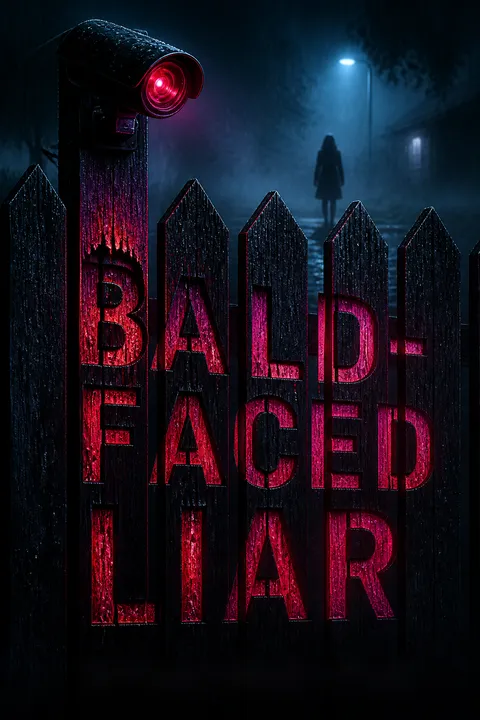


Plot Summary
Lives Through Other Windows
In Santa Cruz, Elizabeth May keeps herself safely unremarkable by collecting other people’s stories through rental cameras, social media, and casual conversation. While spying on vacationing mother Julia, she catches a hint of a strained friendship and searches Julia’s public posts for clues.
Elizabeth’s own life is divided among borrowed names and invented details: she works remotely as a clinical documentation specialist but tells a new acquaintance, environmental chemist Mike, that she is an accountant.
After she helps Mike find his rental, they share dinner, drinks, and a night together. When he reveals he will live nearby for six months, Elizabeth panics at the prospect of continued contact and ushers him out, convinced a temporary fling is safer than being known.
A Name Used Against Her
Elizabeth’s boss, Chen, summons her after receiving screenshots of a Reddit account that appears to use Elizabeth’s name and image to insult their hospital. Elizabeth recognizes the avatar but spots a crucial difference in the username, an extra underscore that proves the account is not hers.
Chen remains wary, and the incident threatens the professional security Elizabeth has built through careful anonymity. At home, Elizabeth messages Tristan, an online nursing friend, who offers to contact the impostor; the account soon disappears.
But the episode leaves her wondering who could connect her online persona to her real life. A separate disturbance deepens her unease when an angry man pounds on her door demanding money from her landlord, Grigore.
The Devil Girl Returns
At a supermarket, Elizabeth finds a small devil doll hidden among her groceries. Its resemblance to the childhood nickname that followed her from Iowa makes the object feel less like a prank than a message.
She searches the history of the Hoffholder daycare case: when Elizabeth was five, older girl Lauren Jensen enlisted her in repeating stories begun by thirteen-year-old Jacob Hoffholder, including claims of Satanic abuse. Authorities pressed the children for details, and Linda and Mitchell Hoffholder were convicted before Lauren and Elizabeth recanted two years later.
Elizabeth remembers being celebrated, then shunned as a liar. The doll forces her to consider that someone knows this history and has deliberately reached through the protective distance she has spent adulthood constructing.
A Hand in Traffic
That night, while crossing a crowded street near the boardwalk, Elizabeth feels someone drive her into traffic. A red car brakes inches from her head, leaving her with scraped hands and knees but alive. The officer she flags down doubts that anyone pushed her and treats her as an agitated drinker.
Mike, who had been eating nearby, offers to walk her home. Elizabeth initially suspects him because his sudden appearances coincide with the harassment, but his calendar confirms he was elsewhere when the shove happened.
She admits that someone has sent disturbing mail and impersonated her online, though she still hides the childhood case. Mike stays with her until she feels safe, and his practical kindness unsettles her belief that closeness can only end in danger.
Proof, Then Paper Faces
Elizabeth persuades a sushi-shop owner to review his security footage. The recording shows a masked, broad-shouldered person following her before the shove, then turning away into the crowd; Mike appears afterward, clearing him of the attack.
Elizabeth also finds Lauren’s obituary and notices comments suggesting regret and unanswered questions, but she cannot tell what happened to her old acquaintance. Soon, flyers bearing Elizabeth’s photograph, phone number, and reputation as a liar appear around town.
She tears them down until Beret, a silent regular from a neighborhood bar, joins her. The public exposure turns her private shame into street furniture. As strangers begin contacting her, Elizabeth sees that the attacker is not merely threatening her safety; he is making her own history the instrument of the attack.
Violet Hears the Truth
At a community noticeboard, Elizabeth is removing another flyer when Violet, her favorite librarian, recognizes her distress and takes her for coffee. Elizabeth finally explains that, as a five-year-old, she helped send daycare owners to prison with false stories shaped by older children and leading adult interviews.
Violet does not treat her as a monster; she focuses on how a child was made responsible for an adult failure. Together they identify Jacob, the boy whose claims started the case, as a possible source of the harassment.
Elizabeth later tells Mike the fuller story, including the humiliations, examinations, and years of being called Devil Girl. He listens without dismissing her. For Elizabeth, the consequences are immediate: she has let two people see more than the safe, invented fragments she usually offers.
The Police Turn on Her
When Elizabeth discovers her bedroom has been tidied while she was out, she calls the police, certain an intruder has entered. Officers find no one and question whether the room was ever disturbed. Detective Heissen arrives, hears about the traffic assault, the flyers, and the strange mail, then produces a Liars Anonymous brochure and asks whether Elizabeth is lying again.
He knows of her childhood testimony and frames her reports as an attention-seeking fabrication, threatening consequences for false complaints. Elizabeth’s old terror returns: once again, an authority figure has decided her history is more credible than her present account.
She starts checking her own memories and records, afraid she has manufactured the danger. Mike’s childhood photo and steady messages help her resist that collapse, but her trust in official protection is nearly gone.
A Friend in the Walls
Elizabeth studies Lauren’s social media and discovers that, shortly before her death, Lauren had sought a lawyer or private investigator and posted safety advice for real estate agents. Mike notices a comment on Lauren’s obituary from Audrey Echols and urges Elizabeth to contact her.
Meanwhile, Elizabeth admits to Mike that she uses several names and invented careers to keep different acquaintances apart; the disclosure strains their fragile connection, though he continues trying to help.
Grigore responds to the danger more decisively than the police: he changes Elizabeth’s entry codes and gives her two Tasers. She installs cameras at her doors and asks online contacts for clues. Her defenses are practical, but they also mark a shift from watching life through screens to preparing to confront whoever is watching her.
Lauren Was Not Alone
Audrey tells Elizabeth that Lauren had described unexplained intrusions, missing or displaced belongings, and police who blamed her for being careless. Two weeks before Lauren died, someone hooded and tied her in a vacant house; authorities concluded she had staged the incident because she could free herself and had no visible injuries.
Elizabeth recognizes the pattern in her own experience and understands that Lauren’s death may not have been a simple suicide. Violet later spots a man in dark clothes leaving the library after Elizabeth, then sees him drive away in an old black pickup.
Searching for Jacob, Elizabeth finds a recent photograph of him and realizes the man in the picture is not Mike or Tristan. She has a suspect’s face at last, but still does not know who is truly following her.
The Ghost Upstairs
After receiving a digitally altered image of Lauren and another threat, Elizabeth stays inside, checking her cameras and trying to sleep. A man suddenly stands between her and the television.
He pins her down, forces pills into her mouth, gags her, and binds her with a blanket and bedsheet, arranging the scene to resemble a distressed woman’s self-inflicted crisis. As the sedative blurs her thoughts, she recognizes his voice: the person she knows as Tristan, her long-distance nursing friend, has been deceiving her.
He explains that he has spent months learning about her and has now reached her home. Elizabeth had suspected Jacob, but the man in front of her is not Jacob. He identifies himself as Noah, Jacob’s older brother, and begins explaining why he has targeted her and Lauren.
Noah’s Debt Comes Due
Noah says Jacob invented the Satanic accusations to escape their father’s sexual abuse, then suffered further violence after the case collapsed and he returned home. Noah admits he failed to protect his brother and blames Lauren and Elizabeth for helping send Jacob back; he also reveals that he killed Lauren and staged her death as suicide.
He intends to make Elizabeth appear to have done the same. While Noah cuts her arm to create evidence, Elizabeth recognizes that he has been living above her, entering through a concealed stairway behind an armoire.
She reaches the Taser Grigore gave her, shocks Noah, and frees herself from the bindings. When Noah rises again and threatens the shelter dog Cocoa, Elizabeth drives her ceramic kitchen knife into his neck. Noah dies before he can stage her death.
A Body Beneath the Water
Elizabeth discovers a hidden camera and Noah’s disguise in the upstairs rental, then calls Grigore instead of the police. Grigore and his associate Luca remove the body, erase camera evidence, and take Noah’s belongings.
On a boat off Moss Landing, Elizabeth helps dispose of the body and the knife, sickened by the act but convinced the police would turn her history against her. When Detective Heissen later reports that a local informant linked a blond man to the power cut, Elizabeth denies knowing anyone from Iowa and sends him away.
Grigore’s people clean her home. Elizabeth receives kind messages from Violet and a photograph of Mike with Cocoa, but assumes she must leave Santa Cruz. She has survived Noah, yet the cover-up binds her to a secret that may outlast the immediate danger.
Epilogue
A month later, Elizabeth has tried to move away but cannot bring herself to leave Santa Cruz. She rents a new studio, adopts a more honest approach to meeting people, and begins therapy, telling her therapist about the lies she uses for protection but not about Noah’s death.
Mike remains in her life, and the two visit Violet, who has adopted Chompers, the frightened little dog Elizabeth once helped coax out of his kennel. Elizabeth agrees to spend a year providing basic medical care for Grigore’s associates in return for his help. Her future remains shadowed by the secret she buried at sea, but she chooses to build a life rooted in one place rather than keep vanishing.
The closing month does not erase Elizabeth’s crime or magically cure the habits that grew from childhood shame. Instead, it gives her a narrower, more credible form of change: she begins therapy, practices pausing before she lies, and lets a few relationships cross the boundaries she once kept absolute. Her decision to stay in Santa Cruz matters because the town is no longer merely a stage for observing strangers. It contains people who have noticed her absence, offered help, and welcomed her back. Yet the ending refuses complete moral closure. Her private bargain with Grigore and concealment of Noah’s death mean her new intimacy rests beside a secret, not beyond it. Recovery here is an imperfect practice, not a clean slate.
Analysis
Bald-Faced Liar makes credibility a physical danger. Elizabeth’s childhood testimony was shaped by adults who wanted a coherent Satanic conspiracy, and the later correction did not restore her standing. Instead, her community converted a child’s false account into a permanent identity: liar, spectacle, warning. As an adult, she turns that imposed label into a tool of her own, inventing names and backgrounds so she can choose what others see. The strategy gives her agency, but only at the cost of dividing connection into sealed compartments.
The novel’s suspense depends on the painful overlap between an actual threat and a history that makes Elizabeth expect disbelief. Her fear is not proof of every suspicion: she wrongly suspects Mike, mistakes ordinary sounds for intrusion, and struggles to trust her own interpretation. But the police use that uncertainty to dismiss evidence rather than investigate it. The parallel with Lauren’s experience sharpens the critique. A person may be mistaken, frightened, or difficult to read and still deserve serious protection. Credibility should not be a prize awarded only to calm, consistent witnesses.
Noah’s motive complicates the childhood case without excusing his choices. Jacob’s Satanic story was false, but, according to Noah, it concealed real abuse by their father. The adults who pursued an occult narrative failed to ask what danger the boy might actually be escaping. Noah later repeats that failure in reverse: he turns grief and guilt into a private theory of justice, then punishes Lauren and Elizabeth rather than confronting the family history that shaped him. His violence is an attempt to make suffering visible, yet it reproduces the same coercion and silencing he claims to avenge.
Elizabeth’s eventual movement toward therapy, honesty, and sustained relationships is deliberately incomplete. She survives through violence and conceals a killing with Grigore’s help, so the ending offers no clean moral reset. What changes is her willingness to remain in a community and risk being known in measured ways. The book’s strongest distinction is between privacy, which can protect a person, and secrecy, which can keep old shame in command.
Review Summary
Bald-Faced Liar by Victoria Helen Stone receives mixed reviews averaging 3.77 stars. Many praise the complex, unreliable protagonist Elizabeth May, a traveling nurse hiding from a traumatic childhood tied to Satanic Panic false accusations. Readers appreciated the psychological depth, dark humor, Santa Cruz setting, and stalker-driven suspense. The audiobook narration by Soneela Nankani earned particular acclaim. However, critics found the pacing slow, the premise flawed, twists predictable, and some questioned the believability of a five-year-old facing such severe consequences, leading to divisive reactions.
People Also Read





Characters
Elizabeth May
The practiced shape-shifterElizabeth, often called Beth, Eliza, Liz, or another name she selects, is a former traveling nurse who now works remotely in clinical documentation. She is observant, funny, and unusually skilled at reading strangers, partly because she has spent years studying them from the safety of temporary relationships. Her habit of inventing details about her background gives her a quick route into social connection while preventing anyone from reaching the person she fears they would reject. Beneath the playfulness is a childhood shaped by public accusation, adult pressure, and lasting humiliation. Elizabeth wants both privacy and companionship, but treats those desires as incompatible. Her central struggle is learning to distinguish self-protection from the isolation that keeps her trapped.
Mike Brocus
The patient scientistMike is an environmental chemist in Santa Cruz for a coastal monitoring project. Awkward, considerate, and more emotionally perceptive than Elizabeth initially expects, he meets her after she helps him locate his rental. He is divorced, remains close to his ex-wife, and misses the dog they once shared. Mike asks direct questions and offers practical help, but does not demand instant access to Elizabeth’s private life. His steadiness challenges her expectation that intimacy must become either a trap or a brief performance. He is attracted to her wit and energy, yet must decide how much uncertainty he can accept in a new relationship.
Noah Hoffholder
The overlooked older brotherNoah is the eldest son in the Hoffholder family, older than Jacob and largely outside Elizabeth’s childhood memories. The family’s case and its consequences shape the life he builds after the scandal. His story is tied to questions of loyalty, responsibility, and what a sibling owes another when adults fail to intervene. As a character, he represents the family members who remain just beyond the public record, carrying experiences that the courtroom never fully examined.
Jacob Hoffholder
The troubled daycare boyJacob was thirteen when his claims about abuse at his parents’ daycare helped ignite the Hoffholder case. Elizabeth remembers him as withdrawn, angry, and rarely present among the younger children. His role in the scandal is bound up with a family under strain and with a community eager to believe a terrifying story. As a boy, he had little power over how adults interpreted his behavior or the accusations surrounding him. His history makes him central to Elizabeth’s understanding of the case, even though she barely knew him.
Lauren Jensen
The first witnessLauren was eleven when she worked at the Hoffholder daycare and became the first child to make accusations against its owners. Bright, sociable, and older than Elizabeth, she became an object of the younger girl’s admiration. Lauren’s influence helped shape Elizabeth’s early account, while her later recantation helped overturn the convictions. As an adult, she built a successful life and remained connected to people who remembered her as energetic and generous. Her story shows how the same person can be both a child in need of protection and a decisive witness in events far beyond her control.
Violet
The compassionate librarianViolet is Elizabeth’s favorite librarian, an attentive community presence who notices when Elizabeth is frightened and overwhelmed. She responds to the public flyers as harassment rather than proof of guilt, then listens as Elizabeth describes the childhood case. Violet is direct, protective, and willing to follow up when she sees a suspicious man. Her willingness to offer coffee, a hug, and practical help contrasts with the official indifference Elizabeth encounters. She does not solve the danger, but she gives Elizabeth evidence that being seen need not always mean being judged.
Grigore
The protective landlordGrigore owns the Santa Cruz properties where Elizabeth lives and rents rooms to visitors. She once helped care for his mother, Doina, and he considers her part of his family. Hulking, guarded, and involved in opaque business, he offers a starkly different kind of protection from the authorities: he changes Elizabeth’s locks, supplies Tasers, and moves quickly when she asks for help. His loyalty is sincere but comes with obligations and compromises. Through Grigore, the novel complicates the idea that safety always comes from respectable institutions.
Tristan
The distant nursing friendTristan is Elizabeth’s online nursing contact, a fellow professional she meets through a work forum. Their shared Midwestern backgrounds and difficult family histories make it easy for them to confide in each other by message. He offers advice, checks on her during crises, and becomes a rare source of companionship at a distance. Because their relationship grows without ordinary face-to-face contact, Elizabeth can experience it as safer than friendship in her daily life. His place in her world depends on that separation.
Audrey Echols
Lauren’s grieving friendAudrey knew Lauren as an adult and carries painful regret about dismissing her reports of danger. When Elizabeth contacts her, Audrey shares what Lauren said about intrusions, police disbelief, and being restrained in a vacant house. Audrey’s account gives Elizabeth a second perspective on Lauren’s final months and helps connect two women’s experiences across decades. She is not an investigator, but her willingness to acknowledge what she once doubted becomes essential evidence.
Hilda
The welcoming booksellerHilda owns a bookstore where Elizabeth feels at ease among books, readings, and casual conversation. She encourages Elizabeth’s imagined writing ambitions and welcomes her warmly, unaware of how many details Elizabeth has invented. Hilda represents a kind of ordinary community Elizabeth enjoys but rarely trusts herself to join.
Detective Heissen
The skeptical investigatorHeissen is the detective who reviews Elizabeth’s reports after the harassment escalates. He treats her childhood testimony as a reason to doubt her present account and raises the possibility that she is fabricating the danger. His role brings Elizabeth’s old experience with authorities into the current crisis, where disbelief has consequences beyond humiliation.
Mr. Sanchez
The watchful neighborMr. Sanchez lives across the street with his young grandson, Roberto. Elizabeth enjoys their neighborly exchanges and admires his warmth with the child. He is part of the familiar Santa Cruz life Elizabeth has gradually come to value, and his observations later affect how the police view her.
Cocoa
The exuberant shelter dogCocoa is a chocolate Labrador at the local shelter whom Elizabeth regularly walks. She loves people, squirrels, and chasing bicycles, though her manners are unreliable. Elizabeth’s affection for her gives the shelter visits a familiar rhythm and makes the dog a vivid measure of what she has begun to care about beyond her private routines.
Plot Devices
Borrowed identities
A portable social shieldElizabeth uses variations of her name and invented histories to create quick connections while keeping acquaintances from comparing notes. The practice allows her to control what each person believes they know, but it also prevents her from being fully present in any relationship. When separate parts of her life begin to collide, her aliases stop functioning as harmless compartmentalization and become a source of exposure and mistrust.
Rental security cameras
Watching becomes evidenceElizabeth’s habit of monitoring rental cameras begins as a way to collect other people’s stories without entering their lives. The devices give her a substitute for intimacy and an illusion of control. Later, surveillance footage helps establish that Mike did not shove her, while new cameras offer some protection at home. Their limits matter too: the angles miss the attacker’s face, and hidden surveillance becomes part of the intruder’s method.
The Hoffholder case
A childhood story reopensThe 1991 daycare scandal gives Elizabeth’s present harassment its history and its emotional force. As a child, she repeated claims shaped by Jacob and amplified by leading adult interviews; the resulting convictions and later recantations left her carrying guilt and public shame. The case also establishes the crucial conflict between a child’s testimony and adults’ duty to investigate carefully. Its unresolved family consequences make the past a live threat rather than a closed chapter.
The hidden stairway
A secret route into homeA concealed internal staircase sits behind an armoire, unnoticed by Elizabeth because she assumes the old building’s locked interior door is an owner’s closet. It gives the intruder access between the upstairs rental and Elizabeth’s home without forcing a window or front door. The discovery explains how someone could enter, rearrange her room, and watch her while avoiding the exterior cameras. The architecture turns her safest space into a place she had never truly controlled.
The pocket Taser
A defense she can reachAfter Elizabeth explains her danger to Grigore, he provides two compact Tasers and changes her entry codes. She places one near the couch and carries the other in her pocket. During the attack, the weapon gives her a brief opening to escape Noah’s restraint, but it does not end the struggle. Its payoff depends on her earlier decision to accept practical help from someone outside the institutions she distrusts.
Download PDF
Download EPUB
.epub digital book format is ideal for reading ebooks on phones, tablets, and e-readers.








