

Key Takeaways
Treat kitchens, military bases, and factories as sites of international politics
Start where power hides. Enloe argues that international politics cannot be understood by studying only presidents, armies, and treaties. It also takes shape in hotel rooms, plantations, households, and government offices. Her method, which she calls feminist curiosity, asks where women are, how they got there, who benefits, and what they think about their situation. A low-status secretary, for example, may reveal how secrecy and record-keeping shape a high-level negotiation. A tourist’s holiday choice can affect another country’s income and the work available to local women.
Follow the connections. The point is not that every personal choice carries the same political weight. It is that supposedly private life is connected to public decisions through work, law, money, and gender expectations. Tracing those links makes familiar explanations more complete.
What's striking is the shift from adding overlooked women to changing the map of what counts as evidence. This resembles standpoint approaches in social inquiry: people closest to routine work may see how an institution operates in practice, even when they lack formal authority. The method also guards against treating policy as abstract intention, detached from its effects. Its challenge is scale. Not every domestic choice is equally consequential, so a strong analysis must trace the actual links between intimate life and institutions rather than assume them.
Question who gains when gendered arrangements are disguised as nature
Natural is often made. Enloe asks readers to investigate claims that women are naturally suited to cleaning, sewing, caregiving, or providing emotional support. These assumptions help organize low-paid jobs, unpaid work, and political exclusion, but they are sustained by decisions, not biology. Employers can classify sewing as unskilled while paying men more for cutting or operating specialized equipment. Governments and media can portray women as victims, symbols, or loyal wives rather than as analysts and organizers.
Look for the beneficiaries. Enloe rejects a simple split between helpless victims and fully empowered actors. Women with little room to maneuver still assess risks, make choices, and sometimes organize collectively. That agency does not erase the unequal power constraining their choices. It makes the constraints, and those benefiting from them, easier to see.
The useful question is not only whether a custom is old, but what work it performs now. That move resembles institutional analysis, which treats rules and classifications as mechanisms that distribute resources and authority. Calling a job unskilled, for example, can make a wage hierarchy appear objective. The approach is especially strong when it identifies who can revise the classification and who cannot. A caution follows: exposing construction does not mean every difference is invented or easily changed. Material conditions and individual preferences still matter.
National independence can arrive without women's political equality
Unity has a price. Nationalist movements can give women a larger public identity and new opportunities to organize. They can also cast women as emblems of national purity, reproducers of the nation, or supporters of male leaders, rather than as political participants. After Algeria won independence, feminist Marie-Aimée Hélie-Lucas described a government that restricted women even though women had taken part in the anticolonial struggle.
Beware the postponed promise. Women activists are often told that equality can wait until the nation is secure. Enloe argues that this delay can entrench male authority: men gain leadership experience and prestige during the struggle, while women are assigned support roles. Yet nationalism is not uniform. Some movements embrace ethnic and religious diversity; others define a narrower, supposedly purer national community. Women must navigate both versions, often while building alliances across differences.
This analysis complicates the familiar story in which liberation from foreign rule naturally produces freedom at home. It also shows why critics inside a nationalist movement face a distinct dilemma: dissent can be branded disloyal, even when it exposes who is excluded from the promised community. The argument is persuasive without requiring nationalism to be treated as inherently oppressive. Collective identity can enable resistance, but its inclusiveness depends on who gets to define the nation and whether equality is part of the struggle's present agenda.
Tourism exports more than scenery: it exports gendered service and sexuality
Pleasure has infrastructure. Tourism brings foreign currency and employment, but it also depends on workers who make travel comfortable. In the early 1980s, women made up 75 percent of tourism workers in Barbados and Jamaica. Globally, women held 90 percent of the lowest-rung tourism jobs cited in the book, including cleaning and serving. These jobs were often low-paid and insecure, while governments relied on tourism as a development strategy.
Safety is political. After the 2012 gang rape and murder of a young woman in India, foreign tourist arrivals fell, with an especially steep decline among women. Businesses and officials responded with women-only tours, emergency phones, and other reassurances. The episode exposed a troubling double standard: local women's long-standing demands for safety had received less international attention than the threat to tourism revenue. Tourism can create opportunities, but its benefits and risks are unevenly distributed.
Tourism makes the connection between reputation and livelihood unusually visible. A destination is not merely scenery; it is a managed service economy shaped by transport, labor conditions, public safety, and visitors' expectations. This framing also clarifies why an industry's growth statistics cannot tell whether workers gain security or bargaining power. The hard question is who gets to define a safe destination. Protecting visitors while ignoring residents' safety would reproduce the inequality that tourism marketing tries to conceal.
Military bases depend on women's labor, sexual economies, and silence
A base is a social system. Its operation can depend on women soldiers, military wives, civilian cleaners, workers in nearby entertainment businesses, and women who organize against the base. Their positions are not identical, and military policies can keep them separate. In the Philippines, women activists documented the labor and sexual economy around Subic Bay, including compulsory health examinations for local entertainers that male soldiers did not face. A Filipino-led antibases movement helped end the agreement, and the base closed in 1992.
Security has a constituency. A base may provide jobs and income to local residents while also limiting sovereignty or creating insecurity. Enloe asks whose priorities define a base as secure and whose experiences are excluded from that judgment. Sexual assault within militaries, the treatment of civilian women nearby, and the unpaid work of military wives belong in that assessment.
The base analysis expands security beyond weapons and borders to the relationships that make military life sustainable. It highlights a basic problem in institutional accountability: the chain of command can be both the organization under scrutiny and the authority expected to investigate harm. The Subic Bay case also shows that local support and opposition need not divide neatly by gender or class. Economic dependence may coexist with political objection, so an adequate account must ask who receives benefits, who bears costs, and who can speak safely.
A banana's cheerful sticker conceals a racialized global labor system
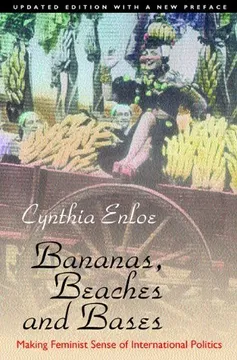
Follow the fruit. Carmen Miranda's Hollywood image helped make a stylized Latin American femininity familiar to American audiences. United Fruit then created Chiquita Banana, a cheerful female cartoon that made a corporation seem like a friendly intermediary between consumers and fruit. Behind the brand were plantations, shipping networks, and political alliances between foreign companies and local elites. The commercial presentation made the banana appear natural and uncomplicated.
Count who does what. Most plantation jobs were assigned to men, while women often supplied unpaid farm and household labor that kept male workers available for plantation employment. Women were also concentrated in packinghouses, where they washed pesticide residue from fruit, sorted rejects, and packed shipments. Enloe reports that supermarkets captured 34 cents of each retail dollar spent on bananas, while producers and workers together received five cents. A sticker cannot show that distribution.
The banana is a compact lesson in how branding can shorten a supply chain in the consumer's imagination while lengthening it in reality. Product labels can identify origin or company, but they rarely reveal who performed each task, who controlled the land, or how revenue was divided. This is a useful bridge between cultural analysis and political economy: an image can organize desire while obscuring production. The comparison also warns against assuming that a fair-trade label, by itself, answers questions about gender, land ownership, or decision-making.
Cheap fashion is engineered through women's labor and elite political alliances
Low wages take work. The Tazreen factory fire in Bangladesh killed 112 workers, and the Rana Plaza collapse killed more than 1,100. These disasters were not simply failures of individual managers. Global brands sought low production costs and tight deadlines, while local factory owners relied on political connections and weak enforcement. In Bangladesh, women made up 85 percent of garment workers in 2002, after employers increasingly recruited young women from rural areas.
Skill gets discounted. Sewing was often treated as natural women's work, while cutting, pressing, and machinery operation were more readily classified as skilled and better paid. This division helped make labor costs appear inevitable. Yet the job's low status depended on choices about training, pay, subcontracting, and enforcement. When workers organize, the supposedly natural arrangement becomes visibly political. Global monitoring schemes may promise oversight, but their reliability is limited when inspectors depend financially on the companies they assess.
The account links factory-floor danger to a wider architecture of incentives: rapid production, subcontracting, weak inspection, and consumer demand for low prices. It is a stronger explanation than blaming a single negligent owner because responsibility is distributed across firms and regulators. It also clarifies why labor standards cannot be reduced to technical checklists. Fire exits matter, but workers need the power to report hazards without retaliation. A further tension is that brands can respond to scandal by moving production elsewhere, shifting the risk rather than repairing the system.
Domestic work is international labor, even inside private homes
The home can be a workplace. The book reports 53 million domestic workers worldwide, 83 percent of them women. Many are migrants whose remittances support families and national economies. Filipina Theresa Dantes traveled to Qatar under a contract promising $400 a month, but her employer paid less, required seven-day workweeks, and refused to let her quit. Her story shows how immigration rules can give an employer control over a worker's movement and job.
Care crosses borders. Middle-class households gain time for paid work because other women provide cleaning, childcare, and elder care, while those workers may leave their own families behind. Enloe calls the combination of paid employment and continuing unpaid household responsibilities the double day. Organizing domestic workers helped produce ILO Convention 189, which recognizes them as workers and sets out rights including rest, organizing, and control of their identity documents.
Domestic work makes visible a dependency that is often hidden by the language of family help or private arrangements. The worker's isolation is not incidental: a home has no factory gate where colleagues can gather at the end of a shift. Convention 189 demonstrates how workers can turn that invisibility into an international labor issue. Still, a treaty is not the same as enforcement. Rights depend on domestic law, accessible complaints processes, and workers' ability to challenge employers without risking their housing or immigration status.
Turn workplace knowledge into organized leverage without flattening women's differences
Experience can travel. Women banana workers called themselves bananeras and organized for a voice inside male-led unions. Their discussions connected pesticide exposure and low pay to household labor and domestic violence. Domestic workers built alliances across countries, while feminist advocates from several organizations helped secure a binding gender-based-violence criterion in the 2013 Arms Trade Treaty. In each case, women used knowledge from daily life to reshape what unions or international negotiators considered a political issue.
Coalitions need care. Women do not share identical interests. Class, race, nationality, sexuality, and immigration status can divide them, and a coalition led by more privileged women can silence the people it claims to represent. Enloe's examples favor organizing that creates space for disagreement, local leadership, and practical accountability. Visibility matters, but durable influence comes when those affected can set priorities and press institutions to act.
The cases show that expertise is not confined to professional policy circles. Workers can identify patterns that aggregate trade or security data miss, then translate that insight into union demands or treaty language. This is a model of knowledge production as political organizing, not simply consultation. The emphasis on difference is crucial: solidarity is an achievement, not a natural feeling among women. Its strength depends on who controls agendas, resources, and representation, and whether those most exposed to harm retain authority within the alliance.
Analysis
The book's central intervention is methodological as much as political. It does not merely ask international-relations experts to add women to an existing cast of decision-makers. It challenges the boundaries that make diplomacy, security, and trade appear separate from housework, sexuality, tourism, and employment. Once those boundaries are questioned, a secretary's record-keeping, a military wife's unpaid labor, or a garment worker's migration can become evidence about how states and markets function.
Its case-based structure makes this claim tangible. The reader moves from tourist economies and nationalist movements to military bases, bananas, clothing, and domestic work. Each setting reveals a different mechanism: women as symbols, workers, consumers, caregivers, or organizers. The recurring question about who benefits from particular gender arrangements gives the cases coherence without making them identical. The book's strongest analytic move is to treat familiar categories such as natural, private, and unskilled as political outcomes that need explanation.
That approach also demands careful distinctions. Women's experiences are shaped by class, race, nationality, and legal status, so visibility alone cannot produce a shared political interest. Enloe's examples repeatedly show both constrained agency and real organizing power. Her argument is most useful when read as a guide to investigate specific relationships, not as a claim that gender explains every outcome by itself. The cases are historically situated, and the statistics belong to the period covered by this edition. The durable contribution is the investigatory habit: identify routine arrangements, trace who maintains them, locate who gains, and listen to those whose knowledge conventional accounts exclude. In this sense, the book reframes international politics as a system reproduced through everyday labor and contested through everyday acts of analysis and organization.
Review Summary
Bananas, Beaches and Bases is widely regarded as a foundational feminist international relations text, praised for its accessibility and insight into how gender dynamics underpin global politics. Readers appreciate Enloe's central question — "where are the women?" — and her examination of tourism, military bases, and trade through a feminist lens. Some critics find the book repetitive, occasionally simplistic, or lacking in prescriptive solutions. Despite being originally published in 1989, most reviewers consider its core arguments remarkably relevant today, recommending it to students and general readers alike.
People Also Read

Glossary
feminist curiosity
gender-focused investigationA method of inquiry that asks where women are in a political or economic process, how they came to occupy those positions, who benefits, and what women themselves think and do. It also investigates how ideas about femininity and masculinity shape power, including in settings usually dismissed as private or unimportant.
masculinized rivalry
contests over manlinessA political contest in which different forms of masculinity are ranked against one another, with some treated as stronger, more rational, or more modern than others. These contests can marginalize women and use femininity as an insult or sign of weakness, while shaping institutions such as governments, militaries, and workplaces.
double day
paid and unpaid workThe combined burden of a woman's paid employment and her unpaid responsibilities, such as housework, childcare, and caring for relatives. The term draws attention to how employment does not necessarily redistribute domestic labor. Women may finish a paid shift only to continue working at home, often with little support from employers, governments, or male partners.
plantation economy
society shaped by plantationsA political and economic arrangement in which foreign agribusiness companies dominate production and influence local society, often with support from local elites. Enloe uses the term to describe more than a crop or workplace: it includes dependency, paternalistic relationships, labor control, and gendered divisions of paid and unpaid work.
militarized masculinity
manhood centered on soldieringA form of masculinity that treats military identity and the capacity for violence, toughness, discipline, and male camaraderie as central measures of manhood. It is cultivated and rewarded through military institutions and social expectations, but its particular form varies by country, era, and military mission.
big-umbrella nation
inclusive national identityA vision of a nation that deliberately embraces ethnic, religious, and regional diversity rather than requiring cultural sameness. It contrasts with a narrower nationalist vision that treats homogeneity as the basis of national strength. The distinction matters because national policies can determine whether difference and intermarriage are treated as belonging or betrayal.
wrapped-umbrella nation
homogeneity-based national identityA narrow vision of a nation in which cultural or social sameness is treated as essential to national strength. It can place pressure on women to embody the community's purity and continuity, and can cast relationships across religious, ethnic, or linguistic boundaries as disloyalty.
bananeras
women banana-worker activistsThe name used by women working in banana plantations, especially packinghouses, who organized for labor rights and a meaningful role in their unions. Their activism connected workplace issues such as low pay and pesticide exposure with unpaid household work, gender discrimination, and women's exclusion from union leadership.
ILO Convention 189
international domestic-worker rights treatyA 2011 International Labour Organization convention recognizing domestic workers as workers entitled to labor protections. It sets out standards including the right to organize, a minimum wage, regular rest, written work agreements, and control over personal identity documents. Its practical effect depends on national ratification and enforcement.
Download PDF
Download EPUB
.epub digital book format is ideal for reading ebooks on phones, tablets, and e-readers.








