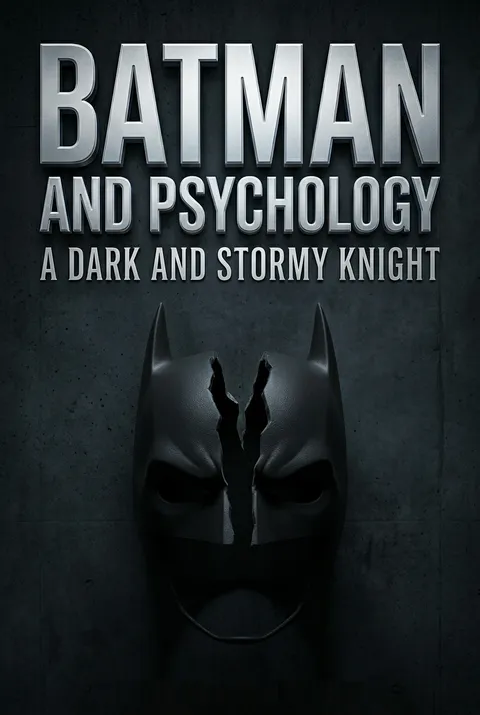


Key Takeaways
Assess Batman's functioning, not just the strangeness of his costume
Symptoms are not diagnoses. Batman revisits his parents' murder, stays guarded, and devotes his life to crime-fighting. Those traits may resemble symptoms of posttraumatic stress disorder, but a diagnosis also requires significant distress or impaired functioning. The book's conclusion is that Batman does not clearly meet the full criteria. A person can show some symptoms without having the disorder, and an unusual life mission is not itself proof of mental illness.
Context changes the judgment. Batman is disciplined, purposeful, and effective in the fictional world he inhabits. His relationships suffer, but that alone does not establish a clinical disorder. The sharper question is whether his traits disable him or help him function in a dangerous, corrupt city. The book's answer is that, for Gotham, his drive is not insanity.
What's useful here is the distinction between unusual behavior and clinically significant impairment. It resists the temptation to turn a memorable character into a checklist of symptoms. The setting matters too: conduct that looks irrational in an ordinary neighborhood may be adaptive in a city full of theatrical criminals. That does not make the cost disappear. Batman's effectiveness at work can coexist with serious limits in intimacy, trust, and rest, a reminder that competence in one domain is not a complete measure of well-being.
Turn trauma into purpose without pretending grief follows five neat stages
Loss rewrites a child's world. Bruce sees his parents murdered, then builds a lifelong mission around that loss. Children bereaved by homicide can face fear, nightmares, anger, and practical upheaval as well as grief. The book cautions against treating the familiar five-stage grief model as universal: people may skip stages, move back and forth, or grieve in entirely different ways.
Meaning can aid recovery. Posttraumatic growth means positive change associated with working through trauma, not erasing or celebrating it. Bruce gives his loss a purpose; real-world examples include Candace Lightner founding Mothers Against Drunk Driving after her daughter was killed, and John Walsh advocating for missing children after his son was murdered. Resilience, the ability to adapt without lasting harm, is common, but no single response is required.
The distinction between making meaning and being cured is important. A cause can restore agency after an event that made the world feel arbitrary, but it cannot undo the loss or guarantee relief. The examples also widen the idea of heroism beyond punishment: advocacy can change conditions that expose other people to harm. Purpose should remain an option, not a demand placed on survivors. Grief that produces no public mission is no less legitimate than grief that does.
Use a mask deliberately, or the role may start using you
Roles change behavior. A mask protects Bruce's identity, but it also helps him become Batman. The book uses deindividuation to describe reduced awareness of oneself as an individual, which can weaken inhibition and increase responsiveness to the situation or costume. In experiments discussed in the book, anonymous participants dressed like aggressors acted more aggressively, while those in nurse uniforms acted less aggressively.
Identity still needs a home. Batman's role can sharpen his attention and make painful feelings easier to set aside, but reduced self-monitoring may also make it harder to notice when force goes too far. Bruce's public playboy identity is another performance. Alfred and Robin help keep the man connected to people, rather than letting the mission become his only remaining self.
A role is not necessarily a lie. Uniforms, professional titles, and online personas can organize attention and make certain actions feel natural. The key question is whether the role remains accountable to a broader identity. Batman's costume is powerful because it permits action, but the same permission can narrow moral attention. The example encourages a practical check: after stepping into a role, can the person still explain and own what that role made easier to do?
Fear can interrupt crime, but it cannot reliably teach conscience
Fear changes immediate choices. Batman uses his appearance and reputation to frighten criminals. Fear can disrupt a person's ability to act, deter some offenses, or prompt someone to flee. It can also backfire: once a criminal believes there is little chance of being caught, fear loses force, and a threat alone does not teach why crime is wrong or what to do instead.
Pressure can corrupt evidence. The book distinguishes intimidation from reliable information gathering. People under extreme pressure may say whatever seems likely to stop the immediate threat, including false answers. It notes that lie detectors measure stress, not lies, and that torture is a poor way to obtain accurate information. The Joker even points out that Batman's violence in an interrogation room cannot make unknown facts appear.
The distinction between compliance and learning travels well beyond Gotham. A person who stops an action to avoid punishment has not necessarily changed the belief behind it. Fear may be useful in an emergency, but treating it as a durable education strategy mistakes silence for understanding. The information problem is equally serious: coercion can produce a statement while making its truth harder to judge. Any system that values accuracy and legitimacy needs methods that do more than make the subject afraid.
A bizarre crime is not proof of psychosis or legal insanity
Law and diagnosis differ. Legal insanity is a standard for deciding whether a defendant understood the nature or wrongfulness of an act because of mental illness. It is not a diagnosis, and strange or cruel behavior does not automatically satisfy it. A person may be psychotic, meaning seriously disconnected from reality, yet still understand that an act is wrong.
Villains are not one category. Psychopathy describes traits such as lack of empathy and remorse. Antisocial personality disorder is diagnosed chiefly through a persistent pattern of violating others' rights and social rules. These concepts overlap, but they are not interchangeable. The Joker's crimes are bizarre, yet he often plans, adapts, and understands his surroundings. Arkham's repeated escapes and mistreatment make it a failure of care, not a realistic model of psychiatric treatment.
This distinction matters because popular stories often use mental illness as shorthand for danger. Separating symptoms, personality traits, criminal behavior, and legal responsibility makes room for more accurate accounts of both harm and suffering. It also prevents a false choice between compassion and accountability. A person can need treatment and still be responsible for what happened; another can commit shocking acts without losing contact with reality. Fiction can dramatize madness, but clinical labels should not serve as dramatic decoration.
Robin makes Batman more human by giving his mission someone to protect
The partner solves a story problem. Batman's co-creator Bill Finger wanted a Watson, someone for the silent detective to talk to. Robin gave readers a younger character to identify with, brightened the stories, and let Batman reveal more of himself without explaining every thought.
The partnership also repairs a loss. Dick Grayson watches his acrobat parents die, as Bruce watched his own parents die. Batman takes him in, helps him bring their killer to justice, and gives him guidance Bruce never had. A partner can offer another perspective, watch Batman's back, and make him more careful. After Jason Todd dies, Batman becomes angrier and more reckless; Tim Drake's arrival helps draw him back toward steadier judgment. Robin is not just an extra pair of hands. The relationship gives Batman a chance to care for a child rather than only fight criminals.
The sidekick works on two levels at once. In the plot, Robin is a practical partner; in the emotional structure, he makes Batman's private wound visible and gives it a human consequence. That combination helps explain why the partnership lasts despite its implausibility as crime-fighting practice. The risk is also real within the story: a mentor's good intentions do not erase the danger imposed on a young recruit. The strongest version of the relationship treats protection and guidance as responsibilities, not excuses for involving children in violence.
Batman’s no-kill rule keeps grief from turning him into the Joker
A rule can restrain emotion. Batman's parents' killer escapes justice in most versions, and the Joker kills people close to him, including Jason Todd. Jason returns convinced that Batman should kill the Joker. Batman understands the temptation, but fears that crossing that line would make it impossible to return to his old limits.
Two-Face shows the opposite move. Harvey Dent uses a coin toss to assign decisions to chance. The ritual lets him avoid responsibility for actions he already wants to take. Batman's rule works differently: it makes him responsible for stopping himself, even when rage offers a persuasive excuse. His code does not end violence in Gotham, but it marks a boundary between fighting wrongdoing and becoming its mirror.
Rules are most revealing when they cost something. A moral boundary has little force when it only blocks actions the person never wanted to take. Batman's refusal to kill is difficult precisely because revenge can feel like justice, especially after grave harm. The contrast with Dent is useful: one person accepts a constraint, while another outsources choice to chance. Still, a personal code cannot substitute for fair institutions. Batman's restraint is meaningful, but it does not resolve the larger failures that leave justice to a vigilante.
Batman loves Catwoman because she understands his divided life
Similarity fuels the attraction. Selina Kyle, Catwoman, moves between crime and attempts at reform, as Bruce moves between public playboy and masked vigilante. The book argues that people generally connect through shared qualities more reliably than through the popular idea that opposites attract. Bruce and Selina understand each other's divided loyalties and guardedness in ways that more conventional partners may not.
Understanding is not intimacy. Intimacy grows through gradually sharing private information and feelings. Bruce often delays revealing that he is Batman, leaving partners to discover a secret that changes the meaning of their relationship. Selina becomes his most persistent love story, while his bond with Talia al Ghul is tangled with her father, their criminal organization, and their son. Even a strong match cannot compensate for silence.
The relationship is compelling because resemblance creates recognition without guaranteeing safety. Selina can understand why Bruce is drawn to a double life, but that shared experience does not automatically make trust easy. The difference between being understood and being known is especially useful here: partners can recognize each other's defenses and still remain isolated behind them. The story also complicates the idea that love should reform a person. A successful bond need not erase the traits that first made two people recognizable to each other.
Read each Batman as its era's myth, not a continuity error
The character keeps changing. Since his 1939 debut, Batman has appeared as a campy television hero, a gothic film figure, an animated detective, and a grounded cinematic vigilante. The versions contradict one another, but the book treats them as valid interpretations rather than one correct answer. Across them, wealthy Bruce Wayne uses a masked identity to investigate crime, protect the vulnerable, and make criminals fear him.
Stories become shared folklore. Editor Dennis O'Neil recalls readers casting a telephone vote on whether Robin Jason Todd should live. More than 10,000 calls came in, and the result became a major public event beyond the comic itself. Batman's long life depends on adaptability: writers reshape him for their moment while retaining enough of his origin and mission for audiences to recognize him.
A recurring character can function like a cultural testing ground. Each new version asks which parts of the myth still matter to its audience, whether fear, justice, class, violence, or the possibility of becoming a hero through effort. That flexibility is a source of durability, not merely a continuity nuisance. It also means no single adaptation can stand for the whole character. Reading across versions reveals the values each era places inside the cowl, as well as the enduring appeal of a mortal hero choosing his own mission.
Analysis
This book uses Batman as a bridge between popular storytelling and psychological literacy. Its most valuable method is comparative rather than diagnostic: it sets Bruce beside his enemies, partners, and the changing versions of his fictional world, then asks what concepts such as trauma, identity, fear, attachment, and moral development can clarify. The answer is rarely a tidy label. Batman may show trauma-related symptoms without meeting criteria for a disorder; the Joker may be terrifying without being psychotic; a mask may conceal identity while also creating it. That insistence on distinctions is the book's strongest safeguard against pop psychology.
The character's many continuities are both the method's advantage and its limitation. They provide a rich archive of alternative choices, but they do not form the stable biography required for confident clinical inference. The book often acknowledges this, treating a diagnosis as a test of concepts rather than a genuine assessment. Readers should carry that caution throughout: an interpretation of one Batman is not a finding about all Batmen, much less real people who resemble them.
The deeper subject is moral agency under pressure. Bruce turns grief into an intervention, but the stories repeatedly test whether intimidation can become justice, whether a secret identity can coexist with intimacy, and whether training a child is care or endangerment. His no-kill rule is a particularly clear example of a chosen limit protecting him from the emotional logic of revenge. Yet individual restraint cannot repair Gotham's institutions. The book's psychological lens makes Batman legible, while its narrative lens shows why audiences keep needing him: he embodies a wish to confront failures that ordinary systems leave unresolved. The myth endures because it keeps that wish open to revision.
Review Summary
Batman and Psychology: A Dark and Stormy Knight receives mostly positive reviews, with readers praising its blend of psychology and Batman lore. Many find it educational and entertaining, appreciating Langley's in-depth analysis of Batman's psyche and his rogues gallery. The book is commended for its accessibility to both psychology enthusiasts and comic fans. Some readers note occasional dry passages or overreliance on certain theories, but overall, it's considered a fascinating exploration of Batman's world through a psychological lens.
People Also Read


Glossary
Posttraumatic growth
Positive change after traumaPositive changes associated with working through a traumatic experience. The concept does not mean trauma is beneficial, that recovery is complete, or that everyone should find a lesson in suffering. In the book, Bruce's commitment to fighting crime illustrates how a person may create purpose from loss, while examples of activism show that meaning can take many forms.
Counterphobic behavior
Approaching a feared stimulusAction that confronts feared objects or situations rather than avoiding them. The book suggests Batman's repeated exposure to criminals and bats could function this way: instead of escaping reminders of his childhood fear, he deliberately faces them. This does not mean that relentless exposure is always healthy or that repeatedly revisiting trauma is necessary for recovery.
Deindividuation
Reduced self-awareness in groupsA state in which awareness of oneself as an individual is reduced, making a person more responsive to anonymity, group circumstances, and situational cues. The book applies this idea to masks and costumes: anonymity may lower inhibition, while the kind of role represented by a costume can shape behavior in either aggressive or nurturing directions.
Psychopathy
Callous interpersonal traitsA psychological construct centered on traits such as lack of empathy, shallow emotional responsiveness, grandiosity, manipulation, and weak concern for responsibility. It is not the same as psychosis, and it is not itself a formal diagnosis in the diagnostic manual discussed in the book. Psychopathy does not automatically mean a person is violent or criminal.
Antisocial personality disorder
Persistent rights violationsA personality disorder characterized chiefly by a persistent pattern of disregarding or violating other people's rights and social rules. Relevant behaviors include deceitfulness, aggression, impulsivity, and irresponsibility. The book contrasts this diagnosis, based largely on observable actions, with psychopathy, which places greater emphasis on interpersonal and emotional traits such as lack of empathy.
Attachment style
Pattern of seeking closenessA characteristic way of forming relationships and responding to closeness, shaped in part by early experiences with caregivers. The book describes secure and insecure patterns, including anxious, avoidant, and disorganized forms. These are broad tendencies, not fixed destinies: a person's behavior can differ across relationships and change with experience.
Hero's Journey
A pattern of heroic transformationJoseph Campbell's account of a recurring story structure in which a hero separates from an earlier life, faces trials, gains a boon or skill, and returns to serve others. The book uses Bruce Wayne's departure from Gotham, his training, and his return as Batman to illustrate the pattern, while noting that superhero origins often compress the journey.
Shadow
Hidden parts of the selfIn Jung's psychology, the Shadow is the part of the personality a person conceals from the world and may also resist recognizing in themselves. It is not necessarily evil. Batman turns feared darkness into a deliberate tool, while his enemies often exaggerate or distort qualities associated with his own aggressive, secretive life.
Persona
Social mask or roleIn Jung's psychology, the Persona is the set of roles or masks through which a person engages with the outside world. A Persona can be genuine without representing the whole self. The book applies the idea to Batman and Bruce Wayne, whose different public identities emphasize different aspects of the same person.
Triangular theory of love
Three components of loveRobert Sternberg's framework describes love through intimacy, passion, and commitment. These elements can appear in different combinations and strengths. The book uses the framework to examine why Batman's romances remain unstable: he experiences attraction, but guardedness limits intimacy, and his mission repeatedly disrupts shared life and commitment.
FAQ
What's Batman and Psychology: A Dark and Stormy Knight about?
- Exploration of Batman's psyche: The book delves into Batman's psychological aspects, examining his motivations, fears, and the impact of witnessing his parents' murder. It discusses how these experiences shape his identity and drive his quest for justice.
- Analysis of villains: Travis Langley explores the psychological profiles of Batman's rogues gallery, including characters like the Joker, Scarecrow, and Harley Quinn. Each villain's backstory and mental state are analyzed to understand their motivations and behaviors.
- Integration of psychology and comics: The book combines comic book narratives with psychological theories, making it accessible to both fans of Batman and those interested in psychology.
Why should I read Batman and Psychology: A Dark and Stormy Knight?
- Unique perspective on superheroes: This book offers a fresh take on the superhero genre by applying psychological theories to well-known characters, providing insights into how trauma and mental health issues influence behavior.
- Engaging and informative: Langley presents complex psychological concepts in an engaging manner, making them relatable through the lens of Batman's story. Readers will find both entertainment and education in the analysis of their favorite characters.
- Cultural relevance: Understanding Batman's psychological depth enhances the appreciation of his stories, connecting the character's struggles to real-world psychological issues.
What are the key takeaways of Batman and Psychology: A Dark and Stormy Knight?
- Impact of trauma: The book emphasizes how traumatic experiences, like the murder of Bruce Wayne's parents, shape his identity and drive his actions as Batman.
- Duality of identity: Langley explores the conflict between Bruce Wayne and Batman, reflecting broader themes of identity and the masks people wear in society.
- Understanding villains: Insights into the psychological motivations of Batman's enemies illustrate how their backgrounds and traumas lead them to become villains.
What are the best quotes from Batman and Psychology: A Dark and Stormy Knight and what do they mean?
- “I wear a mask...”: This quote reflects Batman's understanding of identity and the power of persona, suggesting that the mask allows him to embody the qualities he wishes to project as a hero.
- “Some men aren’t looking for anything logical...”: Attributed to the Joker, this quote highlights the chaotic nature of some villains, underscoring the idea that not all motivations are rational.
- “Why do we fall, sir?”: This quote from Alfred encapsulates the theme of resilience, suggesting that failure and hardship are essential for personal growth and development.
How does Batman and Psychology: A Dark and Stormy Knight analyze Batman's trauma?
- Witnessing parental murder: The book details how Bruce Wayne's traumatic experience of seeing his parents murdered instills a deep sense of loss and drives his mission as Batman.
- Posttraumatic stress symptoms: Langley discusses the symptoms of PTSD that Bruce may experience, such as re-experiencing the trauma and emotional numbing.
- Coping mechanisms: The book explores how Batman copes with his trauma through vigilantism, channeling his pain into a quest for justice.
What psychological theories are applied in Batman and Psychology: A Dark and Stormy Knight?
- Freudian psychoanalysis: The book references Freud's theories on trauma and personality development, particularly how early experiences shape adult behavior.
- Cognitive development: Langley applies Piaget's stages of cognitive development to understand how Bruce Wayne's thinking evolves over time.
- Behaviorism and conditioning: The author discusses how behaviorism can explain the development of phobias and criminal behavior in Batman's enemies.
How does Batman and Psychology: A Dark and Stormy Knight portray Batman's relationship with his sidekicks?
- Mentorship and growth: The book highlights Batman's role as a mentor to his sidekicks, particularly Robin, allowing Bruce to develop his own emotional intelligence.
- Parental figures: Batman's sidekicks often serve as surrogate children, reflecting his unresolved issues with his own parents.
- Conflict and independence: The book addresses the conflicts that arise as sidekicks seek independence from Batman, reflecting broader themes of growth and autonomy.
What insights does Batman and Psychology: A Dark and Stormy Knight provide about Batman's villains?
- Complex motivations: The book delves into the psychological backgrounds of Batman's villains, illustrating how their traumas and experiences shape their criminal behavior.
- Psychopathy and personality disorders: Langley discusses how many of Batman's foes exhibit traits of psychopathy and other personality disorders.
- Symbolism of fear: The villains often embody different aspects of fear, reflecting Batman's own struggles.
How does Batman and Psychology: A Dark and Stormy Knight address the theme of duality in Batman's character?
- Bruce Wayne vs. Batman: The book explores the duality between Bruce Wayne's public persona and his identity as Batman.
- Moral ambiguity: Langley discusses how Batman's actions often blur the lines between heroism and vigilantism.
- Psychological conflict: The duality of Batman's character reflects his internal struggles with trauma, guilt, and the desire for revenge.
What role does Arkham Asylum play in Batman and Psychology: A Dark and Stormy Knight?
- Symbol of failure: Arkham Asylum represents the failures of the mental health system in Gotham City.
- Home for villains: The asylum serves as a home for many of Batman's most notorious foes, illustrating the blurred lines between sanity and insanity.
- Reflection of society: Arkham's chaotic environment mirrors the larger societal issues present in Gotham City.
How does Batman and Psychology: A Dark and Stormy Knight connect Batman's story to real-world psychological issues?
- Trauma and resilience: The book draws parallels between Batman's experiences and real-world trauma, emphasizing the importance of resilience.
- Mental health awareness: By exploring the psychological profiles of Batman and his villains, the book raises awareness about mental health issues.
- Coping strategies: Langley discusses various coping strategies employed by Batman and his foes, illustrating how different individuals respond to trauma and stress.
How does Batman and Psychology: A Dark and Stormy Knight compare Batman to Hamlet?
- Themes of revenge: Both Batman and Hamlet are driven by a desire for revenge, but their approaches differ significantly.
- Psychological depth: The book highlights the psychological complexities of both characters, suggesting that their motivations stem from deep-seated emotional conflicts.
- Defense mechanisms: Langley draws parallels between the defense mechanisms used by Batman and Hamlet, revealing the different ways individuals process grief and loss.
Download PDF
Download EPUB
.epub digital book format is ideal for reading ebooks on phones, tablets, and e-readers.








