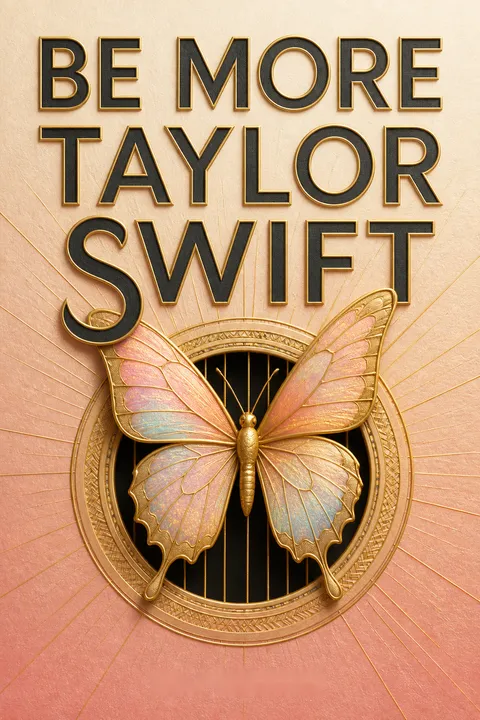


Key Takeaways
Use Taylor's example to become more unmistakably yourself
Inspiration is not imitation. The book presents Taylor Swift as a model not because readers should copy her clothes, career, or public persona, but because she makes room for her particular mix of ambition, sensitivity, humor, and creative drive. Her song Delicate reflects the relief of being accepted when a polished public image falls away. The practical question is not how to act more like a pop star, but what parts of yourself you have been editing to seem easier to like.
Make the lesson personal. The book is a fan-written guide, not an authorized account or a claim that Taylor's life offers a universal blueprint. Its central invitation is to borrow courage from her example, then define success in your own terms.
Role models can help people imagine possibilities that once felt unavailable, especially when they see someone make a career from traits others might dismiss as too sentimental or intense. But imitation can quietly become another form of self-erasure. A useful role model expands a person's sense of what is permissible, rather than supplying a script to follow. The book's strongest move is turning celebrity admiration back toward the reader's own choices. Its limit is that a star's options and resources are not everyone's, so the transferable lesson is self-definition, not the expectation of matching her outcomes.
Count friendship, solitude, and heartbreak as real forms of love
Romance is one strand. The book begins with the excitement of falling in love, but refuses to treat a partner as the only proof that someone belongs. Taylor's songs give heartbreak a place in a person's story without suggesting that pain cancels the love that came before it. Friendship matters too: the book points to the closeness between Taylor and her fans, built through shared songs, concert rituals, and personal gestures.
Single life counts. During the period when she was writing the songs that became 1989, Taylor embraced life in New York and time with friends. The point is not that everyone should prefer being single. It is that a relationship status does not determine whether life is vivid, connected, or worth celebrating.
This broader definition of love counters a familiar cultural imbalance: romantic coupling is often treated as the main plot, while friendship and solitude appear as waiting rooms. Close friendships can offer belonging, mutual care, and a sense of continuity without following a romantic script. At the same time, the book's buoyant tone should not make heartbreak sound easy to outgrow. Grief can linger, and a playlist is comfort, not a cure. The useful distinction is that loss deserves attention without being allowed to define every future relationship.
Tell people what hurt you instead of making affection a guessing game
Be explicit about needs. The book illustrates the point with an imagined birthday: someone close is late, and the hurt person considers either posting pointed messages online or silently nursing resentment. Neither option tells the other person what is wrong. The more useful move is to explain the impact and ask for what is needed, whether that means a change in behavior or an honest conversation about ending the relationship.
Skip the performance. Acting unaffected can hide the problem just as effectively as anger can. The book's advice is plain: other people cannot reliably infer what matters to you. Naming a feeling does not guarantee agreement, but it gives both people a fair chance to respond to the real issue rather than to hints.
Direct communication reduces the mind-reading burden that often turns small disappointments into elaborate stories about disrespect or indifference. It also gives the other person specific information they can act on. This resembles a basic principle in conflict resolution: describe the behavior and its effect before making a judgment about motive. Still, clarity is not a promise of repair. Some people respond poorly, and some relationships are unsafe enough that direct confrontation is unwise. The principle is not to disclose everything to everyone, but to replace avoidable ambiguity with purposeful communication where trust permits it.
Stand by friends without commandeering the choices they must make
Loyalty needs room. The book describes friendship as both dependable support and respect for another person's agency. Taylor was portrayed as patient when friends made romantic choices others might question, including spending time with a friend dating one of Taylor's former partners. The lesson is not to approve of every decision. It is to offer help without turning care into control, and to avoid the smug comfort of saying you predicted a friend's pain.
Repair matters too. The public tension between Taylor and Katy Perry seemed difficult to resolve until Perry sent a symbolic peace offering. That gesture opened a conversation and eventually a reconciliation. A sincere apology or invitation to make peace can restore a relationship, but it works only when it acknowledges harm rather than demanding instant forgiveness.
Good friendship combines two forms of respect: reliability when someone is in trouble, and humility about the fact that their life is theirs to direct. This is close to the idea of supportive accountability, where care includes honest feedback but leaves the other person responsible for their decisions. The book's stories make that balance concrete. Its caution is that nonjudgment should not become passivity when a friend faces serious danger or exploitation. Support can include naming a risk, offering practical help, and staying present without claiming ownership of the outcome.
Treat another woman's success as inspiration, not evidence against you
Success is not scarce. The book pushes back against the idea that one woman's achievement diminishes another's. During the 1989 tour, Taylor invited artists including Lorde, Mary J. Blige, and Joan Baez to share the stage. When recognized as Billboard's Woman of the Decade, she also acknowledged other women working in music. These examples frame visibility as something that can be shared rather than guarded.
Support should have substance. The book also describes Taylor's support for LGBTQ+ equality through a music video and an appeal to fans to back equality legislation. Some people objected, while others felt she had spoken too late. Its standard for allyship is not universal applause: listen, learn, and take actions that help people beyond your own image.
The scarcity mindset treats recognition as a fixed prize, so another person's success feels like a loss. Collaboration offers a different model: networks can create opportunities, introduce audiences to new work, and make a field more welcoming. The allyship example adds an important test. Public statements matter most when they connect to listening and material support, rather than functioning as reputation management. The book is right that criticism cannot be the sole reason to stay silent or speak. Yet good intentions do not settle questions of timing or impact; accountability includes hearing those affected.
Let anxiety inform your risk, not make the decision for you
Fear is not a forecast. The book treats anxiety as a normal response to pressure, not as proof that a choice is wrong. Taylor's move to Nashville, undertaken while she was still young, illustrates acting toward a difficult ambition despite uncertainty. The book also points to her decision to rerecord her albums after a dispute over control of her music as an example of taking on a daunting project rather than accepting fear as the final answer.
Ask what else could happen. A feared outcome may come true, but so might a valuable opportunity. That possibility does not mean every risk is wise. It means the decision should consider both danger and potential, rather than letting the worst imaginable result count as the only plausible one.
This is a useful distinction between courage and fearlessness. In approaches to anxiety that emphasize gradual exposure, people learn by taking manageable steps toward situations they avoid, then discovering that discomfort can be survived. The book's examples give that idea a vivid, career-shaped form. Still, an inspiring story can make risk look cleaner than it is. Taylor's unusual talent, support, and professional circumstances are not ordinary conditions. A reader can borrow the decision process, weighing risks and possible gains, without assuming every bold move will be rewarded.
Curate your feed before its comparisons become your self-judgment
Screens shape the comparison. The book describes social media as a place where people can feel excluded, judged, or less attractive and successful than others. Taylor experienced both closeness with fans online and cruel attention, including the spread of snake emojis. At one point, she withdrew from posting and interaction. That extreme response would not suit everyone, but the underlying advice is practical: monitor time, unfollow accounts that provoke unhelpful comparison, protect some parts of life from public view, and avoid trolling comment sections.
Choose the terms. Social platforms can be useful for connection and creative sharing, but they need not receive unrestricted access to attention. A feed can be edited, and a break can be deliberate rather than a sign of failure.
A social feed is not a neutral window onto other people's lives. It is a stream selected by users, platforms, and attention-seeking incentives, so comparison often pits an ordinary day against someone else's most polished moments. Curating the feed is therefore a design choice, not merely an exercise in willpower. The book's advice is strongest when it treats privacy and disengagement as legitimate tools. Its limits are that personal habits cannot resolve every platform-level problem, and avoiding every uncomfortable view can also narrow perspective. The aim is intentional exposure, not total retreat.
Don't let one mistake become your whole identity
Perfectionism turns errors into verdicts. The book calls this pattern Good Girl Syndrome: the fear that a mistake will destroy a person's work, relationships, or self-image. Taylor's public reputation has sometimes been discussed as if she must be either entirely sweet or entirely false. The book argues for a more realistic picture: a person can be warm and funny, yet also strategic, stubborn, and imperfect.
Respond, then move on. If a mistake hurt someone, apologize or make amends where possible. After that, endless self-punishment adds little. Treating one bad decision as evidence of a permanently bad self confuses an action with a whole identity, and makes learning harder.
The distinction between behavior and identity matters because shame often encourages hiding, while specific responsibility can support repair. Self-compassion does not require pretending a mistake was harmless; it means addressing the harm without declaring the person beyond improvement. The book also points to a gendered double standard in the way public women can be sorted into simplistic moral types. That observation is valuable, though a more complex portrait should not become immunity from criticism. Complexity and accountability belong together: a person can be more than a mistake and still owe others a response.
Disagreement can be the price of protecting creative work and boundaries
Politeness has limits. The book recounts Taylor pushing her record company to let her work with pop producers while making Red, despite having to argue repeatedly for the change. It also describes her withholding her music from streaming services until terms improved for musicians, including less powerful artists. In both cases, avoiding conflict would have meant surrendering a position she believed mattered.
State the boundary. In everyday life, the same principle can mean saying no, naming hurt, or telling someone that a behavior must change. Being considerate does not require accepting every demand. The book recommends fairness in both directions: be clear about what you need, and do not use toughness as an excuse to mistreat others.
Constructive conflict can reveal assumptions that polite silence leaves untouched, especially when a person with less institutional power needs to make a case. The music-industry examples show how persistence can serve both an individual vision and a wider group. In personal relationships, boundaries make expectations legible. But conflict is not automatically courageous or productive; the power balance, potential costs, and available alternatives matter. The useful test is whether the disagreement protects a meaningful value or need, and whether its manner leaves room for evidence, negotiation, and respect.
Outgrow old selves without declaring your former life a lie
Change can be honest. Taylor's large Fourth of July gatherings in Rhode Island became less appealing as she reconsidered their scale and what they signaled. The book presents their end not as proof that the earlier parties were fraudulent, but as evidence that a once-fitting way of living can stop fitting. Her changing looks and musical styles make a similar point: visible reinvention does not require erasing every thread of continuity.
Keep what remains true. A hobby, social circle, or personal style can be useful for a season and still be released. Growth does not require a dramatic rejection of the past. It can mean noticing what has changed, keeping the parts that still feel meaningful, and allowing the rest to go.
People often treat consistency as a moral virtue and change as evidence of hypocrisy. A more flexible view sees identity as a developing story: earlier choices can have been sincere even when they no longer fit. That frame reduces the pressure to defend every past preference. The book's examples also show that change is not always private; public images and social rituals can affect other people, so reconsidering them may involve accountability as well as personal taste. The balance is to honor growth without using reinvention to disown consequences.
Make creative work before confidence arrives, and keep making it
Start with private practice. Taylor has kept diaries since childhood, and the book presents writing as a way to preserve details and discover thoughts before deciding whether anyone else should see them. A notebook does not need to become a public project to be useful. The habit gives experience somewhere to land, and it can help a person notice phrases, memories, or questions worth developing.
Expect imperfect beginnings. The book stresses that creative ability grows through repetition, not instant applause. Taylor's advice about producing many songs before finding a strong one is offered as a reminder to keep working, not as a universal quota. Rejection or indifference to one piece does not establish that the next one will fail.
Private writing lowers the stakes of early creation: a person can explore before performing for an audience. It also trains attention, because recording a day encourages noticing what might otherwise blur together. The practice connects naturally with deliberate practice, where improvement comes through repeated work and feedback rather than talent alone. The book's numerical songwriting maxim is best read as encouragement, not a law. Creative fields differ, and quantity without reflection can become mere repetition. Sustained practice works best when it includes room to revise, learn, and protect curiosity.
Turn intense feelings into art without letting them harden into resentment
Sensitivity can create connection. The book treats strong feeling as part of what lets Taylor write songs that listeners recognize in their own experiences. It does not recommend shutting down after heartbreak or anger. Instead, it points to writing, music, and other forms of expression as ways to give difficult emotions shape. A song can help a person name what happened without requiring that the feeling remain in control forever.
Art can carry a point of view. The book also highlights songs such as The Man, which addresses unequal judgments of women, and argues that playful style and serious values can coexist. Creative work may offer private release, shared recognition, or a public argument. Feeling deeply is a beginning, not a command to act out every impulse.
Emotional expression can help turn an inchoate reaction into something inspectable: a lyric, image, or narrative gives feeling form and distance. Art also makes private experience socially legible, allowing listeners to recognize patterns beyond a single person's story. There is a useful caution here. Repeatedly rehearsing a grievance can intensify rumination rather than resolve it, so expression is most helpful when it creates perspective, not only emotional replay. The book's ideal is not restraint for its own sake, but sensitivity paired with choice about what the feeling becomes.
Analysis
Be More Taylor Swift is a short, fan-oriented self-help book organized around five areas: love, friendship, fear, identity, and creativity. Its structure is episodic rather than analytical. Each lesson pairs an accessible piece of Taylor Swift's public story with practical advice, making the book easy to enter and particularly effective for readers who already feel attached to her music. The title's central reversal is its most valuable idea: becoming more like an admired artist should mean becoming more fully oneself, not reproducing the artist's image.
The book's strongest advice is interpersonal and creative. Speak plainly instead of relying on hints. Support friends while respecting their agency. Treat conflict as sometimes necessary for protecting values. Keep creating through imperfect beginnings. These principles gain force from specific stories, such as Taylor pushing for a pop direction on Red, supporting other women in music, or reconsidering highly visible social traditions as her priorities changed. The stories make abstract encouragement concrete without requiring a formal system.
The format also sets limits. The examples come from a celebrity life, where unusual resources, public attention, and professional leverage shape what is possible. Anecdotes can inspire, but they cannot prove that bold choices reliably pay off for everyone. The book's fan affection sometimes favors affirmation over close scrutiny, and its advice is not a substitute for evidence-based mental health care or specialized support. Its treatment of social media and perfectionism is suggestive rather than comprehensive.
Read as a compact collection of prompts, rather than a universal manual, the book offers a coherent ethic: keep emotional openness, make room for change, and use admiration as fuel for one's own creative and relational life. Its best measure of success is not whether readers resemble Taylor Swift, but whether they become clearer about what matters to them and more willing to act on it.
Review Summary
Be More Taylor Swift receives mixed reviews, with an average rating of 3.96/5. Many readers appreciate its inspirational quotes, life lessons, and beautiful illustrations. Fans find it a quick, enjoyable read that captures Taylor Swift's essence. Some criticize its simplicity and lack of depth, while others note it's unofficial and not written by Swift herself. The book is often described as cute, light, and suitable for young Swifties. Several reviewers mention its potential as a gift or coffee table book for fans.

Glossary
Good Girl Syndrome
Perfectionism driven by approvalThe book's label for perfectionism tied to the fear that one mistake will ruin a person's work, relationships, or sense of self. It describes pressure to remain faultless and acceptable, particularly the expectation that women should appear consistently good. The recommended response is to acknowledge and repair mistakes without treating them as a complete definition of character.
About the Author
Other books by D.K. Publishing




Download PDF
Download EPUB
.epub digital book format is ideal for reading ebooks on phones, tablets, and e-readers.








