

Key Takeaways
Read Black history as a central story of humanity, not a footnote.
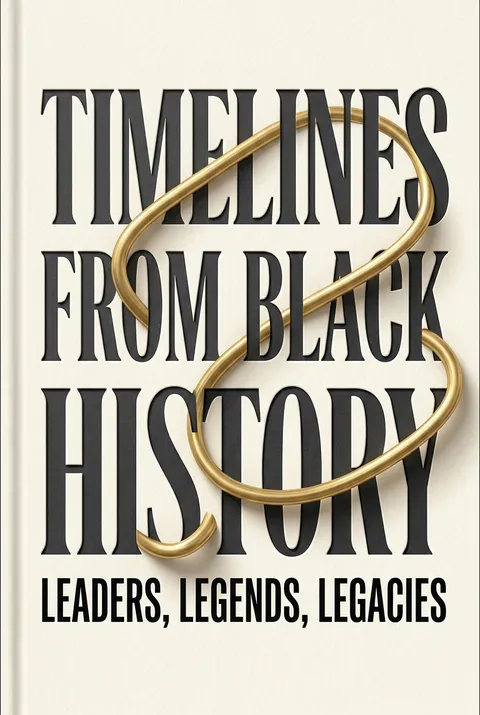
A wider starting point. The book opens in Africa, where the human story begins, then ranges across African kingdoms, the Americas, Europe, the Caribbean, and contemporary Britain. Its premise is corrective: conventional histories have often made Black people visible mainly as enslaved people, while overlooking their cultures, ideas, leadership, and work.
Many histories, connected. The timelines follow people of different countries, genders, beliefs, and backgrounds. A ruler such as Mansa Musa, writer Maya Angelou, athlete Serena Williams, and young activist Marley Dias appear within the same broad account, not as isolated exceptions. The result is a history in which Black experience is part of the world’s main story, across eras and fields.
What's important here is not simply adding missing names to an existing syllabus. It is changing the organizing question from “Where do Black people appear?” to “How did Black people shape the societies being described?” That shift resembles a change in scientific sampling: a record built from a narrow population can distort conclusions about the whole. The book's worldwide scope helps resist that distortion. Its compressed format has a tradeoff, however. A timeline can broaden recognition while leaving local differences and historical disputes underexplored, so it works best as an invitation to investigate, not a final account.
Study African kingdoms as builders of states, trade, learning, and art.
Complex societies came first. The book presents Africa as home to influential civilizations long before European conquest. Aksum built dams, reservoirs, temples, and urban centers, and traded across the Red Sea. The Mali and Songhai empires grew powerful through trade and developed Timbuktu as a center of learning. Great Zimbabwe, built by ancestors of the Shona people, was a major city whose population may have exceeded 18,000.
Wealth had many forms. Mansa Musa expanded Mali’s influence through trade, administration, architecture, and education, not gold alone. His 1324 pilgrimage to Mecca drew attention to the empire’s riches. The book also notes that outsiders wrongly denied African builders credit for Great Zimbabwe, exposing how racial assumptions shaped accounts of the past.
The examples challenge a familiar but false historical sequence in which sophisticated political life arrives in Africa from elsewhere. Trade routes, literacy, architecture, and statecraft are evidence of locally created institutions and international connections. This is also a reminder that wealth should not be reduced to treasure: a city’s infrastructure and educational life are forms of accumulated capacity. The book's continental framing is useful for correcting omission, but Africa was never one uniform civilization. Its kingdoms differed in language, religion, political structure, and historical experience.
Defend self-rule: African leaders resisted conquest with strategy and force.
Resistance took many forms. Queen Nzinga Mbandi of Ndongo and Matamba negotiated with the Portuguese, built alliances, and led military resistance to raids and colonization. Her conflict with Portugal lasted for decades, and she secured a peace agreement that restored Ndongo to her rule. Her story shows diplomacy and war working together, rather than a simple choice between them.
Victory was possible. During the Scramble for Africa, Ethiopia was one of the few African states to avoid colonization. Empress Taytu Betul helped organize resistance to Italy, using intelligence and tactical judgment. At the Battle of Adwa in 1896, Ethiopian forces defeated the invading army. The victory preserved the country's independence and directly challenged European claims of inevitable superiority.
These accounts restore political agency to people often depicted only as victims of imperial expansion. Nzinga's diplomacy and Taytu's wartime leadership show that resistance requires information, coordination, legitimacy, and material resources, not courage alone. The cases also complicate the idea that resistance is purely military: negotiation can protect a population, while armed defense can preserve the conditions for self-government. Their success should not obscure the wider imbalance of power. A few victories against invasion existed alongside extensive conquest and exploitation.
Preserve first-person testimony because slavery tried to erase identity.
The record was contested. Olaudah Equiano was kidnapped as a child from the region of present-day Nigeria and enslaved across the Atlantic. After gaining freedom, he wrote an account of his life that helped readers in Britain confront the violence of the slave trade. Frederick Douglass likewise used his autobiography and public speeches to describe enslavement and campaign for abolition.
Escape required networks. Harriet Tubman repeatedly returned to slaveholding states to guide people to safety through the Underground Railroad, a network of secret routes, helpers, and safe houses. The book estimates that this network helped about 100,000 people escape. These stories present resistance as both personal courage and collective work, while showing how writing and testimony challenged the denial of enslaved people's humanity.
First-person accounts do more than supply emotional detail. They contest who has authority to describe a system, and they preserve evidence that official records may minimize or frame from the enslaver's perspective. The Underground Railroad adds a complementary lesson: liberation depended on trust distributed across many people, not on a solitary hero. At the same time, memoirs are individual accounts, not a complete census of experience. Reading them alongside institutional records and other testimony can preserve their power without mistaking one person's story for everyone's.
Measure freedom in rights, safety, and political power.
Abolition did not end inequality. The US Civil War ended slavery, and the Thirteenth Amendment abolished it, with an exception for punishment for a crime. Yet discriminatory laws and practices continued to restrict Black Americans' lives and voting rights. The book traces this gap from emancipation to the Civil Rights Movement of the 1950s and 1960s.
Collective action changed law. After Rosa Parks was arrested for refusing to surrender her bus seat, Black residents of Montgomery boycotted the bus system for 381 days. The campaign helped force desegregation. Other efforts included school integration, sit-ins, voter registration drives, and marches. Martin Luther King, Jr. championed nonviolent protest, while the broader movement relied on many organizers, participants, and strategies.
The distinction between a legal change and lived freedom is essential. Laws can remove formal barriers while leaving intimidation, unequal access, and weak enforcement intact. The Montgomery boycott illustrates how organized refusal can make an unjust system costly to maintain, especially when participants sustain it together. It also prevents a common historical shortcut: crediting change to a single famous individual. The narrative benefits from recognizing leaders, but movements are durable when ordinary people build the networks, institutions, and pressure that leaders can help coordinate.
Track expertise where institutions tried to deny Black people entry.
Skill survived exclusion. Rebecca Lee Crumpler became the first African American woman to earn a medical degree, then treated women and children who often lacked care. Mary Seacole, refused a nursing role during the Crimean War, funded her own journey and cared for soldiers near the front. Their work combined professional knowledge, practical judgment, and service under difficult conditions.
Opportunity also meant ownership. Sarah Breedlove, known as Madam C. J. Walker, built a hair-care business that employed about 3,000 people and trained other Black women to earn a living. Lewis Howard Latimer contributed technical drawings and improvements to electric lighting. The book also recognizes athletes such as Serena Williams and LeBron James, whose achievements show Black excellence across arenas far beyond formal politics.
These lives make a useful distinction between talent and access. A person may be highly capable while institutions deny credentials, resources, or recognition; biography can reveal both the achievement and the barriers surrounding it. Walker's business also shows that economic power can create opportunities for others, not just wealth for one person. Still, celebrating exceptional figures can accidentally suggest that individual success solves structural exclusion. Their stories are most illuminating when paired with attention to the systems that made their paths unusually difficult.
Use culture to tell truths official histories leave out.
Art carries memory. During the Harlem Renaissance, writers and artists made Black life, thought, and creativity central to American culture. Zora Neale Hurston collected stories and traditions across the United States and the Caribbean, while Maya Angelou turned childhood experience into widely read literature. Their work preserved perspectives often absent from standard accounts.
Music can be argument. Nina Simone brought the realities of racism into her songs and public performances. Fela Kuti developed Afrobeat, a sound blending Nigerian music with jazz, funk, and salsa, and used it to criticize military rule. Contemporary artist Stormzy has used music and publishing to widen access for new voices. These examples show culture as both creative expression and a way to shape public understanding.
Cultural work can function as a counter-archive: it records humor, grief, desire, and everyday life that official documents rarely preserve. Music adds another dimension because it carries arguments through sound, performance, and shared experience, reaching audiences beyond formal political debate. This helps explain why cultural history belongs alongside laws and elections. Yet art should not be treated only as protest or evidence. The same artists make work for pleasure, experimentation, and beauty, dimensions that a solely political reading can flatten.
Treat independence as a beginning, not proof that people are free.
Colonial rule left difficult inheritances. By 1900, European powers controlled about 90 percent of Africa, and independence came unevenly over the following decades. In 1960, 17 African nations gained independence. The book also records what followed in some places: coups, civil wars, economic strain, and political repression. Ending foreign rule did not automatically create stable or fair government.
Freedom needs institutions. Nelson Mandela became South Africa's first Black president after apartheid, then supported a Truth and Reconciliation Commission where victims and perpetrators could speak about the past. Ellen Johnson Sirleaf led Liberia after years of war, and Wangari Maathai linked environmental protection to women's livelihoods and political accountability. Their stories connect national change to the work of building public trust and improving daily life.
Political independence changes who formally governs, but it does not by itself resolve the distribution of land, wealth, security, or political voice. This is why the examples of reconciliation, public service, and community-led environmental work matter: they shift attention from the flag to the institutions and relationships people encounter every day. Transitional justice can help a society establish a shared record, though it cannot substitute for material repair or equal protection. The book's broad sweep makes that distinction visible without implying that every country followed the same path.
Give young people books, platforms, and power to reshape memory.
Children can set public agendas. At eight, Mari Copeny wrote to President Barack Obama about contaminated water in Flint, Michigan. Obama visited the city, and federal emergency assistance followed. Marley Dias noticed that many school stories centered on white boys and dogs, then launched a campaign to collect books featuring Black girls. It drew tens of thousands of donated books and raised awareness about representation in children's publishing.
Visibility must reach institutions. The book places these young advocates alongside Black Lives Matter, a movement protesting racial violence, and Stormzy's work to promote diverse writers. Each example turns an overlooked problem into something the public can see and discuss. Representation is not merely a matter of finding role models; it also concerns who gets to tell stories, influence decisions, and direct resources.
These campaigns show how a focused message can connect lived experience to institutions with the power to respond. Copeny's letter made a local public-health crisis harder to ignore, while Dias's campaign translated a pattern in reading material into a visible publishing challenge. Both demonstrate the civic value of listening to children rather than treating them only as future citizens. Attention alone, however, is not a solution. Durable progress depends on whether public concern leads to sustained investment, accountability, and lasting changes in what communities receive.
Analysis
This book is a visual, chronological survey rather than a single-argument history. Its most consequential choice is to place African kingdoms, enslaved people's resistance, civil rights campaigns, artistic movements, scientific work, sport, and contemporary activism within one continuous field of attention. That structure counters the common habit of treating Black history as a short unit about slavery, or as an appendix to national histories centered elsewhere. The book's biographies make that correction legible through concrete lives: political authority in Nzinga and Taytu, testimony in Equiano and Douglass, public action in Parks and King, and cultural invention in Hurston, Simone, and Kuti.
The timeline form is especially effective at showing simultaneity. Kingdoms and empires existed before and during the periods when European powers expanded; abolition and civil rights were not single turning points but sequences of struggle; independence did not settle the question of justice. Dates help readers see that history is made through overlapping lives and institutions. Yet the form can also imply that events connect neatly because they appear next to one another. Brief entries cannot fully explain contested evidence, causation, or regional differences. The compressed account of a continent risks making Africa seem more uniform than its many societies were.
The book's strongest interpretive thread is therefore not a claim that Black history is one story, but that it contains many histories that must be read as consequential. Its inclusion of women, young activists, diasporic communities, and people working in less celebrated professions broadens the definition of historical importance. That breadth is particularly useful for younger readers, who can encounter agency in rulers, organizers, nurses, writers, entrepreneurs, and athletes. As an introduction, the book succeeds by changing what readers notice. Its timelines are a map of neglected terrain, not a substitute for the deeper, locally grounded histories that each entry invites readers to pursue.
Review Summary
Timelines from Black History receives high praise for its comprehensive coverage of Black history, from ancient African kingdoms to modern figures. Reviewers appreciate the visually engaging timelines, diverse representation, and inclusion of lesser-known individuals. Many found it educational and eye-opening, filling gaps in traditional history education. Some note limitations due to the timeline format and brevity, but overall recommend it as an excellent starting point for exploring Black history. The book is lauded for its design, accessibility, and potential to spark further research.
People Also Read
Glossary
Underground Railroad
Escape network to freedomA network of secret routes, safe houses, and helpers in the United States that aided enslaved people escaping to free states or Canada. Those guiding escapees were sometimes called conductors, and people fleeing were described as passengers. It was not a literal railroad. The book estimates that the network helped about 100,000 people reach freedom.
Scramble for Africa
European partition of AfricaThe late nineteenth-century invasion, occupation, division, and colonization of most of Africa by European powers. The book dates this period from 1881 to 1914 and notes that European states controlled about 90 percent of the continent by 1900. African leaders were excluded from the Berlin Conference, where European powers discussed the continent's future.
Harlem Renaissance
Black cultural floweringA major African American cultural movement centered in Harlem, New York City, during the 1920s. Writers, musicians, and artists created work that celebrated Black culture and examined racism, poverty, identity, and history. Zora Neale Hurston and Langston Hughes were among the writers associated with the movement.
Afrobeat
Nigerian-rooted musical fusionA musical genre developed and popularized by Nigerian musician Fela Kuti. It combines Nigerian music with elements of jazz, funk, and salsa. Kuti used the genre for politically critical songs, including attacks on military rule in Nigeria and on international support for apartheid.
Green Belt Movement
Community tree-planting movementAn organization founded by Kenyan environmentalist Wangari Maathai that organized women to plant trees and develop skills such as forestry and beekeeping. The work addressed deforestation, damaged soil, and food shortages while supporting women's livelihoods. The movement later spread beyond Kenya and became central to Maathai's international environmental advocacy.
apartheid
South African racial segregationA South African government system of racial separation and discrimination that lasted from 1948 to 1994. It restricted Black South Africans' rights and access to political and social life. Nelson Mandela became a leading opponent of apartheid, spent 27 years in prison, and became South Africa's first Black president after the system ended.
About the Author
Other books by D.K. Publishing
Download PDF
Download EPUB
.epub digital book format is ideal for reading ebooks on phones, tablets, and e-readers.








