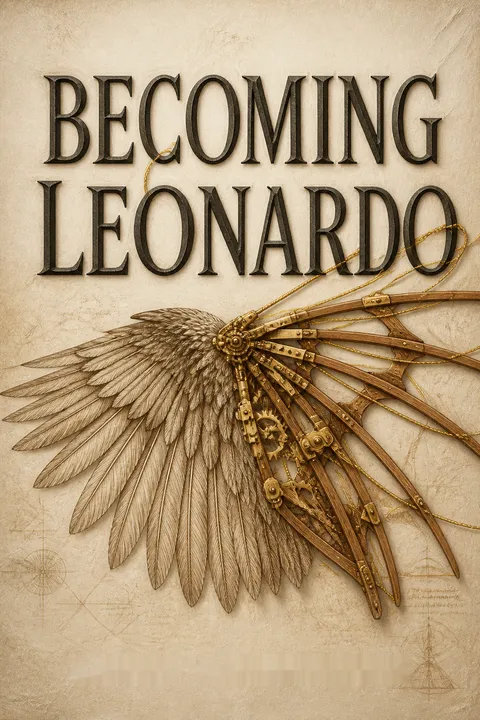


Key Takeaways
Leonardo became himself by learning to see, not by fitting in.
A childhood of gaps. Born in 1452 outside marriage, Leonardo spent his early years in Vinci, a rural town overlooking the Tuscan hills. Almost nothing reliable is known about his childhood. The possibility that his mother, Caterina, was an enslaved woman is an interpretation based on fragmentary evidence, not an established fact. The uncertainty matters: the book resists turning his beginnings into a neat origin story.
A path made by looking. Leonardo was about fifteen when he moved to Florence and entered Andrea del Verrocchio’s workshop. There he encountered techniques and artistic knowledge he had not previously learned. His left-handed mirror writing was another mark of difference, though it does not prove any particular diagnosis. Rather than a finished prodigy, the book presents a young outsider gradually finding methods that worked for him.
The account usefully shifts attention from innate genius to the conditions that let a talent develop: a landscape to explore, an adult who may have encouraged patience, and a workshop that supplied technique. Its strongest point is also its necessary limit. Since the childhood record is so thin, the uncle’s influence and the meaning of Caterina’s possible history remain plausible readings, not demonstrable causes. That uncertainty makes the story more human, not less compelling.
Draw to understand what ordinary looking leaves invisible.
Drawing as investigation. For Leonardo, drawing was not merely a way to produce finished art. It helped him learn the structure of whatever held his attention. The book describes him studying plants, animals, rocks, and water by returning to them and trying to record their particular forms. The act of drawing made looking slower and more exact.
From surface to structure. That habit carried into his studies of machines and the human body. His anatomical drawings attempted to show how parts connected and moved, not just what an opened body looked like. In this sense, the notebook page became a working instrument: observation could be examined, revised, and compared. His skill at rendering made these inquiries unusually clear, even when the science behind a drawing remained incomplete.
This is a powerful account of visual thinking because it treats representation as a way of asking questions, not simply displaying answers. A drawing can expose a mistaken assumption: an imagined mechanism may look elegant on paper but fail when built. The distinction is crucial in Leonardo’s case, since his extraordinary skill could make an uncertain idea appear settled. Drawing deepens inquiry, but it does not replace testing.
Give hard questions time to change shape.
The long work of seeing. Leonardo often approached a subject through repeated observation, measurements, and revisions. His planned bronze horse is the clearest example. He studied real horses, worked through the composition, and tried to solve the engineering problems of a monumental casting. The model stood about twenty-four feet high, and the proposed bronze casting required seventy-two tons of metal.
Time had a cost. Leonardo worked on the project for roughly eleven years, but it was never cast. In 1494, Ludovico Sforza redirected the bronze to make cannon. The project shows both the power and the danger of Leonardo’s patient method: revisiting a problem could produce fresh insight, but prolonged refinement could leave a commission vulnerable to politics, deadlines, and changing resources.
The horse complicates the familiar story that persistence reliably yields achievement. Leonardo’s sustained attention generated knowledge and a compelling model, yet the final work depended on materials and political support he did not control. Patience is not a virtue in isolation; it must be matched to the project’s real constraints. The episode invites a useful question: which parts of a long effort are deepening the work, and which are postponing a decision?
A patron's commission can force a masterpiece into a bad medium.
A difficult wall. Ludovico commissioned Leonardo to paint The Last Supper on a refectory wall that was damp. Fresco, the usual wall-painting method, demanded a different process from the layered effects Leonardo preferred. He experimented with a mixture of oil and tempera instead. The choice allowed him to work in his own way, but the paint soon began to deteriorate.
Art and conditions. The book portrays the commission as a collision between the patron’s requirements and the artist’s working method. Leonardo could not simply move the painting to a safer surface, and he could not make the wall dry. His technical choice produced an extraordinary composition, but it also left the work fragile. The result was neither a simple triumph nor a simple mistake: artistic ambition met the limits of the room.
The episode makes material conditions part of the meaning of the artwork. A painting is not only an idea or an artist’s intention; it is also a surface, a pigment, a building, and a negotiation over who controls them. The book’s portrayal of Ludovico as chiefly responsible is persuasive as a story of constraint, though Leonardo also chose to experiment. Creative freedom and accountability can coexist, especially when the risks are visible in advance.
Do not confuse irregular output with an empty mind.
A difficult reputation. Leonardo left major projects unfinished, including The Adoration of the Magi, the bronze horse, and the Battle of Anghiari. Patrons and officials had reason to worry about his commitments. Yet his working life was full of inquiry: notes and drawings on anatomy, water, geometry, flight, architecture, and machines. The book argues that this private labor was easy to miss when public commissions remained incomplete.
The pressure to explain. At twenty-four, Leonardo was arrested after an anonymous accusation of sodomy. The charges were later dropped when no witnesses came forward; how long he was detained is unknown. Lankford treats the arrest as a possible source of lasting fear and self-protection, while acknowledging that the record cannot establish its effects. The portrait is of a man whose private activity and public reliability did not always align.
This distinction between visible output and hidden work is valuable, but it should not become an excuse that makes every unfinished project evidence of misunderstood brilliance. Leonardo’s notebooks show genuine intellectual labor, while his abandoned contracts also imposed costs on other people. The more complete view holds both facts together. A person can be unusually productive in one sense and unreliable in another, without either description canceling the other.
A convincing image can make an impossible plan feel true.
Pictures carry authority. Leonardo’s map of Imola translated streets and distances into a striking overhead view. He measured the city and turned those observations into a form that made its layout immediately legible. The book presents the map as a practical tool, but also as evidence of how much persuasive force a well-made image could have in a world with few such pictures.
Appearance is not proof. Leonardo’s proposal to divert the Arno away from Pisa also looked convincing enough to win official support. The project failed after construction began, amid changes to the plan, bad weather, and costly damage. Lankford likewise interprets the famous Vitruvian Man as a possible visual joke about the difficulty of fitting a real body into an ideal geometric theory. In each case, a drawing invites belief, but its clarity cannot guarantee its claims.
Leonardo’s images reveal a persistent tension between visualization and verification. A diagram can make a complex system graspable, which is a genuine form of knowledge. Yet the same visual clarity can conceal assumptions, missing data, or practical obstacles. This is especially important when a drawing is used to persuade decision-makers. The strongest reading of Leonardo is not that images deceive, but that their beauty and precision demand scrutiny alongside admiration.
Let the evidence of violence complicate the beauty of war.
An engineer in a brutal campaign. In 1502, Leonardo worked for Cesare Borgia, surveying fortifications and supporting military operations. The book places him amid sieges, reprisals, and massacres, including the destruction of communities that resisted Borgia’s forces. It cannot establish exactly what Leonardo witnessed in every case, or what he felt at the time.
A changed image of battle. Lankford reads Leonardo’s later Battle of Anghiari as a response to the violence he had encountered. Rather than presenting war as clean heroism, the composition centers on men and horses locked in a furious struggle over a banner. The painting’s beauty does not erase its brutality. The book also suggests that Leonardo’s vegetarianism grew from revulsion at violence, but the timing and motive remain interpretations rather than documented certainties.
The section resists an easy separation between artistic mastery and the uses to which that mastery is put. Leonardo’s engineering could serve a ruler’s campaign, while his art could expose the madness beneath martial glory. That tension is more revealing than treating him as either a detached genius or a consistent moral critic. The evidence supports a changing, conflicted response to violence, not a perfectly resolved ethical position.
Even the most solitary genius depends on a working circle.
A crowded workshop. Leonardo valued solitude, but his work relied on other people. Zoroastro was a long-standing companion and practical assistant. Salaì lived with him for years, and Francesco Melzi later became his close companion and executor. Assistants could help with models, materials, errands, and the daily work of a studio.
Knowledge moved socially. The mathematician Luca Pacioli helped Leonardo with mathematical ideas relevant to perspective. Leonardo also depended on scribes because his mirror writing was unsuitable for ordinary correspondence. These relationships complicate the image of a lone mind producing everything in isolation. His notebooks preserve individual observations, but the work around them involved collaborators, teachers, patrons, and practical support.
The book’s private Leonardo is not truly solitary; he is selectively social, relying on trusted people while protecting time to think. This distinction matters because stories of genius often erase the labor that makes creative work possible. Companions and assistants were not incidental to the process. At the same time, the surviving record tells us little about what they contributed, so the collaborative picture should correct the lone-genius myth without inventing a complete workshop history.
An unfinished record can become a mirror for later generations.
A legacy left in fragments. Leonardo died in France in 1519 with paintings, notebooks, and studies still unfinished or unpublished. Melzi inherited much of this material but did not bring the vast body of notes into print. After Melzi’s death, pages were dispersed, and many were lost. The notebooks therefore preserve brilliant observations alongside gaps, repetitions, and ideas that were never developed into public work.
A life open to projection. Lankford argues that Leonardo’s unresolved projects and elusive personality helped later generations remake him as an all-purpose genius. The familiar legend smooths over his failures and contradictions. The book instead asks readers to see a person who was inventive, dependent on patrons, sometimes unreliable, and difficult to interpret. His historical image remains compelling partly because it never closes into one simple explanation.
The book’s central paradox is that Leonardo’s incomplete record both limits knowledge and invites fascination. This is a useful warning about biography: gaps are not permission to turn speculation into fact, but neither are they empty spaces without meaning. The account is most persuasive when it marks the difference between evidence and imaginative reconstruction. Its own vivid scenes sometimes blur that boundary, making the reader’s skepticism part of the method.
Analysis
Becoming Leonardo is a biography that deliberately unsettles the familiar portrait of a serene, omnipotent Renaissance genius. Its central subject is not simply what Leonardo made, but the mismatch between his private habits of inquiry and the public demands of patrons, contracts, and political upheaval. The horse that consumed eleven years without becoming bronze, and the wall painting whose experimental technique began to fail, embody this tension: extraordinary imagination did not reliably produce completed commissions.
The book’s most useful corrective is its attention to process. Leonardo’s drawings and notebooks appear as instruments for thinking, storing observations, and testing possibilities, rather than as a catalogue of inventions ready for use. This view also makes his dependence on Pacioli, assistants, scribes, and patrons more visible. In contemporary terms, it resembles distributed cognition: thought is scaffolded by tools, collaborators, and environments, not housed entirely in an isolated individual. That perspective makes the lone-genius myth less plausible without diminishing Leonardo’s exceptional abilities.
Lankford’s method is intentionally speculative. Sparse records invite scenes about childhood, imprisonment, private motives, and emotional consequences. Such reconstruction gives the biography narrative force, but its claims vary in evidential strength. The discussion of Leonardo’s possible family origins, the psychological effect of his arrest, and the moral impact of military campaigns should be read as interpretations, not settled explanations. The most responsible passages signal that uncertainty; the most vivid ones can make conjecture feel like witnessed fact.
The book also exposes a productive contradiction: Leonardo’s ambiguity helps explain both his difficulties during life and his afterlife as a cultural icon. He resisted simple categorization, and later audiences have repeatedly supplied one. The result is a biography that asks readers to replace worship with attention. Leonardo becomes more interesting, not less, when brilliance is allowed to coexist with delay, dependence, failure, and unresolved motives.
Review Summary
Becoming Leonardo receives mixed reviews, with many praising its unique approach to biography. Readers appreciate Lankford's speculative style, which brings Leonardo to life as a flawed, human genius. The book offers fascinating insights into Renaissance Italy and Leonardo's context. Some criticize the lack of citations and overreliance on conjecture. Overall, reviewers find it an engaging, thought-provoking read that challenges traditional biographical norms, though its accuracy is debated. The casual writing style and fresh perspective on Leonardo's life and times are frequently highlighted as strengths.
People Also Read
Glossary
ingenio
artist-engineer and inventorA Renaissance identity for a maker whose work crossed artistic, technical, and practical boundaries. In the book, Leonardo’s ambitions as an ingenio include painting, designing machines and bridges, studying water, and planning entertainments. The term helps explain why he resisted being reduced to a single craft, even when patrons chiefly employed him as a painter or engineer.
mirror writing
right-to-left writingWriting that proceeds from right to left, with ordinary letter forms that can be read clearly when reflected in a mirror. Leonardo used this form in many notebooks. The book suggests that left-handed writing may have made it convenient, but the reason is uncertain. Its unusual direction also made his notes difficult for others to read without assistance.
Vitruvian Man
body inside geometric formsLeonardo’s drawing of a human figure arranged in relation to a circle and a square, based on the Roman writer Vitruvius’s account of ideal bodily proportions. Lankford proposes that the drawing may playfully expose the difficulty of making a real body fit the theory exactly. This interpretation is the author’s reading, not a settled explanation of Leonardo’s intent.
verisimilitude
appearance of being realThe convincing appearance that an image or design corresponds to reality. The book uses the idea to describe Leonardo’s ability to make maps, machines, and proposed engineering projects seem tangible through precise drawing. Such visual persuasiveness can clarify a sound idea, but it cannot prove that a plan will work when built.
Download PDF
Download EPUB
.epub digital book format is ideal for reading ebooks on phones, tablets, and e-readers.








