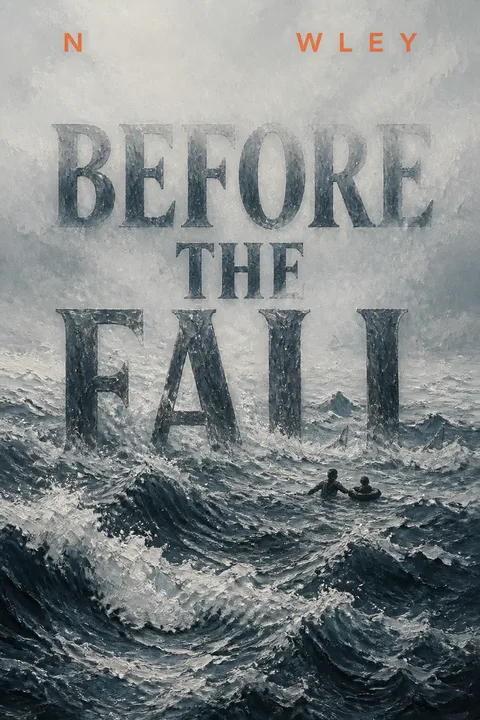


Plot Summary
Fog Delays the Departure
On a foggy August night, television executive David Bateman boards a private jet with his wife, Maggie, their children, nine-year-old Rachel and four-year-old JJ, and their security guard, Gil. The Kiplings, wealthy friends Ben and Sarah, join them, while Maggie’s casual invitation brings painter Scott Burroughs aboard at the last moment.
The trip begins with familiar tensions: David keeps working, Maggie worries about flying in the fog, and Rachel watches over her sleeping brother. The family’s vigilance has a history. Years earlier, Rachel was kidnapped, and the three days before her rescue left her wary of confined spaces and unfamiliar men. The plane lifts toward New York. Sixteen minutes later, it will fall into the Atlantic.
The passenger list gathers the novel’s pressures into one cabin: money, work, family duty, and the desire to be seen as more than one’s social role. David’s phone remains an intrusion even during a family trip, while Maggie’s unease is grounded in experience rather than superstition. Scott arrives as an accidental addition, an outsider whose presence will become a blank surface for competing stories. Rachel’s earlier abduction also complicates the family’s apparent privilege: security has protected them, but it has not restored the feeling of ordinary safety.
A Swim Toward Land
Scott surfaces amid burning fuel, broken aircraft, and black water. His left shoulder is injured, his clothes drag him down, and fog hides the shore. He begins swimming alone, then hears a child calling for help. The boy, JJ, clings to a seat cushion. Scott rigs its straps around him and pulls him through the current.
A brief break in the clouds reveals the North Star and corrects their course before they swim farther out to sea. Scott talks JJ through the cold and panic, then dives with him beneath a towering wave that destroys their makeshift flotation. Exhausted and hypothermic, Scott keeps swimming until JJ spots land. At sunrise, they reach Montauk Beach, having crossed miles of open water together.
The rescue begins as self-preservation and becomes a relationship through action. Scott does not know JJ’s family or what the boy will inherit; he responds because a child is in danger and because his own sister drowned. The North Star supplies practical orientation, not supernatural rescue: survival depends on attention, swimming skill, and the willingness to revise a mistaken course. The wave is the section’s decisive test. Scott’s strength matters, but so does his ability to keep JJ calm enough to cooperate. The first bond between them is not a promise. It is a shared passage through danger.
The Survivor Becomes News
A fisherman drives Scott and JJ to a Montauk hospital, where Scott insists that doctors treat the boy before him. Their injuries are manageable, but the news is not: no other passengers have been found, and television reports identify the Batemans and Kiplings among the missing. JJ’s aunt Eleanor and her husband, Doug, arrive from Westchester.
When Scott is discharged, JJ clings to him, then falls silent with his relatives. Outside, reporters gather to film the man who swam ashore carrying a child. Scott slips away in borrowed scrubs with his friend Magnus, hoping to avoid becoming a public spectacle. Instead, the crash has made him both a witness for investigators and a story the media wants to own.
The hospital establishes the difference between bodily survival and emotional recovery. Scott gives JJ the steadiness of a familiar rescuer, yet cannot replace the family the boy has lost. His escape from the cameras is not an attempt to conceal guilt; it is a refusal to let strangers dictate the meaning of an experience he barely understands himself. The authorities need a sequence of facts, while broadcasters need a compelling character. Scott’s reluctance makes him more attractive to the media, which treats privacy as evidence that a hidden story must exist.
A Second Chance in Blue
Scott’s life before the flight was not a clean ascent toward artistic success. As a child, he watched fitness icon Jack LaLanne swim across San Francisco Bay while towing a boat, and the feat sent him into swimming. Later, Scott became a competitive swimmer, then left the sport for painting, drinking, and short-lived relationships. By middle age, his career had stalled.
A return to swimming helped him sober up and begin a new body of disaster paintings. His work finally attracted gallery interest, and he planned a New York trip to show it. Even before the crash, he had nearly missed the plane and part of him hoped the doors would close first. He boarded anyway, carrying both his paintings and his uncertain hope for a future.
Scott’s past turns the rescue into more than a test of athletic capacity. LaLanne gave the boy a model of human possibility, but Scott’s adult life shows how inspiration can fade into self-neglect. Swimming returns as a discipline that makes change concrete: laps, sobriety, and sustained work replace the fantasy of sudden recognition. His hesitation before boarding reveals that success is not an uncomplicated desire. He fears disappointment and the responsibilities of a renewed career, yet he boards because he has begun to believe his paintings deserve to be seen.
The Orphan's New Guardian
Eleanor becomes JJ’s guardian and executor after David and Maggie’s wills are reviewed. Rachel is also lost, so the trust intended for both children now belongs to JJ. The estate includes homes in New York, Martha’s Vineyard, and London, while the child’s trust is valued at about $103 million, released in stages as he grows older.
Eleanor insists that the money belongs to her nephew, not to her and Doug. Doug, whose unfinished restaurant and stalled writing career have left him frustrated, focuses on what the inheritance could make possible.
At home, he treats the properties and available funds as a change in their fortunes. Eleanor sees instead a grieving child who needs familiar belongings, care, and a guardian able to put his needs first.
The inheritance makes grief administratively visible. Lawyers assign value to the family’s homes and divide assets into percentages, while Eleanor struggles to think beyond the immediate fact that her sister is gone. Her insistence on separating JJ’s money from her own is an ethical boundary, but it also exposes how alone she feels in making decisions. Doug’s interest in the estate does not simply mark him as greedy; it gives shape to his fear that his own stalled life will remain stalled. The conflict begins because each sees the fortune as a different kind of rescue.
Layla Offers a Hideaway
The media soon casts Scott as suspicious, linking his place on the plane to his friendship with Maggie and to Ben Kipling’s reported investigation for laundering money from sanctioned countries.
Bill Cunningham, ALC’s combative star anchor, calls the crash sabotage without evidence and questions why Scott has disappeared. Scott cannot return to his rented home on Martha’s Vineyard without facing reporters, so Magnus brings him to Layla Mueller, a billionaire art patron who admires his paintings and offers him a private apartment.
Layla’s refuge gives Scott space, but not peace. She tells him that Rachel had once been kidnapped, a history he did not know. Then news arrives that bodies are being recovered, making the deaths he witnessed in the water newly undeniable.
Layla’s offer looks like an escape from the media, but it also places Scott inside another story about wealth and access. She is drawn to both his work and his refusal to perform gratitude on demand. The revelation about Rachel’s kidnapping deepens the tragedy without offering a neat pattern: the family has endured one violent interruption and then another. Meanwhile, Cunningham converts missing facts into confident accusations. The more Scott avoids public attention, the easier it becomes for others to treat his silence as proof that their invented account is correct.
A Child Finds His Voice
At Layla’s apartment, Scott calls Eleanor to ask how JJ is coping. The boy barely speaks and has begun seeing a child psychiatrist, while Eleanor tries to build a routine in a house strained by Doug’s drinking and resentment. Scott later drives to visit them, bringing JJ a toy truck. The boy welcomes him and, at bedtime, asks him to read.
Scott stays through several books, offering comfort without pretending to understand the child’s grief. During the visit, Eleanor admits that Doug’s interest in the inheritance is worsening their marriage and that she feels overwhelmed by the money. Scott does not offer to solve either problem. He listens, plays with JJ, and allows the boy to approach him at his own pace.
JJ’s speech returns first in a relationship built without demands. Scott does not quiz him about the crash or insist that he recover on an adult timetable; he offers attention through play and reading. Eleanor’s trust in Scott grows alongside her recognition that Doug’s needs are crowding out the child’s. This is not an easy substitute family. Scott has no experience as a parent, and Eleanor doubts her own capacity. What they share is a willingness to treat JJ as a person rather than a symbol of loss or a claim on money.
Art Becomes Evidence
David’s death leaves ALC without its founder, and Bill uses the crisis to reclaim the airwaves after David had intended to remove him over illegal phone hacking. He frames the crash as terrorism, then directs suspicion toward Scott, whose paintings depict disasters.
Bill’s operation, aided by a former intelligence contractor named Namor, taps the phones of relatives and investigators and leaks private information, including an FBI memo questioning Scott’s role. The FBI seizes Scott’s paintings from his studio, partly because they include transportation disasters.
At a funeral, agents press Scott about Maggie and his art, while Scott tries to explain that he paints catastrophe to understand how ordinary lives can be abruptly broken. The public receives insinuation faster than investigators can establish facts.
Bill’s power comes from controlling the frame, not from solving the mystery. He turns an incomplete investigation into a moral drama with villains, traitors, and suspicious intimacies. The phone hacking literalizes his belief that private life exists for public use, while the leaked memo gives his speculation the appearance of official confirmation. Scott’s paintings become evidence because they resemble the event, although resemblance alone cannot establish cause. The section asks how institutions lose credibility when a broadcaster can make accusation feel more immediate than careful inquiry.
The Fuselage Opens
After days of scattered wreckage and worsening weather, search teams locate the main fuselage on the seabed. Investigators watch divers move through the torn cabin. They find David, Maggie, Rachel, and Ben still restrained in their seats; Sarah and flight attendant Emma had already been recovered elsewhere.
In the galley, Captain James Melody is trapped in a pocket of air, on the wrong side of the cockpit door. The door bears six bullet holes, and the security guard Gil Baruch is missing. The discovery changes the investigation.
Mechanical failure and terrorism remain possibilities, but someone fired at the cockpit, and the captain was outside it during the final moments. The bodies are recovered, yet the crucial explanation remains locked in damaged flight recorders.
The wreckage replaces rumor with material facts, but those facts do not immediately form a complete story. The passengers’ seat belts, the punctured door, the captain’s trapped body, and Gil’s absence each invite competing explanations. The scene also makes investigators confront the physical cost of their theories: the people they have been discussing as names and assets are now bodies in a ruined cabin. Finding the plane narrows the mystery while intensifying it. Evidence can disprove some stories, but it cannot by itself tell investigators what a person intended.
The Copilot's Old Wound
Flashbacks reveal that copilot Charlie Busch built his career with help from his senator uncle and learned to conceal insecurity beneath a confident manner. He met flight attendant Emma Lightner at work and began a relationship, but his jealousy and cruelty escalated until he choked her during sex.
Emma ended it and tried to avoid him. In London, Charlie arrives unexpectedly while she is traveling with another crew. He insults her, watches her flee, and follows her to the airport anyway, hoping persistence will restore their relationship.
Emma makes clear that she wants him kept away. Charlie has spent days drinking and using cocaine with another pilot. On the return flight, exhausted and emotionally volatile, he remains in the cockpit with the controls while Captain Melody steps out.
Charlie’s history explains how entitlement can masquerade as romantic devotion. He imagines that Emma’s refusal is a test, because accepting her independent judgment would require him to face his own behavior. His dependence on borrowed status, from his uncle’s influence to his pilot’s uniform, leaves him especially vulnerable when he feels rejected. Emma’s boundaries are not a mysterious provocation; they are a reasonable response to abuse. This backstory prepares the reader to understand the emotional trigger without excusing the catastrophic choices Charlie makes.
The Recorder Names the Motive
The recovered flight data shows that the aircraft was functioning normally until Charlie disengaged the autopilot and put it into a steep spiral toward the ocean. The cockpit recording supplies the human sequence: Captain Melody leaves to deal with a nosebleed, Charlie is alone, and he mutters an insult before switching off automatic control.
Melody pounds on the locked door as the plane dives. Gunshots follow, consistent with Gil’s service weapon, likely fired as he and the captain tried to break in.
The recording ends in impact. Investigators can now rule out mechanical failure as the cause. Charlie’s intoxication, his fixation on Emma, and his deliberate control of the aircraft explain why nine people died, though no motive can make the decision comprehensible.
The data recorder and the cockpit voice recorder answer different questions. The first establishes what the aircraft did; the second reveals a human voice inside the machine. Their combination defeats the comforting idea that technology failed on its own. Charlie’s insult links the crash to his rejection of Emma, while the shots suggest an attempt to stop him rather than to help him. Yet explanation is not exoneration. The recording gives the disaster a cause, not a proportionate reason, and that gap is where the novel’s moral shock remains.
A Marriage Breaks on Air
After Doug comes home drunk and argues with Eleanor, she tells him their marriage is over and asks him to leave. Bill’s producer draws Doug to ALC, where Bill encourages him to describe Scott as a rival who has taken his place in the house and may be pursuing JJ’s inheritance. Doug’s account becomes a televised attack on Eleanor and Scott, even as Bill supplies the most damaging insinuations himself.
At home, Eleanor sees the broadcast and refuses to let Bill discuss the crash in front of JJ. Scott, meanwhile, gives the boy his father’s fountain pen, then hears Doug’s accusations on television. Rather than retreat again, Scott agrees to an interview with Bill, insisting that the child and Eleanor be kept out of it.
Doug’s appearance shows how private insecurity can be recruited into public performance. He wants recognition as a husband and guardian, but Bill redirects that grievance toward a conspiracy that promises to make Doug’s pain legible and important. Eleanor’s refusal to let the broadcast define her family is a rare act of firm self-protection. Scott’s gift of the pen links his own father to the boy’s lost parents, while his decision to face Bill marks a change in how he uses silence. He will no longer let others speak for him without challenge.
No More Borrowed Story
In the studio, Bill plays recordings of Scott’s private calls with Layla and Gus to portray him as a liar. Scott recognizes that the calls were tapped and accuses Bill of exploiting the bereaved while pretending to seek truth. He outlines what the evidence now shows: Charlie took control of the plane, and someone fired at the cockpit door in an effort to stop the dive.
Bill loses his composure and has to be restrained when Scott condemns his conduct. Scott leaves without accepting the role of either saint or suspect. He intends to return to Eleanor and JJ, reclaim his paintings when possible, and teach the boy to swim. His future remains uncertain, but he no longer treats survival as something that happened to someone else.
The confrontation pits two kinds of storytelling against each other. Bill uses private recordings to make intimacy look like guilt; Scott insists that facts require context and that privacy is not proof of wrongdoing. His anger is measured rather than triumphant, because exposing Bill cannot restore the dead or repair Eleanor’s marriage. The more important resolution is personal: Scott chooses continued attachment over retreat. Teaching JJ to swim will not erase the ocean, but it offers the boy a practical relationship to water and gives Scott a way to turn survival into care.
Analysis
Before the Fall examines the difference between an event and the story made from it. A private plane’s destruction initially leaves almost no facts, only a survivor, a missing aircraft, and a wealthy passenger list. That vacuum attracts narratives: Bill Cunningham’s conspiracy, the investigators’ competing theories, and the public’s wish to decide whether Scott is hero or fraud. The novel makes the contest material through phone taps, leaked memos, seized paintings, and finally the recorders. Truth emerges not through one brilliant interpretation but through separate forms of evidence that can be compared.
Its critique of wealth is specific rather than simple. The Batemans’ security, private aircraft, and homes cannot protect them from chance or from human cruelty. Ben’s money can disguise the sources of capital, but it cannot prevent scrutiny. Layla can offer a secluded apartment, yet media attention reaches her door. Eleanor’s inheritance can pay for JJ’s care, but it cannot tell her how to become his mother or make Doug ready for responsibility. Wealth expands choice while leaving grief, fear, and ethical judgment intact.
Scott’s paintings and swimming join the book’s central questions. Painting tries to give form to catastrophe without claiming that disaster has a just explanation. Swimming turns endurance into action: Scott cannot save the passengers, but he can keep JJ alive, then choose to remain present after the rescue. His intention to teach the boy to swim does not promise healing. It offers a skill, a relationship, and a way to meet fear without pretending it has vanished.
The novel’s final movement rejects both fatalism and manufactured certainty. Charlie’s action has a discernible human trigger, yet the disproportion between rejection and mass death remains appalling. Scott cannot make the dead meaningful, nor can the media’s spectacle repair the living. He can only stop fleeing the life that remains and accept care as a continuing practice.
Review Summary
Before the Fall follows a private plane crash that leaves only two survivors: painter Scott Burroughs and four-year-old JJ. Reviews praise Hawley's tight plotting, character development, and critique of sensationalist media coverage. Many compare the structure to a TV series, noting flashbacks revealing each passenger's backstory. While most found it compelling and thought-provoking, some felt it dragged with excessive philosophical detours. The ending divided readers—some found it anticlimactic, others perfectly fitting. Overall, reviewers appreciated it as more than a typical thriller, offering deeper commentary on heroism, wealth, fate, and media manipulation, though expectations varied on pacing and resolution.
People Also Read




Characters
Scott Burroughs
The reluctant survivorScott is a middle-aged painter whose career has stalled after years of alcohol misuse and self-sabotage. Swimming once gave him discipline and direction; painting offers a way to make sense of disasters that seem to arrive without warning. He is observant, self-deprecating, and uncomfortable with attention, but his instinct under pressure is to act for someone more vulnerable. His ties to Maggie’s family begin as casual island acquaintance, not intimacy, and his relationship with JJ grows through practical care rather than grand promises. Scott’s central tension is between wanting to disappear and wanting his work, and his life, to matter.
Eleanor Dunleavy
The reluctant guardianEleanor is Maggie’s younger sister and JJ’s aunt. She has spent much of her life trying to avoid loneliness by attaching herself to other people, a pattern that shapes her marriage to Doug. Warm and attentive, she is also more capable of firmness than she initially believes. The sudden responsibility of raising her nephew forces her to distinguish care from people-pleasing and to consider what stability means for a traumatized child. Eleanor’s instinct is to protect JJ’s interests, even when doing so strains her relationship with her husband.
JJ Bateman
The child left behindJJ is David and Maggie Bateman’s four-year-old son and Rachel’s younger brother. Curious and energetic, he depends on familiar routines and the adults around him to make the world manageable. After a frightening disruption, he withdraws from speech and becomes watchful, communicating through gestures and play. His connection with Scott develops through shared survival, reading, toys, and time spent without pressure. JJ’s youth does not make him untouched by events; it means he is still learning what safety, family, and loss are.
David Bateman
The newsmaker fatherDavid is a former political operative and founder of ALC News, a network built around shaping events rather than merely reporting them. A disciplined strategist, he is proud of his influence and accustomed to solving problems through control. His own childhood taught him that work and preparation secure a future, a belief that drives his success but also keeps him from the family time he wants. His relationship with Maggie carries affection and recurring frustration, especially over his habit of letting work intrude on home. He tries to give his children the childhood he did not have.
Maggie Bateman
The watchful motherMaggie is David’s wife, a former preschool teacher who once took particular pride in listening seriously to young children. Wealth has changed her circumstances but not erased her discomfort with its distance from ordinary life. She loves David while resenting the work that repeatedly takes him away from the family. Her earlier experience as a mother under threat has sharpened her attention to danger and her concern for Rachel’s emotional well-being. Maggie’s warmth makes her easy to approach, but she is not naïve about the cost of being protected by money.
Rachel Bateman
The guarded older sisterRachel is nine, bright, thoughtful, and protective of her younger brother. She enjoys books about resourceful girls and often seeks reassurance when a story becomes frightening. A childhood kidnapping has made her wary of strangers and small spaces, though her family tries to preserve her independence. Rachel is observant without showing off, and her mother sees in her both resilience and the lingering effects of what happened.
Doug Dunleavy
The insecure husbandDoug is Eleanor’s husband, an aspiring writer and would-be restaurateur whose plans have repeatedly stalled. He distrusts wealth and resents David’s success, even as he longs for the comfort and opportunity money could bring. His humor and culinary enthusiasms coexist with heavy drinking, defensiveness, and a need to feel respected. The arrival of a child and the prospect of financial responsibility expose how uncertain he is about the role of husband and guardian.
Gus Franklin
The searching investigatorGus is the NTSB investigator leading the crash inquiry. Trained as an engineer, he relies on careful observation, systems analysis, and evidence, but years spent confronting transportation disasters have taught him that technical explanations do not contain the whole human cost. He is patient with survivors and wary of investigators who turn suspicion into certainty. His growing ability to make room for grief complicates his former belief that every problem can be fixed by finding the failed component.
Bill Cunningham
The broadcaster who inflamesBill is ALC’s most powerful on-air personality, an abrasive populist whose confidence and outrage make him compelling to viewers. David recognized his talent and gave him a platform, but their professional bond carries a history of corporate conflict and competing ideas about journalism. Bill believes he speaks for ordinary people against hidden powers, yet his appetite for attention and disregard for boundaries compromise that claim. He is skilled at turning uncertainty into a story that rewards allegiance rather than patience.
Layla Mueller
The art-world heiressLayla is a young billionaire and influential art patron who has the means to open doors for artists. She is accustomed to people approaching her for money, sex, or access, and she values the rare person who treats her as more than an inheritance. Her interest in Scott combines admiration for his work with a desire to control her own relationship to the media. She offers generosity freely, though her world of private homes and hidden resources cannot entirely insulate anyone from public attention.
Ben Kipling
The financier under scrutinyBen is a wealthy investment partner whose confidence rests on his belief that money can smooth away life’s obstacles. A sharp trader with a lifelong fascination with value, he treats financial skill as both a game and a source of identity. His dealings are opaque, and he is accustomed to operating through lawyers, offshore accounts, and trusted intermediaries. His marriage to Sarah is shaped by wealth, social performance, and her frustration with his tendency to reduce people to financial terms.
Sarah Kipling
The social peacemakerSarah is Ben’s wife, a sociable woman who often smooths over the awkwardness created by her husband’s bluntness about money. She maintains close ties with their adult daughter and worries about how wealth has altered their relationship to ordinary life. Lists and routines help her manage a distracted mind and an unstructured day. Sarah is attentive to social nuance, often noticing tension before others do, but she cannot make Ben share her belief that people deserve attention beyond their usefulness.
Emma Lightner
The guarded flight attendantEmma is a skilled flight attendant who has traveled widely while maintaining firm boundaries with wealthy clients and colleagues. The daughter of an Air Force pilot, she loves aircraft and remembers her father as a model of protection. Her work requires warmth without surrendering privacy, a balance that becomes difficult when personal attention turns coercive. Emma wants a life with room for family, rest, and choices not dictated by the demands of travel.
Charles Busch
The borrowed-confidence pilotCharlie is a GullWing copilot from Texas who has benefited from his senator uncle’s connections. He is capable enough to hold a demanding job, but his sense of self is weakened by the suspicion that he has never earned his place. He uses swagger, jokes, and charm to conceal insecurity, particularly in relationships. His idea of masculinity is entangled with dominance and performance, leaving him poorly equipped to accept rejection or take responsibility for harm.
James Melody
The careful captainJames is an experienced GullWing captain who approaches flying with methodical seriousness. Raised amid his mother’s changing spiritual obsessions, he turns instead to science, books, and the reliable rules of aviation. He values usefulness and prefers clear systems to vague claims about fate. His life in the air has made him self-sufficient, but his uncertainty about his origins and his complicated relationship with his mother remain private questions he cannot settle through technical knowledge.
Gil Baruch
The silent bodyguardGil is the Bateman family’s longtime security guard, a disciplined professional who watches for small changes others overlook. He is private, highly trained, and accustomed to placing himself between danger and the people he protects. His reputation is surrounded by stories, some of them exaggerated, but his working method is practical: assess the environment, anticipate behavior, and stay ready. Years of personal loss have made him wary of attachment, though his job depends on a close understanding of the family.
Plot Devices
The disaster paintings
Art turned into evidenceScott’s paintings depict catastrophes such as derailments and storms. They begin as his effort to understand how ordinary lives can be overturned, but their resemblance to the plane crash gives investigators and broadcasters material for suspicion. The pictures also register Scott’s inner history: his fear that his own life has become a disaster and his attempt to rebuild it through work. Their seizure makes the art serve two competing roles, private meaning for the painter and apparent clues for people searching for a culprit.
The flight recorders
The machine remembersFlight data and cockpit audio preserve what the passengers cannot report. The data traces the aircraft’s functioning and movements, while the voice recording captures the crew’s final exchanges and the sounds around the cockpit. Investigators rely on both to distinguish mechanical failure from deliberate action. The recordings also expose the limits of evidence: they can establish a sequence and identify a trigger, but they cannot make the cause morally sufficient or restore the people lost.
The media narrative
Suspicion made profitableBill Cunningham converts incomplete information into a continuous broadcast story. Leaks, phone tapping, and selective interpretation let him present Scott’s privacy, paintings, and relationships as suspicious while claiming to pursue the truth. The device creates a parallel investigation, one driven by ratings and emotional certainty rather than the slow accumulation of evidence. It also places survivors and bereaved relatives under scrutiny, showing how a public story can become a second crisis for people already living through loss.
The North Star
A practical point of directionScott uses the stars to establish which way to swim after the crash. The brief clearing of fog prevents him and JJ from heading out into open water. The North Star also echoes the novel’s repeated search for reliable bearings: investigators seek physical evidence, while Scott, Eleanor, and Gus try to orient themselves amid grief and public speculation. Unlike the stories people impose on coincidence, the star provides a direction that can be checked and acted upon.
JJ's inheritance
A fortune with conditionsThe Batemans’ will places their estate in a trust for their children, with JJ as its surviving beneficiary and Eleanor as guardian and executor. Staged access is intended to protect the boy’s future, but the estate immediately becomes a source of conflict between Eleanor and Doug. It raises the question of whether money can provide security without distorting the relationships meant to provide care. The inheritance gives Bill a way to suggest motives where the evidence has not established them.
Download PDF
Download EPUB
.epub digital book format is ideal for reading ebooks on phones, tablets, and e-readers.








