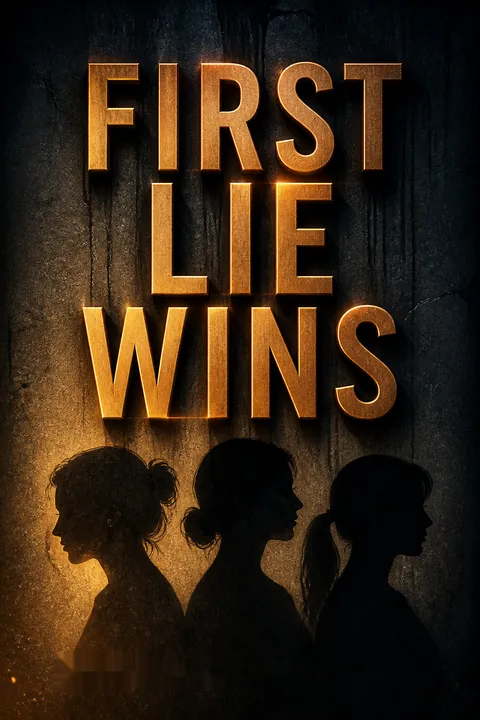


Plot Summary
A Home Built on Lies
At a dinner with Ryan Sumner’s2 childhood friends, Evie Porter1 answers their questions with a carefully assembled story and watches Ryan2 smooth over their suspicions. She has already studied his habits, friends, and family online, and their meeting began when she staged a flat tire at the gas station he regularly visits.
When Ryan2 asks her to move in, she accepts, though her eagerness is complicated by the fact that their romance began as a job. She gives away the furniture she claims to own and spends a week filling a rented apartment with carefully chosen props. To Ryan,2 she is putting down roots. To Evie,1 even a toothpaste tube must look as though it belongs to a life she has lived for years.
The opening makes intimacy feel like an operation with domestic props: a toothbrush, a dinner menu, a moving box. Evie understands belonging as something that can be staged through repeated details, because her experience has taught her that people trust the familiar before they test the truth. Ryan’s willingness to welcome her offers an unexpected danger. The more convincingly she performs a partner, the harder it becomes to separate her professional control from genuine attachment. Her deception is not simply a disguise; it is a rehearsal for a life she has never been able to claim.
The Mailbox Job
Evie1 plants used toiletries, hangers, photographs, and perfume bottles in the temporary apartment so Ryan2 will believe she has possessions and habits of her own. She wants him to see someone poor but settled, not a drifter assembled for his benefit.
At the same time, she slips an envelope into a coded mailbox at a shipping store, part of the covert system through which her employer3 assigns jobs. Ryan’s2 private Thursday work in East Texas keeps drawing her attention, while her employer3 withholds the client’s identity and the full objective.
She is already compromised by a failed assignment and knows another mistake could cost her position. The apartment, the mailbox, and the romance are all pieces of one job, but Evie1 cannot yet see what her employer3 is testing.
The staged apartment is a miniature version of Evie’s larger method: manufacture evidence of continuity, then let other people complete the story for themselves. The mailbox reverses that logic. It is an anonymous channel that gives her instructions while denying her the context needed to judge them. Her employer’s control depends on this information imbalance, while Evie’s competence depends on noticing what is missing. By putting a false life beside a secret assignment, the story establishes its central psychological pressure: she can create convincing identities, but she cannot control what attachment will make those identities mean.
Lucca at the Derby
At a Derby party, Ryan2 introduces Evie1 to James Bernard,8 an old friend who has returned to town, and James’s companion,9 Lucca Marino.9 The woman9 says she grew up in Eden, North Carolina, and describes the same mother7 and childhood Evie1 has kept hidden.
She even corrects Evie’s1 mistaken name for a local festival, a detail only someone from Eden would know. Their matching features make the encounter more frightening: they could pass for sisters. Evie1 retreats to the bathroom, then returns determined to learn why Lucca9 is there.
Ryan,2 already relaxed by several drinks, later mentions that the woman9 wants to reconnect with him and meet Evie.1 Evie1 realizes the newcomer9 is not merely familiar. Someone has placed a second Lucca Marino9 inside her carefully protected life.
The doppelganger threatens Evie at the point where performance and personhood overlap. Evie can tolerate a false identity being challenged; what unnerves her is another person occupying the name, history, and physical resemblance she has reserved as her own. Her panic also exposes how little control she has over the information that formed her. The festival detail functions like a credential, not a confession. It proves that the stranger has access to a real past, while giving Evie no way to tell whether that access comes from research, surveillance, or betrayal.
A Thief Is Recruited
Years earlier, Lucca Marino1 lives in a trailer in Eden with her seriously ill mother, Angelina.7 To pay for medicine, she steals jewelry from wealthy homes by entering as a flower-shop worker, changing her hair and clothes, then returning during crowded parties.
Her mother7 teaches her sewing, observation, and the art of transforming an appearance, unaware of how Lucca1 uses those skills. After her mother7 dies, Lucca1 escalates to stealing credit-card data at a country-club fundraiser.
The scheme is discovered, and police prepare to arrest her, but a detective intervenes, returns her equipment through an intermediary, and directs her to Matt Rowen.10 Matt10 offers money and protection in exchange for criminal work. Lucca1 accepts, choosing a dangerous apprenticeship over a return to poverty and a future she no longer knows how to imagine.
Lucca’s criminal skill begins as an answer to care, not appetite. She steals because a sick parent needs treatment, then learns that changing her appearance can make her almost invisible to the people whose homes she enters. Her mother’s craft becomes both inheritance and instrument: clothing can help a person survive, but it can also conceal the person doing the surviving. After Angelina dies, the moral boundary that once gave Lucca’s risk a purpose begins to dissolve. Matt’s offer exploits that vacancy, presenting organized crime as a more reliable version of the resourcefulness she already depends on.
Lucca Rewrites the Assignment
On her first major assignment, Lucca1 works inside the Kingston household as nanny Izzy Williams,1 searching for a flash drive hidden in the home. She finds it in a wall safe, but Jenny Kingston catches her and falls, striking her head.
Rather than abandon five-year-old Miles, Lucca1 calls his father, then escapes with the drive. Her employer3 scolds her for getting emotionally involved, and the incident teaches her how easily concern can become a liability. Years later, the political operative Mia Bianchi1 is ordered to frame the upright Tennessee candidate Andrew Marshall11 in a staged sexual scandal.
Lucca1 rejects the weak plan, protects Andrew11 from the setup, and obtains compromising evidence against a corrupt senator instead. She confronts Matt10 and demands to report directly to Mr. Smith,3 forcing her way into a more powerful role.
The Kingston job gives Lucca her first costly lesson in attachment: her decision to alert Miles’s father is humane, but it also exposes the conflict between the task and the person trapped inside it. Andrew’s assignment later shows a different kind of growth. Lucca no longer treats obedience as the only route to survival; she evaluates whether a plan can work and changes it when it cannot. Yet her rebellion remains tactical rather than liberating. She gains authority by becoming more useful to the organization, not by leaving it, so competence advances her power while deepening her dependence.
The Laundry Room Test
Four years before the Louisiana job, Lucca1 is one of several operatives sent to steal a painting from Texas oilman Ralph Tate. With Devon’s4 help, she recognizes that the heavily protected trophy room is a decoy.
The real painting is hidden behind a concealed panel in the laundry room, where she replaces it with a forgery and escapes. She later tracks down Amy Holder,5 one of the other operatives, and learns that the contest was also a purge: several workers who failed have since died under suspicious circumstances.
Lucca1 and Amy5 begin to consider how to protect themselves from Mr. Smith,3 though neither can yet act openly. The painting job proves Lucca1 can outthink her employer’s3 tests, but it also convinces her that success alone will never make her safe.
The hidden painting clarifies how Lucca thinks: the most elaborate obstacle may be designed to attract attention, while the true answer sits in an ordinary room. That insight wins the job, but the aftermath turns victory sour. Amy’s account of the other operatives reframes Mr. Smith’s contests as methods of control, not neutral measures of talent. Lucca’s growing independence therefore begins not with a clean break but with a recognition that competence cannot earn security from someone who profits from keeping every worker replaceable.
Two Luccas, One Crash
In the present, Evie1 returns to Ryan’s2 East Texas warehouse and hears him interrogate an employee who tried to divert stolen merchandise. The gentle boyfriend2 has built a ruthless black-market trucking operation, and Evie1 understands why her employer3 targeted his business.
She invites James8 and Lucca9 to dinner, tests Lucca’s9 knowledge of Eden, and deliberately leaves a suspicious spreadsheet where the woman9 will find it. The next morning, news reports that James8 and Lucca9 have died when their car plunged into a lake.
Ryan2 blames himself for their departure after an argument about money, while police question Evie1 and Ryan2 at James’s parents’8 home. Evie’s1 earlier confrontation with the lookalike9 now appears to have ended in murder, and her employer’s3 hand is nowhere yet in view.
This section collapses two kinds of intimacy into one trap. Evie hears Ryan’s violence at work, then returns to a dinner where the impostor can perform tenderness and domestic ease. The contrast complicates Evie’s assumptions about Ryan without yet proving he is her enemy. The crash cuts off the possibility of learning the stranger’s motives directly and leaves Evie with both grief and evidence-shaped uncertainty. Ryan’s guilt is real, but the reader cannot safely treat his emotional response as proof of innocence. In this world, feelings are genuine and still useful to whoever knows how to exploit them.
Evie Becomes a Witness
After James’s8 death, Evie1 helps at the Bernard home and finds the impostor’s9 hidden instructions. They tell her to search Evie’s1 belongings, confirming that the woman9 was on an assignment, though she seemed unaware they shared an employer.3
The next morning police arrive at Ryan’s2 house with a warrant connecting Evie Porter1 to the death of Amy Holder5 in Atlanta. Rachel Murray,6 Ryan’s lawyer friend,6 represents her and uncovers years of documents that make Evie1 appear to have a stable legal identity.
Evie1 recognizes photographs from earlier assignments under other names. After she is released, an origami swan from Mr. Smith3 directs her to a safe-deposit box in Atlanta, where he believes she hid evidence from the Amy Holder5 job. He sets a deadline and threatens to give police more proof.
The warrant transforms Evie’s invented identity from protective cover into a public record that can be used against her. Rachel’s document search is especially destabilizing because it shows that Mr. Smith has not merely assigned aliases; he has manufactured a past with enough bureaucratic weight to survive scrutiny. The impostor’s instructions reveal the same system at work on another person. Evie is no longer simply being watched. Her private history, legal identity, and possible criminal liability have been arranged by someone else, leaving her to fight with evidence that appears more solid than the truth.
The Road Trip Fractures
Evie1 leaves for Atlanta with Ryan,2 despite insisting she must handle the case alone. In Oxford, Mississippi, she visits former coach Mitch Cameron12 and provokes him into contacting Mr. Smith3 through a King Harvest fan forum. The response confirms the employer’s3 hidden communication channel.
Later, at a motel, Evie1 overhears Ryan2 speaking familiarly with George,3 Mr. Smith’s3 delivery man,3 and finds the documents George3 gave Ryan.2 They include the unaltered records Evie1 secretly changed to protect Ryan’s2 trucking business.
She slips away before dawn, drives to Eden, and plants a file that lets Devon4 hack into Mr. Smith’s3 system. Devon4 sends her the identification she needs: her employer3 is Christopher Smith,3 the same man she knew as George.3 The discovery changes the final Atlanta meeting from defense into a trap.
The road trip turns romantic closeness into an evidentiary problem. Ryan’s desire to accompany Evie could signal care, surveillance, or both, and the unaltered records make that ambiguity impossible to ignore. Evie’s decision to flee is not a final judgment on Ryan; it is a refusal to let affection outrank the facts. The Mitch maneuver also marks a shift in her method. Rather than wait for Mr. Smith to reveal himself, she creates a situation that forces him to respond. For once, she uses controlled unpredictability against the person who trained her to expect it.
The Dead Woman’s Alibi
In Atlanta, Rachel6 moves the police interview to a hotel meeting room, where detectives show footage placing a woman who looks like Evie1 inside Amy Holder’s5 burning hotel room. Evie1 identifies the woman9 as Lucca Marino,9 the recently deceased visitor from Lake Forbing, and claims she knew Amy5 through criminal associates.
She backs the account with a fabricated past in Brookwood, Alabama, and an alibi from Tyron Nichols,13 a football player whose career she helped protect years earlier. Tyron13 confirms she was at his home on the night of the fire.
The detectives agree to verify the new information and end the interview without charging her. Evie1 has not disproved the footage; she has given investigators a more plausible person to pursue, buying time to confront Mr. Smith3 at the bank.
Evie’s defense works by redirecting attention rather than proving innocence. She recognizes that the footage is too strong to erase, so she gives the detectives a different identity that can absorb it. The maneuver relies on an uncomfortable distinction between factual accuracy and truthful implication: the woman in the room was indeed Lucca Marino, but the detectives are led to understand that name as belonging to someone else. Tyron’s alibi converts an old act of mentorship into present protection. Evie survives by using the very network of fabricated histories that has been used to endanger her.
The Box Is Empty
At the bank, George3 opens the safe-deposit box he believes contains the information Amy5 stole. It holds only an origami swan. Evie1 tells him she knows his real name, Christopher Smith,3 and explains that Amy’s5 files document years of his double-crossing of Victor Connolly and the Connolly crime family.
She had kept the evidence elsewhere and arranged for it to reach them. Smith3 accuses her of failing her assignment; Evie1 answers that she completed a different, more important one by protecting herself.
Connolly and his people wait outside. Smith3 walks out to meet them and is taken away, while Evie1 leaves the bank without the box. She has not won a clean escape, but she has ended the employer’s3 control over her through the threat he spent years using against others.
The empty box is both a decoy and a final refusal to let Smith dictate the meaning of evidence. He expects the object to confirm his power over Evie; instead, it reveals that she has kept the decisive information beyond his reach. Naming him strips away the protective abstraction of Mr. Smith and George, collapsing the identities he used to manage other people. Yet Evie does not defeat him through moral purity. She hands his crimes to a more dangerous force, choosing a consequence she can direct over a future in which she remains his instrument.
The Swan’s Last Secret
After the bank, Evie1 reaches Devon’s4 cabin and discovers Amy5 alive. The two women and Devon4 had planned for Amy5 to appear drunk, die in a hotel fire, and draw out the evidence Smith3 held against Evie.1
Devon4 smuggled Amy5 from the room in a housekeeping cart, replacing her with an unidentified body, while the staged death forced Smith3 to reveal his evidence and his identity. In Lake Forbing, Ryan2 had stayed close to Evie1 after Smith3 falsely claimed she was stealing from him; the altered records and Evie’s1 grief made him doubt the accusation.
Three months later, Evie1 returns to Ryan,2 explains her past, and learns his own account. They resume their relationship with fewer illusions. The final glimpse finds Evie,1 Amy,5 and Devon4 monitoring new requests through the covert channel, so the old life has not quite released her.
The staged death resolves the thriller’s central question by showing that Evie’s apparent isolation was partly an engineered condition: Amy and Devon had been building an alliance around her for years. Yet the rescue does not restore a simple distinction between crime and freedom. Evie and Ryan reunite because both can acknowledge their compromised lives, while the final return to the message board suggests that she has not abandoned the skills and networks that made her dangerous. The ending grants her chosen companionship, not innocence. Her new possibility is defined by greater agency over whom she trusts and what she risks.
Analysis
First Lie Wins treats identity as a practical technology. A name becomes credible through repeated, ordinary evidence: a social-media photograph, an apartment lease, a familiar brand of soap, a police record. Lucca’s1 talent lies in understanding that people rarely verify a whole life; they verify a few details that fit their expectations. That makes her skilled at deception, but it also leaves her dependent on systems that can be turned against her. Mr. Smith’s3 power comes from controlling not just the lies, but the records that give those lies institutional force.
The novel’s most important emotional tension is not whether Evie1 can fall in love while deceiving Ryan.2 It is whether affection can survive when both people have reasons to observe, test, and withhold. Ryan’s2 home offers a concrete alternative to Evie’s1 itinerant existence, but its apparent safety is inseparable from the secrets attached to his business. Their relationship becomes possible only when each can stop treating partial knowledge as the same thing as trust. The women’s alliance offers another answer to the organization’s isolation. Mr. Smith3 keeps workers divided by making each person believe she is alone and replaceable. Evie,1 Amy,5 and Devon4 counter that structure through shared information, patient planning, and protection of one another’s vulnerabilities. Their methods remain morally compromised; they do not step into a clean world simply because they oppose a worse exploiter. The ending instead suggests a more modest freedom: agency over one’s collaborators, the right to choose what to disclose, and the chance to build a future without pretending the past never happened.
Review Summary
First Lie Wins received mostly positive reviews, with many readers praising its twisty plot, clever writing, and engaging characters. Reviewers enjoyed the cat-and-mouse game and the unreliable narrator aspect. Some found the pacing slow or the plot convoluted, but most agreed it was an entertaining thriller. The book's unique premise and well-executed twists were frequently highlighted. While a few readers felt underwhelmed, the majority recommended it as a gripping, suspenseful read that lived up to the hype.
People Also Read









Characters
Evie Porter
The practiced infiltratorEvie is observant, self-disciplined, and exceptionally skilled at adapting her appearance and story to the people around her. She reads social habits as carefully as other people read documents, but her control has a cost: she treats vulnerability as a security risk and rarely expects anyone to protect her without wanting something in return. Her connection with Ryan2 unsettles that rule because his affection begins to feel meaningful even while she is working against him. Evie’s sharpest strength is not simply lying; it is recognizing which details other people need in order to believe a lie. Her deeper struggle is learning whether a self built for survival can still choose a life beyond the next assignment.
Ryan Sumner
The trusted hometown sonRyan is a dependable friend, a generous host, and a man deeply attached to the house and community that raised him. He inherited his grandparents’ home and carries their history into his adult life, which makes Evie’s1 invitation into that space unusually intimate. His warmth does not mean he is harmless: he is capable of forceful, unsentimental decisions in his business, and he protects what he has built. Ryan’s loyalty can become a weakness when he keeps rescuing people who refuse to change, but it also makes him patient with those who need time to tell the truth. He wants partnership to mean shared responsibility, not merely shared space.
Mr. Smith
The hidden handlerMr. Smith manages criminal jobs through intermediaries, false identities, coded messages, and carefully rationed information. He values competence but does not confuse usefulness with loyalty; his workers are kept uncertain about one another and about the larger organization. His methods turn personal knowledge into leverage, because he studies what each operative wants and saves that knowledge for moments of pressure. He is patient enough to build elaborate identities and ruthless enough to discard the people who inhabit them. For Evie1, he is both employer and teacher, which makes their conflict more intimate than a simple contest between a criminal and a target.
Devon
The unseen technical allyDevon is a gifted hacker and planner who prefers to work behind the scenes, where he can control systems without drawing attention to himself. His caution can look like distance, but he is fiercely loyal to the few people he trusts. He supports Evie1 with surveillance, disguises, secure communications, and the patient technical work her jobs require. Devon is not merely a tool she calls when a plan goes wrong; he challenges her assumptions and makes her consider the risks she would rather rush past. His care is expressed through preparation and practical help, a quieter form of intimacy than Evie1 is accustomed to receiving.
Amy Holder
The guarded operativeAmy is a capable criminal operative who has learned to survive by keeping her intentions and vulnerabilities closely guarded. She understands the danger of working for someone who controls information, and she is wary of alliances that could expose the people she cares about. Her bluntness contrasts with Evie’s1 social camouflage, but both women are skilled at reading a room and anticipating the cost of a mistake. Amy’s relationship with Evie1 grows from professional rivalry into a rare form of trust, built not on easy confessions but on shared recognition of the system that constrains them.
Rachel Murray
The relentless local lawyerRachel is a sharp attorney and one of Ryan’s2 oldest friends. She distrusts Evie’s1 sudden arrival and asks the questions the rest of the friend group avoids, even when doing so makes her unpopular. Her skepticism is not simple hostility; she sees loyalty to Ryan2 as a responsibility to test the people he lets close. Once she represents Evie1, Rachel applies the same professional rigor to a client whose secrets she cannot fully understand. She is capable of respecting a boundary without pretending the boundary has answered every question.
Angelina Marino
Lucca’s resourceful motherAngelina is a talented seamstress who makes dresses and costumes for families in her community. Her creativity teaches her daughter1 that clothing, posture, and presentation can change how the world sees a person. Even while ill, she imagines a safer and more generous future for Lucca1, complete with a house and garden. Angelina’s influence is practical rather than grand: she passes on craft, patience, and the habit of making something beautiful with limited materials. Lucca1 carries those lessons into a life her mother could never have intended.
James Bernard
Ryan’s troubled old friendJames returns to Lake Forbing burdened by gambling, money problems, and a history of relying on Ryan2 to rescue him. He can be charming and familiar, especially with the people who knew him as a boy, but he is not skilled at hiding his instability. His presence reconnects Ryan2 with an unresolved friendship and gives the newcomer Lucca9 an entry into the town’s social circle. James’s need for help repeatedly tests the difference between loyalty and enabling someone who has not taken responsibility for his choices.
The lookalike
The borrowed pastThe woman who arrives in Lake Forbing has Evie’s1 features and claims the history of Lucca Marino1. She is composed, observant, and convincing enough to win over people who once knew the girl she represents. Her presence forces Evie1 to confront the fact that personal history can be researched, rehearsed, and assigned to someone else. She is not simply a mirror image; she is a professional trying to perform a role under the same system of secrecy that shaped Evie’s1 life.
Matt Rowen
The recruiting intermediaryMatt is the polished intermediary who first offers Lucca1 criminal work after she is caught stealing. He presents the organization as a source of money, protection, and opportunity, appealing to a young woman who has little reason to trust ordinary institutions. Matt is personable when he wants cooperation and controlling when a worker challenges his authority. His role reveals how recruitment can dress exploitation in the language of mentorship: he gives Lucca1 access to a larger world while helping bind her to it.
Andrew Marshall
The principled politicianAndrew is a Tennessee political candidate whose integrity makes him a poor target for the scandal his handlers want to manufacture. He treats his wife and staff with respect and resists the temptation to use political power as personal license. Lucca’s1 work around him puts her in contact with a person whose values are not merely public performance. Their encounter gives her a rare example of someone who can acknowledge a dangerous mistake without becoming defined by it.
Mitch Cameron
The coach with a clueMitch is a college football coach whose reputation rests on discipline and strong relationships with his players. He is caught in the machinery of recruiting, wealthy boosters, and institutional pressure, yet he is careful about the young athletes whose futures depend on his choices. His part in Lucca’s1 work reveals how money can shape a sports program without making every person in it corrupt. Years later, he becomes a useful contact because Lucca1 understands that his private dealings can expose the channel her employer3 uses.
Tyron Nichols
The protected young athleteTyron is a talented high-school football player from a crowded, working-class household, with a future that depends on navigating recruitment carefully. Lucca1 watches him weigh offers while understanding how little room he has to make a mistake. He is perceptive enough to recognize that the adults surrounding him do not always have his interests at heart. Their encounter leaves him with practical advice about money, privacy, and keeping his own counsel, establishing a bond that later reaches beyond football.
Heather
Amy’s vulnerable sisterHeather is Amy’s5 estranged sister, a woman trying to build a stable life while carrying the risks of a difficult past. Her daughter’s safety matters deeply to Amy5, making Heather a source of both love and vulnerability. Heather’s circumstances show how an employer3 can threaten someone who never chose to join the criminal world.
Plot Devices
Manufactured identities
A life assembled from detailsThe organization gives operatives names, histories, documents, online traces, and sometimes photographs that support a chosen identity. Lucca1 uses different names and appearances to enter households, political campaigns, and wealthy social circles, while Mr. Smith3 uses the same system to make Evie Porter1 appear legally established. The device works because each fabricated identity contains enough mundane detail to withstand casual scrutiny. Its deeper danger is that a cover can become more documented than the person who created it, leaving the operative vulnerable to evidence that makes a false life look more real than her own.
The coded mailbox
Instructions without contextEvie1 retrieves messages from numbered mailboxes at shipping stores, using codes and timing to receive information without direct contact with her employer3. The system lets Mr. Smith3 reveal the next piece of a job while concealing the client, the larger plan, and the identities of other workers. It gives the story a physical image for the organization’s control: an envelope can direct Evie’s1 movements, but it cannot tell her what she is being used to prove. The mailbox also becomes a point of risk when a message fails to arrive or someone else is sent to inspect her life.
The origami swan
A childhood craft turned signalThe folded paper swan links Lucca’s1 memories of her mother7 with the covert messages and carefully staged evidence that shape her adult life. Angelina7 taught her to fold the figure, and Lucca1 later uses the form as a small, personal token that can pass unnoticed among ordinary objects. In the final confrontation, a swan occupies a safe-deposit box where Mr. Smith3 expects incriminating files. Its familiarity gives the object emotional weight, while its blankness denies him the answer he came to claim. The swan turns a sign of inherited tenderness into an instrument of misdirection.
King Harvest message board
A hidden route to the handlerA fan forum devoted to the band King Harvest doubles as a discreet communication channel between Mr. Smith3 and clients. A casual post about hearing the group’s best-known song can begin a coded exchange, making the site appear harmless to anyone who does not know the convention. Evie1 discovers the channel by prompting Mitch Cameron12 to contact his employer3, then Devon4 uses the trail to help identify Mr. Smith3. The device captures the story’s central irony: a system built to conceal the powerful depends on recognizable patterns, and a pattern can be turned into evidence.
Staged evidence
Proof used as leveragePhotographs, altered records, planted papers, and fabricated online histories repeatedly steer what characters and institutions believe. Mr. Smith3 uses evidence to make Evie1 appear connected to Amy Holder’s5 death and to push her toward a bank vault. Evie1 and her allies answer with their own strategic records, including an alibi and a false trail that encourages detectives to investigate the dead woman who resembles her. These pieces of evidence do not simply establish what happened; they shape which version of events seems easiest to accept. The device keeps the suspense grounded in a world where documentation can be engineered.
FAQ
Synopsis & Basic Details
What is First Lie Wins about?
- A woman's hidden life: The story follows Evie Porter, a woman living a seemingly normal life in a small Louisiana town with her boyfriend, Ryan. However, Evie is not who she appears to be; she has a hidden past and a carefully constructed identity.
- Navigating deception and danger: As Evie integrates into Ryan's world, she must navigate social events and relationships while keeping her true identity a secret. The arrival of a woman with her real name and background threatens to expose her.
- A battle for control: Evie is forced to confront her past and the shadowy figure who has controlled her life, Mr. Smith. She must decide whether to continue playing his dangerous game or break free and forge her own path.
Why should I read First Lie Wins?
- Intriguing protagonist: Evie Porter is a complex and compelling character, a master of deception with a hidden past, making her journey both thrilling and emotionally resonant.
- Twisty plot: The story is full of unexpected twists and turns, keeping readers guessing about Evie's true identity and the motives of those around her.
- Exploration of identity: The novel delves into the themes of identity, deception, and the lengths one will go to protect their secrets, offering a thought-provoking exploration of these concepts.
What is the background of First Lie Wins?
- Contemporary setting: The story is set in the present day, with references to modern technology and social media, which play a role in the characters' lives and the plot.
- Small-town dynamics: The setting of a small Louisiana town highlights the close-knit community and the scrutiny that Evie faces as an outsider, adding to the tension and suspense.
- Criminal underworld: The story touches on the criminal underworld and the dangerous world of espionage, with references to blackmail, stolen goods, and shadowy figures, creating a sense of unease and danger.
What are the most memorable quotes in First Lie Wins?
- "The first lie wins.": This recurring phrase highlights the importance of the initial deception in shaping perceptions and controlling narratives, a key theme in the book.
- "You have to be ruthless in business, even more so when you're working on the wrong side of the law.": This quote reveals a darker side of Ryan and the world he operates in, showcasing the harsh realities of his life.
- "I'm not a part of that family. That is not your life. Not your world. You're a ghost who drifted through it for a little bit of time.": This quote from Mr. Smith emphasizes the transient nature of Evie's existence and the emotional detachment required for her work.
What writing style, narrative choices, and literary techniques does Ashley Elston use?
- First-person perspective: The story is told from Evie's point of view, allowing readers to experience her thoughts, emotions, and internal conflicts, creating a sense of intimacy and immediacy.
- Non-linear timeline: The narrative shifts between the present and the past, gradually revealing Evie's backstory and the events that led her to her current situation, building suspense and intrigue.
- Foreshadowing and red herrings: Elston uses subtle foreshadowing and red herrings to mislead the reader and create a sense of uncertainty, keeping the reader guessing about the true nature of the characters and their motives.
Hidden Details & Subtle Connections
What are some minor details that add significant meaning?
- The perfume bottles: Evie's collection of perfume bottles, initially presented as a quirky hobby, mirrors Ryan's mother's collection, hinting at a deeper connection and a shared interest that Evie uses to her advantage.
- The origami swan: The origami swan, a symbol of Lucca's past, appears at various points, highlighting the connection between Evie and her former identity and foreshadowing the reveal of her true self.
- The silver cups: The personalized silver cups at the Derby party, with the initials R and E, symbolize the superficiality of the social circles Evie is trying to infiltrate and the false sense of belonging she is trying to create.
What are some subtle foreshadowing and callbacks?
- The flat tire: The flat tire incident, which is how Evie and Ryan meet, is a callback to the "damsel in distress" approach that Mr. Smith recommended, highlighting the calculated nature of their relationship.
- The mention of Eden, North Carolina: The repeated mention of Eden, North Carolina, foreshadows the reveal of Lucca's true identity and her connection to Evie's past, creating a sense of unease and anticipation.
- The "You know you can tell me anything" line: Ryan's repeated line, "You know you can tell me anything, right?" is a subtle foreshadowing of the secrets he is hiding and the eventual reveal of his true nature.
What are some unexpected character connections?
- Ryan and Mr. Smith: The connection between Ryan and Mr. Smith, revealed later in the story, is unexpected and highlights the extent of Mr. Smith's influence and the complex web of relationships that Evie is caught in.
- Evie and Lucca: The physical similarities between Evie and Lucca, initially presented as a coincidence, are later revealed to be a deliberate choice by Mr. Smith, highlighting his manipulative nature and the extent of his control over Evie's life.
- Rachel and Ryan: The friendship between Rachel and Ryan, initially presented as a simple connection between friends, becomes a source of tension and conflict as Rachel's loyalty to Ryan clashes with her professional obligations to Evie.
Who are the most significant supporting characters?
- Devon: Devon, Evie's tech expert, is a crucial supporting character who provides her with the tools and information she needs to navigate her dangerous world, highlighting the importance of trust and loyalty.
- Amy Holder: Amy Holder, though deceased, is a significant supporting character whose actions and the information she possessed drive the plot forward, highlighting the dangers of the criminal underworld.
- George: George, the delivery guy, is a seemingly minor character who is later revealed to be Mr. Smith, highlighting the extent of his control and the hidden dangers that surround Evie.
Psychological, Emotional, & Relational Analysis
What are some unspoken motivations of the characters?
- Ryan's need for control: Ryan's unspoken motivation is his need for control, which is evident in his business dealings and his desire to protect Evie, highlighting his complex and often contradictory nature.
- Mr. Smith's desire for power: Mr. Smith's unspoken motivation is his desire for power and control, which is evident in his manipulation of Evie and his willingness to use others to achieve his goals.
- Evie's longing for connection: Despite her carefully constructed facade, Evie's unspoken motivation is her longing for genuine connection and belonging, which is evident in her interactions with Ryan and her desire for a normal life.
What psychological complexities do the characters exhibit?
- Evie's internal conflict: Evie exhibits a complex internal conflict between her desire for a normal life and her need to protect herself, highlighting the psychological toll of living a life of deception.
- Ryan's duality: Ryan exhibits a duality between his charming and caring persona and his ruthless business dealings, highlighting the psychological complexities of his character.
- Mr. Smith's manipulative nature: Mr. Smith exhibits a manipulative and controlling nature, highlighting the psychological impact of power and the lengths to which he will go to maintain it.
What are the major emotional turning points?
- The discovery of Lucca's identity: The discovery of Lucca Marino's true identity is a major emotional turning point for Evie, forcing her to confront her past and the possibility that her secrets are about to be exposed.
- The car accident: The car accident that kills Lucca is a major emotional turning point for Evie, forcing her to confront the consequences of her actions and the dangerous world she inhabits.
- The reveal of Ryan's involvement: The reveal of Ryan's involvement with Mr. Smith is a major emotional turning point for Evie, forcing her to question her trust in him and the nature of their relationship.
How do relationship dynamics evolve?
- Evie and Ryan's relationship: The relationship between Evie and Ryan evolves from a seemingly genuine connection to a complex web of deception and hidden agendas, highlighting the challenges of trust and intimacy in a world of lies.
- Evie and Rachel's relationship: The relationship between Evie and Rachel evolves from a professional alliance to a genuine friendship, highlighting the importance of trust and loyalty in a world of deception.
- Evie and Mr. Smith's relationship: The relationship between Evie and Mr. Smith evolves from a master-apprentice dynamic to a battle of wills, highlighting the struggle for power and control.
Interpretation & Debate
Which parts of the story remain ambiguous or open-ended?
- Mr. Smith's true identity: While Mr. Smith's real name is revealed, his true motivations and the full extent of his organization remain ambiguous, leaving room for speculation and further exploration.
- The future of Evie and Ryan's relationship: The future of Evie and Ryan's relationship is left open-ended, leaving readers to wonder whether they can overcome the lies and betrayals that have defined their past.
- The extent of the criminal underworld: The extent of the criminal underworld and the reach of Mr. Smith's influence remain ambiguous, leaving readers to ponder the larger implications of Evie's actions.
What are some debatable, controversial scenes or moments in First Lie Wins?
- Evie's manipulation of Ryan: Evie's manipulation of Ryan, while necessary for her survival, raises questions about the ethics of her actions and the extent to which she is willing to go to protect herself.
- The death of Lucca Marino: The death of Lucca Marino, while presented as an accident, raises questions about Mr. Smith's true motives and the lengths to which he is willing to go to maintain control.
- Evie's decision to leave Ryan: Evie's decision to leave Ryan at the end of the story, while necessary for her safety, raises questions about the possibility of genuine connection and the sacrifices required for survival.
First Lie Wins Ending Explained: How It Ends & What It Means
- Evie's escape: The ending sees Evie escaping from Mr. Smith's control, but not without a cost. She has to abandon her life with Ryan and go on the run, highlighting the sacrifices she must make to protect herself.
- The cycle of deception: The ending suggests that the cycle of deception and manipulation may continue, as Evie is forced to adopt a new identity and navigate a world where trust is a rare commodity.
- A bittersweet victory: The ending is bittersweet, as Evie achieves a measure of freedom but at the cost of her relationship with Ryan and the possibility of a normal life, highlighting the complexities of her journey and the sacrifices she has made.
Download PDF
Download EPUB
.epub digital book format is ideal for reading ebooks on phones, tablets, and e-readers.








