


Plot Summary
The Explorer Comes Home
Monji Kadokura, a retired archaeology professor and restless traveler, visits Funiculi Funicula hoping to speak once more with Mieko, his wife, who lies in a vegetative state. He does not expect to undo her accident.
He wants to understand the café’s time-travel rules, and his curiosity leads him to ask whether returning visitors’ memories can be changed. Kazu Tokita, the waitress, explains that the past cannot alter the present, but memories remain intact.
That distinction gives Kadokura a reason to go: even if Mieko’s fate cannot change, she can remember what he tells her. His children have grown up while he spent long stretches abroad, and now he faces the cost of having mistaken a life without regrets for a life without unfinished words.
Kadokura’s first impulse is intellectual: he treats the café’s rules as a problem to investigate. Yet his question about memory exposes a more intimate concern. He does not need the past to become malleable; he needs his words to survive the journey. The story distinguishes external causality from inner experience: the event cannot be revised, but the meaning carried forward can. Kadokura’s regret is also belatedly relational. His life of self-directed exploration did not feel costly while Mieko was there to welcome him home. Her silence now makes visible how much he relied on her patient presence without naming its value.
A Curse, Carefully Measured
Before taking the time-travel seat, Kadokura insists on testing the café’s curse by pulling the white-dressed woman from her chair. The supernatural punishment leaves him crawling under an unbearable heaviness until Kazu calms the woman with coffee. Rather than retreat, Kadokura studies what happened, then notices that Kazu’s face resembles the silent customer’s.
He learns that the woman, Kaname, became a ghost after failing to finish her coffee while visiting her dead husband. The discovery turns a strange rule into a family wound: Kazu lives beside a mother fixed in the café, unable to age or leave her seat. Kadokura waits until the chair is vacant, accepts the coffee limit, and prepares to return to the years before Mieko’s accident.
Kadokura’s experiment makes his curiosity both comic and ethically revealing. He wants direct evidence even when another person bears the cost, a habit that recalls the way his own interests once took precedence over family. His recognition of Kazu and Kaname shifts the rules from entertaining oddities to lived consequences. The ghost is not simply a device that enables travel; her continued presence is the price of a missed deadline and an enduring separation. Kadokura’s decision to proceed now carries a sharper awareness of risk. His research-minded attention has not disappeared, but it has been forced to register the human stakes hidden inside the café’s mechanics.
The Anniversary He Forgot
Kadokura arrives three years in the past, when Mieko and their grown children have gathered at the café. His daughters reveal that the visit coincides with his wedding anniversary, a date he has forgotten, and their anger exposes how little attention he has paid to family rituals.
With his coffee cooling, he tells Mieko that an accident will soon leave her unable to respond, despite knowing the warning cannot prevent it. His children are shaken, especially his eldest daughter, who condemns his matter-of-fact delivery.
Kadokura then tells Mieko that their life together made him happy and urges their children to cherish the months ahead. He drinks in time and returns to the hospital, where Mieko remains unresponsive. His regret is eased, but his hope that she will wake begins.
The anniversary becomes a concrete measure of Kadokura’s habitual absence, not because rituals are inherently virtuous, but because he has failed to notice what they mean to Mieko. His warning is morally complicated: he gives the family knowledge that cannot change the outcome, and his daughters must carry it. Yet the visit also breaks his old pattern of assuming that provision and return are enough. He speaks plainly about happiness, something he could not say while ordinary life offered endless chances. The unchanged present does not make the encounter useless. It changes what the visitors know, and therefore what they can choose to value while time remains.
Apollo's Empty Bed
After Apollo, their golden retriever, dies at thirteen, Mutsuo Hikita visits the café carrying an old magazine that describes its time-travel legend. He explains that Sunao stayed beside Apollo through his final illness, but fell asleep shortly before he died and cannot forgive herself for missing his last moments.
Mutsuo hopes that seeing Apollo again might comfort her, though he worries that grief could make her forget to finish the required coffee. Nurse Nana Kohtake and café owner Nagare Tokita warn him that the rules are real and that Sunao must choose for herself.
A few days later, Sunao comes to return Mutsuo’s borrowed umbrella. After circling around her real purpose, she admits she wants to go back, learns she cannot leave the chair to care for Apollo, and nearly gives up.
Sunao’s guilt focuses on a brief lapse in vigilance, but that lapse has become a verdict on her entire relationship with Apollo. Mutsuo’s attempt to help is tender and cautious: he wants to offer a possible meeting, yet fears that the very strength of her love could endanger her. The café’s rules prevent practical repair, which forces Sunao to distinguish care from control. She cannot return to become a better nurse or extend Apollo’s life. Her hesitation shows that grief is not solved by access to the past; the more immediate question is whether she can face the memory without treating one missed moment as proof of abandonment.
A Dog's Secret Watch
Sunao finally takes the vacant chair and returns to a walk Mutsuo and Apollo made about a year before the dog died. Apollo is old but alive, and he pulls Mutsuo into the café when he hears Sunao’s voice. She strokes his warm head, then tells Mutsuo how she fell asleep beside Apollo during his final hours and woke two hours later to find him gone.
Mutsuo listens without blaming her. He reveals that Apollo used to wait until Sunao fell asleep before settling down himself, checking on her and staying near when she cried at night. The memory recasts her last vigil: Apollo had been close to her, not abandoned. When the alarm sounds, Sunao drinks the coffee and returns to the present carrying gratitude instead of only remorse.
The revelation does not change Apollo’s death or erase Sunao’s sleep. Instead, it changes the story she has been telling herself about those facts. Mutsuo’s memory of Apollo’s nighttime habit supplies evidence that Sunao’s bond was reciprocal: the dog watched over her as she watched over him. This is a form of emotional correction, not a revision of history. The visit also lets Sunao speak in detail about the last hours, something she had kept compressed into self-accusation. By returning with gratitude, she can remember Apollo as a companion who understood her, rather than reducing him to the final moment she missed.
The Proposal Left Behind
Hikari Ishimori once met Yoji Sakita through a puzzle-solving group, then delayed answering when he proposed because she was unsure about marriage and wanted to focus on her work as a bridal planner. Yoji promised to wait, but six months later ended the relationship by claiming he had met someone else.
After Hikari learned he had died from a preexisting heart condition, his final email about the café pulled her there. She first believes that going back might let her prevent his death or accept his proposal, then discovers neither the present nor Yoji’s fate can change.
Ready to leave, she hears Kazu clarify that memories remain intact. Hikari realizes she can still tell Yoji what she feels, even if the encounter benefits him more than it changes her own future.
Hikari’s first response to loss is to reconstruct the decision she regrets: if she had accepted, perhaps the relationship and Yoji’s life would have followed another course. The café strips away that counterfactual as a practical possibility, but not as an emotional question. Kazu’s explanation about memory redirects Hikari from outcome control toward testimony. She can no longer bargain for a different future, yet she can refuse to let Yoji’s final months remain defined by a misunderstanding. Her jealousy of Fumiko and her fear of choosing wrongly reveal how uncertainty had disguised itself as prudence. Going back becomes an act of honest attention rather than a strategy for winning him back.
Yoji's Second Proposal
Hikari returns to the Christmas Eve proposal and finds Yoji expecting her from the future. He explains that he knew his illness was worsening and had chosen to end their relationship with a false claim about another woman, rather than let Hikari accept marriage out of pity. His promise to wait had also been literal: he hoped she would come back to see him willingly.
Hikari tells him she would have wanted to share his fear, even if the future stayed fixed. Yoji offers the ring again, and she accepts, though they cannot marry in the present. The warning alarm forces her to drink before the coffee cools. Back in her own time, she keeps the ring and leaves resolved to live with the knowledge of his love.
Yoji’s deception is an attempt to protect Hikari’s freedom, but it deprives her of the chance to choose with full knowledge. His care is therefore neither simple nobility nor simple betrayal. He anticipates that illness could turn her consent into an obligation, and he would rather be misunderstood than make her feel trapped. Hikari’s response exposes the cost of that protection: she wanted the right to decide whether to share his suffering. The ring cannot create a marriage in the unchanged present, but it gives their brief meeting a material trace. Their emotional resolution comes not through a repaired future, but through a truth finally spoken between them.
The Daughter Who Turned Away
Michiko Kijimoto comes to the café six years after driving her father, Kengo, away during a visit to Tokyo. She had resented his strict advice and ignored his calls after leaving their hometown for university.
Three days after their argument, the 2011 earthquake and tsunami killed him in Yuriage. Her fiancé, Yusuke Mori, had suggested the café might let her repair the past, but Kazu explains that Michiko cannot save her father. She collapses under the news and leaves, telling Yusuke she cannot marry him because she cannot be happy while Kengo is gone.
Yusuke explains that Kengo returned toward the tsunami to retrieve savings he had set aside for Michiko’s wedding. Nurse Nana later finds Michiko on the café stairs and brings her back after closing.
Michiko’s guilt has fused two separate truths: she spoke cruelly to her father, and he later died in a disaster. Because the second event followed the first, she experiences her anger as if it caused his death. The café cannot validate that causal fantasy by letting her rescue him, and Kazu’s bluntness initially intensifies the wound. Yusuke understands that consolation cannot simply be imposed, so he does not chase Michiko when she leaves. His account of Kengo’s savings complicates her memory of an overbearing parent: even his final errand was shaped by care for her future. Michiko’s refusal of happiness shows how grief can become an obligation to remain punished.
Takoyaki Before Goodbye
After closing, Michiko returns and tells Kazu she wants to apologize, even knowing she cannot alter Kengo’s fate. In the past, she sees him arrive with Yuriage takoyaki, a favorite he brought to make her happy. She thanks him, admits she is pregnant and frightened, and confesses how badly she has treated him.
Kengo gives her the bankbook and personal seal he had saved for her wedding, then assures her that her well-being matters more than her obedience. When the alarm sounds, Michiko tells him she is glad to be his daughter and drinks the coffee. Back in the present, she takes Yusuke’s hand and chooses a future together. The café’s closing scene brings news that Mieko has awakened, while Nagare tends to baby Miki beside Kei’s photograph.
Michiko cannot prevent Kengo’s return to Yuriage or rewrite the disaster, but she can encounter the father she remembers with adult understanding. The takoyaki, once interpreted as manipulative nostalgia, becomes evidence of an ordinary, deliberate kindness. Her confession of pregnancy also reframes the meeting: she needs not only to apologize for the past, but to face a future she had been afraid to claim. Kengo’s bankbook turns parental care into something tangible, while his blessing releases her from the belief that happiness betrays him. The final café news does not make every loss reversible. It places one unexpected recovery beside ongoing grief and caregiving, preserving the book’s uncertainty about what time can give.
Analysis
The café’s central rule separates historical change from psychological change. Its visitors cannot prevent illness, death, or disaster, so the past is not a machine for repairing outcomes. Yet memory remains available, and that difference gives conversation a consequential role. Kadokura can tell Mieko what he failed to say; Sunao can hear a fuller account of Apollo’s attachment; Hikari can learn why Yoji concealed his illness; and Michiko can see her father’s care without the lens of resentment that once obscured it. None of these encounters cancels the pain that brought the characters to the café. They alter what the pain means and how the living carry it.
The book also treats love as a problem of interpretation. Mieko’s patience can look like permission for Kadokura’s absence. Apollo’s companionship becomes, in Sunao’s grief, an accusation against her. Yoji’s protective lie first resembles betrayal, while Kengo’s rules feel like rejection to a daughter longing for autonomy. In each case, affection exists alongside a failure of communication. The time-travel visits do not make people perfectly transparent; they let them test their assumptions against evidence they could not see before.
The café’s physical rules sharpen this emotional design. Waiting for Kaname’s chair, staying seated, and drinking before the coffee cools impose limits that grief would prefer to ignore. The alarm does not make farewell easier; it forces the visitor to return to the present. The required departure matters because the book refuses the fantasy that love can be proved by remaining forever beside the lost. Instead, its characters must leave with a changed memory and decide what to do next.
Across the four stories, healing is not forgetting or absolution. Kadokura’s regret leads toward gratitude, Sunao’s self-blame gives way to thankfulness, Hikari’s uncertainty becomes an honest acknowledgment of love, and Michiko’s guilt loosens enough for her to accept happiness. The café offers no altered destiny, only a final chance to speak and listen. Its modest miracle is that an unchangeable past can still become newly understood.
Review Summary
Before We Say Goodbye received generally positive reviews, with readers praising its heartwarming stories and emotional depth. Many found the time-travel premise intriguing and appreciated the book's reflections on regret, love, and closure. Some criticized repetitive elements and formulaic storytelling, especially for those familiar with earlier books in the series. The dog-related story resonated strongly with many readers. Overall, fans of the series enjoyed the continuation, while some felt it didn't break new ground compared to previous installments.
People Also Read










Characters
Monji Kadokura
Restless field scholarKadokura is a retired archaeology professor whose appetite for exploration has repeatedly carried him away from home. He is clever, observant, and unusually willing to test an idea firsthand, qualities that make him fascinated by the café’s rules and its ghost. His confidence in living without regrets has depended on treating family obligations as secondary to intellectual freedom. Yet his account of Mieko reveals that he has always relied on her as the place where he could return and speak without being interrupted. His central conflict is not whether his choices were sincere, but whether sincerity excuses the loneliness they imposed on others. He has to learn that naming his gratitude is itself a form of responsibility.
Mieko Kadokura
Patient, steadfast partnerMieko is Kadokura’s quiet wife, a woman who gives him room to pursue an unusually independent life without demanding that he become someone else. Her restraint should not be mistaken for an absence of feeling: she listens to his expedition stories, welcomes him home, and chooses the shared life they have built. She has also raised their children while he spent long periods away. Through Kadokura’s memories, Mieko appears as both an accepting partner and a person whose needs he has rarely tried to understand. Her presence gives his idea of home its emotional substance, even when he has treated home as a place to visit rather than a relationship to tend.
Sunao Hikita
Grieving dog guardianSunao is a devoted wife whose life with Mutsuo and their dog Apollo has given her a family structure she deeply treasures. She is caring and emotionally perceptive, but grief makes her turn one exhausted moment into a sweeping judgment of her own love. Her attachment to Apollo is not a substitute affection; it is a real bond that shaped her daily life and her marriage. Sunao approaches the café cautiously, unsure whether its promise is credible and wary of being offered false comfort. Her story centers on whether she can receive evidence of love without treating forgiveness as something she must earn. She seeks a final meeting not to change Apollo’s life, but to understand their shared one.
Michiko Kijimoto
Guilt-bound daughterMichiko is a university student from Yuriage who has moved to Tokyo in search of independence from her father’s constant guidance. She is quick to feel cornered and uses anger to protect the distance she wants, especially after her mother’s death altered life at home. Her resentment does not mean she lacks love for Kengo; rather, she has difficulty recognizing care when it arrives as rules and criticism. Years later, she carries an argument as though it were the cause of a disaster she could not control. Her struggle is to separate accountability for hurtful words from impossible responsibility for what followed. She wants adulthood, but must discover that accepting help and choosing happiness do not cancel that independence.
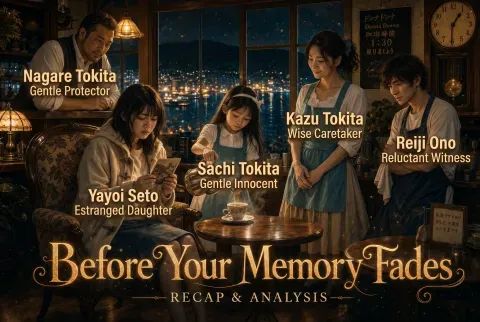
Nagare Tokita
Café's watchful ownerNagare owns Funiculi Funicula and explains its basic rules to customers, though he is less quick than Kazu to answer their deeper questions. He is imposing in stature but often hesitant when a visitor’s grief asks for more than practical guidance. His wife Kei and their baby, Miki, shape the private sadness and tenderness he carries behind the counter. Nagare responds to customers through small acts of care, including preparing familiar meals and offering umbrellas. He listens closely even when he cannot solve what troubles them, and his work in the café places him beside other people’s farewells while he continues to tend his own family life.
Kazu Tokita
Keeper of the rulesKazu is the café waitress who pours the coffee that enables each return to the past. Quiet and easily overlooked, she is also the clearest authority on the rules and their consequences. She does not soften facts merely to make them easier to hear, but neither does she force customers to travel; she leaves the decision with them. Her precision gives visitors the information they need to act under emotional pressure. Kazu’s personal connection to the café’s ghost adds a private dimension to her composure, though she rarely makes her own feelings the center of a customer’s visit. She represents care expressed through accuracy, restraint, and the willingness to let another person choose.
Mutsuo Hikita
Gentle, devoted husbandMutsuo is Sunao’s husband, a warm and practical man who treats Apollo as a beloved member of their family. He tries to help Sunao by telling her about the café, but his instinct to preserve hope makes him less direct about its limits than Kazu. Mutsuo understands that comfort can require patience, and he has a gift for noticing small patterns of care that Sunao has overlooked. His support is neither grand nor forceful. He listens, remembers, and offers a different account of events when self-blame has narrowed his wife’s view of them.
Apollo
Beloved family dogApollo is the golden retriever Mutsuo brings home, eventually becoming central to the couple’s daily life. Sunao initially sees the work involved in caring for a pet, then discovers in Apollo a responsive companion whose attention feels almost wordless. His bond with both spouses is expressed through routines, physical closeness, and sensitivity to their moods. Apollo gives Sunao a meaningful experience of family, especially as she and Mutsuo face difficulty having children. He is not merely a source of comfort in her memories; his presence changes how the couple understands care, companionship, and their shared home.
Hikari Ishimori
Hesitant bride-to-beHikari is a bridal planner whose work has made her attentive to the promises and uncertainties behind weddings. She cares for Yoji, but her hesitation about marriage comes from a genuine fear of choosing wrongly, not from indifference. After their relationship ends, jealousy and self-doubt make it difficult for her to examine her own feelings honestly. Hikari is perceptive about other people’s expressions, even when she is less clear about her own motives. Her return to the past asks her to act without the guarantee of a changed outcome. What matters to her is finally understanding the person she loved and being able to express what she withheld.
Yoji Sakita
Careful, devoted suitorYoji meets Hikari through a puzzle-solving group and draws her in through gentleness, attentiveness, and a dry sense of humor. He notices details others miss, including the moments when Hikari feels excluded or uncertain. His proposal reflects a sincere wish to build a life with her, but he is also deeply concerned about preserving her freedom to choose. That concern can make him secretive, as he tries to manage painful information on her behalf. Yoji’s character is shaped by a tension between self-sacrifice and trust: he wants to protect Hikari from suffering, yet protection risks denying her the chance to decide what she can bear.
Kengo Kijimoto
Protective, worried fatherKengo raises Michiko after her mother dies and carries the practical burden of supporting her education and future. His concern often comes out as instruction, rules, and criticism, making it difficult for Michiko to see the tenderness behind his behavior. He is not skilled at adjusting his parental habits as his daughter grows older, and his worry can feel like control to someone seeking distance. Yet he remembers her favorite food and thinks ahead about her security. Kengo’s character exposes the gap that can open between intention and reception: he believes he is protecting Michiko, while she experiences the same gestures as evidence that he does not trust her.
Yusuke Mori
Steady fiancéYusuke is Michiko’s fiancé and the person who tells her about the café after hearing its story from Fumiko. He offers hope without knowing how tightly Michiko’s guilt is bound to her father’s death. When she leaves the café, he does not force himself into her grief; he explains the context of Kengo’s final actions and gives her space. His restraint shows an understanding that a partner cannot repair every wound by pursuing the person who is hurting. Yusuke remains ready to meet Michiko when she is able to choose a future with him.
Fumiko Kiyokawa
Blunt café regularFumiko is a frequent customer who has already used the café’s time-travel chair herself. Intelligent and competitive, she tends to speak directly, sometimes judging a stranger’s situation before hearing the whole story. Her own unresolved feelings make her especially alert to the cost of stubbornness, though she does not always apply the same advice to herself. Fumiko helps explain the café’s rules to newcomers and reacts emotionally to their choices. She is also an accomplished systems engineer whose professional confidence contrasts with the more vulnerable uncertainty she carries in her private life.
Nana Kohtake
Candid nurse regularNana is a nurse who regularly stops at the café after work. She responds plainly to customers, but her bluntness is grounded in concern rather than cruelty. With Sunao, she encourages an honest conversation before any return to the past; with Michiko, she understands that the café’s rules cannot answer every question of grief. Nana notices when someone needs practical help and acts, including bringing Michiko back to the café. Her combination of bedside experience and direct speech allows her to support people without pretending she can remove their pain.
Kaname
Silent chair occupantKaname is the mysterious woman in a white dress who reads quietly in the café’s time-travel chair. Her regular absence from the seat creates the brief opportunity customers need to travel. She appears detached from the conversations around her, yet her presence makes the café’s rules feel physical and immediate. Kaname’s connection to the chair gives the room an atmosphere of unresolved history, while her habits remain strangely ordinary. She is a reminder that the café’s miracle has consequences beyond the customers who enter seeking one last conversation.
Kei Tokita
Nagare's beloved wifeKei is Nagare’s wife and Miki’s mother. Her photograph sits beside the café’s cash register, where it remains part of Nagare’s daily life. Though she appears mostly through this image and the family’s memories, her presence shapes Nagare’s tenderness toward their child and his understanding of loss.
Miki Tokita
The café's newest lifeMiki is the baby daughter of Nagare and Kei. She appears in the café’s back room and in Nagare’s arms, where her needs interrupt the quiet rhythm of closing duties. Her presence links the café’s grieving adults to the ordinary demands and promise of a child growing up.
Fusagi
Patient late-night visitorFusagi is a man who sometimes remains at the café after closing, studying brochures and hoping for a chance to use the time-travel chair. Nana checks whether he has managed to sit in it and gently urges him home when the café shuts. His quiet persistence suggests a private reason for returning, though the story leaves it unexplained.
Plot Devices
The time-travel chair
A seat into the pastOne particular chair in Funiculi Funicula allows a customer to return to a moment when the person they wish to meet visited the café. The seat is usually occupied by Kaname, who leaves it briefly once a day. Travelers cannot stand or move from the chair while in the past, so the device allows conversation but not physical intervention. Its limits make each visit an encounter rather than a chance to redo events. The chair also gives the café’s ordinary furniture a charged role: a person must wait, accept the rules, and choose what matters enough to say before time runs out.
The cooling coffee
A literal countdownA return begins when Kazu pours a fresh cup of coffee and ends when that coffee cools. The traveler must drink every drop before the limit expires or risk becoming a ghost permanently tied to the chair. A small alarm stirrer warns customers shortly before the coffee turns cold, but it cannot prevent them from becoming absorbed in grief or conversation. This device converts emotional urgency into a physical task: travelers must listen to the person before them while keeping track of the cup. The coffee’s temperature measures time in a way the café’s mismatched clocks cannot.
The fixed present
Memory without revisionNo action taken in the past can change the present. A warning cannot prevent Mieko’s accident, Sunao cannot alter Apollo’s final night, Hikari cannot change Yoji’s fate, and Michiko cannot save Kengo from the tsunami. However, the café does not erase what travelers or the people they meet remember. That distinction allows the visits to matter without granting the power to repair events. People can share truths, revise their understanding, and carry different feelings into the present. Kadokura’s question about memory makes this distinction explicit and becomes the emotional foundation for the other stories.
Kaname's vacant seat
A daily openingKaname occupies the chair used for time travel and leaves it only when she goes to the toilet. Customers cannot choose when this happens, so they must wait without knowing how long the opportunity will take. The rule turns patience into part of the journey and establishes Kaname as more than a supernatural obstacle: her permanent presence is connected to the risk of failing to finish the coffee. Her quiet reading and ordinary routine contrast with the extraordinary function of the chair. When she leaves, the customer’s opportunity is brief, practical, and impossible to command.
FAQ
Synopsis & Basic Details
What is Before We Say Goodbye about?
- A Unique Time-Travel Café: Before We Say Goodbye centers on Funiculi Funicula, a mysterious, dimly lit Tokyo café where patrons can travel back in time, but under extremely strict and seemingly cruel rules. The core premise is that no matter what one does in the past, the present cannot be changed.
- Journeys of Emotional Closure: The narrative unfolds through four interconnected stories, each featuring a different character seeking to revisit a specific moment in their past. Their motivations range from a husband's desire to express unspoken love to his comatose wife, to a daughter's desperate need to apologize to her deceased father.
- The Power of Acceptance: Ultimately, the book explores how these journeys, despite their inability to alter events, profoundly transform the travelers' emotional states. It delves into themes of regret, forgiveness, and the profound human need for closure, demonstrating that true change often lies within oneself, not in rewriting history.
Why should I read Before We Say Goodbye?
- Emotional Depth & Poignancy: Readers seeking a deeply moving and introspective experience will find Before We Say Goodbye compelling. It masterfully explores the complexities of human relationships, grief, and the quiet power of expressing love and regret, often leaving readers with a profound sense of catharsis.
- Unique Time-Travel Trope: Unlike typical time-travel narratives focused on altering outcomes, this novel subverts expectations by making the past immutable. This forces characters (and readers) to confront the true nature of acceptance, offering a fresh perspective on how we deal with our pasts and find peace in the present.
- Subtle Symbolism & Rich Themes: The book is rich with subtle symbolism, from the constantly ticking, misaligned clocks to the cooling coffee, all reinforcing its core themes. It's a perfect read for those who appreciate layered storytelling and enjoy uncovering deeper meanings beneath the surface of a seemingly simple plot.
What is the background of Before We Say Goodbye?
- Japanese Cultural Context: The novel is set in a traditional Japanese café, reflecting cultural nuances in communication, familial duty, and the quiet endurance of emotion. The emphasis on unspoken feelings and the importance of "saying goodbye" aligns with certain Japanese sensibilities regarding closure and respect for the deceased.
- Author's Theatrical Roots: Toshikazu Kawaguchi, a playwright and director, brings a distinct theatrical quality to the narrative. The café setting acts like a stage, with characters entering and exiting, and the strict rules creating a dramatic framework. This background contributes to the focused, character-driven scenes and poignant dialogue.
- The Great East Japan Earthquake: The fourth chapter, "The Daughter," directly references the devastating 2011 Great East Japan Earthquake and tsunami. This real-world tragedy grounds the fantastical element of time travel in a profound, collective trauma, highlighting the irreversible nature of certain losses and the enduring impact of grief on survivors.
What are the most memorable quotes in Before We Say Goodbye?
- "No matter how hard you tried to prevent the cash register from getting stolen, the thief would still make their way into the café and steal the cash register, even if it was well hidden.": This quote, early in the book, succinctly establishes the café's central, immutable rule: the present cannot be changed. It sets the stage for the characters' emotional journeys, shifting the focus from altering events to altering one's perception and acceptance of them.
- "Not having any regrets might actually be my biggest regret. I wish I was capable of feeling regret.": Spoken by Monji Kadokura, this line reveals a profound psychological complexity. It highlights his lifelong emotional detachment and sets up his journey to finally connect with his feelings, underscoring the theme that even the absence of regret can be a form of emotional void.
- "If you don't drink it all up before it cools... You will turn into a ghost and end up permanently sitting in that chair.": This chilling rule, revealed by Kazu, is a powerful cautionary tale. It not only explains the presence of the ghostly woman but also raises the stakes for every time traveler, symbolizing the danger of clinging too tightly to the past and the necessity of letting go.
- "The present does not change, right? ... Then why do I feel like I have returned a completely different person?": Sunao Hikita's poignant question after her journey encapsulates the core paradox and ultimate message of the book. It emphasizes that while external circumstances remain fixed, the internal landscape of a person—their memories, feelings, and perspective—can be profoundly transformed, leading to a new sense of peace and gratitude.
What writing style, narrative choices, and literary techniques does Toshikazu Kawaguchi use?
- Magical Realism & Subverted Tropes: Kawaguchi employs magical realism by introducing time travel into an otherwise ordinary café setting, but he subverts typical time-travel tropes by imposing strict rules that prevent altering the present. This choice shifts the narrative's focus from plot manipulation to profound emotional and psychological transformation.
- Episodic & Interconnected Structure: The novel is structured as a collection of four distinct but interwoven stories, each focusing on a new visitor to the café. This episodic approach allows for exploration of diverse human experiences of regret and loss, while recurring characters like Kazu and Nagare provide continuity and reveal subtle connections between the tales.
- Understated Prose & Dialogue: Kawaguchi's writing is characterized by its simple, direct, and often understated prose, translated from Japanese. The emotional weight is carried not by elaborate descriptions, but by the characters' internal monologues, subtle gestures, and the profound subtext within their brief, impactful dialogues, creating a quiet yet powerful emotional resonance.
Hidden Details & Subtle Connections
What are some minor details that add significant meaning?
- The Ghost's Book Choice: Kaname, the woman in the white dress, is often seen reading "The Dog that Wanted to Be a Cat and the Cat that Wanted to Be a Dog." This seemingly whimsical title subtly reflects the novel's themes of identity, longing for what one is not, and the blurring of boundaries (like life and death, or past and present), hinting at her own unresolved desires.
- The Chilly Space Around the Chair: Kadokura, with his scientific curiosity, observes that it's not just the time-traveling chair itself that's special, but the "space of about eighty centimeters long and wide that is special in some way; it begins from the middle of the table and includes the chair." This detail suggests that the magic is tied to a specific, localized anomaly, making the phenomenon more tangible and less purely mystical.
- The Misaligned Clocks: The three large pendulum clocks in the café always show different times, with only the middle one being correct. This subtle detail symbolizes the subjective and often disorienting nature of time within the café, reflecting how each character's perception of their past and present is unique and often out of sync with objective reality.
What are some subtle foreshadowing and callbacks?
- Kazu's Resemblance to the Ghost: Early in Kadokura's chapter, he observes Kazu's "translucent complexion, her narrow eyes and pensive expression, and more than that, her bone structure—or rather, her silhouette," leading him to deduce that she and the ghost are mother and daughter. This subtle foreshadowing builds anticipation for the later reveal of Kazu's personal connection to the café's most tragic rule.
- Kadokura's "Curse" Experience: Kadokura, the adventurous professor, deliberately provokes the ghost to experience her "curse," finding it "interesting" and even "therapeutic." This seemingly eccentric act foreshadows the idea that even painful or seemingly negative experiences in the café can lead to unexpected insights or a sense of relief, setting a precedent for the emotional transformations of later characters.
- Hikari's Haircut Story: Hikari's memory of cutting her hair short to impress a boy, only to be disappointed by his reaction and then comforted by Yoji's kind words, subtly foreshadows her later regret over her indecision with Yoji. It highlights her past tendency to seek external validation and her eventual realization that Yoji's love was deeper than superficial appearances.
What are some unexpected character connections?
- Nagare's Mother and Kadokura's Personality: Nagare observes that Kadokura's eccentric, wanderlust-filled personality reminds him of his own mother, who was "free-spirited and consumed by wanderlust" and "had no regard for family." This unexpected parallel connects Nagare's personal history of abandonment to Kadokura's regretful neglect of his family, subtly highlighting a shared human experience of parental impact.
- Fumiko's Subtle Shift: After Hikari's story about Yoji's self-sacrificing lie and her own "ugly jealousy," Fumiko, who had been stubbornly refusing to contact her American boyfriend, "promptly left the café, saying she just remembered there was something she had to do." This suggests Hikari's story, particularly her "I want no regrets" statement, subtly influenced Fumiko to reconsider her own stubbornness, creating an unspoken connection of mutual emotional impact.
- The Ghost's Lingering Humanity: The detail that Kaname, the ghost, still goes to the toilet and reads books ("Kaname likes novels," Nagare reveals) suggests a lingering thread of her former human routine and preferences. This unexpected "connection" to her past self makes her a more tragic and relatable figure, emphasizing that even in a ghostly state, remnants of one's life and personality persist.
Who are the most significant supporting characters?
- Fumiko Kiyokawa: Initially appearing as a "know-it-all" regular, Fumiko serves as a crucial catalyst and mirror for new visitors. Having experienced time travel herself, her blunt explanations of the rules and her own unresolved relationship with her American boyfriend provide both practical information and a relatable emotional backdrop for characters like Hikari, subtly influencing their decisions.
- Nana Kohtake: The nurse, Kohtake, acts as a voice of pragmatic empathy and blunt honesty. Her direct, no-nonsense questions and observations, such as calling Michiko "one lousy daughter," cut through self-pity and force characters to confront their true feelings, while her underlying compassion ensures her interventions are ultimately supportive.
- Yusuke Mori: Michiko's fiancé, Yusuke, is significant not just as her partner but as the initial source of her hope for time travel. His unwavering support and understanding of Michiko's deep-seated guilt, even when she pushes him away, highlight the theme of unconditional love and the importance of external support in one's journey toward self-forgiveness.
Psychological, Emotional, & Relational Analysis
What are some unspoken motivations of the characters?
- Yoji's Self-Sacrificing Lie: Yoji's "I met someone else" breakup was an elaborate, unspoken motivation to spare Hikari the pain of his terminal illness. He wanted her to be angry, not pity him, so she could move on without the burden of his impending death, demonstrating a profound, selfless love that he couldn't openly express.
- Kengo's "Interference": Michiko's father, Kengo, is perceived as "interfering" and nagging, but his unspoken motivation is a deep, anxious love and concern for his daughter, especially after her mother's death. His actions, like calling her university or bringing her favorite takoyaki, are clumsy attempts to connect and care for her in his own way.
- Kazu's Stoic Detachment: Kazu's consistently calm, almost emotionless demeanor is an unspoken coping mechanism for her profound personal tragedy: her mother is the ghost trapped in the chair. Her detachment allows her to enforce the café's cruel rules without breaking down, embodying the immense emotional burden she carries as the guardian of this liminal space.
What psychological complexities do the characters exhibit?
- Kadokura's Intellectualization of Emotion: Professor Kadokura initially approaches his wife's vegetative state with a detached, scientific curiosity, even finding the "curse" fascinating. His complexity lies in his struggle to access and express genuine regret and grief, a lifelong habit of intellectualizing his experiences, which he finally breaks through tears at his wife's bedside.
- Sunao's Guilt and Self-Punishment: Sunao's overwhelming guilt over falling asleep during Apollo's final moments leads to a form of self-punishment, where she believes she doesn't deserve happiness. Her psychological journey involves moving from this self-blame to a profound understanding of Apollo's unconditional love and her own worthiness of peace.
- Hikari's Fear of Commitment & Jealousy: Hikari's initial reluctance to marry Yoji stems from a complex mix of career focus, a vague desire for "someone better," and a deep-seated insecurity that manifests as "ugly jealousy" towards Fumiko. Her journey forces her to confront these internal conflicts, realizing her true feelings for Yoji and accepting her own imperfections.
What are the major emotional turning points?
- Kadokura's Tears at Mieko's Bedside: After his time travel, Kadokura returns to the present and, seeing his comatose wife, finally breaks down in tears, admitting, "I managed to get rid of my regrets. But now I'm hoping that you will wake up!" This is a pivotal moment where his intellectual curiosity gives way to raw, unadulterated grief and hope, signifying his emotional awakening.
- Sunao's Realization of Apollo's Love: The moment Mutsuo (in the past) reveals that Apollo always waited for Sunao to fall asleep before resting, and would "lick your eyes" when she cried, is a profound emotional turning point for Sunao. This revelation transforms her guilt into gratitude and understanding, allowing her to forgive herself and find peace.
- Michiko's Confession of Pregnancy: Michiko's decision to tell her father in the past about her pregnancy, despite knowing it won't change his fate, is a major emotional turning point. It's an act of profound vulnerability and trust, allowing her to share her present reality and fears with him, and in turn, receive his unconditional blessing and acceptance.
How do relationship dynamics evolve?
- Kadokura and Mieko: From Distance to Deep Connection: Their relationship, initially characterized by Kadokura's emotional distance and Mieko's quiet acceptance, evolves through his time travel. While the present doesn't change, his journey allows him to express his happiness and gratitude, transforming his internal relationship with her memory and leading to a deeper, albeit one-sided, connection in the present.
- Sunao and Mutsuo: Shared Grief to Mutual Healing: Sunao's guilt over Apollo's death initially creates a silent burden in her marriage. Mutsuo's encouragement for her to visit the café, and her subsequent realization about Apollo's love, allows them to move from individual grief to a shared understanding and acceptance, strengthening their bond through mutual healing.
- Hikari and Yoji: Misunderstanding to Profound Understanding: Their relationship, marred by Hikari's indecision and Yoji's "betrayal," transforms from one of misunderstanding and resentment to deep, empathetic connection. Hikari's journey reveals Yoji's selfless motivations, allowing her to accept his love and his ring, creating an enduring bond that transcends his death and her initial regrets.
- Michiko and Kengo: Rebellion to Reconciliation: Their strained father-daughter dynamic, marked by Michiko's rebellion and Kengo's perceived interference, undergoes a profound shift. Michiko's apology and confession, coupled with Kengo's unwavering love and blessing, lead to a spiritual reconciliation that allows Michiko to shed her guilt and embrace her future, honoring her father's memory.
Interpretation & Debate
Which parts of the story remain ambiguous or open-ended?
- Mieko's Miraculous Awakening: At the very end, Kadokura's wife, Mieko, "miraculously" wakes up from her vegetative state. The novel explicitly states that the present cannot be changed, leaving it ambiguous whether this awakening is a direct, albeit delayed, consequence of Kadokura's emotional journey or simply a separate, unrelated miracle. This open-endedness allows readers to ponder the subtle, indirect impacts of emotional healing on the fabric of reality.
- The Ghost's True Nature and Purpose: While Kaname is identified as Kazu's mother and a former waitress trapped by the rules, the exact nature of her ghostly existence remains somewhat ambiguous. Her ability to go to the toilet and read books adds a layer of mundane humanity to her spectral state, prompting debate about whether she is truly a "ghost" in the traditional sense or a manifestation of lingering regret and the café's unique temporal anomaly.
- The "Why" of the Rules: The café's strict rules—especially "no matter how hard you try, you cannot change the present"—are repeatedly stated as simply "because that's the rule." The narrative never provides a scientific or magical explanation for why these rules exist or who established them, leaving the ultimate purpose of the time travel open to interpretation: is it a cosmic law, a moral lesson, or simply a narrative device to focus on internal change?
What are some debatable, controversial scenes or moments in Before We Say Goodbye?
- Kadokura Provoking the "Curse": Kadokura's deliberate act of forcing the ghost to move, purely out of scientific curiosity to "experience what it feels like" to be cursed, can be seen as controversial. While it provides a unique insight into the curse's nature (and even a humorous, therapeutic outcome for him), it also highlights his initial emotional detachment and a disregard for the ghost's tragic state, sparking debate about his character's empathy.
- Yoji's "Lie" to Hikari: Yoji's decision to break up with Hikari by claiming he "met someone else," rather than revealing his terminal illness, is a debatable act of self-sacrifice. While intended to spare her grief and allow her to move on without pity, it causes Hikari significant pain and confusion in the present, raising questions about the ethics of such a "kind" deception and whether honesty, even painful, would have been preferable.
- Michiko's Initial Treatment of Her Father: Michiko's harsh words and actions towards her father, Kengo, culminating in her throwing his souvenir bag on the floor and telling him to "Go home!" are undeniably cruel. This scene is controversial because it depicts a raw, unlikable side of Michiko, forcing readers to confront the depth of her regret and the painful realities of strained family relationships before her eventual transformation.
Before We Say Goodbye Ending Explained: How It Ends & What It Means
- Emotional Transformation, Not Factual Change: The ending of Before We Say Goodbye reinforces the core theme that while the past and present cannot be factually altered, the act of revisiting and confronting past regrets leads to profound emotional transformation for the characters. Michiko finds peace by apologizing to her father, Hikari accepts Yoji's love and his ring as a symbol of their enduring bond, and Sunao finds gratitude instead of guilt regarding Apollo.
- The Enduring Power of Connection: Each character's journey culminates in a renewed appreciation for the connections they shared, even with those who are gone. The ring on Hikari's finger, the bankbook from Kengo, and Sunao's lingering warmth from Apollo's touch are tangible symbols that love, understanding, and forgiveness transcend the boundaries of time and death, creating a lasting impact on the living.
- Hope in the Present's Unpredictability: The final revelation that Kadokura's wife, Mieko, "miraculously" wakes up from her vegetative state is a powerful, yet ambiguous, note of hope. It does not contradict the "present cannot change" rule, as her awakening is not explicitly linked as a direct result of his time travel. Instead, it suggests that while fate is immutable, life itself remains unpredictable, offering unexpected moments of joy and reaffirming the importance of living fully in the present, free from the burden of regret.
コーヒーが冷めないうちに Series





About the Author
Download PDF
Download EPUB
.epub digital book format is ideal for reading ebooks on phones, tablets, and e-readers.








