

Key Takeaways
Treat conscious will as a steering wheel, not the mind's whole engine
One mind, three times. Bargh argues that the unconscious is not a second, shadowy personality. It is the same mind operating beyond awareness, carrying traces of the past, responding to the present, and pursuing future goals. He calls this largely automatic machinery the adaptive unconscious: processes that help people function without constant deliberation. The book’s DJ image captures the overlap: the present is loudest, while past experience and future aims quietly alter the mix.
Awareness adds control. In split-brain experiments, patients sometimes acted on information presented outside their awareness, then invented plausible explanations for what they had done. This does not mean conscious thought is useless. It means conscious intention is not the sole cause of behavior, and explanations we give ourselves may be incomplete. Recognizing hidden influences gives conscious choice a chance to adjust for them.
What's valuable here is the move away from a contest between an authentic conscious self and a suspect unconscious one. The model instead treats mental life as coordinated work by processes with different strengths. That view also makes responsibility more practical: a person may not choose every impulse, but can learn what situations reliably trigger it. The caution is that unconscious processes are not one unified agent with a single purpose. Habit, perception, memory, and motivation can work differently, so the metaphor of one mind is useful without being a literal map of brain organization.
Use evolutionary instincts as defaults, not as verdicts about modern life
Ancient pressures persist. The book traces automatic responses to dangers and demands that shaped human survival: avoid threats and disease, seek mates, and cooperate with trusted others. These tendencies are not conscious memories of ancestral life. They are inherited starting points that still influence present-day judgments. The preserved body of Ötzi, a Copper Age man killed by an arrow, makes the ancestral risks vivid, but modern surroundings are vastly safer than the world that shaped these responses.
Needs color opinions. In one experiment, imagining complete physical invulnerability temporarily made conservative participants more open to social change. In another, reminders of flu danger made unvaccinated participants less favorable toward immigration, while flu protection or hand sanitizer reduced that effect. Such findings suggest that some apparently abstract opinions can be nudged by underlying safety concerns, including disease avoidance.
The strongest implication is not that political beliefs are secretly reducible to fear, but that bodily needs can alter which arguments feel compelling. That is a useful corrective to the fantasy that reasoning happens in a vacuum. It also demands care: an experimental shift in a questionnaire is not proof that a whole political identity has one biological cause. Evolutionary explanations are most helpful when treated as hypotheses about predispositions, not moral permissions or complete accounts of complex social behavior.
Audit the childhood and culture you cannot remember
Early trust leaves traces. Attachment is the early bond through which a child learns whether caregivers are dependable. In a long-running study, a child’s response to separation from a parent at twelve months predicted aspects of later friendships and romantic relationships. The child may remember none of the original experiences, yet those early expectations can shape how safe closeness feels.
Culture arrives early. Children also absorb the assumptions around them before they can critically examine them. In one study, five-year-old Asian-American girls performed differently on a math test depending on whether their Asian identity or their female identity was made salient. The example illustrates how cultural stereotypes can affect performance before formal schooling begins. This accumulated learning forms part of the hidden past, alongside early family experience.
This account helps explain why people can experience a pattern as simply part of their personality when it may also be a learned expectation. It shifts the question from blame to history: what did a person repeatedly learn to anticipate? That perspective can open room for change, especially when later relationships provide different evidence. The findings should not be read as a life sentence. Early attachment predicts tendencies across groups, not an individual’s fixed future, and culture is transmitted through many channels that can also be challenged.
Wait for yesterday's emotions to cool before explaining today's reaction
The body remembers briefly. Excitation transfer is the carryover of arousal from one event into another, where the lingering feeling gets mistaken for a response to the current situation. In a classic experiment, men exercised, then watched an erotic film. Those who believed they had recovered, while still physiologically aroused, reported greater excitement than participants who were either clearly still exercising or fully recovered. The leftover arousal was attributed to the film.
Moods distort judgment. Students questioned on sunny days rated their lives more favorably than students questioned on rainy days, unless the interviewer first drew attention to the weather. A large study of 26 stock exchanges also linked morning sunshine with higher returns that day. The practical lesson is to consider whether fatigue, anger, excitement, or mood comes from something that happened before the decision at hand.
This is a compact lesson in emotional attribution: feelings are information, but not always information about the thing currently in view. Naming the likely source of a mood can prevent a temporary state from becoming a verdict about a relationship, a purchase, or one’s life. The examples also vary in evidential strength. A controlled arousal experiment can isolate a mechanism, while market and weather patterns are harder to interpret causally. The general caution is sound even when any single real-world association needs restraint.
Let intuition synthesize complex choices, but do not mistake fluency for truth
Automatic judgments are basic. The mind rapidly sorts much of experience into favorable or unfavorable, often before deliberate reasoning begins. The mere exposure effect is the tendency to like something more after repeated encounters, even without remembering each encounter. Bargh presents this quick evaluation system as useful for navigating a crowded world, but it can also produce biases.
Match method to problem. Unconscious Thought Theory proposes that an unconscious interval can help integrate many features in a complex decision. In experiments comparing cars or apartments, participants who were distracted after receiving information sometimes chose the objectively strongest option more often than those who deliberated immediately. But conscious thought is better for applying explicit constraints, such as a fixed budget. A practical sequence is to rule out unacceptable choices deliberately, then step away before weighing the remaining options.
The most useful point is not that intuition beats analysis, but that each mode has a different job. Conscious attention is good at applying rules; less focused processing may combine many competing features without over-weighting whichever detail is easiest to explain. That distinction helps prevent both impulsiveness and endless rumination. Still, laboratory choice tasks simplify real decisions, and the unconscious interval is not a substitute for trustworthy information. Where reliable measurements exist, such as costs or safety requirements, data should constrain the choice.
Judge people by their behavior, not their faces alone
Faces invite false certainty. People shown political candidates’ faces for just a fraction of a second made competence judgments that predicted some election outcomes. Yet experiments comparing judgments from photographs with base-rate guesses found that the pictures could make predictions less accurate. A static expression can be mistaken for a stable personality trait, with serious consequences in voting, hiring, and court sentencing.
Behavior gives better evidence. Thin slices are brief samples of a person’s behavior used to form an impression. In studies, observers who watched a few seconds of a teacher’s classroom conduct produced ratings that corresponded with students’ end-of-term evaluations. Bargh also describes implicit egotism, the tendency to feel drawn to people or places sharing small features with oneself, such as initials. These cues may shape preference, but behavior over time is a sounder basis for trust.
The distinction between a face and a behavioral sample is crucial. A face can communicate a momentary emotion, but a photograph strips away the context that helps distinguish passing expression from character. Brief behavior is richer evidence because it shows how someone acts, though even a short sample can mislead when the setting is unusual. In consequential decisions, impressions should therefore be treated as hypotheses to test, not as verdicts. This is especially important when stereotypes or attractiveness could quietly influence the evaluator.
Change the cues you consume and broadcast, because behavior spreads
Seeing can prompt doing. The chameleon effect is the unconscious tendency to copy another person’s gestures or mannerisms. In Bargh’s study, participants who discussed photographs with someone who shook a foot or touched their face tended to adopt that same behavior without realizing it. Such mimicry can foster rapport, but cues can also encourage antisocial behavior. In a Dutch field experiment, people littered more when nearby walls were covered in graffiti.
Influence travels through networks. The book describes research suggesting that emotions and behaviors can spread across social connections, including online. Facebook users’ posts shifted in tone after their newsfeeds contained more positive or negative material, with effects reported for several days. The point is not that every post controls its reader, but that repeated exposure creates a social climate. Choose environments and feeds with care, and make considerate behavior visible.
The chapter turns social influence into a two-way responsibility. People are not merely shaped by surroundings; their own ordinary actions become part of those surroundings for others. That makes small norms consequential, from how a team handles disagreement to what a neighborhood treats as acceptable. Yet similarity within networks can arise because people choose like-minded friends, not only because they influence one another. The contagion metaphor captures a real possibility, but should not erase individual differences, selection effects, or the importance of local context.
Name your active goal before it rewrites your values
Goals tint the present. A goal makes helpful people, objects, and actions seem more attractive, sometimes pushing other values aside. In the Good Samaritan experiment, seminary students passed a person apparently in distress. Whether they were hurried to their next task predicted helping more than whether their speech topic concerned helping a stranger. A narrow time goal displaced an otherwise relevant moral concern.
Incentives can backfire. Mexico City restricted driving by license-plate number to reduce pollution, but some residents bought second cars with different plate numbers. The policy increased vehicles rather than reducing them. In the book’s research on power, activating power increased attraction to a woman only among men already predisposed toward harassment. Goals and incentives do not simply motivate; they can change what people notice, excuse, and pursue.
This is a warning about motivated reasoning with practical bite: people often defend the means that serve the goal they currently want, rather than neutrally evaluating those means. The same logic applies to policy design, where a reward can encourage people to game the measure instead of producing the intended outcome. Naming the operative goal creates a pause in which costs and affected parties can be reconsidered. It does not eliminate self-interest, and institutional safeguards remain necessary when one person’s goal can harm someone with less power.
Start important work early, then give your unconscious room
Effort can continue offstage. In a 1931 problem-solving study, participants had to connect two ropes hanging too far apart to reach. Some found the solution by attaching a weight to one rope and swinging it like a pendulum. When the experimenter accidentally set a rope moving, many participants solved the problem soon afterward, without recalling the clue. The insight seemed to arrive whole, rather than through visible steps of conscious reasoning.
Preparation matters. Chemist August Kekulé famously described a dream that helped him imagine benzene’s ring structure after prolonged work on the problem. The book’s argument is not that sleep produces answers from nothing. Conscious effort supplies the problem and its importance; less deliberate thought can keep combining what has been learned during breaks, mind-wandering, or sleep. Begin early, then change activities instead of demanding an instant solution.
The account offers a grounded version of inspiration: incubation is most plausible when the mind has already been loaded with relevant material. A break can loosen a rigid approach and allow unattended associations to surface, while returning to the task lets deliberate reasoning check the result. That balance is more useful than either worshipping sudden insight or dismissing it as magic. The caution is that a compelling dream or hunch still needs verification. A solution can feel complete and remain wrong.
Make self-control automatic with plans and environments, not heroic effort
Specify the moment. Implementation intentions are concrete plans linking a situation to an action. Instead of merely resolving to remember medication, a person identifies a reliable cue, such as finishing breakfast, and connects it to taking a particular pill. One study of elderly patients reported adherence rising from 25 percent in the comparison group to 100 percent among those who made such plans. The precise result should not be treated as a guarantee, but the method can make follow-through easier.
Design the routine. Research on self-control suggests that people who succeed often face fewer temptations because their habits and surroundings do part of the work. Regular place-and-time routines help make desired actions automatic; removing tempting cues can reduce unwanted behavior. Start with a plan, repeat it in a stable setting, and alter the environment so the easier option is the one that serves the goal.
This is the book’s clearest practical contribution: self-regulation can be designed instead of reenacted as a daily test of character. A cue-linked plan reduces reliance on memory, while changing the environment lowers the number of moments that demand resistance. The approach fits a broader principle of human factors design: systems work better when they make the desired action easy to execute. It is not a cure-all. People have unequal control over their time, housing, and surroundings, so personal routines should complement, not replace, supportive institutions.
Analysis
The book’s central model is temporal rather than simply conscious versus unconscious. A person’s present behavior is shaped by inherited tendencies, early experience, recent events, and imagined goals, all interacting at once. This makes the DJ metaphor more than a stylistic device: it captures the problem of causal overlap. A person hears one mental track most clearly and may mistake it for the whole composition.
The book is strongest when it demonstrates specific mechanisms and shows their practical consequences. Arousal carried from exercise, mimicry in conversation, goal-driven attention, or a cue-linked plan are concrete processes readers can recognize and sometimes alter. The final shift from willpower to design follows naturally: if context guides behavior, then changing context can be more reliable than repeatedly resisting it.
The argument also benefits from separating mechanisms that the word unconscious can blur together. Automatic evaluation, learned habit, implicit memory, and goal pursuit are not interchangeable processes, even if none is fully accessible to introspection. The book’s broad umbrella makes the story coherent, but can encourage a reader to treat every surprising choice as proof of hidden control. A more careful reading asks which mechanism is proposed and what evidence distinguishes it from alternatives.
Some experiments illustrate causal effects under controlled conditions; others connect behavior to complex real-world outcomes. Those are different levels of evidence. A short-term shift in ratings does not establish the origin of a political identity, and an association in markets or social networks does not by itself prove direct causation. Evolutionary accounts also need discipline, since an adaptive story can sound persuasive without being uniquely supported by evidence.
The lasting insight is neither that people command themselves completely nor that they are helplessly programmed. Agency is conditional and can be strengthened by noticing patterns, seeking better evidence, and arranging surroundings to support considered aims. The book’s most defensible promise is not total self-knowledge, but improved self-management through a more honest account of how behavior is produced.
Review Summary
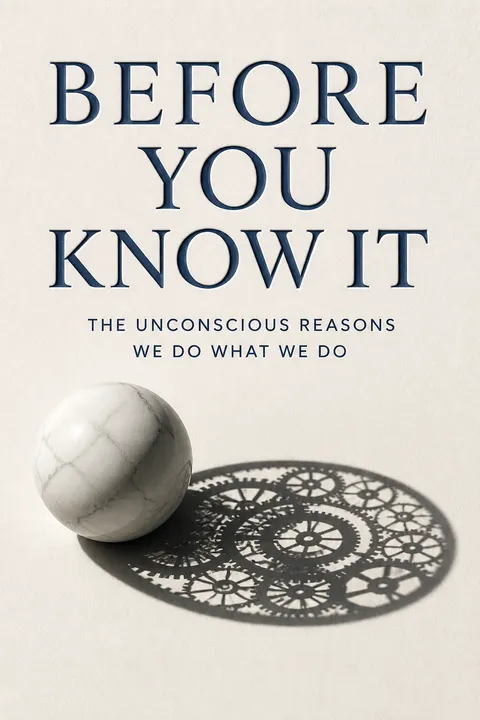
Before You Know It explores the unconscious influences on our behavior, decisions, and emotions. Bargh synthesizes decades of research on the power of the subconscious mind, illustrating how past experiences, present environment, and future goals shape our actions without our awareness. Readers appreciate the book's insights into human nature, though some find it repetitive. Many praise Bargh's engaging writing style and practical advice for harnessing unconscious processes. While some criticize the lack of new information, others find the book enlightening and potentially life-changing.
People Also Read





Glossary
adaptive unconscious
automatic, useful mental processesMental processes that influence perception, feeling, judgment, and action without conscious awareness or intention. In Bargh’s account, these processes are not a separate, hostile mind. They are part of the same brain systems used in conscious thought, and they often help people respond efficiently to familiar or demanding situations.
priming
a cue activates related ideasA process in which recent exposure to a word, image, sensation, or situation makes related ideas or behaviors more accessible. A person may then be more likely to notice or act in line with those ideas without recognizing the cue’s influence. The book uses priming experiments to investigate how context can shape behavior.
attachment
early caregiver bondA child’s early relationship with a caregiver, especially the child’s expectation that the caregiver will be available and responsive. Bargh discusses secure and insecure attachment as patterns that can shape later expectations of trust and closeness. These patterns are associated with later social outcomes, but do not determine an individual’s life.
excitation transfer
arousal carries into another eventThe carryover of bodily arousal from one experience into a later one. If a person no longer recognizes the first event as the source, the remaining arousal may be attributed to whatever is happening now. The book illustrates this with exercise followed by an erotic film, and with anxiety increasing attraction after a frightening bridge crossing.
mere exposure effect
familiarity increases likingThe tendency to develop greater liking for something after encountering it repeatedly, even when a person does not consciously remember all the encounters. The book presents this as one way preferences can form without deliberate reasoning. The effect is a general tendency, not a rule that familiarity overrides danger or every other influence.
Unconscious Thought Theory
unfocused thought integrates complex informationThe theory that unconscious processing can help combine multiple pieces of information when making complex decisions, especially after conscious attention has moved elsewhere. Bargh describes studies involving choices among cars and apartments. He also presents a complementary role for conscious thought: applying clear rules and eliminating options that fail necessary constraints.
thin slices
brief samples of behaviorShort observations of a person’s behavior used to make judgments about traits or abilities. Research discussed in the book found that observers could sometimes make useful assessments from brief classroom videos. Thin slices are different from judgments based on a static face because they contain actions and interaction, though brief samples can still be misleading.
chameleon effect
unconscious imitation of othersThe tendency to automatically copy another person’s gestures, posture, or mannerisms during interaction. In Bargh and Tanya Chartrand’s study, participants unconsciously adopted a confederate’s face-touching or foot-shaking behavior. The book links mimicry with smoother interaction and increased liking, while noting that people can inhibit it when they recognize the influence.
Implementation intentions
cue-linked action plansSpecific plans that connect a recognizable situation to a chosen action. Rather than relying on a general intention, a person decides in advance what to do when a particular cue occurs. The book describes their use for medication, voting, exercise, and resisting temptations. They can improve follow-through, especially when the person is genuinely committed.
Environmental dependency syndrome
behavior driven by surroundingsA condition described by neurologist François Lhermitte in stroke patients whose behavior became unusually controlled by objects and settings around them. Patients drank water placed before them or acted according to cues in a garden, bedroom, or office. Bargh uses the cases to illustrate how environmental prompts can guide action when normal behavioral control is impaired.
implicit egotism
preference for self-related cuesThe proposed tendency to feel more positively toward people, places, or choices that share features with oneself, even when the similarity is minor or arbitrary. The book describes research on name letters, occupations, place names, and birthdays. The reported effects are subtle and statistical, not conscious preferences or reliable predictions about any one person.
FAQ
What's Before You Know It about?
- Exploring the Unconscious Mind: The book examines how our unconscious mind influences our thoughts, feelings, and behaviors without our awareness. It highlights the interplay between past, present, and future experiences.
- Three-Part Structure: Divided into The Hidden Past, The Hidden Present, and The Hidden Future, each section explores different aspects of unconscious processes.
- Practical Implications: Bargh discusses how understanding these processes can improve our lives, relationships, and help overcome biases.
Why should I read Before You Know It?
- Insight into Human Behavior: The book offers valuable insights into the unconscious forces driving our actions, enhancing self-awareness and personal growth.
- Scientific Backing: Grounded in psychological research and neuroscience, it provides a credible understanding of the mind's complexities.
- Practical Applications: Readers can apply the concepts to improve decision-making, relationships, and overall well-being.
What are the key takeaways of Before You Know It?
- Unconscious Influences: Much of our behavior is driven by unconscious processes, often leading to misunderstandings about our motivations.
- Impact of Early Experiences: Childhood experiences significantly shape adult relationships and trust levels, often without our realization.
- Cultural Conditioning: Cultural influences and societal norms affect our beliefs and behaviors, perpetuating stereotypes and biases.
What are the best quotes from Before You Know It and what do they mean?
- “The past is never dead. It’s not even past.”: Emphasizes that past experiences continue to influence present behavior and decisions unconsciously.
- “The unconscious never sleeps.”: Suggests that our unconscious mind is always active, influencing thoughts and actions without our awareness.
- “You are the DJ.”: Implies that understanding unconscious influences allows us to take control and make conscious choices.
How does [Author] explain the "hidden past" in Before You Know It?
- Evolutionary Influences: The hidden past includes evolutionary history shaping unconscious motivations like survival and reproduction.
- Childhood Experiences: Early experiences impact trust and relationships in adulthood, often unconsciously.
- Cultural Context: Cultural environment influences biases and stereotypes affecting behavior.
What does Before You Know It say about the "hidden present"?
- Immediate Influences: Unconscious influences affect thoughts and actions in real-time, such as situational cues and social contexts.
- Trusting Instincts: Bargh discusses when to trust gut feelings and when to be cautious, highlighting instinct fallibility.
- Social Interactions: Interactions are shaped by hidden influences, leading to snap judgments and biases.
How does Before You Know It address the "hidden future"?
- Unconscious Goals: The hidden future involves unconscious motivations guiding actions and decisions without conscious awareness.
- Impact of Aspirations: Hopes and fears about the future shape present perceptions and interactions.
- Mind Control: Understanding hidden future influences helps align actions with true goals and values.
How does [Author] address the concept of free will in Before You Know It?
- Questioning Free Will: The book questions the extent of free will, suggesting many decisions are influenced by unconscious processes.
- After-the-Fact Narratives: We often create narratives to explain actions, which may not reflect true motivations.
- Empowerment through Awareness: Recognizing unconscious influences can increase agency and lead to informed choices.
What research methods does [Author] use in Before You Know It?
- Experimental Studies: References psychological experiments illustrating unconscious influences, such as priming studies.
- Longitudinal Research: Discusses studies tracking individuals over time to understand early experiences' impact.
- Neuroscience Insights: Integrates neuroscience findings to explain biological underpinnings of unconscious processes.
How can the insights from Before You Know It be applied in everyday life?
- Improving Relationships: Understanding hidden past influences can help navigate relationships and foster trust.
- Overcoming Biases: Recognizing unconscious biases helps mitigate their effects on judgments and interactions.
- Personal Growth: Encourages reflection on unconscious motivations, leading to greater self-awareness and development.
What is the "endowment effect" mentioned in Before You Know It?
- Definition: The endowment effect is the tendency to assign greater value to owned items compared to identical non-owned items.
- Influence of Emotions: Emotional states can alter the endowment effect, affecting valuation of possessions.
- Practical Implications: Understanding this effect aids in making rational financial decisions and better negotiations.
How does [Author] suggest we can mitigate the negative effects of unconscious influences?
- Awareness of Triggers: Recognizing environmental cues and emotional states influencing behavior is crucial.
- Mindfulness Practices: Mindfulness techniques enhance self-awareness and emotional regulation, leading to intentional decision-making.
- Social Environment: Surrounding oneself with positive influences and supportive individuals fosters better decision-making.
Download PDF
Download EPUB
.epub digital book format is ideal for reading ebooks on phones, tablets, and e-readers.








