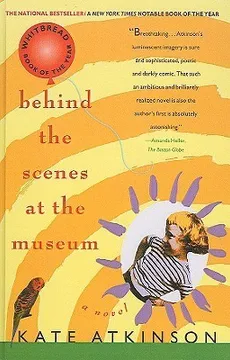


Plot Summary
A Baby Above the Shop
Ruby1 is conceived in 1951 while her mother,2 Bunty,2 resents the marriage and domestic life she has inherited. In February 1952, Ruby1 is born as her father,6 George,6 drinks elsewhere, and Bunty2 barely looks at her. The family lives above George's6 pet shop beneath York Minster, where the shop's cages and counter shape daily life.
Ruby's1 sisters are Patricia,3 watchful and solitary, and Gillian,4 demanding and vivid. As Ruby1 grows, she studies the distances between them: George6 slips away from the shop, Bunty2 dreams of another life, and neither parent gives much comfort. Ruby1 begins narrating her family as a witness who belongs to it, yet feels she may have been given the wrong place in it.
Ruby's comic certainty about her own beginnings sits beside a child's more painful uncertainty: whether she is wanted. The shop makes family life materially crowded, with work, marriage, and parenting occupying the same rooms. Ruby's first act of imagination is to interpret absence, George's and Bunty's emotional distance, as evidence that she may belong elsewhere. That habit will later make memory both a refuge and a danger.
Alice Behind the Glass
A photograph found among family possessions introduces Alice Barker,8 Ruby's1 great-grandmother,8 posed in 1888 by the travelling photographer Jean-Paul Armand. Alice8 is pregnant with Nell,7 the child who will become Ruby's1 grandmother.7
She has married Frederick,15 a hard-drinking farmer whose gambling has cost the family its land, and now raises a large, precarious household. Soon after the photograph is taken, Alice8 disappears. Frederick15 tells the children she is dead, and Rachel,11 Alice's8 cousin,11 takes over as stepmother and housekeeper.
Rachel11 imposes order through work and punishment, while Alice's8 children preserve scraps of their vanished mother's life: a photograph, a silver locket, and a pink glass button that will pass through generations.
The photograph converts family history into a problem of evidence. Alice's posed stillness looks permanent, but the lives around the frame are unstable, shaped by poverty, bereavement, and a story that may not be true. Small objects survive where explanations fail. Their passage between generations suggests that inheritance is not only biological: it also consists of silences, partial records, and the meanings later relatives attach to them.
Three Men Go to War
As a young woman, Nell7 first becomes engaged to policeman Percy Sievewright, but he dies of appendicitis before their wedding. She later falls in love with Jack Keech,12 a friend of her brother Albert,13 while Frank,10 another of the young men, becomes part of their close circle. Albert13 enlists, followed by Jack12 and Frank.10 In 1916, a shell kills Albert13 at the Somme.
Jack12 survives the battle, earns a medal, and is reassigned to train messenger dogs. When one of his dogs is badly wounded at the front, Jack12 crawls out to reach it and is killed by a grenade. Frank10 returns from the war carrying their rabbit-foot charm. Nell7 marries him, though the losses of Percy, Albert,13 and Jack12 remain lodged in her family life.
Nell's romances are repeatedly overtaken by history, but the war also changes what she expects from intimacy. Frank's survival offers a future, not a restoration of what was lost. The rabbit's foot becomes a portable argument against randomness: people preserve it because they need survival to mean something. Yet the family's later generations inherit the opposite lesson as well, that affection does not protect anyone from sudden loss.
Lillian Crosses the Ocean
Nell's7 sister9 Lillian9 gives birth to Edmund outside marriage and clashes with Nell7 and Frank10 over the judgment surrounding him. Rather than let her son grow up inside that narrow household, she leaves England with him and travels through Canada, repeatedly moving when a place begins to feel like another enclosure.
In Saskatchewan, she marries farmer Pete Donner and builds a home with Edmund and a younger son, Nathan. Edmund later returns to Britain as a bomber crewman during the Second World War and visits his English relatives, startling Nell7 with his resemblance to Albert.13 He is killed on a subsequent sortie. Lillian9 remains on the prairie, far from the family that once made her feel watched and unwelcome.
Lillian's emigration is both escape and an act of authorship. She refuses to let other people define Edmund as a shameful secret, then chooses a life whose scale and movement oppose the confinement of Lowther Street. Her story also links distant branches of the family without making them identical: Edmund carries the old family resemblance into a new country, where his loss becomes another severed connection.
York's Blackout
During the Second World War, a German raid strikes York while the Lennoxes shelter in their Morrison shelter. Their neighbors Ena Tetley and her baby, Spencer, are killed when a bomb destroys their home. Bunty2 sees the devastation the next morning, including the ruins of the shop where she once worked.
Her father,10 Frank,10 later dies when a bomb falls into an alley as he walks home. Around the same period, Lillian's9 son Edmund visits the family in his RAF uniform, then is killed on his next mission. These deaths land amid rationing, factory work, and Bunty's2 growing disappointment with wartime life, leaving the family to treat grief as another domestic burden to be managed.
The raid collapses the distinction between public history and private routine. A spoon, a bed, a familiar street, and a family member can all be caught in the same indiscriminate violence. The novel refuses to make courage or virtue a reliable defense; the people left behind instead turn mourning into practical labor. Bunty's later hunger for a different life grows in a world that has already taught her how little control she possesses.
Bunty Chooses George
Before marrying George,6 Bunty2 imagines war will make her life larger. She works in a factory, briefly entertains the prospect of marriage to Sandy Havis, then becomes engaged to Buck, an American serviceman from Kansas. Buck loses a foot in an accident and returns to the United States, promising to send for her but never doing so.
Bunty2 meets George6 near the end of the war and accepts his proposal as the future narrows around her. They marry after the war, and Nell7 gives Bunty2 Alice's8 silver locket. Bunty2 also keeps a coronation teaspoon recovered from Ena's ruined home, polishing it as a private reminder of a life taken by the raid.
Bunty's marriage is not the fulfillment of her romantic dreams so much as a settlement reached after possibility has ebbed away. She longs to become someone else, yet the social script offers her marriage and unpaid domestic work as the available transformation. The locket and teaspoon carry contradictory inheritances: one recalls a mother she never knew, the other a neighbor whose life was cut short.
A Coronation Above the Shop
In 1953, George6 buys a television for the coronation, and Bunty2 fills the rooms with relatives, food, and children she finds exhausting. Patricia3 follows the ceremony closely, displaying her appetite for rules and knowledge.
Gillian4 dances for the audience, drawing attention with her blond curls and confidence. Ruby1 watches both sisters and tries to claim a brief moment with Gillian's4 pedal horse, Mobo, until Gillian4 knocks her down while reclaiming it.
The day exposes the girls' unequal positions: Patricia3 earns approval through diligence, Gillian4 commands attention, and Ruby1 learns to make herself agreeable and observant. The adults' jokes, grudges, and careful silences give the children an early education in the family's unwritten rules.
The coronation gives the family a public ritual to imitate, but the gathering reveals a private hierarchy beneath the celebration. Patricia seeks security in knowledge, Gillian secures affection by performing, and Ruby learns to watch before acting. Mobo's brief transfer from one sister to another condenses the household's emotional economy: even a toy carries ownership, favoritism, and the threat of being pushed aside.
The Dewsbury Exile
In 1956, Ruby1 is sent to stay with her Aunt Babs24 and the silent, identical twins Daisy and Rose21 in Dewsbury. She does not understand why she has been removed from home, and her parents explain little. At night she fears the twins,21 the dark stairs, and the furniture; by day she studies alphabet cards and a picture book, hoping that reading will give her a way to communicate with the outside world.
After a few weeks, Aunt Gladys brings her home. Patricia3 greets Ruby1 gently, but Bunty2 insists the family must put an accident behind them. Ruby1 cannot remember what happened. Her return brings a new unease to the house, and Patricia's3 questions suggest that someone may have been blamed.
Ruby's exile is a rupture without an explanation, so she fills its blank space with monsters and elaborate rules. Reading becomes more than a childhood accomplishment: it is a strategy for recovering agency when adults control the facts. The family treats silence as protection, but the unspoken event continues to shape how Ruby and her sisters approach one another.
A Holiday Without Bunty
In 1958, Bunty2 and the pet-shop parrot disappear overnight, leaving George6 to manage the shop and three daughters. He cannot cancel a planned holiday, so he persuades Doreen Collier,16 a family acquaintance, to take the girls to Whitby. Their cousin19 Lucy-Vida19 joins them.
Doreen16 listens to the children, lets them choose treats, and turns chores and games into shared pleasures. Patricia,3 usually guarded, eventually responds to Doreen's16 kindness. Ruby1 sees George6 and Doreen16 behave with an intimacy the children cannot explain.
When George6 arrives to collect them, he insists they conceal who cared for them. Bunty2 has returned by then, and the family resumes its old routine without discussing her absence or the holiday that briefly gave the girls a different kind of home.
Doreen's care offers a concrete counterexample to the Lennox household's emotional austerity. She does not abolish rules; she makes ordinary responsibilities feel shared rather than imposed. The children sense adult secrets but lack the language to interpret them. Their holiday survives afterward as a cherished, partly disavowed memory, showing how family history can preserve comfort while hiding its causes.
Gillian Runs Into Traffic
On Christmas Eve 1959, the family goes to a pantomime despite the strain between George6 and Bunty.2 Gillian4 wins a place onstage and shines before the audience, while Ruby1 and Patricia3 remain more withdrawn. After the performance, Gillian4 spots school friends across the street and runs between parked cars. A pale blue Hillman Husky strikes her and throws her into the path of George's6 taxi.
Gillian4 dies that night. George6 and Bunty2 leave the surviving girls with Nell7 while they arrange the funeral, and Ruby1 and Patricia3 spend Christmas trying to keep the household functioning. Patricia3 makes a stocking for Ruby,1 but neither sister can make the presents or rituals restore the sister4 who is missing.
Gillian's death arrives through an ordinary gesture of childhood excitement, not a moral failing that can be corrected afterward. The family had invested her with beauty and attention, and her sudden absence destabilizes both its routines and its preferred explanations of itself. Patricia's stocking is a small act of care that does not claim to repair grief, only to keep a bond alive through it.
Fire Eats the Pet Shop
In 1960, an iron Bunty2 has left switched on ignites the kitchen and sends fire through the pet shop. Smoke traps Ruby1 and Patricia3 upstairs. Patricia3 breaks a bedroom window, climbs down a drainpipe, and goes back toward the shop to help the animals. Firefighters bring Ruby1 down from her window.
The family and the surviving pets gather in the yard, where Patricia3 finds Rags, the small dog George6 had threatened to put down. After Gillian's4 death, the fire destroys the family's rooms above the shop and forces George6 and Bunty2 to take out a mortgage on a suburban house. They rebuild the shop as a medical-supply business, while Rags becomes the girls' own dog.
The fire makes the family's grief physically visible: familiar rooms and animals are damaged, and survival depends on urgent action rather than explanation. Patricia's courage changes Ruby's experience of her sister, whose defiance now protects rather than intimidates. Moving from the shop also ends the household's old spatial order, though a new address cannot erase the losses carried out of it.
Nell's Last Winter
In the new house, Ruby1 prepares for the Eleven Plus while Patricia3 grows more distant and begins a relationship with Howard. Bunty's2 depression worsens, and her attention shifts toward Clive Roper,18 the confident neighbor whose family lives next door. Ruby1 catches Bunty2 and Clive18 together in the garage, but no adult acknowledges what she has seen.
Meanwhile, Nell7 becomes confused and increasingly confined to bed. Her last months bring relatives to the house and expose the family's discomfort with illness and dependence. Ruby1 passes the entrance exam for Queen Anne Grammar School, a success that briefly gives her a future beyond home. Nell7 dies in 1964, leaving another gap in the family and no clear instruction for how Ruby1 should mourn.
Ruby's academic success offers a route outward, but it cannot shield her from the adult arrangements unfolding around her. Bunty's affair repeats her old wish to escape into a different self, while Nell's decline forces the family to confront aging without emotional fluency. Ruby is learning to read institutions and secrets at once, and neither kind of knowledge makes her feel fully included.
The Farmhouse Holiday
In 1964, the Lennoxes travel to a remote Scottish farm with the Ropers.18 The holiday becomes a succession of wrong turns, bad meals, and sickness, while Bunty2 and Clive18 keep finding reasons to be alone. During a game of Cluedo, George6 catches them together. Patricia3 then reveals that she is pregnant, adding a second crisis to the quarrel.
The families cut the holiday short. Back in England, Patricia3 goes to a mother-and-baby home in Clacton, gives birth, and relinquishes her child for adoption. When she returns, she is changed and soon leaves home without telling Ruby1 where she is going. Rags remains with Ruby1 after Patricia3 makes her promise to care for him.
The holiday's farce exposes how little the adults can control once private choices become public consequences. Bunty's affair is no longer a fantasy she can conceal, and Patricia's pregnancy places her inside the same social machinery that constrained her mother. Giving up the baby and leaving are decisions made under pressure, but they also show Patricia resisting a life prescribed by other people.
The World Cup Wedding
At Ted and Sandra's 1966 wedding, Ruby1 serves as chief bridesmaid among Sandra's younger relatives. The reception loses its shape as the men abandon the speeches and gather to watch England's World Cup final. Sandra confronts Ted, relatives begin fighting, and the wedding cake is smashed in the commotion.
Ruby1 tries to escape the quarrel and finds George6 with a waitress in the television room. George6 has suffered a fatal heart attack. Bunty2 attempts to revive him, but he is dead. At the funeral, Ruby1 panics as his coffin disappears from view. Afterward, Bunty2 and Ruby1 return to a household stripped of George's6 presence, while Ruby's1 fear of death and her own place in the family intensify.
The wedding's comic disorder does not soften the finality of George's death. The World Cup pulls the men into a public spectacle while the family fractures in private, making the reception a collision of performance and consequence. Ruby's panic at the cremation signals that death is no longer an abstract family pattern; it has become an immediate threat to her own sense of safety.
Pearl's Name Returns
In 1968, Ruby's1 despair deepens into a deliberate overdose, and she wakes under medical care before beginning sessions with Dr Herzmark.17 She has already found a birth certificate for Pearl Ada Lennox,5 born on the same day as Ruby,1 and a death certificate recording Pearl's5 drowning in 1956. Bunty2 confirms that Ruby1 had a twin sister5 and says Ruby1 pushed her into the pond.
Under therapy, Ruby1 remembers the frozen duck pond at Uncle Tom's14 home: Gillian4 goaded Pearl5 onto thin ice, Ruby1 cried for her to return, and the ice gave way. Patricia3 tried to dive after Pearl,5 but the child drowned. Ruby1 had not pushed her. The memory explains the exile, the accusation, and the family silence.
The recovered memory does not erase responsibility from the scene; it redistributes it accurately. Ruby's guilt had been built from a child's fragmentary perception and an adult accusation, then reinforced by everyone choosing silence. Therapy gives her a sequence of events she can inhabit without mistaking helplessness for murder. The revelation also recasts Gillian as more than a favored sister and Bunty as a grieving parent who could not separate blame from loss.
Alice's Long Way Home
The family archive eventually corrects the story told about Alice.8 Rather than dying after Nell's7 birth, Alice8 runs away with Armand, the photographer who made the family portrait. Their life together brings poverty, failed business ventures, and years in France.
After the First World War, Alice8 returns to England to find her children, but they have scattered and no one can tell her where they went. She searches through Yorkshire towns without finding them, unaware that she passes Nell7 in York.
Alice8 dies in a 1940 bombing in Sheffield, still holding a photograph of her children. The image survives the rubble and later reaches Ruby,1 linking the woman erased from family memory to the daughter7 who has spent her life fearing she was misplaced.
Alice's history turns the family's founding silence into a human choice with consequences, rather than a simple tale of abandonment or death. She leaves an oppressive marriage, then discovers that escape does not grant control over what follows. Her unsuccessful search mirrors Ruby's own struggle to recover what was lost. The unbroken photograph becomes a form of belated contact, not a substitute for reunion.
Ruby Leaves the Wrong Life
After failing her history A Level, Ruby1 takes summer work in an Edinburgh hotel with Kathleen,22 who soon returns to her fiancé Colin. Ruby1 stays, meets Gian-Carlo Benedetti,23 and marries him, then runs a fish-and-chip shop in Forfar. Years later, Patricia3 calls from Australia, where she has built a new life as a wife, mother, and veterinarian.
The contact brings the sisters back into one another's reach. When an exploding potato peeler makes Ruby1 recognize that her marriage and shop are not the life she wants, she leaves Gian-Carlo23 with their two daughters, Alice and Pearl. Ruby1 eventually settles in Shetland, works as a translator, and begins writing poetry, carrying her family history into a life of her own making.
Ruby's escape is neither a clean break nor a rejection of family. She takes her daughters, names them after women whose stories have been fractured, and turns inherited memory into material for work and art. Patricia's call offers contact without prescribing reconciliation. Ruby's decisive change comes when she stops treating endurance as proof that a life belongs to her.
Bunty's Last Home
In 1992, Ruby1 returns to York because Bunty's2 dementia has made independent living impossible. Adrian20 helps Ruby1 arrange care, but a stroke sends Bunty2 to hospital, where Patricia3 arrives from Australia. The sisters keep vigil as their mother2 dies, then bury her and sort through a house emptied of its old inhabitants.
They visit the former pet shop, now a café, and the graves of Bunty,2 Gillian,4 and Pearl.5 Patricia3 plans to search for the child she gave up in Clacton. Ruby1 returns north to her daughters and her work, carrying Alice's photograph and the family clock's history with her. The sisters leave York with no promise that every loss can be repaired, but no longer mistaking silence for disappearance.
Bunty's dementia makes identity unstable in the present, while Ruby and Patricia must decide what care means after a difficult childhood. Their mother's death does not produce a tidy reconciliation; it produces attention, practical tenderness, and a shared account of what happened. The final journey from York suggests that home is not a fixed building but a set of relationships and memories one can carry without being ruled by them.
Analysis
Behind the Scenes at the Museum treats family history as something assembled from partial evidence: photographs, keepsakes, stories repeated as fact, and memories that arrive late or in the wrong order. Ruby's1 narration makes that process visible. She is funny because she notices how adults disguise their motives in routines, but her wit also protects her from pain until the past becomes impossible to evade. The novel's time shifts are therefore not ornamental. They reproduce the way a family actually remembers, moving from a present irritation to an ancestor's loss and back again, with one object or resemblance carrying the connection.
The Lennox women inherit more than names and features. Alice,8 Nell,7 Bunty,2 Patricia,3 and Ruby1 each confront limits imposed by marriage, class, gender, and family duty, but they respond differently. Some endure, some flee, some hide their grief inside work, and some refuse the expected role altogether. The novel resists simple judgments because the same behavior can be both an act of survival and a source of injury. Bunty's2 emotional failures matter, but so do the conditions that taught her to imagine a life rather than claim one.
Loss is everywhere, yet the novel does not make it a single, solemn register. The deaths of children, soldiers, parents, and animals sit beside shopkeeping jokes, bad holidays, and family ceremonies. This tonal mixture refuses to let tragedy become an abstract lesson. Ruby's1 recovery of the truth about Pearl5 is the clearest example: compassion requires distinguishing an accident from an accusation, and memory becomes useful when it restores the actual sequence of events. By the end, Ruby1 cannot retrieve every person or repair every relationship. She can, however, carry the family's fragments without mistaking silence for truth, and create a life in which those fragments become material for understanding rather than a sentence to repeat.
Review Summary
Behind the Scenes at the Museum receives mixed but generally positive reviews, averaging 3.98/5. Readers praise Atkinson's witty, layered storytelling spanning four generations of a Yorkshire family, with Ruby Lennox's narration drawing particular admiration. The novel's non-linear structure and "footnote" chapters are considered ambitious and ingenious, though some find the large cast overwhelming. Many note the book's dark themes are offset by sharp humor. The ending frequently earns emotional praise, with several readers considering it a favorite despite difficulties following the complex narrative.
People Also Read








Characters
Ruby Lennox
The family's witnessRuby is the youngest Lennox daughter and the novel's alert, imaginative narrator. She reads people through their habits, objects, and silences, often converting confusion into a story she can manage. Her wit protects her from loneliness, but it can also keep painful facts at a distance. Ruby is deeply attached to her sisters even when she cannot understand them, and she wants both escape from the family and a place inside it. Her interest in books, language, and lost things reflects a mind trying to make connections across gaps. She is perceptive rather than omniscient, and the difference between what she remembers and what she believes becomes central to her understanding of herself.
Bunty Lennox
The restless motherBunty, born Berenice, is Ruby's1 mother2 and the wife of George6, a pet-shop owner. She longs for romance, beauty, and a life less burdened by domestic labor, but rarely knows how to ask directly for what she wants. Her daydreams offer alternate versions of herself, while housework and child-rearing make her feel trapped in the one she has. Bunty can be funny, stylish, and resourceful, yet her irritation often becomes the family's emotional weather. She is neither simply cruel nor secretly nurturing; she struggles to express care without surrendering her resentment. Her daughters learn to read her moods because she seldom explains them.
Patricia Lennox
The principled rebelPatricia is Ruby's1 older sister, serious, academically gifted, and fiercely protective of her privacy. As a child, she seeks order in schoolwork and royal history, while her strictness can leave her isolated from other children. She has a strong moral instinct and a sharp, often cutting sense of humor, especially when adults evade responsibility. Patricia's independence is not effortless: she wants connection but distrusts the roles her family and society offer her. Her relationship with Ruby1 shifts between impatience and tenderness. She is the sibling most likely to act decisively when danger arrives, even when her own life is unsettled.
Gillian Lennox
The favored sparkGillian is Ruby's1 lively middle sister, a charismatic child whose blond curls and talent for performance draw attention from adults and relatives. She is impulsive, competitive, and skilled at winning affection, but she can also be possessive and dismissive of Ruby1. Gillian's energy gives the family its most visible brightness, making it difficult for the quieter sisters to compete with her. She acts from immediate desire rather than careful reflection, a quality that can delight or hurt those around her. Ruby1 admires her and resents her in equal measure.
Pearl Lennox
An obscured relativePearl belongs to the family history Ruby1 tries to understand. Her place in that history is bound to the Lennoxes' habit of preserving fragments while leaving difficult events unexplained. The name also carries the family's recurring association between children, precious objects, and loss.
George Lennox
The charming shopkeeperGeorge is Bunty's2 husband6 and the owner of the pet shop above which the family lives. He is sociable with customers and comfortable performing the easy friendliness his business requires, but at home he often retreats into evasions and private errands. George's charm makes him likable to outsiders without making him emotionally available to his children. He and Bunty2 share a marriage marked by frustration, habit, and unspoken grievances. His practical world is built around the shop, while his daughters watch for signs of a more complicated man beneath the shopkeeper's public manner.
Nell Lennox
The grieving matriarchNell is Bunty's2 mother7 and Ruby's1 grandmother7, a modest woman whose life is shaped by bereavement and domestic duty. She once hoped marriage would give her a secure identity, but early losses leave her cautious and inward. Nell is not a commanding family elder; she is often overlooked, even as her memories connect Ruby's1 generation to the past. Her affection tends to appear through small routines rather than grand declarations. As age brings confusion, her family struggles to distinguish the person she was from the needs she has now.
Alice Barker
The vanished ancestorAlice is Ruby's1 great-grandmother8, a teacher by upbringing and a farmer's wife by circumstance. She is intelligent, imaginative, and increasingly overwhelmed by poverty, repeated pregnancies, and the rough life Frederick15 imposes on her. A family photograph preserves her composed face but cannot explain her choices. Alice's story becomes a measure of how easily a woman can be reduced to the version of events others find easiest to tell. She is a distant ancestor, yet her hunger for a different life echoes through Bunty2 and Ruby1.
Lillian Barker
The restless emigrantLillian is Nell's7 sister9, an independent woman who resists the small-minded judgment surrounding her son Edmund's birth. She is affectionate with her child and unwilling to let relatives dictate how he should be raised. Movement becomes her answer to confinement: she leaves England, makes a life in Canada, and continues to choose unfamiliar horizons. Lillian's independence can look like abandonment to those she leaves behind, but she experiences it as necessary self-preservation. Her correspondence and family photographs keep a tenuous thread running between distant generations.
Frank Lennox
The war-worn husbandFrank is Nell's7 husband10 and the father10 of Bunty2, Babs24, Betty, Clifford, and Ted. A veteran of the First World War, he tries to build a quiet domestic life after surviving losses that his family cannot fully imagine. He is steady and practical, though not especially skilled at discussing grief. Frank's experience makes him wary of danger without making him immune to it. He offers Nell7 a dependable marriage, but the family life they build remains marked by wartime absences and sudden bereavements.
Rachel Barker
The hard second motherRachel is Alice's8 cousin11 and becomes stepmother to Alice's8 children after her disappearance. She is practical, industrious, and convinced that strict order is the only protection a poor household can afford. Her upbringing has taught her to value work over sentiment, so she views the children as unruly dependents rather than grieving individuals. Rachel's authority helps keep the household functioning, but her severity deepens the children's sense that affection must be earned. She stands in sharp contrast to the idealized mother they remember.
Jack Keech
The wounded idealistJack is Albert's friend and, for a time, Nell's beloved. He is handsome, self-possessed, and skeptical of patriotic slogans, though the war forces him into acts of courage. His bond with dogs offers him a form of loyalty less complicated than human attachment. Jack changes under the strain of battle and becomes harder for Nell to recognize. His presence links love, war, and the uncertain line between bravery and despair.
Albert Barker
The beloved brotherAlbert is Nell7 and Lillian's9 brother, remembered for his generosity and unusual capacity for happiness. His sisters and friends treat him as a source of warmth in a difficult family. Albert's memory persists in stories, photographs, and resemblances that later relatives notice. He represents the young life the family repeatedly tries to protect in its recollections.
Tom Barker
The cautious survivorTom is one of Nell's7 brothers and a practical, anxious man who feels the pressure of wartime expectations. He is close to his siblings, though he does not share their confidence about danger. Tom's own injury changes how others judge him, while his care for a family photograph helps preserve a connection to Alice8.
Frederick Barker
The gambling farmerFrederick is Alice's8 husband15 and the father of her children. A volatile gambler and drinker, he loses the family farm and moves them into increasingly precarious circumstances. His authority rests on force rather than emotional understanding, leaving the children to seek comfort among themselves. Frederick helps establish the hardship against which Alice8 and Rachel11 make their choices.
Doreen Collier
The Belfast caretakerDoreen is a warm, capable woman who takes the Lennox girls to Whitby when George6 cannot care for them during Bunty's2 absence. She listens to the children and gives them routines that feel generous rather than punitive. Doreen's calm presence reveals how hungry the girls are for ordinary attention. She does not need to know them well to treat their feelings as real, and that brief care stays with Ruby1.
Dr Herzmark
The patient therapistDr Herzmark is the psychiatrist who helps Ruby1 explore the memories and fears she cannot organize alone. She works through patience, attention, and careful invitations rather than forcing a ready-made explanation onto Ruby1. Her office, with its warmth and small comforts, becomes a place where difficult recollections can be approached gradually. Dr Herzmark treats Ruby1 as a person capable of understanding her own history.
Clive Roper
The polished neighborClive is a confident former RAF man who lives next door to the Lennoxes with his wife and children. His polish and easy attention appeal to Bunty2, while his presence unsettles the fragile balance of both households. Clive is part of the respectable suburban world the Lennoxes observe from close range, though appearances do not make him a reliable guide to character.
Lucy-Vida
The exuberant cousinLucy-Vida is Bunty's2 niece and a lively presence among the Lennox girls. She loves dancing, performs with confidence, and often approaches family upheaval with more directness than the adults. Her humor and appetite for experience make her a companion to Ruby1, even when their lives diverge. Lucy-Vida's openness contrasts with the family's habit of hiding uncomfortable facts.
Adrian
The family caretakerAdrian is a relative who becomes an ally to Ruby1 during Bunty's2 later years. He is practical, affectionate, and comfortable with domestic work, offering care without making it a test of virtue. His ease in the family home contrasts with the tension that once governed it. Adrian's companionship helps Ruby1 face decisions she would find harder to manage alone.
Daisy and Rose Lennox
The unnerving twinsDaisy and Rose are Bunty's2 nieces, identical twins whose quiet habits and private world unsettle Ruby1 during her stay in Dewsbury. They seem to share thoughts and routines, though Ruby1 interprets their silence through the fears of a displaced child. Their presence intensifies her isolation and makes the house feel governed by rules she cannot read.
Kathleen
Ruby's loyal friendKathleen is Ruby's1 school friend, a practical young woman whose choices are guided by loyalty and a desire for security. She accompanies Ruby1 to Edinburgh after their exams, but her romantic and career decisions lead her back toward the life she has planned. Their friendship provides Ruby1 with companionship beyond her family, though it cannot keep them on the same path.
Gian-Carlo Benedetti
The alluring strangerGian-Carlo is an Italian man Ruby1 meets in Edinburgh while working at a hotel. His beauty and attention make him seem like an answer to Ruby's1 wish to be chosen. He speaks limited English and brings Ruby1 into a life far from York. Their relationship is shaped by attraction and haste, while the ordinary demands of marriage reveal how little romance alone can settle.
Aunt Babs
The practical auntBabs is Bunty's2 older sister, a capable woman who values order, cooking, and family duty. Ruby1 stays in her house in Dewsbury, where its fixed routines contrast with the uncertainty of home. Babs can be brisk and emotionally restrained, yet she provides the shelter Ruby1 needs at a difficult point in childhood.
Plot Devices
The family photographs
Evidence across generationsPhotographs give the Lennoxes visible proof of relatives whom later generations barely know. Alice's8 portrait, taken by Jean-Paul Armand, becomes especially important because it preserves a face while leaving the story behind it uncertain. Other family pictures show siblings together before separations and deaths alter the household. Ruby1 treats these images as clues, but they are never complete records: pose, omission, and the memories of whoever keeps them shape what they seem to mean. The photographs connect otherwise scattered family branches and show how an image can outlive both its subject's intentions and the explanation attached to it.
The silver locket
A hidden family linkThe locket passes through the women of the Barker and Lennox families, holding hair or tiny photographs close to the body. Its significance changes as each generation gives it a different use: an intimate possession, a keepsake, then a clue Ruby1 must interpret. The object makes family inheritance tangible, but it also exposes how easily relatives can confuse resemblance with identity. Its paired images ultimately matter to Ruby's1 understanding of the family, so this device contains a major revelation.
The pink glass button
A trace passed onwardA pink glass button falls from Alice's8 blouse on the day her children are photographed. It moves through the household, enters Rachel's11 button box, and eventually reaches Nell's7 collection before Gillian4 swallows it. The button's route is small and almost absurd, yet it gives the novel a physical image of how family history travels: through ordinary objects whose owners do not know all the lives they connect. Its later disappearance does not undo its value as a marker of continuity.
The Lost Property Cupboard
A model for recoveryRuby's1 work monitoring her school's lost property cupboard becomes a private theory of what happens to lost things. She imagines that memories, objects, innocence, and even relationships might remain somewhere until someone knows how to claim them. The idea gives shape to her fear that parts of the past have vanished beyond recovery. It also prepares her to treat memory as something recoverable rather than a blank she must accept. The cupboard is both a school chore and a psychological map of Ruby's1 search for what her family has misplaced.
The family clock
Time made domesticAlice's8 clock passes into the Lennox home and continues to mark birthdays, nights, and family gatherings, though it never keeps perfect time. Its ordinary chimes link the generations without making their lives orderly. In moments of fear or grief, Ruby1 notices the clock as a witness to events that people would rather forget. The clock becomes a counterpoint to human memory: it registers that time has passed, but cannot explain what happened during it. Its presence helps the novel move between private rooms and distant decades.

Download PDF
Download EPUB
.epub digital book format is ideal for reading ebooks on phones, tablets, and e-readers.








