

Key Takeaways
Treat language as a lived craft, not a list of classroom rules
An unlikely apprenticeship. Mary Norris arrives at The New Yorker by a winding route: checking swimmers’ feet, driving a milk truck, packing mozzarella, and studying English. The work that finally fits her is copy editing, where words meet knowledge of food, travel, cars, and ordinary life. A piece by John McPhee, whose exact vocabulary made Norris look up the word synecdoche, helped draw her toward the magazine.
Attention makes expertise. Norris’s career begins not with mastery but with curiosity and mistakes. She presents grammar as a craft learned through use, reference books, conversation, and repeated correction. The memoir’s jokes and workplace stories make technical details feel like part of a life, not a school exercise.
What's striking is how the book refuses the familiar divide between manual work and intellectual work. Driving a delivery truck and studying an unfamiliar word both require attention to particulars. That continuity makes Norris’s authority persuasive: she has learned to notice, not merely to recite rules. The approach also offers a useful antidote to perfectionism. Expertise need not begin with confidence; it can grow from being willing to ask what a word means, or how a thing works. The limit is that one editor’s workplace is unusually rich in institutional resources, but the habits of curiosity travel well.
Let context, not spell-check, decide which word belongs
Machines miss meaning. Spell-check can catch a typo, but it cannot reliably distinguish homophones such as a verb meaning to sell from a pedal operated by the foot. Autocorrect can produce absurd substitutions because it predicts likely strings rather than understanding intention. A copy editor has to read for meaning as well as spelling.
English carries its history. Its mixed linguistic roots, silent letters, and inconsistent sound patterns make spelling hard to standardize. Noah Webster tried to shape an American norm, with mixed success: some changes took hold, while others did not. The New Yorker’s reliance on several Webster dictionaries reflects another point: dictionaries record and guide usage, but they are not interchangeable or beyond dispute.
The distinction between error detection and interpretation remains central to human-machine collaboration. A spell-checker can compare a word with a stored lexicon; context-sensitive judgment asks what the sentence is trying to do. Norris also shows that a dictionary is a record of editorial choices, not a neutral oracle. Modern language tools inherit those choices from their training data and design. Yet human readers are not automatically wiser: familiarity can conceal mistakes, and a well-used reference can correct individual blind spots. The strongest method combines tools with contextual reading rather than treating either as sufficient.
Edit the sentence without erasing the writer who made it
Restraint is editorial skill. Norris describes copy editing as work with boundaries. An editor should correct genuine problems, but should not replace a writer’s deliberate oddity with smoother prose just to impose personal taste. When Norris mistook a food word for a more familiar one, another reader restored the original. The embarrassment taught her that unfamiliarity is not evidence of error.
Voice can depend on a flaw. In George Saunders’s diary-like story, a sentence seems to make a car part perform an action that belongs to the narrator. Repairing the grammar would have made the sentence less like the narrator’s clipped voice. Norris also leaves an unusual phrase in John McPhee’s polished prose rather than silently changing what she assumes is a typo.
This is a practical account of editorial ethics: intervention should be proportional to the harm being prevented. The idea resembles minimally invasive practice in other fields, where a professional protects function without redesigning the whole system. It also explains why queries matter. Asking the writer preserves agency and exposes uncertainty that a silent correction can conceal. Restraint is not an excuse for neglect, however. A confusing sentence can burden readers even when its oddness is intentional, so the editor’s task is to identify the tradeoff and make it visible rather than decide that voice always outweighs clarity.
Use a pronoun’s job, not its company, to choose its case
Function determines form. In formal standard English, a pronoun’s case depends on its role in the sentence. The nominative case usually marks a subject, as in a sentence where she performs an action. The objective case marks an object, as in a sentence where an action happens to her. Adding another person does not change the pronoun’s job, so the familiar construction is between you and me, not between you and I.
Check the smaller sentence. Who and whom follow the same logic. When the pronoun sits inside a clause, judge its role there, not its role in the larger sentence. Recasting the clause with an ordinary pronoun often reveals the answer. Norris stresses the rule while acknowledging that casual speech regularly bends it.
The book’s mechanical explanation is effective because it replaces vague correctness with a diagnostic question: what role does this word play here? That is a general teaching advantage of grammatical analysis. It turns a social shibboleth into a pattern a learner can inspect. The caution is that standards are not socially neutral. A form such as between you and I can signal hypercorrection, but it can also become conventional in some speech communities. The practical value of the distinction depends on context: formal prose may call for a traditional standard, while correcting someone’s conversation can create more embarrassment than understanding.
Treat pronouns as social recognition, not grammatical decoration
Language carries identity. English lacks a universally accepted singular pronoun that is both gender-neutral and unobtrusive. Proposed replacements have included many invented forms, while singular they has become a common practical choice. Norris recounts a different kind of pronoun challenge when her sibling came out as a transgender woman. Norris initially struggled to change the words she had used since childhood, then saw how a pronoun could affirm or wound someone close to her.
Grammar enters relationships. The chapter traces how gendered job titles have shifted, and how arguments about pronouns reflect changing expectations about who counts as the default person. Norris’s story makes the issue intimate: choosing a pronoun is not only a decision about grammatical number, but also about how one recognizes another person.
The memoir’s family story gives sociolinguistic change its human scale. Pronouns are small, frequent words, so their use can signal belonging with unusual force. This connects grammar to social categorization: language continually sorts people into roles, even when speakers do not intend to make a statement. The chapter also captures a real tension between ease of expression and the desire not to be misrecognized. No single workaround fits every context, and a form that feels smooth to one speaker may feel loaded to another. Listening to the person being referred to is therefore part of linguistic competence.
Use commas to show which information holds a sentence together
Structure before breathing. The comma began as a mark for separating parts of text, but writers and editors disagree about whether it should mainly represent pauses or clarify sentence structure. Norris explains restrictive clauses, which identify or limit a noun, and nonrestrictive clauses, which add information that can be removed without changing the noun’s identity. In the sentence The guests who arrived late missed dinner, the clause identifies which guests; commas would suggest that the detail applies to all the guests.
Consistency has a cost and a benefit. The New Yorker favors close punctuation, often marking extra information with commas. A serial comma, placed before the final and in a list, can prevent comic ambiguity. Norris ultimately treats house style as a practical choice, not a test of virtue.
Punctuation is a form of information design. Readers use marks to infer hierarchy: which detail defines the subject, which one merely supplements it, and where one thought ends. This is why punctuation can change meaning without changing vocabulary. The same principle appears in interface design, where visual grouping tells users which pieces of information belong together. But there is no universally ideal density. Dense punctuation can make relationships explicit while slowing the eye; sparse punctuation can feel quick while leaving more interpretive work to readers. A style guide is most useful when its choices are consistent and suited to its audience.
Let punctuation carry rhythm when clarity leaves room
Marks have different jobs. A semicolon can join two complete, closely related clauses. A colon points forward to an explanation, example, or list. A dash is more flexible and can interrupt, amplify, or leave a thought hanging. Norris compares the tidy use of these marks with writers who bend convention for pace and personality.
Sound can matter. Dickens’s commas sometimes reflect the cadence of speech, while Emily Dickinson’s dashes can slow a reader, emphasize a word, or leave syntax unsettled. Norris also describes James Salter’s deliberate commas, which separate adjectives to draw attention to a quality. The editor’s challenge is to distinguish a meaningful effect from an accidental obstacle, without assuming every unconventional mark is a mistake.
Punctuation works partly as a written score for timing. Readers do not literally pause at every mark, but marks influence expectation, emphasis, and pace. This helps explain why standardizing a writer’s punctuation can flatten voice even when the revised sentences remain grammatical. The useful nuance is that intention cannot be inferred with certainty from the mark itself. A dash may be expressive, habitual, or simply unclear. Editors and readers benefit from treating punctuation as evidence of a possible effect, then testing whether the effect actually appears in the sentence.
Hyphenate to prevent misreading, not to make every compound behave
A hyphen can change the map. Hyphens join words into compounds and divide words at line breaks. Norris shows how a compound can be misunderstood if its parts are not grouped clearly, but warns that no single rule settles every case. Usage changes over time: compounds can move from two words to a hyphenated form and then to one word, though some skip stages or resist a pattern.
Even a classic title has an editor. Herman Melville’s novel appears as Moby-Dick, while the whale’s name in the text is generally unhyphenated. Norris traces the title’s hyphen to publishing and copy-editing conventions, not a clear authorial decision. The mark helps distinguish book from whale, while reminding readers that printed texts carry editorial history.
The hyphen is a tiny piece of visual syntax. It can clarify which words modify one another, but excessive use makes prose look as if every phrase requires a safety rail. The Moby-Dick example is especially revealing because a typographic convention becomes part of a book’s identity, then invites readers to treat it as authorial. This is a broader feature of publishing: editorial decisions can harden into cultural facts. The lesson is not that editors should avoid intervention, but that seemingly minor interventions deserve documentation when they affect a work’s received form.
Keep apostrophes for meaning, not as proof of moral seriousness
One mark, distinct uses. Apostrophes usually signal possession or mark letters missing from a contraction. Confusion arises because the letter s also forms many plurals. Norris uses Kelleys Island to explain the difference between a family name in the plural and a possessive form. The island’s name has no apostrophe partly because government policy removed apostrophes from many geographic names, treating them as labels rather than statements of ownership.
Errors do not decide fortunes. The outdoor company Lands’ End began with its apostrophe misplaced, yet the mistake did not prevent commercial success. Norris finds humor in stray apostrophes but resists treating every sign as evidence of cultural collapse. The mark can clarify meaning, but its misuse is not a reliable measure of anyone’s intelligence or character.
The apostrophe debate exposes how orthography becomes a proxy for social judgment. A reader may see a misplaced mark as evidence that a writer is careless, even when meaning remains perfectly clear. That reaction can be useful in carefully edited prose, where consistency supports trust, but it can also become class-coded gatekeeping. Norris’s geographic example adds a political wrinkle: a mark can disappear not through natural language change but through administrative policy. The question is therefore not only what the rule says, but who sets it, for what purpose, and with what effect.
Quote profanity for what it reveals, not merely for its shock
Taboos change with the room. Norris contrasts William Shawn’s conservative editorial restrictions at The New Yorker with a later era in which writers and editors used profanity more openly. A curse can express intimacy, anger, humor, or a speaker’s social world; it can also become background noise when used indiscriminately. Censorship and euphemism shape how readers hear it, as do asterisks and partial bleeps.
Accuracy still needs judgment. Norris worries that a locker-room phrase in a story about Brazilian soccer could carry a harsher implication when translated or read by the people described. In another case, an executive’s blunt language is removed after he clarifies that he had been paraphrasing himself. Verbatim quotation is not automatically the fairest or most accurate choice.
Profanity is both vocabulary and social action. A swear word can signal group membership, challenge authority, or intensify a complaint, so counting its shock value misses much of its function. The chapter also makes a strong case for editorial context: a phrase may travel beyond its original audience and acquire implications its speaker did not anticipate. Still, removing offensive language can sanitize evidence or protect powerful people from accountability. A responsible editor weighs fidelity, relevance, foreseeable harm, and the reliability of the quotation rather than applying a blanket rule.
Treat the pencil as part of the thinking, not disposable stationery
Tools shape attention. Norris prefers a soft-leaded No. 1 pencil and describes the frustration of a whole shipment whose graphite broke repeatedly. The manufacturer tested the returned pencils and proposed shipping damage or an aging sharpener as possible causes. Norris later finds satisfaction in Blackwing pencils and hand sharpening, where the point and the shavings are visible rather than hidden inside a machine.
Obsession can become community. A visit to Ohio’s museum of more than 3,400 pencil sharpeners gives her an unexpected place in a shared hobby, and she donates a sharpener to the collection. The epilogue turns to colleague Lu Burke, who left more than a million dollars to a public library. Both stories reveal how private devotion can support public institutions.
The pencil chapter is a comic defense of material knowledge. A tool is not merely a conduit for thought; its weight, friction, and reliability alter the experience of making a mark. This insight resonates with design research on affordances, the actions an object makes easy or difficult. Yet devotion to a preferred instrument can become ritual rather than necessity. Norris’s humor keeps that tension visible: the pencil matters deeply to her, but the craft still depends on attention, judgment, and the people who preserve shared resources.
Analysis
Between You & Me is best read not as a final authority on English but as a memoir about how authority is made. Norris moves among linguistic history, workplace practice, family conflict, and comic self-exposure. That structure matters: rules become memorable because readers see the consequences of applying them, ignoring them, or enforcing them too aggressively. Her career also gives the book a rare view of editing as collaborative labor, where a comma can involve a writer, fact checker, editor, proofreader, and printer.
The book’s central tension is between prescription and description. A working editor needs standards to make a publication coherent, yet language belongs to speakers whose habits change without permission from style manuals. Norris does not resolve this conflict by declaring every form equally useful. Instead, she asks what a convention does in context: does it prevent ambiguity, preserve a voice, signal status, or merely satisfy an editor’s reflex? This approach is more durable than memorizing isolated rules because it makes judgment part of the method.
The memoir is also a critique of overconfidence. Machines can identify patterns but miss intention; editors can correct errors but invent them; writers can invoke rhythm but misjudge an effect. Norris’s stories of mistakes, including her own, make fallibility central to expertise. Her strongest principle is not that every sentence needs a guardian, but that readers deserve both clarity and a writer’s living voice.
Some of her grammatical preferences remain debatable, particularly where spoken usage has developed beyond formal conventions. That tension is a feature rather than a defect. It invites readers to distinguish a rule useful for a particular publication from a universal law of speech. In this sense, the book teaches both precision and tolerance: take language seriously, but do not confuse a style decision with moral superiority.
Review Summary
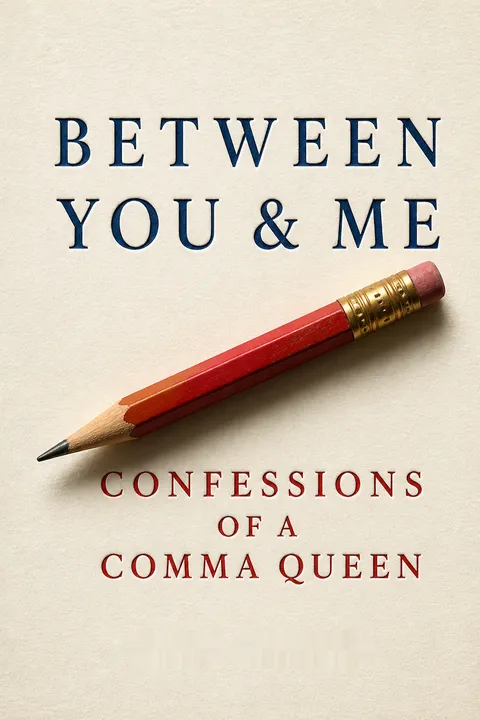
Between You & Me: Confessions of a Comma Queen receives mixed reviews. Many praise Norris's wit, expertise, and entertaining anecdotes about language and her career at The New Yorker. Readers appreciate her insights into grammar, punctuation, and the evolution of language. Some find the book informative and humorous, perfect for word lovers and grammar enthusiasts. However, others criticize it as dry, unfocused, or overly technical. The book's appeal seems to depend on the reader's level of interest in language minutiae and copy editing.
Glossary
page OK’er
final proof managerAt The New Yorker, a page OK’er manages a piece through its final stages before printing. The job involves query-proofreading and coordinating with the editor, writer, fact checker, and another proofreader. The term describes a publication-specific role rather than a general synonym for copy editor.
epicene pronoun
gender-neutral personal pronounAn epicene pronoun refers to a person without specifying male or female sex. English has no universally accepted, unobtrusive third-person singular form of this kind. Norris reviews proposed inventions and existing workarounds, including singular they, while showing why pronoun choices remain both grammatical and socially consequential.
nominative case
subject-form pronounThe nominative case is the form used for a noun or pronoun functioning as a sentence’s subject, and in certain constructions after a linking verb. In English, the nominative personal pronouns include I, he, she, we, and they. Norris uses the concept to explain why grammatical role, not politeness or word order, determines pronoun form.
accusative case
object-form pronounThe accusative case is a form used for a noun or pronoun functioning as the object of a verb or preposition. English retains distinct object forms in pronouns such as me, him, her, us, and them. Norris uses this distinction to explain constructions such as between you and me and to clarify who versus whom.
copulative verb
verb linking subject and descriptionA copulative verb links a subject to a noun or adjective that identifies or describes it, rather than transferring an action to an object. Forms of to be are the clearest examples; verbs such as seem, become, and taste can also function this way. The term explains why a pronoun after a linking verb may take the subject form.
restrictive clause
clause identifying a nounA restrictive clause supplies information needed to identify or limit the noun it modifies. Because it is integral to the sentence’s meaning, it is generally not set off by commas in standard American editing. Norris contrasts it with a nonrestrictive clause, which adds information about an already identified person or thing.
serial comma
comma before final list conjunctionThe serial comma is the comma placed before the conjunction introducing the final item in a list of three or more items. Some publications use it consistently, while others omit it unless needed to prevent ambiguity. Norris treats the choice as a matter of house style and reader clarity, not a moral distinction.
diaeresis
dots separating adjacent vowelsA diaeresis consists of two dots placed over the second of two adjacent vowels to show that it begins a separate syllable, as in some spellings of cooperate. It is distinct from an umlaut, which marks a change in a vowel’s sound in languages such as German. The New Yorker has historically used the mark in selected words.

Download PDF
Download EPUB
.epub digital book format is ideal for reading ebooks on phones, tablets, and e-readers.








