

Key Takeaways
Study Greek to turn ordinary words, ruins, and journeys into discovery
A language reopens the world. Mary Norris’s Greek obsession begins with a closed door: her father refuses to let her study Latin. Years later, a colleague at The New Yorker reads aloud from a Greek book, revealing that the unfamiliar alphabet can be learned. Norris studies both demotic Greek, the language of ordinary people, and Katharevousa, a puristic written form that served as Greece’s official language until the 1970s. Words such as the everyday Greek for “thank you” connect routine acts to older ideas of grace and gift.
Study becomes a way of seeing. Greek follows Norris from the copy desk to ferries, islands, and ancient texts. A word can turn a harbor sign into a legible invitation, or make a familiar English term suddenly strange. The book’s central pleasure is not mastery. It is discovering how language links daily life to history, myth, and place.
What's striking is that language learning works here as a practice of attention, not merely a route to fluency. A new word makes ordinary objects newly noticeable, while the effort to speak keeps the learner alert to other people. This resembles ethnographic observation: understanding begins by questioning what once seemed self-evident. The book also avoids claiming that Greek unlocks some uniquely authentic world. Norris remains an outsider, and her mistakes and partial knowledge are part of the point. A language can widen perception without granting ownership of another culture.
See the alphabet as humanity's memory machine, not a schoolroom chart
Small signs, vast reach. The Greek alphabet grew from a Phoenician system of twenty-two consonants. The Greeks added vowels, making it easier to represent the sounds of their language. From there, the alphabet traveled and was adapted by other peoples, eventually contributing to the Roman letters used in English. Norris describes it as a compact technology: a small set of marks can preserve anything from a shopping list to a poem.
Writing changes what survives. The Homeric epics began in oral tradition and were written down around the time the Greek alphabet emerged. Scholar Barry Powell has controversially proposed that the alphabet may have been invented to record Homer. Each epic has twenty-four books, matching the twenty-four Greek letters. The claim is uncertain, but the connection makes visible how writing can give a structure to stories and carry them beyond the people who first recited them.
The alphabet is more than a neutral container. Its portability lets speech outlast a speaker, and its adaptability means a writing system can travel without remaining unchanged. That is a useful corrective to the idea that writing simply replaces oral memory: Homer’s poems moved between performance and inscription, gaining different forms of durability. The book’s account also marks an important limit. The proposed Homeric origin is a scholarly hypothesis, not established fact. Cultural technologies often have multiple origins and uses, even when a compelling story makes one purpose seem definitive.
Make mistakes aloud; conversation is where vocabulary becomes knowledge
Use the words in the world. Norris learns Greek not only from lessons and dictionaries, but from trying it with people. On Rhodes, she identifies artichokes in Greek, only to have the vendor answer in English. As she leaves, she hears him ask how to say the word in English, and offers her own approximate pronunciation. In another exchange, she counts tortoises in Greek, then tells a waiter in English that the restaurant has eight. He thinks she has accused them of serving the animals.
Context makes words stick. Her teacher Dorothy Gregory asks whether Norris is thirsty, and a verb she already recognizes from the English word “dipsomaniac” becomes attached to a real sensation. Language learning is full of wrong turns, but each one can create a human exchange and a more durable memory than memorizing a list.
What's valuable is the shift from language as a performance to language as a relationship. A mistake gives the other person something to answer, correct, or laugh about, and the resulting feedback is specific to the moment. That kind of learning is difficult to reproduce with solitary study. Still, embarrassment is not equally easy for everyone: a patient interlocutor, a safe setting, and time to try again matter. Norris’s encounters show the rewards of imperfect speech, not a duty to put oneself in situations where misunderstanding carries serious costs.
Treat translation as a doorway, not a substitute for the original
Meaning has a sound. Virginia Woolf’s essay “On Not Knowing Greek” is not a confession of ignorance. Woolf knew the language; she meant that readers cannot recover precisely how ancient Greek sounded or what its full emotional force felt like. In Aeschylus, a character’s cry of distress may be impossible to carry into English without losing its sound and ambiguity. Norris sees why translation can never be identical to an original, but also why it can still draw readers toward one.
Accessible versions matter. Edith Hamilton retells Greek myths in lucid prose, helping Norris and many other readers find their way to ancient texts. Ancient Greek particles, short connective words that can signal emphasis, attitude, or a relation between thoughts, are another reminder that meaning does not always fit neatly into separate English words. A translation is an interpretation, but it can open the door to further reading.
Translation is best understood as both access and transformation. It carries a story across languages while exposing the differences that cannot be carried over intact. This is why a readable retelling can be intellectually serious: it gives a newcomer enough footing to approach harder versions. At the same time, fluency can conceal the translator’s choices, making a difficult ambiguity look settled. Norris’s examples invite readers to hold both truths together. An original text offers particular pleasures, but the absence of that access should not become a reason to stay outside the literature.
Borrow mythic models when inherited roles feel too small
Myths offer other scripts. As a girl, Norris sees a narrow set of futures: wife, nun, or someone who remains single by default. Athena becomes a different model. She is unmarried, intellectually capable, a warrior, and a patron of crafts. In the myth of Athens’ founding, she gives the city an olive tree, a gift associated with resilience and practical abundance. Norris later finds Athena useful as a model for copy editing: a role that requires protecting the language rather than winning a writer’s affection.
The stories have many lives. At college, a lecture on Demeter and Persephone introduces Norris to the Eleusinian Mysteries, religious rites connected to the myth of a mother grieving for a daughter taken to the Underworld. The story gives her a way to think about seasons, loss, and renewal. Its Great Round is the cycle of life moving through growth, death, and return. These myths do not dictate one identity; they offer material for imagining others.
Myth works here as a storehouse of roles, not a set of instructions. Athena makes competence and independence imaginable within a culture that offers Norris few appealing examples. That imaginative function is especially powerful when a reader has not yet found a real-life model. The stories also benefit from being revisable: a goddess can be read differently by different generations. Yet Athena’s freedom depends partly on her divine exceptionalism, including her distance from ordinary family obligations. A myth can expand the imaginable without proving that every life can follow its heroine’s path.
Let tragedy name grief without pretending it repairs anything
Art can make pain legible. While studying Sophocles’ Antigone, Norris connects the heroine’s determination to bury her brother with her own changing relationship with her younger brother. His marriage feels like the loss of their shared life; later, his transition to living as a woman brings another change in how Norris understands their past. Antigone does not solve these feelings, but the play gives them shape. Norris also learns the term anagnorisis, a moment in drama when a character recognizes a truth about themself.
Performance gives feeling form. Playing Hecuba in Euripides’ The Trojan Women, Norris draws on memories of her mother grieving a child who died before Norris could remember him. She also uses the role to understand a colleague’s grief at losing control of The New Yorker. Acting the queen’s sorrow leaves her feeling emptied out and less consumed by anger. The play offers relief, not a cure or a tidy moral.
Tragedy can make private experience shareable without reducing it to a lesson. A character’s grief gives an audience distance, while performance brings that grief back into the body through voice, gesture, and repetition. This resembles a form of rehearsal: feeling can be approached in a bounded artistic space rather than only encountered as raw experience. But the effect is personal, not guaranteed. A play can clarify one person’s emotions and leave another unmoved. Norris’s account is most persuasive when it treats art as a means of contact and expression, not as a replacement for support or time.
Travel alone to trade familiar scripts for direct attention
Solitude forces contact. Norris’s travels through Greece take her from one ferry and island to another, often without a fluent command of the language. Traveling alone means she has to ask for directions, negotiate meals, and respond to strangers herself. Limited Greek can make exchanges awkward, but it also pushes her to speak plainly and listen closely. She describes the freedom to change plans, follow a detour, or skip dinner without consulting anyone.
Independence has a cost. Men repeatedly assume that a woman traveling alone wants a companion, and some encounters become intrusive or frightening. Norris refuses to let that pressure decide her route. Her account makes solo travel both a source of self-direction and a demand for vigilance. The point is not that being alone is always better, but that a journey can reveal what a person wants when familiar companions and routines are absent.
Solo travel can disrupt the social scripts that make people behave as they do at home. Without a companion to speak for her, Norris has more direct encounters and more control over small decisions. That autonomy is a genuine form of discovery. The risks she describes are equally important: independence does not erase unequal power or guarantee safety. Her story therefore resists the glossy travel ideal in which discomfort is automatically enriching. A more useful lesson is to distinguish chosen solitude from imposed vulnerability, and to make room for both agency and caution.
Beauty begins when attention stops treating the body as a defect
A new setting shifts the gaze. Before visiting Cyprus, Norris is deeply dissatisfied with her appearance and hopes that a swim at a beach associated with Aphrodite, goddess of love and beauty, might transform her. She swims out to the rocks, removes her bathing suit, and returns to shore feeling newly alive to the water and landscape. The change is not a miraculous change in her features. It is a change in how she experiences her body and the world around it.
Desire need not be a verdict. Norris has spent years treating grooming as evidence that she is failing to meet some standard. At the beach, she feels present rather than inspected. Later, she looks into a mirror and rearranges her hair, an ordinary gesture that no longer carries the same self-disgust. The story turns Aphrodite from an ideal of perfect appearance into an occasion for pleasure, embodiment, and self-recognition.
The episode separates beauty from the constant evaluation of whether a body is attractive enough. Sensory attention shifts the question from appearance to experience: warmth, salt, movement, and the feeling of being physically present. That shift has parallels with body-based therapeutic practices, which often redirect attention from judgment toward sensation. The beach does not permanently resolve Norris’s insecurity, and its mythic setting should not be mistaken for a universal remedy. Its more modest claim is compelling: a person’s relationship to a body can change, even when the body itself has not.
Treat ruins as ongoing work, not scenery from a finished past
History is still being made. Norris walks the Sacred Way from Athens toward Eleusis, site of the Eleusinian Mysteries, through an industrial landscape of traffic, refineries, and small remnants of older life. The contrast makes the damage to a place associated with agriculture impossible to ignore. At the monastery of Dafni, she encounters mosaics that have fallen in earthquakes and are being painstakingly restored, tile by tile.
Preservation is active labor. At the Acropolis, the Parthenon remains fragmented and under repair. Workers sort and stabilize stones while visitors crowd the site. Norris comes to see the restoration itself as a form of attention to the past, rather than a failure to preserve a pristine monument. Ruins are not sealed evidence of an ended civilization. They are vulnerable places shaped by later choices, neglect, pollution, tourism, and the work of people trying to conserve them.
This view corrects the tourist habit of treating ruins as beautiful objects detached from the present. Restoration makes clear that heritage survives through decisions, expertise, money, and labor. The same perspective also sharpens the cost of development: a place can be culturally sacred and economically useful in conflicting ways. Still, preservation is not a simple return to an untouched original. Every repair reflects a judgment about which version of the past deserves to be seen. Norris’s encounters are valuable because they foreground that ongoing responsibility instead of promising a perfect recovery.
Stay long enough for Greece to become memory, not a checklist
The journey changes pace. Early in her travels, Norris moves quickly from island to island, treating arrival as a reason to leave for the next place. Decades later, she spends time in Kardamyli, the southern Peloponnese town where travel writer Patrick Leigh Fermor built a home. She watches the sea from a balcony, reads, and waits for permission to visit the house. The slower rhythm lets a location become more than another stop.
Nostalgia includes the former self. Norris understands longing for home as a desire for a place and for the person one was while there. After months in Greece, she can cherish the country and still feel the pull of home. Her visit to Leigh Fermor’s house and swim at the nearby beach are not a final conquest of Greece. They become part of a personal history that remains incomplete, with more islands still calling from the map.
The movement from rapid itinerary to lingering stay offers a useful account of how travel can mature without making one style morally superior. Collecting destinations creates breadth; remaining in one place creates texture and repetition. The deeper change is temporal: a landscape begins to hold earlier versions of the traveler, not merely new sights. Nostalgia then becomes a relationship between place and personal history. Yet slow travel can require money, time, and freedom from obligations, so it is not equally available to everyone. The insight is about attention, not a prescription for how every trip must be taken.
Analysis
Greek to Me is part travel memoir, part linguistic essay, and part account of how inherited stories become personal equipment. Its chapters move through the alphabet, gods, tragedies, islands, and monuments, but the deeper structure is a series of crossings: from English into Greek, from the copy desk into performance, from childhood roles into self-chosen models, and from tourist observation into historical responsibility.
Language is the book’s connective tissue. Norris’s fascination with word origins does not merely decorate the travel narrative. Etymology gives her a method for approaching a place without claiming to master it. Greek helps her read signs, but it also makes her notice how much remains inaccessible. This tension keeps the book from becoming a simple celebration of classical inheritance. Ancient Greek can feel intimate, while modern Greece is not a museum and is not reducible to ancient glory.
The personal stories make the scholarship matter. Athena helps Norris imagine a life beyond the roles presented to girls; Antigone and Hecuba give form to grief and family change. The myths do not offer neat answers. Their value lies in their capacity to be reused, questioned, and felt differently at different ages. Likewise, the ruins are not merely symbols of permanence. Pollution, earthquakes, restoration, and tourism show how vulnerable cultural memory is.
The book’s strongest complication is its outsider’s gaze. Greece is often the setting for Norris’s transformation, and the people she meets appear through her limited language and brief encounters. Her frankness about mistakes, sexual pressure, and contemporary hardship partly resists turning the country into a fantasy. Still, philhellenism can romanticize a place by arranging it around a visitor’s desires. The book is most persuasive when it acknowledges that distance: love of Greece is not the same as possession of Greek experience. Its lasting argument is more modest and richer. Learning a language or visiting a place can deepen attention, but attention remains partial, reciprocal, and open to correction.
Review Summary
Greek to Me is a memoir by Mary Norris exploring her love for Greek language, culture, and travel. Reviews are mixed, with some praising Norris's wit, linguistic insights, and travelogue aspects, while others find the book disjointed or overly detailed. Many readers appreciate the blend of personal anecdotes, etymology, and Greek history. Some criticize the book's structure and occasional tangents. Overall, it appeals to language enthusiasts and those interested in Greece, though it may not be for everyone.
People Also Read
Glossary
demotic
People's spoken GreekDemotic is the everyday form of modern Greek associated with ordinary speech. Norris contrasts it with Katharevousa, a puristic written variety developed to connect modern Greek with its classical past. The distinction matters in the book because learning Greek means encountering both a living language used in daily interaction and the historical politics of how that language was written.
Katharevousa
Puristic written GreekKatharevousa was a formal, puristic form of modern Greek devised in the nineteenth century to bring the contemporary language closer to its classical heritage. It served as Greece’s official language in legal documents and news reporting until the 1970s, although it was rarely spoken in ordinary conversation. Norris presents it alongside demotic Greek to show that a language can contain competing versions of its identity.
boustrophedon
Alternating-direction writingBoustrophedon is an early writing style in which a line runs in one direction and the next line runs in the opposite direction, like an ox turning as it plows a field. Norris uses the term to describe an early phase of Greek writing, before the convention of writing consistently from left to right became established.
Eleusinian Mysteries
Rites linked to DemeterThe Eleusinian Mysteries were secret religious rites associated with Demeter and Persephone at Eleusis, near Athens. Participants traveled in procession to the sanctuary, and initiates were forbidden to disclose what they experienced. The surviving evidence does not reveal the rites’ full content. In Norris’s account, the mysteries are connected to the myth of a mother’s grief, seasonal change, and the possibility of renewal.
Great Round
Cycle of life and returnThe Great Round is the cyclical pattern Norris learned through a lecture on Demeter and Persephone: life emerges from the earth, passes through loss and death, and returns to life again. The cycle does not deny suffering or promise that every loss is repaired. It offers a way to understand change and renewal through the recurring movement of the seasons.
particles
Small words that shape toneIn Greek grammar, particles are short words that connect clauses, add emphasis, or signal a speaker’s attitude and the relation between ideas. Their force can be difficult to translate into a separate English word. Norris points to them as part of the personality and nuance of Greek speech, much like informal conversational expressions that keep an exchange moving.
anagnorisis
Recognition of a truthAnagnorisis is a term from Aristotle for a turning point in drama when a character recognizes a truth about themself or their situation. Norris encounters the concept while thinking about Euripides’ Electra and the moment when Orestes understands that the act being urged on him is wrong. The term helps describe how recognition can change a character’s understanding without undoing what has happened.
FAQ
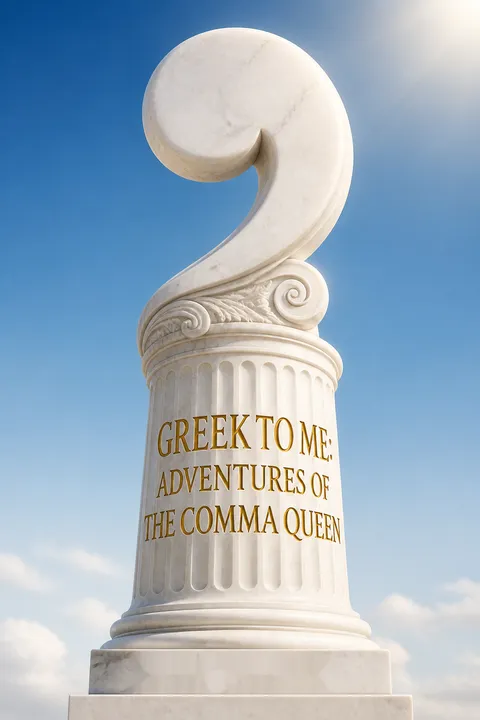
What's "Greek to Me: Adventures of the Comma Queen" about?
- Personal Journey: The book is a memoir by Mary Norris, detailing her adventures and experiences with the Greek language and culture.
- Language and Culture: It explores her fascination with the Greek language, both ancient and modern, and how it has influenced her life and career.
- Travel Experiences: Norris shares her travels through Greece, providing insights into the country's history, mythology, and landscapes.
- Literary Exploration: The book also delves into Norris's love for literature, particularly Greek classics, and how they have shaped her understanding of language and storytelling.
Why should I read "Greek to Me: Adventures of the Comma Queen"?
- Cultural Insight: The book offers a deep dive into Greek culture and language, making it a rich read for anyone interested in linguistics or travel.
- Engaging Storytelling: Mary Norris's writing is both humorous and insightful, making complex topics accessible and enjoyable.
- Personal Growth: It provides a narrative of personal growth and discovery, as Norris learns and evolves through her experiences with Greek.
- Literary Appreciation: Readers will gain a greater appreciation for Greek literature and its impact on Western culture.
What are the key takeaways of "Greek to Me: Adventures of the Comma Queen"?
- Language as a Gateway: Norris illustrates how learning a language can open doors to new cultures and personal insights.
- Mythology's Relevance: The book highlights the timeless nature of Greek mythology and its continued relevance in modern times.
- Travel's Transformative Power: Norris's travels in Greece show how exploring new places can lead to profound personal transformation.
- The Joy of Learning: The narrative emphasizes the joy and fulfillment that come from lifelong learning and curiosity.
How does Mary Norris describe her relationship with the Greek language?
- Initial Fascination: Norris was initially drawn to Greek due to its historical and cultural significance.
- Lifelong Learning: She describes her ongoing journey with the language as both challenging and rewarding.
- Cultural Connection: Learning Greek allowed her to connect more deeply with Greek culture and history.
- Personal Fulfillment: Norris finds personal satisfaction and joy in mastering the complexities of the Greek language.
What role does Greek mythology play in "Greek to Me: Adventures of the Comma Queen"?
- Cultural Foundation: Greek mythology serves as a cultural foundation that enriches Norris's understanding of Greece.
- Personal Reflection: Norris uses myths to reflect on her own life and experiences, drawing parallels between ancient stories and modern life.
- Literary Exploration: The book explores how Greek myths have influenced Western literature and storytelling.
- Timeless Lessons: Norris highlights the timeless lessons and moral dilemmas presented in Greek mythology.
How does Mary Norris's career at The New Yorker influence her experiences in "Greek to Me"?
- Editorial Skills: Her work as a copy editor at The New Yorker honed her attention to detail, which she applies to learning Greek.
- Literary Connections: Her career provided her with a deep appreciation for literature, which she explores through Greek texts.
- Professional Support: The New Yorker supported her Greek studies, allowing her to pursue her passion for the language.
- Cultural Insights: Her editorial background gives her a unique perspective on the cultural and linguistic nuances she encounters in Greece.
What are some of the best quotes from "Greek to Me: Adventures of the Comma Queen" and what do they mean?
- "Greek has been my salvation." This quote reflects Norris's deep personal connection to the Greek language and how it has enriched her life.
- "The alphabet is the greatest invention of humankind." Norris emphasizes the importance of the Greek alphabet in shaping language and communication.
- "Greek isn’t easy, though the modern language is at least phonetic." This highlights the challenges and rewards of learning Greek, with its complex grammar and pronunciation.
- "I hope this book will cast that spell on you." Norris expresses her desire for readers to fall in love with Greek culture and language as she has.
How does Mary Norris explore the theme of personal growth in "Greek to Me"?
- Language Learning: Norris's journey with the Greek language is a metaphor for personal growth and self-discovery.
- Cultural Immersion: Her travels in Greece push her out of her comfort zone, leading to new insights and experiences.
- Overcoming Challenges: Norris shares her struggles and triumphs in learning Greek, illustrating the resilience required for personal development.
- Reflective Narration: The book is a reflection on how Norris's experiences have shaped her identity and worldview.
What insights does "Greek to Me" provide about Greek culture and history?
- Historical Context: Norris provides historical context for her experiences, enriching the reader's understanding of Greece.
- Cultural Traditions: The book explores various Greek traditions, from language to mythology, offering a comprehensive cultural portrait.
- Modern Greece: Norris discusses contemporary issues in Greece, such as economic challenges and cultural preservation.
- Cultural Appreciation: Through her narrative, Norris fosters a deep appreciation for the richness and complexity of Greek culture.
How does Mary Norris use humor in "Greek to Me: Adventures of the Comma Queen"?
- Lighthearted Anecdotes: Norris shares humorous anecdotes from her travels and language-learning experiences.
- Witty Observations: Her observations about Greek culture and language are often delivered with wit and charm.
- Self-Deprecating Humor: Norris is not afraid to laugh at herself, making her narrative relatable and engaging.
- Balancing Seriousness: Humor is used to balance the more serious themes of personal growth and cultural exploration.
What is the significance of the title "Greek to Me: Adventures of the Comma Queen"?
- Play on Words: The title is a play on the phrase "It's all Greek to me," indicating the initial challenge of learning Greek.
- Comma Queen: The subtitle references Norris's career as a copy editor, known for her expertise in punctuation.
- Adventures: The word "adventures" suggests the exciting and transformative journey Norris undertakes in exploring Greek language and culture.
- Personal Connection: The title reflects Norris's personal connection to Greece and her passion for language.
How does "Greek to Me" address the theme of identity?
- Cultural Identity: Norris explores her own cultural identity through her connection to Greece and its language.
- Linguistic Identity: Her journey with Greek language shapes her understanding of herself and her place in the world.
- Personal Reflection: The book is a reflection on how Norris's experiences in Greece have influenced her identity.
- Universal Themes: Norris's exploration of identity is relatable to anyone who has sought to understand themselves through language and culture.
Download PDF
Download EPUB
.epub digital book format is ideal for reading ebooks on phones, tablets, and e-readers.








