

Key Takeaways
M-spec men exist, even when media, partners, and queer spaces erase them
Identity needs room. M-spec means multi-gender attracted: an umbrella for people whose attraction is not limited to one gender. Bisexual, pansexual, polysexual, and omnisexual identities can overlap, but they are not interchangeable, and people choose the labels that fit them. Some contributors also identify as non-binary or genderfluid, a reminder that the book’s title does not describe every person whose experience it includes.
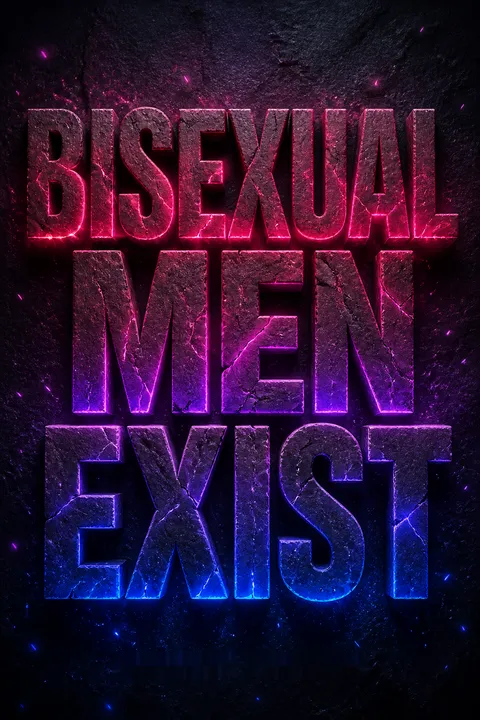
Names can unlock understanding. Author Vaneet Mehta recalls recognizing attraction to more than one gender as a child, but knowing only the words straight and gay. He did not encounter bisexuality until he was 17. His #BisexualMenExist project grew from that isolation: a public statement meant to counter erasure and help others find community.
What's striking is that a label can work less like a box than a key: it gives someone a way to interpret feelings that were already there. That does not make labels compulsory, nor does it mean every person with multi-gender attraction must choose the same word. The distinction between an umbrella category and individual identities matters here. It allows shared political language without flattening personal meaning. The book’s central claim is both simple and consequential: invisibility is not evidence of absence.
Make bisexual men visible by naming them, not leaving attraction ambiguous
Visibility needs clarity. Media can offer a mirror to people searching for language, but an unlabeled character may be read as straight or gay instead. Mehta points to Willow in Buffy the Vampire Slayer, whose earlier relationships with men were followed by an explicitly lesbian storyline, and Teddy in 90210, whose relationships with women were reframed as denial before he came out as gay. Both stories could reflect real individual journeys, yet repeated binary endings leave bisexuality unrepresented.
A practical screen. The Ramirez Test asks whether a character is recognizable as bisexual, whether that identity is treated as a joke or flaw, and whether the character names it. GLAAD counted 36 bisexual+ men on television in 2019-20, compared with two in 2014-15. A 2017 Stonewall report found 76% of LGBT students had never learned about bisexuality.
Explicit representation reduces the interpretive burden placed on viewers, especially young people with little other access to accurate information. The Ramirez Test is useful because it moves beyond counting characters to asking what a portrayal actually communicates. Still, a test cannot determine how every viewer will understand a story, and fictional characters need not function as classroom materials. The goal is not spotless characters or mandatory identity speeches in every plot. It is a wider range of recognizable lives, including bisexual men whose histories are not rewritten to preserve a straight-or-gay binary.
Recognize monosexism before mistaking social erasure for personal confusion
The binary is learned. Monosexism is the structural privileging of gay and straight identities, which makes multi-gender attraction harder to recognize, explain, and accept. Mehta connects it to sparse education and media, and to phallocentrism, the tendency to make a man’s relationship to the penis the defining measure of his sexuality. Together, these assumptions can cause men to dismiss attraction to one gender as a phase or treat attraction to men as proof that they are secretly gay.
Disclosure shows the gap. In a cited Stonewall survey, only 14% of bisexual men were out to everyone in their family, while 46% were out to no one. For gay men, the figures were 59% and 10%. These differences point to barriers beyond an individual’s confidence or willingness to speak.
Naming a structure changes the question from what is wrong with this person to what limits the identities they can imagine and safely express. That shift resembles other forms of institutional analysis: patterns that look like private choices can be shaped by repeated social incentives and penalties. At the same time, an identity that changes over time is not automatically evidence of oppression or confusion. The useful distinction is between fluidity chosen or discovered by a person and other people using the possibility of change to deny that person’s present self-description.
Come out on your timetable, with a safety plan, not a quota
Disclosure is a choice. Coming out can risk family rejection, housing, financial support, safety at school or work, and access to community. The contributors’ accounts range from warm acceptance to harassment and being forced out of home. For some, disclosure brings relief; for others, remaining private is the safer decision. The book rejects a single correct timetable and stresses that no one must prove an identity through dating or sexual experience.
Make the decision yours. Contributors suggest exploring without rushing to choose a label, seeking reliable community information, and starting with a trusted friend if that feels safer. Before telling a family member on whom someone depends, it may help to consider practical support and where to turn if the reaction is hostile. Experimentation is optional, and clear communication and sexual safety matter if it happens.
This advice treats coming out as a decision under real constraints, not a test of courage. That framing respects autonomy and makes room for differences in age, money, family dependence, local laws, and risk. It also resists a common mistake in supportive messaging: presenting visibility as universally liberating. Disclosure can strengthen relationships, but it can also expose someone to harm. The relevant measure is not how publicly a person identifies, but whether they retain agency over who knows, when they know, and what support is available.
A partner's gender does not erase your orientation or predict your fidelity
Attraction is not a contract. M-spec people are often assumed to be confused, secretly gay, unfaithful, or unable to be satisfied with one partner. Yet a bisexual man in a monogamous relationship remains bisexual; his partner’s gender does not settle his identity. The book contrasts these assumptions with James P, who told his wife about his bisexuality without seeking a change to their marriage, and Bobby, who worked with his wife to establish a consensual non-monogamous arrangement.
Rejection is measurable. A Zava survey cited in the book found that 81% of women said they would not date a bisexual man. The figure signals substantial stigma, though it does not explain each respondent’s reason or predict every dating interaction. M-spec identity itself does not determine whether someone is monogamous, polyamorous, or interested in casual sex.
Separating orientation from relationship structure is a useful conceptual correction. Attraction describes whom someone may desire; agreements describe how partners choose to organize a relationship. Treating those as the same thing fuels suspicion without improving trust. The book’s examples also show why honest communication matters, especially when partners want different arrangements. A survey rejection rate captures an attitude in a particular sample, not the prospects of every bisexual man. Its strongest use is as evidence of a social pattern, not as a forecast for an individual.
Treat unequal health outcomes as evidence of barriers, not defective identities
Distress has context. A cited Stonewall report found depression among 59% of bi respondents, compared with 46% of gay and lesbian respondents. In another report, 43% of bi men reported suicidal thoughts, compared with 32% of gay men. The book links these disparities to accumulated rejection, concealment, and exclusion, including within LGBTQIA+ services, rather than to bisexuality as an illness.
Care can add friction. Stonewall reported that 40% of bi men were not out to anyone when seeking medical care, compared with 10% of gay men. Contributors describe clinicians who did not understand bisexuality or questioned patients’ identities. Cost and long waits also obstruct therapy. The book points readers toward queer-informed providers and support organizations, while emphasizing that professional care should not require patients to educate or defend themselves.
The distinction between identity and the conditions surrounding it is essential in clinical practice. A clinician who treats a stigmatized identity as a symptom can reproduce the very stress the patient needs help addressing. The figures make disparities visible, but they do not establish that one single cause explains them, and the surveys differ in scope and date. A careful reading keeps both points in view: the unequal outcomes warrant attention, while better data and competent, accessible care are needed to identify which interventions help.
Replace HIV scapegoating with research and sexual-health care that reaches bisexual men
Blame obscures prevention. During the AIDS crisis, media often portrayed bisexual men as a bridge carrying HIV from gay men to unsuspecting women. A 1994 San Francisco study found major declines in unprotected sex among bisexual men and concluded that single bisexual men there did not appear to be a common route of transmission to women. That local finding does not settle every setting, but it challenges the image of bisexual men as inherent disease carriers.
Exclusion hides need. The cycle of invisibility describes how discrimination keeps people away from services and studies, leaving little data about their needs. That absence can then be mistaken for evidence that tailored services are unnecessary. Research based only on behavior, such as men who have sex with men and women, can also miss people whose identity or behavior does not fit that category. The book calls for research and care that account for both.
The cycle is a powerful explanation of how an institution can create the evidence gap it later uses to justify inaction. It also clarifies why counting people is not enough: recruitment, question design, and the categories used in analysis shape what becomes visible. Behavioral measures remain important for sexual-health planning, but they cannot substitute for identity when studying stigma or barriers to disclosure. A stronger approach uses both, asks people how they understand themselves, and avoids turning one group into a convenient explanation for transmission.
Build support around intersecting identities, not one label at a time
Barriers interact. Intersectionality describes how overlapping systems of disadvantage can create obstacles that a single-identity view misses. M-spec men of colour may encounter racism in queer spaces and queerphobia in cultural communities. Trans m-spec men can face assumptions that being a man means being straight, including in healthcare. The author also traces some anti-queer laws in former colonies to rules imposed under British rule, complicating claims that queer identities are foreign to those cultures.
One-size support fails. In a cited Stonewall report, 51% of LGBT people of colour said they had experienced racism in their local LGBT community, rising to 61% among Black LGBT people. These figures are not specific to m-spec men, but illustrate why a space can be welcoming on one dimension and unsafe on another. Support must address the actual combinations of barriers people face.
Intersectionality is most useful here as a design principle, not a contest over who has the most hardship. It asks whether a service or community works for people who sit at several boundaries at once. That has practical consequences: who is represented in leadership, whose experience informs policy, and whether a space is physically and culturally accessible. The cited statistics establish that racism within LGBT communities is not marginal, but they should not be treated as direct estimates for every m-spec subgroup. Better disaggregated evidence can guide more precise responses.
Separate romantic and sexual attraction when one label cannot describe both
Attraction has dimensions. The split attraction model treats romantic orientation and sexual orientation as related but distinct; they may align, or they may not. Someone might be biromantic, with romantic attraction to more than one gender, and asexual, with little or no sexual attraction. The book calls people whose romantic and sexual orientations differ cross-orientated. This vocabulary can make experiences legible that a single label cannot capture.
Social expectations distort self-understanding. Liam, a trans man who is biromantic and asexual, spent years doubting himself after others insisted sex was necessary for a meaningful relationship. The book connects this pressure to allonormativity, the assumption that everyone experiences sexual attraction, and amatonormativity, the assumption that everyone wants romantic partnership. Both can make a person feel broken for wanting something different.
This distinction prevents one kind of attraction from being used as a test for another. It also broadens relationship language beyond the assumption that sex, romance, and commitment must arrive as a package. The model is a tool for describing experience, not a diagnostic scheme that must fit everyone; some people find their attractions difficult to separate or prefer simpler labels. Its value is that it offers vocabulary without making conventional patterns the standard against which all others are judged.
Fund the communities you claim to include, not just the acronym
Inclusion needs resources. In the 1980s, London’s Lesbian and Gay Centre barred bisexual groups, arguing in part that bisexual people did not fit its remit. In 2017, Pride in London initially had no bisexual groups marching, saying none had applied by the deadline. These episodes show how formal inclusion can coexist with practical exclusion when organizations do not build relationships or remove barriers to participation.
Volunteer effort has limits. A report on funding for bisexual organizations found that many were run by unpaid organizers who lacked the time and administrative capacity to apply for grants. The book cites less than 1% of international LGBTQI funding outside the US going to bisexual communities in 2017-18. A bi community float at Pride in London cost about £4,000, money that organizers said could otherwise support community services.
The institutional lesson is sharper than a request for better slogans: inclusion requires budgets, outreach, decision-making power, and accountability. Small volunteer groups are often asked to repair gaps created by larger organizations, then blamed when they cannot sustain that work. This pattern appears in many nonprofit settings, where the burden of proving need falls on the least resourced groups. Funding alone is not a guarantee of impact, so grants should also be assessed for who sets priorities and whether promised services actually reach the people named.
Analysis
The book’s strongest contribution is to make invisibility legible as a system rather than a personal failure. Its recurring pattern is concrete: people cannot find accurate representation, lack language for their experience, anticipate rejection, avoid services, and then disappear from the data used to design those services. The cycle links intimate life to institutional practice without reducing every problem to individual prejudice. It also explains why adding a letter to an acronym can be symbolic while leaving the underlying distribution of care, funding, and authority unchanged.
The personal accounts give this argument emotional force and reveal mechanisms that aggregate statistics can miss: a partner’s assumptions, a clinician’s intrusive questions, or a queer venue treating a bisexual man as an intruder. The book is strongest when these stories and structural analysis illuminate one another. Its scope is necessarily broad, and the reader should distinguish between evidence of disparity and proof of a single cause. The statistics are drawn from different surveys, years, and populations, often in the UK and US. They establish serious differences, but do not always isolate the effects of sexuality from race, class, gender identity, or other conditions.
That limitation points toward the book’s practical research agenda. Studies should record identity and behavior without treating either as a proxy for the other, recruit beyond established gay venues, and report subgroup differences rather than burying them in combined categories. Services should likewise ask what someone needs instead of inferring it from a label. The book’s argument is not that every m-spec person has the same life, but that systems designed around a straight-or-gay model repeatedly fail to see them. Its call for pride therefore has a material dimension: self-acceptance matters, but so do safe relationships, competent care, usable data, and organizations with enough support to endure.
Review Summary
Bisexual Men Exist receives mixed reviews, with praise for its comprehensive research and inclusive approach to m-spec identities. Readers appreciate the personal stories and statistical data, finding it informative and validating. However, some criticize its focus on negative experiences, repetitive content, and lack of nuance in representation discussions. The book is considered a valuable resource for those questioning their sexuality or seeking to understand bisexual men's experiences, despite occasional writing issues and a perceived need for more positive narratives.
People Also Read




Glossary
m-spec
multi-gender attraction spectrumAn umbrella term for identities in which attraction is not limited to one gender. It includes labels such as bisexual, pansexual, polysexual, and omnisexual, while recognizing that these labels have distinct meanings and are not interchangeable. Individuals choose the language that best describes their own experience.
monosexism
privileging single-gender attractionThe structural privileging of monosexual identities and behavior, especially gay and straight. It treats attraction to one gender as the expected or valid pattern, making multi-gender attraction less visible or credible. The book connects this structure to limited education, media erasure, and social pressure to identify as either gay or straight.
phallocentrism
centering the penis in sexualityA way of organizing ideas about sexuality that treats a person’s relationship to the penis as the decisive measure of their orientation. In the book’s account, this can cause men’s attraction to men to define them as gay while their attraction to women is discounted, helping erase bisexual and other m-spec identities.
Ramirez Test
test for bisexual representationA three-question tool for evaluating whether a media character provides recognizable bisexual representation. It asks whether the character’s bisexuality is clear within the story, whether it is presented as a joke or flaw, and whether the character explicitly names the identity. The test draws attention to portrayal quality as well as visibility.
bisexual bridge theory
claim about cross-community HIV transmissionA theory, prominent in media coverage during the AIDS crisis, that bisexual men transmit HIV from gay male communities to heterosexual partners. The book challenges the scapegoating built into this claim and discusses research that complicates it. It emphasizes that transmission is not unique to bisexual men and that local findings should not be generalized without evidence.
cycle of invisibility
exclusion that perpetuates itselfA repeating process in which stigma and exclusion keep a group away from services and research, producing little data about its needs. The lack of evidence can then be read as a lack of need, leading to limited policy, funding, and tailored services. Those omissions reinforce exclusion and make the group harder to see in future research.
intersectionality
overlapping systems of disadvantageA framework for understanding how multiple forms of inequality can interact and create barriers that a single-identity analysis misses. The term was developed by Kimberlé Crenshaw to describe the specific oppression experienced by Black women. The book applies the framework to m-spec men whose sexuality intersects with race, gender identity, or other marginalized identities.
split attraction model
separating romantic and sexual orientationA way to describe romantic and sexual attraction as distinct dimensions that may align or differ. For example, someone may experience romantic attraction to more than one gender and little or no sexual attraction. The model gives people language for cross-orientated experiences without assuming that romance and sexual desire are identical.
allonormativity
assuming everyone experiences sexual attractionThe social assumption that sexual attraction is universal and a normal part of human life. It can make asexual-spectrum people seem confused, immature, or in need of correction. The book describes its effects alongside allosexism, the structural privileging of people who do experience sexual attraction.
amatonormativity
prioritizing romantic partnershipThe assumption that everyone wants a romantic relationship and that romantic love should take priority over other forms of connection. It can lead aromantic-spectrum people to feel pressured into romance or to interpret their preferences as evidence that something is wrong. The book treats it as a social norm, not an individual failing.
ethical non-monogamy
consensual non-exclusive relationshipsAn umbrella term for relationships that are not sexually or romantically exclusive, with the defining condition that everyone involved gives informed and enthusiastic consent. Forms can include open relationships and polyamory. The book distinguishes these arrangements from cheating and emphasizes that partners need to communicate and agree on their boundaries.
Download PDF
Download EPUB
.epub digital book format is ideal for reading ebooks on phones, tablets, and e-readers.








