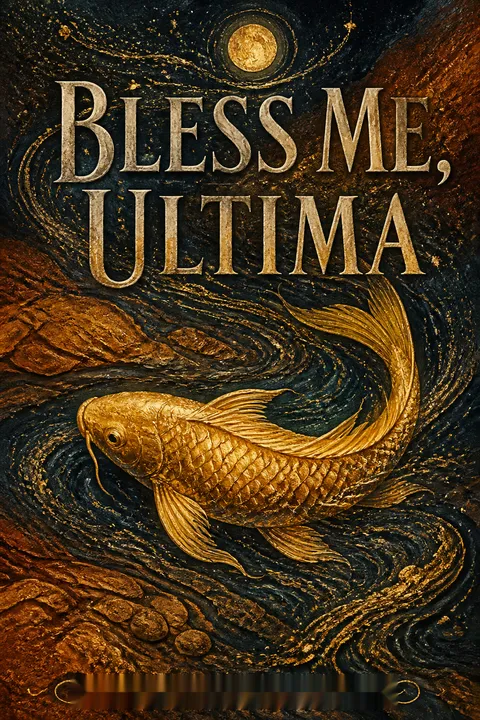


Plot Summary
Ultima Enters the House
Before he is seven, Antonio1 dreams of his birth: his mother's4 Luna relatives13 claim him for farming and the priesthood, while his father's3 Márez kin imagine a free-roaming vaquero. The midwife who delivered him2 stops their quarrel and keeps his fate to herself. Years later, his parents bring that same healer,2 Ultima,2 to live with their family in Guadalupe.
His mother4 hopes Antonio1 will become a priest; his father3 longs for a son who will join him in the open country. When Ultima2 takes Antonio's1 hand, he feels the hills and river become newly vivid. Her owl settles near the house, and the boy senses that the woman from his dream2 knows something about the life ahead of him.
Antonio's first conflict is inherited before it is chosen. The opposed gifts in his birth dream, cultivated earth and open range, are not merely career options; they are rival family histories asking a child to become their proof. Ultima's refusal to declare his fate gives him room, but her arrival also makes his inward life more alert. The owl's presence joins domestic care to the unknown without making either seem false. The opening therefore frames identity as something received in fragments, not a single destiny waiting to be discovered.
Lupito Dies at the River
One night, Jasón's father,17 Chávez, rushes to Antonio's1 home with news that his brother, the sheriff, has been shot by Lupito, a veteran made unstable by war. Antonio1 follows his father3 and the armed townsmen to the river, where he sees Lupito hiding in the reeds. Narciso5 tries to calm the wounded man, but the posse fires when Lupito shoots into the air to draw their aim.
Lupito crawls to the bank and dies in front of Antonio.1 The boy runs home shaken, and Ultima2 treats his cuts and comforts him. The next morning he questions whether God will condemn Lupito and whether his father3 sinned by joining the men. Ultima2 tells him not to presume to judge a soul.
Lupito's death makes Antonio's moral education bodily and immediate: he does not hear about violence later, he sees a frightened man die within reach. The posse's fear turns a possible surrender into another killing, while Narciso's failed attempt at mercy establishes him as a counterweight to the crowd. Antonio's questions expose the limits of the religious categories he has inherited. Ultima does not replace them with easy answers; she restrains judgment. Her response models a form of ethical attention that can hold responsibility and uncertainty together.
Three Sons Come Home
Antonio1 begins school speaking little English and feeling conspicuous among children who mock his lunch and language. He finds a small community with other farm children, then learns his name in writing so quickly that teachers advance him from first grade to third.
When World War II ends, León,8 Eugene,9 and Andrew7 return, briefly restoring the family their mother4 has prayed for. Their reunion revives Gabriel's3 hope of moving west, but the brothers7 are restless, sleepless, and burdened by wartime memories.
In spring, León8 and Eugene9 leave for new lives in Santa Fe, while Andrew7 stays in Guadalupe for work. Antonio1 is left to absorb the cost of dreams that belong to other people, even as his success at school strengthens his mother's4 priestly hopes.
School gives Antonio a new instrument of belonging, but literacy does not dissolve the cultural difference he feels in the classroom. His promotion rewards his hunger to learn while making him more useful to his mother's imagined future. The brothers' homecoming briefly seems to repair wartime separation, yet their restlessness shows that return is not the same as recovery. Each parent reads the sons through an older story, and the sons refuse to live as symbols. Antonio watches family love become a pressure to choose before he understands what either choice costs.
The Golden Carp Appears
After school lets out, Antonio1 waits for Cico,11 a quiet boy who knows the river's hidden places. Cico11 asks him to promise never to hunt carp, then leads him to a secluded pond. There Antonio1 sees an enormous golden fish glide through the water.
Cico11 explains a legend in which a compassionate god became a carp to protect people transformed into fish, and tells Antonio1 that the golden carp has foretold the town's eventual submersion under the weight of its sins. The sight leaves Antonio1 awed and unsettled: he has been taught there is one God, yet this being seems sacred too. He takes the story to Ultima,2 who refuses to dictate his beliefs and tells him that he must discover his own truths.
The golden carp turns Antonio's religious doubt from a hypothetical question into an encounter with beauty. Its authority comes not from doctrine or threat but from the boy's direct perception, which makes disbelief feel as inadequate as unquestioning acceptance. Cico's prophecy also complicates the child's wish for a just universe: this god offers protection, yet the legend contains judgment and catastrophe. Ultima's restraint matters because she declines to recruit Antonio into her own worldview. She teaches him how to remain curious without pretending that curiosity has already resolved the conflict.
Lucas Vomits the Curse
Antonio's1 uncle Lucas14 has wasted away after encountering Tenorio's6 daughters performing a forbidden rite. Doctors and the priest at El Puerto cannot help him, so his family asks Ultima2 to intervene. She warns that changing a person's fate may set consequences in motion, then brings Antonio1 because his Luna blood and name matter to the cure.
At his grandfather's15 house, she confronts Tenorio,6 identifies his daughters as the source of the curse, and then works for days beside Lucas's14 bed. Antonio1 helps administer her remedies and experiences Lucas's14 pain as if their bodies were connected. At last Lucas14 convulses and expels a living ball of hair. Ultima2 burns the cursed material at the witches' clearing, and Lucas14 begins to recover.
The cure makes healing a demanding practice rather than a spectacle. Antonio is not simply shown a miracle; Ultima gives him work, risk, and responsibility inside it. His bodily identification with Lucas suggests how care can cross the distance between witness and sufferer, while the expelled hair gives an otherwise invisible violence a material form. The episode also unsettles the authority of institutions: medical treatment and church ritual have failed where Ultima's knowledge succeeds. Yet she has warned that intervention carries consequences, planting an ethical caution that the later conflict will test.
The Mob Tests Ultima
After one of Tenorio's6 daughters dies, he tells the town that Ultima2 caused her death and claims a curandera's pouch proves it. He leads an armed, whiskey-fueled mob to Antonio's1 home, demanding that Gabriel3 surrender her. Gabriel3 refuses to let the crowd cross his land, while Narciso5 challenges the men to use their own customary test instead of acting as a lynch mob.
They pin blessed needles in a cross above the doorway. Ultima2 walks through unharmed, establishing that the accusation cannot stand by the mob's rules. Her owl attacks Tenorio6 and blinds one eye. The crowd disperses, but Tenorio6 leaves with a deeper hatred of Ultima,2 and Antonio1 understands that proving goodness will not make an enemy abandon revenge.
The test exposes how a community can dress collective violence in the language of law and faith. Narciso interrupts that conversion by forcing the men to submit their accusation to a standard they themselves recognize. Ultima's passage through the doorway defeats the charge on its own terms, but the owl's attack leaves the resolution unstable: public vindication does not produce reconciliation. Tenorio's wounded pride turns humiliation into a private mandate. Antonio learns that truth may stop a mob for a night without curing the appetite for vengeance that gathered it.
Narciso Dies Beneath Juniper
During a winter blizzard, Antonio1 sees Tenorio6 and Narciso5 fight outside the Longhorn. Narciso5 breaks away to warn Andrew7 that Tenorio6 is threatening Ultima,2 but finds him at Rosie’s house and fails to persuade him to leave. Antonio1 follows Narciso5 through the storm.
Beneath the juniper near home, Tenorio6 ambushes him and shoots him; Antonio1 reaches Narciso5 in time to hear his confession and pray over him, though he is only a child. The murder leaves Antonio1 feverish with guilt and grief. After he recovers, León8 and Eugene9 return following a car wreck, then leave again with Andrew,7 who abandons his local job and plans for school. Gabriel3 loses all three sons once more.
Narciso's death is the novel's sharpest collision between loyalty and human weakness. He risks himself to protect Ultima, while Andrew's desire and disbelief in the warning keep him indoors; Antonio witnesses the cost of that failure without being old enough to prevent it. Asked to hear a dying man's confession, the boy occupies a role his mother has imagined for him, but he does so through compassion rather than ordination. The brothers' final departure compounds grief with ordinary family rupture. No grand explanation arrives, only the knowledge that love does not guarantee timely action.
Communion Brings Silence
As Antonio1 studies for his first communion, Florence,10 an orphan whose sisters work at Rosie's, challenges the lessons about sin, punishment, and a God who permits suffering. Antonio1 tries to defend the faith but cannot answer Florence's10 questions about why an innocent child should suffer.
During a children's mock confession, the others18 demand that Florence10 admit guilt; Antonio1 refuses to punish him and declares him absolved, then is beaten for taking his side.
At Easter, Antonio1 receives communion expecting God to answer his questions about Lupito, Narciso,5 and evil. He hears only silence. The rite gives his mother4 joy, but it does not give Antonio1 certainty, and Florence's10 honest doubt remains more difficult to dismiss than the catechism's confident formulas.
The communion scene reverses the expected promise of initiation: Antonio completes the ritual but gains no explanatory certainty. Florence functions less as a rival believer than as a test of whether doctrine can accommodate actual suffering. Antonio's decision to protect him during the mock confession anticipates an ethics grounded in mercy, even before he can defend it intellectually. The scene also exposes the social force of religious instruction: the children enforce orthodoxy through violence when compassion threatens their rules. Antonio's silence after communion is not simple loss of faith; it is the beginning of discernment.
The Téllez Curse Burns
A vaquero named Téllez asks Ultima2 to help his family, whose house suffers falling stones and flying dishes despite a priest's blessing. Gabriel3 sees the disturbance himself and brings Ultima,2 Antonio,1 and Téllez to the ranch. Ultima2 explains that brujas have awakened the spirits of three Comanche men whom Téllez's grandfather hanged and left unburied.
She directs Gabriel3 and Antonio1 to build a raised platform from cedar posts and juniper, then performs a ceremony inside the house. At dusk she brings out three heavy bundles and has them burned on the platform. The attacks stop. Téllez offers payment, but Ultima2 asks for a lamb instead and warns him to avoid Tenorio,6 whose vengeance has spread beyond the original accusation.
The ranch haunting widens the novel's moral field beyond personal wrongdoing. The spirits are not inherently evil; they have been trapped by an old act of violence and manipulated by people who know how to exploit that harm. Ultima's cure therefore requires recognition of historical injury, not merely expulsion of a supernatural force. Gabriel's willingness to help marks a shift from skepticism toward trust in his friend's experience. The burning platform joins Indigenous burial knowledge with the family's present need, suggesting that healing depends on attending to histories the dominant religious account has left unburied.
Florence Drowns at Blue Lake
Later, Cico11 takes Antonio1 back to the pond to see the golden carp again, and Antonio1 decides Florence10 should be allowed to see it too. Before they can find him, the boys18 at Blue Lake call for help: Florence10 has dived into a restricted, weed-choked section and failed to surface. Antonio1 and Cico11 help pull him from the water, but barbed wire has caught his arm and he is dead.
Antonio1 prays for him, knowing Florence10 never believed in the church's God, then flees the crowd as the bells begin to toll. Shaken by repeated deaths, he refuses to attend Florence's10 funeral. Ultima2 persuades his parents to send him to El Puerto for the summer, where work with his Luna uncles13 may restore his attention to life.
Florence's drowning arrives just as Antonio hopes to offer him a different spiritual possibility, making the loss feel both intimate and unanswerable. The barbed wire gives the death a brutal material cause; it is not a supernatural punishment, despite the boy's fear that every death must fit a cosmic verdict. Antonio's inability to attend the funeral reflects exhaustion, not indifference. Ultima responds by changing his surroundings rather than forcing another explanation upon him. The move toward El Puerto becomes a form of care: after so much exposure to death, he needs sustained contact with cultivation and ordinary communal work.
The Lunas Teach Antonio
On the drive to El Puerto, Gabriel3 tells Antonio1 that understanding grows through living and sympathy, not through a single religious answer. He admits that the Márez and Luna dreams need not remain enemies. Antonio1 spends the summer working beside his uncles,13 learning how they plant and harvest by the moon and care for the soil.
He tells himself he is Márez first and Luna after, yet accepts that the valley will always remain open to him. Near summer's end, word arrives that Tenorio's6 remaining daughter has died and that he is raging against Ultima.2 Uncle Pedro13 takes Antonio1 toward Guadalupe. On the bridge, Tenorio6 tries to run him down, but Antonio1 escapes into the brush and makes the long journey home to warn Ultima.2
The summer's work does not settle Antonio's future by assigning him to farming; it gives him an embodied knowledge of one inheritance without erasing the other. Gabriel's account of understanding as sympathy reframes the boy's search: certainty is less important than learning to perceive how people and histories are bound together. Antonio's declaration of Márez precedence remains emotionally significant, but his acceptance of the Lunas' welcome prevents that identity from becoming a rejection. Tenorio's attack then tests this integration through action. Antonio runs not to prove a doctrine, but because care has become a responsibility he chooses.
Tenorio Hunts the Owl
Antonio1 reaches home as Uncle Pedro's13 truck arrives, but Tenorio6 is already hiding beneath the juniper. Antonio1 warns his family; Ultima2 calls to her owl, and Tenorio6 fires. He raises the dead bird in triumph, believing he has destroyed the spirit tied to Ultima.2 When Tenorio6 aims at Antonio,1 Pedro13 shoots him from the truck, killing him before he can fire again.
Antonio1 carries the owl inside. Ultima2 lies dying and explains that the bird was her bond to the harmony of the world. She asks Antonio1 to burn her medicines and bury the owl beneath a forked juniper, then blesses him. Antonio1 watches her die and understands that her death cannot be undone, even by all the care he bears her.
The climax makes the owl's earlier role explicit: it has been not only a guardian but the living bond through which Ultima's work touches the world. Tenorio targets that bond because he mistakes destruction for mastery, while Pedro's intervention ends the immediate threat through an act of justified violence that nonetheless carries moral weight. Ultima's final instructions turn Antonio from protected child into caretaker of her remains and practice. Her blessing does not promise safety or revelation. It gives him a way to continue living without confusing grief with the collapse of everything she taught.
Antonio Buries Ultima's Owl
After Ultima2 dies, Antonio1 follows her instruction into the moonlit hills and buries the owl beneath a forked juniper, covering the grave with a stone. He returns knowing that a wake, funeral, and burial in Las Pasturas will come, but that the bird's resting place is the truer farewell for him.
From the hill he can see the town, the river, and the road to school, places that now hold both wonder and loss. He does not receive a final answer about becoming a priest, farmer, or wanderer. Instead, he understands that his future must be built from the lives he has encountered, and from the different inheritances he can carry without letting either erase the other.
The burial is a small, deliberate act after a story crowded with forces Antonio could not control. By honoring Ultima's request, he converts grief into responsibility and gives the owl a place within the landscape that shaped their bond. The ending refuses to solve his vocation because the novel's central development is not choosing one parental dream over another. Antonio has learned to make meaning from overlapping traditions, nature, and human sympathy. Childhood ends not with certainty, but with a capacity to carry contradiction without surrendering to fear.
Analysis
Bless Me, Ultima places a child inside disputes that adults often treat as settled: whether faith can explain suffering, whether family inheritance determines a vocation, and whether unfamiliar powers must be called evil. Antonio's1 development comes not through a single conversion but through repeated encounters with experiences that resist one authoritative account. Lupito's death exposes the gap between religious judgment and compassion. Lucas's14 cure makes traditional healing observable and effective, while the golden carp gives Antonio1 a direct experience of another sacred order. Florence10 then presses the same problem from the opposite direction: a belief system that cannot answer the suffering of the vulnerable risks becoming a discipline of exclusion.
The novel's landscape is active in this argument. The river carries both fertility and blood; the bridge links family, church, school, and violence; the llano grants Gabriel3 a sense of freedom while the valley offers the Lunas4 continuity and nourishment. These places are not interchangeable scenery. They make the family's divided history tangible, and Ultima2 teaches Antonio1 to attend to the life present in each. Her healing is ethical as well as supernatural because she approaches suffering with sympathy, even while warning that intervention has consequences.
The book does not resolve its tensions by declaring one tradition victorious. Antonio's parents,3 Ultima,2 Cico,11 Florence,10 and the Lunas13 each provide partial knowledge, shaped by different losses and loyalties. His task is to carry these perspectives without mistaking synthesis for a painless compromise. By the end, he has learned that maturity means accepting responsibility for what he can do, mourning what he cannot prevent, and refusing to let inherited categories replace attention to particular people. The final burial of Ultima's owl gives him no doctrine to memorize. It leaves him with a practice: remember, care, and make a life from the many truths he has encountered.
Review Summary
Bless Me, Ultima is a coming-of-age story set in 1940s New Mexico, following young Antonio as he grapples with faith, culture, and identity. The novel explores themes of good vs. evil, tradition vs. modernity, and the blending of Catholic and indigenous beliefs. While praised for its lyrical prose and cultural significance, some readers found it slow-paced or objectionable due to language and religious content. The book has faced censorship attempts but remains an important work in Chicano literature, resonating with many readers for its portrayal of cultural complexity and spiritual growth.
People Also Read




Characters
Antonio Márez y Luna
Child between two inheritancesAntonio, usually called Tony, narrates the story as a thoughtful boy growing up in a New Mexican town at the end of World War II. His father3 comes from the restless Márez vaquero tradition; his mother4 belongs to the settled Luna farming family and hopes he will become a priest. Antonio wants knowledge and approval, but his questions about death, sin, and competing spiritual traditions make simple obedience impossible. He is observant rather than naturally bold, yet repeatedly acts when someone vulnerable needs help. His sensitivity to landscape, dreams, and other people's pain gives him a way to perceive truths that adults around him explain differently. He is learning to form an identity without reducing himself to one family's expectations.
Ultima
Healer and moral guideUltima is an elderly curandera, or traditional healer, whom Antonio's parents3 welcome into their home. She has delivered their children, knows the medicinal plants of the region, and is respected and feared because she can treat illnesses attributed to witchcraft. She teaches Antonio1 to observe nature closely and to wait when an answer is not yet his to know. Her authority comes from practiced knowledge, courage, and deep sympathy for suffering people, not from a desire to control them. She is comfortable beside Catholic ritual while also drawing on older spiritual traditions. For Antonio1, she is a source of protection and a model of how knowledge can serve life without requiring certainty about every mystery.
Gabriel Márez
Restless father and vaqueroGabriel is Antonio's1 father, a former vaquero who now works on highway crews. He longs for the openness of the llano and imagines moving west with his sons7, but economic change and family choices have narrowed that dream. His drinking and Sunday quarrels reveal grief as much as pride. Gabriel distrusts institutional religion and values freedom, yet he can be tender with his children and generous toward old friends. He refuses to force Antonio1 into either parental destiny, and his reflections on land, history, and understanding help his son1 see that inherited identities can be reshaped. His strength is not that he escapes disappointment, but that he can speak honestly about it.
María Luna
Mother with a priestly dreamMaría is Antonio's1 devout Catholic mother and a daughter of the farming Lunas15 of El Puerto. She wants her youngest son1 to become a priest and hopes he will preserve her family's religious and agricultural traditions. Her faith gives structure to a life marked by worry for sons7 away at war, but it can also make her anxious to define Antonio's1 future before he can choose it. She is affectionate, industrious, and closely tied to her brothers13 and the fertile valley they cultivate. Her disagreements with Gabriel3 arise from different histories rather than lack of love. María's devotion shows both the comfort religion can offer and the pressure a parent's hopes can place on a child.
Narciso
Drunk with a generous heartNarciso is a large, weathered vaquero from Gabriel's3 llano community. Townspeople dismiss him as a drunk, but his garden is renowned for its abundance and he remains loyal to old friends. He tries to prevent the posse from killing Lupito and later risks himself to protect Ultima2. His generosity coexists with grief and drinking, and he is not presented as a flawless moral hero. Antonio1 sees that a person's public reputation can conceal a more complicated private character. Narciso's actions make loyalty concrete: he spends his strength and safety on people others have already decided are expendable.
Tenorio Trementina
Vengeful saloonkeeperTenorio runs a saloon in El Puerto and is the father of three daughters suspected of practicing witchcraft. He reacts to accusations against his family with fury and interprets resistance as an insult that must be answered. His ability to gather frightened or intoxicated men makes his private resentment a public danger. Tenorio is not simply a supernatural villain: pride, grief, and a refusal to accept responsibility feed his hostility. His conflict with Ultima2 forces Antonio1 to distinguish a real injury from the story Tenorio builds around it, and to see how revenge can recruit a whole community.
Andrew Márez
Brother caught between pathsAndrew is Antonio's1 brother, one of three sons who return from military service after the war. He is more independent than León8 and Eugene9, and for a time remains in Guadalupe, working at a store and considering further schooling. He cares for Antonio1 but is reluctant to accept the parental futures his younger brother1 is still being asked to fulfill. His choices reveal how difficult it is for adult children to separate affection from obligation. Andrew's quietness can look like indecision, but it also reflects an effort to make a life that belongs to him.
León Márez
Melancholy returned soldierLeón is Antonio's1 eldest brother. He returns from the war carrying sadness and exhaustion, and his troubled sleep suggests that home cannot simply restore the person he was before leaving. He is drawn to Eugene's9 plans for independence but retains a gentler, more reflective temperament. His relationship with Gabriel3 is shaped by affection and the knowledge that the father's3 dream of moving west may not be shared by his sons. León's experience gives Antonio1 an early glimpse of how war changes a family even after its soldiers come home.
Eugene Márez
Brother who pushes outwardEugene is Antonio's1 youngest older brother and the most forceful of the three returned soldiers. He resists Gabriel's3 plan to move the family to California and argues that the brothers7 should build independent lives. His impatience and bluntness can hurt his parents, though he is also trying to name a freedom his father3 once claimed for himself. Eugene's restlessness echoes the Márez tradition, now altered by military service and modern work. To Antonio1, he represents both the pull of the open road and the pain of watching a loved one leave.
Florence
Doubting friend and questionerFlorence is a tall, fair-haired schoolmate whose mother and father are dead and whose sisters work at Rosie's. He attends catechism to remain with his friends, not because he accepts its teachings. His questions about suffering, punishment, and God's responsibility are unusually direct, and he refuses to pretend belief simply to satisfy others. Antonio1 recognizes in Florence a moral seriousness that the other boys18 often mistake for defiance. Their friendship gives the novel's theological debate a human face: the question is not only what is true, but whether a belief can answer the pain of a child.
Cico
Keeper of the carp's secretCico is a quiet boy who spends much of his time fishing and knows the hidden watercourses around Guadalupe. He trusts Antonio1 with the story of the golden carp and brings him to see the great fish. Cico's belief is practical and intimate, rooted in a place he knows rather than a formal institution. He is careful about whom he trusts and warns Antonio1 about dangers near the Hidden Lakes. His friendship opens a new spiritual possibility while leaving Antonio1 free to question it.
Samuel
Quiet teller of old storiesSamuel is a thoughtful schoolmate and Cico's11 older brother. He tells Antonio1 the first version of the golden carp legend and speaks with a calmness that makes him seem older than his years. Unlike the louder boys18, Samuel notices what others overlook and treats inherited stories as knowledge worth protecting. He offers Antonio1 companionship during school and helps connect the river's mythology to the boy's growing questions about faith.
Uncle Pedro Luna
Practical uncle and allyPedro is one of María's4 brothers and the Luna uncle Antonio1 feels closest to. He is affectionate and direct, often serving as the link between the Guadalupe household and El Puerto. Pedro brings the family to the harvest and asks Ultima2 to help Lucas14 when other remedies have failed. He respects her power, though he admits that fear and family authority can make people hesitate to act. His decency combines practical loyalty with a capacity to recognize when he has been wrong.
Uncle Lucas Luna
Farmer struck by a curseLucas is María's4 youngest brother, a skilled farmer and orchard worker. He becomes gravely ill after seeing Tenorio's6 daughters perform a forbidden ceremony, and his suffering draws Ultima2 and Antonio1 into the work of healing. Lucas's ordeal brings the competing authority of church, medicine, and folk practice into direct contact. He is valued by his family not only as a patient but as a man whose hands know how to care for trees.
Prudencio Luna
Patriarch of El PuertoPrudencio is María's4 elderly father and the respected head of the Luna family in El Puerto. His home anchors a large extended family, and his authority reflects the valley's agricultural traditions. He values custom and family continuity, even when those values lead him to hesitate in a crisis.
Father Byrnes
Priest and catechism teacherFather Byrnes teaches Antonio1 and the other children18 Catholic doctrine and prepares them for confession and communion. He is disciplined and confident in the church's rules, though his lessons sometimes sharpen the children's fear of sin and damnation. For Antonio1, he represents a formal religious authority that offers ritual and structure but does not answer every question about suffering.
Jasón
Friend drawn to an elderJasón is Antonio's1 quiet friend, a boy who keeps visiting an Indigenous man despite his father's disapproval. His persistence suggests an instinctive attraction to knowledge outside the town's approved boundaries. He gives Antonio1 an early glimpse of how a child can choose curiosity even under family pressure.
The schoolboys
Rough schoolyard companionsAntonio's1 schoolmates include Red, Horse, Bones, Ernie, and several other boys. They are unruly, funny, competitive, and often cruel, using wrestling and taunts to establish place in the group. Their behavior shifts when Antonio1 stands up for Ultima2 and later refuses to condemn Florence10. As a chorus, they show how children absorb community beliefs and enforce them long before they understand their consequences.
Plot Devices
Ultima's Owl
Guardian spirit and bondThe owl arrives with Ultima2 and watches over Antonio's1 household. Its calls mark danger, and its presence accompanies Ultima's2 work as a healer. For much of the story, Antonio1 experiences it as a protective creature rather than understanding its full connection to her. The owl gives the supernatural a visible, recurring form and links the healer2 to the landscape's cycles of night, moon, and open country. Its ultimate significance is revealed in the climax.
The Golden Carp
Alternative sacred visionThe golden carp appears in a story told first by Samuel12 and then in a secluded pond where Cico11 takes Antonio1. The fish is understood as a god who chose to protect people transformed into carp, and its prophecy gives the river valley a future shaped by human wrongdoing. Its beauty is not merely decorative: seeing it forces Antonio1 to compare a lived experience of the sacred with the Catholic teachings he has received. The legend opens a spiritual possibility without settling which belief he should choose.
Antonio's Dreams
Inner conflict made visibleAntonio's dreams transform family expectations, religious fears, and recent deaths into scenes he can experience before he can explain them. His birth dream stages the conflict between Luna and Márez futures; later dreams mix the river, the Virgin, the golden carp, and the dead. These visions do not provide a reliable map of events. Instead, they show how a child's mind absorbs adult stories and tries to make them answer moral questions. Their changing imagery tracks Antonio's1 movement from fear toward a more complex understanding.
The River and Bridge
Border between worldsThe river and its bridge connect Antonio's1 home on the edge of the llano to the town, church, school, and Luna13 farms. Characters cross the bridge for school, family visits, and danger, so it becomes a practical threshold as well as a symbolic one. The river carries life, blood, fish, and spiritual presence, resisting any single explanation Antonio1 tries to impose on it. Its recurring physical geography helps the novel join domestic events to the larger landscape and its remembered histories.
Herbs and Healing Rituals
Restoring disrupted harmonyUltima's2 remedies combine gathered plants, careful observation, prayer, and ritual action. In Lucas's14 illness, Antonio1 helps her administer medicine and witnesses the physical expulsion of the curse. At the Téllez ranch, a platform and a fire address a haunting rooted in older violence. These practices show healing as both bodily and communal: a patient needs care, but the source of suffering may also involve memory, history, or broken relations with the land. The rituals remain powerful without being reduced to a simple formula.
FAQ
Synopsis & Basic Details
What is Bless Me, Ultima about?
- A Boy's Spiritual Quest: Bless Me, Ultima follows Antonio Márez, a young boy growing up in rural New Mexico during World War II, as he navigates the complex spiritual and cultural landscape shaped by his family's conflicting heritages and the arrival of a wise folk healer, Ultima. The narrative explores Antonio's coming-of-age, his struggle to reconcile Catholic doctrine with indigenous spirituality, and his search for understanding in a world marked by both beauty and violence.
- Clash of Cultures: The story centers on Antonio's internal conflict, pulled between his mother's devout Luna farming lineage, which desires him to become a priest, and his father's restless Márez vaquero heritage, which yearns for freedom and the open llano. Ultima acts as his spiritual guide, introducing him to a syncretic worldview that challenges his preconceived notions of good, evil, and God.
- Loss of Innocence: Through a series of traumatic events, including witnessing murders and the suffering of loved ones, Antonio confronts the harsh realities of life, death, and moral ambiguity. These experiences force him to question his faith and seek a personal truth that can encompass the contradictions he observes, ultimately shaping his identity and understanding of the world.
Why should I read Bless Me, Ultima?
- Rich Cultural Immersion: Readers are drawn into the vibrant, often mystical, world of New Mexican Chicano culture, experiencing its unique blend of Spanish, Mexican, and Native American traditions, folklore, and language. The novel offers a profound exploration of cultural identity and the challenges of assimilation.
- Universal Themes Explored: Beyond its specific setting, Bless Me, Ultima delves into timeless themes such as the nature of good and evil, the search for faith and meaning, the transition from childhood innocence to adult understanding, and the power of mentorship. Antonio's spiritual journey resonates deeply with anyone grappling with life's big questions.
- Masterful Magical Realism: Rudolfo Anaya seamlessly weaves supernatural elements, vivid dreams, and ancient myths into a realistic narrative, creating a captivating reading experience. This blend of the ordinary and extraordinary enriches the story, inviting readers to consider different ways of perceiving reality and the sacred.
What is the background of Bless Me, Ultima?
- Post-WWII New Mexico: The story is set in the late 1940s, a period of significant change in New Mexico. The return of soldiers from World War II, like Antonio's brothers, brought new ideas and restlessness, challenging traditional ways of life in small, isolated communities. This historical context underscores themes of societal transition and the erosion of old customs.
- Chicano Cultural Heritage: Anaya draws heavily from his own experiences and the rich cultural tapestry of New Mexico, incorporating elements of curanderismo (folk healing), vaquero life, Luna farming traditions, and indigenous myths. The novel reflects the syncretic nature of Chicano spirituality, where Catholic beliefs often intertwine with pre-Columbian and Native American spiritual practices.
- Landscape as Character: The geographical setting of the llano (open plains) and the Pecos River valley is not merely a backdrop but an active force shaping the characters' identities and worldviews. The stark beauty and harshness of the landscape symbolize the freedom and wildness of the Márez, and the rootedness and fertility of the Luna, influencing Antonio's internal struggle.
What are the most memorable quotes in Bless Me, Ultima?
- "The golden carp is a god.": This simple yet profound statement by Samuel (Chapter 7) shatters Antonio's singular Catholic worldview, introducing the radical idea of alternative deities and challenging the exclusivity of his inherited faith. It marks a pivotal moment in Antonio's spiritual awakening and the novel's exploration of religious syncretism.
- "A man's destiny must unfold itself like a flower, with only the sun and the earth and water making it blossom, and no one else meddling in it.": Ultima's wisdom (Chapter 20) encapsulates the novel's central theme of self-discovery and the importance of allowing one's true path to emerge naturally, free from external pressures or predetermined expectations. This quote highlights the organic, naturalistic philosophy she imparts to Antonio.
- "The waters are one, Antonio.": Ultima's ultimate revelation in Antonio's dream (Chapter 11) synthesizes the conflicting elements of his world—the sea and the moon, the river and the sky, God and the golden carp—into a unified, interconnected whole. This quote represents the culmination of Antonio's journey towards understanding the underlying harmony of existence, transcending dualities.
What writing style, narrative choices, and literary techniques does Rudolfo Anaya use?
- First-Person Retrospective Narration: Anaya employs a first-person narrative from Antonio's adult perspective looking back on his childhood, allowing for a blend of innocent observation and mature reflection. This narrative choice imbues the story with a sense of nostalgia and allows the narrator to foreshadow events and offer philosophical insights that a child character could not articulate in the moment.
- Lyrical and Evocative Prose: The writing is characterized by its poetic quality, rich sensory details, and vivid descriptions of the New Mexican landscape, making the setting a living, breathing entity. Anaya's prose often blurs the line between reality and the spiritual, enhancing the novel's magical realism and drawing the reader into Antonio's subjective experience.
- Symbolism and Archetypal Imagery: Anaya extensively uses symbolism (e.g., the owl, the river, the golden carp, the juniper tree, the sun and moon) and archetypal figures (the wise old woman, the restless father, the nurturing mother) to explore universal themes and cultural conflicts. This technique gives the story a mythic quality, connecting Antonio's personal journey to broader human experiences and ancient traditions.
Hidden Details & Subtle Connections
What are some minor details that add significant meaning in Bless Me, Ultima?
- The Falling Needles: After Ultima passes the witch test by walking through the door marked with holy needles, Antonio later finds the needles on the ground (Chapter 12). This subtle detail suggests that while Ultima's power is good and she is not a "bruja" in the malicious sense, her magic operates outside the rigid confines of Catholic ritual, causing the "holy" barrier to simply fall away rather than being overcome by a direct confrontation of forces. It hints at a different, more natural order of power.
- Ultima's Scapular: Ultima gives Antonio her scapular, a small pouch of herbs, for protection (Chapter 12), which he wears under his shirt. This act is a profound transfer of spiritual guardianship and a subtle rejection of purely Catholic symbols for Antonio's personal protection. It signifies Ultima's direct, personal influence on Antonio's spiritual path, offering a tangible, earthy form of grace that contrasts with the abstract nature of the church's sacraments.
- The Wind's Voice: Antonio's father often speaks of the wind as having a voice, particularly when discussing the changes on the llano or the atomic bomb (Chapter 17). This personification of the wind subtly reinforces the animistic worldview that Ultima embodies, where nature is alive and communicates. It shows Gabriel, despite his Márez restlessness, shares a deep, intuitive connection to the land's spirit, bridging his and Ultima's perspectives.
What are some subtle foreshadowing and callbacks in Bless Me, Ultima?
- Antonio's Birth Dream's Echoes: Antonio's vivid dream of his birth (Chapter 1), where his Márez and Luna relatives fight over his destiny, is a powerful foreshadowing of his entire spiritual and identity struggle. This dream is not just a one-time vision; it's repeatedly referenced and re-experienced, such as when his brothers return from war and mock his mother's dream of him becoming a priest (Chapter 8), constantly reminding Antonio of the deep-seated conflict within his blood.
- The Owl's Shifting Hoots: Ultima's owl initially hoots a "soft hooting... like a song" that lulls Antonio to sleep (Chapter 1), symbolizing peace and protection. However, as danger approaches, particularly before Narciso's murder and Tenorio's final attack, the owl's cries become "a danger cry" or "cries of alarm" (Chapter 12, 20). This subtle shift in the owl's vocalization foreshadows impending violence and highlights its role as Ultima's spiritual familiar and a barometer of the world's harmony.
- The River's Stained Waters: After Lupito's death, Antonio observes the river's "brown waters would be stained with blood, forever and ever and ever" (Chapter 2). This early observation foreshadows not only the continued violence and loss Antonio will witness but also his ongoing struggle to cleanse the world and his own soul of sin and suffering. The river, a source of life and a symbol of the Golden Carp, becomes a recurring motif for the indelible marks of human actions.
What are some unexpected character connections in Bless Me, Ultima?
- Samuel and the Vitamin Kid's Brotherhood: The revelation that Samuel, the quiet, wise boy who introduces Antonio to the Golden Carp, is the brother of the energetic, almost mythical "Vitamin Kid" (Chapter 8) is unexpected. This connection subtly links the spiritual and the physical, the contemplative and the active, suggesting that different paths can emerge from the same family roots and that even seemingly disparate individuals share a common origin.
- Narciso's Hidden Kindness to María: Despite his reputation as the town drunk, Narciso is revealed to have been a steadfast friend to María Luna, Antonio's mother, particularly during the difficult births of her twins (Chapter 12). This connection challenges Antonio's simplistic view of Narciso as merely a "drunkard" and highlights the complex, often hidden, goodness in people, reinforcing Ultima's teaching that judgment should be withheld.
- Ultima's Past with Antonio's Grandfather: Ultima mentions that Antonio's Luna grandfather and she are "old friends" (Chapter 4), implying a deeper, long-standing connection to the Luna family beyond just being María's midwife. This detail suggests that Ultima's influence and wisdom have been a quiet, guiding force in the Luna family for generations, further solidifying her integral role in Antonio's heritage and destiny.
Who are the most significant supporting characters in Bless Me, Ultima?
- Narciso, the Moral Compass: Despite his alcoholism, Narciso emerges as a crucial moral figure, embodying courage and selflessness. His attempts to reason with the mob during Lupito's death (Chapter 2) and his ultimate sacrifice to warn Ultima (Chapter 13) highlight his inherent goodness and challenge Antonio's simplistic understanding of sin and virtue. Narciso's death is a profound lesson in the cost of doing good.
- Florence, the Skeptical Catalyst: Florence, Antonio's friend who openly questions God due to his suffering, serves as a vital intellectual and spiritual foil for Antonio. His unwavering doubt forces Antonio to critically examine his own faith and the limitations of Catholic dogma (Chapter 17, 18). Florence's tragic death further deepens Antonio's crisis of faith, pushing him towards a more personal and inclusive understanding of spirituality.
- Samuel and Cico, Guides to Alternative Truths: Samuel and Cico are instrumental in introducing Antonio to the legend of the Golden Carp, a pagan deity that offers a contrasting, nature-based spirituality (Chapter 7, 11). Their friendship provides Antonio with an alternative framework for understanding the divine, demonstrating that truth and divinity can exist outside the confines of the Church and are deeply intertwined with the natural world.
Psychological, Emotional, & Relational Analysis
What are some unspoken motivations of the characters in Bless Me, Ultima?
- Gabriel's Yearning for Lost Freedom: Gabriel Márez's constant talk of moving west to California and his lament for the "freedom of the llano" (Chapter 6) is an unspoken desire to reclaim a lost identity and escape the perceived emasculation of settled town life. His drinking is a coping mechanism for the unfulfilled dreams and the feeling of being "shackled to one piece of land" (Chapter 3), a deep-seated regret that he projects onto his sons.
- María's Fear of Márez Blood: María Luna's intense desire for Antonio to become a priest is driven by an unspoken fear of the "wild, restless" Márez blood (Chapter 4) that she believes led her older sons astray and could lead Antonio to a life of wandering and sin. Her dream for Antonio is a protective measure, an attempt to anchor him to the stability and moral certainty of the Luna farming tradition and the Church.
- Andrew's Lingering Guilt and Loyalty: Andrew's decision to stay behind when his brothers León and Eugene leave (Chapter 9), and his later presence at Rosie's house, hints at an unspoken motivation of guilt or a desire to protect his mother from further disappointment. His initial reluctance to leave suggests a deep-seated loyalty to his family, even as he grapples with his own desires and the disillusionment of war, making his eventual departure with his brothers more complex than simple restlessness.
What psychological complexities do the characters exhibit in Bless Me, Ultima?
- Antonio's Syncretic Identity Formation: Antonio grapples with profound psychological complexity as he attempts to synthesize the conflicting worldviews of his parents and Ultima. His mind is a battleground for Catholic dogma, Márez freedom, Luna stability, and indigenous spirituality, leading to intense internal debates and vivid dreams that reflect his struggle to forge a coherent identity rather than choosing one path over another.
- Tenorio's Obsessive Vengeance: Tenorio Trementina's character is psychologically complex, driven by an all-consuming, almost pathological need for vengeance after his daughters' deaths. His inability to accept natural causes or the limitations of his own power transforms his grief into a destructive obsession, blinding him literally and figuratively, and leading him to commit further acts of evil, as seen in his murder of Narciso and Ultima's owl.
- Florence's Existential Despair: Florence's atheism stems from a deep psychological wound caused by the suffering and loss in his life, particularly the death of his mother and the perceived injustice of God. His inability to reconcile a benevolent God with the harsh realities of the world leads to a profound existential despair, making him a poignant figure who challenges Antonio's simplistic notions of faith and divine justice.
What are the major emotional turning points in Bless Me, Ultima?
- Lupito's Death and Loss of Innocence: The brutal murder of Lupito (Chapter 2) is Antonio's first direct encounter with death and violence, shattering his childhood innocence. This event marks a significant emotional turning point, as he grapples with the concept of mortal sin, the ambiguity of justice, and the realization that evil exists in the world, leading to his initial crisis of faith and a profound sense of fear and sadness.
- Ultima's Cure of Lucas: Witnessing Ultima's dramatic and successful cure of his uncle Lucas (Chapter 10), after both doctors and priests have failed, is an emotional revelation for Antonio. It instills in him a deep respect for Ultima's power and indigenous healing, but also creates emotional confusion about the hierarchy of spiritual authority and the efficacy of the Church's teachings.
- Florence's Drowning and Crisis of Faith: Florence's drowning (Chapter 21), especially after his open questioning of God and Antonio's inability to share the Golden Carp's message with him, is a devastating emotional blow. This event pushes Antonio into a profound crisis of faith, forcing him to confront the silence of God and the limits of traditional religious answers in the face of inexplicable suffering and loss.
How do relationship dynamics evolve in Bless Me, Ultima?
- Antonio's Shifting Parental Allegiances: Antonio's relationship with his parents evolves from simple filial love to a complex negotiation of their conflicting dreams for him. Initially, he feels immense pressure to fulfill his mother's desire for him to be a priest and his father's dream of a vaquero, but through Ultima's guidance, he learns to synthesize these influences rather than choosing one, asserting his own emerging identity.
- Ultima as a Foundational Mentor: Ultima's relationship with Antonio deepens from that of a respected elder to a profound spiritual mentor and surrogate grandmother. She becomes the central figure in his emotional and intellectual development, offering unconditional love, wisdom, and a holistic worldview that helps him process trauma and understand the interconnectedness of life. Their bond transcends traditional family ties, becoming the anchor of his journey.
- The Brothers' Disillusioned Return: The return of Antonio's older brothers from war dramatically alters family dynamics, as their restlessness and disillusionment clash with their parents' expectations. Their inability to settle and their eventual departure highlight the generational divide and the impact of external forces on family unity, leaving Antonio to bear the weight of his parents' unfulfilled dreams and accelerating his own path to maturity.
Interpretation & Debate
Which parts of the story remain ambiguous or open-ended in Bless Me, Ultima?
- The Nature of the Golden Carp: The Golden Carp's existence and divinity remain ambiguous; it is presented as a pagan god, a symbol of nature's power, and a myth believed by children and a few adults. Antonio's struggle to reconcile it with his Catholic God leaves its ultimate "truth" open to interpretation, allowing readers to ponder whether it represents a literal alternative deity or a metaphorical understanding of spiritual interconnectedness.
- Ultima's True Power and Identity: While Ultima is clearly a curandera, the exact source and limits of her power are never fully defined. Is she a shaman, a witch (as Tenorio claims), or simply a woman with profound knowledge of herbs and a deep connection to nature? Her ability to heal, her owl familiar, and her calm demeanor in the face of evil suggest a power that transcends simple medicine, leaving her identity as a figure of mystical ambiguity.
- Antonio's Future Path: The novel concludes with Antonio burying Ultima's owl and reflecting on building his "own dream," but his specific future path—whether he becomes a priest, a vaquero, a farmer, or a storyteller—remains open-ended. This ambiguity emphasizes that his journey is one of continuous synthesis and self-discovery, rather than a definitive choice, allowing readers to imagine his future as a blend of all the influences that shaped him.
What are some debatable, controversial scenes or moments in Bless Me, Ultima?
- Florence's Atheism and Drowning: Florence's open questioning of God and his subsequent drowning (Chapter 17, 21) are highly debatable. Readers often debate whether his death is a divine punishment for his lack of faith, a tragic accident, or a symbolic representation of the Church's failure to provide solace for all. This scene directly challenges the comfort of traditional religious answers and forces a confrontation with existential suffering.
- The Christmas Play's Chaos: The chaotic and irreverent Christmas play (Chapter 19), where the boys mock religious figures and sacred events, can be seen as controversial. While providing comic relief, it also highlights the boys' lack of understanding or respect for religious rituals, contrasting sharply with Antonio's earnest spiritual quest and raising questions about the effectiveness of religious instruction.
- The "Indian Torture" Scene: The scene where Antonio's schoolmates physically punish him, calling it "Indian torture" (Chapter 18), for absolving Florence's "sins" is a disturbing and controversial moment. It exposes the cruelty of mob mentality, the pressure to conform, and the casual racism prevalent among children, forcing Antonio to confront the harsh realities of human nature and the cost of standing up for one's beliefs.
Bless Me, Ultima Ending Explained: How It Ends & What It Means
- Ultima's Sacrifice and the Owl's Death: The novel culminates in Tenorio's final act of vengeance, killing Ultima's owl, which is revealed to be her
Download PDF
Download EPUB
.epub digital book format is ideal for reading ebooks on phones, tablets, and e-readers.








