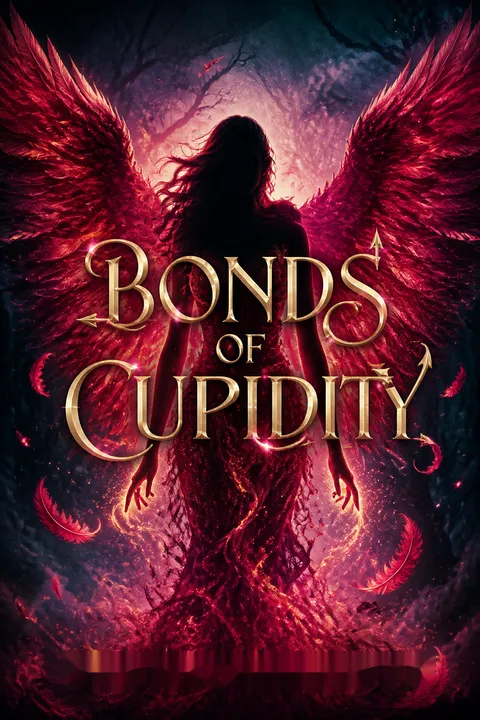


Plot Summary
Pink Hair, False Fae
Emelle,1 a newly physical cupid with feathered red wings, arrives in Highvale after following three genfin men into the fae kingdom. The prince’s8 magic brought her into the physical realm, but the genfins have become her anchors, and she cannot stray far without growing ill. Their capture has left her without her usual cupid bow, while a bounty makes her wings dangerous to reveal.
Fae in the town square stop her to demand what kind of creature she is. Emelle1 claims to be half high fae and half human, then uses Lust-Breath to turn the crowd’s scrutiny into a public sexual commotion. At a clothing stall, she charms a pixie into giving her silk clothes, shoes, and a bag for her weapons and furs.
Emelle’s first attempt to survive is performance: she invents a fae identity, deploys desire as crowd control, and dresses herself into a version of belonging. Yet every disguise exposes her more clearly. Her chatter, human body, and unfamiliar powers make the kingdom’s social categories feel less like natural truths than checkpoints guarded by the curious and powerful. The scene also establishes the double edge of her cupid magic. It can redirect danger, but it works by influencing other people’s bodies, a form of control she later distinguishes from genuine love.
Soora Opens the Wall
Unable to enter the castle keep, Emelle1 spends the night near its wall and tries to evade a suspicious guard with an improvised family story. The next morning, Princess Soora6 recognizes her outside a shop and warns her that Prince Elphar8 is searching for her.
At midnight, Soora6 leads Emelle1 through a concealed door in the western wall, with her handmaiden Duru7 guiding them through a cellar, stable, and servant passage to a spare room. Soora6 admits she belongs to a rebellion seeking to remove the king9 and prince.8
She had once hoped to change the monarchy from within, but Elphar’s8 conduct has destroyed that plan. Emelle1 explains that she watched over Soora6 as a cupid, though she had mistaken the princess’s grief for heartbreak over her husband.8
Soora’s rescue turns private compassion into political risk. She helps Emelle not because she trusts her completely, but because she recognizes a chance to act against a monarchy that has made reform impossible. Their exchange also corrects Emelle’s habitual assumption that she can read every heart. She sensed Soora’s grief accurately but assigned it the wrong object. The mistake matters: emotional perception is not the same as knowledge, and Soora’s composed public self has concealed a history and motive that Emelle’s supernatural sensitivity could not supply.
An Anchor Begins to Fade
Soora6 asks Emelle1 to investigate a hidden island where Elphar8 may be building a weapon against rebellious fae. Emelle1 agrees in principle, then reveals that distance from the genfins makes parts of her body turn invisible. Soora6 postpones the mission and assigns Okot,5 one of her guards, to watch over her while she searches for a way to stabilize Emelle.1
Meanwhile, Duru7 disguises her as a high fae servant, dyes her skin pink, and gives her a place in Soora’s6 rooms. Emelle’s1 attempt to reach the prisoners through the kitchen leads her to Mossie,13 an earth sprite who delivers their meals. Emelle1 helps Mossie13 attract the water-sprite guard Blix,14 but the guards refuse to let her enter the towers.
The supernatural crisis sets a limit on Emelle’s usual improvisation. She can influence attraction and slip through some magical barriers, but neither skill solves the bodily dependence she has kept secret from the genfins. Her servant disguise is deliberately fragile, built from dye, clothing, and Duru’s supervision rather than genuine acceptance. The failed prison attempt makes the hierarchy concrete: food reaches the prisoners, but compassion does not automatically grant access. Even Emelle’s matchmaking with Mossie has consequences beyond romance, briefly opening a route toward the cells while showing how easily desire can become a tool in her hands.
Okot Smells His Mate
Okot5 enters Emelle’s1 room before dawn and recognizes her scent as his mate. His sudden kiss startles her, but he listens when she explains that she already cares deeply for the three genfins in the prison. Rather than demand exclusivity, Okot5 accepts that her heart may hold others and promises to protect her.
Duru7 then brings urgent news: the royal culling begins that day, and the prisoners will soon be sent through a portal. To time Emelle’s1 crossing with theirs, Duru7 uses tiny twiddlefairies to relay the prisoners’ movements. Emelle1 reaches the culling island with Okot5 and Duru,7 then persuades a guard to grant her ten minutes at the cells. She finds Evert,2 Sylred,3 and Ronak4 alive, filthy, and starving.
Okot’s immediate recognition offers Emelle the intimacy she has long wanted, but the scene refuses to make desire a solution to her existing attachments. His willingness to accept her other bonds contrasts with the possessiveness of court politics and gives her a form of care not based on bargaining. The reunion with the genfins, however, exposes the cost of her secrecy. Her vanishing arm alarms them, and her new mate intensifies their jealousy. Their conflict makes clear that emotional belonging has already outgrown the simple labels each character hoped would contain it.
Three Genfins Face Earth
At the first culling trial, the contestants must cross sections representing earth, air, water, and fire. Emelle1 watches through a monocular as earth erupts in crushing arms, grasping vines, and sudden pits; the three genfins make it through by recovering quickly and helping one another. On the slick black ground of the air section, wind repeatedly throws contestants backward.
Sylred3 organizes them into a human chain, and they crawl forward by passing each person over the others. They refuse to advance until everyone reaches solid ground. In the water section, Ronak4 throws Evert2 and Sylred3 clear, then rescues other contestants before a whirlpool drags him under. A gilled fae dives after him, and Ronak4 resurfaces alive.
The trial is designed to punish the very capacity that makes the contestants resilient: cooperation. Instead, Sylred’s improvised chain turns dependence into technique, while Ronak’s strength becomes useful because he spends it on people beyond his covey. The men’s actions revise the prince’s definition of disloyalty. They have been condemned as traitors, yet they behave with more mutual responsibility than the spectators who cheer from safety. Emelle’s position in the stands makes her both witness and advocate, emotionally bound to their survival but unable to intervene without exposing herself.
One Death Opens Fire
The last section is a living wall of fire. A contestant who tries to jump through is incinerated, and a pixie dies when the flames catch her attempt to fly over them. Her grieving companion runs into the fire after her.
Only then does the blaze draw back, forming a narrow passage through which the remaining contestants can escape. The prince8 presents the opening as mercy, but Okot5 recognizes the message behind it: the crown has required a willing death before allowing anyone else to live.
Sixteen contestants survive the trial. Emelle1 sees her three genfins among them, exhausted but standing, before guards force them through a portal. Their survival brings relief, while the deaths leave the celebration that follows impossible to mistake for justice.
The fire makes the culling’s moral structure impossible to disguise. Survival is not earned through skill alone; it is granted by a ruler who makes one person’s death the price of everyone else’s passage. The pixie’s grief turns private attachment into a public sacrifice, but the monarchy absorbs that loss as spectacle. Emelle’s relief for the genfins therefore arrives mixed with horror. Their survival does not mean the contest is fair or finished. It means only that the prince has allowed them to remain useful to his performance.
Beluar’s Blades Choose Victims
Before the second trial, the sixteen contestants return visibly beaten, a punishment for having helped one another. The arena divides them into two teams and places blue-glowing Beluar Blades in their hands. Okot5 explains that King Beluar’s9 magic gives the swords their own will, forcing their bearers to fight. When Evert2 is wounded and falls, his opponent’s blade swings toward his heart.
Ronak4 intercepts the strike, then turns on the opposing team. His animal side takes over as he kills the attackers who threaten his covey, leaving the field strewn with bodies. Six contestants survive, including Evert,2 Sylred,3 and Ronak.4 Emelle1 cannot reach Ronak4 as guards lead them away, and she fears that he will regret what his feral state made him do.
The swords literalize the crown’s preferred politics: subjects become instruments, and violence is made to appear as the contestants’ own choice. Ronak’s ferocity saves Evert, but the rescue exacts a psychological price because his animal strength carries him beyond deliberate control. His instinct to protect is real; so is the danger of a system that exploits it. Emelle’s distress centers not on whether Ronak is powerful enough to survive, but on what survival may make him feel about himself afterward. The scene binds physical protection to moral injury.
Feast Behind the Bars
On the night before the final trial, the six surviving contestants are displayed in a cage at the royal ball while nobles feast around them. Emelle1 recognizes Delsheen,10 the genfin woman whose history with Ronak4 remains raw, seated beside Elphar8 as he flaunts their closeness before the prisoners.
Unable to watch the court eat while the contestants receive nothing, Emelle1 carries bread, meat, and drink to the cage. Elphar8 summons her, questions her supposed human parentage, and tests her story. She escapes punishment by apologizing and letting him believe her submission. He then dances with Delsheen10 in front of the cage, while Okot5 supports Emelle1 through the court’s mockery of her dancing.
The feast stages class power through food, bodies, and attention. The prisoners are denied nourishment while being made into an audience for abundance; Emelle’s simple act of sharing breaks that arrangement in full view of the court. Her choice is ethically clear but strategically costly, because it draws the prince’s attention. Elphar’s display with Delsheen adds a second weapon: he uses an intimate betrayal as public theater, hoping to destabilize Ronak and the covey. Okot’s steady presence offers Emelle a counterpoint to the court’s scrutiny, though it cannot remove her exposure.
Elphar Makes Her Roll
Elphar8 invites Emelle1 into the royal box for the final culling and separates her from Okot.5 He gives her a die, then forces her to roll it, each symbol summoning a monster assigned to attack a contestant. Ronak4 and Evert2 help Sylred3 kill the first creature, but more beasts enter the arena as Elphar8 compels Emelle1 to cast additional dice.
He admits that he recognized her disguise and has turned the trial into a game of punishment. Guards drag Emelle1 below the amphitheater before she can see how the contest ends. Chaucel11 questions her about the rebellion while Gammon12 beats her and breaks one wing. As the distance from the genfins becomes too great, Emelle1 loses her physical form and returns to the Veil, unable to know whether they survived.
Elphar converts chance into a mechanism for transferring guilt. Emelle appears to choose which monsters attack, but the prince controls the rules, the symbols, and the consequences, making her feel responsible for violence he has designed. Her resistance cannot prevent the harm; it only exposes her to punishment. The torture then attacks the condition on which she has depended, her physical connection to the genfins. Losing her body is more than escape from pain. It removes her access to the people whose survival gives that pain meaning.
The Veil Holds Survivors
From inside the Veil, Emelle1 escapes the cell and follows palace servants back to Highvale. At Soora’s6 celebration, she finds the three genfins alive, cleaned and restored to society after winning the culling. She cannot touch or speak to them, but discovers she can affect them with Lust-Breath and Flirt-Touch. The genfins realize she is present and move somewhere private to ask questions.
Soora6 later meets them secretly and confirms that she helped Emelle1 hide, explaining the anchor bond and revealing that Elphar8 recognized her. Soora6 also admits she recruited Emelle1 to investigate the prince’s8 rumored weapon and proposes that the covey seek the Horned Hook,15 a thief who may know how to restore her physical form.
The survivors’ return gives Emelle the answer she feared she would never receive, but not the reunion she wants. She is close enough to influence the genfins and still cannot share ordinary physical space with them. Their recognition through her powers makes intimacy feel both possible and painfully incomplete. Soora’s explanation also changes Emelle’s understanding of their alliance: the princess has offered sincere help while pursuing her own political aims. The two motives coexist, refusing the easy distinction between pure loyalty and manipulation.
Okot Beneath the Ruins
The genfins exchange a stolen necklace for the Horned Hook’s15 help, revealing that they took it from Soora’s6 open room. The thief agrees to locate Okot5 and arrange contact with magic that can reach the Veil. After several days, his first lead sends them to the Finitsal Ruins.
Beneath a collapsed garden, they find Okot5 chained in a dark chamber, dehydrated and bruised after being drugged and imprisoned in iron. He can sense Emelle1 nearby, though he cannot see her. The genfins carry him out and arrange care at an inn. During the journey, Evert2 insists he wants Emelle1 as his mate, and Ronak4 admits that politics and fear of another betrayal have kept him from choosing what he wants.
The rescue of Okot enlarges the story’s definition of captivity. The culling cages were public and ceremonial; his cell is hidden, designed to erase him from notice. His ability to sense Emelle across the Veil gives their bond an unusual material presence, but it does not spare him suffering. Meanwhile, the carriage argument exposes the genfins’ deeper conflict. Ronak has mistaken emotional distance for self-protection, while Evert sees that the cost of preserving status may be the loss of the covey itself.
Belren’s Price in Secrets
The Horned Hook’s15 second lead takes the genfins and Okot5 to an icy island, where the conjoined fae Plik and Plak16 combine their magic. Plik16 drinks a potion that kills him so he can enter Death’s Hollow, find Emelle,1 and channel Plak’s16 living power into a spell. The ritual burns Emelle1 back into physical form and anchors her to the group’s lives rather than their proximity.
She recognizes the masked Horned Hook15 as Belren,15 a fae she once helped escape another island. Evert2 tends her injuries and shares her first physical intimacy; later, Okot5 returns after punishing Gammon12 for the assault. The men agree that Emelle1 may love them together, and Okot5 confirms his mate bond with her.
The rescue depends on a carefully negotiated exchange between living and dead, making Emelle’s return an act of collaboration rather than a lone magical cure. The new anchor changes the terms of her belonging: closeness is no longer required, but the group’s lives are now bound to hers. That dependence could be frightening, yet the men answer it with explicit consent to share her and protect one another. Belren’s unmasking also collapses the divide between past and present, showing that people Emelle once encountered as incidental can become essential allies.
Home Is a Buried Den
Back in Highvale, Duru7 warns that Elphar’s8 soldiers will search the city at dawn, so Emelle1 and the genfins must leave immediately. Ronak4 startles Emelle1 into slipping voluntarily into the Veil, allowing the group to evade the patrols and reach the genfin homeland. At their carefully built den, a caretaker is startled to see the genfins bring home a non-genfin mate.
The elders warn that their choice may cost them status, magic, and the chance to strengthen a dwindling population. The men refuse to withdraw their decision. Okot5 and Emelle1 travel to a flower-covered island to confirm their bond, while Evert2 and the others prepare the genfin ceremony. Emelle1 agrees to become the shared mate of the entire covey.
The den is more than shelter: it is a future the genfins built before they knew who would share it. Their community’s objection reveals that mating is also a political and reproductive institution, not merely a private bond. Emelle worries that her presence will damage the men’s standing and the species’ survival, but the genfins insist their choice is theirs to make. The scene shifts the central question from whether they desire her to whether they can accept the social cost of that desire without making her responsible for it.
Four Mates, One Burrow
The genfins and Emelle1 complete a private mating ceremony with a shared chalice containing their blood and ritual ingredients. The drink triggers a week-long heat, and the three men build a soft, enclosed burrow from the den’s pillows, blankets, and curtains.
They care for Emelle1 through the intense days of their bond, while she learns the rhythms of their animal instincts and the safety of being cherished by all three. After the heat ends, Ronak4 discovers that bright red cupid wings have grown from his back.
Emelle’s1 own body continues changing: her eyes reflect many colors, black and white feathers appear among the red, and her desire magic begins leaking without her control. Their new family is joyful, but its magic is no longer predictable.
The ritual turns the covey’s verbal commitment into shared bodily consequence. The burrow literalizes their wish to make a protected interior space, while the week of heat makes care inseparable from desire. Yet the transformations that follow resist a neat happily-ever-after. Emelle’s magic and appearance keep changing, and Ronak’s wings mark a bond that crosses the boundaries of their species. The story treats intimacy as generative but not stabilizing: choosing one another creates new obligations and new uncertainties rather than restoring a simple, settled identity.
Cupidville Claims Its Cupid
After the den’s garden is attacked by armed fae wearing Soora’s6 violet insignia, Ronak4 and the other genfins fight back while Emelle1 alternates between the Veil and physical form. She shoots one soldier and, when another attacks her, discovers she can pull a gray life-force from his body, killing him.
The survivors retreat into the woods, where Emelle1 proposes spying on Soora6 to learn whether the princess6 betrayed them. Ronak4 agrees to support the mission, though Evert2 fears for her safety.
Emelle1 turns invisible and takes flight toward Highvale. Before reaching the island, an unseen force yanks her across space and time into Cupidville. She recognizes the summons as a sign that her superiors have discovered her absence and that she is in serious trouble.
The raid breaks the safety the mating ceremony seemed to establish. The attackers’ violet insignia implicates Soora’s household but does not prove Soora herself ordered the assault, leaving the covey with suspicion instead of certainty. Emelle’s lethal new ability further unsettles her sense of self: her magic can now take life as well as kindle desire. Her decision to investigate is therefore both political and personal, an attempt to regain agency after repeated capture. The abrupt arrival in Cupidville ends the book by making her origin realm another source of danger rather than a refuge.
Analysis
Bonds of Cupidity places a comic, sexually frank cupid inside institutions that turn intimacy into property and punishment. The contrast is not simply between love and cruelty. Emelle’s1 own powers can alter desire, so the story repeatedly asks what makes affection ethical. Her answer is not that influence can be avoided altogether, but that her mates must choose her without being magically compelled. That principle gives her a standard against which both her work and the fae court’s manipulation can be judged.
The genfin covey’s conflict makes belonging a political problem. Ronak4 fears losing status, powers, and the future expected of an alpha; Evert2 rejects a system that asks him to sacrifice the person he wants; Sylred3 protects the group’s ability to decide together. Their eventual commitment to Emelle1 matters because it is made with the costs visible. Their community may disapprove, and their choice does not erase the consequences of that disapproval.
The culling extends this critique into public life. The prince8 uses trials, enchanted weapons, and staged feasts to make domination look like tradition. Cooperation becomes an ethical refusal of the rules, while Emelle’s1 act of feeding prisoners interrupts the spectacle at its simplest point: she refuses to eat comfortably while others are starved for the court’s amusement. Yet her impulse to intervene also exposes her to danger, and the final raid shows that kindness cannot reliably identify who is safe.
The book’s ending resists closure. Emelle1 returns to her body, forms a shared bond, and finds a home, only to discover new powers, uncertain political loyalties, and an unexplained summons to Cupidville. Her transformation is therefore not a completed journey from loneliness to security. It is a widening of responsibility: she now belongs to others, can harm as well as help, and must decide what her cupid nature means when the world demands more than matchmaking.
Review Summary
Bonds of Cupidity receives mixed reviews, with most readers enjoying the humor, romance, and character development. Many praise Emelle's witty narration and the expanding relationships. Some dislike the addition of a new love interest or find the plot scattered. The cliffhanger ending leaves readers eager for the next book. While some criticize the writing or character depth, others appreciate the lighthearted, fun nature of the story. Overall, it's seen as an entertaining paranormal reverse harem romance with both passionate fans and detractors.
People Also Read






Characters
Emelle
Unruly Veil cupidEmelle is a cupid whose work is to stir love and desire, but decades of invisibility have left her lonely and hungry for connection of her own. Newly physical in the fae realm, she is short, pink-haired, red-winged, and almost incapable of keeping an anxious thought to herself. Her humor is a defense and a genuine gift: she uses it to break tension, charm strangers, and keep fear from silencing her. She wants affection to be freely given, not manufactured by her arrows, even when her powers could make it easier to get what she craves. Her impulse to help often outruns caution, especially when someone she loves is in danger.
Evert
Guarded, loyal genfinEvert is a blunt, sharp-tongued member of the genfin covey, quick to challenge authority and quicker to defend the people he considers his own. His humor often arrives as profanity or provocation, but beneath it lies a deep fear of losing the covey that has become his family. He is wary of political expectations and impatient with anyone who asks him to sacrifice feeling for status. Evert’s practical side appears in the way he assesses threats and tends to injuries, while his emotional honesty can surface most clearly as anger. He responds to vulnerability with fierce presence rather than polished reassurance.
Sylred
The covey’s mediatorSylred is the considerate, observant member of the genfin trio and often the one who keeps Evert2 and Ronak4 from turning disagreement into a rupture. His Sound Soother abilities suit his temperament: he notices emotional pressure and knows how to redirect it. He is warm without being naive, capable of strategic thinking, healing, and cooperation under danger. Sylred values the covey as a shared responsibility rather than a hierarchy to exploit, and he often makes space for others to speak before taking a position himself. His patience can be mistaken for passivity, but he is quietly decisive when someone’s safety depends on it.
Ronak
Proud genfin alphaRonak is the physically formidable alpha of the genfin covey, a skilled fighter whose strength is matched by a strong sense of duty. He takes responsibility for the group’s future and feels pressure to preserve its place among genfin society. That sense of obligation can make him stern and difficult to read, especially when personal desire conflicts with public expectation. Ronak’s animal nature is close to the surface, giving his protectiveness a forceful edge, but his discipline comes from years of training and leadership. He respects loyalty, expects people to mean what they choose, and is more emotionally vulnerable than his controlled exterior suggests.
Okot
A lamassu protectorOkot is a lamassu and one of Princess Soora’s6 personal guards. Large, heavily built, and marked by a bright red mohawk and nose ring, he initially appears imposing; in practice, he is gentle, direct, and deeply attentive. His kind recognizes mate bonds through scent, and his loyalty expresses itself through concrete care, from helping someone dress to carrying them when they are tired. Okot speaks sparingly and takes promises seriously. He is secure enough to listen before claiming what he wants, and his protective instinct is balanced by respect for the other person’s choices.
Princess Soora
A princess in rebellionSoora is a politically astute princess married to Prince Elphar8, but she does not share his loyalty to the existing monarchy. She once hoped to change the system from within and now works with a movement seeking its overthrow. Her public manner is controlled and diplomatic, habits that conceal both grief and a stubborn capacity for risk. Soora shelters Emelle1 because she sees both a person worth helping and a potential ally with unusual abilities. She is neither purely selfless nor casually manipulative; she weighs people’s character alongside their usefulness, a calculation shaped by life at court.
Duru
The princess’s watchful handDuru is Soora’s6 brownie handmaiden and longtime protector. Meticulous, suspicious of outsiders, and devoted to the princess6, she turns housekeeping into both a source of power and a form of vigilance. She helps disguise Emelle1, teaches her the routines of palace service, and keeps danger from reaching Soora’s6 rooms. Her sharp tongue does not erase her capacity for kindness, which tends to arrive as food, practical instructions, or an insistence that someone stop behaving foolishly. Duru trusts actions more than assurances and expects loyalty to be proven.
Prince Elphar
A charming tyrantElphar is the handsome, socially polished prince of the fae kingdom and the chief architect of its spectacle-driven cruelty. He understands how charm can quiet suspicion and how public rituals can make violence appear lawful. His rule treats dissent as a personal insult, and he uses banishment, trials, and humiliation to remind the court who controls the rules. Elphar enjoys games because they let him disguise domination as entertainment. He is perceptive enough to notice inconsistencies in others and patient enough to turn that knowledge into leverage.
King Beluar
A complacent fae kingBeluar is the reigning fae king and father of Prince Elphar8. His authority is embodied in the magic of the Beluar Blades, which can control those forced to wield them. At court he appears indulgent and disengaged, leaving much of the visible rule to his son8. His name and power nevertheless stand behind the machinery of the culling.
Delsheen
A courtly genfin nobleDelsheen is a beautiful genfin noble whose status and social ambition shape her place at court. She knows how to use attention, appearance, and rank to influence the people around her. Her confidence can become contempt for those she considers beneath her, and she treats relationships as closely connected to prestige. Delsheen’s history touches the genfin covey’s political and emotional life, making her presence difficult for them to ignore.
Chaucel
The prince’s inquisitorChaucel is Prince Elphar’s8 personal assistant and an efficient agent of the palace. He gathers information, manages access, and asks questions with the calm of someone who considers cruelty an administrative tool. His polished manner makes him difficult to read, and his loyalty to the prince8 gives him influence beyond his formal duties.
Gammon
A brutal palace guardGammon is one of Prince Elphar’s8 guards and carries out the physical violence that the prince’s8 court prefers to delegate. He is a capable enforcer whose actions make the palace’s threats immediate and bodily. His presence warns that questioning power can have consequences beyond public humiliation.
Mossie
A hopeful earth spriteMossie is an earth sprite who tends the palace gardens and carries food to prisoners. Her flowers grow from her head, reflecting her bond with plants and her pride in her work. She longs to be noticed by Blix14, and Emelle’s1 matchmaking gives her the confidence to act on that hope.
Blix
A water-sprite guardBlix is a water-sprite guard assigned near the prisoner towers. He is the object of Mossie’s13 affection and is more susceptible to a nudge toward romance than he is to subtle courtship. His brief role helps Emelle1 find a path toward the prison’s underground food route.
Belren
A masked secret brokerBelren is a silver-skinned fae with curved horns, telekinetic ability, and a reputation for acquiring what others cannot. He operates as a thief and broker of secrets, treating information as a form of leverage rather than mere gossip. His past includes encounters with Emelle1, though his life has taken a very different shape since then. Belren is theatrical, opportunistic, and difficult to intimidate, yet he can recognize when a request matters enough to justify his help.
Plik and Plak
Twin Veil magiciansPlik and Plak are conjoined fae whose lives and magic are linked. They can combine their abilities to reach the Veil, a dangerous feat that requires one twin to enter death while the other remains among the living. Their unusual partnership makes them powerful, eccentric, and unusually suited to problems that ordinary fae magic cannot solve.
Plot Devices
Emelle’s anchors
A tether to the physicalThe prince’s8 magic gives Emelle1 a physical body, but the effect would fade without the three genfins who first anchor her to the realm. Distance or prolonged separation makes her body disappear, initially in pieces. This rule creates urgency during the culling and explains why she risks entering the palace, arena, and later the Veil. Plik and Plak’s16 combined magic changes the bond so that she no longer needs to remain near the group, though their lives remain linked. The device makes intimacy materially consequential rather than merely symbolic.
Cupid abilities
Desire as interventionEmelle’s1 powers include Love Arrows, Lust-Breath, and Flirt-Touch. The first can create romantic attachment, while the latter abilities can heighten desire or encourage flirtation. She uses them to distract hostile crowds, help Mossie13 attract Blix14, and eventually communicate with the genfins when they cannot see or hear her. The powers make her effective without conventional fighting skills, but they raise a moral distinction she takes seriously: she wants the affection of her mates to come from their own choices, not from magical compulsion.
The royal culling
Execution disguised as mercyThe culling is presented as a path for banished nobles to regain their place, but its trials are designed by the monarchy to maim and kill. Contestants face dangerous elemental terrain, enchanted weapons, and a final monster trial. The public watches from the stands, turning punishment into entertainment and betting opportunity. Cooperation among the prisoners repeatedly frustrates the prince’s8 intent, while the rules shift to punish their solidarity. The culling provides the central external threat and exposes how the monarchy converts state violence into a ceremony that appears fair.
Elphar’s dice
Chance as coercionDuring the final culling, Elphar8 forces Emelle1 to roll dice whose symbols summon monsters and direct them toward specific contestants. The ritual makes her appear to choose the danger, even though the prince8 controls the game and intends the contestants to suffer. It is an extension of the culling’s larger logic: power hides behind rules, and a victim can be made to feel responsible for the violence imposed on them. The dice also reveal that Elphar8 has recognized Emelle1 despite her disguise.
Veil-crossing ritual
A second tetherPlik and Plak16 combine their magic to enter the Veil and retrieve Emelle1 after her original anchors fail. One twin enters death while the other supplies power from the living world, allowing the pair to pull her back into a physical body. Their ritual does not simply repeat the prince’s8 magic. It gives Emelle1 a more durable connection, tied to the lives of the people she loves rather than their immediate proximity. The process makes her return possible and establishes the new vulnerability and mutual responsibility of the group.
Heart Hassle Series

About the Author
Other books by Raven Kennedy



Download PDF
Download EPUB
.epub digital book format is ideal for reading ebooks on phones, tablets, and e-readers.








