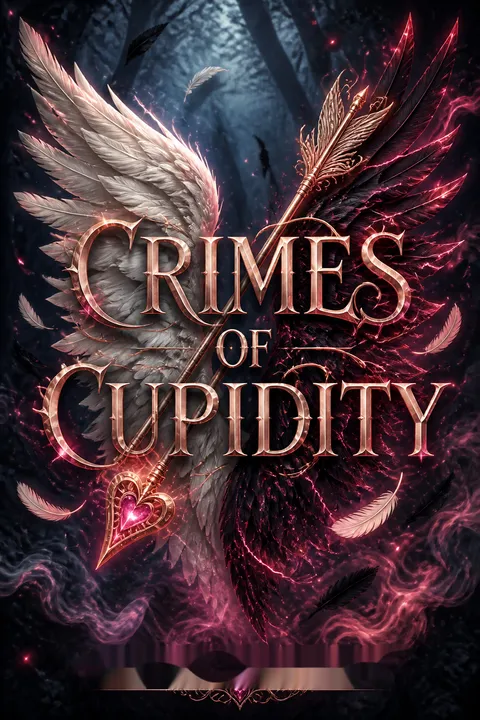


Plot Summary
Cupidville Calls Emelle
Emelle, a cupid who has been shirking her duties in the fae realm, is summoned to Cupidville to answer for missed matches, excessive Love Arrows, and her ability to cross the Veil. Head Cupid, angel Raziel, and demon Jerkahf accuse her of accumulating powers that do not belong to her.
Her mismatched feathers reveal angelic and demonic traits, while her unexplained crossings risk disrupting the Veil. The officials sentence her to termination, which would separate her from her four mates and the life she has only recently begun to enjoy. When Head Cupid reaches for the execution button, Emelle stops pleading and becomes corporeal, lunging across the table to fight for her survival.
Emelle’s first crisis turns a workplace summons into a fight over whether she is allowed to keep the life she has built. Her failure at cupid work is real, but the institution treats it as proof that she is disposable rather than as evidence of loneliness or a bad assignment. The unexpected powers make her a danger to the Veil, yet her fear is grounded in particular attachments: mates, friends, food, and a physical existence. Her sudden physical attack is comic, but it also marks a change from pleading for approval to acting on her own behalf.
The Boss Button
In the struggle, Emelle and Head Cupid press the termination button together, but the magic removes him instead. His authority mark transfers to her, leaving Emelle in charge of cupidity and legally able to enter and leave the Veil. Raziel and Jerkahf explain that her mixed powers are now permanent, though neither can offer a simple cure.
Emelle summons Cupid Sixty-Nine, whom she renames Lex, and makes the veteran Cupid of the Month her assistant. She then overturns the punishing rules: cupids will get partners, paid holidays, physical vacations, and a yearly celebration. Before leaving, she appoints Sev a supervisor and trusts Lex to implement the reforms, hoping happier cupids will do better work.
The transfer of power reverses the institution’s judgment without making Emelle suddenly competent by its old standards. Her first leadership decision is to change the conditions that helped make her lonely and ineffective. The reforms treat emotional welfare as practical infrastructure: a cupid who experiences companionship may be better equipped to foster it for others. Lex offers a counterexample to Emelle’s disengagement, showing genuine pleasure in the work, while Sev suggests that new authority can be accepted when it restores something people were denied. Emelle’s promotion is both accident and opportunity.
Weeks Lost in Transit
Emelle returns to the fae realm expecting to have been gone only hours, then learns that several weeks have passed. Her den is empty, the palace is under guard, and the prince’s soldiers have filled the prison tower. There she finds Princess Soora, starved and beaten, and brings her food, water, and clean clothes.
Soora explains that Prince Elphar discovered her work with the resistance and directs Emelle to seek the Horned Hook, Belren. While searching the palace, Emelle finds her lamassu mate Okot, disheveled and frantic. When she makes herself visible, he attacks, calls her an enemy, and tries to deliver her to the prince. Emelle escapes into the Veil, shaken by what she believes is a deliberate betrayal.
The time distortion converts Emelle’s apparent absence into an abandonment experienced by everyone she left behind. Her first response is practical care for Soora, even while her own mates remain missing. Okot’s attack then turns the story’s central emotional promise against her: the mate she trusted becomes physically dangerous. At this stage, Emelle has no explanation for his altered behavior, so the wound is not softened by knowledge of the tea. Her escape is necessary, but it leaves her holding grief and uncertainty while the political danger continues to grow.
A Thief and a Worm
Emelle follows Soora’s directions to Belren’s hidden refuge on the island of the cannibal fae Arachno. She finds the Horned Hook hosting a revel, not searching for the princess, and tells him Soora is alive in the palace prison. Belren agrees to help, explaining that escape magic responds to the king’s authority.
They enter Arachno’s cave to steal a parodworm, a rare creature able to imitate a fae’s appearance and powers after tasting them. Arachno traps the pair with fire and water, disables Belren’s magic, and nearly boils Emelle alive. Emelle’s angelic light erupts and destroys Arachno. She retrieves the worm, giving Belren the means to impersonate the king and bypass the prison’s defenses.
Belren’s apparent selfishness is tested by a concrete obligation: Soora is alive, and the way into her prison depends on a thief’s particular skill. The plan also gives the story’s comic creature a strategic function, making the parodworm more than an eccentric detail. Arachno’s cave forces Emelle to use a power she barely understands under lethal pressure. The resulting light is not a carefully mastered weapon but a response to her fear of losing the people she loves. Her growing power remains inseparable from vulnerability and improvisation.
The Prison Opens
Belren and Emelle sneak into King Beluar’s chambers, where the parodworm imitates the monarch after licking him. Belren controls the false king’s movements while Emelle distracts the real one, escaping only after accidentally blowing Lust into him. They use the impersonator to pass the prison guards and reach Soora’s cell.
Once Soora touches the false king, she can leave the tower, and Emelle persuades Belren to free other prisoners as well. More than a hundred captives join their escape, helping one another when the exhausted Belren can no longer sustain the disguise. A rebel ally takes them through a portal to Soora’s family island, where her brother Zalit welcomes her home.
The escape succeeds through a chain of cooperation rather than a single heroic act. Belren supplies the plan and magic, Emelle handles the unpredictable human-sized complications, and the prisoners themselves become participants rather than cargo. Emelle’s insistence on freeing them complicates Belren’s opportunism, but his eventual agreement shows that his self-protective identity is not the whole of him. The false king turns authority into a costume that can be borrowed, exposing how much the prison depends on recognition rather than justice. Soora’s return restores a political center to the resistance.
Three Mates Found
From Soora’s island, Emelle flies to the rebel camp and finds Evert and Sylred, who have spent weeks searching for her. Evert’s anger gives way to desperate reunion, while Sylred welcomes her with the chocolates he has carried in his pocket. They lead her to Ronak, who has been locked in an iron cell after her apparent disappearance drove him into a feral state.
Ronak’s animal attacks Sylred and drags Emelle inside, but she refuses to let the others kill him. She stays close, calms the beast, and kisses Ronak until his human awareness returns. The reunion is tender and frightening at once: Emelle can reach him, but her absence has already pushed him to the edge of himself.
Each reunion gives Emelle a different measure of the harm caused by her disappearance. Evert expresses injury as anger, Sylred as steadfast care, and Ronak as a physical crisis that cannot be solved by explanation alone. Emelle’s refusal to abandon Ronak is not denial of danger; she sees that his animal is guarding her even as it threatens her. Their recovery depends on embodied recognition, the same bond that makes separation so devastating. The scene establishes that love here is not merely a feeling but a force that can steady, endanger, and sometimes retrieve a person.
The Genfin Island Falls
Just as Ronak returns to himself, Prince Elphar attacks the genfin island with phoukas, monstrous beasts that burn buildings and slaughter residents while soldiers pick off anyone who flies. The mates guide Emelle through the wreckage, but Ronak turns feral again when she slips into the Veil to protect herself.
Emelle helps fight, then escapes with Evert and Sylred through a closing portal, carrying a terrified child named Tula. At the rebel camp, injured genfins blame Emelle for bringing the prince’s wrath upon them. Princess Soora arrives and publicly rejects that accusation, naming Elphar as the attacker and warning the resistance not to be divided. The survivors regroup, but the attack has made the war personal and costly.
The attack turns Emelle’s unusual powers into a liability for the community around her. She can evade danger by entering the Veil, but that act destabilizes Ronak, so her safety and his are suddenly in conflict. The rebels’ accusation is emotionally understandable in the immediate aftermath, but it repeats Elphar’s strategy by shifting attention from the ruler who ordered the violence to a vulnerable outsider. Soora’s public defense matters because it restores a shared account of responsibility. Tula’s survival gives the devastation a human scale beyond military losses.
Tea on the Hidden Island
Emelle summons Lex and Sev to scout Elphar’s secret island, using her new authority to send cupids through the Veil. They return with alarming numbers: nearly ten thousand trained soldiers, compared with roughly two thousand rebels. The soldiers include fae who should support the resistance, yet Lex senses no ordinary love, fear, or longing in them.
She also finds guarded tea-leaf crops and King Beluar walking among them. The discovery suggests that the army is not simply loyal to Elphar; something has flattened its members’ inner lives. Soora and her commanders now face an enemy much larger than expected, while Emelle has a clue linking the crops, the king, and the blankness she has seen in the prince’s forces.
The reconnaissance shifts the conflict from a contest of numbers to a question of agency. Lex’s cupid sense identifies what military observation cannot: the soldiers are present, organized, and effective, yet emotionally absent. The tea crops and the king’s involvement offer a material explanation for that absence, though the mechanism is not fully known yet. This is an important limit on Emelle’s usual powers. If the soldiers have no accessible feelings, neither Love Arrows nor ordinary persuasion can reach them. Love becomes an instrument of diagnosis before it can become a remedy.
Love Brings Ronak Back
After the attack, Emelle’s first period leaves her convinced she is dying, and Sylred tends to her with food, chocolate, and patient reassurance. During her distress, she admits that she loves her mates. Ronak, still trapped in his animal state after turning feral during the escape, hears her and returns to himself.
He has been conscious inside the animal, unable to reach her, and her words help him break through. The confession also resolves the uncertainty between them: Evert and Sylred affirm that they love her, and Okot remains the absent, wounded bond she cannot yet repair. Emelle’s emotional homecoming is real, but the prince’s forces are still gathering for another attack.
The scene links bodily change, shame, and attachment without reducing any one of them to a plot mechanism. Emelle’s panic over menstruation reveals how unfamiliar she is with embodied life, while Sylred responds with care instead of ridicule. Her declaration of love is not strategically timed; it slips out under stress, which gives it emotional credibility. Ronak’s return makes the bond reciprocal in a literal way, but does not erase the cost of her repeated disappearances. The moment offers comfort while keeping the wider danger unresolved.
The Barrier Shatters
As Soora and her advisers debate their next move, repeated blasts break the barrier protecting her family’s island. The manor shakes apart, and Ronak holds up its collapsing ceiling long enough for the others to escape. Elphar’s soldiers descend in overwhelming numbers, defeating the rebel force and capturing Emelle’s mates and Belren.
The prince gives Emelle a choice: attempt a shot at him and risk the prisoners’ deaths, or surrender so they may live. She lowers her arrow and enters the portal with him. On the secret island, she sees soldiers drinking tea made from the guarded crops and recognizes the king’s role in their blank obedience. Elphar’s victory rests on control, not allegiance.
The barrier’s destruction turns Soora’s island from a refuge into a trap, while Ronak’s strength buys time but cannot prevent the defeat. Elphar’s ultimatum weaponizes Emelle’s attachment, forcing her to choose the lives of others over the possibility of an unlikely strike. Her surrender is not cowardice; it is a refusal to gamble with captives’ lives for the sake of a symbolic act. The tea completes the clue planted by Lex, showing that the soldiers’ discipline is built on stolen will. The prince’s power depends on making care itself a lever of coercion.
Love Arrows Fail
Elphar forces Emelle to drink the mind-controlling tea, then orders her to make his soldiers love him. The drink has no effect on her, so she pretends to be obedient while testing her arrows on fae whose tea is wearing off. The Love Arrows and Lust breath produce no feeling in them; their emotional emptiness confirms the tea has suppressed their agency.
When a surprise force of genfins storms the island, Ronak fights Okot, who is still controlled. Emelle realizes the soldiers move like sleepwalkers and uses her sandman dust to knock Okot unconscious before the fight can kill him. She then invokes the Veil’s law against taking free will and summons Raziel, Jerkahf, angels, and demons to intervene.
Emelle’s apparent compliance is a performance designed to keep her alive long enough to understand the system around her. Her arrows fail not because love is weak, but because the tea has removed the emotional capacities those arrows require. That distinction gives her a way to name the prince’s crime in terms the Veil’s authorities must recognize: he has violated free will. Her sandman power offers a nonlethal answer to Okot’s control, contrasting with the violence surrounding them. The rescue arrives through a combination of political resistance, observation, and careful use of power.
The Prince’s Last Move
The genfins and Veil forces turn the battle against Elphar’s soldiers. Okot hears Emelle beside him and breaks through the tea’s hold, though he fears the harm he caused while controlled. When Elphar’s blast targets Lex, Belren takes the hit meant for her. Emelle faces the prince and releases a Love Arrow just as his magic strikes her.
The arrow pierces his heart and kills him, but the blast leaves Emelle motionless. Okot kills Gammon as the others rush to her, and her mates remain beside her while the bond draws her back from the emptiness. The victory ends Elphar’s rule, but it costs Belren his life and leaves Emelle’s survival uncertain.
The climax makes protection costly in sharply distinct ways. Belren’s sacrifice is a choice made for Lex, while Emelle’s final shot turns the weapon of her vocation against a ruler who tried to command love itself. Okot’s recovery arrives through recognition and proximity, not a magical cure, and his remorse remains part of the aftermath. The prince dies, but victory does not restore everyone who was lost. Emelle’s apparent death gives the mate bond its final test: connection can summon her back, yet it cannot undo Belren’s sacrifice or the realm’s damage.
Four Bonds Bring Her Home
Three days after the battle, Emelle wakes in Okot’s home, pulled back from death by the bonds she shares with her four mates. Elphar and King Beluar are dead, and the controlled soldiers are gradually recovering, but Princess Soora has disappeared with Benicia while Chaucel remains unaccounted for.
Emelle accepts that the realm’s political future is unsettled and returns with her mates to help rebuild the genfin island. She uses a Love Arrow to help Viessa, a genfin whose covey lacks affection, pursue the love she wants with her mates. Ferno, whom Emelle accidentally struck with an arrow earlier, still adores her. Emelle ends the story with her covey intact and her cupid work newly meaningful.
The ending resolves the opening’s fear of losing a life and a family without pretending that every wound has closed. Emelle survives through reciprocal bonds rather than institutional rescue, and Okot’s home becomes the place where she can recover. The open questions around Soora, Benicia, and the leadership vote preserve political uncertainty, while the rebuilding work moves attention toward repair. Emelle’s Love Arrow for Viessa also marks a change in her practice: she now asks whether someone wants love and has a real inclination for it, rather than treating attraction as a quota.
Epilogue
After Belren dies, he wakes in a featureless afterlife with no clear memory of who he is, though Emelle’s pink hair and red wings remain in his mind. A pull carries him into a processing room filled with other newly arrived spirits.
A clerk explains that he must choose a new role, offering paths associated with angels and demons. Belren, who spent his life defining himself through theft and secrecy, now faces a strange bureaucracy of the dead with no memory to guide his decision.
The epilogue turns Belren’s death into an unresolved beginning rather than a final explanation. His memory of Emelle survives when his name, history, and body do not, suggesting that relationships may persist even when identity is stripped away. The afterlife’s job-selection desk also echoes Cupidville’s bureaucracy, but with a sharper uncertainty: Belren cannot yet claim the familiar role of thief or choose what comes next. His arrival leaves his fate open while carrying the emotional trace of his sacrifice into another realm.
Analysis
The novel sets two systems of power against each other. Cupidville measures love through quotas, match counts, and discipline, while Elphar’s regime reduces people to obedient bodies through mind-control tea. Emelle’s own growth depends on refusing both extremes. She learns that love cannot simply be imposed, even by a cupid, and that a bond’s force does not excuse neglect, as her disappearance demonstrates. The most meaningful uses of her magic come when she responds to a person’s existing desire, protects someone’s agency, or recognizes the emotional absence imposed by the prince.
The story’s comedy is not separate from its treatment of vulnerability. Emelle jokes when she is frightened, but her humor does not cancel the physical danger of Okot’s attacks, the prisoners’ suffering, or the deaths in the rebellion. Her comic misfires also expose the gap between the job she was assigned and the life she wanted. Once she becomes Cupidville’s leader, she changes the labor conditions that made cupids isolated, converting private loneliness into institutional reform.
The four mates embody different forms of care: confrontation, patience, protection, and the deep vulnerability of a bond that can be damaged by coercion. Okot’s mind control makes the distinction between action and intention painfully important, while his later shame shows that recovery requires more than simply being freed. Belren’s self-protective persona and sacrifice, Soora’s compromised loyalties, and Lex’s disciplined devotion all complicate easy judgments about virtue. The ending offers no claim that love prevents harm. Instead, love becomes the work of choosing, repairing, and protecting one another without confusing control for devotion.
Review Summary
Crimes of Cupidity receives mostly positive reviews, with readers praising its humor, steamy romance, and entertaining characters. Many enjoy Emelle's character development and the unique world-building. Some criticize the abundance of internal dialogue and perceived randomness in the plot. The book concludes the Heart Hassle series, leaving readers satisfied overall but wishing for more exploration of certain characters and plot points. The epilogue generates interest in potential spin-offs, particularly for Lex and Belren's story.
People Also Read








Characters
Emelle
Unruly cupid bossEmelle is a cupid who has spent decades arranging other people’s desire while remaining lonely and inexperienced in her own embodied life. She is impulsive, funny, and prone to turning anxiety into a joke, but her apparent frivolity does not prevent practical courage: she feeds Soora, risks herself for prisoners, and keeps trying to bring her mates home. Her growing powers make her a threat to the Veil’s rules, yet she resists the idea that safety requires surrendering her agency. As Cupidville’s leader, she tries to make the work kinder for the cupids who follow her.
Evert
Fierce genfin mateEvert is one of Emelle’s genfin mates, a physically formidable male whose anger often arrives before his softer feelings can be spoken. He is protective, jealous, and capable of turning a threat into action, but his harshness is rooted in fear of losing the people he loves. His reunion with Emelle shows both his hurt at her disappearance and his confidence that she belongs with him. Evert’s bluntness can make him difficult to approach, yet he does not confuse tenderness with weakness and repeatedly puts himself between Emelle and danger.
Sylred
Gentle covey anchorSylred is Emelle’s thoughtful genfin mate, distinguished by patience, emotional attentiveness, and a soothing musical power. He responds to crisis by noticing what others need, whether that means calming a frightened child, tending Emelle through her first period, or carrying chocolate for her while she is missing. His gentleness is not passivity: he fights beside his covey and helps guide difficult decisions. Sylred gives Emelle room to be unruly without treating her as unreliable, making his steady care a counterweight to Evert’s challenge and Ronak’s intensity.
Ronak
Protective genfin alphaRonak is the strong, proud alpha of Emelle’s genfin covey. His instinct is to protect his mates and his people, sometimes at the cost of his own safety or control. He can be demanding and possessive, but beneath that authority is a deep capacity for loyalty and tenderness. His connection to Emelle is unusually powerful, and separation threatens the boundary between his human self and his animal. Ronak’s struggle reveals how responsibility can become self-punishment when he believes he has failed those in his care.
Okot
Gentle lamassu mateOkot is Emelle’s lamassu mate, a large, gentle figure whose loyalty is expressed through quiet affection and attentive care. His strong mate bond makes him unusually sensitive to Emelle’s presence, while his sense of honor shapes how he understands their relationship. Okot is not a simple embodiment of strength: his softness and protectiveness coexist with a powerful animal nature. He values the covey’s trust and can be deeply shaken when his actions seem to violate it.
Belren
Mysterious fae thiefBelren, known as the Horned Hook, is a silver-skinned fae thief with horns, telekinetic skill, and a taste for glittering possessions. He presents himself as an opportunist who takes what belongs to others, using charm and secrecy to keep people from reading his motives. Beneath that performance is a capacity for loyalty, especially toward Soora and the people connected to her. Belren is wary of obligation but repeatedly chooses to help when someone he cares about is in danger. His interest in Lex challenges his confidence and composure.
Princess Soora
Rebel princessSoora is a fae princess who works against the prince’s tyranny while carrying the responsibilities of family, rank, and rebellion. She is elegant and politically capable, with formidable glamour and barrier magic, but her composure can conceal fear and personal conflict. Soora trusts Emelle with dangerous work because she recognizes her courage and directness. Her devotion to those she loves shapes her choices, while her public leadership requires her to keep a fractured resistance moving toward a common purpose.
Lex
Cupid assistant and aceLex is Cupid Sixty-Nine, a high-performing cupid who has been Cupid of the Month for centuries. She takes pride in Love Matches, Flirt Touches, and careful professional goals, making her a striking contrast to Emelle’s improvisational approach. Lex is polite, disciplined, and sincere rather than merely dutiful. As Emelle’s assistant, she investigates Veil lore and carries out dangerous scouting missions. Belren’s attempts to charm her meet a reserved professional who is not easily distracted from her work.
Sev
Flirtatious cupid supervisorSev is a cupid who becomes a senior supervisor under Emelle. He is irreverent, sexually confident, and eager to reclaim physical pleasures after a long existence without a body. His enthusiasm for flirting and celebration can distract him from official duties, but he is willing to help Emelle and Lex investigate Elphar’s hidden army. Sev brings comic bravado to the new Cupidville leadership and embodies the appetite for life that Emelle’s reforms are designed to restore.
Prince Elphar
Controlling fae princeElphar is the fae prince and central political threat, a strategist who treats the realm as a game whose people can be moved or discarded. He values control and spectacle, presenting cruelty as entertainment and demanding devotion rather than earning loyalty. His charm and composure make his violence more unsettling, because he can discuss mass death with casual confidence. Elphar’s contempt for other fae and his appetite for power drive the rebellion’s escalating danger.
King Beluar
Fae king and power sourceBeluar is the aging king whose magic can impose a will on objects and, through the tea crops, help sustain Elphar’s control over the realm. He is imperious toward servants and convinced that order depends on obedience. His physical decline sits uneasily beside the reach of his power. Beluar’s relationship with his son is shaped by the cultivation of control, leaving him both a ruler in his own right and an instrument in Elphar’s scheme.
Raziel
Proud angel representativeRaziel represents the angels among the Veil’s Major powers. Beautiful, righteous, and deeply attached to celestial rules, he is initially impatient with Emelle’s disorderly behavior and mixed abilities. His formal sense of duty makes him resistant to being summoned, yet he is willing to act when a violation of the laws of life gives him grounds to intervene. Raziel’s stiff authority provides a comic contrast to Emelle’s informal command.
Jerkahf
Grumbling demon envoyJerkahf is the demon representative, a dark-winged, smoke-wreathed figure whose gruff humor and appetite for conflict contrast with Raziel’s formality. He treats Emelle with skepticism but can recognize when her strange powers are beyond reversal. His interest in the disorder she causes does not make him gentle, though he follows the rules governing when Veil powers may intervene. Jerkahf brings an irreverent, infernal perspective to Emelle’s dealings with the Majors.
Mossie
Earth-sprite friendMossie is an earth sprite with flowers and vines growing from her head, a warm friend Emelle meets in the fae realm. She is sociable, energetic, and openly invested in romance, sometimes treating attraction as a project that can be organized into a list. Mossie’s friendship gives Emelle a connection to ordinary fae life outside her covey and political work. Her presence also links the resistance’s everyday community to Emelle’s cupid abilities.
Duru
Loyal brownie cleanerDuru is a brownie and a close servant of Soora, known for taking cleanliness seriously and for her loyalty to the princess. She leads the brownies’ withdrawal from the palace after Elphar threatens Soora, showing how care work can carry political force. Duru is concise, practical, and unimpressed by disorder, including the mess Emelle leaves behind. Her work is essential to the palace even when the high fae overlook it.
Zalit
Soora’s protective brotherZalit is Soora’s brother, a high fae who welcomes her back to the family island and helps organize the resistance. He is warm with his sister and protective of their family, but he also takes on the practical burdens of command. Zalit’s home gives the rebellion a temporary refuge and a place to gather after Soora’s rescue. His affection is visible without erasing the political responsibilities he carries.
Viessa
Genfin seeking loveViessa is a genfin female who once shared a history with Evert and longs for a more loving bond with her current covey. She is disciplined and capable, helping manage the resistance’s portal travel even while carrying private disappointment. Viessa does not seek to disrupt Emelle’s relationship; she wants the kind of affection she sees in Emelle’s mates. Her honesty gives Emelle the chance to use cupid magic in response to someone’s stated desire rather than imposing a match.
Ferno
Fire-fae guardFerno is a fire fae who serves as a guard in the palace prison. Proud and quick to anger, he wields fire magic and treats prisoners as subjects to be controlled. His confidence makes him vulnerable to Emelle’s unconventional cupid powers, and his fiery appearance suits his volatile manner.
Chaucel
Prince’s chief adviserChaucel is Elphar’s adviser and a powerful fae capable of raising protective barriers. He helps enforce the prince’s plans and accompanies him during confrontations with the resistance. His position places him close to the machinery of Elphar’s rule, though his private motives remain difficult to read.
Plik and Plak
Conjoined Veil guidesPlik and Plak are conjoined fae who once helped Emelle return from the Veil. They speak in alternating fragments and are matter-of-fact about their unusual bodies and desires. Their knowledge of Veil travel makes them useful to the story’s rules, while their odd, direct manner keeps even tense scenes from becoming solemn.
Tula
Young genfin survivorTula is a very young genfin child caught in the attack on her island. She loses her fathers in the violence and is carried to safety by Emelle and Sylred. Her fear gives the battle a personal face, while her willingness to trust the princess offers a small opening toward recovery.
Benicia
Belren’s missing sisterBenicia is Belren’s sister, a fae whose disappearance is closely tied to his long search and Soora’s history. Her relationship with Belren is defined by loyalty and unresolved separation. Though she appears only briefly in the central events, her absence shapes Belren’s guardedness and gives his choices a private stake beyond the rebellion.
Plot Devices
The Veil
Crossing between realmsThe Veil separates the physical realms from the domain where cupids and other powers operate. Emelle’s unusual ability to enter and leave it at will first brings her before the Veil authorities, then becomes a tool for spying, escaping, and moving between places. Its rules also create consequences: time passes differently, living beings cannot be carried through freely, and Emelle’s disappearances can destabilize her mates. The Veil is both a transport system and a boundary whose misuse has personal and political costs.
Cupid magic
Influencing attraction and feelingLove Arrows, Lust, and Flirt Touches are Emelle’s traditional cupid tools. The story uses them for comedy and practical intervention, from Emelle’s accidental effects to her attempt to create a match for Viessa. Their limits matter as much as their power: arrows cannot manufacture genuine love without an existing inclination, and they cannot reach the fae whose emotions have been suppressed. Cupid magic therefore raises questions about consent, influence, and what makes affection real.
Parodworm imitation
Borrowing a king’s authorityA parodworm can imitate a fae’s appearance and powers after tasting them, though the effect fades quickly. Belren and Emelle use one to mimic King Beluar, whose authority allows them to pass the prison’s magical protections and free Soora and other captives. The device turns an apparently disgusting creature into the key to a daring rescue. Its short duration also creates urgency, forcing the escapees to act before the borrowed identity collapses.
Mind-control tea
Suppressing the realm’s willTea made from guarded crops on Elphar’s secret island carries the king’s power and helps control the fae who drink it. The victims become unnaturally obedient and emotionally blank, including Okot. This explains why the prince can command a vast, disciplined force that includes fae who would otherwise oppose him. The tea also marks the difference between love and obedience: Elphar demands that Emelle create affection for him, but his army demonstrates what power can do when feeling and choice are removed.
Mate bonds
Connection across separationThe bonds between Emelle and her four mates are emotional ties with physical and magical consequences. They make her absence painful, draw Ronak toward feral states, and help her reach him when he is trapped in animal instinct or controlled by the tea. At the story’s end, the bonds pull Emelle back after the prince’s attack leaves her seemingly dead. They are not a guarantee against harm, but a reciprocal connection that gives the characters a way to recognize and retrieve one another.
Heart Hassle Series
About the Author
Other books by Raven Kennedy




Download PDF
Download EPUB
.epub digital book format is ideal for reading ebooks on phones, tablets, and e-readers.








