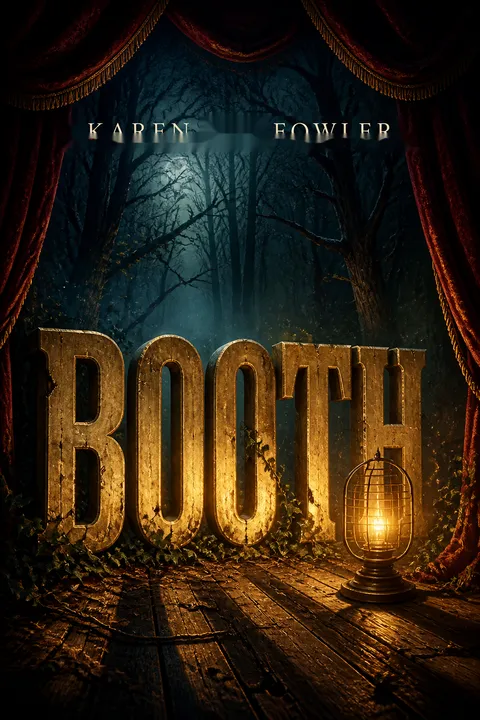


Plot Summary
Beech Spring's Secret
In 1822, Shakespearean actor Junius Brutus Booth moves a cabin to a secluded Maryland farm, where his English wife, Mary Ann, raises their children while he tours for most of each year. By 1838, eldest daughter Rosalie has learned to read the house by the sound of the dogs and the arrival of her father's letters.
She watches over little Edwin and Asia, helps her pregnant mother, and senses that the family’s calm is always temporary. The children know nothing of the scandal that shadows their birth or of the adult bargains holding the household together. Their father’s dramatic gifts fill their home with plays and stories, but his absences leave Rosalie to manage its ordinary needs.
The farm’s seclusion is never quite the privacy Junius intends: neighbors know where the cabin stands, while his children remain ignorant of the truths adults conceal. That contrast establishes the novel’s central tension between public reputation and private knowledge. Rosalie’s close attention is a survival skill, not simply a temperament. With Junius away and Mary Ann overburdened, Rosalie learns to monitor other people’s moods before she can understand her own. The family’s theatrical language offers imaginative escape, but the daily labor of care remains stubbornly real.
The Empty Places
Rosalie loses her younger siblings Frederick, Mary Ann, Elizabeth, and Henry Byron to illness and death. When cholera strikes, Junius rushes home in costume and tries to exhume Mary Ann, convinced he can reverse her death; neighbors restrain him and rebury the child. Henry dies of smallpox in England, leaving Rosalie without the brother who shared her games and understood her silences.
She stops speaking above a whisper and takes responsibility for the surviving children and her grieving mother. Around the Booths, enslaved families face their own separations. Joe Hall works to buy his wife Ann’s freedom, while Ann’s children remain owned by others. Rosalie befriends Nelson, then learns he has been sold.
Loss does not produce one uniform family response. June grows dutiful, Edwin anxious, Asia volatile, while Rosalie turns caution into a form of caretaking. Junius’s attempt to unearth Mary Ann dramatizes how grief can make denial feel like action, but its failure leaves Rosalie with an early lesson in the limits of parental power. The Booths’ mourning unfolds beside the forced separation of enslaved families, yet the household’s sympathy does not erase its entanglement with slavery. Nelson’s sale exposes the distance between a child’s affectionate fantasy of his happiness and the fact of his captivity.
A Fire Names Johnny
Junius’s erratic conduct grows harder to contain. After attempting suicide during a tour, he jumps from a ship into the sea, then attacks his friend and manager Thomas Flynn in a Charleston hotel, leaving his face permanently injured. Mary Ann travels to him with young Edwin, while Rosalie remains at the farm.
The household soon receives Junius’s sister Jane, her drunken husband James Mitchell, and their seven children, who arrive in rags and stay despite the lack of room. The new baby, John Wilkes, is born in 1838. Mary Ann later interprets a flame in the hearth as a sign of his remarkable future, and Junius begins investing the child with hopes once reserved for Henry.
The household keeps absorbing crises without ever resolving their causes. Junius can be tender toward animals and children, yet his impulsive violence makes the family’s safety depend on everyone else’s vigilance. His theatrical self-dramatization turns even a near-suicide into a public episode, leaving Mary Ann and the older children to manage its aftermath. The arrival of the Mitchells makes material scarcity visible: a family’s claim on shelter can rest on obligation, leverage, and a father’s reputation. John’s supposed destiny begins as a story adults tell around a cradle, one that will shape how they interpret him long after the omen itself fades.
Adelaide's Black Bonnet
After the Booths settle in Baltimore, Junius’s younger children build a close world among themselves, using new names and relying on one another against neighborhood gossip. That fragile security breaks when Adelaide Booth arrives from England and claims Junius as her husband.
Rosalie tells the others that their mother was denounced at the farm and that the Booth children have been publicly branded illegitimate. Their explanations divide them: Asia insists the marriage claim is false, Johnny believes Junius deceived Mary Ann, and Edwin suspects his mother knew the truth.
Junius pays Adelaide, but her harassment continues while she waits to bring a legal claim. Her son Richard appears beside her, making the children confront a brother and a family history they never knew existed.
The revelation does more than threaten the children’s social standing. It fractures their shared account of who their parents are, and each sibling chooses the interpretation that best protects a cherished bond. Asia shields Mary Ann by rejecting Adelaide’s claim; Johnny redirects blame toward Junius; Edwin and Rosalie are less able to avoid the possibility that their mother knowingly entered an unequal arrangement. The novel refuses to settle the matter through a single authoritative version. Family identity emerges instead as a contested narrative, shaped by secrecy, shame, and the different needs of those who inherit it.
Edwin Takes the Road
Edwin longs to act, but Junius declares that he should become a cabinetmaker. When the family’s finances worsen and Junius must tour alone, Mary Ann sends fourteen-year-old Edwin to accompany him, supervise his drinking, and keep him from missing performances. Edwin performs this exhausting task through hotels and taverns, sometimes chasing his father through the night.
On an Albany street fire, Junius finds Edwin in the panicked crowd and leads him to safety, briefly reversing their assigned roles. In 1852, Junius leaves for California, but Edwin stays behind. During a winter crossing, Junius falls ill and dies aboard ship, cared for by a stranger rather than his son. Edwin blames himself and insists on playing Hamlet in his memory.
Mary Ann’s decision gives Edwin the career he wants while making him responsible for a parent who cannot reliably care for himself. The arrangement reverses the usual direction of family obligation, but it does not make Edwin powerful: Junius still controls the money, the movement, and the emotional terms of their relationship. The Albany fire offers a rare image of reciprocal protection, yet Junius’s later death restores the imbalance. Edwin’s guilt turns absence into presumed responsibility. His decision to perform Hamlet becomes less an artistic choice than an attempt to keep a promise that death has made impossible to fulfill.
California's Golden Rescue
After Junius dies, Edwin’s California years swing between theatrical promise and self-destructive drinking. He survives a near-drowning, quarrels with older brother June, and eventually earns a fortune through farewell performances.
When he returns to Maryland in 1856, he gives the money to Mary Ann, rescuing the family from hardship and enabling a move back to Baltimore. John, meanwhile, has tried to run the failing farm and resents the life imposed on him.
Asia witnesses his violence toward neighbors and animals, as well as his loyalty to the family. Edwin’s arrival brings relief, but his wealth also sharpens the differences between the brothers: Edwin has escaped the farm, while John feels trapped by it and determined to find a more consequential life.
Edwin’s rescue is real, but it cannot restore the years during which the family had to survive without him. Money relieves material pressure and gives the siblings new choices, while also creating a hierarchy based on who appears to have succeeded. John’s frustration is not merely envy: he has been assigned responsibility for a farm he dislikes, then measured against a brother whose opportunity arrived elsewhere. His cruelty toward animals and neighbors coexists with tenderness, revealing a divided character rather than a simple villainous impulse. The family’s gratitude for Edwin’s success risks obscuring the costs that John has absorbed.
John Chooses the South
John leaves farm work for the stage, but his early performances are uneven and his pride makes criticism difficult to bear. The national crisis over slavery deepens his convictions.
After the Christiana confrontation, where slaveholder Edward Gorsuch is killed while trying to reclaim escaped men, John sympathizes with the slaveholder and treats the violence as a grievance against the South. He joins the Know-Nothings, admires Southern social codes, and later travels with a Virginia militia during the uproar over John Brown’s raid.
He visits Brown in jail and watches his execution, finding courage in a man whose cause he rejects. The experience intensifies John’s appetite for dramatic action even as his family fears that war will claim him.
John’s politics grow from inherited loyalties as much as from considered principle. The Gorsuch story gives him a personal frame for slavery, centering the death of a white man while excluding the agency and coercion of the people Gorsuch pursued. His encounter with John Brown complicates that frame: he can admire a resolute opponent without revising his own beliefs. Politics also offers John a role more satisfying than the one he has found onstage. The militia’s rituals, uniforms, and speeches let him feel close to history, feeding a desire to matter that will eventually outrun his family’s attempts to contain it.
A Wife, A Stage, A War
Asia marries actor John Sleeper Clarke after years of trusting Edwin’s judgment over her own doubts. Edwin forms a bond with actress Mary Devlin, while continuing to resist marriage; John tries to establish himself as an actor and claims independence from his father’s name.
The siblings’ private hopes unfold against Lincoln’s rise. After the Kansas-Nebraska Act revives the conflict over slavery, Lincoln challenges Stephen Douglas and becomes a national Republican figure. His election in 1860 prompts Southern secession.
The Booth brothers do not enlist, though their sympathies diverge: Edwin favors the Union, while John increasingly sides with the South. Mary and Edwin sail for England, and Asia begins building a household of her own as the family’s old unity gives way to distance.
The family’s romances and careers are not a refuge from politics; they show how private choices reproduce inherited expectations. Asia’s marriage satisfies Edwin’s hopes more clearly than her own, while John’s insistence on a separate stage identity masks his need to be recognized. Lincoln’s emergence makes the national conflict impossible to keep abstract. The Booths’ loyalties split along lines already present in their childhood: Edwin seeks artistic recognition and Union belonging, while John interprets Southern honor as a more compelling form of identity. The family’s physical scattering anticipates a political division it has not yet fully understood.
Mary Dies, Edwin Changes
In England, Edwin struggles to win over London audiences while Mary gives birth to their daughter, Edwina. He grows more attached to the Union as British opinion often favors the Confederacy.
After returning to New York, Edwin learns that his friend Richard Cary has died in battle, then begins performing benefit shows for soldiers and their families. His acting career flourishes, and he develops a subtle Hamlet with help from critic Adam Badeau. But his drinking threatens both work and marriage.
Mary, ill and isolated under a physician’s treatment, dies in 1863 before Edwin reaches her. He discovers that a friend had warned Mary about his behavior, blames himself, and ends his drinking. His mourning draws him toward spiritualism and away from the stage.
Edwin’s grief gathers earlier losses into one unbearable conclusion: that love makes him responsible for preventing every death. Mary’s illness and delayed messages leave him with no corrective conversation, so guilt becomes a story he can control more easily than chance. His sobriety is an act of loyalty, but it also reveals how little trust he has in his own desires. Onstage, his restraint is an artistic innovation; in private, restraint becomes a defense against further harm. The search for spirits extends this defense, offering a way to imagine that relationships survive even when the body cannot.
The Country Closes In
As the Civil War intensifies, John’s sympathies harden into secret service for the Confederacy. He uses travel and a pass secured through Edwin’s connections to move across Union territory, while concealing his activities from most of the family.
Edwin, meanwhile, becomes a celebrated Hamlet and a theater owner, then shelters Union officer Adam Badeau and Badeau’s assistant Randall during the New York draft riots. John risks himself in the streets to gather supplies and intelligence, but the family cannot tell whether he is observer or participant.
In 1864, Edwin announces that he will vote for Lincoln’s reelection. John erupts, condemns Lincoln, and leaves Edwin’s house after a bitter quarrel. Their mother fears the brothers will never reconcile.
The siblings’ split makes political allegiance a domestic force. John’s clandestine movements turn family trust into infrastructure: he can use Edwin’s reputation and Asia’s affection precisely because they do not know the full purpose of his visits. Edwin’s protection of Badeau and Randall places him in immediate opposition to John’s cause, though he does not yet understand the danger within his own family. The election argument converts long-held differences into an explicit rupture. John’s exit from Edwin’s house is both a consequence of his politics and a practical loss of the relationships that might have challenged his isolation.
Letters Locked in Philadelphia
John’s anger at Lincoln’s reelection and the Union’s military progress turns into a plot to kidnap the president and exchange him for Confederate prisoners. He recruits acquaintances from his boyhood and theatrical circles, but several hesitate or withdraw. As his purpose darkens, John visits Asia in Philadelphia and gives her a packet of letters to keep in her safe.
She senses danger and refuses to hear the details, yet hides the papers as he asks. John later shifts from kidnapping to assassination without telling her. Meanwhile, Lincoln hopes the war will end without vengeance, and Lee surrenders at Appomattox in April 1865. Asia believes John’s visits are linked to a future in Virginia, not to an attack on the president.
Asia’s refusal to hear the plan is not ignorance alone; it is an attempt to preserve a relationship by limiting what she must know. Yet hiding the letters makes her a participant in the secrecy she hopes to avoid. John exploits their closeness without offering her the truth or the possibility of meaningful consent. His shift from kidnapping to murder isolates him further, while the family’s hope that the war’s end will restore ordinary life makes them less prepared to recognize the danger. Lincoln’s preference for reconciliation provides a sharp counterpoint to John’s decision to answer defeat with private violence.
The Final Performance
On April 14, 1865, John enters Ford’s Theatre while Edwin is performing in Boston and June is touring elsewhere. Lincoln attends Our American Cousin with Mary, Clara Harris, and Major Rathbone, despite warnings that public appearances are risky.
During the play, John reaches the presidential box, shoots Lincoln, wounds Rathbone with a knife, and leaps to the stage, breaking his leg. He escapes on horseback and reaches the Maryland home of Dr. Mudd to have the fracture set. Lincoln dies the following morning.
John insists to himself that he has performed a patriotic deed, but the assassination turns his family name into a public curse. Rosalie hears that John has been arrested and clings to his last letter as proof that the reports must be wrong.
The theater makes the assassination both a crime and a final act of self-authorship. John chooses a public stage where his family’s craft can amplify his gesture, converting political violence into a spectacle with a prepared ending. The choice also distorts the meaning of performance: an audience expecting fiction must suddenly interpret real blood, while the nation becomes an unwilling witness. Rosalie’s attachment to John’s letter shows how quickly fact and emotional necessity diverge. She is wrong about his capture, but her deeper resistance is to the idea that the brother she remembers could have chosen this act.
A Family Under Judgment
Federal agents search the homes of John’s relatives, while angry crowds threaten the family. Asia burns one letter and gives the remaining papers to her husband, who turns them over to authorities. June and Sleeper are arrested on suspicion of conspiracy; Asia remains under guard while pregnant, and Mary Ann leaves her sickbed to reach her.
John is found in a Virginia barn and shot after refusing to surrender. Edwin, spared arrest, grieves both his brother and the president, then testifies about John’s history without being called. The government holds June and Sleeper for months, while newspapers publish the letters that reveal John’s Confederate beliefs. The Booths lose privacy, reputation, and the right to define their own grief.
The assassination transfers punishment from the guilty individual to an entire family. Public suspicion treats proximity as evidence, while Asia’s concealment of the letters becomes both an act of sisterly loyalty and a source of legal peril. Edwin’s exclusion from the testimony underscores the limits of family knowledge: he is asked to explain John but has spent years estranged from the person John became. The letters cannot settle what the family wants settled. They establish political commitments, yet leave intact the more painful question of how love and complicity can occupy the same household.
The Living Carry On
After John’s death, Edwin refuses alcohol and eventually returns to the stage as Hamlet. The audience’s applause gives him a way to represent national mourning without pretending to erase his own.
Rosalie privately preserves a gentler account of John, even comforting a woman who claims to have borne his child. Asia leaves America and writes a private defense of her brother alongside her public work on Junius and Edwin. Mary Ann remains unable to forgive Edwin for casting John out, while Rosalie eventually moves the graves of the three younger Booth children beside their father.
Edwin builds an actors’ home and dies in 1893, long after the family has scattered. The novel closes by gathering the dead, famous and forgotten, into the same imagined company.
The ending refuses a clean division between remembrance and exoneration. Edwin’s return to Hamlet converts his private bereavement into a public form, but the applause cannot restore Mary, John, or the family he once hoped to save. Rosalie’s invented or sustained account of John reveals how memory can protect love without changing the historical record. Asia’s separate writings make the same conflict visible in another register, one public and one hidden. By gathering enslaved people, soldiers, relatives, and spectators in its final image, the novel challenges a history that preserves famous names more readily than ordinary lives.
Analysis
Booth asks how a family can remain a family when its members inherit both affection and damage from the same source. Junius’s genius gives his children a language for performance, but his absences, drinking, and hidden marriage force them to improvise care and identity around him. Rosalie becomes the keeper of intimate memory, Edwin turns performance into disciplined self-reinvention, Asia protects family belonging through loyalty, and John seeks significance in a political cause that ultimately consumes the people who love him.
The novel’s account of slavery complicates the Booths’ self-image. Their tenderness toward Joe and Ann Hall exists beside a household sustained by enslaved labor and the ease with which white characters mistake affection for justice. John’s Confederate allegiance is not treated as an inexplicable rupture; it grows from selective memory, racial hierarchy, and a desire to be heroic. Lincoln’s parallel story likewise resists easy moral polish. He opposes slavery while accepting racial assumptions that limit his vision, and his decisions are made within a political system where compromise can preserve injustice as well as prevent violence.
Theatricality is the book’s governing metaphor, but not because life is merely performance. Acting can cultivate empathy, precision, and restraint, as Edwin’s work demonstrates. It can also turn conviction into spectacle, as John’s final crime does. The family’s memories become performances too: Asia writes one version, Rosalie preserves another, and Edwin tries to make himself responsible for what no son could control. None can fully reconcile love with judgment. The novel’s final gathering of the dead therefore offers no absolution. It insists instead that history must remember those erased by fame, including the enslaved, the bereaved, and the family members left to live with the consequences.
Review Summary
Booth by Karen Joy Fowler receives mixed reviews, with some praising its historical detail and family saga, while others find it slow-paced and unfocused. The novel explores the Booth family, particularly John Wilkes Booth's siblings, against the backdrop of 19th-century America. Readers appreciate Fowler's research and character development but criticize the lack of focus on John Wilkes Booth himself. Many note parallels drawn to modern political divisions. Overall, the book is seen as an ambitious historical fiction that succeeds in some areas but falls short in others.
People Also Read






Characters
Rosalie Booth
The watchful eldest sisterJunius and Mary Ann’s eldest surviving daughter, Rosalie grows up as an extra pair of hands in a crowded household. She is shy, bookish, physically awkward, and extraordinarily sensitive to changes in other people’s moods. Her closeness to younger siblings, especially Edwin, comes partly from the years when she had to protect and comfort them. Rosalie’s imagination gives her a private life richer than the family recognizes, but it also makes her vulnerable to cherished stories that cannot be verified. She is less interested in public distinction than in preserving relationships and memories. Her perspective keeps the family’s private suffering in view, particularly the burdens placed on women and children who are expected to absorb the consequences of adult choices.
Edwin Booth
The actor seeking his own voiceThe sensitive son of Junius and Mary Ann, Edwin wants to act from childhood, but his father initially dismisses that ambition. Quiet, imaginative, and prone to self-doubt, he becomes a caretaker on the road before he can become an artist on his own terms. Edwin’s acting develops through study, observation, and a preference for emotional restraint over his father’s grander style. His friendships and romances reveal both his capacity for devotion and his difficulty trusting himself. He is drawn to performance because it lets him inhabit another person, yet his central struggle is to make a life that is recognizably his. Family loyalty repeatedly presses him to sacrifice personal desire for someone else’s survival.
Asia Booth
The beautiful, stormy sisterThe youngest Booth daughter, Asia is energetic, proud, intelligent, and quick to anger. Beauty gives her social attention, but she cares just as intensely about the family name and her place among her brothers. She is educated, curious, and fond of riding, books, and theatrical life, while remaining capable of overlooking the experiences of people whose lives differ from her own. Her affection for John is unusually deep, and she often treats his ambitions as if they were her own. Asia’s emotional force can make her generous and protective, but it can also harden into jealousy or judgment. She longs for love that will not be divided by the family’s competing loyalties.
John Wilkes Booth
The ambitious younger brotherThe youngest son to receive Junius’s concentrated hopes, John grows up handsome, energetic, and hungry for distinction. He is sociable and daring, drawn to acting, horse riding, weapons, and the charged atmosphere of public causes. His confidence hides a sensitivity to comparison, particularly with Edwin, whose success becomes a measure John resents. John’s attraction to Southern honor and dramatic action gives him a powerful sense of identity, but his certainty makes disagreement feel like betrayal. He can be affectionate with his siblings and protective of people he loves, while also acting impulsively and cruelly. The gap between his private tenderness and public convictions shapes his relationships throughout the story.
Junius Brutus Booth
The brilliant, volatile fatherA celebrated Shakespearean actor, Junius is magnetic onstage and unpredictable at home. He loves his family and can show startling tenderness, yet his drinking, financial irresponsibility, and theatrical temperament leave others to manage the consequences. He disapproves of his children entering the profession even as he fills their home with plays and trains them in performance. Junius sees people through the roles they might play, sometimes mistaking dramatic intensity for truth. His moral convictions, especially his opposition to killing animals, coexist uneasily with his capacity for anger and control. To his children, he is both an artistic inheritance and a difficult measure of what love can demand.
Mary Ann Holmes Booth
The enduring family matriarchMary Ann leaves England with Junius expecting adventure, then finds herself raising a large family on a rural Maryland farm while he tours. Beautiful, industrious, and deeply devoted, she spends much of her life caring for children, managing money, and protecting the household from scandal. Repeated bereavement shapes her into a woman whose love is powerful but often expressed through control and self-sacrifice. She relies heavily on her daughters, especially Rosalie, and invests particular hopes in her sons. Mary Ann’s loyalty to Junius persists alongside fear and disappointment. Her efforts to keep the family together offer security, but they can also make it harder for her children to claim independent lives.
Abraham Lincoln
The burdened presidentLincoln appears in interwoven sections that trace his rise from a troubled Illinois politician to president during the Civil War. He is intellectually agile, deeply affected by slavery and mob violence, and often forced to weigh principle against political possibility. His private sorrow over family losses sits beside the public demands of war. The novel presents him as neither a flawless emblem nor a detached statesman: he can recognize the wrongs of slavery while retaining the racial assumptions of his era, and he can seek reconciliation even when others demand punishment. His relationship to history is shaped by both deliberate choices and events beyond his control.
June Booth
The steady older brotherThe eldest Booth son, June is handsome, sociable, and more grounded than his younger brothers. He pursues acting despite Junius’s objections, then builds a family and career on the other side of the country. His steadiness makes him a practical ally, though he can be blunt and emotionally reserved. He often mediates between siblings but cannot prevent their choices from pulling them apart.
Joseph Adrian Booth
The elusive youngest brotherUsually called Joe, the youngest Booth son is dreamy, melancholy, and difficult to pin down. He often feels overlooked beside the more vivid personalities of Edwin, Asia, and John. His intelligence is hard for others to assess, partly because he gives little away. Joe’s restlessness reflects a young man searching for a place in a family that seems already arranged around its other members.
Richard Booth
The hidden half-brotherRichard is Junius’s son from his earlier English family and a figure whose presence unsettles the Booth children’s understanding of their father. Gentle, educated, and physically unlike Junius, he has a talent for languages but little appetite for confrontation. His quietness makes him easy for the younger Booths to misread as hostile. Richard embodies the cost of a family secret borne by someone who had no part in creating it.
Adelaide Booth
The claimant from EnglandJunius’s estranged English wife, Adelaide arrives in Baltimore with a claim that destabilizes the Booth family. She is angry, relentless, and intent on securing recognition and support for herself and her son. Her public confrontations make her easy for the younger children to dismiss as a spectacle, but her grievances arise from real abandonment. Adelaide forces the family to confront the difference between the respectable story it tells about itself and the history Junius has kept hidden.
Mary Devlin Booth
Edwin's devoted artistic partnerAn actress with a quiet manner and strong artistic judgment, Mary meets Edwin while both are performing. She believes in a more natural, morally serious style of theater and helps him refine his work. Her affection for him is generous, though she understands that his melancholia and dependence on alcohol can make intimacy difficult. Mary is not merely a romantic refuge: she has her own standards, ambitions, and professional insight. Her presence brings warmth and discipline into Edwin’s unsettled life.
John Sleeper Clarke
Asia's ambitious actor husbandAn actor and longtime friend of the Booth brothers, Sleeper Clarke is devoted to Asia and eager to succeed professionally. His affection can be intense, while his ambitions and political views complicate his ties to her family. He often seeks recognition through his connection to the Booth name, a concern John distrusts. Sleeper’s loyalty and his self-interest coexist, making him difficult for Asia to judge clearly.
Adam Badeau
Edwin's critic and confidantA writer and theater critic, Badeau recognizes Edwin’s potential before most reviewers do and helps him cultivate a more intellectually grounded style. Educated, articulate, and ambitious, he brings Edwin into literary circles and pushes him to study rather than rely on inherited reputation. Badeau’s deep emotional attachment to Edwin is not always returned in equal measure. Their bond mixes mentorship, affection, rivalry, and disappointment.
Ann Hall
The family's steadfast neighborA skilled cook and longtime worker on the Booth farm, Ann Hall is a trusted caregiver to the Booth children and a central member of her own family. She and her husband, Joe, work for years to secure freedom for themselves and their children. Ann is observant, resilient, and careful about what she reveals to white neighbors. Her affection for the Booths does not erase the unequal conditions in which she must live.
Joe Hall
The farm's quiet backboneJoe Hall manages the Booth farm whenever Junius is away, handling its labor, animals, and repairs. He is strong, patient, and a steady presence to the children, who grow up trusting him. His central private aim is to reunite his family and secure their freedom. The Booths’ affection for him coexists with their dependence on his labor, a contradiction the novel keeps in view.
John Sleeper Clarke
The devoted stage companionA longtime friend to the Booth siblings, Clarke is a comic actor who becomes part of their professional and domestic circle. His humor and persistence make him a familiar presence, though his personal ambitions can complicate his friendships.
Hagar
The enslaved caregiverAn enslaved woman who works in the Booth household, Hagar helps care for the children and becomes part of their early sense of family. Her experience of freedom beyond Maryland changes what she can accept, though the Booths are slow to understand her choices.
Richard Booth Sr.
The rebellious grandfatherJunius’s father, an Englishman who once supported the American Revolution, lives unhappily on the Maryland farm. He is learned, frequently drunk, and more openly opposed to slavery than his son. His lessons and covert acts of assistance expose the children to principles that their daily lives do not consistently uphold.
Hattie Booth
June's courageous partnerAn actress and June’s partner, Hattie travels with the Booth men across Panama and later builds a life with June in California. She is practical, good-humored, and unusually kind to Edwin during a period of grief. Her courage is clearest when travel becomes dangerous and the men around her fail to recognize how vulnerable she is.
Thomas Flynn
Junius's manager and friendFlynn manages Junius’s theatrical work and is one of his closest friends. His loyalty draws him into the consequences of Junius’s volatility, while his letters help Mary Ann and Rosalie understand what happened away from home.
John Brown
The uncompromising abolitionistBrown leads the raid on Harpers Ferry in the hope of arming enslaved people and beginning a rebellion. His absolute conviction horrifies John Booth, who nevertheless admires his courage. In Lincoln’s sections, Brown’s raid becomes a political shock that changes how Republicans calculate the danger of appearing radical.
Plot Devices
Shakespearean Roles
Life rehearses the stageThe Booth children grow up surrounded by plays, costumes, and theatrical stories, even though Junius discourages them from acting. Shakespearean roles become a shared language for affection, rivalry, and grief. Edwin uses acting to develop an artistic identity distinct from his father, while John is drawn to the grandeur of heroic and political parts. The novel also uses theatricality to show how people perform versions of themselves for family and public audiences. In the final crisis, John turns a theater into the setting for a real political crime, collapsing the distinction between spectacle and consequence.
Family Omens
Prophecy becomes inheritanceStars, cauls, flames, and palm readings attach stories of exceptional futures to the Booth children. The omens are less reliable predictions than emotional scripts: adults use them to organize grief, hope, and favoritism, and the children learn to interpret their lives through them. Edwin’s birth signs fade from family memory when Johnny receives a more vivid destiny. John later carries a palmist’s forecast with him, treating it as both warning and permission. The device asks how much a person’s idea of fate is made by the stories others repeatedly tell about them.
Letters and Records
Private evidence, public harmLetters move news, money, affection, and suspicion across the scattered Booth family. They also create a problem of interpretation: each recipient reads the same words through fear, loyalty, or self-protection. Asia’s attempt to preserve John’s papers becomes consequential because the documents reveal information she did not want to know. Separately, the destruction of Junius’s letters deprives Asia of the source material for her father’s biography. Written records preserve evidence, but they cannot restore the people who made them or settle the motives that readers project onto them.
Ghosts and the Dead
Grief keeps speakingRosalie senses the dead children around the farm, while Edwin later seeks contact with lost loved ones through spiritualism. The novel leaves room for supernatural experience without treating it as a dependable source of truth. Ghosts express the living characters’ unfinished grief, guilt, and longing; their presence changes as the siblings grow and scatter. Rosalie’s private encounters and Edwin’s séances differ in tone, but both show how bereaved people search for forms of continued connection. The dead remain emotionally active even when the living cannot agree on what their presence means.
Lincoln's Parallel Story
Private grief meets public historyInterludes following Abraham Lincoln place the Booth family’s personal history inside the same national crisis that shapes John’s politics. Lincoln’s speeches, losses, compromises, and wartime choices form a counterpoint to the Booths’ divided loyalties. The parallel prevents the assassination from appearing as an isolated act by one villain: it emerges from a nation already accustomed to political violence and moral contradiction. Lincoln’s own record is presented with complexity, including the limits of his racial assumptions and the burden of his decisions. His story offers a second perspective on who gets to claim patriotism.
About the Author
Other books by Karen Joy Fowler

Download PDF
Download EPUB
.epub digital book format is ideal for reading ebooks on phones, tablets, and e-readers.








