

Key Takeaways
Turn individual mastery into doctrine other people can teach.
Skill became shareable. At Boyd’s 1997 Arlington memorial, Marines honored an Air Force colonel while only two Air Force officers attended. The contrast captures his career: his influence often outran the institution’s recognition. Raised in a struggling family in Erie, Boyd learned discipline from a swimming coach and a lifeguard who became a mentor. In Korea, he flew combat missions but never became a shooter, so he returned without a MiG victory.
He made tactics teachable. At Nellis, Boyd studied air combat, tested maneuvers, and taught other pilots. His Aerial Attack Study, a manual that analyzed how fighters gain and lose tactical advantage, became official Air Force doctrine in 1960. His distinction was not simply flying exceptionally well. He translated experience into principles other pilots could learn and use.
What's striking is the move from tacit expertise to shared knowledge. In many fields, the best practitioner knows more than they can explain, leaving performance dependent on rare individuals. Boyd's manual treated tactics as something that could be observed, analyzed, and taught. That shift resembles the creation of professional standards in medicine or engineering. Yet codification is never complete: a manual can preserve sound principles while becoming outdated when technology or conditions change. The value lies not in freezing expertise into rules, but in giving learners a foundation they can test.
Measure usable energy, not speed, when comparing fighter performance.
Performance is a trade-off. While studying thermodynamics at Georgia Tech, Boyd connected the exchange of energy in a physical system to the choices a pilot makes in combat. Speed alone could mislead: an aircraft might be fast but unable to climb, turn, or regain energy after a maneuver. His Energy-Maneuverability Theory, or E-M, compared how quickly an aircraft could gain or lose energy across different speeds, altitudes, and G-loads.
The charts changed the argument. With mathematician Tom Christie, Boyd used aircraft data and computer calculations to map performance across the flight envelope. The resulting comparisons showed where American aircraft had advantages over Soviet designs, and where they did not. E-M helped turn fighter design from vague claims about speed and power into measurable trade-offs relevant to combat.
Boyd's technical contribution illustrates a broader lesson in measurement: the metric that matters is the one connected to the task. A car's top speed says little about its ability to climb a hill or stop safely; similarly, an aircraft's headline speed does not define its combat usefulness. E-M made comparisons more systematic by considering performance across conditions rather than at a single showcase point. Models still depend on accurate inputs, however. Boyd's repeated disputes over aircraft data show that a precise calculation can produce false confidence when its measurements are unreliable.
Design around the mission, then strip away everything that dilutes it.
More capability can mean less performance. The Air Force's proposed F-X fighter grew heavy as officials added speed, radar, fuel, and other features. Boyd argued that the design should prioritize winning air-to-air combat, not accumulate equipment for every imagined mission. Using E-M to assess trade-offs, he fought to reduce weight and helped steer the aircraft away from a variable-sweep wing. The F-X became the F-15, although it remained heavier than Boyd wanted.
A smaller alternative survived. Boyd and allies secretly encouraged a lightweight-fighter study, eventually producing competing YF-16 and YF-17 prototypes. The YF-16 won the fly-off and became the F-16. The Air Force then added equipment and missions that Boyd believed compromised the original design. His influence was substantial, but he could not prevent the institution from reshaping the aircraft.
This is a classic design problem: features impose costs beyond their purchase price. Added weight can demand a larger structure or engine, which creates further weight and expense. Systems engineering calls attention to these interactions, while Boyd's approach insisted that requirements be judged against a clear purpose. The counterpoint is that military aircraft face uncertain missions, and specialization can leave forces less adaptable. The practical challenge is not to reject versatility automatically, but to make its cost visible and ask whether each added capability earns its place.
Break stale mental models before building a better one.
Creativity begins by loosening assumptions. In Destruction and Creation, Boyd described how people build mental models from observations, then rely on those models to interpret new events. When reality stops matching the model, he argued, adding details may not solve the problem. The model itself may need to be taken apart.
Recombine, then test. Boyd called the breaking apart of established concepts destructive deduction. The next step, creative induction, is finding connections among the separated elements and forming a new model. That model must be checked for internal coherence and tested against what is actually happening. Boyd linked this cycle to ideas associated with Gödel, Heisenberg, and thermodynamics. His larger point was practical: learning requires revising the lens, not merely collecting more facts.
The framework resembles scientific paradigm change and modern design practice: teams often need to question the categories that shape what they notice before they can generate a useful alternative. It also warns against treating a familiar model as reality itself. Boyd's use of mathematical and physical theories is intellectually ambitious, but analogy should not be mistaken for proof. Gödel's results about formal systems and Heisenberg's principle do not directly establish a general theory of human creativity. The framework is most persuasive as a disciplined metaphor for model revision, followed by empirical testing.
Outpace an opponent by disrupting the assumptions behind their decisions.
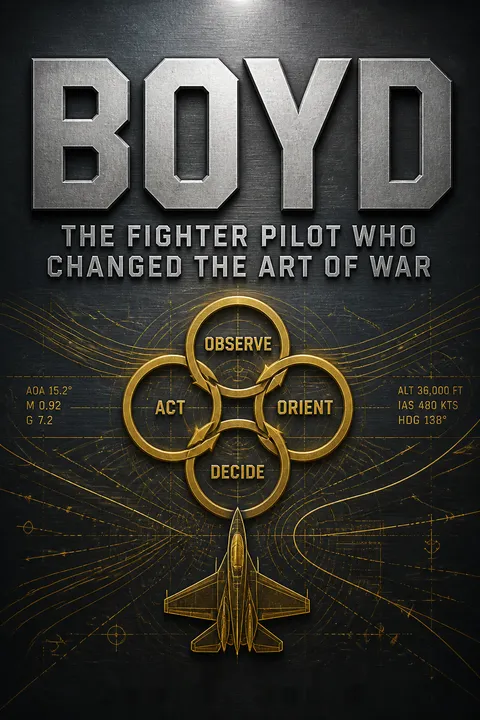
The OODA Loop is more than speed. Boyd used the term for a cycle of observing, orienting, deciding, and acting. Orientation means interpreting events through experience, training, culture, and new information. Because people orient differently, Boyd treated the cycle as adaptive rather than a simple mechanical sequence.
Make the other side react to yesterday. A force can gain advantage by changing the situation before its opponent has made sense of the previous change. The goal is not merely to move faster, but to make the opponent's information and expectations less useful. Boyd connected this idea to aerial combat, where a pilot's quick transition between maneuvers could create an opening, and to broader conflict, where repeated surprises can produce confusion and poor decisions.
The model anticipates a familiar problem in organizations: decision-makers can become trapped responding to a situation that has already changed. Fast feedback and local judgment help reduce that lag. But speed alone is not an advantage if it produces careless action, and an opponent can exploit predictable haste. Boyd's emphasis on orientation is therefore essential. The most valuable capability is not simply rapid cycling through decisions, but accurate interpretation that supports timely adaptation. In complex systems, leaders also need ways to distinguish meaningful signals from noise.
Let decentralized teams exploit openings instead of marching in lockstep.
Maneuver warfare targets cohesion. Boyd used this term for an approach that seeks to confuse and disorganize an opponent rather than defeat every unit through direct attrition. It draws on historical examples including German infiltration tactics and the Blitzkrieg, which used speed, deception, and movement through weak points to disrupt command and supply.
Shared intent enables initiative. Boyd argued that subordinates should understand the larger purpose, then act without waiting for detailed instructions. In Marine Corps teaching, Mike Wyly helped translate this approach into exercises and doctrine. In Grenada, Marine commanders bypassed resistance and moved quickly, while the Army's emphasis on synchronized movement sometimes slowed its forces. The lesson is not that coordination is useless, but that excessive control can prevent teams from exploiting changing opportunities.
This approach aligns with mission command, a leadership philosophy in which clear intent and trust allow teams to act under uncertainty. Decentralization can make an organization more responsive because local actors see conditions before headquarters does. It also raises real risks: units may diverge, misunderstand intent, or create hazards for neighboring forces. Shared purpose and training are the safeguards. Boyd's critique is most useful where leaders confuse synchronization with effectiveness, not as an argument against coordination when timing and safety require it.
Test weapons under battlefield conditions, not on reassuring paper models.
Budgets can hide readiness problems. In Defense Facts of Life, commonly called the Spinney Report, analyst Chuck Spinney argued that increasingly costly and complex weapons crowded out training, maintenance, and supplies. The Air Force could not afford to operate some systems at the levels it had promised. The issue was not simply insufficient funding: purchasing decisions helped create the shortfall.
Real tests challenged institutional claims. Colonel Jim Burton pushed for live-fire tests of the Bradley Fighting Vehicle using realistic loads and weapons. The Army initially used weaker munitions and water in place of fuel, making results less representative of combat. Burton's pressure helped force fuller testing and changes to the vehicle. The dispute showed how testing can become an advocacy exercise when the institution responsible for a program also controls how its success is measured.
The story is a vivid case of principal-agent conflict: the institution buying and defending a system has incentives that may differ from the people who rely on it in combat. Independent testing helps counter that bias, especially when consequences are severe and difficult to reverse. The same logic applies to medical devices, infrastructure, and software used in safety-critical settings. Testing is not automatically objective, however. Test conditions, chosen metrics, and excluded scenarios can all tilt results. Credibility depends on transparent methods and the power to publish inconvenient findings.
Count the human cost before romanticizing principled dissent.
Integrity carried a price. Boyd repeatedly challenged senior officers, contractors, and institutional decisions. His bluntness helped him expose weak designs and challenge questionable claims, but it also damaged his prospects for promotion. In advising young officers, he contrasted a career built through accommodation with work that could matter but carry professional risk. Burton and Wyly faced similar consequences when they challenged military practices.
The costs reached home. Boyd's commitment to work came at the expense of his family. His wife and children describe years of neglect, conflict, and distance. His professional courage does not erase those harms. The biography holds both truths together: Boyd could serve the public interest with unusual resolve and fail the people closest to him. Integrity at work is not a substitute for responsibility in private life.
The section complicates the familiar hero story. Dissent can protect the public from institutional error, but self-sacrifice is not automatically virtuous when other people bear its costs. Ethical leadership includes duties to colleagues, family, and the institution itself. Boyd's case also shows why organizations need channels where accurate criticism is heard without requiring a dissenter to destroy a career. Courage matters, but systems that depend on heroic personalities are fragile and often unjust.
Track influence through changed aircraft and doctrine, not official credit.
Ideas traveled through other people. Boyd's work influenced fighter tactics, the design debates around the F-15 and F-16, and Marine Corps doctrine. His briefings also shaped officers who applied maneuver principles in military planning. Secretary of Defense Dick Cheney later acknowledged that Boyd's ideas informed his thinking about the Gulf War, though the book's claims about Boyd's precise role remain difficult to verify independently.
Recognition stayed uneven. The Marine Corps gave Boyd unusual prominence, including a display at Quantico and a place for his papers. The Air Force often used or taught material connected to his work without naming him. This uneven legacy reflects the biography's central tension: institutions can absorb useful ideas while resisting the people who challenge their authority.
Influence is often distributed rather than attributable to one person. Boyd's ideas moved through pilots, analysts, commanders, and advocates, so the story is stronger when understood as a network than as a lone inventor changing history by himself. The biographical account is based heavily on interviews with devoted colleagues, whose testimony preserves details but can also magnify a mentor's role. Distinguishing documented adoption from retrospective attribution does not diminish Boyd's contribution. It makes the history more credible and shows how ideas survive through use, adaptation, and argument.
Analysis
This biography is both an account of technical innovation and a study of institutional resistance. Boyd's career moves through three forms of expertise: the pilot who reads combat as a system of energy and position, the engineer who makes performance measurable, and the strategist who treats conflict as a contest over perception and decision. The connecting thread is not simply speed. It is the repeated effort to replace inherited assumptions with models that can be tested against reality.
The narrative's strongest evidence concerns concrete changes: the Aerial Attack Study became a tactics manual, E-M entered aircraft analysis, the lightweight fighter survived to become the F-16, and Marine officers built doctrine and training around maneuver. The account is less conclusive when assigning Boyd personal authorship over complex events such as the Gulf War. The author acknowledges the limits of the record, and Cheney's later testimony supports influence without proving that one theorist designed a campaign. The distinction between inspiration, contribution, and direct operational control matters.
Boyd's ideas also arrive through an unusually tight circle of loyal colleagues. Their recollections make the technical work vivid and expose the cost of bureaucratic retaliation, but their devotion can tilt the portrait toward legend. Coram counters this by showing disputed stories, missed promotions, and especially the damage Boyd's work ethic inflicted on his family. That complexity is essential. His integrity in public service cannot be used to excuse neglect in private life.
The book's lasting insight is that learning, design, and strategy share a common discipline: observe, question the model, revise it, and test again. Its warning is equally specific. A system that rewards conformity, protects its own forecasts, and treats new evidence as a threat can turn expertise into ritual. Boyd's example is powerful, but healthy institutions should not need a disruptive genius to make honest measurement possible.
Review Summary
Boyd is a highly praised biography of John Boyd, an influential but underappreciated military strategist. Readers appreciate the detailed account of Boyd's life, his innovative ideas like the OODA loop, and his impact on military tactics and aircraft design. The book highlights Boyd's brilliance and dedication, as well as his flaws as a family man. Many reviewers consider it essential reading for those interested in military history, strategy, and reform, though some note it could be more concise or balanced in its portrayal.
People Also Read

Glossary
Energy-Maneuverability Theory
Aircraft performance comparisonBoyd's method for comparing an aircraft's ability to gain, preserve, or lose energy across different speeds, altitudes, and maneuvering loads. It uses performance data to show where an aircraft has an advantage or weakness throughout its flight envelope. The method helped evaluate tactics and inform fighter design, including debates around the F-15 and lightweight fighter.
OODA Loop
Adaptive decision cycleBoyd's model of how people respond to changing circumstances: they observe events, orient themselves by interpreting what they see, decide what to do, and act. The cycle is not merely a race to make decisions quickly. Orientation, shaped by experience and context, is central to understanding the situation and adapting before an opponent can respond effectively.
Destruction and Creation
Revising mental modelsBoyd's paper on how people build concepts to understand reality and revise them when experience no longer fits. He describes breaking apart established categories, finding useful connections among their elements, and constructing a new model. The new model must be internally coherent and tested against observation. Boyd presents this cycle as a basis for learning and creativity.
Patterns of Conflict
Briefing on maneuver strategyBoyd's evolving briefing on the history and theory of conflict. It draws examples from ancient battles, modern warfare, guerrilla campaigns, and the Blitzkrieg to explain how deception, speed, initiative, and disruption can undermine an opponent's cohesion. The briefing connects these ideas to decision-making and the OODA Loop, and became central to military reformers and maneuver-warfare advocates.
Aerial Attack Study
Manual for fighter tacticsA manual Boyd developed at the Fighter Weapons School and completed in 1960. It organized air-to-air tactics around aircraft position, energy, available maneuvers, and possible counters. The study helped turn aerial combat from an informal craft passed between pilots into a more systematic subject. It became official Air Force tactics doctrine and circulated internationally.
maneuver warfare
Disrupting an opponent's cohesionAn approach to conflict that seeks advantage through movement, surprise, deception, and attacks on weak points rather than relying primarily on direct attrition. It aims to confuse and disorganize an opponent while preserving initiative. In Boyd's account, it also depends on decentralized action: subordinates understand the overall intent and use judgment as conditions change.
cheng and ch’i
Expected and unexpected actionA distinction Boyd drew from Sun Tzu's writing on war. Cheng refers to the expected or conventional action, while ch'i refers to the unexpected or unconventional action. Used together, they describe how a force can hold an opponent's attention in one place while creating an opening elsewhere. Boyd treated the distinction as a recurring pattern in successful strategy.
Schwerpunkt
Central focus of effortA German military term Boyd used for the main focus or purpose that gives an operation coherence. A clear Schwerpunkt helps units understand what the larger effort is trying to achieve, even when they are not given detailed instructions for every move. It supports initiative because local decisions can remain aligned with the commander's intent.
Fingerspitzengefuhl
Intuitive feel for conditionsA German term Boyd used for a leader's intuitive grasp of a changing situation. It is not mere instinct or guesswork. It develops through experience, close attention, and a deep understanding of the mission and environment. This feel can help a commander recognize an opening or danger quickly, before a slower, fully explicit decision process is possible.
FAQ
What is Boyd: The Fighter Pilot Who Changed the Art of War by Robert Coram about?
- Biography of John Boyd: The book is a comprehensive biography of Colonel John Boyd, a U.S. Air Force fighter pilot, engineer, and military strategist who revolutionized air combat and military doctrine.
- Military innovation and reform: It details Boyd’s development of the Energy-Maneuverability (E-M) Theory, the OODA Loop, and his leadership in the military reform movement.
- Lasting influence: The narrative covers Boyd’s impact on aircraft design (F-15, F-16, A-10), military strategy, and even business management, showing how his ideas reshaped multiple fields.
Why should I read Boyd: The Fighter Pilot Who Changed the Art of War by Robert Coram?
- Insight into innovation: The book offers a rare look at how one individual’s ideas and persistence can challenge entrenched military dogma and bureaucracy to bring about revolutionary change.
- Lessons in leadership and integrity: Boyd’s story is a study in leadership, creativity, and the costs of challenging authority, providing valuable lessons for anyone interested in innovation, organizational dynamics, and perseverance.
- Broader applications: Boyd’s concepts, especially the OODA Loop and maneuver warfare, have applications beyond the military, including business and personal conflict, making the book relevant to a wide audience.
What are the key takeaways from Boyd: The Fighter Pilot Who Changed the Art of War by Robert Coram?
- Transformation of military doctrine: Boyd’s theories fundamentally changed how the U.S. military approaches air combat, strategy, and organizational reform.
- Importance of adaptability: The book emphasizes the need for rapid, flexible decision-making in conflict, as embodied in the OODA Loop.
- Power of individual impact: Boyd’s life demonstrates how one person’s relentless pursuit of truth and integrity can reshape institutions and doctrines, even in the face of fierce resistance.
Who was John Boyd, and why is he significant according to Robert Coram?
- Legendary fighter pilot: Known as “Forty-Second Boyd,” he was reputedly able to defeat any opponent in simulated air combat in under forty seconds, earning a reputation as America’s best fighter pilot in the 1950s.
- Innovator and reformer: Boyd authored the “Aerial Attack Study,” developed the Energy-Maneuverability Theory, and created the OODA Loop, all of which had profound impacts on military tactics and strategy.
- Mentor and leader: He led the military reform movement, mentored a generation of reformers, and influenced not just the Air Force but also the Army, Marine Corps, and business leaders.
What is the Energy-Maneuverability (E-M) Theory developed by John Boyd in Boyd: The Fighter Pilot Who Changed the Art of War?
- Scientific basis for air combat: E-M Theory quantifies an aircraft’s energy state and its ability to gain or lose energy during maneuvers, providing a mathematical framework for evaluating fighter performance.
- Impact on aircraft design: The theory shifted design priorities from speed and electronics to agility and energy management, directly influencing the F-15 and F-16.
- Tactical applications: E-M Theory enables pilots to optimize their energy states to gain positional advantage, fundamentally changing how dogfights are fought and taught.
What is the OODA Loop, and why is it important in Boyd: The Fighter Pilot Who Changed the Art of War by Robert Coram?
- Definition and components: The OODA Loop stands for Observe, Orient, Decide, Act—a decision cycle describing how individuals and organizations process information and respond to conflict.
- Strategic advantage: Operating inside an adversary’s OODA Loop creates confusion and disorder, allowing for decisive advantage in warfare, business, and personal interactions.
- Depth and application: Boyd’s original concept emphasizes the critical role of orientation (culture, experience, analysis) and adaptability, not just speed, making it a powerful tool for decision-making in complex environments.
How did John Boyd and the Fighter Mafia influence the development of the F-15, F-16, and A-10, according to Robert Coram?
- Challenging flawed designs: Boyd and the Fighter Mafia opposed heavy, complex, and expensive aircraft, advocating for lightweight, maneuverable fighters.
- Direct involvement: Boyd’s E-M Theory and advocacy led to the design and adoption of the F-15 and F-16, emphasizing agility and simplicity.
- A-10 and close air support: Boyd and Pierre Sprey championed the A-10, ensuring the Air Force developed a dedicated, survivable close air support aircraft despite institutional resistance.
What was the “Aerial Attack Study” and its significance in Boyd: The Fighter Pilot Who Changed the Art of War?
- First formal air combat manual: Written by Boyd in 1960, it was the first comprehensive manual to codify fighter tactics, moving air combat from an art to a science.
- Emphasis on energy and maneuvering: The study taught pilots how to maintain offensive advantage by preserving energy, influencing air combat training worldwide.
- Enduring influence: Initially classified, it became the basis for air combat doctrine and remains relevant decades later.
What is the significance of Boyd’s “Destruction and Creation” paper and his learning theory in Robert Coram’s book?
- Philosophical foundation: “Destruction and Creation” is Boyd’s only major written work, synthesizing ideas from mathematics, physics, and philosophy to explain how mental models are destroyed and rebuilt.
- Dialectic process: The paper describes a continuous cycle of breaking down old concepts and building new ones, essential for adaptation and creativity.
- Application to strategy: This theory underpins Boyd’s approach to learning, decision-making, and maneuver warfare, emphasizing flexibility and synthesis over rigid doctrine.
How did John Boyd’s ideas influence the U.S. Marine Corps and Army, as described in Boyd: The Fighter Pilot Who Changed the Art of War?
- Marine Corps transformation: Boyd’s maneuver warfare concepts became foundational in Marine Corps doctrine, influencing training and operations through his “Patterns of Conflict” briefing.
- Army doctrinal changes: His ideas contributed to the Army’s AirLand Battle Doctrine, promoting agility and maneuver over attrition warfare.
- Cultural impact: Boyd’s influence helped shift both services toward decentralized command and rapid, adaptive decision-making, despite resistance from traditionalists.
What challenges and opposition did John Boyd face in his career, according to Robert Coram?
- Institutional resistance: Boyd frequently clashed with Air Force bureaucracy, defense contractors, and senior officers who resisted his ideas and tried to undermine his work.
- Personal and political battles: His confrontational style and refusal to conform made him many enemies, leading to stalled promotions and attempts to exclude him from key projects.
- Persistence and support: Despite these obstacles, Boyd’s expertise and the support of key allies allowed him to continue influencing military doctrine and reform.
What is the legacy of John Boyd as presented in Boyd: The Fighter Pilot Who Changed the Art of War by Robert Coram?
- Military innovation: Boyd is credited with transforming air combat, influencing fighter design, and pioneering maneuver warfare, with his theories remaining foundational in military education.
- Intellectual and cultural impact: His ideas extended beyond the military into business and management, inspiring concepts like lean thinking and rapid adaptation.
- Enduring influence: Boyd’s legacy lives on through the doctrines, aircraft, and leaders he shaped, as well as the ongoing relevance of his theories in diverse fields.
Download PDF
Download EPUB
.epub digital book format is ideal for reading ebooks on phones, tablets, and e-readers.








