

Key Takeaways
Make ordinary routines the daily material of your philosophy
Wisdom lives in practice. This book’s premise is that philosophy is not reserved for abstract debates. It can clarify the small decisions that shape a day, from what counts as fair to how we respond to strangers. Socrates, imagined over breakfast, would ask why a person lives as they do, not merely what they believe in theory.
Examine the familiar. A commute, a meal, or getting dressed can reveal assumptions about identity, power, desire, and responsibility. The point is not to turn every task into homework. It is to notice that ordinary habits are where values become actions, often before anyone has stopped to name them.
The book’s most useful move is its change of scale: instead of asking readers to become philosophers, it asks them to inspect the life already in front of them. That resembles reflective practice in fields such as medicine, where reviewing routine decisions can expose hidden assumptions. There is a limit, though. Not every action needs interpretation, and constant scrutiny can become another burden. The strongest version of the invitation is selective attention: pause where a routine feels automatic, irritating, or unusually important.
Treat waking as proof of existence, not proof your perceptions are true
Consciousness is a beginning. Descartes reasons that doubting proves there is a thinker doing the doubting. Waking therefore restores a direct awareness of existing, but it does not guarantee that the world is being understood accurately. Kant’s challenge is that a perception, such as hearing unbearable traffic, may reflect a person’s mood rather than an objective truth.
Night complicates certainty. Dreams show mental activity that can feel vivid yet puzzling, while dreamless sleep raises the harder question of what existence means without awareness. Freud treats dreams as meaningful productions of the unconscious; Jung adds a shared store of recurring human images. The book links waking and sleep to religious ideas of death and renewal, then contrasts them with a culture that demands constant availability.
This section usefully separates being conscious from being correct. That distinction matters well beyond philosophy: perception is filtered through attention, mood, and expectation, so confidence alone cannot certify a judgment. Dream theories are more contested. Freud’s account is historically influential, but dreams do not reliably decode into a single hidden message, and Jung’s collective imagery is difficult to test. The durable insight is less about a definitive dream key than about humility: the mind is not fully transparent to itself.
Prepare for uncertainty without trying to armor away the day
Readiness has two faces. Getting ready means opening yourself to the day while also trying to guard against what might happen. The book uses Lucretius’s account of a world shaped partly by chance to question the fantasy of perfect preparation. If every event were settled in advance, there would be little room for meaningful choice or responsibility.
Rituals reveal the tension. Clothing both covers the body and signals something about its wearer. Washing can feel like a physical reset and a gesture toward a better start. Freud’s idea of sublimation describes how private impulses are redirected into socially acceptable forms. Yet routines that create steadiness can harden into compulsions. Preparation helps, but some openness to error and surprise is part of acting freely.
The useful distinction is between preparation that increases capacity and preparation that tries to eliminate uncertainty. The first supports agency; the second can become a control ritual, especially when no amount of checking feels sufficient. This connects to risk management: robust plans leave room for unexpected conditions rather than assuming forecasts are perfect. The book’s account of clothing and cleanliness is interpretive, not universal. Their meanings vary across cultures, and practical comfort can matter as much as symbolism.
Let the commute remind you that identity and arrival are never guaranteed
A journey can change its traveler. Nietzsche challenges people to stop treating an imagined ideal life as an escape from the one they have. His thought experiment asks whether a person could accept living the same life repeatedly, including its tedious passages. The commute also tests continuity: arriving at work, a person is recognized as the same self who left home, although time and experience can alter that self.
Order is shared, not automatic. Hobbes sees unregulated competition as a threat to social peace. The traffic light offers an ordinary example of abstract rules that coordinate strangers and distribute turns. Derrida’s term destinerrance names the possibility that a journey can be diverted. A destination is reachable precisely because the route is not guaranteed to be free of disruption.
The commute makes an unusually concrete setting for thinking about identity: the self persists, but not as an untouched object carried through space. Memory, recognition, and other people help maintain continuity. Meanwhile, traffic rules show that cooperation often depends on systems that do not require strangers to trust one another personally. The book’s Nietzschean challenge can inspire attention to the present, but it should not be used to romanticize a harmful job or a constrained life. Some realities need changing, not rebranding.
Judge work by its power, purpose, and pay, not salary alone
Work is more than exchange. The book cites a survey in which 34 percent of lottery winners kept working, suggesting that employment can provide purpose or identity as well as income. Marx asks who benefits when labor is underpaid and who controls the capital generated by it. Weber offers a contrasting account: wealth can reflect discipline and a work ethic, though charisma and authority can also conceal weak competence.
Organizations embody choices. Bureaucratic hierarchy can clarify responsibility and move decisions through a large institution. Teams can draw on varied skills, but diffuse accountability when nobody clearly owns the task. Neither structure is neutral: each distributes voice, responsibility, and power. The service economy complicates the question further, since much paid work consists of communication and coordination rather than making a visible product.
The section resists a simple verdict that work is either noble or exploitative. That is valuable because employment combines material exchange with status, identity, and institutional power. Contemporary organizational research likewise treats role clarity and accountability as important, while recognizing that rigid hierarchies can suppress useful information. The book’s Marx and Weber contrast is a powerful lens, not a complete economic model. Individual effort matters, but so do bargaining power, ownership, and unequal access to opportunity.
Keep space for play, but count the people your freedom affects
Freedom has a boundary. John Stuart Mill’s harm principle permits individual liberty unless it harms others. Skipping work may feel like self-determination, but it can also break an agreement or shift work onto colleagues. Durkheim warns that freedom detached from social ties can become isolation, which he calls anomie.
Play needs room. Donald Winnicott treats play as a way to explore the boundary between inner imagination and shared reality. A stolen afternoon can briefly loosen the demands of work and restore curiosity, especially when it is not converted into another task list. But playing hooky is tethered to the job it escapes. It can feel adult and liberating while still depending on secrecy and the structure being refused.
This is a helpful correction to the idea that freedom means doing whatever feels good. Autonomy is relational: a choice can be personally liberating while imposing hidden costs on someone else. At the same time, institutions can overstate those costs to make compliance seem virtuous. The best question is not whether play is productive, but whether its costs are honestly distributed. Winnicott’s account also suggests that play is not mere idleness: experimentation can help people integrate private wishes with public life.
Use medical expertise without mistaking diagnosis for complete self-knowledge
A diagnosis names, but does not exhaust. Doctors hold authority because they have expertise and patients often cannot see or interpret their own symptoms fully. Naming an illness can turn a frightening uncertainty into something that can be discussed and treated. Yet the patient’s pain remains private, and a technical explanation may not capture the whole experience of being sick.
Keep both trust and judgment. The book warns that illness can be burdened with moral stories, as if a disease revealed a person’s character. Susan Sontag argues against such stigmatizing metaphors. The author also discusses iatrogenesis, harm caused by medical intervention, and the placebo effect, in which expectation can influence symptoms. These ideas support thoughtful questions, not automatic distrust of clinicians or treatment.
The strongest point is epistemic rather than anti-medical: expertise can improve judgment, while the patient still knows something about the lived experience that tests cannot capture. Modern clinical care increasingly treats communication and shared decision-making as part of good treatment. The placebo effect also illustrates how expectation can shape experience, but it does not mean belief cures disease or that effective care is optional. A diagnosis should be a useful map, not a total account of the person.
See the family meal as inherited care, not a debt to repay
Food carries family history. Parents sustain children through the basic work of feeding and protecting them. The book explores how food can symbolize both care and sacrifice, especially when families face scarce resources. Thomas Malthus argues that population growth can run ahead of the food available to support it, creating pressure within households as well as societies.
Gratitude is not repayment. A meal with parents can stir affection, obligation, embarrassment, or old conflict. Bert Hellinger’s family Constellations are a therapeutic practice in which people represent family members spatially to explore hidden patterns. The book uses the practice to illustrate how excluded histories may affect those still present, though its claims should not be mistaken for established medical evidence. The parent-child bond, it argues, cannot be settled like a bill; care is passed on across generations.
This account makes an ordinary meal legible as a social institution: food distributes care, labor, and obligation, not just calories. That connects with anthropology, where eating together often marks belonging and hierarchy. The image of care moving between generations is more persuasive than the claim that one person unconsciously carries another’s illness. Family Constellations may offer a compelling metaphor for listening to family stories, but the method’s dramatic interpretations need independent evidence before being treated as causal explanation.
Ask what a holiday or purchase promises you will forget
Consumption sells a scene. The mall offers a controlled environment where shopping becomes an experience, not simply an exchange of money for needed goods. Credit defers the pain of payment and makes a future purchase feel available now. The book links this to narcissism: products can promise a more complete or attractive image of the self, although the image remains difficult to inhabit.
Travel trades sameness for memory. Holiday language can soften inconvenient realities and guide travelers toward the scenes they expect to find. At the same time, a break from routine creates contrasts that can make an experience memorable. The book traces holidays from religious rest and pilgrimage to modern leisure, noting that destinations gain an aura partly through shared expectations. A good visitor, it suggests, should consider the impact made on a place and its people.
This analysis anticipates a familiar feature of consumer culture: people buy not only objects, but stories about who they might become. Such stories can bring pleasure, though they also make satisfaction dependent on an image that no purchase can secure for long. Travel is similarly ambivalent. A change of setting can renew attention, but tourism can consume local resources and turn lived places into scenery. The more useful question is not whether escape is bad, but what it helps a person notice or avoid.
Reading and television do not deliver meaning without your participation
Words do not simply mirror reality. The book contrasts the idea that words naturally match things with the view that their meanings depend on convention and context. Wittgenstein’s language-game is a useful example: a word’s meaning can become clear through what people are doing with it. Reading also requires a reader to bring a mind to the page, so a text becomes meaningful through an encounter between writing and interpretation.
Media shape attention. Television presents people and events at a distance, while its format can influence how viewers understand what they see. Raymond Williams treats television as both a reflection of society and a response to it. Marshall McLuhan emphasizes that the medium itself shapes perception, not just the program’s content. Viewers are participants, but that does not make every interpretation equally accurate or every message harmless.
The book offers a productive middle ground between two extremes: texts do not carry one self-evident meaning, but readers are not free to make them mean absolutely anything. Interpretation is constrained by language, context, and evidence. Media literacy adds another layer by asking how format directs attention before a viewer reaches a conclusion. The claim that a medium shapes thought is strongest when treated as an influence, not a total determination. People can notice and resist some of the habits their media encourage.
Cooking turns ingredients into culture, not just dinner
Meals classify the world. Claude Lévi-Strauss uses the contrast between raw and cooked food to explain how cultures draw boundaries between nature and social life. In the book’s reading of Beowulf, a monster consumes people violently, while the warriors’ shared feasts express group identity. Cooking is therefore more than a practical transformation; it can mark belonging, taste, and status.
Taste is social, too. Pierre Bourdieu argues that preferences often signal class distinction, not simply superior judgment. Yet sophisticated eating can involve opposing ideals: elaborate cooking, raw ingredients, or foods valued for advanced ripeness. Preparing a meal can also become a reflective practice, requiring attention to materials, timing, and transformation. The point is not that one style is best, but that dinner carries meanings beyond its ingredients.
Food is an unusually clear place to see culture becoming physical. A preference can express memory, ethics, class, or access, often all at once. Bourdieu’s lens is especially useful when supposedly personal taste is treated as proof of someone’s refinement. Still, taste is not only social signaling: hunger, health, pleasure, and family tradition also shape what people eat. Reading a meal as cultural evidence deepens appreciation without requiring every dinner to become a status performance.
Let intimacy survive uncertainty, difference, and imperfect desire
Desire is not fully commanded. Plato’s Symposium gives Aristophanes a myth in which humans were split apart and seek their lost halves. The story presents sex as a longing for wholeness, while evolutionary explanation casts it as a force serving reproduction. Neither account fully explains sex between people who seek pleasure, affection, or intimacy without intending to have children. The book argues that sex can combine physical desire with love, friendship, skill, and vulnerability.
Relationships need room for difference. At a party, chance can rearrange loyalties, as in the song about a host whose partner leaves with a guest. In arguments, partners may use rhetoric to win rather than understand. Carl Schmitt’s account of political identity through opposition offers a way to see conflict as a struggle to remain distinct, though it is not a license for cruelty. Intimacy needs both connection and separateness.
This section is strongest when it refuses to reduce intimacy to either biology or sentiment. Desire has bodily force, but people give it meaning through commitments, communication, and culture. Conflict can reveal boundaries, yet treating every argument as necessary identity-work risks normalizing destructive behavior. A useful distinction is between disagreement that clarifies needs and contempt that erodes safety. Likewise, the party’s unpredictability can enrich social life, but hosts and guests still owe one another basic care.
Analysis
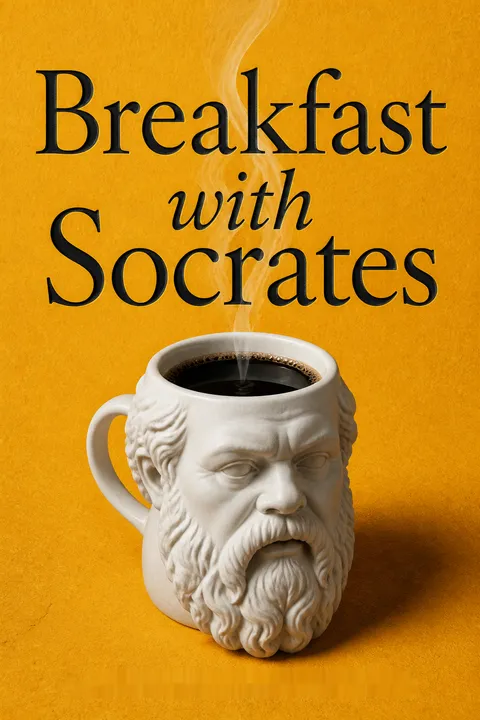
Breakfast with Socrates is a philosophical essay arranged as a day, not a manual that asks readers to follow a program. Its organizing achievement is to make ordinary activities carry conceptual weight. Waking becomes a problem of consciousness and truth. Dressing becomes a negotiation between protection and exposure. Work becomes a question about compensation and power. Meals, screens, sex, and sleep reveal how private experience is shaped by shared structures.
The sequence creates a quiet argument: life is not divided into meaningful events and empty intervals. Repetition is where social rules, identities, and desires become visible. The book’s imagined encounters with thinkers make difficult ideas approachable, while the literary and everyday examples keep abstraction attached to felt experience. That method is also its risk. Because the chapters move by analogy, a vivid connection can sound like proof. The account of water responding to words, for example, is not equivalent to well-established scientific evidence, and the therapeutic interpretation of family patterns should be treated cautiously. The reader benefits from distinguishing a suggestive lens from a verified causal claim.
Its strongest insights are often tensions rather than conclusions: preparation protects but can restrict freedom; work provides purpose yet can exploit; medical authority helps while leaving parts of experience unseen; leisure offers escape but can intensify dissatisfaction. These paired possibilities resist simplistic advice and invite practical judgment, the kind of wisdom the introduction sets against cleverness for its own sake.
The book is most valuable when read as an invitation to notice how meaning is made, not as a claim that every routine hides a secret. A commute does not need to become a grand metaphor to matter. It can matter because it consumes time, depends on collective rules, and may alter how a person arrives. Philosophy here is less a solution machine than a way of making the familiar newly available for thought.
Review Summary
Breakfast with Socrates receives mixed reviews. Many readers appreciate its accessible approach to philosophy in everyday life, finding it thought-provoking and engaging. Some praise Smith's writing style and ability to connect philosophical concepts to mundane activities. However, others feel disappointed, expecting more depth or struggling with cultural references. Critics argue it oversimplifies complex ideas. Despite varied opinions, the book is generally seen as a good introduction to philosophy for beginners, offering a unique perspective on daily routines through a philosophical lens.
People Also Read







Glossary
law of destinerrance
arrival through possible diversionA term associated with Jacques Derrida, used here to describe the dependence of arrival on the possibility of being diverted. A route can lead to its destination only because its outcome is not completely guaranteed. The concept turns an ordinary journey into an image of how intention and uncertainty coexist.
harm principle
liberty bounded by harmJohn Stuart Mill’s principle that individual freedom should generally be protected unless an action harms other people. In the book, the principle complicates the idea of playing hooky: a person’s freedom from work may shift duties or violate an agreement, creating costs for others.
iatrogenesis
harm caused by treatmentThe production of illness or harm through medical intervention. The book uses Ivan Illich’s concept to question whether medical authority can encourage unnecessary treatment and increase dependence on healthcare. The term does not imply that treatment is generally harmful; it names a risk that must be weighed against the benefits of care.
Constellations
spatial family representationA therapeutic practice associated with Bert Hellinger in which people represent members or elements of a family by taking positions in a room. The arrangement is intended to make family relationships visible and prompt interpretation. The book presents it as a striking way to think about inherited patterns, not as established proof that one relative’s hidden fate causes another’s illness.
collective unconscious
shared inherited image patternsCarl Jung’s proposed layer of the psyche that is not limited to an individual’s memories. It is said to contain recurring images and patterns shared across human experience, which can appear in dreams as archetypes. The book contrasts this account with Freud’s emphasis on personal history and repressed wishes.
simulacrum
copy treated as originalA concept associated with Jean Baudrillard, describing a representation or copy that can become more compelling than the reality it imitates. The book applies it to recreated destinations, such as themed versions of famous cities, which can shape expectations so strongly that the original place seems less vivid by comparison.
docile bodies
bodies trained for complianceMichel Foucault’s term for bodies shaped by institutions, routines, and systems of observation so they become easier to manage. The book applies the idea to gyms, which can turn exercise into a measured, supervised practice and encourage people to accept expert standards for how bodies should be trained.
language-game
meaning through situated useLudwig Wittgenstein’s term for language operating within a particular activity governed by shared practices. A word’s meaning is not always captured by a dictionary definition; it can depend on what people are doing when they use it. The book uses this idea to show how language gains meaning through context.
About the Author
Other books by Robert Rowland Smith

Download PDF
Download EPUB
.epub digital book format is ideal for reading ebooks on phones, tablets, and e-readers.








