

Key Takeaways
Treat Jiu Jitsu as practice for staying composed in life's bad positions.

The art beyond fighting. Rickson Gracie presents Jiu Jitsu as more than a way to defeat an opponent. It is practice in staying calm, noticing what is happening, and responding effectively when circumstances are uncomfortable. Its physical lessons include patience, leverage, timing, and adapting when a plan stops working. The book traces how these habits shaped his work as a fighter, teacher, father, and grieving parent.
A useful, imperfect metaphor. On the mat, a person can learn to make small adjustments under pressure rather than panic. Rickson extends that lesson to life, where setbacks also demand composure and judgment. The comparison is powerful, but life is not always a contest with an opponent to outmaneuver. Sometimes the right response is asking for help, changing the goal, or leaving the situation.
Build technique around constraints, not fantasies of strength.

Weakness shaped the method. Rickson's uncle Carlos learned Jiu Jitsu from Japanese fighter Hideyo Maeda, who had adapted grappling for real fights against opponents of varied sizes. Carlos's younger brother Hélio was physically frail, so he developed his fighting around leverage, sensitivity, and timing rather than power. He refined the guard, a position in which a fighter on their back uses their legs to control an opponent, both to defend and to attack.
Design for the smaller person. The Gracie family promoted Jiu Jitsu through challenge matches against other fighters, arguing that technique could overcome size. Hélio's body became part of the argument: the art was intended to help someone with less strength survive and gain control. This is a durable design principle. A method built around constraints can be more useful than one that assumes ideal bodies, ideal conditions, or ideal resources.
Use pressure to reveal what a student needs, not to prove dominance.

The mat as a mirror. Rickson learned from his father and brother Rorion to watch how students behaved under physical pressure. Some rushed; others froze or became passive. Their reactions offered clues about what each person needed to practice, so he tried to teach the whole person, not merely a sequence of moves. One timid student who returned after an arm injury later surprised himself by using a triangle choke to defeat a stronger training partner.
Calibrate the challenge. Rickson believed that learning to tolerate discomfort could build resilience. His own teenage attempt to master claustrophobia by being rolled tightly in a carpet shows the intensity of that belief. Pressure can reveal habits, but pain alone does not teach well. Effective coaching requires consent, safety, and a challenge matched to the learner, not simply a harder ordeal.
Train breath until panic no longer chooses your next move.
Breathing as a control lever. Rickson credits movement teacher Orlando Cani with teaching him to coordinate breathing and motion. Cani's animal-like exercises encouraged flowing movement and attention to bodily sensation. Rickson found that slower breathing helped him settle nervousness, while deeper, faster breathing supported exertion. He used these skills in training and in fights, where panic could drain energy before technique had a chance to work.
The first Zulu fight. Facing the much larger King Zulu, Rickson reached his corner after a punishing first round and wanted to quit. His father insisted he was doing better than he thought, and his brother jolted him with cold water. Rickson returned to the fight, recognized that his opponent was tiring, and eventually won by choke. Slow breathing can support emotional regulation, but the book's precise claims about lung capacity and performance are personal claims, not universal proof.
Borrow techniques freely, but keep asking what the art is for.
Cross-training made the art stronger. Rickson's brother Rolls studied Judo, wrestling, and Sambo instead of treating Jiu Jitsu as a closed system. When American wrestler Bob Anderson trained with Rolls in Rio, the two compared techniques. Their exchange helped develop a version of the keylock submission that Rolls called the Americana. The story illustrates how serious practice can absorb useful ideas from outside its own tradition.
Keep the purpose in view. The Gracie family disagreed over whether the art should emphasize self-defense, sport competition, or professional fighting. Rickson valued innovation, but he also worried that new techniques and formats could distract from Jiu Jitsu's purpose of helping a person defend themselves. Traditions stay alive through adaptation, not purity tests. Yet adaptation without a clear purpose can make a practice excellent at winning its own games while less useful elsewhere.
Competition can reward skill while quietly narrowing what skill means.
Rules change behavior. As Jiu Jitsu tournaments grew, rules involving points, time limits, and judging encouraged competitors to secure an advantage and protect it. Rickson saw this as a shift away from the fluid exchanges and submissions he valued. He also objected to MMA rules that could interrupt ground fighting, arguing that a timed sport encouraged different tactics from open-ended vale tudo, the no-holds-barred fighting format he had known in Brazil.
A tradeoff, not a simple decline. Rickson's critique is grounded in his own ideal of a martial art centered on survival and submission. But competitive rules can also make participation more measurable, repeatable, and accessible, and can reward technical innovation. The key question is not whether sport is false and combat is real. It is whether the skills being trained match the goal a student actually has.
Courage without judgment turns a warrior code into needless danger.
Fear can guide, not govern. Rickson grew up in a family that prized bravery and treated quitting as shameful. He learned that fear could be managed through preparation, but his own life also included street fights, dangerous risks, and decisions driven by family honor. His near-drowning in a powerful ocean current taught him to stop fighting the water, swim parallel to shore, and use a distant light to orient himself. The survival lesson was patience and judgment, not toughness alone.
Distinguish resolve from recklessness. Rickson eventually describes courage as something to spend carefully, not a reason to seek every danger. That distinction matters because honor cultures can make retreat feel like failure, even when retreat is the intelligent choice. A fighter's ability to withstand pain is not automatically evidence that a conflict was worth entering.
Grief cannot be mastered by performing toughness; let it change you.
A loss beyond control. Rickson's son Rockson grew up determined to match his father's reputation, but also became increasingly reckless. In 2001, Rickson learned that Rockson had died in New York from a combination of drugs. The family struggled to establish what had happened. Rickson turned down a highly lucrative fight offer, stopped training and teaching, and spent years grieving with his family rather than acting as though discipline could erase the loss.
Making room for pain. Rickson built a platform in a tree as a place to remember his son. The work gave him a reason to begin moving again, but did not undo the grief. His account challenges the idea that strength means staying composed at all times. Emotional suppression can preserve appearances while leaving a person isolated. Still, no single ritual or timeline can prescribe how another person should mourn.
Spend time as if each call could be the last one.
Attention is a choice. After Rockson's death, Rickson realized that he had treated time as something he could always reschedule. He gives the example of a daughter calling while he is on the way to the airport. The old response would have been to promise a call after landing. His new response would be to pull over and listen, even if it meant missing the flight.
Choose what deserves your energy. After years of supporting an expensive life in California, Rickson returned to Brazil, simplified his spending, and looked for work that felt meaningful rather than merely familiar. The Japanese phrase ichi-go ichi-e describes the idea that a meeting or moment is unrepeatable. This need not mean treating every choice as an emergency. It means noticing when convenience is quietly displacing a relationship or experience that cannot simply be recreated.
Make Jiu Jitsu welcoming without stripping away its real-world purpose.
Access is part of the mission. As his own body aged and required hip replacement, Rickson reconsidered who could comfortably enter a Jiu Jitsu school. He wanted beginners, older adults, and people who lacked athletic confidence to learn without first enduring a bruising, competitive culture. His proposed cooperative classes teach movement, balance, timing, and connection with a partner who is helping rather than trying to win.
Keep practical skills in reach. Rickson still argues that students should learn basic self-defense, including how to respond to punches, headlocks, and being pinned. He sees the art as a way to build confidence and human connection, not just produce elite fighters. A welcoming class can reduce fear and injury, but cooperative practice alone cannot establish how skills work under resistance. A thoughtful curriculum can make room for both.
Analysis
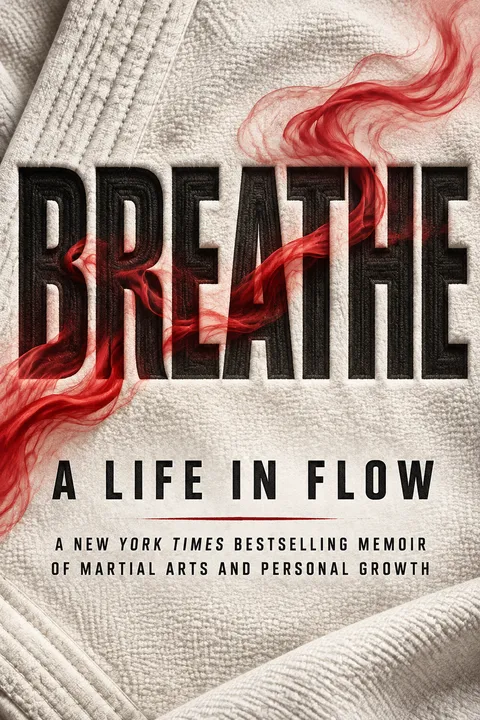
Breathe is a memoir built around a martial artist's changing definition of strength. Its family history establishes Jiu Jitsu as an inherited craft shaped by Hélio Gracie's physical limitations. Its fight stories show Rickson learning to regulate fear and trust trained perception. Its later chapters put the warrior ideal under pressure through family conflict, the death of his son, and physical aging. The narrative's deepest movement is from proving mastery to asking what mastery is for.
The book is most persuasive when it treats knowledge as embodied. Rickson's examples of breath, balance, timing, and tactile awareness explain why instruction cannot be reduced to memorizing techniques. Training is a social environment where a person experiences their own habits under pressure, then has the chance to change them. That account usefully connects martial arts to education and emotional development, while acknowledging that the teacher's judgment and the student's trust matter.
The memoir also contains tensions that should remain visible. It criticizes violence and reckless bravado while recounting episodes in which honor and reputation justified serious confrontations. Its ideal of never quitting can inspire persistence, but it can also make self-protection or withdrawal seem morally inferior. Likewise, Rickson's preference for open-ended fighting is a personal conception of martial effectiveness, not a neutral standard by which every sport or school must be judged. His physiological claims about breathing deserve the same distinction between lived experience and general evidence.
These tensions do not cancel the book's value. They make its strongest insights more credible when read as hard-won, situated lessons rather than universal laws. The clearest message is not that everyone should live like a fighter. It is that focused practice can develop composure, that skill must serve a chosen purpose, and that genuine strength includes changing course when life reveals a better one.
People Also Read





Glossary
Invisible Jiu Jitsu
Feel-based principles of grapplingRickson's name for teaching the underlying sensations that make techniques work, including balance, timing, weight distribution, and connection to a training partner. Rather than relying only on memorized sequences, students learn to feel how their bodies and their partner's bodies are positioned and moving. The aim is to develop practical understanding that transfers across different situations.
Bioginástica
Breath-led natural movementA movement approach developed by Orlando Cani that Rickson studied to reconnect attention, breathing, and bodily movement. Exercises drew on animal-like motions, flowing transitions, and awareness of ordinary actions. Cani used the practice to develop coordination, flexibility, and intuitive movement, rather than treating exercise primarily as repetition for strength or appearance.
Vale tudo
Open-ended, no-holds-barred fightingA Brazilian fighting format whose name means anything goes. In the fights Rickson describes, there were no weight divisions or time limits, and competitors fought without gloves. It was far less standardized than modern MMA, though not literally without limits. Rickson contrasts it with rule-bound contests because its open-ended conditions changed pacing, strategy, and the risks fighters faced.
Guard
Leg control from the backA Jiu Jitsu position in which a fighter on their back uses their legs to control an opponent positioned between them. The guard can protect against strikes and pressure while also creating opportunities to sweep, reverse, or submit the opponent. Hélio Gracie further developed it as a way for a smaller fighter to defend and attack without relying on strength.
Base
Balance for stable movementIn Rickson's usage, base is the balance and structural stability that make a person difficult to push, throw, or sweep. A strong base does not mean remaining fixed. It allows a practitioner to move without losing control, absorb or redirect force, and respond to an opening. Rickson treats the concept as a foundation for both defense and offense.
Upa
A bridging escapeA Jiu Jitsu movement in which a person lying on their back raises their hips, usually to create space and escape from someone mounted on top. The movement can also contribute to other escapes. Rickson uses the upa to illustrate how small adjustments in positioning and timing can turn a trapped position into an opportunity to reverse control.
Bushido
Samurai warrior codeThe name Rickson uses for the ethical code associated with the Japanese samurai. He describes its values as including courage, honor, loyalty, respect, compassion, honesty, and righteousness. The book presents Bushido as an ideal that shaped his understanding of fighting and his relationship with Japan, while also showing the tension between loyalty, personal judgment, and a modern life.
Gracie challenge
Public tests of fighting stylesMatches in which members of the Gracie family invited fighters from other martial arts to test their skills against Gracie Jiu Jitsu. Some were organized sporting contests, while others were vale tudo fights. The challenges helped publicize the family's claim that their approach worked against different fighting styles, and became part of the family's identity and promotional history.
Download PDF
Download EPUB
.epub digital book format is ideal for reading ebooks on phones, tablets, and e-readers.








