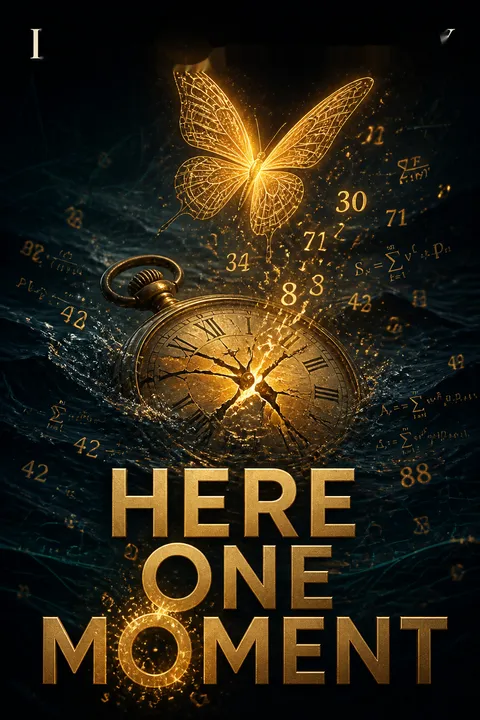


Plot Summary
Aisle Four, Row D
On a delayed flight from Hobart to Sydney, a silver-haired passenger rises and begins moving down the aisle. Leo Vodnik, a civil engineer already brooding over missed family moments, watches her point at strangers and name a cause and age for each death. She predicts heart disease for Max O’Sullivan and pancreatic cancer for Sue, Max’s cheerful wife.
Leo tries to treat the spectacle as dementia or a joke, but the woman’s precise prediction for him, a workplace accident shortly after his forty-third birthday, unsettles him. She repeats that fate cannot be resisted, then continues past him. Around them, passengers begin listening, laughing, filming, or wondering whether to believe her.
The prediction lands in a setting designed to make strangers briefly share a sealed space, yet each passenger brings a private fear aboard. Leo’s response is shaped by a familiar failure of control: he already believes he should have prevented his father’s death by being more attentive. Cherry’s certainty therefore finds a ready-made opening in his guilt. The plane turns private mortality into public entertainment, and the ordinary cabin becomes a place where people must decide whether to dismiss an alarming claim or carry it into their lives.
The Baby’s Seven Years
Paula Binici wakes from a strained doze with her toddler and baby asleep against her, then learns the gray-haired passenger is predicting deaths. Paula refuses a reading, but Cherry predicts that Paula will die of lung disease and that her daughter Willow will live to 103. When she looks at baby Timmy, she hesitates before predicting he will drown at seven.
Paula’s anger gives way to panic as she imagines the child’s future disappearing. Elsewhere, Cherry predicts that newlywed Eve will die by intimate partner homicide at twenty-five, and tells the frightened young passenger Kayla she will die in a car crash at nineteen. Ethan, mourning his friend Harvey, is told he will die by assault at thirty and breaks down crying.
These predictions do not affect everyone equally. Paula’s fear attaches to the person she feels most responsible for protecting, while Eve’s warning makes an unknown future husband sound dangerous before he has done anything. Ethan’s grief is already raw, so the prediction opens the wound of Harvey’s death rather than creating a new one. The episode shows how a sentence can become psychologically powerful without being believed: people may reject its logic while still reorganizing attention around its possibility.
Allegra’s Birthday Flight
Cabin manager Allegra Patel returns from the lavatory to find call buttons lighting up and passengers crowding the aisle. She hurries past a pregnant traveler and a child who vomits over her uniform, while the predictions continue. Another attendant finally persuades Cherry that her task is complete and guides her back to her seat.
As the plane prepares to land, Cherry points at Allegra and predicts self-harm before her twenty-ninth birthday. Allegra, who is turning twenty-eight that day, is shaken despite insisting she is well. Cherry’s water cup slips from her hand, her voice fades, and she falls asleep. Allegra remains on duty through landing, in pain from straining her back and unable to stop thinking about the prediction.
Allegra’s professional role requires her to convert disorder into procedure, but this crisis exceeds the training that normally gives her confidence. Her injury and birthday make the prediction feel cruelly tailored, even though no one can know whether it is accurate. The contrast between her practiced calm and private alarm introduces a recurring tension: competence does not eliminate vulnerability. Cherry’s collapse ends the spectacle without resolving its meaning, leaving the passengers to supply their own explanations.
The Woman Wakes
After the passengers have left the plane, the woman wakes with a headache, thirst, and no memory of standing, speaking, or landing. She believes she has merely fallen asleep and apologizes to Allegra for keeping her behind. In the taxi queue, the wedding dress worn by Eve suddenly makes sense: Cherry had donated her own dress to charity years earlier.
The clues she noticed at Hobart Airport had seemed charged with personal meaning, from a familiar face to a brooch and old memories, but now she cannot explain what happened aboard. She goes to stay with friends in Sydney, unaware that passengers are already comparing stories and that her predictions will soon follow them home.
The waking gap changes the central mystery. The question is no longer only whether Cherry can see the future, but whether she knows what she did at all. Her missing memory gives the passengers’ certainty and her own uncertainty equal narrative weight. The wedding dress provides a mundane answer to one apparent omen, quietly establishing that coincidence can feel meaningful without being supernatural. Yet the larger event remains unresolved, because a sensible explanation for one sign cannot account for the whole cabin.
The First Proof
Months later, Kayla turns nineteen and drives unusually cautiously because Cherry predicted a fatal car crash at that age. A friend films her explaining the reason. A drunk driver runs a red light and strikes Kayla’s car; Kayla dies, while her friend survives. The video makes the prediction public and gives the passengers’ private unease a terrible focus.
Soon afterward, retired doctors Barbara and Brian Bailey die at the ages Cherry assigned them, one after the other. They had treated the prediction lightly and lived long, full lives, but their daughter is devastated by losing both parents. Leo reads the news and recognizes them. The apparent accuracy of three forecasts turns a strange flight story into a public hunt for the woman.
Kayla’s death is not caused by belief in the prediction: she obeys the road rules, and an intoxicated driver creates the collision. Still, her attempt to protect herself becomes part of the tragedy’s public record, making the prediction seem more powerful than it was. The Baileys’ deaths intensify that impression because their ages appear exact, though their advanced years made the outcomes statistically less surprising. The sequence exposes how people mistake a visible match for proof while overlooking the countless details that do not fit.
A Daughter Keeps Watch
Leo tells his wife, Neve, about the flight, and their daughter Bridie overhears that her father may die at work. For weeks, she searches online for psychic predictions and construction accidents, asks whether Leo wears safe shoes, and loses sleep. Neve lets her voice the fear instead of simply correcting her.
Leo’s teenage son dismisses the prediction, but Leo notices that his own work habits leave little room for his family. Meanwhile, Sue, uneasy about the pancreatic cancer prediction, asks her friend Caterina for medical checks. Her tests find no warning signs, yet the prospect of losing her long-awaited chance to travel keeps pressing on her. Each family tries to manage uncertainty with the tools it knows.
The prediction exposes existing patterns rather than inventing them. Bridie’s fear reveals how easily a child converts an adult’s casual story into a threat; Leo’s workload gives the threat credibility because his job does involve risk and already competes with family life. Sue’s response is more practical, but her wish to be tested carries emotional weight beyond diagnosis: she fears having postponed her own life until too late. In both cases, mortality forces people to inspect ordinary arrangements they had assumed would continue.
Ethan Seeks a Second Opinion
Ethan tells his flatmate Jasmine about Cherry’s prediction and the friend he has just buried. Jasmine arranges a session with Luca, a tarot reader she trusts, and accompanies Ethan to the appointment. Luca does not claim anyone’s future is fixed, but he offers Ethan a possible message from Harvey that encourages him to stop waiting for the right moment with Jasmine.
Ethan remains skeptical, yet the reading gives him a way to think about grief and desire together. He begins noticing danger in public places because of the assault prediction, while Jasmine’s wealthy, chaotic world still makes him feel like an outsider. For now, their closeness grows, even as her new boyfriend Carter complicates the apartment.
Ethan’s visit to Luca is less a search for supernatural proof than an attempt to make grief speak. The tarot session supplies an emotionally useful story, but its comfort is inseparable from Ethan’s longing to hear Harvey again. His growing vigilance also shows how a prediction can alter behavior without winning intellectual belief. The romance subplot complicates that change: Ethan must confront his habit of assuming he is not the sort of person who gets chosen, a pessimism Harvey reinforced even while remaining his closest confidant.
A Marriage Under Sentence
Eve and Dom’s honeymoon begins happily, but the prediction about intimate partner homicide unsettles Dom when he remembers a sleepwalking episode in which he threatened Eve while repeating a movie line. He researches rare cases of violent sleepwalking and becomes afraid of harming her.
Their financial troubles worsen after Eve finds their large credit-card balance and Dom admits he crashed the car without insurance. They work extra jobs, argue over money, and Dom considers separating for Eve’s safety.
Paula’s fear takes another form: she enrolls Timmy in multiple swim schools and writes reassurance sentences repeatedly, though she hides the pages from Matt. Swimming calms her, but her growing rituals signal that an old mental health struggle may be returning.
The predictions latch onto real vulnerabilities: Dom’s sleepwalking, the couple’s financial inexperience, and Paula’s history of obsessive fear. Neither household is responding to evidence alone. Dom’s attempt to prevent harm risks creating the strain he fears, while Paula’s repeated writing offers momentary relief that strengthens the compulsion over time. The novel treats protective behavior with sympathy but not romanticism. Care can become a trap when it promises certainty that no amount of vigilance can provide.
Mae’s Daughter
Cherry grows up in suburban Sydney with a cautious father who teaches her probability and a charismatic mother, Mae, who reads palms. When lightning kills her father, Mae becomes a professional fortune teller, partly remaking grief into a calling. Cherry studies mathematics and statistics, falls in love with carpenter Jack Murphy, and imagines a life with him.
A national-service lottery sends Jack to Vietnam, where he dies soon after arriving. Cherry grieves with her mother, aunt, and grandmother, then builds a career analyzing risk and mortality. Her life repeatedly places statistical chance beside personal loss: her father’s rare death, Jack’s unlucky number, and Mae’s conviction that intuition can reveal what numbers cannot.
Cherry’s formative losses make prediction morally charged long before the flight. Her father gives her a language for randomness, while Mae offers a language of meaning; neither can restore the people they lose. Jack’s selection by lottery makes probability intimate rather than abstract, and Cherry’s later profession lets her study mortality at a distance. Her divided inheritance is not simply science versus superstition. It is the human need to calculate danger alongside the equally human desire to believe that pain has been foreseen.
The Marriage That Unravels
After university, Cherry becomes an actuary and marries cardiologist David Smith, whose charm and desire do not make them well matched. He moves her to Perth for his career, where she drinks heavily to fit into his social world.
When they learn David is infertile, they plan to adopt a Korean child, but an agency mistakenly sends them another couple’s photograph. Cherry returns to Sydney when Mae’s cancer is diagnosed. Her marriage deteriorates, and she discovers David’s affair with Stella, his diving companion.
The adoption ends and Cherry and David divorce. Mae dies after delaying medical care, leaving Cherry with anger and regret. Later, at a dinner party, Cherry meets Ned Lockwood, whose humor, curiosity, and ease offer a different kind of partnership.
Cherry’s early adult life is shaped by other people’s decisions being presented as settled fact: David’s move, the adoption plan, and the assumptions surrounding motherhood. Her own reluctance is repeatedly mistaken for consent. The misdirected baby photograph turns hope into a bureaucratic error, while Mae’s preventable illness echoes Cherry’s helplessness after her father and Jack. Meeting Ned matters because he does not fit the old pattern of desire without regard for her wishes; their connection grows through conversation and shared attention.
Ned’s Last Flight
Cherry and Ned build a long marriage around travel, mathematics, teaching, and close friendship with neighbors Jill and Bert. Before a planned European river cruise, Ned leaves a cardiology appointment after an impatient wait, deciding to be checked later. On the flight from Hobart to Sydney, he falls asleep and dies of a heart attack.
The same day, Jill and Bert are killed in a car crash. Cherry loses her husband and her two closest friends at once. She later travels with Ned’s ashes, still surrounded by reminders of the three people she has lost. The passenger flight in April becomes a pressure point: she is grieving, severely dehydrated, and surrounded by echoes of her past.
The losses are devastating partly because each seems preventable in retrospect: Ned could have waited for his appointment, and the car crash might have gone differently. Cherry’s mind returns to these alternate paths because counterfactual thinking offers the illusion of a repairable past. Her grief is not a lesson neatly learned but an ongoing disturbance to memory and judgment. The crowded flight brings her losses into immediate contact with strangers, making the later predictions an expression of grief as much as a mystery.
The Missing Hours
Cherry later considers whether dehydration or a mental health crisis caused her memory loss, but she cannot reconstruct the moment she began predicting deaths. She had spent her career estimating mortality across groups, not naming an individual’s future. On the flight, familiar faces and objects revived memories of Ned, Jill, Bert, Jack, and her parents.
She suspects that actuarial patterns, personal associations, and severe grief fused into predictions that felt certain. The words she used came from Mae, her mother, but the guesses may have come from her own trained attention to risk. Cherry understands that this explanation does not excuse the harm. She is ashamed that she may have frightened people while unable to recognize herself.
The novel refuses a tidy choice between supernatural power and meaningless accident. Cherry’s actuarial training offers plausible sources for the predictions, while grief and altered consciousness explain why those calculations emerged as personal certainties. Yet the explanation remains a hypothesis, not a diagnosis that settles every question. This uncertainty matters because the harm is real regardless of its cause. Cherry’s insistence on responsibility does not require her to claim control over fate; it requires her to acknowledge what her actions did to others.
The Fourth Alarm
As the Bailey deaths and Kayla’s crash circulate online, passengers create a page to find Cherry and compare predictions. The story grows when Sarah, a pregnant passenger told she would develop breast cancer, receives a diagnosis and resists treatment because she believes the prediction has already decided her future.
Her husband pleads for help. Then Simon Says Be Kind, a supposed young creator predicted to die of a respiratory infection, is reported dead, prompting a fresh surge of attention.
Sue and her family read the passenger page, where other travelers describe changed lives, fear, and confusion. Cherry’s identity remains unknown, but Paula and Eve begin tracing leads together, hoping to reach the woman whose words still govern their private decisions.
The online page converts isolated encounters into a community, but it also rewards the most dramatic interpretation of events. Sarah’s diagnosis gives the story an urgent practical stake: a prediction can discourage treatment even when a treatable illness is present. Simon’s apparent death adds spectacle and scale, showing how quickly public certainty can grow through repetition. The passengers are not simply gullible or rational; they are trying to find a coherent account of events that have made chance feel personal.
Ethan Turns Thirty
On his thirtieth birthday, Ethan is still alive and tries to mark the day with Jasmine, though he is beginning to accept that his crush may not become a relationship. Later, he meets Harvey’s sister Lila and their cousin Faith at the Opera Bar. Faith makes him feel relaxed and understood, and Lila reveals Harvey had hoped to introduce them.
Carter, Jasmine’s volatile former boyfriend, appears drunk and accuses Ethan of wanting Jasmine. When the women leave, Carter moves toward him with a raised fist. Ethan freezes, unsure whether to defend himself. A seagull dives at Carter, startling him long enough for Ethan, Lila, and Faith to run. The forecast nearly becomes reality, but no assault lands.
Ethan’s danger is not a contest between bravery and cowardice. He must act while frightened, and the interruption arrives through an absurd accident rather than a heroic plan. The scene resists making the prediction come true simply because the plot has prepared it. It also marks a shift in Ethan’s grief: Harvey’s absence remains, but the possibility of connection with Faith gives the future a shape not defined by loss. Survival here is contingent, not proof that fate has been defeated.
Cherry Sees Leo
Eve finds Cherry’s name online, and former intelligence officer Ben visits Cherry before the searchers reach her. He tells her about the predictions, the deaths, and the public hunt, then helps her prepare an apology explaining that she is not psychic. Cherry goes to see her new neighbor Mira and meets Mira’s son Leo, recognizing him as the engineer from the flight.
In the muddy backyard, an excavator begins tipping toward him. Cherry calls his name and warns him in time; Leo jumps clear of the trench. Her intervention is immediate and practical, not a prophecy. When Paula later meets Cherry, Cherry apologizes but refuses to promise that Timmy will be safe, insisting that ordinary precautions still matter.
Cherry’s warning to Leo is the story’s most consequential answer to the question of agency. She cannot guarantee his safety, but she can notice a machine falling and urge him to move. The distinction is small and profound: knowledge is uncertain, action is available. Her refusal to offer Paula a comforting guarantee may sound harsh, yet it respects the limits of what she can know. The scene replaces the authority of prediction with the ethics of attention and timely intervention.
Lives Beyond Prediction
The false report of Simon’s death is exposed as a stunt, and Cherry’s predictions begin to fail: the caftan-wearing passenger dies decades before the age Cherry assigned her. Sue recovers from a virus and an allergic rash, then joins Max for salsa lessons instead of waiting for a diagnosis.
Leo reconnects with his estranged friend Rod and, with Neve and the children, plans a move to Tasmania rather than continuing to surrender family time to work. Allegra recovers her back and applies for pilot training. Paula seeks help for her returning OCD, while Eve and Dom face their debt with family support. Cherry finds Ned’s notebooks and begins tutoring Bridie, discovering a new bond in an ordinary Wednesday routine.
Resolution does not make the characters invulnerable. Instead, it returns them to choices that had been postponed or narrowed by fear. Sue and Max act on a long-standing wish; Leo repairs a friendship and reconsiders work; Paula accepts that expertise can help her manage uncertainty without erasing it. Cherry’s notebooks turn memory into a form of continuing attachment, while tutoring Bridie gives her a living relationship rather than a supernatural answer. The futures remain open because the characters resume participating in them.
Epilogue
Years later, Timmy Binici stands at his first Olympic Games as a champion swimmer. At seven, a freak wave knocked him from a rock platform into the sea, but the swimming Paula had insisted he learn helped him survive. A reporter credits the fortune teller whose warning sent him to lessons.
Cherry, watching from home, celebrates his victory. The prediction did not come true as stated, yet the fear it created prompted a skill that mattered when danger arrived. Timmy’s life is not proof that Cherry saw the future. It is proof that actions taken under uncertainty can change what happens next.
The ending holds two truths without forcing them into a supernatural explanation. Cherry’s forecast was not accurate in the literal sense, but Paula’s response helped Timmy survive a real accident. That outcome complicates the easy claim that predictions are either wholly harmful or secretly prophetic. Preparation can be valuable even when its premise is false, though obsessive preparation can also consume a life. The Olympic image gives the story a bright, concrete consequence while leaving its central uncertainty intact: no one knows what is coming, but people can still learn, choose, and help.
Analysis
Here One Moment asks what people do when uncertainty becomes personal. Cherry’s predictions seem to collapse probability into individual fate, but the novel steadily shows how unstable that collapse is. A forecast can be statistically plausible and still be wrong; a coincidence can feel like proof when it arrives beside grief; a warning can alter behavior in ways that help or harm. The book’s most important distinction is between control and responsibility. No character can secure a future by worrying hard enough, and Cherry cannot guarantee anyone’s safety. Yet people can still seek treatment, learn to swim, leave an unhealthy relationship, call an estranged friend, or warn someone beside a falling machine. These acts matter without making anyone master of fate. The interwoven stories also resist treating fear as irrational noise. Paula’s rituals arise from a known condition, Leo’s overwork from guilt and duty, Sue’s anxiety from years of seeing illness arrive without warning, and Allegra’s caution from family history. Each response makes sense in context, even when it narrows life. Against this narrowing, the novel values ordinary commitments: a shared meal, an apology, a returned phone call, a child’s math lesson. They do not solve mortality. They make a life more inhabitable while it lasts. Cherry’s final bond with Bridie does not fulfill prophecy in a miraculous sense. It grows from attention, memory, and the decision to show up. The title’s brief present tense names the only time any character can actually inhabit, not as a slogan to seize the day, but as the fragile interval in which care and choice remain possible.
Review Summary
Here One Moment received mostly positive reviews, with readers praising its thought-provoking premise and character development. Many found it emotionally engaging and appreciated its exploration of fate versus free will. Some criticized its length and pacing, feeling it dragged in parts. The unique concept of a woman predicting passengers' deaths on a plane intrigued readers, though opinions varied on the execution. Overall, reviewers found it a compelling, if sometimes uneven, read that prompted reflection on mortality and life choices.
People Also Read






Characters
Cherry Lockwood
The bereaved actuaryA retired actuary, Cherry is analytical, socially awkward, and unusually attentive to patterns. Her mother’s work as a fortune teller sits uneasily beside the mathematical habits she inherited from her father. Cherry has spent much of her life trying to distinguish evidence from intuition, while losses have made that distinction emotionally complicated. She dislikes being treated as an oracle or as a curiosity and is sensitive to criticism of her social manner. Her instinct is to explain, qualify, and correct, sometimes when comfort would be easier. Beneath that precision is a person who feels deeply, remembers vividly, and struggles to accept that some events have no satisfying explanation.
Leo Vodnik
The overworked engineerLeo is a civil engineer, husband, and father whose conscientiousness often tips into chronic worry. As the oldest child and only son, he feels responsible for managing family needs, a pressure intensified by regret over his father’s final illness. Work gives him measurable problems and clear standards, but it also lets him postpone less controllable questions about intimacy and time. He is earnest, self-conscious, and capable of humor when he relaxes. His marriage to Neve gives him a counterweight to his anxious habits, although her patience cannot make him change until he recognizes what his work is costing.
Sue O’Sullivan
The generous nurseSue is an emergency-room nurse, mother, and grandmother whose warmth makes strangers feel known. She is practical because her work exposes her daily to illness and fear, but that experience also gives her a vivid understanding of how quickly a healthy life can change. Sue is sociable, observant, and inclined to care for others before examining her own needs. Her plans for travel and retirement matter because they represent time she has postponed while raising a family and working. She does not want to be defined by illness or by other people’s expectations of what a grandmother should do.
Paula Binici
The vigilant young motherPaula is a former contract lawyer caring for two young children, a role that leaves her missing the structure and intellectual challenge of work. Her mind is systematic and quick, but she has a history of obsessive-compulsive disorder and intrusive thoughts that become harder to manage under stress. She loves her children fiercely and is especially vulnerable to fears that she might fail to protect them. Paula can recognize the logic of a situation without feeling reassured by it, a gap that shapes her response to Cherry’s warning. Beneath her control is a thoughtful person trying to live with uncertainty rather than eliminate it.
Ethan Chang
The grieving software engineerEthan is a software engineer who often measures himself against more confident men and assumes he is unlikely to be chosen by the women he admires. His close friendship with Harvey gives him a companion for awkwardness and disappointment, so the loss leaves him with feelings he has not learned how to name. Ethan is conflict-avoidant but not indifferent; when someone he cares about is threatened, he must decide whether fear will keep him still. His skepticism toward psychics coexists with an openness to ritual, jokes, and stories that help people endure grief.
Allegra Patel
The capable flight attendantAllegra is a cabin manager who takes pride in competence, composure, and the lively work she chose for herself. She is perceptive about other people but guarded about her own vulnerabilities, especially in relationships. A demanding family history has made mental health an intimate subject, though she resists being treated as fragile. Allegra enjoys the independence of her career and the attention her beauty attracts, while carrying old wounds about how others judge her appearance and background. Her steadiness is genuine, but it can also become a defense against risk, ambition, and emotional commitment.
Eve Archer-Fern
The young newlywedEve is twenty, newly married, and still learning how to manage money, adulthood, and the expectations she inherited from her outspoken mother. She is funny, self-conscious, and candid about wanting a life that feels both romantic and financially possible. Her closeness with Dom is built on years of shared history, but she is not blind to his stubbornness or his tendency to take advice too literally. Eve can be idealistic without being foolish; when trouble arrives, she tries to name it directly rather than preserve a perfect image of marriage.
Ned Lockwood
Cherry’s curious partnerNed is a lively mathematics teacher whose restless curiosity makes even errands feel like excursions. He is quick to talk, quick to move, and happiest when sharing ideas with Cherry, though his impatience can create real consequences. As a partner, he offers a contrast to Cherry’s caution without dismissing her intelligence. He keeps notebooks, collects observations, and finds daily pleasures worth recording. His presence in Cherry’s life is tied to conversation, humor, teaching, and the habits through which two people make a shared history.
Mae
The fortune-telling motherMae is Cherry’s charismatic mother, a beautiful and forceful woman whose interest in palm reading develops into a public profession after personal tragedy. She is ambitious and intuitive, but also superstitious and resistant to medical care. Mae wants her customers to leave with hope, and her readings often give women a way to imagine choices they had not considered. Her relationship with Cherry is loving but complicated by their different beliefs and by Mae’s need to be right.
Neve
Leo’s steadying wifeNeve is Leo’s wife and a mother who understands how his anxiety works without simply indulging it. She is warm, practical, and more comfortable with uncertainty than Leo, though she can be quietly forceful when she believes he is sacrificing too much to work. Her own habits are untidy and unceremonious, an affectionate contrast to Leo’s need to manage details. Neve does not often say I told you so; her patience is both a kindness and a way of making Leo arrive at his own conclusions.
Max O’Sullivan
Sue’s practical husbandMax is Sue’s husband, a self-employed plumber and affectionate family man who expresses fear through practical objections and jokes. He is happiest surrounded by his sons and grandchildren, and he likes problems that can be repaired with tools or effort. Uncertainty leaves him restless, especially when Sue’s health is involved. His robust manner can conceal how deeply he depends on her, while his good humor helps their family absorb tension without pretending that nothing is wrong.
Matt Binici
Paula’s careful husbandMatt is Paula’s husband, a lawyer and father who prefers to believe that difficult fears can be set aside if they lack evidence. He loves Paula and their children, but his effort to keep anxiety from taking over can sometimes sound like a refusal to engage with it. He is precise in arguments and protective in practical matters. His steadiness is valuable, though he must learn that reassuring Paula is not the same as helping her manage an old condition.
Dom Archer-Fern
Eve’s devoted husbandDom is Eve’s childhood sweetheart and new husband, a gentle personal trainer whose kindness often makes him poor at enforcing boundaries or charging what his work is worth. He is physically strong but emotionally vulnerable to fears he cannot control. His sleepwalking has been part of his life since childhood, and he treats it as a private embarrassment until circumstances force him to reconsider it. Dom’s loyalty to Eve is genuine, even when his attempts to protect her become impractical.
Jasmine Dumas
Ethan’s wealthy flatmateJasmine is an heiress and entrepreneur who lives by bursts of curiosity, elaborate plans, and frequent reinvention. She is generous with Ethan and unembarrassed about the advantages her family wealth gives her, though she tries to keep a foot in the ordinary world. Jasmine is open to psychics and other spiritual practices without treating them as a substitute for therapy. Her confidence and busy social life draw Ethan toward her, while also making him feel he does not belong in the same world.
Jonathan Summers
The guarded pilotJonathan, usually called Jonny, is a first officer whose handsome, self-assured appearance hides a more vulnerable and thoughtful person. He begins as someone Allegra finds irritating, but his curiosity, family stories, and willingness to cook for her reveal a softer side. He takes pride in being capable in a crisis, though genuine intimacy makes him less certain. His relationship with Allegra tests whether he can be patient with her defenses and whether she can risk being known beyond the workplace.
Kayla Halfpenny
The fearful young travelerKayla is a young woman from Hobart who is afraid of flying but makes a solo trip to Sydney for a friend’s party. She is friendly, earnest, and pleased by small acts of kindness from strangers. Her anxiety does not prevent her from trying new things, including driving, meeting people, and traveling alone. Kayla’s confidence is still forming, and she relies on friends and family as she begins to imagine an independent adult life.
Timmy Binici
Paula’s water-loving sonTimmy is Paula and Matt’s baby son, an affectionate child who takes delight in water and physical play. He is too young to understand the fears adults attach to his future, but his mother’s protective response shapes his early experience. His bond with Paula is expressed through closeness, trust, and his eagerness to follow her into new activities.
Harvey
Ethan’s irreverent best friendHarvey is Ethan’s friend and former colleague, a sardonic man who often expects life to disappoint him. He has a distinctive laugh and a talent for turning an awkward moment into a private joke. His pessimism can be contagious, but it also gives Ethan a companion who does not demand a polished version of himself. Harvey’s absence remains part of Ethan’s inner life, shaping how he thinks about friendship, failure, and what cannot be postponed.
Rod Van Blair
Leo’s estranged friendRod is Leo’s former university housemate and closest friend from early adulthood. He and Leo shared the practical intimacies of student life, from cooking to laundry, and their friendship helped shape Leo’s adult world. Rod is direct and loyal, but their different ways of handling conflict leave room for a lasting rupture. He represents a friendship Leo once assumed would always be there.
Jack Murphy
Cherry’s first loveJack is a tall, kind carpenter who makes shy Cherry feel brave enough to enter rooms and enjoy parties. He shares her interest in the outdoors and treats her intelligence as part of her appeal. Jack is warm and easygoing, a person who imagines a future in practical, affectionate terms. Their young relationship becomes one of Cherry’s defining memories of love and possibility.
David Smith
Cherry’s first husbandDavid is a cardiologist whose confidence and physical charm attract Cherry, though he tends to make major decisions as if other people will naturally follow. He is driven by professional ambition and prefers convenience, qualities that shape his marriage. His clinical knowledge of the heart contrasts with his limited ability to respond to emotional pain. David is not presented as a simple villain, but his self-interest leaves lasting consequences for Cherry.
Dr. Donnelly
Paula’s former therapistDr. Donnelly helped Paula understand obsessive-compulsive disorder and practice exposure therapy. He is direct rather than reassuring, teaching her that intrusive thoughts can be managed without promises that nothing bad will happen. His approach remains an important resource when Paula’s fears return.
Faith
Harvey’s spirited cousinFaith is a computer game designer who also cares for other people’s pets. She is funny and observant, and she shares Ethan’s capacity to talk openly about Harvey. Her ease with him makes their first meeting feel less like an interview than a conversation already in progress.
Plot Devices
Cause and age predictions
A forecast that unsettles livesCherry names how and when passengers will die, turning strangers’ private vulnerabilities into a shared problem. Some predictions appear accurate, while others are delayed, false, or misunderstood. Their force comes not only from whether they come true, but from how people react: Paula increases Timmy’s swimming lessons, Ethan scans for danger, and Dom fears his sleepwalking. The device keeps the story’s central question active without providing a simple supernatural answer.
The delayed flight
A sealed human crossroadsThe Hobart to Sydney flight gathers people with separate histories in one confined space. The delay makes them observe one another, while the ordinary routines of air travel briefly suspend their usual lives. Cherry’s predictions then send consequences outward through those passengers, linking families and subplots that otherwise would not meet. The plane functions as a small social world where fear, humor, grief, and kindness become visible at close range.
The viral prediction story
Private fear becomes public evidencePassengers compare memories online after Kayla’s crash and the Bailey deaths. News articles, a social media page, and a widely shared video magnify the apparent accuracy of Cherry’s predictions. The same tools help Paula and Eve search for Cherry, but they also encourage strangers to treat coincidence as proof. Simon’s staged death demonstrates how easily online attention can distort the facts.
Actuarial probability
Statistics beside intuitionCherry’s professional background in mortality forecasting offers a possible source for the predictions, while her childhood lessons from her father teach her how probability differs from destiny. The story repeatedly tests the gap between population-level risk and individual outcomes. A likely event is not a guaranteed event, and a rare event is not impossible. Statistics can clarify what is known, but they cannot remove grief or tell a family how to feel.
Ned’s notebooks
Memory made useful againNed’s notebooks preserve teaching ideas and small observations from his life with Cherry. When Cherry finds them, she recovers ordinary moments that grief had obscured and uses the notes to help Bridie with mathematics. The notebooks do not undo loss or offer a prediction. They let Cherry continue a shared habit of attention and build a new bond with a child who needs encouragement.
FAQ
Synopsis & Basic Details
What is Here One Moment about?
- Unsettling Flight Predictions: A woman on a flight from Hobart to Sydney begins predicting the cause and age of death for various passengers, creating chaos and fear.
- Lives Thrown into Turmoil: The passengers' lives are thrown into turmoil as they grapple with the implications of these predictions, leading to introspection and change.
- Search for Truth: The story follows the passengers as they search for the woman and the truth behind her predictions, exploring themes of fate vs. free will, and the human condition.
Why should I read Here One Moment?
- Intriguing Premise: The story offers a unique and compelling premise that explores the impact of a stranger's predictions on a group of ordinary people.
- Complex Characters: The characters are well-developed and relatable, each grappling with their own fears and insecurities in the face of their foretold fates.
- Thought-Provoking Themes: The novel delves into thought-provoking themes of fate vs. free will, mortality, and the human condition, prompting readers to question their own beliefs and choices.
What is the background of Here One Moment?
- Contemporary Setting: The story is set in a contemporary world, with references to modern technology and social media, making it relatable to a modern audience.
- Australian Locale: The story is set in Australia, with specific references to Hobart and Sydney, providing a unique cultural backdrop.
- Focus on Everyday Life: The story focuses on the everyday lives of ordinary people, highlighting the impact of extraordinary events on their relationships, careers, and personal beliefs.
What are the most memorable quotes in Here One Moment?
- "Fate won't be fought": This recurring phrase, spoken by the woman making the predictions, encapsulates the theme of determinism and the characters' struggle against their perceived destinies.
- "I expect catastrophic stroke. Age seventy-two.": This quote exemplifies the unsettling specificity of the predictions, highlighting the fear and uncertainty they create among the passengers.
- "Cause of death. Age of death. It's really very simple.": This quote reveals the woman's detached and matter-of-fact approach to her predictions, adding to the unsettling nature of her pronouncements.
What writing style, narrative choices, and literary techniques does Liane Moriarty use?
- Multiple Perspectives: Moriarty employs multiple points of view, allowing readers to experience the story through the eyes of various characters, enhancing the complexity of the narrative.
- Subtle Foreshadowing: The author uses subtle foreshadowing and callbacks, creating a sense of unease and anticipation, and connecting seemingly unrelated events.
- Character-Driven Narrative: The story is driven by the characters' internal struggles and emotional responses, making it a deeply personal and relatable experience for the reader.
Hidden Details & Subtle Connections
What are some minor details that add significant meaning?
- The Brooch: The silver brooch worn by the woman making the predictions is described as "small, possibly antique," and "a symbol of some kind," which later connects to her past and her profession as an actuary.
- The "Jewels of Europe River Cruise" Ad: The advertisement on the back of the in-flight magazine becomes a symbol of the future that some characters may not get to experience, highlighting the fragility of life.
- The "One Good Thing": The phrase "one good thing" is a subtle reference to Ned's habit of writing down one good thing each day, which becomes a source of comfort and connection for Cherry after his death.
What are some subtle foreshadowing and callbacks?
- The "Crash-Tackle" Comment: Leo's father's comment about crash-tackling anyone suspicious foreshadows the later chaos and fear on the plane, and Leo's own internal struggle with how to react to the woman.
- The "River Cruise": The mention of the river cruise early in the story foreshadows the later discussion about travel and the desire to see the world, which becomes a poignant reminder of the fragility of life.
- The "Red Wine": The mention of red wine in the context of the couple's honeymoon foreshadows the later revelation of Dom's sleepwalking and the fear of violence, creating a sense of unease.
What are some unexpected character connections?
- Leo and the Woman: Leo's connection to the woman is revealed through the symbol on her brooch, which he recognizes from his family's jewelry business, creating a sense of shared history and fate.
- Sue and the Pregnant Woman: Sue's interactions with the pregnant woman at the airport, offering help and support, create a subtle connection that highlights the shared experiences of motherhood and the fragility of life.
- Ethan and the Woman: Ethan's encounter with the woman in the security line, where he is restricted to the use of one hand, foreshadows his later injury and the prediction of his death by assault.
Who are the most significant supporting characters?
- Auntie Pat: Cherry's aunt, who provides a sense of stability and support, and whose own experiences with loss and love add depth to the story.
- Michelle: David's mother, who is initially presented as a potential antagonist but becomes a source of comfort and understanding for Cherry, highlighting the complexities of family relationships.
- Dr. Donnelly: Paula's former therapist, whose methods and insights provide a framework for understanding her OCD and her struggle with the predictions.
Psychological, Emotional, & Relational Analysis
What are some unspoken motivations of the characters?
- Leo's Guilt: Leo's unspoken motivation is his guilt over his father's death, which drives his need to protect his mother and his anxiety about his own mortality.
- Eve's Fear: Eve's unspoken motivation is her fear of losing control, which is why she is so resistant to the idea of her husband's sleepwalking and the possibility of violence.
- Cherry's Grief: Cherry's unspoken motivation is her grief over the loss of her husband, which manifests as a need to make sense of the world and her place in it.
What psychological complexities do the characters exhibit?
- Leo's Anxiety: Leo exhibits a complex mix of anxiety, guilt, and a need for control, which is revealed through his obsessive behavior and his struggle to balance work and family.
- Paula's OCD: Paula's OCD is a central aspect of her character, highlighting her struggle with intrusive thoughts and her need for control, which is exacerbated by the predictions.
- Cherry's Grief and Guilt: Cherry's psychological complexity is revealed through her grief, her guilt over her mother's death, and her struggle to reconcile her rational mind with her mother's psychic abilities.
What are the major emotional turning points?
- Leo's Decision to Resign: Leo's decision to consider resigning from his job marks a turning point in his emotional journey, as he begins to prioritize his family and his own well-being over his career.
- Eve's Realization of Dom's Fear: Eve's realization that Dom is genuinely afraid of hurting her in his sleep marks a turning point in their relationship, as she begins to understand the depth of his fear and the impact of the prediction on his psyche.
- Cherry's Acceptance of Her Past: Cherry's decision to share her life story and her acceptance of her mother's influence mark a turning point in her emotional journey, as she begins to reconcile her past with her present.
How do relationship dynamics evolve?
- Leo and Neve: The relationship between Leo and Neve evolves from a partnership based on shared responsibilities to a deeper understanding of each other's fears and desires, leading to a more authentic connection.
- Ethan and Jasmine: The relationship between Ethan and Jasmine evolves from a casual friendship to a deeper connection, as they navigate the complexities of their lives and find support in each other.
- Sue and Max: The relationship between Sue and Max evolves from a comfortable partnership to a deeper understanding of each other's fears and vulnerabilities, as they confront the possibility of Sue's early death.
Interpretation & Debate
Which parts of the story remain ambiguous or open-ended?
- The Nature of the Predictions: The story leaves the nature of the predictions ambiguous, allowing readers to interpret them as either genuine psychic abilities or the result of chance and coincidence.
- The Meaning of the Brooch: The significance of the symbol on the brooch is never fully explained, leaving readers to speculate about its connection to Cherry's past and her profession.
- The Characters' Futures: The story leaves the characters' futures open-ended, allowing readers to imagine the long-term impact of the predictions on their lives and relationships.
What are some debatable, controversial scenes or moments in Here One Moment?
- The Woman's Predictions: The woman's actions on the plane are controversial, as some readers may view her as a harmless eccentric while others may see her as a source of fear and anxiety.
- The Characters' Reactions: The characters' reactions to the predictions are also debatable, as some may view their actions as rational and others may see them as irrational and self-destructive.
- The Ending: The ending of the story is open to interpretation, as some readers may find it hopeful and empowering, while others may see it as ambiguous and unsettling.
Here One Moment Ending Explained: How It Ends & What It Means
- Cherry's Apology and Explanation: The story concludes with Cherry's public apology and explanation of her actions, revealing that she was not a psychic but a grieving actuary who suffered a mental health crisis.
- Characters' Acceptance and Growth: The characters come to terms with the uncertainties of life, embracing new paths and finding strength in their relationships and choices.
- Emphasis on Choice and Resilience: The ending emphasizes the importance of free will and resilience, suggesting that while we cannot control our fate, we can choose how we respond to it and live our lives to the fullest.
About the Author
Other books by Liane Moriarty







Download PDF
Download EPUB
.epub digital book format is ideal for reading ebooks on phones, tablets, and e-readers.








