

Key Takeaways
Buddhism asks you to test a path, not merely inherit a belief.
Practice over assent. Buddhism is a religion, philosophy, and practical discipline, but it does not depend on belief in a creator God. Its teachings invite investigation: consider whether they fit experience, then put them to work rather than accepting them solely on authority. The Buddha is presented less as a supernatural ruler than as a teacher who found a way through suffering and showed others how to try it for themselves.
Treat the urgent problem. In the poisoned-arrow parable, a wounded man refuses treatment until he learns every detail about the arrow and the person who shot it. The Buddha’s point is that some questions can distract from the immediate work of easing suffering. Inquiry matters, but not when it becomes a reason to postpone practice.
This practical emphasis resembles clinical reasoning: a model earns trust by helping explain a problem and guiding useful action, not simply by sounding authoritative. It also offers a productive answer to the faith-versus-skepticism divide. The approach is not proof that every Buddhist claim is empirically testable, however. Some traditions make metaphysical claims that cannot be settled by personal observation alone. The strongest reading is therefore disciplined openness: test what can be tested, stay honest about what remains a matter of interpretation, and avoid confusing usefulness with proof.
Change the mind’s response without pretending circumstances do not matter.
Experience is interpreted. The book argues that mental habits strongly influence whether life feels satisfying or miserable. Two friends on the same holiday can return with opposite accounts: one remembers paradise, the other disappointment. Stories of prisoners facing similar hardship make the same point more starkly. External events matter, but they do not determine every person’s inner experience in the same way.
Do not blame the sufferer. This teaching is not a claim that poverty, illness, violence, or loss are imaginary, or that people can simply choose to feel fine. It directs attention to a second source of distress: the mind’s resistance, expectations, and repeated interpretations. Buddhist practice aims to build inner steadiness, not to deny the reality of difficult conditions.
The distinction between an event and its appraisal has close parallels in cognitive psychology, where interpretation helps shape emotional response. That insight can restore agency: not every painful reaction is fixed by the situation itself. But it needs a social and ethical boundary. If applied carelessly, attention to mindset can become a way of blaming people for suffering caused by material conditions or other people’s actions. The more humane version holds both truths together: circumstances deserve practical intervention, and mental patterns can still be examined and changed.
Train attention before trusting what experience seems to show.
Awareness has layers. Buddhist analysis distinguishes five sensory forms of consciousness, related to sight, hearing, smell, taste, and touch, from mental consciousness, which can remember, imagine, interpret, and direct attention. What reaches awareness is not the same as everything happening around you. While reading, a person may overlook the pressure of a chair until attention is deliberately directed toward it.
Perception can mislead. A blocked nose can dull smell, a familiar taste can become hard to notice, and pressure near the eye can make one moon appear as two. Expectations and attention also shape how sensory information is understood. Meditation develops mindful awareness, meaning deliberate attention to present experience, and concentration, the ability to sustain attention. The aim is not merely calm, but clearer observation.
The account makes attention a skill rather than a passive spotlight. Contemporary cognitive science likewise finds that perception involves selection and interpretation, not a perfect recording of the outside world. This helps explain why careful observation can reveal assumptions that normally feel like facts. Still, attention training does not make perception infallible, and focused attention can sometimes intensify fixation. A useful practice pairs close observation with a willingness to check interpretations against other evidence and other people’s perspectives.
Inspect craving, permanence, and the separate self as mistaken assumptions.
Three distortions feed distress. The book describes ignorance not as a lack of information, but as misreading how things exist. It identifies three recurring errors: treating a source of distress as a route to lasting happiness, imagining changing things to be permanent, and assuming people or objects possess an independent, self-contained essence. An alcoholic who expects a drink to solve a life problem illustrates the first error.
Notice the mind’s edits. Attachment can magnify an appealing person or possession until it seems flawless; disappointment can then make the same thing appear worthless. The object has changed less than the mind’s picture of it. Buddhist wisdom means seeing these distortions more clearly. This is not a demand to reject ordinary pleasures, but an invitation to stop asking unstable things to provide permanent security.
These three errors connect Buddhist thought to modern work on cognitive bias and the constructed sense of self. People often overestimate how long a new possession or achievement will satisfy them, while identity is continually shaped by memory, relationships, and context. That makes the framework psychologically useful without requiring every reader to accept its full metaphysics. It should not, however, reduce all suffering to faulty thinking. Pain, trauma, and deprivation are real; examining interpretation can complement treatment and material change, not replace them.
Look beneath mental turmoil without mistaking spiritual metaphor for proof.
Clouds are not the sky. Some Tibetan Buddhist teachers describe the mind’s deepest nature as fundamentally pure, with greed, anger, and confusion obscuring rather than destroying that underlying capacity. The book compares this to sunlight hidden by clouds: the sun remains present even when it cannot be seen. This view gives practitioners a reason to work with difficult mental states instead of treating them as their permanent identity.
Traditions explain this differently. Theravada texts analyze many changing mental functions. Vajrayana teachings describe a subtle clear-light awareness. Some Zen teachers speak of Buddha nature or a vast Mind beyond the narrow, self-focused mind. These accounts are not identical descriptions, but each offers a way to understand awakening as a shift from constricted experience toward clearer awareness.
The image of hidden sunlight can support resilience by separating a person from a passing emotion: anger may be present without defining the whole self. Similar distinctions appear in therapies that treat thoughts as events to observe rather than commands to obey. The metaphor should remain a metaphor, though. The claim that awareness has an inherently pure essence is a religious and philosophical position, not a conclusion established by the analogy itself. Its value may lie in how it shapes practice, while its truth remains open to deeper debate.
Pair clear seeing with compassion that reaches beyond your favorites.
Compassion widens the circle. Buddhist compassion begins with concern for someone in pain, then asks whether that concern can extend beyond children, friends, and people who are easy to like. The book uses the example of a person hearing that a rival has suffered. Rejoicing in the rival’s misfortune reveals how conditional one’s compassion still is. Buddhist practice aims to loosen that preference, not to pretend that hostility or harm never occur.
Make concern practical. In Mahayana Buddhism, a bodhisattva dedicates the path to the awakening and welfare of all beings. The book also describes Engaged Buddhism, which applies ethical principles to public problems. Thai reformer Sulak Sivaraksa, for instance, interprets practice as including resistance to consumerism and nonviolent work toward social justice.
This pairing matters because insight without concern can become private refinement, while concern without insight can become exhausted or selective. Research on compassion training suggests that people can practice noticing others’ needs and responding with greater care, although results depend on the method and setting. The demand to care equally for everyone is ethically ambitious, not a simple emotional switch. It may be more realistic to treat impartial compassion as a direction of practice, while maintaining boundaries and taking concrete steps against harm.
Build practice from conduct, meditation, and devotion, not meditation alone.
Three strands support the path. The book presents Buddhist practice as ethical behavior, meditation with the wisdom it develops, and devotion. Ethical guidelines are practical disciplines intended to reduce craving, conflict, and distraction, rather than rules imposed by a creator God. Meditation can cultivate mindful awareness, concentration, and insight into experience. Devotion expresses reverence and connection to the tradition, its teachers, and its community.
Take refuge. The Three Jewels are the Buddha, the Dharma, and the Sangha: the awakened teacher, the teaching, and the community that preserves and practices it. Taking refuge means orienting oneself toward these three supports. Traditions give these practices different emphasis. Pure Land Buddhism, for example, is strongly devotional, while Zen is often associated with direct meditation and insight, alongside its own rituals and ceremonies.
The three strands resemble a balanced learning system: conduct shapes behavior, meditation trains attention, and devotion or community sustains commitment. This helps explain why meditation alone may not transform how someone treats other people. The framework also resists a narrow, modern picture of Buddhism as a private stress-reduction technique. At the same time, devotion can support belonging without guaranteeing wisdom, and communities can reproduce harmful power dynamics. Ethical scrutiny remains necessary, including when authority is presented in sacred terms.
Read the Buddha’s life as an invitation, not settled biography.
A human example, told through legend. Traditional accounts describe Prince Siddhartha leaving a protected royal life after encountering suffering, undertaking severe practices, and discovering a middle way. The book gives the traditional outline: he left at 29, awakened at 35, taught for 45 years, and died at 80. It also cautions that these stories were written down centuries after his death, so the details cannot all be treated as verified history.
One teaching, many forms. As Buddhism spread, communities preserved and interpreted its teachings in different settings. Theravada, Mahayana, Vajrayana, Zen, and Pure Land traditions developed distinct practices and emphases. Their variety is part of Buddhism’s history, not evidence that there is only one uniform way to be Buddhist. The Buddha’s story functions as a model of sustained inquiry and compassionate teaching, even where biography and legend meet.
The book’s caution about biography is important: religious traditions preserve memory through stories that can communicate meaning even when historical verification is limited. Treating the Buddha’s life as both cultural history and spiritual narrative avoids two reductions, dismissing it as mere myth or claiming every episode as fact. The spread of Buddhism also shows how traditions change through translation and local practice. That adaptability can keep teachings alive, while making it essential to ask whose interpretation is being represented and what has changed.
Analysis
The book’s central move is to present Buddhism as a disciplined response to dissatisfaction rather than as a list of exotic doctrines. Its implied sequence is practical: investigate experience, notice how attention and interpretation shape it, recognize recurring distortions, and cultivate both wisdom and care for others. The poisoned-arrow story makes this orientation memorable. Speculation is not condemned, but it is judged by whether it helps address the problem at hand.
The account’s strongest feature is its refusal to reduce Buddhism to meditation. Ethical conduct, devotional connection, analysis, and compassion all matter, and their balance varies across traditions. That breadth helps counter the popular Western image of Buddhism as a secular relaxation technique. The introduction of different Buddhist approaches to mind also signals that the tradition contains real internal plurality, rather than one fixed doctrine expressed in interchangeable language.
A key tension lies in the claim that suffering originates in the mind. Read carefully, this means that mental reactions contribute substantially to dissatisfaction, not that external hardship is unreal or irrelevant. That qualification is essential. Without it, a useful account of agency could become victim-blaming. Similarly, the idea of an inherently pure mind may function as a powerful practice metaphor, but it is not the same kind of claim as the observable fact that attention can be trained.
The most useful contemporary reading is therefore neither unquestioning acceptance nor casual appropriation. Buddhist concepts can be tested as practical hypotheses about craving, perception, and attention, while claims about rebirth, ultimate reality, or mind’s deepest nature require distinct philosophical and religious evaluation. The book’s accessible survey is most valuable when it keeps those levels visible. Its lasting invitation is to examine what the mind adds to experience, act with greater care, and remain curious about the limits of one’s own view.
Review Summary
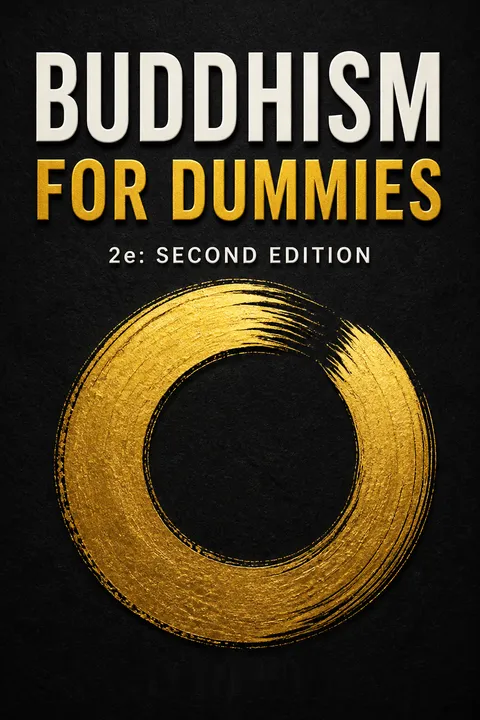
Buddhism for Dummies receives mostly positive reviews, with readers praising its comprehensive introduction to Buddhism. Many find it informative, easy to understand, and well-structured. Reviewers appreciate the book's coverage of Buddhist history, philosophy, and practices. Some note its helpfulness for beginners and its potential as a reference. A few criticisms include its focus on North American Buddhism and occasional overuse of cross-references. Overall, readers find the book valuable for gaining a solid foundation in Buddhist concepts and traditions.
People Also Read





Glossary
Dharma
Buddhist teaching and pathDharma refers to the Buddha’s teachings and, more broadly, the path of practice those teachings describe. It includes guidance about understanding suffering, developing wisdom and compassion, and living ethically. In Buddhist communities, the Dharma is one of the Three Jewels, a central source of orientation and refuge.
Sangha
Buddhist spiritual communitySangha means the community that preserves and practices the Buddhist teachings. It can refer especially to the monastic community of monks and nuns, and in broader usage to Buddhist practitioners more generally. Alongside the Buddha and the Dharma, the Sangha forms one of the Three Jewels.
Three Jewels
Buddha, teaching, communityThe Three Jewels, also called the Three Treasures or Triple Gem, are the Buddha, the Dharma, and the Sangha. They represent the awakened teacher, the teachings that describe the path, and the community that carries those teachings forward. Taking refuge in them is a formal way of orienting oneself toward Buddhist practice.
mindfulness
Attentive present awarenessMindfulness is the practice of paying deliberate attention to experience as it unfolds. In the book’s account, it is a foundational form of Buddhist meditation, helping practitioners notice sensations, thoughts, and emotions rather than reacting automatically. It is not simply relaxation or withdrawal from ordinary concerns.
samadhi
Deep meditative concentrationSamadhi is a concentrated state in which the mind remains steadily focused. Buddhist traditions describe it as a developed capacity that can support profound insight into experience and reality. It is more than ordinary attention, though the book emphasizes concentration as a mental ability that can be cultivated through practice.
Abhidharma
Systematic analysis of mindAbhidharma, meaning higher teachings, is a body of Buddhist analysis that classifies mental functions and other aspects of experience. The book describes it as especially important in Theravada study and also used by some Vajrayana practitioners. Its detailed categories help practitioners observe changing mental states and investigate the assumption of a fixed self.
Buddha nature
Potential for awakeningBuddha nature refers, in some Buddhist traditions, to the fundamental capacity or nature associated with awakening. The book presents it through the image of sunlight hidden by clouds: confusion may obscure this nature without destroying it. Different Buddhist schools understand the idea in different ways, so it is not a single uniform doctrine.
bodhisattva
Being devoted to awakeningA bodhisattva is an enlightenment-bound being who dedicates spiritual practice to the welfare and awakening of all beings. In Mahayana Buddhism, the bodhisattva ideal expands the purpose of practice beyond personal liberation. Traditions differ in how they describe the bodhisattva and the path, but compassion for all beings is central to the ideal.
Four Noble Truths
Diagnosis and path beyond sufferingThe Four Noble Truths are the Buddha’s foundational account of suffering and liberation. They identify suffering, its cause, the possibility of its cessation, and a path leading toward that cessation. The book presents them as a practical diagnosis: understand the problem, identify its source, recognize that release is possible, and undertake the path.
FAQ
What's "Buddhism For Dummies, 2nd Edition" about?
- Comprehensive Introduction: The book provides a broad overview of Buddhism, covering its history, philosophy, and practices. It aims to make Buddhism accessible to beginners.
- Structure and Organization: It is organized into six parts, each focusing on different aspects of Buddhism, from its basics to its historical development and practical applications.
- Practical Approach: The book emphasizes applying Buddhist teachings to everyday life, making it relevant for modern readers seeking personal growth and understanding.
Why should I read "Buddhism For Dummies, 2nd Edition"?
- Accessible Language: The book is written in a straightforward, easy-to-understand style, making complex Buddhist concepts accessible to all readers.
- Broad Coverage: It covers a wide range of topics, from the basics of Buddhism to more advanced practices, providing a well-rounded understanding.
- Practical Insights: Readers can learn how to apply Buddhist principles to improve their daily lives, offering practical advice for personal development.
What are the key takeaways of "Buddhism For Dummies, 2nd Edition"?
- Mind's Role: The book emphasizes the mind's role in shaping experiences and achieving happiness, highlighting the importance of mental development.
- Ethical Living: It underscores the significance of ethical behavior as a foundation for spiritual growth and personal well-being.
- Meditation and Devotion: The book explores meditation as a central practice in Buddhism and discusses the role of devotion in connecting with Buddhist teachings.
How does "Buddhism For Dummies, 2nd Edition" define Buddhism?
- Not Just a Religion: Buddhism is presented as a practical approach to life, not just a belief system or religion, focusing on personal experience and transformation.
- Philosophical and Practical: It combines philosophical teachings with practical methods to address life's fundamental questions and challenges.
- Path to Enlightenment: The book describes Buddhism as a path to awakening and enlightenment, aiming to end suffering and achieve lasting happiness.
What is the role of the Buddha in "Buddhism For Dummies, 2nd Edition"?
- Historical Figure: The Buddha is introduced as a historical figure who achieved enlightenment and shared his teachings to help others overcome suffering.
- Inspiration and Example: His life and teachings serve as an inspiration and example for those seeking spiritual growth and understanding.
- Central to Teachings: The Buddha's teachings form the core of Buddhist philosophy and practice, guiding followers on their spiritual journey.
How does "Buddhism For Dummies, 2nd Edition" explain the mind's influence on experience?
- Mind Shapes Reality: The book explains that the mind shapes and colors all experiences, influencing happiness and suffering more than external circumstances.
- Interconnected with Body: It discusses the intimate connection between the mind and body, highlighting how mental states can affect physical health.
- Potential for Change: The mind is described as dynamic, with the potential for transformation through practices like meditation and mindfulness.
What are the main Buddhist practices discussed in "Buddhism For Dummies, 2nd Edition"?
- Ethical Behavior: Living an ethical life is emphasized as a foundation for spiritual practice, helping to maintain focus and peace of mind.
- Meditation: The book explores meditation as a key practice for developing insight, concentration, and emotional intelligence.
- Devotion: Devotional practices, such as taking refuge in the Three Jewels, are discussed as ways to connect with Buddhist teachings and cultivate compassion.
How does "Buddhism For Dummies, 2nd Edition" address the concept of enlightenment?
- Varied Interpretations: The book presents different interpretations of enlightenment across Buddhist traditions, highlighting its central role in spiritual practice.
- Path to Awakening: Enlightenment is described as the ultimate goal of Buddhism, involving a profound realization of one's true nature.
- Practical Steps: It outlines practical steps and practices that can lead to enlightenment, emphasizing the importance of wisdom and compassion.
What are the Four Noble Truths according to "Buddhism For Dummies, 2nd Edition"?
- Truth of Suffering: The book explains that suffering is an inherent part of life, which Buddhism seeks to understand and address.
- Cause of Suffering: It identifies the cause of suffering as attachment and ignorance, which can be overcome through spiritual practice.
- Cessation of Suffering: The cessation of suffering is possible through the realization of enlightenment and the practice of the Eightfold Path.
- Path to Liberation: The Eightfold Path is presented as a practical guide to achieving liberation from suffering and attaining lasting happiness.
How does "Buddhism For Dummies, 2nd Edition" explain the concept of karma?
- Law of Cause and Effect: Karma is described as the law of cause and effect, where actions have consequences that shape future experiences.
- Ethical Guidance: The book emphasizes following the Buddha's ethical guidance to create positive karma and avoid negative consequences.
- Purification Practices: It discusses practices for atoning for mistakes and purifying negative karma, promoting spiritual growth and well-being.
What are the major Buddhist traditions covered in "Buddhism For Dummies, 2nd Edition"?
- Theravada Buddhism: The book covers Theravada Buddhism, focusing on its teachings and practices, particularly in Southeast Asia.
- Mahayana Buddhism: It explores Mahayana Buddhism, highlighting its emphasis on compassion and the bodhisattva path.
- Vajrayana Buddhism: The book discusses Vajrayana Buddhism, known for its esoteric practices and emphasis on the mind of clear light.
What are the best quotes from "Buddhism For Dummies, 2nd Edition" and what do they mean?
- "My religion is kindness." This quote from the Dalai Lama emphasizes the importance of compassion and kindness as central to Buddhist practice.
- "Do not accept anything I say as true simply because I have said it." This quote from the Buddha encourages critical thinking and personal investigation of teachings.
- "Phenomena are preceded by mind, led by mind, formed by mind." This quote highlights the mind's role in shaping experiences and the importance of mental development.
Download PDF
Download EPUB
.epub digital book format is ideal for reading ebooks on phones, tablets, and e-readers.








