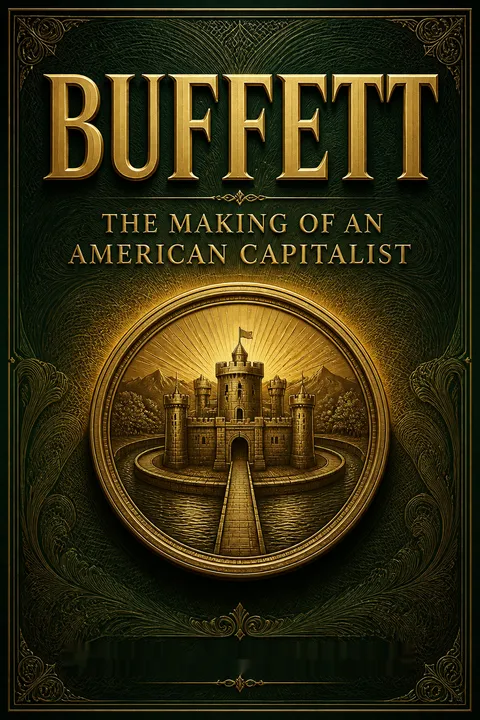


Key Takeaways
Build an investing temperament strong enough to outlast four decades of market moods
A record built slowly. Buffett’s defining achievement was not a single lucky trade. From 1957 to 1969, his partnership compounded at about 29.5 percent annually before fees. From 1970 to 1995, Berkshire grew at about 29.2 percent annually, far above the broad market’s roughly 11 percent. An investor who had put $10,000 with Buffett in 1956 and stayed through 1995 would have ended with about $125 million.
Character mattered. He avoided leverage, ignored market forecasts, and kept returning to the businesses behind the shares. His discipline was tested in both mania and panic, from the Go-Go boom of the 1960s to the despair of 1974. The numbers are extraordinary, but the biography’s central claim is that patience, independence, and rationality helped make them possible.
What’s striking is how the biography makes temperament part of the investing method, not a decorative personality trait. Compounding rewards consistency, but consistency is difficult when prices move faster than business fundamentals and peers loudly claim to know what comes next. The account also cautions against turning Buffett’s record into a promise: a remarkable outcome can reflect unusual skill, favorable circumstances, and decisions that cannot be copied mechanically. The transferable lesson is narrower and sturdier: a process must be psychologically survivable before it can benefit from time.
Buy a business, not a ticker, and demand room for error
Look beneath the quote. Benjamin Graham taught Buffett to estimate a company’s intrinsic value, meaning the underlying worth of its assets and future earning power, rather than treating its share price as the final answer. He also taught margin of safety: buy substantially below that estimated worth so that imperfect analysis or bad luck does not immediately ruin the investment.
Let the market offer, not command. Graham’s Mr. Market is a fictional business partner who offers a different price every day, sometimes driven by enthusiasm, sometimes fear. The investor can accept the offer or ignore it. Buffett used this idea to keep falling prices from automatically becoming evidence that his original judgment was wrong. The key question remained whether the business itself had deteriorated.
This framework separates two questions that financial headlines often collapse: what an asset is worth, and what someone will pay for it today. That distinction resembles the difference between measurement and observation in science: a noisy reading is not necessarily a change in the object being measured. Still, intrinsic value is an estimate, not a hidden fact that can be read off a balance sheet. The margin of safety therefore matters most when analysis is uncertain, and it cannot rescue an investor who misunderstands the business or treats a guess as precision.
Use Graham’s rules as a compass, not a cage
Start with cheapness. Graham trained Buffett to search for securities priced far below measurable assets, such as cash or working capital. These bargains could be neglected, troubled companies with little appeal beyond their low price. Buffett learned to read financial statements closely and to trust evidence over popular opinion.
Then widen the lens. Buffett initially rejected See’s Candy because its book value looked too small. He eventually recognized that customers paid for its reputation and product, not merely its physical assets. Coca-Cola presented the same challenge at a larger scale: its brand and ability to grow overseas mattered more than what its balance sheet could capture. Buffett kept Graham’s insistence on value while changing what he counted as valuable.
The useful intellectual move is neither blind loyalty to a mentor nor fashionable rejection of one. Buffett preserves Graham’s core question, whether price is justified by value, while improving the answer to include durable earning power and intangible assets. This resembles scientific model revision: a sound principle can survive even when its first measurement tools prove incomplete. The danger is that “quality” can become a flattering excuse to overpay. Buffett’s evolution remains disciplined only because business strength and purchase price are assessed together.
Keep cash when prices are foolish, then act when panic discounts businesses
Refuse the fashionable game. During the 1960s boom, investors rushed into fast-moving growth stocks and funds that chased each new trend. Buffett became increasingly short of attractive ideas, closed his partnership to new money, and shut it down in 1969 rather than imitate a market he did not understand.
Use fear as a price signal. In 1973 and 1974, pessimism pushed shares of sound businesses to unusually low prices. Buffett bought aggressively, including the Washington Post, whose market value appeared far below the value of its media assets. He did not need to predict the bottom or the economy’s recovery. He needed to judge whether a particular business was selling for less than it was worth.
The discipline here is not contrarianism for its own sake. It is a refusal to let the crowd’s confidence or distress substitute for a business assessment. Behavioral finance gives a name to part of this problem: social proof makes popular choices feel safer, while losses make otherwise tolerable uncertainty feel catastrophic. Yet staying in cash is not automatically wise; it can become a costly form of indecision. Buffett’s restraint works only when cash is a deliberate alternative to unattractive prices, not a bet that markets can be timed.
Concentrate only when understanding and odds justify the risk
Make conviction count. Buffett often held a small number of large positions rather than hundreds of stocks. After investigating the American Express salad-oil fraud, he found that customers still used its cards and traveler’s checks. He concluded that the company’s name and customer loyalty remained powerful, then invested nearly a quarter of his assets. Coca-Cola later became another unusually large holding.
Concentration is not casualness. Buffett built positions only after studying the business, its competitors, and the facts available to him. He was willing to accept temporary price declines when his view of the company remained intact. But a concentrated portfolio also magnifies the cost of being wrong, which is why his approach depended on careful analysis, a margin of safety, and knowing where his knowledge stopped.
Concentration can be understood as a consequence of unequal opportunity: if a few ideas are unusually compelling, equal weighting may understate their relative merit. It also forces a useful question about what the investor actually knows, rather than disguising ignorance with a long list of holdings. But concentration is not proof of insight. A portfolio can be concentrated because of overconfidence, familiarity, or an unrecognized common risk. The discipline is not simply to hold fewer securities; it is to make the burden of evidence rise with the size of the bet.
Move capital out of businesses that consume it without earning adequate returns
A cheap company can stay bad. Buffett’s early Berkshire Hathaway investment was a classic bargain on paper: the textile company had substantial working capital relative to its share price. But the industry was crowded, its products were interchangeable, and every manufacturer had to keep investing merely to remain competitive. Berkshire’s mills absorbed capital without producing attractive returns.
Find better uses for the money. Buffett gradually directed Berkshire’s resources toward insurance, banking, candy, and media. Insurance was especially useful because premiums arrive before many claims are paid. The funds held in between, called float, can be invested while Berkshire remains responsible for future claims. The lesson was to judge a business by what each dollar of capital earns, not by its size, history, or apparent cheapness.
This is a capital-allocation lesson as much as a stock-picking lesson. A company’s past investment is a sunk cost; the relevant decision is whether the next dollar is more productive there or somewhere else. Buffett’s textile experience shows why loyalty to a familiar asset can become economically expensive. Float adds another layer: it can be powerful funding, but it is not free money, because claims remain real obligations. The combination of investment opportunity and underwriting discipline matters more than the headline amount of cash temporarily available.
Pay for durable advantages, not merely assets you can count
A moat protects earning power. Buffett admired Rose Blumkin, who built Nebraska Furniture Mart by buying in volume, keeping costs low, and selling honestly at low prices. By the time Berkshire bought the store, it controlled about two-thirds of furniture sales in Omaha. Its reputation, customer loyalty, and operating efficiency made it much harder to displace than an ordinary retailer.
Brand can be an asset. Coca-Cola’s name, See’s Candy’s customer attachment, and dominant newspapers such as the Washington Post gave these businesses pricing power or a protected market. Buffett called such strength a franchise: an advantage that helps a company keep customers and earn attractive returns without constant heavy investment. By contrast, textile goods were commodities that buyers could easily replace.
The contrast clarifies why competitive advantage is not simply a popular brand or a large market share. A durable advantage must affect customer behavior or competitors’ economics in a way that supports returns over time. In modern terms, network effects, switching costs, and trusted brands can all help create that protection, though none is permanent. The Furniture Mart’s strength came from a whole operating system, not a slogan. Buffett’s method asks what makes imitation difficult, then checks whether that protection is reflected in actual economics.
Judge managers by capital returns, candor, and alignment with owners
Measure stewardship, not size. Buffett emphasized return on equity and resisted the idea that a larger company is automatically a better one. At Berkshire, managers generally ran their businesses with considerable freedom, while Buffett retained control of where capital went. He opposed stock options that rewarded executives without exposing them to the same downside as owners.
Make communication part of governance. Buffett’s letters explained results plainly, acknowledged mistakes, and used consistent yardsticks rather than redefining success after the fact. He also supported share repurchases when they increased each remaining owner’s share of a good business. His approach treated investors as long-term partners, not a passing audience to be reassured with polished announcements.
The biography links governance to information quality. Owners cannot evaluate management if reported performance changes meaning whenever results disappoint. A stable yardstick makes comparison possible, while candid explanation can expose incentives that headline growth conceals. This is especially important in organizations where decision-makers control other people’s capital. Yet decentralization has limits: hands-off ownership can leave weak managers in place or slow investment in new opportunities. Trust works best when paired with clear accountability, relevant measures, and the willingness to intervene when the economics require it.
Protect reputation even when a shortcut promises faster profit
A crisis tests the owner. In 1991, Salomon Brothers disclosed that trader Paul Mozer had submitted unauthorized bids in Treasury auctions and that senior leaders had delayed reporting the problem. Buffett, whose Berkshire had invested heavily in Salomon, became interim chairman. He apologized publicly, cooperated with regulators, removed responsible managers, and insisted that conduct near the legal boundary should be treated as unacceptable.
Credibility has economic value. Salomon depended on customers, lenders, and the government trusting its promises. A formal legal defense could not quickly restore that confidence. Buffett’s intervention put his own reputation on the line, and his willingness to accept scrutiny helped persuade regulators not to prosecute the firm criminally. The rescue did not erase the failures or guarantee a triumphant outcome, but it showed that trust is an asset that can be destroyed faster than it is rebuilt.
The episode turns ethics from an abstract virtue into a condition of operating a financial institution. Reputation lowers friction: customers and counterparties are more willing to transact when they believe rules will be followed. That makes integrity economically consequential without reducing it to mere public relations. Buffett’s approach also shows the value of taking responsibility before demanding leniency. Still, a trusted rescuer cannot substitute for sound internal controls. Personal credibility can stabilize a crisis, but durable compliance requires systems that do not depend on one person’s presence.
Treat focus as a tool, not a complete philosophy of life
The gift had a cost. Buffett’s ability to shut out distraction helped him study companies with extraordinary intensity. The same habit left family members feeling emotionally distant from him, and his wife Susie often carried the household and social life. His refusal to give his children substantial financial help reflected a sincere concern that inherited wealth could weaken independence, but it could also feel rigid and impersonal.
Not every value has a stock-price measure. Buffett was slow to give away his own fortune because he wanted confidence that charitable money would produce measurable results. The 2008 afterword describes his eventual decision to direct most of his Berkshire shares to the Gates Foundation and family foundations. His precision served investing exceptionally well, but human needs, family relationships, and philanthropy do not always offer the clean feedback of an earnings report.
The biography’s most useful human complication is that a strength can become costly when applied everywhere. Buffett’s focus creates an unusually coherent working life, but relationships often require attention that has no immediate measurable return. His later philanthropic decision can be read as a form of specialization: entrusting a task to people he judged better equipped to perform it. At the same time, concentrating charitable resources raises questions about accountability and pluralism. Social outcomes are difficult to measure, but difficulty is not evidence that only measurable causes deserve support.
Analysis
Lowenstein’s biography is not simply a record of exceptional returns. It argues that Buffett’s performance grew from a tight fit between method and temperament: he could study businesses for long periods, tolerate being out of step, and refuse to trade merely because prices moved. Graham supplied the intellectual structure, but Buffett’s career also shows that a method must evolve. Asset discounts led to a broader understanding of brands, customer loyalty, and managerial quality, while the governing question remained whether price justified value.
The book is especially strong when it places investment decisions inside institutions. Berkshire’s transformation from textile mill to insurer and holding company makes capital allocation concrete. The Salomon crisis makes reputation and governance concrete. In both cases, money is not just a score. It is a claim on future choices, and the people controlling it can either preserve or dissipate trust. The narrative also complicates its own hero. Buffett’s patience and focus help explain why he succeeds, yet they contribute to emotional distance, missed opportunities, and an unusually narrow approach to philanthropy. His refusal to pay for unproductive growth is financially coherent, but not every human good can be evaluated like a business. That tension matters because the book’s portrait is most convincing when Buffett is treated as a gifted person with specific limits, rather than as a universal template.
The investment lessons are portable only in principle. Most people cannot reproduce Buffett’s memory, judgment, access, or decades-long record. The useful inheritance is not the claim that anyone can become Buffett. It is the habit of separating a business from its ticker price, asking what capital earns, and resisting decisions driven by imitation. Those practices can improve judgment even when the scale of the results is not repeatable.
Review Summary
Buffett: The Making of an American Capitalist is highly praised as an insightful biography of Warren Buffett, offering a balanced view of his investing genius and personal life. Readers appreciate the detailed look into Buffett's investment philosophy, business acumen, and character. The book is lauded for its thorough research and engaging storytelling, providing valuable lessons for investors. While some find Buffett's single-minded focus on wealth accumulation off-putting, most reviewers consider the book a must-read for anyone interested in business and investing.
People Also Read







Glossary
Mr. Market
Daily offers from marketsA metaphor from Benjamin Graham for the stock market as an emotional business partner who offers to buy or sell each day at a changing price. The investor may accept the offer when it is attractive or ignore it when it is not. Market quotations are opportunities, not commands.
Intrinsic value
Estimated underlying business worthAn estimate of what a business or security is worth based on its assets, earning power, and prospects, rather than its current quoted price. It is not an exact figure. Buffett uses it to compare what an investor pays with the economic value expected from owning a share of the business.
Margin of safety
A buffer against errorThe gap between an investor’s estimate of a security’s value and the price paid for it. A sufficiently wide gap allows for mistakes in analysis, unexpected setbacks, or delayed market recognition. The concept does not eliminate risk, but reduces dependence on precise forecasts being correct.
Circle of competence
Businesses one can assessThe set of businesses an investor understands well enough to evaluate their economics and risks. The boundary matters as much as the knowledge inside it. Buffett argues that investors should avoid decisions requiring expertise they do not possess, rather than treating every opportunity as something they must understand.
Float
Premiums held before claimsMoney an insurer receives in premiums before paying claims and other obligations. The insurer can invest those funds during the interval, but must remain prepared to meet future claims. For Berkshire, float became an important source of investment capital, especially when insurance was underwritten at sound prices.
Franchise
A durable competitive advantageA business position that gives a company lasting customer loyalty, pricing power, or protection from competitors. Buffett uses the idea for businesses such as Coca-Cola and See’s Candy, where reputation and customer attachment support strong economics. A famous brand alone does not ensure a valuable franchise.
Efficient Market Theory
Prices reflect public informationThe theory that market prices incorporate available information so rapidly that consistently finding undervalued securities is extremely difficult. Lowenstein presents Buffett’s record as a challenge to the strongest version of the theory. The book distinguishes the claim that markets are often efficient from the claim that they are always right.
Beta
Historical market volatility measureA measure used in modern finance to describe how much a stock’s price has historically moved relative to the overall market. The book contrasts this price-based proxy for risk with Buffett’s concern about the risk of paying more for a business than it is worth. A volatile quotation does not by itself establish that a business is more dangerous.
Rhinophobia
Fear of holding cashA joking label for an investor’s anxiety about having cash available rather than fully invested. Buffett recognized that this urge can push investors into weak opportunities simply to feel active. The term highlights the discipline required to wait when prices are unattractive, despite the discomfort of doing nothing.
FAQ
What's Buffett: The Making of an American Capitalist about?
- Biography of Warren Buffett: The book chronicles Warren Buffett's journey from a young boy with a passion for numbers to becoming one of the wealthiest individuals in the world.
- Investment Philosophy: It explores Buffett's unique investment strategies, emphasizing long-term value investing and understanding the businesses behind stocks.
- Personal and Cultural Insights: The biography delves into Buffett's personal life and places his story within the context of American capitalism.
Why should I read Buffett: The Making of an American Capitalist?
- In-depth Understanding: Gain comprehensive insights into Buffett's life, thought processes, and decision-making as an investor.
- Investment Lessons: Learn valuable lessons about investing, patience, and rationality applicable to personal finance and economic understanding.
- Cultural Context: Understand Buffett's story within the broader context of American capitalism, relevant for those interested in business and finance.
What are the key takeaways of Buffett: The Making of an American Capitalist?
- Value Investing Principles: Buffett's approach focuses on buying undervalued companies with strong fundamentals.
- Long-term Focus: Emphasizes patience and a long-term perspective in investing, contrasting with Wall Street's short-term focus.
- Character and Ethics: Highlights Buffett's integrity, discipline, and rationality as essential components of his success.
What are the best quotes from Buffett: The Making of an American Capitalist and what do they mean?
- “Be greedy when others are fearful.”: Encourages taking advantage of market downturns to buy undervalued stocks.
- “The market is a voting machine.”: Reflects the belief that stock prices are often driven by sentiment rather than intrinsic value.
- “Never lose money.”: Underscores the importance of capital preservation and risk management.
How did Buffett's upbringing influence his investment style in Buffett: The Making of an American Capitalist?
- Early Exposure to Numbers: Childhood fascination with numbers and business laid the foundation for his analytical approach.
- Parental Influence: His father, a stockbroker, instilled a strong work ethic and independent thought.
- Resilience and Independence: Growing up during the Great Depression taught financial prudence and self-reliance.
What investment strategies does Buffett use in Buffett: The Making of an American Capitalist?
- Long-term Value Investing: Focuses on acquiring undervalued stocks and holding them for many years.
- Margin of Safety: Emphasizes buying stocks at a discount to their intrinsic value to minimize risk.
- Understanding Businesses: Advocates for a deep understanding of the businesses behind the stocks.
What role did Benjamin Graham play in Buffett's career as described in Buffett: The Making of an American Capitalist?
- Mentorship Influence: Graham was a pivotal figure, teaching Buffett the principles of value investing.
- Investment Philosophy: Buffett adopted Graham's focus on intrinsic value and margin of safety.
- Ethical Influence: Graham's emphasis on ethical investing resonated with Buffett, shaping his approach.
How does Buffett's investment philosophy differ from Wall Street's in Buffett: The Making of an American Capitalist?
- Focus on Fundamentals: Prioritizes understanding the underlying business, contrasting with Wall Street's trend-chasing.
- Patience vs. Urgency: Advocates for a patient, long-term approach, unlike Wall Street's speculative nature.
- Avoiding Leverage: Prefers investing his own capital in businesses he understands, avoiding complex financial instruments.
How did Buffett's investments evolve over time in Buffett: The Making of an American Capitalist?
- From Partnerships to Berkshire: Transitioned from managing small partnerships to taking control of Berkshire Hathaway.
- Adopting New Strategies: Incorporated qualitative assessments into investment decisions, beyond quantitative analysis.
- Diversification of Holdings: Expanded his portfolio to include various industries while maintaining a focus on long-term value.
What challenges did Buffett face in his career as described in Buffett: The Making of an American Capitalist?
- Market Fluctuations: Navigated various market cycles, including the 1960s Go-Go era and the 1973-74 bear market.
- Skepticism from Peers: Faced skepticism from investors focused on short-term gains, contrasting with his long-term strategy.
- Personal Struggles: Dealt with complex relationships and the pressures of managing wealth and expectations.
What is the significance of Berkshire Hathaway in Buffett's career as described in Buffett: The Making of an American Capitalist?
- Transformation into a Holding Company: Evolved from a struggling textile manufacturer into a diversified holding company.
- Source of Capital: Insurance operations provided steady cash flow, enabling investments without external financing.
- Legacy of Success: Became synonymous with Buffett's investment success, showcasing his ability to generate substantial returns.
How does Buffett define risk in investing according to Buffett: The Making of an American Capitalist?
- Risk of Overpaying: Defines risk as paying more for a business than it is worth, not just stock price volatility.
- Long-Term Perspective: Believes long-term investors can withstand short-term fluctuations if confident in the business.
- Focus on Fundamentals: Emphasizes understanding a company's fundamentals and assessing intrinsic value to mitigate risk.
About the Author
Download PDF
Download EPUB
.epub digital book format is ideal for reading ebooks on phones, tablets, and e-readers.








