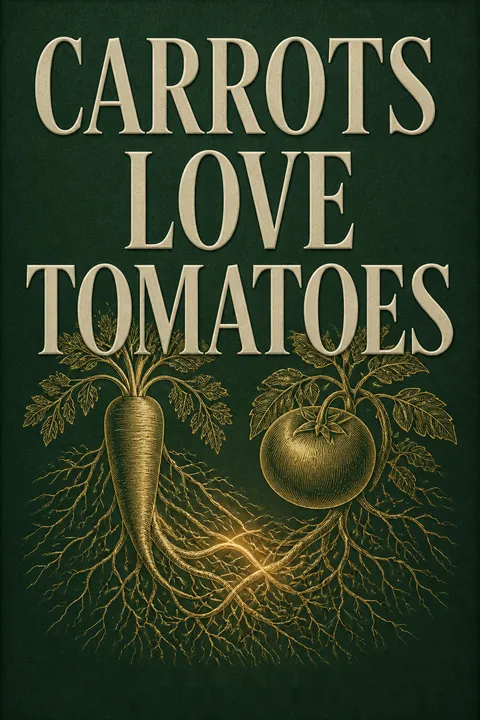


Key Takeaways
Pair plants for what they change around each other, not just what they yield
A garden is a community. Companion planting means growing different plants near one another because their interactions may improve growth, discourage pests, or make better use of space. Riotte’s emblematic pairing is carrots and leeks: she reports that the leek’s strong scent deters carrot flies, while the carrot’s scent helps protect leeks from their pests. She also describes planting tomatoes beside asparagus after the spring harvest, to deter asparagus beetles and suppress weeds as the tomatoes grow.
Match benefits to conditions. The book’s extensive lists include helpful neighbors and plants that inhibit one another. Beans, for instance, are generally poor neighbors for onions, while carrots are described as helpful to beans. The practical lesson is to plan relationships, not simply assemble favorite crops.
What's valuable here is the shift in scale: a plant is not merely an individual crop but part of a local neighborhood. That perspective encourages gardeners to ask what a planting does to its surroundings, including shade, scent, soil use, and pest access. It also resists the idea that every square foot must serve one crop alone. The limitation is that a pairing is not a universal guarantee. Variety, climate, soil, and pest pressure matter, so a garden relationship is best treated as a testable possibility rather than a rule.
Mix crops to confuse pests, but give protective plantings time to work
Diversity can disrupt pests. Riotte argues that mixed plantings often fare better than long rows of a single crop because a pest encounters fewer uninterrupted hosts. Aromatic plants may mask a crop’s scent or repel insects. Her examples include onions, leeks, rosemary, and sage near carrots, and herbs such as thyme and hyssop near cabbage-family vegetables. She also points to marigolds for nematode control, while stressing that they may need a full season or longer for an effect to accumulate.
Protection has limits. Some companion plants can weaken each other’s effects, and an overcrowded planting can compete for light, water, and nutrients. Use the book’s pairings as starting points, observe the result, and avoid assuming that an herb’s presence alone solves a pest problem.
This is a useful form of ecological risk management. Instead of relying on a single intervention, a diverse planting can make the garden less predictable and less convenient for a specialized pest. The distinction between prevention and cure also matters: a plant that changes pest pressure gradually cannot be expected to rescue a crop already under attack. Diversity is not automatically beneficial, though. It can complicate monitoring and increase competition, so the relevant question is not how many species fit in a bed, but whether their arrangement supports the crops and beneficial organisms the gardener wants.
Read weeds as clues to soil, then turn their growth into fertility
Weeds reveal conditions. The book treats wild plants as more than nuisances. Their presence can suggest soil characteristics: asters may point to wet ground needing drainage, while certain weeds are associated with acidic soil, hardpan, or cultivated ground. Deep-rooted plants such as dandelions and pigweed can reach minerals below the surface and leave channels that help water, air, and earthworms move through the soil.
Harvest the biomass wisely. Riotte recommends letting useful weeds grow, then cutting them before they set seed and using them as green manure or compost. Their roots and leaves add organic matter as they decompose. This is not an invitation to let weeds overwhelm vegetables. Some spread aggressively or compete strongly, so identification and timing matter as much as the potential benefit.
The deeper idea is diagnostic: unwanted growth can carry information about the conditions that produced it. That approach replaces a simple good-plant versus bad-plant judgment with a question about function and context. It also connects observation to action, since a weed can indicate a problem and provide material for improving the soil. The caution is important: indicator plants offer clues, not a definitive soil test, and the same species may behave differently across sites. A measured soil test and direct observation can keep an intriguing ecological interpretation from becoming an expensive guess.
Build fertility with cover crops, compost, and deliberate crop succession
Feed the soil between harvests. Green manure is a crop grown mainly to protect and improve soil, then cut or turned in so its organic matter can decompose. Riotte especially values legumes such as clover, alfalfa, beans, peas, and vetch because bacteria in their root nodules convert atmospheric nitrogen into forms that support plant growth. Cover crops can also shield bare ground from erosion and contribute roots and humus.
Sequence crops by appetite. The book groups vegetables by feeding needs: heavy feeders such as tomatoes and cabbage-family crops use richly amended soil; lighter feeders such as carrots and beets can follow; legumes help replenish the rotation. Compost adds decomposed organic matter and can include garden debris, kitchen scraps, and weeds, provided the pile heats enough to destroy seeds.
This makes fertility a cycle rather than a bag of inputs. Cover crops capture and return resources, while compost turns discarded biomass into material for future growth. The approach is especially compelling because it asks what happens to a bed after harvest, a question conventional crop-by-crop planning can overlook. A practical nuance is that nitrogen fixation does not mean every nearby crop receives an immediate, reliable dose. The clearest benefit comes when legume biomass and roots remain in the system and decompose. Soil tests and crop response help determine whether the intended cycle is actually meeting a plant's needs.
Use timing, shade, and root depth to make small gardens work harder
Arrange plants in layers and seasons. Intercropping means growing two or more crops in the same ground at once. Riotte suggests combining quick crops, such as radishes or lettuce, with slower crops that will later need the space. Two-level planting pairs vegetables that use different soil depths, while taller plants can provide useful shade for crops that struggle in heat. Corn, for example, can shelter cucurbits, and lettuce can grow beneath taller vegetables before they fill out.
Keep competition in view. The book also recommends succession planting, in which one crop follows another, and vertical gardening for climbers such as beans and cucumbers. These methods can stretch limited space, but they depend on matching crops’ needs. A shade-loving plant should not be trapped beneath a dense canopy, and two thirsty or sprawling crops may compete rather than cooperate.
Space efficiency here comes from time as much as geometry. A bed can serve one crop early, another later, and several at once if their roots, heights, and growth schedules differ. That is a more sophisticated design problem than simply packing plants tightly. The same complexity creates risk: close planting can hide pests, reduce airflow, or intensify competition. The most useful design is therefore not the one with the highest theoretical plant count, but the one that allows enough light, water, access, and harvest space for each crop to thrive.
Shift planting dates when pests follow a predictable seasonal schedule
Use the calendar as pest control. Riotte describes changing planting dates to let crops avoid the period when particular insects are most damaging. She reports that fall-planted squash and cucumbers in her Oklahoma garden suffered little insect damage, and notes that early planting can help some squash mature before borers become active. Winter wheat can also be sown after a local Hessian fly period, according to the book’s guidance.
Let local observation set the date. These are not universal calendar prescriptions. The author explicitly ties timing to regional conditions and encourages gardeners to notice when infestations peak. Climate, frost dates, and the length of the growing season determine whether an early or late planting is feasible. Recording planting dates and pest outbreaks helps turn timing from guesswork into a locally useful strategy.
Timing is a form of avoidance: the plant and pest need not meet at their most vulnerable moments. This can reduce the need for direct control and makes the garden’s calendar an active design tool. The strategy works best when the pest’s seasonal pattern is reasonably consistent and the crop can mature within the available growing season. Weather variability can disrupt both assumptions. A garden journal is therefore more than a record of success; it lets the grower distinguish a repeatable seasonal pattern from a lucky year.
Choose fruit trees for compatible pollen, not blossoms alone
Flowers do not guarantee fruit. Many fruit trees need pollen from a compatible variety nearby. Riotte explains that a tree may bloom beautifully and still set little fruit if it is self-unfruitful and lacks a suitable pollenizer. Apples, pears, sweet cherries, plums, almonds, and many nut trees can require another variety, while sour cherries and many peaches are self-fruitful. Even two varieties of the same fruit may not always pollinate one another successfully.
Plan the orchard before planting. Check a nursery’s pollination guidance and consider trees already growing in the neighborhood. If space allows only one apple tree, the book suggests grafting a pollinating branch onto it. Site preparation matters too: fruit trees need good drainage, settled soil, and mulch, while flowers should not be sprayed during bloom because bees and other insects perform much of the pollination.
Pollination makes companion planting a matter of reproductive compatibility, not simply neighborly influence. A tree can be healthy and well cared for yet fail to crop because the missing ingredient is another flowering variety at the right time. This is a useful reminder that visible plant vigor does not reveal every hidden dependency. The advice also points toward planning at the scale of the neighborhood, since nearby trees may contribute pollen. Nursery labels and local expertise are essential because compatibility can vary by variety; a second tree is not automatically the right partner.
Recruit predators and selective controls before reaching for broad insecticides
Make the garden hospitable to allies. Birds, lady beetles, toads, spiders, and parasitic wasps all appear in the book as predators of garden pests. Riotte recommends bird habitat and water, careful release of lady beetles near aphid-infested plants, and preserving visible beneficial insects. She also describes Bacillus thuringiensis, a bacterial control aimed at caterpillars, and milky spore disease, which targets Japanese beetle grubs.
Selectivity still requires care. Botanical insecticides may break down faster than some synthetic products, but the book warns that products such as pyrethrum can harm bees and other beneficial insects, and that some plant-derived substances are toxic. Identify the pest first, use a control suited to it, and follow product directions. A control that kills indiscriminately can remove the garden’s helpers along with its problem.
This is an early integrated-pest-management sensibility: prevention, natural enemies, targeted treatments, and observation belong in the same toolkit. Its strongest principle is restraint, not the assumption that a natural product is harmless. A botanical origin says little by itself about safety or ecological effect. The gardener must consider which organism is targeted, which others are exposed, and when treatment occurs. The book’s descriptions also vary in evidentiary strength, so the most reliable practice is to verify current local recommendations and judge success by actual pest damage, not by the mere presence of insects.
Design the garden around the gardener’s space, strength, and safety
A garden should fit its keeper. Riotte offers plans for weekend gardeners, small plots, roof gardens, kitchen herb beds, children, and gardeners with limited mobility. Raised or elevated beds can reduce bending and improve access; narrow beds allow work from either side. Roof gardens need deep enough boxes, drainage, wind protection, and confirmation that the structure can bear their weight. For a time-limited gardener, a small plot, mulch, a watering timer, and frequent harvesting make maintenance more manageable.
Beauty and usefulness can share ground. Flowers and herbs can attract pollinators or serve as companions, while food plants can occupy ornamental beds. But the book also stresses that some attractive or useful plants are poisonous, including castor bean and several common ornamentals. Identify plants before allowing children or animals access, and do not treat traditional remedies as proof of safety.
The garden is not successful if its design works only for an idealized, tireless gardener. Accessibility, reach, wind exposure, water access, and available time are part of horticultural design, not afterthoughts. This human-centered approach broadens the book beyond plant pairings and makes experimentation more sustainable. The safety warning is equally important because a garden’s useful plants can also be hazardous. Historical gardening lore often mixes observation, tradition, and claims that deserve modern verification, especially around medicinal use. Identification and current safety guidance should take priority over inherited confidence.
Analysis
Riotte’s book is best understood as an ecological field guide organized around relationships. Its central proposition is not merely that certain plants benefit others, but that garden outcomes emerge from overlapping influences: scent, root depth, shade, nutrient cycling, insects, pollination, climate, and the gardener’s own choices. That breadth gives the book its imaginative energy. It asks readers to see weeds as potential soil builders, insects as possible allies, and a fruit tree’s pollen needs as another form of companionship.
The same breadth makes the material difficult to summarize and difficult to use uncritically. The book is a reference work, not a controlled account of every proposed pairing. It combines personal observations, inherited lore, reported studies, practical advice, and claims that may not have equal evidentiary support. Some recommendations are highly conditional, and the text itself acknowledges variation by region, season, and planting density. The soundest interpretation is therefore not to memorize a definitive compatibility chart, but to adopt its method: observe relationships, begin with plausible combinations, record results, and revise locally.
A contemporary reader can strengthen that method by separating mechanism from outcome. If leeks appear to help carrots, is the effect due to odor, altered pest movement, or an unrelated difference in weather or soil? Small comparison plots, consistent records, and advice from local extension services can help distinguish a repeatable effect from coincidence. This does not diminish the value of Riotte’s practical curiosity. It makes curiosity more precise.
The book’s most durable contribution is its invitation to design gardens as living systems rather than rows of isolated crops. Its best advice is also its most modest: diversify where it helps, build soil continually, plan for pollination, protect beneficial organisms, and treat every planting rule as something to test against the conditions in front of you. The garden becomes both a source of food and a place to learn how interdependence works.
Review Summary
Carrots Love Tomatoes receives mixed reviews. Many praise its wealth of companion planting information and folksy charm, finding it useful for garden planning. However, some criticize its disorganized layout, lack of scientific evidence, and outdated information. Readers appreciate the tips on pest control and soil improvement but note inconsistencies and missing details. While experienced gardeners find value in the book as a reference, beginners may struggle with its structure. Despite its flaws, many consider it a classic gardening resource, though some suggest more modern alternatives.
People Also Read


Glossary
Companion planting
Purposeful plant partnershipsGrowing different plants near one another because their relationships may improve growth, reduce pest damage, support pollination, or use garden space more efficiently. The book includes both beneficial and harmful pairings, and emphasizes that results can vary with location, season, and planting density.
Intercropping
Growing crops togetherGrowing two or more crops in the same area at the same time. The crops may be arranged in a shared row or neighboring rows. Riotte uses intercropping to combine compatible vegetables, herbs, and flowers, and to make productive use of spaces between crops that mature at different rates.
Green manures
Crops grown for soilCover crops grown to protect and improve soil, then cut or incorporated so their plant matter can decompose. Legumes such as clover and vetch can add nitrogen through bacteria in root nodules. Other green manures contribute organic matter, protect soil from erosion, and help maintain soil life.
Trap crops
Plants that lure pestsPlants used to attract insects away from a valued crop. The target pests feed or lay eggs on the trap crop, which should be destroyed before the eggs hatch. The method depends on selecting a plant the pest prefers and monitoring it so it does not become a source of further infestation.
Microclimate
A small area’s growing conditionsA localized area with growing conditions that differ from the surrounding site. A pond, hedge, fence, or grouping of tall plants can affect temperature, shade, wind, moisture, and air movement. Gardeners can use these differences to shelter crops or support plants that would otherwise struggle.
Rhizobium
Nitrogen-fixing root bacteriaBacteria associated with nodules on legume roots that convert atmospheric nitrogen into compounds usable in plant growth. The book describes this relationship as a basis for using legumes in rotations and cover crops. When legume material decomposes, some of its nutrients become available to subsequent crops.
Juglone
Black walnut growth inhibitorA substance associated with black walnut roots and leaves that Riotte says inhibits the growth of many nearby plants. The book notes that sensitivity differs by species: some garden crops and ornamentals are described as poor neighbors, while certain bulbs and other plants may grow successfully beneath or near a black walnut.
FAQ
What's "Carrots Love Tomatoes: Secrets of Companion Planting for Successful Gardening" about?
- Companion Planting Focus: The book explores the concept of companion planting, where certain plants are grown together to enhance growth, repel pests, and improve yields.
- Historical and Practical Insights: It delves into the historical background and practical applications of companion planting, offering insights into how plants interact with each other.
- Comprehensive Guide: The book serves as a comprehensive guide for gardeners, covering a wide range of plants, including vegetables, herbs, wild plants, and trees.
- Environmental Harmony: It emphasizes gardening in harmony with the environment, promoting sustainable and organic gardening practices.
Why should I read "Carrots Love Tomatoes" by Louise Riotte?
- Enhance Gardening Skills: The book provides valuable information on improving your gardening skills through the strategic use of companion planting.
- Pest Control Naturally: It offers natural solutions for pest control, reducing the need for chemical pesticides.
- Increase Yields: By understanding plant relationships, you can increase the productivity and health of your garden.
- Sustainable Practices: The book promotes environmentally friendly gardening practices, aligning with sustainable living values.
What are the key takeaways of "Carrots Love Tomatoes"?
- Plant Relationships Matter: Understanding which plants benefit each other can lead to healthier and more productive gardens.
- Natural Pest Control: Many plants can naturally repel pests, reducing the need for chemical interventions.
- Soil Health is Crucial: The book emphasizes the importance of soil health and how companion planting can improve soil conditions.
- Diverse Planting Benefits: A diverse garden with a variety of plants can lead to better pest control and increased yields.
What are the best quotes from "Carrots Love Tomatoes" and what do they mean?
- "The magic and mystery of companion planting have intrigued and fascinated humans for centuries." This quote highlights the long-standing interest and potential benefits of companion planting.
- "Plants that assist each other to grow well, plants that repel insects, even plants that repel other plants — all are of great practical use." It underscores the practical applications of understanding plant interactions.
- "To know is to be forewarned, and because we know, we may use them safely." This emphasizes the importance of knowledge in safely using plants, especially those that are poisonous.
- "Your own experiments will lead you into many exciting pathways and discoveries." Encourages gardeners to experiment and learn from their own gardening experiences.
How does companion planting work according to "Carrots Love Tomatoes"?
- Mutual Benefits: Companion planting involves growing plants together that can benefit each other, such as by repelling pests or enhancing growth.
- Pest Repellence: Some plants naturally repel insects, protecting their neighbors from pest damage.
- Nutrient Sharing: Certain plants can improve soil conditions, making nutrients more available to their companions.
- Disease Prevention: Mixed plantings can reduce the spread of diseases compared to monocultures.
What are some examples of companion plants mentioned in "Carrots Love Tomatoes"?
- Carrots and Tomatoes: These are classic companions, with tomatoes helping to repel pests that target carrots.
- Beans and Corn: Beans can fix nitrogen in the soil, benefiting corn, while corn provides support for climbing bean plants.
- Basil and Tomatoes: Basil is known to improve the flavor and growth of tomatoes while repelling insects.
- Marigolds and Vegetables: Marigolds are often planted with vegetables to deter nematodes and other pests.
What are the benefits of companion planting as described by Louise Riotte?
- Increased Yields: Companion planting can lead to higher yields by optimizing plant growth and health.
- Reduced Chemical Use: By naturally controlling pests and diseases, it reduces the need for chemical pesticides and fertilizers.
- Biodiversity: Encourages a diverse garden ecosystem, which can lead to more resilient plant communities.
- Soil Improvement: Certain plant combinations can enhance soil fertility and structure.
How does "Carrots Love Tomatoes" address pest control?
- Natural Repellents: The book lists plants that naturally repel specific pests, offering an organic approach to pest management.
- Beneficial Insects: It discusses how certain plants can attract beneficial insects that prey on garden pests.
- Disease Resistance: Companion planting can help prevent the spread of diseases by creating a more balanced garden ecosystem.
- Specific Plant Pairings: Provides detailed pairings that can help protect plants from common pests.
What are some common mistakes in companion planting according to "Carrots Love Tomatoes"?
- Ignoring Plant Needs: Not considering the specific needs of each plant, such as sunlight and water requirements, can lead to poor growth.
- Overcrowding: Planting too closely can lead to competition for resources, negating the benefits of companion planting.
- Wrong Combinations: Some plants can inhibit each other's growth, so it's important to choose compatible companions.
- Neglecting Soil Health: Focusing solely on plant pairings without improving soil health can limit the effectiveness of companion planting.
How does "Carrots Love Tomatoes" suggest improving soil health?
- Compost and Mulch: Regularly adding compost and mulch can improve soil structure and fertility.
- Green Manures: Planting cover crops like clover can fix nitrogen in the soil and improve its quality.
- Diverse Plantings: A variety of plants can contribute to a balanced soil ecosystem, enhancing nutrient availability.
- Avoiding Chemicals: Reducing chemical use can help maintain healthy soil microbiomes and structure.
What role do herbs play in companion planting as per "Carrots Love Tomatoes"?
- Pest Deterrence: Many herbs, such as basil and mint, can repel pests and protect neighboring plants.
- Flavor Enhancement: Herbs like basil can improve the flavor of nearby vegetables, such as tomatoes.
- Attracting Beneficial Insects: Herbs can attract pollinators and predatory insects that help control pests.
- Soil Health: Some herbs can improve soil conditions, making nutrients more available to other plants.
How can "Carrots Love Tomatoes" help a beginner gardener?
- Comprehensive Guide: The book provides detailed information on a wide range of plants, making it accessible for beginners.
- Practical Tips: Offers practical advice on plant pairings, soil improvement, and pest control.
- Encourages Experimentation: Encourages gardeners to experiment and learn from their own experiences, fostering a deeper understanding of gardening.
- Focus on Sustainability: Promotes sustainable and organic gardening practices, aligning with modern environmental values.
Download PDF
Download EPUB
.epub digital book format is ideal for reading ebooks on phones, tablets, and e-readers.








