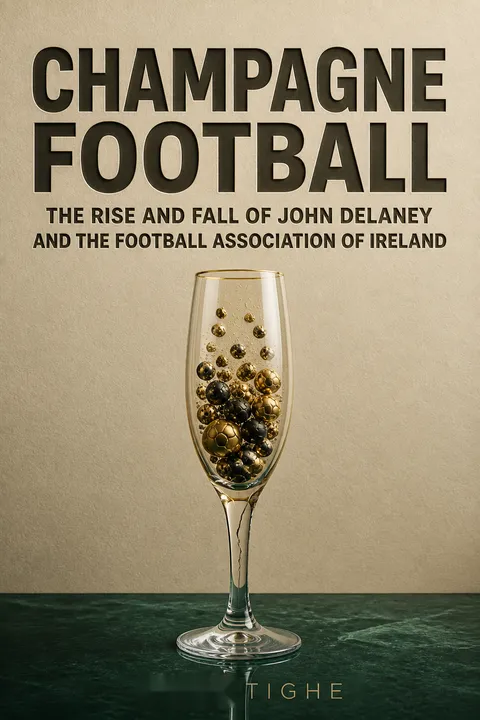


Key Takeaways
A lavish birthday party exposed the gap between Delaney's image and the FAI's books
A party with a public bill. In October 2017, John Delaney, chief executive of Ireland’s Football Association, celebrated his fiftieth birthday with a James Bond-themed event at Mount Juliet. The party involved FAI staff and resources, and its eventual cost to the association exceeded €80,000. Delaney paid €50,000, leaving more than €30,000 for the FAI to absorb, despite its serious financial troubles.
The joke had a receipt. The celebration looked like a portrait of a powerful football boss: celebrity guests, UEFA officials, a stadium-shaped cake, and staff organizing the spectacle. A radio comedian’s gag about an endless party bill seemed apt when the accounts emerged. The contrast was not merely extravagance. It showed how blurred the boundaries had become between Delaney’s personal life and an association responsible for football across Ireland.
What's striking is how a party can reveal institutional norms more clearly than a policy document. When staff organize a chief executive’s private celebration and the organization absorbs part of the cost, the issue is not just the size of the bill. It is whether anyone believes ordinary controls apply. The FAI's grassroots mission makes the contrast especially sharp: money intended to support football was also used to sustain executive spectacle. A lavish event is not proof of wrongdoing by itself, but it is a useful signal to investigate who authorized it and who paid.
The FAI's volunteer hierarchy survived scandals and swallowed reform
Old structures, new crises. In 1996, a scandal over World Cup ticket dealings brought down John Delaney’s father, Joe, the FAI treasurer. The association’s management was dominated by volunteer officers and a large council, with unclear accountability and extensive informal power. A review by consultant Ray Cass called for clearer responsibilities and limits on concentrated authority, but the proposed changes were largely diluted.
Reform without redistribution. After the chaotic 2002 World Cup preparations, the Genesis review again recommended professional management and two independent directors. The FAI adopted some changes, including a smaller board, but never appointed the independent directors. This history matters because formal reform did not reliably alter who controlled information, money, and decisions. John Delaney’s rise happened inside a system that had already shown how difficult it was to turn criticism into lasting checks on power.
The institutional lesson is more precise than the familiar warning about a bad leader: a system can absorb reform language while preserving the relationships that made reform necessary. Organizational charts may change, yet authority remains concentrated if access to information and resources stays informal. This is a form of institutional inertia, where routines and loyalties outlast a review’s recommendations. The FAI’s volunteer tradition also deserves fair treatment: local commitment sustained the game. The problem was not volunteerism itself, but relying on goodwill where explicit accountability was needed.
FAI grants and tickets built loyalty, making dissent costly
Help could feel personal. Delaney spent much of his time visiting clubs, attending local events, and distributing grants or match tickets. For some communities, this support produced real results. Clones Town, for example, received funding that helped it develop pitches and a clubhouse, transforming the resources available to its teams. Supporters and club officials who trusted Delaney were not necessarily acting cynically; they had seen tangible benefits.
Dependence weakens challenge. But when grants, tickets, and access flow through one powerful executive, beneficiaries may hesitate to question that executive or the institution. The book describes clubs and football figures who feared that criticizing Delaney could jeopardize future help. This arrangement did not need explicit threats to shape behavior. A network built on repeated favors can make loyalty feel like gratitude, and scrutiny feel like betrayal.
This is a classic patronage problem: benefits can be individually valuable while collectively weakening independent oversight. The distinction matters. A club that accepts a grant is not thereby corrupt, and a leader who helps local football may earn genuine affection. Yet good governance requires that useful resources be allocated through visible rules rather than personal relationships. Transparency protects both sides: communities can receive support without feeling indebted, and leaders can demonstrate that decisions serve the sport rather than a personal following.
A premium-seat stadium gamble turned optimistic forecasts into lasting debt
The seats were meant to pay. To finance its contribution to the new Aviva Stadium, the FAI planned to sell about 10,000 ten-year premium tickets through a scheme called the Vantage Club. A seat near the halfway line cost €32,000 over ten years. The FAI projected that ticket sales could raise €185 million, but the scheme launched in September 2008, days after Lehman Brothers collapsed and the financial crisis became unmistakable.
Optimism met the market. The Irish Rugby Football Union’s cheaper ten-year ticket offer had sold out, but the FAI’s expensive seats proved far harder to move. By 2011, the association was owed millions by buyers who had defaulted, while many games filled seats through discounts or giveaways. Rather than solving the stadium’s financial burden, the plan left the FAI exposed to debt, shortfalls, and pressure to draw on future income.
The Vantage scheme illustrates the danger of treating a forecast as a financing plan. Premium products can sell well in one market and fail in another, especially when prices, timing, and buyer behavior differ. The comparison with rugby’s sold-out offer was not enough to establish that football supporters would pay more than twice as much. A robust capital plan would test demand under less favorable assumptions and show what happens if sales miss targets. Optimism is useful for ambition, but dangerous as a substitute for downside planning.
Ireland's football rankings fell while executive prestige and manager salaries rose
Results tell another story. During Delaney’s leadership, Ireland qualified for two European Championships but did not reach a World Cup. The national team’s FIFA ranking fell from fourteenth when he became interim chief executive in 2004 to thirty-sixth in October 2019. The League of Ireland also slipped from thirty-eighth among European leagues in 2004-05 to forty-second in 2019-20.
Visibility is not performance. The FAI invested heavily in senior managers, including Giovanni Trapattoni and Martin O’Neill, with some salary costs subsidized by businessman Denis O’Brien. Delaney also gained influence within UEFA and helped secure high-profile events. Those achievements mattered, but they did not translate into sustained improvement on the pitch or in the domestic league. The figures do not prove that one executive caused the decline. They do challenge claims of success based mainly on stadiums, relationships, and institutional growth.
The contrast between organizational prestige and sporting outcomes is a reminder to define success before celebrating it. Stadium access, international influence, and strong relationships can be valuable inputs, but they are not the same as better player development, a stronger domestic league, or tournament qualification. At the same time, rankings are blunt measures: they cannot capture every improvement in facilities or participation. The strongest evaluation uses several measures and asks whether spending and attention support the sport’s long-term capacity, not only its most visible team.
When players are denied basics, collective action can force recognition
The women made the imbalance visible. Ireland’s women’s national team players were unpaid, received no match bonuses, and often had to change out of FAI tracksuits in airport toilets before returning them. Many lost workdays to training and matches without compensation. Their requests for better treatment had made little progress, and the FAI initially refused to negotiate with the players’ chosen representatives, the Professional Footballers’ Association of Ireland.
A strike changed the terms. In April 2017, fourteen players wore shirts calling for respect and warned they would withdraw from a friendly against Slovakia. The FAI relented after mediation, agreeing to provide dedicated tracksuits and match payments, among other improvements. The campaign also drew attention to the barriers facing women and girls throughout Irish football. It showed that collective action could move an issue that polite requests and internal channels had left stalled.
The episode demonstrates why representation is a practical tool, not a ceremonial one. Negotiating with an employer requires time, expertise, and leverage, all of which individual players may lack. A union can pool those resources and reduce the personal risk of speaking up. The contrast with the men’s team, whose bonus negotiations had an established representative, made the refusal to deal with the women’s union particularly difficult to defend. The result was not equality across football, but it established a concrete precedent for treating players’ conditions as a matter for negotiation.
A court rejected Delaney's attempt to suppress a public-interest story
A cheque prompted a legal fight. In March 2019, Sunday Times journalist Mark Tighe received documents showing a €100,000 cheque from Delaney to the FAI and a matching repayment to him weeks later. The newspaper asked the FAI to explain the transaction. Delaney sought an emergency injunction, arguing that the documents were connected to private family-court proceedings and could not be published.
The public interest prevailed. The High Court found no evidence that the newspaper had obtained the documents through those proceedings. It also ruled that the FAI’s finances and payments to its chief executive were matters of significant public interest. The paper published. Further reporting described the FAI’s payment of Delaney’s rent and use of its credit card. The episode shows how access to documents, careful verification, and legal resistance can expose decisions that internal governance has failed to explain.
The case captures a vital balance: privacy rules protect people from exposure of intimate proceedings, but they should not automatically shield business records from legitimate scrutiny. The court’s reasoning distinguished a document’s existence from the legal setting in which it may later appear. That distinction preserves both privacy and accountability. Investigative reporting still requires restraint: documents must be authenticated, relevant, and put to the subjects for response. Here, the newspaper’s repeated questions and the judge’s examination of the evidence made that process central to the outcome.
Delaney's €100,000 bridge loan exposed an FAI near out of cash
A short-term fix revealed a deeper problem. Delaney said he wrote a €100,000 cheque in April 2017 to help the FAI through a temporary cash-flow crunch, and that the association repaid him about six weeks later. The FAI had not disclosed the transaction in its accounts. Its first public statements also gave the impression that the board had been kept fully informed, which was later corrected.
The liquidity gap was real. The KOSI review found that the FAI repeatedly lacked enough cash to cover cheques it had issued. In the week Delaney paid the €100,000, the association had about €169,000 available through its overdraft but had issued cheques worth €593,000. This was not simply a question of whether Delaney’s loan helped. It was evidence that the FAI’s apparent financial stability rested on fragile cash management and weak disclosure.
A loan can be both a useful emergency measure and a warning that the underlying system is failing. The important questions are not only whether the money was repaid, but why the organization lacked liquidity, who knew, how the transaction was authorized, and whether stakeholders received an accurate account. Cash flow and profitability are different: an organization can report a surplus yet be unable to meet immediate payments. The FAI’s case also shows how a board’s confidence in its chief executive can become a substitute for understanding the numbers.
Replace FAI loyalty networks with independent oversight and usable accounts
The accounting exposed structural failure. KOSI found that decision-making had become concentrated around Delaney, while the board was too passive to challenge him. The FAI lacked effective procurement controls, and financial information reaching directors was limited and overly optimistic. Its 2018 accounts showed net liabilities of €55 million; restated figures turned a reported 2017 profit into a €2.85 million loss.
Personal spending and institutional costs blurred. KOSI calculated that the FAI had covered about €952,000 in Delaney’s personal expenditure, while he had paid about €228,000 back, leaving a net difference of roughly €725,000. The report found no public money had been misspent, a distinction that should not be confused with sound internal controls. The eventual rescue involved public money, UEFA support, and bank restructuring, conditional on major governance changes and independent directors.
The accounting is most useful when read as a map of system failure, not just a ledger of one executive’s expenses. Controls must work before money is spent, not merely identify problems afterward. That requires directors who can understand reports, auditors who can test management claims, and clear rules for procurement, expenses, and conflicts. The distinction between public money and organizational money is also important: the absence of misused public funds does not make weak governance harmless. The FAI’s rescue protected the game, but it also transferred part of the cost of failure to the public.
Analysis
Champagne Football is not simply the story of a chief executive who spent too much. It traces how a weakly governed association made one person both its public face and its practical center of gravity. The FAI’s volunteer culture had genuine strengths: local clubs needed money, tickets, attention, and access, and Delaney often delivered them. Those tangible benefits helped build trust. But when those benefits depended on personal relationships, the same network that connected the association to grassroots football also made it harder to challenge its leader.
The book’s central tension is between visible activity and institutional capacity. The Aviva Stadium, expensive managers, UEFA influence, and packed community events could all be presented as progress. Yet debt, poor liquidity, weak financial reporting, and declining football rankings tell a less flattering story. The association confused motion with resilience and access with accountability. The Vantage Club’s failure and the eventual €100,000 bridge loan make that distinction concrete: confident public claims rested on financial arrangements that were fragile or poorly explained.
The women’s national team strike offers a powerful counterpoint. It shows that resistance was possible when players organized, secured representation, and made the costs of inaction public. The investigative reporting plays a parallel role by turning private documents into questions that formal oversight had not asked. Neither episode suggests that transparency alone fixes a broken institution. It does show that scrutiny needs independent sources of power, not merely invitations to speak.
The evidence also requires careful handling. The book draws on interviews, internal records, board minutes, and external reviews, but Delaney declined to be interviewed and several investigations were unfinished at publication. KOSI’s findings, reported accounts, and allegations should not all be treated as equivalent legal conclusions. The strongest conclusion is institutional: an association without meaningful checks can normalize blurred boundaries, conceal financial weakness, and make its own recovery dependent on outsiders.
Review Summary
Champagne Football is highly praised for its engaging and detailed account of John Delaney's corrupt mismanagement of the FAI. Readers find it well-researched, eye-opening, and often infuriating. The book is commended for its thorough investigative journalism, exposing the extent of financial misconduct within Irish football. Many describe it as a must-read for Irish soccer fans, offering insights into corporate governance issues. While some found the abundance of names confusing, most reviewers appreciate the book's ability to present complex information in an accessible, almost thriller-like manner.
People Also Read




Glossary
Vantage Club
FAI premium-seat schemeThe FAI’s ten-year premium-ticket scheme for the new Aviva Stadium. Buyers paid a substantial upfront membership fee plus annual charges for a seat. The association expected the scheme to help finance its stadium contribution, but demand fell short, many buyers defaulted, and tickets were later discounted or given away.
Genesis report
Review of World Cup managementAn independent review commissioned after Ireland’s troubled preparations for the 2002 World Cup. It criticized weak planning and management and recommended professional staff, clearer governance, and independent directors. The FAI adopted some recommendations, but important proposed checks, including independent board members, were not implemented.
Hall report
Review of FAI executive rolesA 2019 review commissioned by the FAI to consider its senior management structure. It proposed separating the chief executive’s duties from international and special-project work, creating an Executive Vice-President role for Delaney. The board accelerated the change during the financial and governance crisis, before the proposed transition process was complete.
KOSI Corporation report
Independent review of FAI financesA 103-page examination of the FAI’s finances and governance, commissioned by Sport Ireland and delivered in November 2019. It documented weak financial controls, concentrated decision-making, cash-flow problems, and substantial expenditure on Delaney. Its findings informed demands for stronger controls and governance reform.
golden handcuffs
Undisclosed executive bonus agreementsTwo agreements made in 2014 by Delaney with FAI officers Michael Cody and Eddie Murray. They promised him a combined €3 million if he completed his term through 2020, with substantial payments also due if his employment ended early. The deals were not disclosed to the full board or included in the accounts at the time.
Executive Vice-President
Delaney's new FAI positionA senior position created for Delaney in March 2019 when he moved out of the FAI chief executive role. It covered UEFA and FIFA matters, international relations, and special projects. The arrangement allowed him to remain influential within the association and retain eligibility for UEFA’s Executive Committee while a replacement chief executive was sought.
FAQ
What's Champagne Football about?
- Focus on John Delaney: The book chronicles the rise and fall of John Delaney, the former Chief Executive of the Football Association of Ireland (FAI), highlighting his controversial leadership and financial mismanagement.
- Investigative Reporting: Authors Mark Tighe and Paul Rowan use investigative journalism to uncover the truth behind Delaney's tenure, including lavish spending and questionable financial practices.
- Cultural Context: It explores the broader cultural and political implications of Delaney's actions, affecting the perception of football in Ireland and the governance of sports organizations.
Why should I read Champagne Football?
- Insightful Analysis: The book provides a detailed examination of the FAI's inner workings and the complexities of sports administration, offering insights into financial and public relations challenges.
- Engaging Storytelling: Tighe and Rowan weave a compelling narrative filled with anecdotes, making it both informative and entertaining.
- Lessons on Governance: It serves as a cautionary tale about the importance of transparency and accountability in sports governance, relevant for those interested in sports management or organizational ethics.
What are the key takeaways of Champagne Football?
- Financial Mismanagement: Delaney's extravagant spending, such as a lavish birthday party, contributed to the FAI's financial troubles, highlighting the need for fiscal responsibility.
- Impact of Leadership: Delaney's rise and fall illustrate the significant influence a leader can have on an organization’s culture and success, emphasizing ethical leadership.
- Crisis Management: The FAI's struggles with crises underscore the importance of effective communication and strategic planning in successful governance.
What are the best quotes from Champagne Football and what do they mean?
- “I come amongst you”: Reflects Delaney's approach to engaging with fans, blurring personal and professional lines, and hinting at self-serving tendencies.
- “If these recommendations are not implemented in full in one year, I will be out of this place. End of story.”: Highlights Delaney's initial commitment to reform, contrasting with the reality of continued mismanagement.
- “I’ve the fucking board in there. And as long as I have them, it doesn’t matter what you say.”: Illustrates Delaney's confidence in his control over the FAI board, reflecting a culture of fear and loyalty.
How did John Delaney's actions affect Irish football?
- Financial Crisis: Delaney's mismanagement led to a significant financial crisis within the FAI, impacting funding for grassroots football and the sport's overall health in Ireland.
- Public Perception: His controversial actions and ensuing scandals damaged the FAI's and Irish football's reputation, eroding public trust.
- Cultural Shift: The fallout prompted discussions about governance, accountability, and the future of football in Ireland, emphasizing the need for transparency and ethical leadership.
What role did the media play in the events described in Champagne Football?
- Investigative Reporting: Journalists like Mark Tighe played a crucial role in uncovering financial mismanagement and controversies, prompting public outcry.
- Public Awareness: Media coverage raised awareness of the FAI's issues, leading to increased scrutiny from government bodies and stakeholders.
- Pressure for Accountability: The relentless media attention forced the FAI to confront its governance failures, leading to significant leadership and structural changes.
What specific events are covered in Champagne Football?
- Delaney's Birthday Party: The book details the extravagant celebration costing over €80,000, symbolizing leadership excesses and financial disconnect.
- The 2010 FIFA Payment: Explores the controversial €5 million payment from FIFA to the FAI, raising ethical questions about governance and transparency.
- The Women’s National Team Strike: Covers the pivotal strike demanding better treatment, highlighting gender inequality issues in sports and the need for reform.
How did the FAI's financial situation deteriorate?
- Cash Flow Issues: The FAI faced ongoing cash flow problems, leading to reliance on loans and advances, culminating in a €55 million debt.
- Mismanagement of Funds: Poor financial oversight and lack of proper accounting practices contributed to the FAI's precarious financial state.
- Failure to Adapt: The organization failed to implement necessary reforms and governance structures, exacerbating financial troubles and losing public trust.
What were the main controversies surrounding John Delaney?
- €100,000 Loan: Delaney's personal loan to the FAI in 2017 raised questions about financial transparency and governance.
- Expenditure on Personal Items: Details how Delaney used FAI funds for personal expenses, including luxury hotels and personal rent, without proper disclosure.
- Golden Handcuffs Deals: Secret agreements guaranteeing Delaney substantial bonuses raised ethical concerns about governance and accountability.
What reforms were proposed for the FAI?
- Independent Directors: The KOSI report recommended appointing independent directors to enhance governance and accountability.
- Financial Oversight: Establishing proper financial controls and auditing processes was deemed essential to prevent future mismanagement.
- Crisis Management Strategies: The FAI was urged to develop comprehensive crisis management strategies to address public concerns and restore trust.
What is the significance of the women's national team strike in 2017?
- Catalyst for Change: The strike highlighted inequalities faced by women in Irish football, serving as a turning point for the women's game in Ireland.
- Empowerment of Players: Empowered players to voice grievances and demand better treatment, setting a precedent for future advocacy in sports.
- Legacy for Future Generations: Inspired future generations of female athletes to fight for their rights and recognition in sports.
How did John Delaney's personal life intersect with his professional role?
- Public Persona: Delaney's relationship with Emma English became a focal point of his public image, often overshadowing his professional responsibilities.
- Socializing with Fans: His tendency to socialize with fans blurred personal and professional lines, leading to questionable decisions.
- Impact on Governance: The intertwining of personal relationships with his professional role raised ethical concerns about favoritism and conflicts of interest.
Download PDF
Download EPUB
.epub digital book format is ideal for reading ebooks on phones, tablets, and e-readers.








