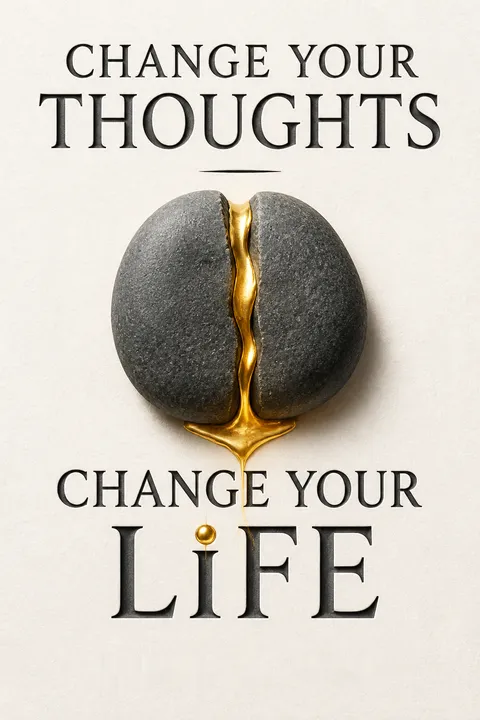


Key Takeaways
Change your life by aligning your thoughts with the Tao, not by forcing outcomes
Start with a different lens. Wayne Dyer presents the book as a personal guide to the Tao Te Ching, an ancient work of 81 short verses. After studying ten translations, he built an essay around each verse and its possible use in modern life. The Tao, in his interpretation, is the nameless source that gives rise to the visible world. He calls its countless forms the 10,000 things. The point is not to solve the mystery by naming it, but to notice how certainty, labels, and rigid expectations shape experience.
Practice allowing. Dyer uses gardening to make the distinction concrete: a gardener can prepare the ground and plant, but cannot force a seed to grow on command. In the same way, a person can make an effort while leaving room for events to unfold. His invitation is to notice irritation or disappointment without immediately judging or trying to erase it.
What's valuable here is the separation between preparation and control. Cognitive reappraisal, the practice of interpreting a situation differently, can reduce distress without changing the facts themselves. That makes Dyer's emphasis on shifting perspective psychologically useful even for readers who do not share his metaphysical belief in a universal Source. The limit matters: thoughts influence attention and behavior, but they do not guarantee that desired events will arrive. The Tao works best as a discipline for meeting uncertainty, not as a promise that the universe will deliver a preferred outcome.
Prepare fully, then stop forcing the moment to obey your plan
Act without strain. Dyer interprets wu-wei, often translated as nonaction, as action that does not rely on unnecessary force. It is not a command to sit still while responsibilities go unmet. It means doing what the situation calls for, then easing off the impulse to micromanage every result. The book compares this quality to dancing: a person must engage, but movement becomes more fluid when attention is not trapped in effortful self-correction.
Notice the difference. Dyer describes writing after sitting with a verse and allowing ideas to form, and swimming by moving with the ocean's current rather than resisting it. In both cases, skill and participation remain; the unnecessary struggle recedes. The practical test is whether effort is helping the task or merely feeding anxiety about how it should turn out.
This account resembles the experience of flow, a state in which focused attention and practiced skill make action feel less effortful. The useful distinction is not between action and inaction, but between responsive effort and compulsive control. That distinction can help in work, sport, and difficult conversations. Still, restraint is not always the wise response. A person facing injustice or danger may need direct intervention. Nonforcing should mean choosing proportionate action, not using spiritual language to excuse avoidance.
Stay soft enough to adapt, and steady enough to keep giving
Learn from water. Across the Tao Te Ching, water represents strength without domination. It nourishes living things, settles in low places, and gradually wears down what seems harder than itself. Dyer uses this image to challenge the assumption that toughness means rigidity. A person who can bend, listen, and change course may endure pressure better than someone committed to winning every exchange.
Practice yielding without disappearing. Dyer also points to palm trees that bend in fierce winds instead of standing stiffly until they break. In relationships, the equivalent might be letting another person finish an argument before responding, or reconsidering a position when new information appears. The aim is not to give up one's principles, but to stop mistaking inflexibility for strength.
The water image connects well with resilience research, where adaptation is often more protective than an insistence on returning to exactly the previous state. Flexible thinking lets people update plans while preserving deeper commitments. The image also clarifies that gentleness can be active: water moves, persists, and changes its surroundings without needing to overpower them. A necessary qualification is that flexibility should not become limitless accommodation. In relationships marked by coercion or abuse, boundaries and outside help may be more protective than yielding.
Choose enough before accumulation turns success into another burden
Recognize the cost of more. Dyer returns repeatedly to the idea that wealth, status, possessions, and recognition can become exhausting when they are treated as proof of personal worth. A fuller house brings more things to maintain and protect; a growing appetite for approval creates fresh dependence on other people's reactions. He recommends noticing the point at which additional effort stops adding genuine satisfaction.
Make stopping a skill. The book applies this idea to ordinary decisions: stop eating when hunger has passed, finish a project without endlessly polishing it, or give away something useful instead of keeping it merely because it is yours. Dyer's larger argument is that contentment is not the prize waiting at the end of acquisition. It can begin when people ask what is sufficient and redirect their surplus toward others.
The argument anticipates the modern idea of sufficiency: well-being depends partly on having enough, not on maximizing every measurable good. It also highlights how consumption creates obligations that are easy to overlook. Yet personal restraint cannot replace fair wages, public services, or access to basic needs. A call to be content can be liberating for someone trapped in status competition, but it should not be used to romanticize deprivation or tell people facing scarcity to simply want less.
Lead so people can act well without needing your presence
Make room for others. Dyer's ideal leader does not rely on fear, constant correction, or a hunger for credit. The leader creates conditions in which people can take responsibility and recognize their own contribution. The book applies this idea not only to rulers and executives, but also to parents and teachers. A parent, for example, can offer guidance while letting a child make age-appropriate decisions and learn from them.
Trust is part of the work. Dyer contrasts control with a style that uses few words, models the desired behavior, and steps back when others can manage. He recounts his preference for giving children space to solve problems rather than immediately telling them how. The goal is not an absent leader, but one whose influence builds other people's competence instead of dependence.
This principle aligns with autonomy-supportive leadership, which gives people meaningful choice, clear expectations, and responsibility. Such environments can foster initiative more effectively than constant surveillance. The book's insight is especially sharp in parenting: compliance while an authority figure watches is not the same as sound judgment when no one is watching. Still, trust does not mean withholding structure. People need clear limits, feedback, and protection, especially when they are inexperienced or when a decision could cause serious harm.
Practice impartial kindness without confusing compassion with approval
Look beyond labels. Dyer reads the Tao's image of straw dogs as a reminder that the source of life does not divide people into favorites and rejects. He explains that straw dogs were ritual objects treated with reverence during a ceremony and then set aside. In his interpretation, the image asks people to respect life without clinging to appearances, rank, or temporary status.
Replace verdicts with attention. Dyer suggests noticing when the mind sorts people into categories such as good, bad, worthy, or unworthy, then trying to see the shared humanity beneath those judgments. This does not require pretending that all actions are harmless. It asks readers to distinguish a person from a harmful act and to avoid making contempt the default response. Generosity and fairness, in this view, express a recognition of common origin.
Impartiality can weaken the mental shortcuts that make outsiders seem less deserving of care. In that sense, the idea resonates with moral psychology and efforts to expand the circle of concern beyond one's own group. The distinction between a person and an action is also useful: accountability can address harm without turning the offender into a permanent category of lesser humanity. Compassion, however, does not require access, trust, or forgiveness on demand. It can coexist with firm consequences and protective boundaries.
Refuse to manufacture enemies, even when conflict demands firm action
Do not feed retaliation. Dyer argues that force invites counterforce, whether in war, family conflict, or an argument at work. If harm has occurred, celebrating the defeat of an opponent can keep the conflict alive in another form. He urges readers to avoid starting fights and, when conflict cannot be avoided, to resist turning victory into a reason for pride.
Forgiveness can interrupt a cycle. Dyer describes an Amish community responding to a deadly schoolhouse attack by grieving with the killer's family and offering them support. The story illustrates his claim that compassion can reach beyond the person directly harmed. His advice is not that pain should be denied, but that hatred need not become the only response. Returning kindness, he argues, can create a chance for hostility to become something else.
The Amish story makes compassion concrete at a moment when it might seem impossible. Research on conflict resolution likewise distinguishes the end of violence from the restoration of trust: one does not automatically produce the other. Forgiveness may help a person release a desire for revenge, but it cannot substitute for safety, justice, or accountability. The strongest version of Dyer's position is not that victims must reconcile, but that societies can oppose harmful acts without treating whole groups as permanent enemies.
Treat endings as part of life's cycle, not evidence of failure
See the cycle around you. Dyer presents the Tao as the constant beneath a world of changing forms. Seasons turn, relationships shift, projects conclude, and bodies age. He encourages readers to view endings not only as loss, but as part of the movement through which new conditions emerge. When a setback feels final, remembering that circumstances change can create room to respond rather than freeze.
Hold mortality lightly. Dyer extends this view into a spiritual claim: the self is more than the body and returns to the Tao after death. Readers need not accept that belief to use the book's practical counsel. During grief or upheaval, they can notice that the present feeling is real without assuming it will last forever. The practice is to meet change with attention, patience, and less attachment to what cannot be kept unchanged.
The book's emphasis on impermanence echoes traditions that use awareness of change to reduce clinging. It can also support psychological flexibility by helping people distinguish a painful present from an unchangeable future. Dyer's spiritual account of survival beyond bodily death is a matter of faith, not something established by the examples in the text. And the claim that loss may contain good fortune should be handled gently. Some events are simply devastating, even when people eventually find ways to live beyond them.
Shrink the challenge to today's step before it becomes a crisis
Begin while the task is small. Dyer uses the Tao Te Ching's images of a seed becoming a tree and a first step beginning a long journey to show how large achievements start with manageable actions. He recommends addressing problems early, before neglect gives them room to grow. Instead of carrying the weight of an entire future, identify what can be done in the present moment.
Make progress concrete. Dyer describes writing one essay at a time for this book and maintaining sobriety by focusing on the choice not to drink that day, rather than imagining decades of effort at once. The same approach can make a daunting project, habit change, or conversation less overwhelming. Small actions do not guarantee success, but they turn an abstract intention into something a person can actually begin.
This is the book's most practical bridge from spiritual language to behavior change. Breaking a large goal into small actions lowers the friction of starting and makes progress easier to observe. Addressing minor problems early also resembles preventive maintenance: a timely conversation or repair can prevent a more costly breakdown. The caution is that not every obstacle is small or individually controllable. Incremental action helps, but it should not imply that serious social, medical, or financial problems can be solved by attitude alone.
Analysis
Change Your Thoughts, Change Your Life is a spiritual self-help book organized as 81 reflections on the Tao Te Ching. Its engine is repetition with variation: each essay returns to a handful of linked ideas, including yielding, humility, simplicity, noninterference, and recognition of shared life. That circular structure imitates the text it interprets. It is less a linear argument than a set of reminders intended to be revisited and practiced.
The book's distinctive contribution is its translation of Taoist paradox into ordinary conduct. Water becomes a model for flexible strength. An ideal leader gives others room to act. Nonaction becomes a way to distinguish useful effort from anxious control. These images make abstract philosophy memorable and offer readers concrete experiments, such as listening before advising or breaking a daunting task into one immediate step.
The interpretive frame is explicitly Dyer's own. He says he combined ten translations and wrote from personal contemplation, so the book should not be mistaken for a definitive account of Laozi's historical intent. Its spiritual claims about an eternal Source and life beyond the body are central to his reading, but are not demonstrated as empirical facts. The most portable value lies in the practices that do not depend on accepting those claims: notice judgment, resist needless escalation, value sufficiency, and make room for others.
The book also exposes a productive tension. Acceptance can loosen futile struggles, yet it can be misread as passivity; generosity can soften conflict, yet it cannot replace justice; humility can enable leadership, yet excessive deference can conceal power. Read carefully, the Tao is not an excuse to tolerate preventable harm. It is a challenge to act without egoic domination, while still responding clearly to what needs protection or change. The result is both a spiritual worldview and a behavioral discipline: participate fully, but do not confuse control with influence.
Review Summary
Change Your Thoughts - Change Your Life receives mostly positive reviews for its interpretation of the Tao Te Ching. Readers appreciate Dyer's accessible approach to ancient wisdom, finding it applicable to modern life. Many report personal growth and improved mental health from applying the book's teachings. Critics argue Dyer misinterprets the Tao and oversimplifies its concepts. Some find his writing repetitive or too focused on manifesting material success. Overall, readers value the book for its potential to inspire positive change and provide daily spiritual guidance.
People Also Read





Glossary
Tao
the underlying WayIn Dyer's interpretation, the Tao is the nameless, all-pervading source from which the world arises and to which it returns. It cannot be fully captured by a label or sensory description. The book treats living in harmony with the Tao as a way to practice humility, simplicity, nonforcing, and connection with other forms of life.
Te
the Tao's expressed virtueTe is the shape, power, or virtue through which the Tao becomes active in the world. Dyer sometimes describes it as an inner quality that nurtures and protects life without possessing or controlling it. In this account, a person expresses Te through generosity, humility, and actions that support others without demanding credit.
10,000 things
the world of manifested formsThis Taoist expression refers to the countless named and observable forms of existence, rather than a literal count. Dyer uses it to distinguish the changing, material world from the nameless source he calls the Tao. The phrase includes people, animals, plants, objects, and the many forms through which life appears.
wu-wei
action without forcingDyer uses wu-wei to describe acting in harmony with circumstances rather than relying on strain, domination, or unnecessary interference. It does not mean refusing to act or neglecting responsibilities. It means responding appropriately while releasing compulsive efforts to control every outcome, much as a swimmer can move with a current instead of fighting it.
yin and yang
complementary opposing forcesYin and yang name contrasting yet interdependent aspects of life, often associated in the book with feminine and masculine qualities. Dyer uses their relationship to challenge the idea that opposites must cancel each other out. The terms point toward balance, where apparent contrasts can coexist as parts of a larger unity.
Three Treasures
mercy, frugality, humilityThe Three Treasures are the qualities Dyer highlights from one Tao Te Ching verse: mercy, frugality, and humility. He presents them as foundations for courage, generosity, and effective leadership. Together, they counter the pursuit of dominance and excess by directing attention toward compassion, moderation, and service.
hidden virtue
nurturing power without controlHidden virtue describes the life-supporting quality through which the Tao gives rise to beings and helps them develop without claiming ownership or demanding obedience. Dyer applies the idea to human relationships: nurture another person's growth, offer help without keeping score, and avoid turning care into control.
FAQ
What's Change Your Thoughts - Change Your Life about?
- Exploration of the Tao: The book is a personal interpretation of the Tao Te Ching by Lao-tzu, focusing on its wisdom and relevance to modern life.
- Transformative Philosophy: Wayne Dyer emphasizes that changing our thoughts can transform our lives, aligning us with the universe's natural flow.
- Practical Applications: Each of the 81 verses is paired with insights and practical advice for living a more fulfilling and harmonious life.
Why should I read Change Your Thoughts - Change Your Life?
- Personal Growth: The book offers profound insights into self-mastery and personal transformation, encouraging reflection on thoughts and beliefs.
- Timeless Wisdom: Dyer distills ancient wisdom into accessible lessons that resonate with contemporary challenges, making it relevant for today’s readers.
- Spiritual Connection: It fosters a deeper understanding of the Tao and encourages readers to connect with their inner selves and the universe.
What are the key takeaways of Change Your Thoughts - Change Your Life?
- Embrace Simplicity: Simplicity and humility are essential for living in harmony with the Tao, as highlighted in the 32nd verse.
- Living Without Force: The importance of non-resistance and allowing life to unfold naturally is emphasized, as discussed in the 30th verse.
- Self-Mastery: Understanding oneself is portrayed as the path to true wisdom, contrasting with the pursuit of external validation or control over others.
What are the best quotes from Change Your Thoughts - Change Your Life and what do they mean?
- “The Tao does nothing, but leaves nothing undone.” This suggests that true power lies in allowing things to unfold naturally rather than forcing outcomes.
- “If you realize that you have enough, you are truly rich.” This emphasizes contentment and recognizing abundance in one’s life, shifting focus from material wealth to inner fulfillment.
- “The gentle outlasts the strong.” This highlights the strength found in flexibility and humility, suggesting that adaptability and gentleness endure challenges better than rigidity.
How does Wayne Dyer interpret the concept of self-mastery in Change Your Thoughts - Change Your Life?
- Inner Strength: True mastery comes from understanding oneself rather than exerting control over others, as stated in the 33rd verse.
- Responsibility for Reactions: Readers are encouraged to take responsibility for their feelings and reactions, promoting a shift from blame to self-awareness.
- Connection to the Tao: Mastery is achieved by aligning with the Tao, fostering peace and fulfillment that transcends external circumstances.
What practical advice does Dyer offer for living in accordance with the Tao?
- Letting Go of Control: Relinquish the need to control outcomes and trust the natural unfolding of life, as discussed in the 29th verse.
- Embracing Humility: Humility is key to connecting with the Tao, allowing individuals to remain open and receptive to life’s experiences.
- Practicing Gratitude: Cultivating gratitude for all aspects of life reinforces the idea that abundance comes from recognizing what one already has.
How does Change Your Thoughts - Change Your Life address the idea of duality?
- Understanding Opposites: Recognizing and embracing duality—such as good and bad, success and failure—leads to a deeper understanding of life’s complexities, as seen in the 2nd verse.
- Paradoxical Nature of Existence: Accepting life's paradoxes can lead to greater peace and acceptance.
- Unity in Diversity: All opposites are part of a greater whole, encouraging readers to see the interconnectedness of all things.
What role does humility play in Dyer’s interpretation of the Tao?
- Foundation of Virtue: Humility is essential for living virtuously and connecting with the Tao, recognizing one's place within the larger universe.
- Openness to Learning: Humility fosters a willingness to learn from others and see oneself as part of a collective rather than superior.
- Inner Peace: Practicing humility leads to inner peace and contentment, aligning with the natural flow of the Tao.
How can I apply the teachings of Change Your Thoughts - Change Your Life in my daily life?
- Mindfulness Practice: Practice mindfulness and self-reflection to become more aware of thoughts and reactions.
- Living in the Present: Emphasize being present and appreciating the moment, rather than constantly striving for future goals.
- Cultivating Compassion: Advocate for compassion towards oneself and others, promoting unity and understanding aligned with the Tao.
What does Dyer mean by "non-action" in Change Your Thoughts - Change Your Life?
- Effortless Action: Non-action, or "wu wei," refers to taking action in harmony with life's natural flow rather than forcing outcomes.
- Trusting the Process: Trust the process of life and allow things to unfold naturally, reducing stress and enhancing well-being.
- Alignment with the Tao: Practicing non-action aligns individuals with the Tao, leading to a more peaceful and fulfilling existence.
How does Change Your Thoughts - Change Your Life address the concept of death?
- Fearlessness: Confront the fear of death, suggesting that understanding one's true nature can alleviate this fear.
- Life as a Journey: Death is presented as a natural part of the life cycle, to be accepted as a return to the Source.
- Living Fully: Embracing the inevitability of death allows individuals to live more fully and authentically in the present moment.
How does Wayne Dyer define the Tao in Change Your Thoughts - Change Your Life?
- Universal Source: The Tao is described as the "treasure-house, the true nature, the secret Source of everything," connecting all beings.
- Path to Harmony: The Tao is a guiding principle leading to harmony and balance in life, offering peace and fulfillment.
- Non-Interference: The Tao operates without force or interference, encouraging a similar approach in life.
About the Author
Other books by Wayne W. Dyer




Download PDF
Download EPUB
.epub digital book format is ideal for reading ebooks on phones, tablets, and e-readers.








