Key Takeaways
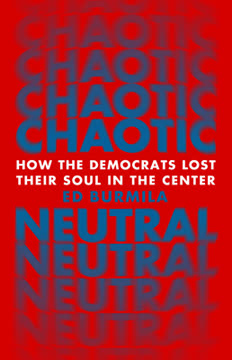
1. The Democratic Party abandoned its populist soul for the political center.
Democrats give up when they should fight. They say they know how to get things done and then spend their time in power explaining what they can’t do.
A pervasive feeling. Many voters feel something is fundamentally "off" with the Democratic Party, characterized by exasperation and disappointment. Despite holding power, Democrats often declare unsatisfying victories, using phrases like "better than nothing" or "half a loaf," suggesting an endorsement of mediocrity. This leads to a sense that even when Democrats are in control, Republicans dictate the agenda.
Broken worldview. The core issue isn't just a willingness to compromise or moderation, but a deeply flawed perception of politics itself. This broken worldview leads to predictable patterns of underachievement and disappointment, where the party reacts to every failure with calls to "vote blue, harder!" and a barrage of fundraising emails, rather than genuine self-reflection.
Consequences of failure. This consistent failure to fight when necessary, or to deliver on promises, has profound consequences. It contributes to a political reality where critical issues like climate change, income inequality, and poverty worsen, while the opposing party increasingly undermines the electoral process. The party's inability to act as an effective counterweight to the Republican "death cult" threatens the country's future.
2. The New Deal built a powerful coalition on economic populism but ignored social inequalities.
The New Deal was not a social justice agenda; the harshest and most valid criticisms leveled at Roosevelt retrospectively involve his failure to address directly issues of racial inequality—a political calculation intended to placate prosegregation white southerners.
A lifeline offered. Franklin D. Roosevelt's New Deal, born from the desperation of the Great Depression, offered tangible economic relief to millions, solidifying Democratic support for decades. Programs like the Works Progress Administration (WPA) provided jobs and dignity, while Social Security created a crucial safety net, appealing directly to the material interests of diverse classes.
Saving capitalism. The New Deal, far from being a socialist revolution, was explicitly designed to save capitalism by intervening in the economy, creating jobs, and reducing unemployment. This approach, rooted in Keynesian economics, saw government as a necessary force to fill the void left by a receding free market, leading to unprecedented investment in public works and infrastructure.
A fundamental weakness. Despite its economic successes, the New Deal coalition harbored a critical flaw: it achieved unity by deliberately sidelining issues of racial inequality. This cynical ploy, while politically expedient in the short term, created a ticking time bomb of unresolved social tensions that would eventually explode, increasing the cost of confronting these issues later.
3. Electoral defeats in 1968 and 1972 pushed Democrats to abandon traditional liberalism.
How did liberal become a dirty word, and liberalism a taboo concept even within the nominally liberal party? What happened that so traumatized the Democratic establishment that it still trots out McGovern ’72 as a warning about why it must keep moving to the right fifty years later?
A year of chaos. 1968 was a pivotal year, marked by assassinations, urban riots, and escalating Vietnam War involvement, which fractured the Democratic Party's New Deal coalition. The chaotic Democratic Convention in Chicago, with televised clashes between police and protesters, highlighted deep divisions between anti-war activists, civil rights advocates, and the party establishment.
McGovern's disaster. The 1972 presidential election, where George McGovern suffered a crushing defeat to Richard Nixon, became a defining trauma for Democrats. McGovern, a figure of the "New Politics" movement, was relentlessly mocked as a radical liberal, and his loss was interpreted as a rejection of progressive social issues by the broader electorate. This led to a lasting fear of being perceived as "too liberal."
Reforming the process. In response to the 1968 chaos, the McGovern-Fraser Commission reformed the presidential nomination process, shifting power from party bosses to primary voters. This inadvertently empowered interest groups and activists, leading to a more candidate-centered politics and a platform that often felt like a collection of disparate demands, further alienating traditional working-class voters.
4. The Democratic Leadership Council (DLC) redefined liberalism around free markets and technocratic solutions.
Neoliberal politicians came to see free-market capitalism not only as an enlightened economic system but as the ideal organizing principle for society.
Insurgent moderates. Emerging from the electoral disasters of the 1970s and 1980s, the Democratic Leadership Council (DLC) sought to reinvent the party. Led by figures like Al From, this group of "New Democrats" believed the party needed to shed its "tax-and-spend liberal" image and embrace free-market solutions, deregulation, and fiscal conservatism to win back lost voters.
The "Atari Democrats." This new faction, including young, educated professionals from New England and the Sun Belt, championed a vision of economic growth driven by technology and entrepreneurship. They were deeply influenced by theories like Lester Thurow's "Zero-Sum Society," arguing that politics should focus on "making the pie bigger" rather than squabbling over distribution, a stark departure from New Deal principles.
A new constituency. The DLC explicitly targeted "highly educated professionals" (HEPs) – a growing demographic of successful, often suburban, white liberals – as the future of the party. They believed these voters, who valued competence and efficiency, would be receptive to a liberalism that supported growth and innovation, even if it meant abandoning the working class and organized labor.
5. Bill Clinton solidified the party's centrist shift, embracing conservative priorities for electoral gain.
No individual is more responsible than Bill Clinton for pushing the Democratic Party toward Eisenhower Republicanism.
The "Comeback Kid." Bill Clinton, a charismatic and adaptable politician, rose to prominence with the enthusiastic backing of the DLC, promising to be a "different kind of Democrat." His 1992 campaign skillfully blended populist rhetoric with moderate positions, notably vowing to "end welfare as we know it" and taking a tough stance on crime, appealing to white middle-class voters.
Triangulation's triumph. After the 1994 Republican Revolution, Clinton embraced "triangulation," positioning himself as a centrist fighting extremists in both parties. This strategy, heavily influenced by consultants Dick Morris and Mark Penn, involved adopting Republican priorities like welfare reform and deficit reduction, but presenting them as "smarter" or "kinder" versions, effectively ceding ideological ground to the GOP.
A Faustian bargain. Clinton's presidency institutionalized a neoliberal economic worldview within the Democratic Party, championing free trade agreements like NAFTA and financial deregulation. While this pleased Wall Street and the "knowledge economy" elite, it devastated blue-collar America. The party learned that it could win by giving the powerful what they wanted, while mollifying its traditional base with rhetoric and symbolic gestures.
6. Newt Gingrich's aggressive partisanship transformed the GOP, while Democrats failed to adapt.
Gingrich convinced Republicans to stop working with Democrats to keep the business as usual of Congress puttering along.
The disruptor. Newt Gingrich, leading the 1994 Republican Revolution, fundamentally changed the rules of engagement in Washington. Frustrated with the GOP's long-standing "go along to get along" strategy, he advocated a scorched-earth approach, relentlessly attacking Democrats and the political establishment to achieve conservative goals.
Weaponizing politics. Gingrich pioneered the use of aggressive partisan tactics, including ethics charges and constant delegitimization of opponents, to gain power. He centralized control in the Speaker's office, rewarding loyalty and punishing dissent, and used the "Contract with America" to unite Republicans around a clear, conservative agenda.
A new media landscape. Gingrich's rise coincided with the growth of conservative media (talk radio, Fox News), which amplified his message and created an alternate reality for right-wing voters. Democrats, clinging to norms of civility and bipartisanship, were ill-equipped to counter this new, aggressive style of politics, often expressing amazement that Republicans "got away with" their tactics.
7. Barack Obama prioritized consensus and incrementalism, missing chances for radical change.
Barack Obama was the man who had an opportunity—not a guarantee of course, but a chance—to be FDR and instead set out to be a less horny Bill Clinton.
Hope and change, then caution. Obama's 2008 campaign promised transformative change and inspired millions, but his presidency quickly pivoted to cautious incrementalism and a deep commitment to the status quo. Despite a global financial crisis and large congressional majorities, he prioritized consensus and bipartisanship over bold, structural reforms.
Nudging, not leading. Obama's administration was heavily influenced by "nudge" theories, believing government could best solve problems by subtly incentivizing individual behavior rather than through direct intervention. This approach, while intellectually appealing to elites, often left powerful economic actors unchecked and failed to deliver the fundamental changes many voters expected.
A legacy of missed chances. Obama's "radical incrementalism" meant steering the "ocean liner two degrees north or south," hoping for a different destination decades later. This philosophy, combined with a reluctance to upset economic elites, led to policies like the Affordable Care Act (ACA) that were complex compromises rather than universal solutions. His presidency, for all its rhetorical brilliance, ultimately perpetuated many of the neoliberal trends established by Clinton.
8. "Pragmatism" became a pervasive justification for Democratic inaction and ideological surrender.
The fatal flaw of pragmatism as a guiding approach to politics and governing is that it requires, if it is to work as proponents intend, a dispassionate, accurate, and unbiased determination of the possible.
The highest praise. In modern Democratic circles, "pragmatic" is often the ultimate compliment, while "ideological" is a slur. This emphasis on pragmatism, however, frequently serves as an excuse for inaction, ceding ideological ground, and avoiding difficult political battles. It implies that better solutions are simply "not possible" due to external constraints.
A self-limiting belief. Democrats, from Jimmy Carter to Joe Biden, have consistently invoked pragmatism to justify compromises that move policy to the right, often against the preferences of their own base. This mindset respects existing power hierarchies and institutional limitations, ensuring that any "solutions" perpetuate the very power relationships that create problems.
The cost of caution. This cult of pragmatism has led to a party that spends more time explaining what it cannot do than what it will do. It fosters a defeatist belief that transformative change is unrealistic, alienating voters who desperately need bold action. The constant pursuit of the "possible" often means settling for the least ambitious outcomes, which rarely inspire loyalty or deliver lasting electoral success.
9. After 2016, Democrats blamed external factors and voters, avoiding ideological self-reflection.
At no point did the candidate or party establishment consider that 'people might dislike us and what we stand for' as an explanation for a crushing loss.
A brain-breaking defeat. Donald Trump's victory in 2016, against a candidate as experienced and qualified as Hillary Clinton, was a profound shock to Democrats. Instead of prompting deep ideological self-reflection, the party largely attributed the loss to external factors: voter stupidity, racism, sexism, Russian interference, or media bias.
Ignoring internal flaws. Clinton's campaign, and the broader Democratic establishment, failed to consider that their centrist, neoliberal worldview might be unpopular outside of highly educated, professional liberals. Her message of "America is already great" resonated poorly with millions whose lives had been worsening for decades, particularly in the Rust Belt.
The "competence" trap. Like previous Democratic candidates, Clinton relied on a message of competence and experience, contrasting herself with Trump's perceived ineptitude. This approach, however, failed to connect with voters desperate for someone to address their economic anxieties, leading to lower turnout among key Democratic blocs and a narrow loss in crucial swing states.
10. Democrats consistently neglect state and local politics, ceding crucial ground to Republicans.
American liberalism is an overwhelmingly DC-centric world; that’s where the glamor resides, where the only careers worth a damn are made.
A blind spot. Democrats have suffered a catastrophic decline in state and local power since 1994, losing thousands of legislative seats and numerous governorships. This "statehouse problem" is widely recognized by scholars but largely ignored by national party elites, who remain fixated on Washington, D.C.
Cultural bias. Liberal political culture prioritizes national politics, viewing state capitals as less glamorous and less important career destinations. In contrast, conservatives actively build power from the ground up, using organizations like ALEC to coordinate policy and push a coherent right-wing agenda across state lines.
Consequences of neglect. Republican dominance at the state level allows them to enact partisan redistricting maps and restrictive voting laws, tilting the political playing field in their favor. Democrats' inconsistent and uncoordinated efforts to rebuild state-level strength, often dissolving after national elections, leave them unable to counter these democracy-eroding tactics.
11. Relying on being "not the Republicans" has led to voter apathy and a failure to deliver.
Once voters accept the premise that they are morally obligated to support a political party no matter what it does, then the party has no incentive to respond to voters.
The lesser of two evils. Democrats' primary electoral strategy often boils down to "we are better than the Republicans," setting a low bar for performance. This approach, while often true given the GOP's extremism, creates a "vote blue no matter who" mindset among loyalists, which removes any incentive for the party to respond to voter demands.
Disillusioned base. When voters feel morally obligated to support a party that consistently fails to deliver on its promises or actively works against their interests, they become disillusioned. This leads to apathy, lower turnout, or even defection to third parties or, in some cases, to the right-wing outrage machine.
A self-defeating cycle. The Democratic Party's ideal constituent is a well-off person who demands nothing more than "not Republican." This caters to a demographic with little "skin in the game," whose preferences are easily satisfied by symbolic gestures rather than substantive policy. This strategy, however, alienates working-class voters who need tangible results, perpetuating a cycle of electoral underperformance.
12. Democrats must embrace aggressive partisanship and new leadership to counter the GOP's nihilism.
There is no future for a political party that rejects the idea of being partisan.
The partisan imperative. Democrats' insistence on nonpartisanship and bipartisanship, while noble in theory, is a suicidal strategy against a Republican Party that has embraced aggressive, uncompromising partisanship. The GOP, under figures like Mitch McConnell, has consistently prioritized power grabs and ideological goals over norms and cooperation.
Leadership vacuum. The Democratic Party is plagued by entrenched, often octogenarian, leadership that resists change and clings to outdated strategies. These leaders, who have spent decades in a system that rewards centrism, are unwilling to fight as hard and as uncompromisingly as their Republican counterparts.
A new path forward. To break the cycle of electoral underperformance and policy stagnation, Democrats must:
- Embrace self-interested partisanship, pushing back against GOP power grabs.
- Prioritize structural reforms like abolishing the filibuster and expanding the Supreme Court.
- Recruit and support new, aggressive leaders committed to a core, shared agenda.
- Deliver tangible, direct benefits to voters, especially the working class and poor, rather than relying on symbolic gestures or complex, ineffective policies.
Last updated: